Billboards near Paramount, CA
No Minimum Spend. No Long-Term Contracts. Just Results.
Trusted by Leading Brands


Billboard advertising
near Paramount has never been easier



How much is a billboard near Paramount?
Why Choose Blip for Billboard Advertising near Paramount
Blip lets you launch Paramount billboards in minutes and target I-710, I-105, and SR-91 commuters without long-term contracts.
In Paramount, set flexible daily budgets and reach family-heavy shoppers on Lakewood Blvd, Alondra, and Paramount Blvd as traffic ebbs and flows.
Use Blip's dayparting to hit Paramount rush hours and school-run peaks, when Southeast LA drivers spend more time seeing your ad.
Track real-time results in Paramount and shift spend fast toward boards near Compton, Lynwood, and South Gate if they perform best.
Blip's creative tools help tailor simple, bilingual Paramount ads for a young, value-focused audience moving between work, school, and errands.
Frequently Asked Questions About Billboard Advertising near Paramount
How much does a billboard cost near Paramount, California with Blip?
With Blip, advertising on Paramount billboards is flexible enough for any budget, because you only pay per “blip,” a 7.5 to 10-second ad display that runs on rotating digital billboards near Paramount, California. You simply set a daily budget during campaign creation, and Blip automatically keeps your campaign within that amount, so you stay in control. Prices per blip vary based on when and where your ad shows and current advertiser demand, and you can adjust your budget at any time as you see results.
Where can I advertise near Paramount, California with Blip?
With 51 digital billboards serving the Paramount area within about 10 miles, we can build campaigns that blanket residents as they move through multiple neighboring cities in a typical week. Nearby cities where these boards are located include Los Angeles, Lynwood, South Gate, Compton, Bell Gardens, Artesia, Carson, Montebello, Norwalk, Santa Fe Springs, La Palma, and Buena Park. This tight radius supports several strategic patterns, including halo coverage of Paramount and commuter corridors into surrounding areas.
What kind of traffic do Paramount, California billboards reach?
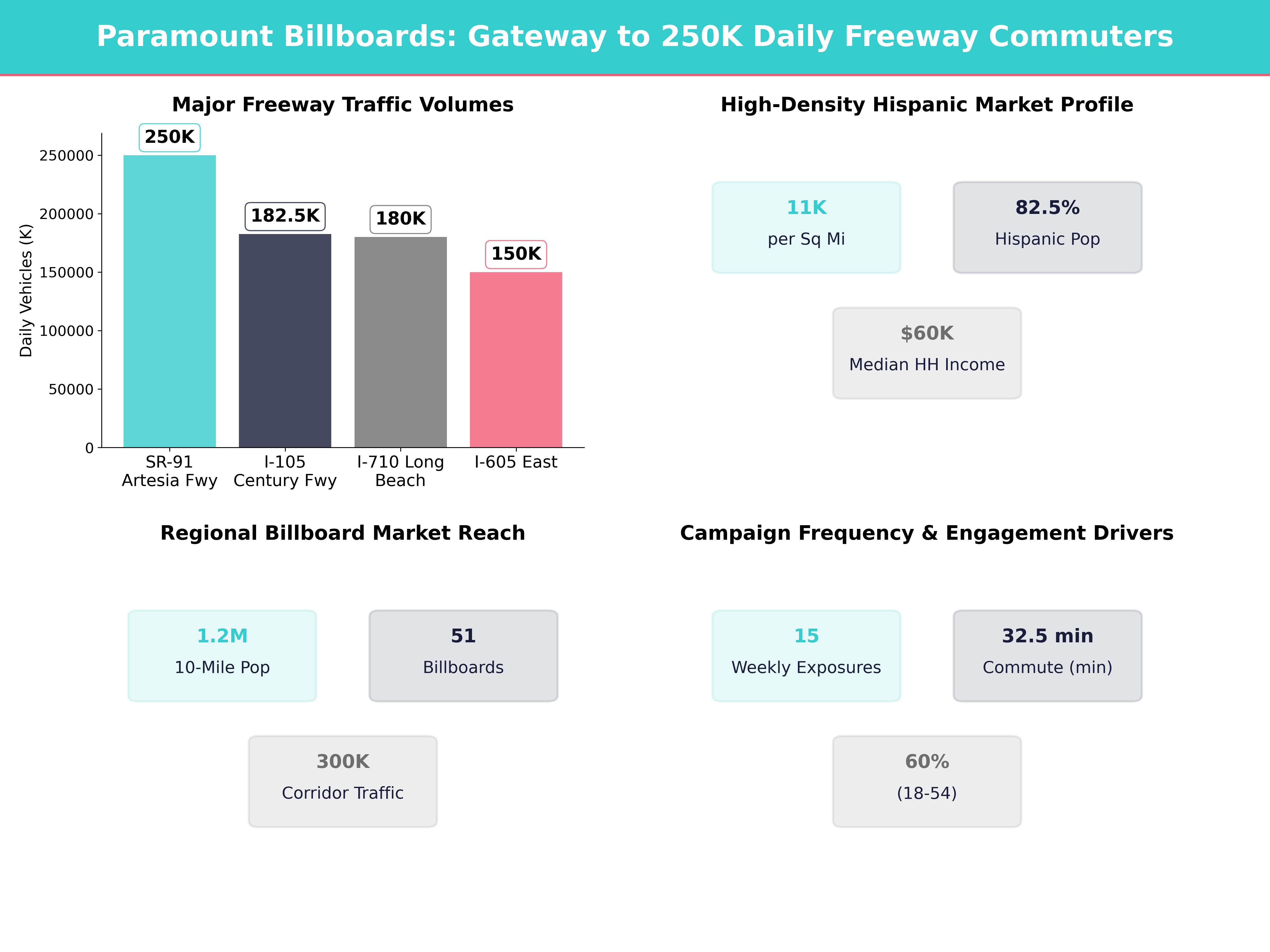
Paramount sits between several of Southern California’s most heavily used freeways, and nearby corridors carry very high daily traffic volumes. I-710 west of Paramount carries roughly 160,000–200,000 vehicles per day, I-105 north of Paramount handles around 175,000–190,000 vehicles per day, and SR-91 south of Paramount draws about 240,000–260,000 vehicles per day in segments. Across these corridors, it’s common for individual billboard faces to generate hundreds of thousands of weekly impressions.
When is the best time to run a Paramount, California billboard campaign with Blip?
The Paramount area’s rhythms are shaped by commuting, school schedules, and regional shopping patterns. Weekday rush hours are morning 6:30–9:00 a.m. and evening 3:30–7:00 p.m., and running heavier during these windows maximizes impressions to workers heading to downtown LA, Long Beach, the ports, and local industrial zones. Midday is valuable for retail and grocery shoppers, parents on school-related trips, and service businesses, while evenings, late nights, and weekends can work well for dining, entertainment, and family outings.
What kind of Paramount, California audience should I target with my billboard creative?
Billboard creative serving the Paramount area performs best when it is bilingual or Spanish-aware, short, bold, and offer-driven. The Paramount area skews young, with a median age in the low 30s, and has a large middle-income, family-heavy audience that responds well to value, convenience, and local relevance. The page also recommends using location-anchored messages and culturally relevant creative that fits community sensibilities like family, hard work, faith, and neighborhood pride.
Do I need a contract to advertise with Blip near Paramount?
No, Blip has no long-term contracts or minimum commitments. You can start, pause, or stop your campaign at any time.
How fast can I launch a billboard campaign with Blip near Paramount?
You can have your campaign live in minutes. Create a free account, select your locations, set your budget, upload your design, and start running once approved.
Where can I advertise with Blip near Paramount?
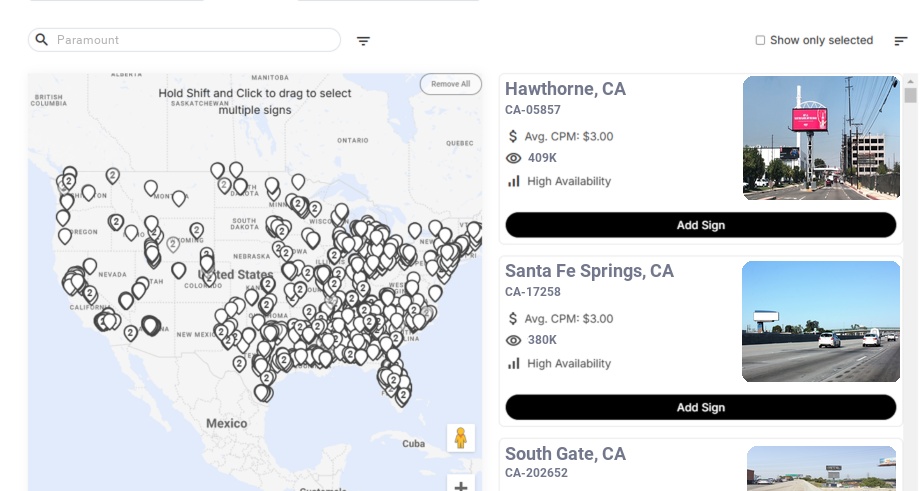
Blip has digital billboards near Paramount. You can browse available locations on a map, choose the ones that fit your audience, and start advertising right away.
Still have questions? Launch a campaign in minutes — no contracts, no commitments.
Start Your CampaignParamount Billboard Advertising Guide
The Paramount area sits at the heart of Southeast Los Angeles County Los Angeles, Lynwood South Gate, Compton Norwalk, advertisers can use Blip to tap into one of the busiest, most diverse traffic zones in Southern California—without committing to traditional, long-term billboard contracts or inflexible billboard rental near Paramount.
Understanding the Paramount Area Market
Paramount is a compact but densely populated city in southeast LA County. According to the City of Paramount
Key demographic characteristics in the Paramount area:
- Population: ~53,000 residents in Paramount, with roughly 9.7–10 million people across Los Angeles County as a whole. Within a 10-mile radius of Paramount, the total population easily exceeds 1.2 million, giving advertisers a broad draw area for regional brands and reinforcing the value of billboards near Paramount for citywide and countywide campaigns.
- Age profile: The Paramount area skews young, with a median age in the low 30s. Roughly 25–27% of residents are under 18, and close to 60% are in the prime working ages of 18–54. This creates a strong base for consumer brands, quick-service restaurants, streaming and mobile apps, and workforce recruiting.
- Ethnicity: Paramount and surrounding communities like South Gate, Lynwood
- Household income: Median household income in the Paramount area falls in the low-to-mid $60,000s, with adjacent cities like Compton, Lynwood, and South Gate often in a similar $55,000–$70,000 band, and nearby Norwalk and La Palma trending higher into the $70,000–$90,000 range. This means a large middle-income audience that is price- and value-sensitive but still spends heavily on food, retail, auto, and wireless services.
- Housing & families: Many neighborhoods in and around Paramount have average household sizes of 3.5–4.0 people, compared with about 3.0 countywide, and family households make up well over 70% of all households in several nearby cities. Multi-generational homes with multiple wage earners and multiple school-age children are common—important for advertisers in education, family entertainment, healthcare, grocery, banking, and insurance.
These fundamentals tell us that billboard campaigns serving the Paramount area work best when they:
- Speak clearly and simply to a busy, working-class, family-heavy audience.
- Leverage bilingual or Spanish-preferred creative when appropriate.
- Emphasize value, convenience, and local relevance rather than luxury or abstract branding.
- Highlight practical benefits—saving time, saving money, or helping families manage work, school, and obligations.
How People Move Around the Paramount Area
Paramount sits between several of Southern California’s most heavily used freeways. By understanding traffic patterns and commuting behavior, we can decide which boards to prioritize and when to run messages, ensuring billboard advertising near Paramount reaches the right drivers at the right times.
Key transportation and traffic characteristics:
-
Major nearby freeways
According to Caltrans count data, nearby freeways carry very high daily traffic volumes:- I-710 (Long Beach Freeway) west of Paramount carries roughly 160,000–200,000 vehicles per day in this corridor, connecting the Port of Los Angeles and Port of Long Beach
- I-105 (Century Freeway) north of Paramount handles around 175,000–190,000 vehicles per day, including airport-related traffic between central LA and Los Angeles International Airport (LAX).
- SR-91 (Artesia Freeway) south of Paramount draws about 240,000–260,000 vehicles per day in segments between Artesia, Compton, and Cerritos, functioning as a major east–west commuter spine between LA County and Orange County.
- I-605 to the east, near Norwalk and Santa Fe Springs, adds another 150,000+ daily vehicle trips, capturing traffic between the San Gabriel Valley, the 91, and the 405.
Across these corridors, it’s common for individual billboard faces to generate hundreds of thousands of weekly impressions, especially when positioned near interchanges or major exits. This makes freeway-facing billboards near Paramount especially attractive for regional advertisers.
-
Surface streets and arterials
Paramount residents and shoppers heavily use corridors like:- Lakewood Boulevard
- Alondra Boulevard
- Rosecrans Avenue
- Paramount Boulevard
On key arterials in Southeast LA, average daily traffic commonly ranges from 25,000–45,000 vehicles per day. Many of our 51 digital billboards near the Paramount area sit on these types of arterial roads in neighboring cities like Compton Lynwood
-
Commute behavior
LA County has some of the longest commute times in the U.S. In many Southeast LA communities, average one-way commute times hover around 30–35 minutes, with a significant share of workers commuting 45 minutes or more. It’s common for workers in the Paramount area to travel to jobs in downtown Los Angeles, Long Beach, and industrial zones in cities like Santa Fe Springs and Carson. For a typical 5-day workweek, that can translate into 10–20+ billboard exposures per commuter per week when messages are aligned with their routes. -
Transit usage
The Los Angeles County Metropolitan Transportation Authority (Metro)
Implications for billboard planning:
- Emphasize boards along I-710, I-105, SR-91, and I-605 for regional reach and commuter audiences.
- Use boards on arterials in Lynwood, South Gate, Compton, Bell Gardens, Norwalk, and Artesia to capture local, repeat impressions of Paramount area residents on daily trips.
- Align your dayparting with commuting windows and school schedules (more below), recognizing that many corridors are congested for 2–3 hours per peak period.
Where Our 51 Digital Billboards Reach the Paramount Area
With 51 digital billboards serving the Paramount area within about 10 miles, we can build campaigns that blanket residents as they move through multiple neighboring cities in a typical week. Many Southeast LA residents cross 2–4 city boundaries in a single day, meaning one campaign can reach the same person multiple times in different jurisdictions. For advertisers comparing Paramount billboards with placements in nearby cities, this overlapping movement is a key efficiency advantage.
Nearby cities where these boards are located include:
- Los Angeles (about 2.8 miles from Paramount)
- Lynwood (2.9 miles)
- South Gate (3.4 miles)
- Compton (3.9 miles)
- Bell Gardens (4.6 miles)
- Artesia (5.2 miles)
- Carson (5.8 miles)
- Montebello (6.2 miles)
- Norwalk (6.2 miles)
- Santa Fe Springs (7.0 miles)
- La Palma (7.9 miles)
- Buena Park (9.5 miles)
These cities themselves are substantial markets: for example, Norwalk has around 100,000 residents, South Gate about 90,000, Compton Buena Park more than 80,000. This tight radius supports several strategic patterns:
- “Halo” coverage of Paramount: By running blips on boards in Lynwood, South Gate, Compton, and Bell Gardens, we create a near-continuous ring of visibility for residents who leave Paramount for work, shopping, or school. Many local residents shop or work in at least one neighboring city each week, multiplying total weekly impressions.
- North–south commuter corridors: Commuters traveling between Long Beach, Carson, and central Los Angeles often pass through or near the Paramount area using I-710, I-110, or arterials. Boards near Carson and South Los Angeles extend your message along these flows, tapping into the 300,000+ daily vehicles traveling north–south between the ports, the South Bay, and central LA.
- East–west corridors: Traffic moving between the Gateway Cities (like Norwalk, Artesia, and La Palma) and central LA or Long Beach via SR-91 and I-105 can see your message several times in a single trip. Many east–west commuters use both a freeway and surface streets, making it possible to show them 2–3 exposures on the same commute with the right board mix.
Using Blip’s tools, we can select specific boards around these corridors and allocate budgets based on where your target customers are most likely to travel, whether that’s toward regional attractions like Visit Buena Park destinations, downtown LA, or employment centers in the Gateway Cities. This allows you to treat the full cluster as a single, flexible network of billboards near Paramount rather than isolated placements.
Timing Your Campaign: When to Run in the Paramount Area
The Paramount area’s rhythms are shaped by commuting, school schedules, and regional shopping patterns. In LA County, roadway sensors consistently show that peak speeds drop significantly (often by 30–50%) during rush hours, which increases dwell time near billboards and boosts the likelihood of message recall.
Consider these time-based insights:
-
Weekday rush hours
- Morning: 6:30–9:00 a.m.
- Evening: 3:30–7:00 p.m.
Many Paramount-area workers commute to job centers in downtown LA, Long Beach, and industrial cities such as Carson and Santa Fe Springs. In some freeway segments, over 60% of daily traffic occurs during the combined morning and evening peaks. Running heavier during these windows maximizes impressions to workers heading to downtown LA, Long Beach, the ports, and local industrial zones.
-
Midday traffic (10:00 a.m.–3:00 p.m.)
This is valuable for campaigns targeting:- Retail and grocery shoppers
- Parents on school-related trips
- Service businesses (auto repair, clinics, insurance, tax prep)
Local retail areas in South Gate, Compton, Norwalk, and Buena Park enjoy steady midday traffic from workers on split shifts, service workers with irregular hours, and parents handling errands. Many regional shopping centers see 30–40% of their daily customer counts during this midday band.
-
Evenings and late nights
Dining, entertainment, and nightlife traffic builds again after 7:00 p.m. Around the Paramount area, residents often travel to nearby cities for dining, movies, or attractions highlighted by Discover Los Angeles, Visit Long Beach, and entertainment hubs in Buena Park and Lakewood. Food delivery orders and QSR visits also spike in the 6:00–10:00 p.m. window, making it a prime time for restaurant, streaming, and gaming offers. -
Weekends
Weekend patterns differ significantly from weekdays:- Shopping trips to malls and big-box centers in Lakewood, Norwalk, Buena Park, and Carson.
- Family outings, parks, and leisure travel across the LA basin, including beaches in Long Beach and events in downtown LA.
- Church and community events, especially on Sunday mornings and early afternoons—important for family-focused and community-oriented brands.
How to use Blip’s scheduling flexibility:
- Concentrate budget Mon–Fri during drive times if your focus is workers and commuters; for many brands, these windows can produce the highest impression density per hour.
- Add weekend and midday emphasis for retail, restaurants, family attractions, and events, especially near shopping corridors and destination venues.
- Test late-night slots for industries like QSR, delivery, entertainment, and 24-hour services, where competition for impressions may be lower and cost-per-impression more efficient.
Tailoring Creative to the Paramount Area Audience
Billboard creative serving the Paramount area performs best when it is:
-
Bilingual or Spanish-aware
With a large Hispanic/Latino majority in Paramount and neighboring cities—often 75%+ of residents in nearby communities—consider:- Spanish-first headlines when your business can serve Spanish-speaking customers.
- Mixed English/Spanish (e.g., headline in Spanish, CTA or brand in English).
- Avoid overly complex language; keep phrases simple and conversational.
For example:
- “Ahorra en tu seguro de auto – 5 min de aquí”
- “Tacos al pastor • 2 salidas adelante”
Businesses that switch to bilingual creative in similar LA County markets frequently report double-digit percentage increases in calls or web visits from local ZIP codes.
-
Short, bold, and offer-driven
With drivers traveling at 35–65 mph, you typically have 3–5 seconds to communicate:- 7 words or fewer in the headline.
- One main visual (product, person, or logo).
- A single strong CTA (e.g., “Salida Lakewood Blvd” or “Ordena en la app”).
Studies of outdoor advertising recall show that simple, high-contrast creatives can achieve unaided recall rates 20–30% higher than cluttered designs—critical in a competitive market like Southeast LA.
-
Location-anchored
People in the Paramount area move across city lines constantly. Use geographic cues they recognize:- “Near Paramount Blvd & Alondra”
- “5 minutes from Lynwood Plaza”
- “Just off the 105 at Long Beach Blvd”
Referencing well-known corridors (I-710, I-105, SR-91, Lakewood Blvd, etc.) helps drivers instantly map your location, increasing visit intent and improving response to billboard advertising near Paramount.
-
Value-emphasizing
For a mid-income, family-oriented audience, highlight:- Price points: “Lunch combos desde $7.99”
- Savings: “Paga menos por tu seguro”
- Convenience: “Sin cita • Walk-ins welcome”
In similar LA County markets, price-led creatives can drive 10–20% more redemptions for promotions compared with branding-only messages, especially in grocery, QSR, and wireless categories.
-
Culturally relevant
Incorporate elements related to:- Local sports passions (LA pro teams, local high schools, regional soccer clubs).
- Holidays and celebrations (Día de los Muertos, Navidad, back-to-school, tax season).
- Community sensibilities: family, hard work, faith, and neighborhood pride.
When brands align messages with local cultural moments, it often boosts social engagement and word-of-mouth, even for offline media like billboards.
Leveraging Nearby Cities to Reach Paramount Area Residents
Because our boards are physically located in nearby cities, we can use each cluster to reach different slices of the Paramount area audience:
-
Lynwood & South Gate
Great for:- Paramount residents traveling north or northwest toward downtown LA, Inglewood, and East LA.
- Workers commuting via I-105 or surface streets like Long Beach Blvd and Atlantic Ave.
- Retail and restaurant brands with locations in these cities and Paramount’s trade area.
Lynwood South Gate together account for nearly 180,000 residents, many of whom shop and work along the same corridors used by Paramount residents.
-
Compton & Carson
Ideal for:- Industrial, logistics, and trade employers recruiting workers from the Paramount area; Compton and Carson host large concentrations of warehouses and distribution centers tied to the ports.
- Port-related businesses and transportation services using I-710 and I-110.
- Auto dealers and service centers drawing from Southeast LA residents, especially along major auto rows and commercial boulevards.
Traffic between Compton, Carson, and the ports can exceed several hundred thousand vehicle trips per weekday when you combine multiple freeway segments, making this cluster powerful for employment and B2B services.
-
Norwalk, Artesia, La Palma, Buena Park
Useful when:- Your customers come from across the Gateway Cities, not just Paramount.
- You’re promoting regional destinations like malls, amusement parks, or large-format retail near Buena Park and Cerritos.
- You want to catch east–west commuters traveling between Orange County and Los Angeles via SR-91, I-5, and I-605.
Norwalk, Artesia La Palma Buena Park sit on high-traffic corridors leading to popular attractions promoted by Visit Buena Park and nearby shopping centers.
-
Montebello, Bell Gardens, Santa Fe Springs
Effective for:- Manufacturing, warehouse, and office parks employing Paramount area residents, especially near I-5 and I-605.
- Financial services, health services, or education providers serving multiple Southeast LA communities.
- Regional churches and community organizations that draw attendees from across the Gateway Cities.
Montebello Bell Gardens Santa Fe Springs also have strong daytime worker populations, which increases impressions for employment, training, and B2B campaigns.
Using Blip, we can allocate different portions of your budget to these clusters, then refine based on performance indicators like website traffic, store visits (if you track them), or promo-code redemption by ZIP code. This approach turns what might seem like a simple billboard rental near Paramount into a targeted, data-informed regional strategy.
Industry-Specific Strategies for the Paramount Area
Different businesses can leverage the same 51 boards serving the Paramount area in distinct ways, based on how local households and workers spend:
Local Retail & Restaurants
- Focus on boards along routes to regional shopping centers and big-box retailers in Norwalk, Buena Park, Lakewood, and Carson—areas that attract tens of thousands of shoppers on busy weekends.
- Emphasize drive-time and weekend coverage, when discretionary trips and family outings peak.
- Use distance-based CTAs like “Salida 1/2 milla” or “Next right at Lakewood Blvd” to convert impulse decisions.
Retail and restaurant categories are some of the strongest performers in out-of-home; industry studies frequently show that over 30% of consumers report visiting a store or restaurant after seeing an outdoor ad in the past month.
Healthcare, Dental, and Clinics
- Paramount area residents often seek care in nearby hubs like Lynwood, South Gate, Norwalk, Long Beach, and Downey
- Promote walk-in availability, bilingual staff, and insurance acceptance, since a high share of local households rely on employer insurance, Medi-Cal, or HMOs.
- Run heavier campaigns during back-to-school, flu season (typically October–March), and tax refund months (February–April), when many families schedule deferred care.
Digital billboards near medical hubs can help increase awareness for new clinics or specialists, especially when combined with search and local listings.
Education & Training
- Community colleges, trade schools, apprenticeship programs, and language schools can reach a large pool of working-age adults; in many Paramount-area ZIP codes, over 55–60% of residents are between ages 18 and 54.
- Use boards near industrial areas in Santa Fe Springs, Carson, and Compton during commuting hours to reach workers considering upskilling or career changes.
- Highlight outcomes and timelines: “Become a medical assistant in 9 months,” “Earn your CDL in 8 weeks,” or “Evening classes cerca de ti.”
Out-of-home is frequently used by regional colleges and trade schools; clear program timelines and salary outcomes tend to improve response rates.
Hiring & Workforce Campaigns
- Many logistics, manufacturing, retail, and service jobs draw employees from the Paramount area and surrounding Southeast LA communities.
- Use boards near freeways that connect job sites with residential neighborhoods, especially I-710, I-105, I-5, and SR-91.
- Rotate creatives with different job titles, pay ranges, and shift types to test response: e.g., daytime vs. overnight shifts, entry-level vs. experienced roles.
In tight labor markets, employers that advertise wages and benefits openly (e.g., “Desde $18/hr + beneficios”) often see higher application volume.
Seasonal and Event-Based Opportunities
The Paramount area’s proximity to Los Angeles and Long Beach creates recurring marketing opportunities that you can align to the city’s event calendar and regional patterns:
- Back-to-school (August–September)
Strong for retailers, after-school programs, tutoring, and youth sports. Local school districts serving Paramount and nearby communities enroll tens of thousands of students, making family-focused promotions especially timely. - Tax season (January–April)
Ideal for tax preparers, financial services, auto dealers, furniture and electronics stores, and other big-ticket retail where customers may use refunds. Many households in the area qualify for refundable credits, increasing disposable spending in late winter and early spring. - Holiday shopping (November–December)
Push offers and store hours to shoppers traveling through Norwalk, Buena Park, Carson, and Lakewood. Regional malls and power centers often see double-digit percentage increases in foot traffic compared with typical months, which magnifies the impact of billboard promotions. - Local events & community programs
The City of Paramount Los Angeles, Long Beach, and Carson host festivals, sports events, and cultural gatherings that draw visitors from the Paramount area. Brands can align messaging with these moments to appear more locally engaged and community-minded.
Using Blip’s flexible scheduling, we can ramp up impressions around these periods and then scale back to always-on, brand-building levels during quieter times.
Measuring and Optimizing Your Campaign
Even without direct one-to-one tracking, there are practical ways to gauge how well your digital billboard campaign serving the Paramount area is working:
-
Track by ZIP code
Monitor leads, sales, or signups from Paramount and nearby ZIP codes like:- 90723 (Paramount)
- 90262 (Lynwood)
- 90280 (South Gate)
- 90221 / 90222 (Compton)
- 90650 (Norwalk)
- 90701–90703 (Artesia/Cerritos and surrounding areas)
If you see a 10–30% lift in activity from these ZIP codes during campaign periods compared with baseline weeks, that’s a strong signal that your out-of-home is contributing.
-
Use unique promo codes or URLs
- Example: “Use code PARAMOUNT20” or “Visit Brand.com/Paramount”.
- Compare response during weeks with active Blip campaigns vs. off weeks.
- Track call volume and web sessions during specific dayparts (e.g., rush hours) to see if they correlate with your scheduled billboard slots.
-
A/B test creatives
Rotate different messages to the same boards:- Version A: English-forward value message.
- Version B: Bilingual message with emphasis on community or family.
- Version C: Location-anchored (“By the 105 at Long Beach Blvd”).
Analyze which coincides with better in-store or online performance. In many LA-area tests, bilingual or culturally tailored creatives have outperformed generic ads on metrics like coupon redemptions and call volume.
-
Adjust board mix over time
Start with a broad footprint across several nearby cities, then:- Shift more budget to boards whose nearby neighborhoods generate the most response (measured by store visits, signups, or calls from local area codes).
- Reduce spend near corridors that don’t produce measurable lift, or reframe the creative to better match those audiences (e.g., more commuter-focused messaging on freeway boards, more family and shopping messages on surface streets).
Putting It All Together
The Paramount area combines high population density, heavy freeway and arterial traffic, and a predominantly Hispanic, family-focused population that moves seamlessly across city boundaries every day. With 51 digital billboards serving the Paramount area from nearby cities like Los Angeles, Lynwood, South Gate, Compton, and Norwalk, we can:
- Reach residents on their daily commutes and errands, tapping into freeway corridors that carry hundreds of thousands of vehicles each day.
- Speak to them in the languages and cultural contexts they use at home, increasing relevance in a market where 70%+ of households in many neighborhoods speak Spanish.
- Time campaigns around the rhythms of work, school, shopping, and seasonal events, capitalizing on the peaks in traffic and spending.
- Continually test, learn, and optimize using Blip’s flexible, pay-per-blip approach and practical performance indicators like ZIP-code sales, unique URLs, and promo codes.
By aligning your creative, targeting, and scheduling with how people in the Paramount area actually live and move, you can turn digital billboards near Paramount into a powerful, measurable part of your marketing mix—and a reliable way to stay visible in one of Southern California’s busiest, most dynamic local markets through smart, flexible billboard advertising near Paramount.