Billboards in Anaheim, CA
No Minimum Spend. No Long-Term Contracts. Just Results.
Trusted by Leading Brands


Billboard advertising
in Anaheim has never been easier
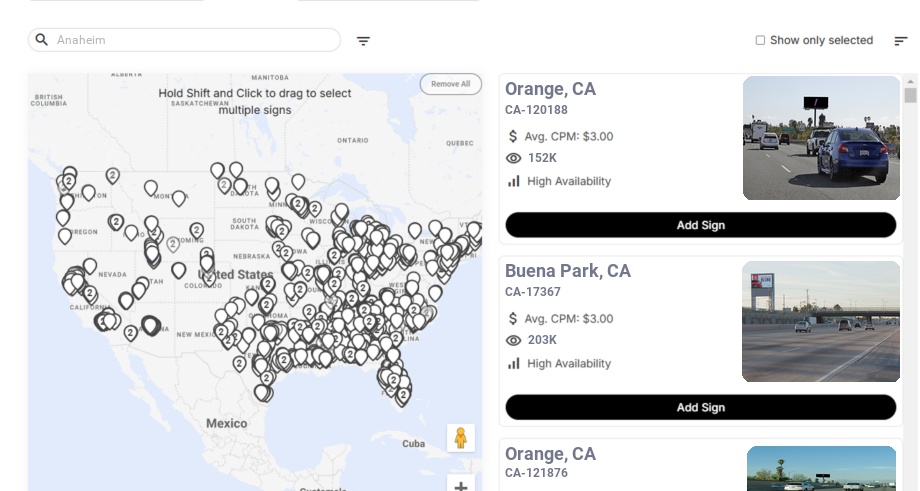



How much is a billboard in Anaheim?
Why Choose Blip for Billboard Advertising in Anaheim
Blip lets you launch Anaheim billboards fast and self-serve, reaching I-5, SR-57, and SR-22 traffic without the usual buying hassle.
Use Blip's flexible budgets in Anaheim to test ads during Disneyland peaks, Angels games, or Convention Center surges, then scale what works.
No contracts with Blip means you can run Anaheim campaigns on weekday commuter hours or weekend tourist waves, then change course anytime.
Blip's real-time analytics help you see what works near Anaheim's resort corridor, so you can shift spend between Orange, Garden Grove, and Buena Park.
Build sharper Anaheim creatives with Blip's tools for quick, bold copy that stands out to families, convention-goers, and resort-bound drivers.
Frequently Asked Questions About Billboard Advertising in Anaheim
How much does a billboard cost near Anaheim, California with Blip?
With Blip, advertising on Anaheim billboards is flexible enough for virtually any budget. You choose your daily spend during campaign setup, and Blip automatically keeps your digital billboard ads serving the Anaheim area within that amount. Pricing per blip varies based on the time of day, location, and advertiser demand, so you stay in control by adjusting your budget or schedule whenever you like.
Where can I advertise with Blip near Anaheim, California?
Our 8 digital billboards serve the Anaheim area from nearby Orange, Garden Grove, and Buena Park. These boards are positioned on key routes that serve major destinations like Disneyland Resort, Angel Stadium of Anaheim, and Honda Center. By using multiple boards across these three nearby cities, we can create a ring of visibility around the Anaheim area that hits both inbound and outbound traffic.
What kind of people see Anaheim billboards near Blip?
Anaheim sits at the heart of northern Orange County, and the city itself is home to roughly 345,000–350,000 residents. But the real power of billboard advertising near Anaheim comes from the combination of residents, workers, and visitors passing through the area and viewing Anaheim billboards during daily trips. This includes families, locals, tourists, convention-goers, and commuters moving between cities.
When is the best time to run billboards in Anaheim with Blip?
Morning peak is roughly 6:30 a.m. to 9:00 a.m., with volumes often 40–60% higher than mid-day lulls on commuter-heavy routes. Evening peak is roughly 3:30 p.m. to 7:00 p.m., with particularly heavy congestion in the 4:30–6:30 p.m. window when both commuters and visitors are on the road. Around the Disneyland Resort and convention district, there is also a mini-peak around 10:00 a.m.–11:00 a.m. and another around 9:00 p.m.–11:00 p.m.
What areas around Anaheim get the most billboard traffic?
Segments of I-5 near the Anaheim–Orange–Garden Grove cluster often exceed 250,000 vehicles per day, with some stretches approaching 270,000–280,000 during peak seasons. SR-57 and SR-91 near the Anaheim area regularly carry 200,000+ vehicles per day on busy segments, forming key commuter and visitor arteries. SR-22 also connects commuters between the coastal cities and inland Orange/Anaheim, adding 120,000–160,000 vehicles per day on many segments.
Do I need a contract to advertise with Blip in Anaheim?
No, Blip has no long-term contracts or minimum commitments. You can start, pause, or stop your campaign at any time.
How fast can I launch a billboard campaign with Blip in Anaheim?
You can have your campaign live in minutes. Create a free account, select your locations, set your budget, upload your design, and start running once approved.
Where can I advertise with Blip in Anaheim?
Blip has digital billboards in Anaheim. You can browse available locations on a map, choose the ones that fit your audience, and start advertising right away.
Still have questions? Launch a campaign in minutes — no contracts, no commitments.
Start Your CampaignAnaheim Billboard Advertising Guide
Anaheim is one of Southern California’s most dynamic visitor and employment hubs, drawing millions of tourists and hundreds of thousands of daily commuters through its streets and freeways each year. With our 8 digital billboards serving the Anaheim area from nearby Orange Garden Grove, and Buena Park, advertisers can tap into a constant flow of families, locals, tourists, and convention-goers moving near Anaheim every hour of the day. These high-visibility billboards near Anaheim give brands a powerful way to stay in front of both residents and visitors as they travel between cities. Below, we walk through how to turn that movement into measurable impact using smart, data-driven digital billboard campaigns.
Understanding the Anaheim Area Audience
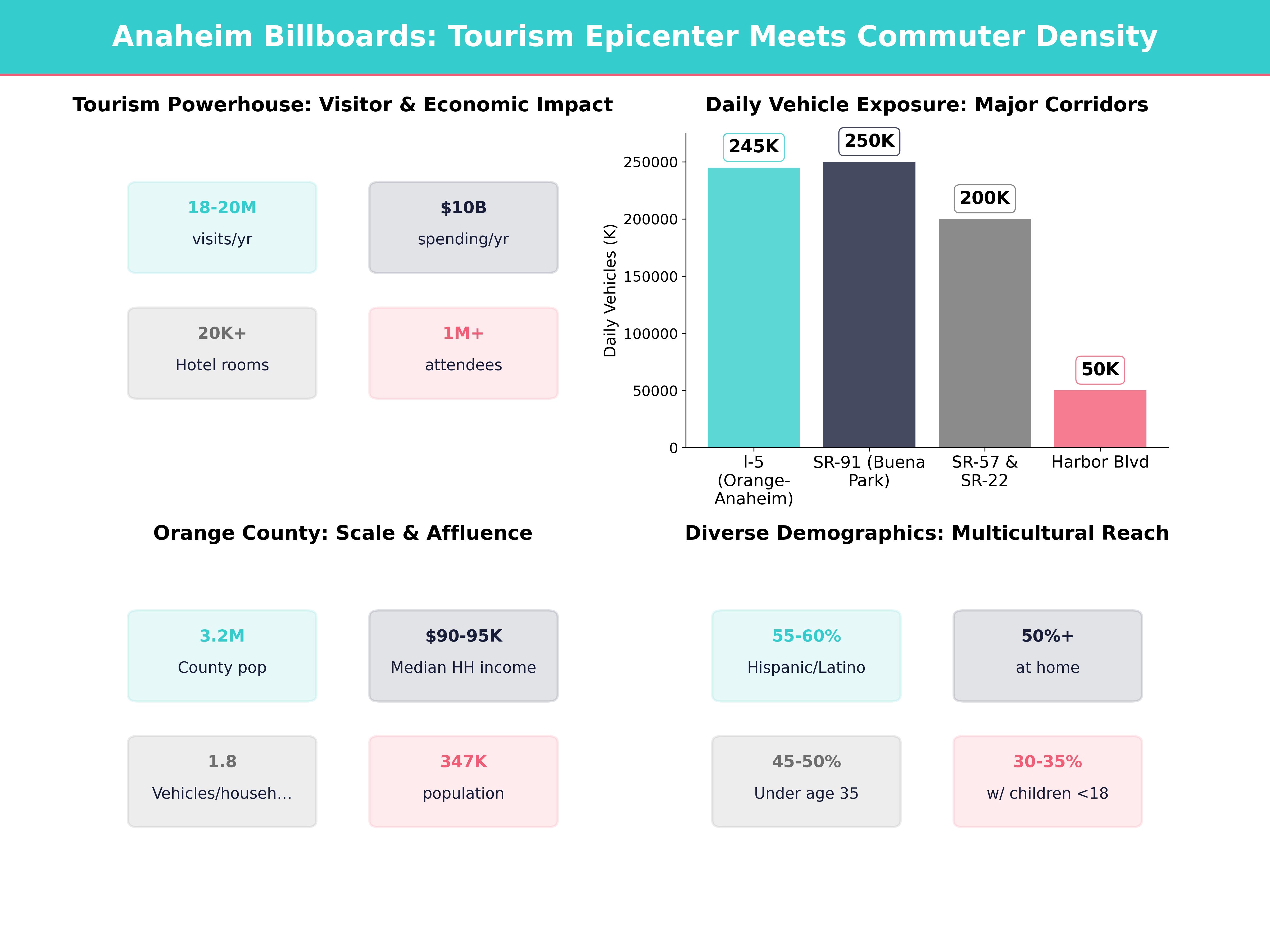
Anaheim sits at the heart of northern Orange County, a county of about 3.2 million residents spread across 34 cities and communities, according to Orange County. The city of Anaheim itself is home to roughly 345,000–350,000 residents, ranking it among the top 10 largest cities in California by population and the largest in Orange County by land area. But the real power of billboard advertising near Anaheim comes from the combination of residents, workers, and visitors passing through the area and viewing Anaheim billboards during daily trips.
Key audience components:
-
Residents and local households
- Anaheim’s median household income is around $90,000–$95,000, placing it above both the national and many neighboring-county averages and signaling solid purchasing power across middle- and upper-middle–income households.
- Roughly 35–40% of households in the broader Anaheim–Orange–Garden Grove corridor own their homes, while the rest rent, supporting strong demand for services like apartment communities, home services, and financial products.
- The population is relatively young; nearly 26–28% of residents are under 18, and roughly 45–50% are under 35, making family-oriented products, education, entertainment, and quick-service restaurants especially relevant.
-
Tourism and theme park traffic
- The Disneyland Resort 18–20 million visits per year between Disneyland Park and Disney California Adventure alone, making it one of the most visited theme park destinations in the world.
- According to Visit Anaheim, Anaheim welcomes well over 20 million visitors annually in a typical pre-pandemic year, generating more than $10 billion in annual visitor spending across hotels, dining, shopping, and entertainment.
- The city’s resort district offers 150+ lodging properties and over 20,000 hotel rooms within a short distance of the parks and convention center, meaning a dense concentration of tourists who repeatedly travel the same corridors each day and frequently see Anaheim billboards as they move between attractions.
- Visitors travel primarily by car or rideshare—Orange County’s vehicle ownership rate typically exceeds 1.8 vehicles per household—which means freeways and arterials near Anaheim (and therefore our nearby billboards) get a disproportionate share of tourist eyeballs.
-
Convention and business traffic
- The Anaheim Convention Center 1.8 million square feet of exhibition space, including over 1 million square feet of exhibit halls and extensive meeting rooms and ballrooms.
- In a strong year, the center hosts 250–300 events and can draw 1 million or more attendees annually, from major industry trade shows to national association meetings and cheer/dance competitions.
- Convention attendees tend to spend more per day than leisure tourists, often 2–3 times more on dining and entertainment, and they are highly responsive to clear, directional messaging about nearby restaurants, services, and venues.
-
Commuters and employees
- Major employers in the Anaheim area include the Disneyland Resort, Anaheim Elementary and Union High School Districts UCI Health and regional hospital systems, logistics hubs near SR‑91 and I‑5, and city/county agencies.
- Orange County’s job centers are spread across Anaheim, Orange, Irvine, and Santa Ana, creating heavy daily cross-city commuting. The Orange County Transportation Authority (OCTA) reports that tens of thousands of workers cross city boundaries daily, with some freeway segments near Anaheim seeing over 300,000 person-trips per weekday.
- This means our signs in Orange, Garden Grove, and Buena Park reach Anaheim-area workers multiple times per week, often 10+ exposures per commuter per week for ongoing campaigns, making billboard advertising near Anaheim a reliable way to build frequency with local commuters.
For advertisers, this combination means you’re not speaking to one audience—you’re speaking to multiple overlapping audiences in constant motion near Anaheim. The more precisely you define which of those audiences matters most, the easier it is to use Blip-style tools to schedule and place your messages for maximum impact with billboards near Anaheim.
Where Our Billboards Reach: Orange, Garden Grove, and Buena Park
While our billboards sit in nearby cities, they are positioned on key routes that serve the Anaheim area and its major destinations like Disneyland Resort, Angel Stadium of Anaheim, and Honda Center. For brands considering billboard rental near Anaheim, these nearby placements are designed to intercept both local and visitor traffic on their way in and out of the city:
-
Orange (about 2.5 miles from Anaheim)
- Intersections near freeways such as the I-5, SR-55, and SR-22 carry large volumes of traffic heading to or from the Anaheim area. Caltrans traffic counts show certain I‑5 segments between Orange and Anaheim carrying 230,000–260,000 vehicles per average day.
- The City of Orange
- Orange has roughly 140,000 residents and a daytime population that swells due to education and healthcare employers, including Chapman University and local hospitals, providing a strong base for both local and regional advertising.
- Many visitors stay in hotels or short-term rentals in Orange and drive back and forth to the Anaheim area for theme parks and conventions, often generating 4–6 trips per day per party across key corridors.
-
Garden Grove (about 5.4 miles from Anaheim)
- Garden Grove borders the Disneyland Resort area closely on the southwest side and includes a significant cluster of hotels and restaurants serving Anaheim-area visitors. The city has around 170,000 residents and a strong tourism-adjacent economy.
- State Route 22 (the Garden Grove Freeway) is a key east–west corridor feeding I-5 and SR-57 near Anaheim; Caltrans traffic data shows segments of these freeways frequently carry more than 200,000 vehicles per average day on busy sections, with weekend volumes often spiking during peak tourism seasons.
- Major arterials such as Harbor Boulevard, Chapman Avenue, and Garden Grove Boulevard carry heavy resort traffic, with Harbor often seeing 50,000+ vehicles per day near the resort district.
- Our boards near Garden Grove can catch drivers heading toward the Anaheim Resort district in the morning and returning at night, creating a natural “outbound and inbound” impression cycle ideal for restaurants, entertainment, and parking services using billboard advertising near Anaheim.
-
Buena Park (about 8.6 miles from Anaheim)
- Buena Park is home to Knott’s Berry Farm and other attractions, creating a “twin magnet” tourism effect with the Anaheim area; Knott’s alone typically draws over 4 million visitors per year in strong seasons.
- The city lies along the I-5 and SR-91 corridors, both major commuter routes linking Los Angeles County and the Anaheim area. Caltrans counts on SR‑91 between Buena Park and Anaheim frequently exceed 250,000 vehicles per day on key segments.
- Buena Park’s population of roughly 80,000 residents more than doubles with daily visitors when the park and nearby entertainment venues are in full swing, generating consistent out-of-town traffic.
- Visitors often split itineraries between Buena Park attractions and Anaheim-area attractions over multiple days, driving back and forth across our digital faces and giving advertisers multiple chances to influence where they eat, shop, or stay next through Anaheim billboards.
By using multiple boards across these three nearby cities, we can create a ring of visibility around the Anaheim area that hits both inbound and outbound traffic. For example:
- An Anaheim-area family attraction can show morning and late-afternoon ads in Garden Grove to catch resort-bound traffic, while showing evening ads in Buena Park to entice visitors returning to their hotels.
- A B2B company exhibiting at the Anaheim Convention Center can run rush-hour creative in Orange and Buena Park to reach incoming attendees who are driving in from inland Riverside County Los Angeles County
Traffic Patterns and Scheduling Strategy
To maximize results, we should align campaign delivery with how drivers actually move near Anaheim. Public sources from Caltrans and Orange County Transportation Authority (OCTA) highlight several traffic realities that shape the performance of billboard rental near Anaheim:
-
Freeway volumes
- Segments of I-5 near the Anaheim–Orange–Garden Grove cluster often exceed 250,000 vehicles per day, with some stretches approaching 270,000–280,000 during peak seasons.
- SR-57 and SR-91 near the Anaheim area regularly carry 200,000+ vehicles per day on busy segments, forming key north–south and east–west commuter and visitor arteries.
- SR-22 connects commuters between the coastal cities and inland Orange/Anaheim, adding 120,000–160,000 vehicles per day on many segments.
- Combined, these corridors can deliver well over 1 million vehicle trips per day within the broader Anaheim travel-shed, providing scale that rivals or exceeds many major media markets.
-
Rush-hour peaks
- Morning peak: roughly 6:30 a.m. to 9:00 a.m., with volumes often 40–60% higher than mid-day lulls on commuter-heavy routes.
- Evening peak: roughly 3:30 p.m. to 7:00 p.m., with particularly heavy congestion in the 4:30–6:30 p.m. window when both commuters and visitors are on the road.
- Around the Disneyland Resort and convention district, there is also a mini-peak around 10:00 a.m.–11:00 a.m., when visitors arrive at theme parks and convention sessions, and another around 9:00 p.m.–11:00 p.m., when they depart, especially on fireworks or event nights.
-
Event-driven surges
- Home games for the Los Angeles Angels at Angel Stadium and the Anaheim Ducks at Honda Center can add tens of thousands of extra vehicle trips in the 2–3 hours before and after games, spiking traffic on I‑5, SR‑57, Katella Avenue, and Orangewood Avenue.
- Large conventions can bring 10,000–50,000 attendees into the area over a few days, amplifying traffic on feeder routes from major hotels and parking facilities.
Given this, advertisers can:
-
Use dayparting to match intent
- Promote breakfast, coffee, and quick-service dining in the 6:30–10:30 a.m. window when commuters and park-goers are en route; food service operators often see 20–30% of daily sales in this morning period.
- Push retail, entertainment, and family activities in late afternoon and evening when visitors are deciding how to spend downtime and locals are heading home, typically the 4:00–9:00 p.m. window.
- Run B2B and trade show messaging heavily during convention opening days, focused on early mornings and late afternoons when attendees are most likely to be commuting between hotels and the convention center.
-
Adjust for weekends vs weekdays
- Weekdays near Anaheim skew toward commuters and convention attendees. On many corridors, 70%+ of weekday trips are work-related or business-purpose trips.
- Weekends skew toward families, regional day-trippers, and overnight tourists. Disneyland-area visitation can jump 30–50% on Saturdays compared with low midweek days.
- For example, a local staffing firm might emphasize weekday rush hours, while a restaurant near the resort district prioritizes weekends and evening entertainment hours when party sizes and ticket averages tend to be higher.
Because we can buy digital billboard exposure in flexible increments, we can concentrate budget specifically on the time blocks that align with your best customers instead of paying for low-value overnight or off-peak inventory unless it’s strategically helpful. This flexibility is one of the biggest advantages of digital billboard rental near Anaheim compared with traditional static placements.
Demographics and Language: Crafting the Right Message
Anaheim’s population is diverse and deeply multicultural, and that extends into the broader travel-shed served by our boards in Orange, Garden Grove, and Buena Park.
-
Ethnic and language mix
- In the Anaheim area, roughly 55–60% of residents identify as Hispanic or Latino, with a strong presence of Mexican and Central American heritage, according to local demographic summaries from the City of Anaheim.
- A large Asian American community is concentrated in nearby cities like Garden Grove and Westminster over 35% Asian American residents, heavily Vietnamese, which influences restaurant, retail, and service patterns along key corridors.
- More than 50% of residents in Anaheim speak a language other than English at home, and Spanish is by far the most common. In some neighborhoods, Spanish-speakers make up 65–70% of households.
- Religious and cultural diversity is also strong, with numerous churches, temples, and community centers that draw regional visitors on weekends and evenings.
-
Income and household composition
- Around 30–35% of Anaheim-area households include children under 18, supporting demand for family-focused entertainment, healthcare, education, and quick-service dining.
- A significant share of residents—often 20–25% of households—live in multigenerational arrangements, increasing the relevance of products and services that address both seniors and children.
-
What this means for creatives
- Consider bilingual English–Spanish creative, especially for consumer services, healthcare, education, retail, and financial services that cater to local residents. Bilingual campaigns in similar markets often show 10–20% higher recall among Hispanic audiences.
- In Vietnamese- and Korean-influenced corridors (particularly near Garden Grove and Westminster), consider localized messaging or visuals that reflect Asian languages and culture where appropriate.
- Keep language simple and direct—billboards near the Anaheim area must be understood in 2–3 seconds at freeway speeds; drivers often have only 400–600 feet of viewing distance at typical speeds.
- For tourist-focused ads, prioritize clear English messaging and internationally recognizable imagery (icons, maps, recognizable landmarks) since theme parks attract visitors from across the U.S. and overseas; Visit Anaheim has noted that international visitors can account for 10–15% of total visitation in strong years.
Effective messaging tactics for this market:
-
Use short, benefit-led lines:
- “5 Minutes from the Resort Area”
- “Kids Eat Free Tonight”
- “Walk to the Convention Center”
-
For locals, highlight convenience and trust:
- “Trusted by Anaheim-Area Families Since 1990”
- “Same-Day Urgent Care Near You”
-
For tourists, emphasize time, distance, and ease:
- “Parking for the Anaheim Area – Next Exit”
- “Late-Night Dining, 2 Miles Ahead”
Visual Design for High-Impact Displays
Traffic speed and visual clutter in the Anaheim area mean your creative has to work hard. To stand out on our boards in Orange, Garden Grove, and Buena Park:
-
Keep it bold and simple
- Limit copy to 7 words or fewer when possible; outdoor industry studies consistently show that messages under 7 words achieve significantly higher recall rates than longer copy.
- Use large, high-contrast fonts that can be read from 500–700 feet away at speeds of 55–65 mph.
- Avoid thin fonts, cursive, or text over busy images, which can reduce legibility by 30–50% at highway speeds.
-
Focus on one main idea
- One major offer, one call to action, or one directional message per creative. This is especially important in areas like the resort district where drivers are processing heavy visual information from hotels, attractions, and street signage.
- If you have multiple offers, we can rotate multiple creatives rather than cramming them into a single design, increasing clarity without sacrificing variety.
-
Use color strategically
- Bright, saturated colors like red, orange, yellow, and cyan tend to stand out against sky and freeway environments; tests in similar markets often show 10–15% higher recognition for high-contrast color pairings.
- Avoid color combinations that blend into Southern California’s frequent blue skies and sun (e.g., pale blues and light grays), or into nighttime lighting, such as muted dark tones without contrast.
-
Include fast-acting calls to action
- Calls like “Exit Katella,” “Book Now,” “Open Late,” or “This Weekend Only” give drivers a clear next step and can lift response by 15–30% versus generic brand statements.
- For mobile-driven responses, use easy-to-remember URLs or short phrases that make it simple to search later (e.g., “Search: Anaheim Dental Care”). Short, brandable phrases work especially well given that roughly 95% of U.S. adults own a mobile phone and a majority will search businesses they see offline.
In a market with so many distractions—from theme park signage to hotel marquees—clarity is your competitive advantage when planning billboard advertising near Anaheim.
Targeting Tourists vs. Locals Near Anaheim
Tourists and locals behave very differently near Anaheim, and it’s worth tailoring your buy and creatives accordingly.
Reaching tourists
-
Stay near routes that link hotels, attractions, and freeways:
- Routes between the Anaheim Resort area and the I-5, SR-57, and SR-22 corridors, which collectively carry hundreds of thousands of vehicle trips per day.
- Connections between Anaheim and Buena Park (for travelers visiting both Disneyland Resort and Knott’s Berry Farm), where a family may log 30–50 miles of driving per day over multi-day stays.
-
Prioritize:
- Evening and late-night slots when visitors are contemplating where to eat, drink, or shop after a day at the parks; restaurant and bar operators often see 40–50% of daily revenue after 5 p.m.
- Weekends, school breaks, and major holiday periods. For example, around spring break and summer, Disneyland-area resort occupancy regularly pushes into the 80–90% range.
-
Messaging ideas:
- “Family-Friendly Dining Near the Anaheim Area – Exit Now”
- “Souvenirs & Gifts 1 Mile from the Resort Area”
- “Skip the Parking Hassle – Park & Ride Near Anaheim”
Reaching locals
-
Focus on commute paths:
- Freeways and major arterials connecting Anaheim with Orange, Garden Grove, Buena Park, and inland cities such as Fullerton Placentia, and Yorba Linda.
- Corridors near industrial parks, office clusters, schools, and hospitals, which collectively employ tens of thousands of workers.
-
Prioritize:
- Weekday morning and evening peaks, when local workers make predictable, repeated trips past your message.
- Consistent, evergreen messaging that builds brand familiarity over weeks and months; outdoor exposure over 8–12 weeks often leads to meaningful lifts in aided recall.
-
Messaging ideas:
- “Anaheim-Area Home Services – Call Today”
- “Your Local Credit Union for the Anaheim Area”
- “New Apartments Near Anaheim – Now Leasing”
Because digital billboards are flexible, you don’t have to choose exclusively. We can design a campaign where:
- Tourist-focused creatives run more heavily on weekends, evenings, and peak holiday seasons.
- Local-focused creatives dominate weekday commute hours and off-peak seasons, maximizing reach among residents who drive the same routes 200+ workdays per year.
This approach lets advertisers use Anaheim billboards in a way that mirrors the real-world behavior of both visitor and resident audiences.
Seasonality: Timing Your Campaign Around Anaheim’s Calendar
The Anaheim area’s event calendar is packed, and aligning with it can dramatically boost results. Local resources like Visit Anaheim and regional news outlets such as the Orange County Register, ABC7 Los Angeles, and Spectrum News 1 – Southern California highlight many of these events.
Key seasonal patterns:
-
Spring (March–May)
- Spring break boosts Disneyland Resort and Anaheim-area visitation; theme park attendance during peak spring weeks can run 20–30% above winter weekday baselines.
- Graduation season at local high schools, colleges, and universities (including California State University, Fullerton nearby) increases local family spending on dining, florists, photography, and venues.
- Ideal for: attractions, outdoor activities, restaurants, seasonal retail, education services, and prom/graduation-related businesses.
-
Summer (June–August)
- Peak family tourism; hotel occupancy and park attendance are high, and many properties near the resort district report occupancy levels in the high 80s to low 90s percent range during peak weeks.
- Local residents look for cooling activities, travel deals, and summer programs for kids; summer camp and youth program enrollment often peaks in late spring and early summer.
- Road traffic on beach and resort corridors tends to rise 10–25% compared with off-season months.
- Ideal for: hotels, attractions, quick-service restaurants, retail sales, auto services (road-trip prep), and family entertainment centers.
-
Fall (September–November)
- Convention season is typically strong at the Anaheim Convention Center, with multiple large shows bringing tens of thousands of attendees each month.
- Halloween events at theme parks—such as Oogie Boogie Bash Knott’s Scary Farm—draw regional visitors and can sell out many nights, adding heavy evening and late-night traffic.
- Sports seasons (Los Angeles Angels baseball through early fall and Anaheim Ducks hockey starting in October) add game-day traffic, often 30,000–45,000 attendees per Angels game and 15,000–17,000 per Ducks game.
- Ideal for: B2B exhibitors, nightlife, bars, transportation, sports-related offers, and seasonal events.
-
Winter (December–February)
- Holiday tourism and special events light up the Anaheim area; Disneyland’s holiday season and winter events at nearby attractions draw both local and out-of-town visitors, keeping traffic elevated on weekends.
- Post-holiday (January–February): residents focus on health, finance, and home improvement, creating windows where gyms, clinics, and financial institutions see spikes in new inquiries.
- Hotel occupancy moderates somewhat after the New Year but remains supported by conventions, cheer/dance competitions, and youth sports tournaments at nearby venues.
- Ideal for: holiday shopping, events, financial services, gyms, medical/dental, home services, and tax preparation.
Using flexible scheduling, we can increase your impressions during the weeks that matter most to your business—such as a major trade show at the convention center, a school break highlighted by Anaheim Elementary and Union High School District calendars, or a seasonal promotion—without locking you into wasteful, year-round contracts. This makes billboard rental near Anaheim especially attractive for businesses with strong seasonal patterns.
Industries That Win on Billboards Near Anaheim
Many verticals are especially suited to billboard campaigns serving the Anaheim area, and each can benefit from strategically placed Anaheim billboards that align with their best customers’ travel patterns:
-
Hospitality and travel
- Hotels, resorts, vacation rentals, and travel packages benefit from the 20+ million annual visitors that flow through Anaheim and surrounding cities.
- Shuttle services and parking providers promoting convenience near the resort district and convention center can capture demand from the tens of thousands of daily visitors arriving by car.
- Messaging like “Free Breakfast,” “Walk to Disneyland,” or “Convention Rate Specials” performs especially well when tied to clear directional cues.
-
Food and beverage
- Restaurants, quick-service chains, and late-night eateries tap into both local residents and visitor traffic. In tourist-heavy zones, restaurant spending can exceed $100–$150 per visiting party per day.
- Cafés and breakfast spots targeting early park-goers and commuters can leverage the 6:30–9:30 a.m. window, when many families leave hotels for the parks.
- Bars and lounges appealing to convention attendees after show hours benefit from the 5:00–11:00 p.m. surge, when many exhibit halls close and attendees seek nearby options.
-
Attractions and entertainment
- Museums, escape rooms, local tours, family fun centers, and live entertainment venues can position themselves as “the next thing” after the parks or conventions.
- Seasonal events like holiday lights, festivals, and sports games can use short bursts of high-frequency impressions 2–4 weeks before events to drive attendance.
-
Retail and shopping centers
- Outlet malls, shopping districts, and big-box retailers within a short drive of the Anaheim area, such as those in Orange, Garden Grove, Buena Park, and nearby cities, draw both locals and visitors.
- Special sales, new store openings, and limited-time offers can see noticeable traffic lifts during 1–2 week promotional windows when supported by billboards.
-
Healthcare and professional services
- Urgent care, dental, pediatric, and specialty clinics appealing to local families can use directional signage and “open late” messaging to capture unscheduled visits.
- Legal, financial, and insurance services benefit from broad name recognition and trust; studies in similar markets show that sustained out-of-home exposure can contribute to double-digit increases in brand awareness over a few months.
-
Education and training
- Local colleges, trade schools, bootcamps, and extracurricular learning centers can use billboards to support enrollment campaigns; application periods often cluster in late winter and summer.
- Campaigns around enrollment periods, new programs, or campus events can focus on corridors heavily used by young adults and working professionals.
For each of these, digital billboards allow us to test different creatives, time slots, and locations—then reinforce what works with targeted spending, making billboard advertising near Anaheim a practical performance channel rather than just a branding exercise.
Measuring Success and Iterating
To make billboard advertising near Anaheim as accountable as possible, we should plan measurement from the start:
-
Use trackable elements
- Custom URLs and landing pages dedicated to your billboard campaign let you isolate traffic; it’s common to see 5–15% of total site sessions during a campaign period coming from users who arrive via branded search or direct visits correlated with flight dates.
- Unique promo codes (“ANAHEIM20”) for offers shown only on billboards can help you attribute in-store or online purchases.
- “How did you hear about us?” questions on forms and at point of sale, with “billboard” or “sign near Anaheim” as options, provide simple but valuable attribution data.
-
Align with online channels
- Run search and social campaigns targeting users near Anaheim during the same time window when your boards are active; multi-channel campaigns can see 20–40% higher response rates than single-channel efforts.
- Use similar headlines and visuals so people connect the offline and online experiences; consistency can improve recognition and recall by up to 30% in some studies.
-
Iterate based on performance
- If a time-of-day block or creative variant drives more calls, bookings, or web sessions, shift budget to favor that combination and test further refinements.
- Rotate fresh creatives every 4–8 weeks for ongoing campaigns so frequent commuters don’t tune your message out, while still giving each design enough exposure to produce consistent data.
- For businesses with physical locations, compare foot traffic data (where available) to campaign periods; advertisers often see lift in store visits of 5–20% when billboards are combined with digital tactics.
By treating digital billboards serving the Anaheim area as a testable, optimizable channel—rather than a static buy—we can steadily increase your return on ad spend and ensure your Anaheim billboards continue to perform over time.
Putting It All Together for the Anaheim Area
The Anaheim area is uniquely rich in both everyday residents and constantly refreshing waves of visitors, employees, and convention attendees. With our 8 digital billboards nearby in Orange Garden Grove, and Buena Park, we can:
- Surround key access routes into and around the Anaheim area, reaching corridors that collectively see hundreds of thousands of vehicles per day.
- Tailor messages to locals vs. tourists, commuters vs. vacationers, families vs. business travelers, based on when and where they are most likely to be on the road.
- Adjust schedules around daily traffic flows and the city’s seasonal event calendar highlighted by Visit Anaheim, City of Anaheim updates, and local media.
- Continuously refine creatives and timing based on real-world response, using measurable tactics like trackable URLs, promo codes, and synchronized digital campaigns.
When we combine deep local insight with the flexibility of digital out-of-home, billboard campaigns near Anaheim become more than just brand awareness—they become a measurable, adaptable driver of traffic, leads, and sales for businesses that want to stand out in one of Southern California’s busiest, most opportunity-rich markets.