Billboards near Vallejo, CA
No Minimum Spend. No Long-Term Contracts. Just Results.
Trusted by Leading Brands


Billboard advertising
near Vallejo has never been easier



How much is a billboard near Vallejo?
Why Choose Blip for Billboard Advertising near Vallejo
Blip lets you launch Vallejo billboards fast on I-80, SR-37, and ferry traffic—no long setup, just self-serve control.
Set flexible budgets for Vallejo commuters and Six Flags weekends, so your spend follows the traffic that matters most.
Use dayparting in Vallejo to hit 6-9 a.m. and 3:30-7 p.m. drive times, when bridge and freeway traffic peaks.
No contracts means Vallejo businesses can test ads near Benicia and Martinez, then adjust as demand shifts.
Track Vallejo campaign results in real time and tune creative for families, commuters, and tourism spikes.
Frequently Asked Questions About Billboard Advertising near Vallejo
How much does a billboard cost near Vallejo, California with Blip?
With Blip, you control exactly what you spend on Vallejo billboards by setting a daily budget that can be as small or as flexible as you like. Each ad is a short “blip” of 7.5 to 10 seconds on rotating digital billboards near Vallejo, California, and you only pay for the individual blips you receive. Costs vary based on when you run your ads, where they display, and real-time advertiser demand, so your budget stretches efficiently in the Vallejo area.
Where can I advertise with Blip near Vallejo, California?
Our five digital billboards serving the Vallejo area are positioned in nearby Benicia and Martinez. These locations give you strong coverage of several major corridors that Vallejo residents and visitors rely on daily and form the backbone of effective billboard advertising near Vallejo. Boards near I‑680, I‑780, the Benicia–Martinez Bridge, and the Martinez interchange are especially important for reaching commuters and regional traffic.
Who do Vallejo billboards reach in the Vallejo area?
Federal data for 2020 show that Vallejo’s roughly 126,000 residents are among the most diverse in California, with about 30–35% identifying as Hispanic or Latino, roughly 20–25% as Asian, around 20–25% as Black or African American, and around 15–20% as non-Hispanic White. The median age is roughly 38–39 years, and about 60–65% of residents are between ages 18 and 64. Household sizes average around 3 people, indicating numerous families and multigenerational homes.
When is the best time to run Blip ads near Vallejo, California?
In and around Vallejo, Benicia, and Martinez, traffic typically peaks during the morning commute from roughly 6:00–9:00 a.m. on weekdays and the evening commute from roughly 3:30–7:00 p.m. Midday traffic from about 11:00 a.m.–2:00 p.m. is also useful for school runs and errands. Weekend traffic rises around Six Flags Discovery Kingdom, Mare Island events, and waterfront parks, especially spring through fall.
Why is Vallejo a good market for billboard advertising with Blip?
Vallejo is one of the most strategically located cities in the North Bay, positioned at the junction of Interstate 80, State Route 37, and the San Francisco Bay Ferry’s Vallejo terminal. Recent county-level economic data show Solano County’s median household income in the mid–$80,000 range, with Vallejo’s median close to that level, and a majority of households in the middle-income to upper-middle-income bracket. That combination of traffic, commuting, and spending power makes billboard advertising near Vallejo especially valuable.
Do I need a contract to advertise with Blip near Vallejo?
No, Blip has no long-term contracts or minimum commitments. You can start, pause, or stop your campaign at any time.
How fast can I launch a billboard campaign with Blip near Vallejo?
You can have your campaign live in minutes. Create a free account, select your locations, set your budget, upload your design, and start running once approved.
Where can I advertise with Blip near Vallejo?
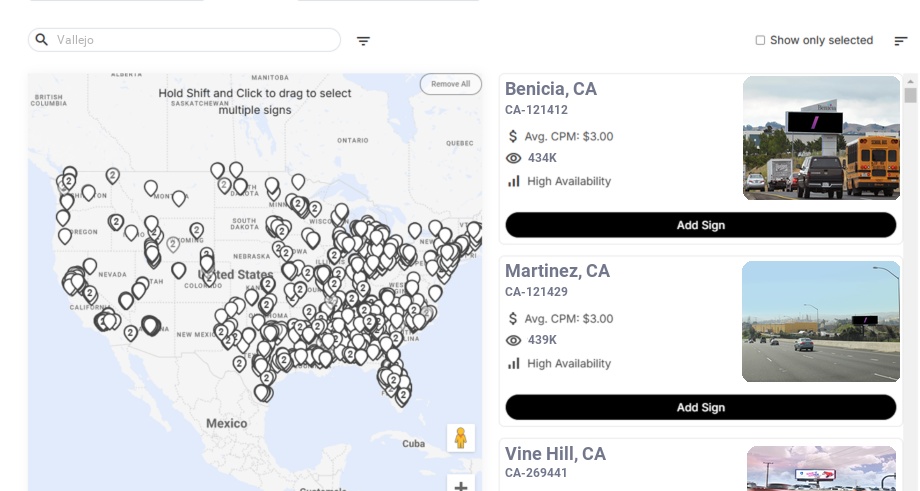
Blip has digital billboards near Vallejo. You can browse available locations on a map, choose the ones that fit your audience, and start advertising right away.
Still have questions? Launch a campaign in minutes — no contracts, no commitments.
Start Your CampaignVallejo Billboard Advertising Guide
The Vallejo, California Benicia (about 6.6 miles away) and Martinez
Why the Vallejo Area Is a High-Value Billboard Market
Vallejo is one of the most strategically located cities in the North Bay, which makes Vallejo billboards especially valuable for reaching both local and regional audiences:
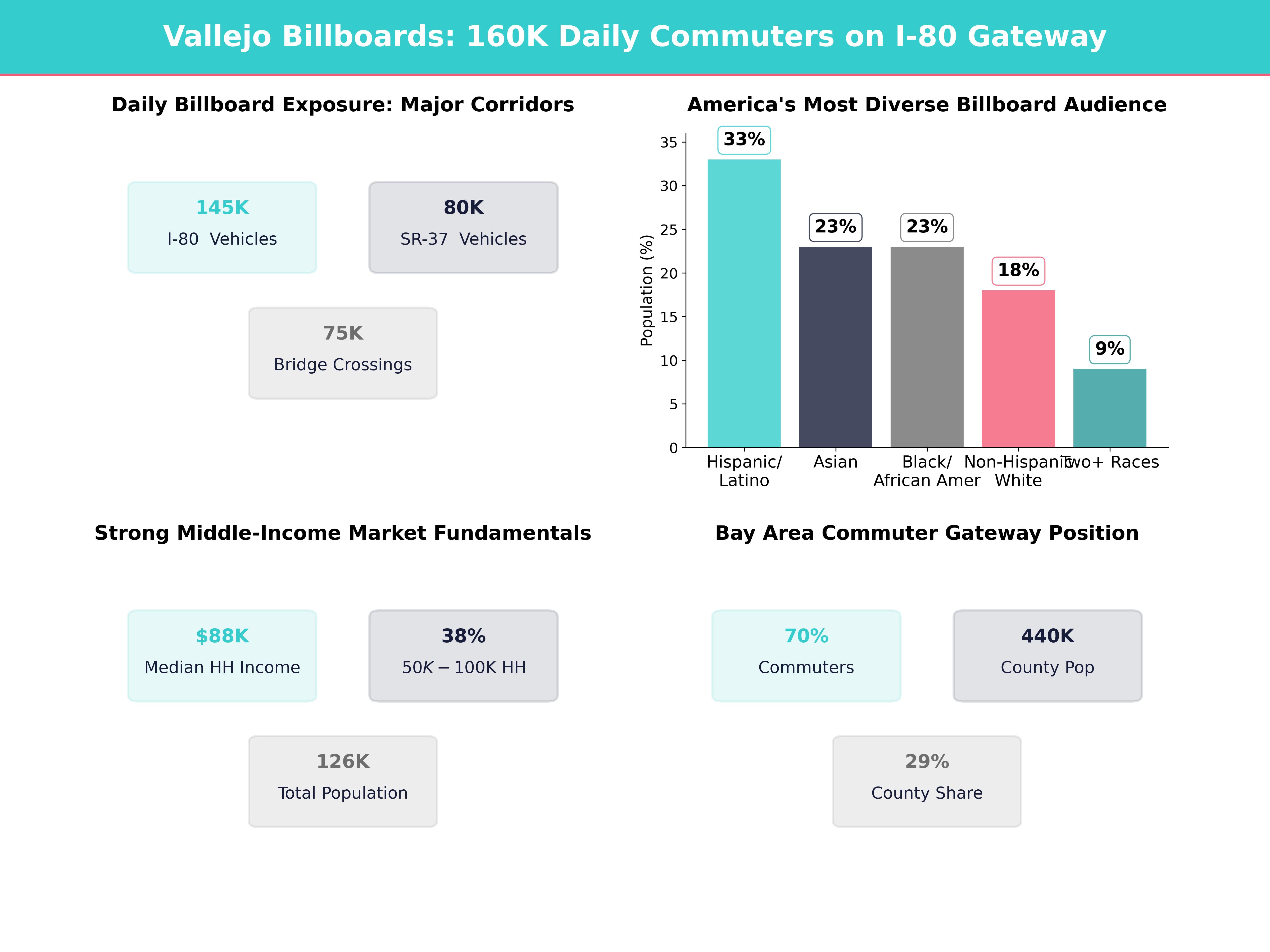
- The City of Vallejo Solano County and accounting for nearly 28–30% of the county’s roughly 440,000 residents.
- Vallejo is positioned at the junction of Interstate 80, State Route 37, and the San Francisco Bay Ferry’s Vallejo terminal Metropolitan Transportation Commission and Caltrans District 4.
- Recent county-level economic data show Solano County’s median household income in the mid–$80,000 range (approximately $85,000–$90,000), with Vallejo’s median close to that level. Roughly 35–40% of households fall between $50,000 and $100,000 per year, and another 25–30% are above $100,000, placing a majority of households squarely in the middle-income to upper-middle-income bracket with meaningful disposable spending on dining, entertainment, home improvement, and services.
The broader Vallejo area also benefits from tourism and regional draws that increase the impact of billboard advertising near Vallejo:
- Six Flags Discovery Kingdom has historically attracted on the order of 1–1.5 million visitors annually, with peak daily attendance on busy summer weekends commonly exceeding 10,000–15,000 guests. Most visitors arrive via I‑80 and nearby corridors, contributing to strong weekend and holiday traffic.
- Mare Island
- Nearby Benicia Martinez Benicia Main Street, while Martinez’s marina, amphitheater, and downtown festivals pull visitors from across Contra Costa and Solano counties.
All of this means a well-placed, well-timed message on digital billboards serving the Vallejo area can consistently reach people with both the interest and the means to act, making billboard rental near Vallejo a cost-effective part of your marketing mix.
Understanding Who You Reach Near Vallejo
Knowing who lives and works in the Vallejo area helps shape effective messaging and creative for Vallejo billboards and nearby corridors.
Population and diversity
Federal data for 2020 show that Vallejo’s roughly 126,000 residents are among the most diverse in California:
- About 30–35% identify as Hispanic or Latino.
- Roughly 20–25% identify as Asian.
- Around 20–25% identify as Black or African American.
- Around 15–20% identify as non-Hispanic White.
- Around 8–10% identify with two or more races.
In many Vallejo neighborhoods, no single group holds an absolute majority, which is unusual even within the Bay Area. This diversity translates to real creative opportunities:
- Bilingual English/Spanish messaging can be powerful, especially for retail, food, healthcare, and community services. In several Vallejo ZIP codes, Spanish is spoken at home in more than 20–25% of households.
- Tagalog and other Filipino languages are also highly relevant. Vallejo has one of the largest Filipino communities in Northern California, with Filipino/Filipino American residents commonly estimated at 15–20% of the city’s population.
- Inclusive visuals and casting—families, multigenerational households, and diverse professional roles—will tend to resonate strongly and reflect the reality that more than 40% of Vallejo households include children.
Age, families, and households
The median age in the Vallejo area is roughly 38–39 years:
- A large share of residents fall into working and child-rearing years, with about 60–65% between ages 18 and 64.
- Roughly 22–25% of residents are under age 18, while about 13–15% are 65 or older, supporting a mix of youth- and senior-focused services.
- Household sizes average around 3 people, higher than the statewide average, indicating numerous families and multigenerational homes. In some Vallejo neighborhoods, average household size exceeds 3.2 persons.
For billboard strategy near Vallejo, that suggests:
- Emphasizing family-oriented offerings: schools, childcare, healthcare, parks, auto dealers, quick-service restaurants, and entertainment.
- Featuring “everyday life” moments—commuting, school drop-off, weekend outings—that match the lived experience of Vallejo-area audiences.
- Highlighting educational and youth-focused offerings tied to local institutions like the Vallejo City Unified School District and regional colleges.
Commuters and regional workers
Vallejo’s location means a large share of residents commute out of town:
- Regional labor data indicate that more than 70% of Vallejo workers commute to jobs outside the city, with significant flows toward San Francisco, Oakland, Richmond, Fairfield, and Concord/Walnut Creek.
- Thousands of commuters travel daily via I‑80, SR‑37, and the Vallejo–San Francisco ferry. The San Francisco Bay Ferry
- Many others commute east and south toward refineries, industrial areas, and office parks near Benicia and Martinez, including major employers around the Benicia Industrial Park and Martinez’s refinery and county office cluster.
For advertisers, this commuting pattern means:
- Morning and evening drive times near Benicia and Martinez are prime windows to reach Vallejo-area workers. For example, weekday peak-hour traffic on the Benicia–Martinez Bridge can account for more than 10% of the bridge’s roughly 70,000–80,000 average daily vehicle crossings reported by agencies like the Contra Costa Transportation Authority.
- Calls-to-action like “Tonight,” “This Weekend,” or “On Your Way Home” can be especially effective during PM drive times when people are thinking about plans.
- Service-area messages (e.g., “Serving Vallejo, Benicia & Martinez”) reinforce that commuters can access your business from either side of the bridge or bay.
Key Traffic Corridors and Where Our Boards Fit
Our five digital billboards serving the Vallejo area are positioned in nearby Benicia and Martinez. These locations give you strong coverage of several major corridors that Vallejo residents and visitors rely on daily and form the backbone of effective billboard advertising near Vallejo.
According to corridor-level counts from groups such as Caltrans District 4, the Solano Transportation Authority, and the Contra Costa Transportation Authority, key highways in this subregion routinely carry tens of thousands of vehicles per day, with some segments exceeding 150,000 vehicles daily.
Interstate 680 (I‑680) near Benicia
I‑680 connects Solano County to Contra Costa County and beyond. It carries:
- Heavy commuter traffic from Vallejo/Benicia toward Concord, Walnut Creek, and the Tri‑Valley. Many I‑680 segments near Benicia and Martinez see daily traffic volumes in the 120,000–150,000 vehicles-per-day range.
- Commercial and freight traffic between the I‑80 corridor and I‑580/I‑680. Trucks typically account for 8–12% of traffic on these segments, important for B2B messaging.
Boards near I‑680 are ideal for:
- B2B and industrial services (logistics, equipment, staffing, safety training) that align with the Benicia Industrial Park, which includes hundreds of businesses and thousands of jobs.
- Healthcare systems and higher education, given cross-county commuting to facilities and campuses in Concord, Walnut Creek, and beyond.
- Auto dealers, home services, and financial institutions targeting stable, commuting professionals with incomes commonly in the $75,000–150,000 range along this corridor.
Interstate 780 (I‑780) and the Benicia–Martinez Bridge
I‑780 links Vallejo and Benicia to the Benicia–Martinez Bridge and I‑680. This is a core path for Vallejo-area drivers heading to Contra Costa County:
- I‑780 daily traffic volumes often fall in the 50,000–70,000 vehicles-per-day range.
- The Benicia–Martinez Bridge typically sees around 70,000–80,000 vehicles per day, making it one of the most important north–south crossings in the central Bay Area.
Placing creative that speaks clearly to “Vallejo & Benicia” commuters on billboards near Vallejo can:
- Reinforce local identity for brands based in the Vallejo area and along the Benicia waterfront.
- Encourage stop‑offs in downtown Benicia or along the waterfront for food, shopping, and services, tapping into the hundreds of thousands of annual visitors that Visit Benicia
- Promote Vallejo destinations to Contra Costa residents traveling through, including attractions highlighted by Visit Vallejo.
Martinez and the I‑680 / Highway 4 junction
Martinez sits at a critical interchange:
- I‑680 runs north–south between Benicia and Walnut Creek, with major employment centers at both ends.
- State Route 4 runs east–west toward Pittsburg, Antioch, and eastern Contra Costa County, where several cities have grown rapidly over the last decade and now contribute substantial commuter flows.
Digital billboards near Martinez give you:
- Access to Vallejo-area residents working in the refineries, courts, county offices, and industrial areas around Martinez. The City of Martinez
- Strong visibility to Contra Costa residents who may visit Vallejo or Benicia for waterfront recreation or Six Flags. Contra Costa County’s population of more than 1.1 million residents and median household income well into the six figures creates a sizable higher-income audience for Vallejo-area attractions and services.
By spreading impressions across these Benicia and Martinez boards, you can blanket primary approach routes serving the Vallejo area from multiple directions and tap into traffic streams that together account for several hundred thousand vehicle trips per day, maximizing the reach of your billboard advertising near Vallejo.
Timing Your Campaign Around Vallejo’s Daily and Seasonal Rhythms
Blip allows you to schedule and budget by hour and by day, which is especially valuable in a market like the Vallejo area where traffic ebbs and flows with commuting, schooling, and tourism.
Daily patterns
In and around Vallejo, Benicia, and Martinez, traffic typically peaks:
- Morning commute: roughly 6:00–9:00 a.m. on weekdays, when many freeway segments see hourly volumes of several thousand vehicles per lane.
- Midday / school runs and errands: roughly 11:00 a.m.–2:00 p.m.
- Evening commute: roughly 3:30–7:00 p.m., often with the heaviest congestion between about 4:30 and 6:00 p.m.
Strategy ideas:
- Morning focus (6–9 a.m.):
Promote coffee shops, quick breakfast, transit services, and reminders for same-day events (“Tonight at 7 p.m.—Mare Island show”). Morning commuters often have higher incomes and are more likely to respond to professional services, auto care, and financial offers. - Midday (11 a.m.–2 p.m.):
Highlight lunch spots, medical clinics, car services, and retailers, aiming at parents, service workers, and flexible-schedule professionals. Midday periods can account for 25–30% of daily traffic volumes on some corridors with generally smoother flow than peak hours. - Evening (3:30–7 p.m.):
Feature family dinners, grocery stores, after-school programs, gyms, and “after work” experiences in Vallejo or Benicia that catch both commuters and families heading to activities.
With Blip, you can bid more per “blip” during the commute windows that matter most to you, then scale back during off-peak hours to stretch your budget. Even a modest reallocation—such as shifting 20–30% of your budget from late-night to peak commute windows—can significantly increase the number of relevant impressions for Vallejo billboards.
Weekend and tourism cycles
Vallejo-area traffic has distinct weekend patterns:
- Six Flags Discovery Kingdom, Mare Island events, and waterfront parks pull in visitors on Saturdays and Sundays—especially spring through fall. Theme parks like Six Flags tend to see weekend attendance spikes of 2–3x weekday levels during peak season.
- Downtown Benicia and Martinez see higher strolling and dining traffic on weekends. Event calendars from Visit Benicia City of Martinez
Consider:
- Increasing your weekend budget during peak tourism months (roughly April–October), when regional day-trip volumes along I‑80, I‑780, and I‑680 are highest.
- Running event-specific creative Thursday–Sunday only (e.g., “This Weekend Only at Six Flags” or “Benicia Waterfront Brunch—Exit Here”) and using short countdowns (“2 Days Only”) to create urgency.
- Aligning creatives with specific, heavily promoted events featured by Visit Vallejo, the City of Vallejo Vallejo Times-Herald.
Seasonal considerations
Seasonal trends you can build campaigns around:
- Spring–Summer:
Peak for theme parks, waterfront recreation, and road trips. In these months, daily traffic volumes on key recreational corridors can increase by 5–15% compared to winter. Ideal for hospitality, events, boat tours, outdoor dining, and festivals near Vallejo and Benicia. - Back-to-School (August–September):
Promote schools, tutoring, youth sports, clothing retailers, and healthcare (checkups, vision, dental). In a city where roughly one in four residents is under 18, back-to-school messaging can reach tens of thousands of families. - Holiday Season (November–December):
Highlight local shopping districts (e.g., Vallejo downtown, Benicia First Street), charitable drives, and church/community events. Retail sales and dining activity often spike 20–30% above typical monthly levels in this period. - Rainy Season & Winter:
Use weather-responsive messaging (“Rainy day car wash specials,” “Stay warm with local delivery”) and emphasize essentials and services. Wet-weather months can shift some discretionary trips toward indoor attractions and home-based services.
Crafting Creative That Resonates With Vallejo Audiences
Digital billboards near Vallejo are viewed at high speeds on freeways and major routes, so your creative needs to be both visually powerful and culturally tuned to the local audience.
Visual style for busy corridors
- Use high-contrast color combinations (e.g., dark background with bright yellow or white text). Studies of out-of-home (OOH) effectiveness consistently show that high-contrast designs can improve legibility distances by 20–30%.
- Limit to 6–10 words of main copy; drivers at 55–65 mph typically have 5–7 seconds of viewing time.
- Keep logos large and simple. At a 400–500 ft viewing distance, fine detail disappears; aim for logos that occupy at least 10–15% of the creative area.
- Feature one main image or icon—families, waterfront scenes, local landmarks like the Vallejo ferry, the Carquinez Strait, or the Benicia Bridge—to anchor attention quickly.
Messaging that fits Vallejo’s identity
Vallejo is a working-class and middle-class city with artistic, maritime, and military history:
- Emphasize authenticity, community, and value rather than luxury for its own sake. With a substantial share of households in the $50,000–$100,000 range, “value” resonates widely.
- Use phrases like “Serving Vallejo Families,” “Vallejo & Benicia Proud,” or “North Bay Locals Save Here.”
- Highlight local ownership, especially if your business is based in the Vallejo area: “Locally owned since 1998 in the Vallejo area.” Many residents express strong support for independent and family-owned businesses, which can differentiate you from regional or national chains.
Language and cultural nuance
Given the area’s diversity:
- Consider bilingual English/Spanish lines for broad consumer offerings. Example:
“Affordable Braces for Vallejo Families / Frenos accesibles para familias de Vallejo.” Even a short Spanish tagline can expand relevance for the 20–25% of households where Spanish is spoken at home. - If your core audience includes Filipino families, you might incorporate small nods such as Tagalog greetings or cultural holidays—especially for healthcare, education, or family services. Vallejo often hosts Filipino community events, which you can time your campaigns around using information shared by local community organizations and the City of Vallejo
- Keep language clear and direct; billboard readers typically process only a few words, and simple phrasing can increase recall.
Connect to local landmarks and routes
Reference what drivers actually see and experience:
- “Just 10 minutes from the Vallejo ferry.”
- “Next exit for Benicia Waterfront Shops.”
- “On your way home to Vallejo? Stop by tonight.”
- “Across the bridge in 5 minutes—Martinez location.”
These cues feel specific and trustworthy compared to generic regional language and help drivers orient quickly, which is critical at freeway speeds.
Using Blip Tools to Target the Vallejo Area Efficiently
Blip’s model—purchasing individual ad rotations (blips) at chosen boards and times—fits the Vallejo area’s mixed commuting and tourism patterns and makes billboard rental near Vallejo accessible even for smaller advertisers.
Select boards that match your audience’s path
With five digital billboards serving the Vallejo area from Benicia and Martinez:
- If your primary customers live in the Vallejo area but work in Contra Costa (e.g., Concord, Martinez), focus on boards they see morning and evening on I‑680 and the Benicia–Martinez Bridge. This taps daily flows that can exceed 70,000 vehicles across the bridge alone.
- If your customers are Contra Costa residents visiting the North Bay, skew toward Martinez boards that catch them before they cross toward Benicia and Vallejo.
- For industrial or B2B audiences, emphasize boards closest to the Benicia Industrial Park, Martinez refineries, and logistics corridors, where truck and fleet traffic shares are higher.
Adjust bids by board and daypart
- Invest more in morning and evening commute blips if you’re targeting workers. For example, you might allocate 50–60% of your budget to the 6–9 a.m. and 3:30–7 p.m. windows if your goal is weekday lead generation.
- Concentrate your spend on midday and weekend blips if you’re promoting dining, attractions, or retail experiences near the waterfronts, when leisure trips and family outings are more common.
- Use lower bids overnight unless you’re specifically targeting late-night workers or entertainment. Overnight traffic volumes can drop to 20–30% of daytime levels on many corridors, so you may secure inexpensive impressions but with a smaller potential audience.
Run tests across creative and timing
Because you can change artwork quickly on digital billboards:
- A/B test different taglines: “Vallejo Families Save Big” vs. “Benicia & Vallejo Save Big,” or “Across the Bridge in Minutes” vs. “Next Exit for Benicia Waterfront.”
- Try specific offers during narrower windows (e.g., “Weekday Happy Hour 4–6 p.m.”) and adjust based on performance. If your website sessions or calls increase 15–20% during those hours after your campaign launches, you can double down on that schedule.
- Test geographic cues (“5 minutes from the Benicia Bridge”) against benefit-focused copy (“Save $500 This Weekend”) to see which resonates more with your audience.
Example Campaign Ideas for Vallejo-Area Advertisers
To spark ideas, here are a few campaign structures tailored to the Vallejo area and nearby corridors, all of which can be executed using billboards near Vallejo.
1. Local restaurant or bar in downtown Vallejo or Benicia
- Target: Evening commuters heading home via I‑680 and I‑780.
- Boards: Mix of Benicia and Martinez boards serving the Vallejo area.
- Timing: Weekdays 3:30–7:00 p.m., heavier Thursday–Friday; weekends midday to evening. For many restaurants, Thursday–Sunday can account for 60–70% of weekly sales, so aligning spend with these days maximizes impact.
- Creative:
Line 1: “Dinner On Your Way Home to Vallejo”
Line 2: “Waterfront Patio • Daily Happy Hour”
Callout: “Exit at Benicia Downtown”
2. Healthcare clinic or dental office serving Vallejo families
- Target: Parents and working adults living in the Vallejo area.
- Boards: Boards near Benicia and Martinez with strong commute visibility.
- Timing: Weekdays 6:30–9:00 a.m. and 3:00–6:30 p.m.; Saturdays 10:00 a.m.–2:00 p.m. Many clinics see appointment demand peak on weekday mornings and early afternoons, plus late Saturday mornings.
- Creative:
“Same‑Day Appointments for Vallejo Families”
“Se habla español • Most insurance plans”
3. Regional attraction or event at Mare Island or Six Flags
- Target: North Bay and Contra Costa families planning weekend activities.
- Boards: All boards serving routes into the Vallejo area from Benicia and Martinez.
- Timing: Heaviest Friday–Sunday, with some Thursday lead‑in. Event promoters often see 60–80% of ticket sales in the week leading up to the event, so this timing is critical.
- Creative:
“This Weekend in the Vallejo Area”
“Festival at Mare Island – Tickets at [Short URL]”
Rotating versions with date countdowns: “3 Days Left,” “Starts Tomorrow.”
4. Auto dealer near Vallejo or Benicia
- Target: Commuters and families with stable incomes in the $75k–$120k range.
- Boards: Focus on I‑680 and Benicia–Martinez Bridge approaches, plus I‑780 where appropriate.
- Timing: All week with higher intensity on weekends and paydays (1st and 15th). Auto sales frequently spike 10–20% around paycheck periods and month-end deadlines.
- Creative:
“Zero‑Down Deals for Vallejo & Benicia Drivers”
“Exit [X] – 5 Minutes from the Benicia Bridge”
Measuring Success and Iterating in the Vallejo Area
To get the most from digital billboards serving the Vallejo area, pair your campaign with simple, trackable goals.
Define realistic KPIs
For businesses near Vallejo, meaningful metrics can include:
- Increases in walk‑in traffic from ZIP codes in and around Vallejo and Benicia. Even a 5–10% uptick in customers from targeted ZIP codes during your flight can be a strong indicator of success.
- Uplifts in website sessions during the hours/days your Blip schedule is most active. Many advertisers look for a 10–30% increase in direct and branded search traffic while boards are running.
- More calls or form submissions referencing seeing you on “the freeway near the bridge” or “on the way into Benicia/Martinez.”
Use trackable elements in your creative
- Custom landing pages (e.g.,
yourbrand.com/vallejo) to connect traffic surges to your billboard messaging. - Unique promo codes (“VALLEJO10”) promoted only on your billboard creative.
- Distinct phone numbers or QR codes for billboard campaigns. Even a few dozen QR scans per week from a high-traffic corridor can indicate strong engagement, given the short viewing time.
Iterate with local context
Combine data with what you know from local sources:
- Monitor local news via outlets like the Vallejo Times-Herald and city channels such as the City of Vallejo Visit Vallejo to align with events, festivals, or infrastructure changes.
- Follow updates from the Solano Transportation Authority and Contra Costa Transportation Authority for corridor studies or construction that might affect traffic volumes and patterns on I‑80, I‑780, I‑680, and SR‑4.
- If the City of Benicia or City of Martinez
- Coordinate with community calendars from organizations such as Visit Benicia
By combining data-driven targeting, flexible scheduling, and creative rooted in the Vallejo area’s unique character, we can help you turn digital billboards near Vallejo into a consistent, measurable growth channel for your business.