Billboards near South San Jose Hills, CA
No Minimum Spend. No Long-Term Contracts. Just Results.
Trusted by Leading Brands


Billboard advertising
near South San Jose Hills has never been easier
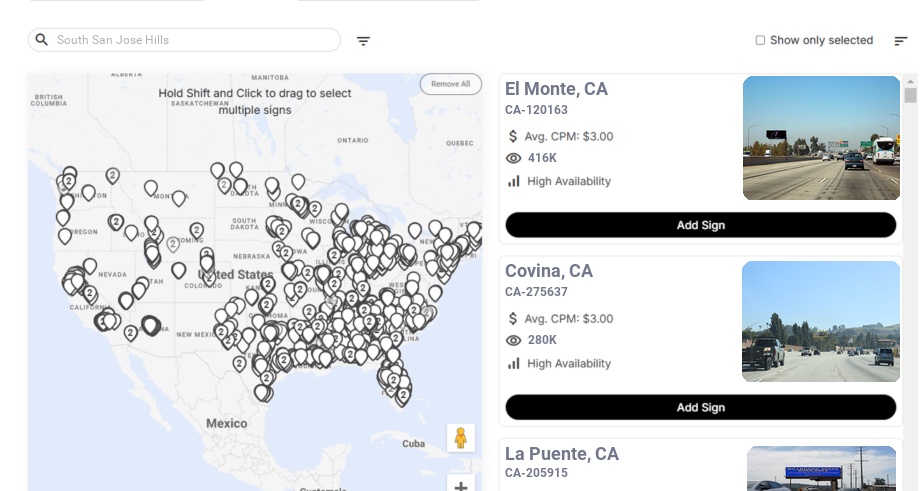



How much is a billboard near South San Jose Hills?
Why Choose Blip for Billboard Advertising near South San Jose Hills
Blip lets South San Jose Hills advertisers launch fast on SR-60, I-10, and I-605 commuter corridors with self-serve control.
In South San Jose Hills, set flexible budgets for daily drivers heading to City of Industry, La Puente, and Baldwin Park—no contracts needed.
Daypart your South San Jose Hills Blip campaign for 5:30-9:30 a.m. and 3:30-7:30 p.m. to catch peak commute traffic.
Track South San Jose Hills performance in real time and shift spend as traffic moves on Azusa Ave, Hacienda Blvd, and Valley Blvd.
Use Blip's creative tools to make bilingual ads for South San Jose Hills families and workers who speak Spanish at home.
Frequently Asked Questions About Billboard Advertising near South San Jose Hills
How much does a billboard cost near South San Jose Hills, California with Blip?
With Blip, you choose a daily budget that works for you, and our system automatically serves your digital ad in the South San Jose Hills area without going over that amount. Each “blip” is a brief 7.5 to 10-second display, and you only pay for the blips you receive, making South San Jose Hills billboards accessible even on a tight budget. The price of individual blips on billboards near South San Jose Hills, California varies based on the time of day, location, and advertiser demand, so your total spend is simply the sum of all your blips.
Where can I advertise with Blip near South San Jose Hills, California?
Blip lets you tap into 23 digital billboards near South San Jose Hills, California, serving the South San Jose Hills area with flexible budgets, real-time data, and totally fun campaign control. Our 23 digital billboards serving the South San Jose Hills area are strategically placed in neighboring cities, very close to daily travel routes. Key nearby corridors include SR-60 through City of Industry and La Puente, I-10 through Baldwin Park, Covina, and El Monte, and I-605 near Irwindale and El Monte.
Why is South San Jose Hills, California a strong billboard market for Blip?
The South San Jose Hills area is compact but densely populated. The community itself has roughly 19,000–20,000 residents packed into less than 3 square miles, translating to more than 6,000 people per square mile. Combined, these nearby cities create a reach of well over 350,000 local residents within about 8–10 miles, before we even consider through-commuters and visitors using the freeways.
When is the best time to run billboards in South San Jose Hills, California?
Los Angeles County has some of the longest commutes in the country, with average commute times around 30–32 minutes each way and many SGV commuters experiencing 45–60 minutes of door-to-door travel. Morning from 5:30–9:30 a.m. is ideal for reaching workers heading west toward City of Industry, downtown LA, or east toward the Inland Empire. Evening from 3:30–7:30 p.m. is perfect for capturing people heading home to the South San Jose Hills area and nearby neighborhoods.
What kind of audience can I reach with South San Jose Hills billboards?
The South San Jose Hills area and nearby La Puente and Baldwin Park are overwhelmingly Hispanic/Latino, and Spanish is widely spoken at home. The area also skews younger than the U.S. average, with median ages in nearby cities around 30–33 years and household sizes commonly averaging 4.0–4.5 people. Many households are dual-income, with a high share of workers in construction, transportation, warehousing, retail, hospitality, healthcare support, and public sector roles.
Do I need a contract to advertise with Blip near South San Jose Hills?
No, Blip has no long-term contracts or minimum commitments. You can start, pause, or stop your campaign at any time.
How fast can I launch a billboard campaign with Blip near South San Jose Hills?
You can have your campaign live in minutes. Create a free account, select your locations, set your budget, upload your design, and start running once approved.
Where can I advertise with Blip near South San Jose Hills?
Blip has digital billboards near South San Jose Hills. You can browse available locations on a map, choose the ones that fit your audience, and start advertising right away.
Still have questions? Launch a campaign in minutes — no contracts, no commitments.
Start Your CampaignSouth San Jose Hills Billboard Advertising Guide
The South San Jose Hills area sits in the heart of the east San Gabriel Valley, surrounded by busy commuter corridors, dense neighborhoods, and major employment centers in La Puente, City of Industry Baldwin Park Irwindale El Monte

Why the South San Jose Hills Area Is a High-Value OOH Market
The South San Jose Hills area is compact but densely populated. The community itself has roughly 19,000–20,000 residents packed into less than 3 square miles, translating to more than 6,000 people per square mile—more than 5 times the U.S. average density of around 1,200 people per square mile and well above the overall Los Angeles County
Surrounding cities add significant scale (rounded recent estimates):
- La Puente: about 39,000–40,000 residents in just 3.5 square miles (over 11,000 people per square mile)
- City of Industry
- Covina
- Baldwin Park
- El Monte
- West Covina Irwindale
Combined, these nearby cities create a reach of well over 350,000 local residents within about 8–10 miles, before we even consider through‑commuters and visitors using the freeways. When you layer in the millions of annual visitors moving across Greater Los Angeles for work, tourism, and events highlighted by groups like Discover Los Angeles, the extended audience pool for billboard advertising near South San Jose Hills grows substantially.
The area’s economic footprint is particularly influenced by the City of Industry
- Roughly 67,000–70,000 jobs supported in a city with fewer than 500 residents
- More than 2,500 businesses, many in logistics, warehousing, food distribution, and light manufacturing
- A daytime population that can be more than 200 times the number of people who actually live there
Many workers come from surrounding neighborhoods, including the South San Jose Hills area, La Puente, Baldwin Park, Covina, West Covina, and El Monte—exactly the audiences our digital billboards can reach on their daily drive.
The broader San Gabriel Valley, represented regionally by organizations like the San Gabriel Valley Council of Governments, houses well over 2 million residents and is one of Southern California’s most active retail and logistics hubs:
- Over 30 distinct cities and communities
- Household incomes that range widely—from working‑class neighborhoods in La Puente and Baldwin Park to more affluent pockets in cities like San Marino and Pasadena
- Proximity to downtown Los Angeles (about 20–25 miles from South San Jose Hills) and Inland Empire warehousing, which keeps truck and commuter traffic consistently strong
For billboard advertisers, this adds up to:
- High population density and multiple overlapping commute patterns across SR‑60, I‑10, and I‑605
- A strong blue‑collar and service‑sector workforce along with large numbers of middle‑income families
- A year‑round outdoor lifestyle and driving culture—Los Angeles County typically records more than 280–290 sunny days per year—supporting consistent billboard exposure and making billboard rental near South San Jose Hills a reliable way to maintain constant visibility.
Audience & Demographics: Who You Reach Near South San Jose Hills
Understanding who lives and works in the South San Jose Hills area informs messaging, language, and visuals. Local city profiles and school district data from entities like the Rowland Unified School District and Baldwin Park Unified reinforce a clear demographic picture.
Ethnicity & language
The South San Jose Hills area and nearby La Puente and Baldwin Park are overwhelmingly Hispanic/Latino. In most of these cities, 70–85% of residents identify as Hispanic or Latino, and Spanish is widely spoken at home. For example:
- La Puente reports close to 80–85% Hispanic/Latino residents, with many households speaking Spanish as the primary language
- Baldwin Park
- El Monte
In several nearby ZIP codes, more than 60–70% of households speak a language other than English at home, and in many cases Spanish is spoken in over half of all homes. This has clear implications:
- Bilingual or Spanish‑forward creative can significantly improve resonance.
- Simple Spanish taglines (“Ahorra hoy”, “Abierto hasta tarde”, “Financiamiento fácil”) or bilingual call‑to‑actions can attract attention from families and workers.
- Using culturally familiar imagery—families, food, community gatherings, local sports, and church events—tends to perform better than generic stock visuals.
Age & household structure
The area skews younger than the U.S. average and much of California:
- Median age in nearby La Puente and Baldwin Park is roughly 30–33 years, compared with about 37–38 years nationally
- El Monte’s median age is in the low 30s, with a large share of residents under 18
- Household sizes commonly average 4.0–4.5 people, compared with about 2.6–2.7 nationally, and multi‑generational living is common
What this means for campaigns:
- Family‑oriented offers (groceries, casual dining, kids’ activities, healthcare, and education) have outsized relevance.
- Young parents and working adults (25–44) represent a large share of drivers—often more than 30–35% of the population—ideal for service businesses, banking, automotive, and quick‑serve restaurants using South San Jose Hills billboards to stay top of mind.
- Youth‑focused messaging (after‑school programs, sports, tutoring) lines up with the strong K‑12 footprint across local districts and nearby colleges like Mt. San Antonio College and Rio Hondo College
Income & spending
Median household incomes in the immediate area are generally in the $60,000–$80,000 range, slightly below the Los Angeles County median (around $83,000 as of 2022) but with significant variability:
- La Puente median household income: roughly $70,000–$75,000
- Baldwin Park: around $70,000–78,000
- El Monte: typically in the low‑ to mid‑$60,000s
- Some neighborhoods in West Covina and Covina reach median incomes above $90,000
Many households are dual‑income, with a high share of workers in construction, transportation, warehousing, retail, hospitality, healthcare support, and public sector roles. Spending patterns tend to prioritize:
- Groceries and discount retail—clubs, ethnic supermarkets, dollar and off‑price stores
- Auto maintenance, gas, and insurance, since a majority of workers commute by car
- Fast food and affordable dining—Los Angeles County residents spend thousands of dollars per year on food away from home, and high‑traffic corridors in La Puente and Baldwin Park see a heavy mix of QSR options
- Telecom, streaming, and personal services (beauty, barbershops, fitness, financial services)
Billboard messaging that highlights savings, value, financing options, and “nearby and convenient” language typically resonates strongly with this value‑conscious but steadily employed audience and is a strong fit for billboard advertising near South San Jose Hills.
Key Corridors & Where Our 23 Digital Billboards Shine
Our 23 digital billboards serving the South San Jose Hills area are strategically placed in neighboring cities, very close to daily travel routes. Regional traffic data from Caltrans and local planning agencies show that Los Angeles County freeways rank among the nation’s busiest, and the east San Gabriel Valley is no exception. This means billboards near South San Jose Hills are exposed to both local drivers and long‑haul traffic all day long.
Key nearby corridors include:
-
SR‑60 (Pomona Freeway) through City of Industry and La Puente
- Carries heavy east‑west commuter and freight traffic between downtown Los Angeles, the San Gabriel Valley, and the Inland Empire.
- Some segments near Industry carry on the order of 240,000–260,000 vehicles per day according to Caltrans.
- Trucks can represent 8–12% of daily traffic on some stretches, providing added exposure for B2B and logistics‑oriented messages.
- Ideal for reaching commuters moving between the South San Jose Hills area, downtown LA, and Inland Empire job centers.
-
I‑10 (San Bernardino Freeway) through Baldwin Park, Covina, and El Monte
- One of Southern California’s main arteries, with many segments above 250,000 vehicles per day in the San Gabriel Valley; combined annual traffic reaches into the tens of millions of vehicle trips.
- Supports both long‑distance commuters and local trips between SGV cities.
- Heavy use by commuters and transit riders—nearby Foothill Transit LA Metro
-
I‑605 (San Gabriel River Freeway) near Irwindale and El Monte
- A key north‑south connector linking SR‑60, I‑10, and I‑210.
- Several segments handle over 200,000 vehicles per day when you include both directions.
- Strong for regional campaigns serving multiple SGV communities at once.
-
Major surface streets with heavy local traffic:
- Azusa Avenue, Hacienda Boulevard, Amar Road, and Valley Boulevard in and near La Puente and the South San Jose Hills area
- Ramona Boulevard, Garvey Avenue, Peck Road, and Valley Boulevard in El Monte and Baldwin Park
- Many of these arterials carry 20,000–40,000 vehicles per day, with high signal density that keeps speeds lower and dwell time on signs higher—ideal for “shop this exit” or “5 minutes away” messaging and for promoting local businesses like markets, auto shops, and clinics.
The nearby cities housing our boards—La Puente, Covina Baldwin Park Irwindale El Monte
- Many Industry and Irwindale warehouse workers live in La Puente, Baldwin Park, and El Monte
- Students commute to nearby campuses like Mt. San Antonio College, Cal Poly Pomona, and Rio Hondo College
- Shoppers travel to major retail centers in West Covina, Industry, and Covina
That means a single digital billboard can repeatedly touch the same households at different times of day and on different routes, making billboard rental near South San Jose Hills highly efficient when boards are chosen along these shared corridors.
With Blip, we can choose exactly which of these 23 boards to use, building a footprint that mirrors where South San Jose Hills‑area residents actually drive, rather than just where they live.
Timing Your Campaign: When to Run Your Blips
Los Angeles County has some of the longest commutes in the country. Recent transportation surveys show average commute times around 30–32 minutes each way, with many SGV commuters experiencing 45–60 minutes of door‑to‑door travel, particularly along SR‑60 and I‑10. For South San Jose Hills‑area drivers, congestion and frequent incidents mean long windows of prime billboard exposure.
Here’s how we recommend scheduling:
Weekday commute focus
-
Morning (5:30–9:30 a.m.)
- Reach workers heading west toward City of Industry, downtown LA, or other centers, and east toward the Inland Empire.
- Local data from LA Metro Foothill Transit
- Ideal for coffee shops, QSR, transit‑adjacent retail, and services that benefit from top‑of‑mind awareness during the day (insurance, dental, automotive, B2B services).
-
Evening (3:30–7:30 p.m.)
- Capture people heading home to the South San Jose Hills area and nearby neighborhoods. In many corridors, PM peak volumes equal or exceed morning peaks.
- Perfect for restaurants, grocery stores, retailers, family entertainment, and healthcare/urgent care.
- Many local grocery and discount retailers report their heaviest in‑store traffic between 4–8 p.m., aligning well with this daypart.
Midday patterns
- 10 a.m.–3 p.m. sees strong local circulation: stay‑at‑home parents, seniors, service workers on split shifts, and delivery routes.
-
This is a great daypart for:
- Retailers promoting same‑day visits or weekday specials
- Medical and dental offices promoting walk‑ins or next‑day appointments
- Education and training centers targeting flexible schedules, including adult schools and ESL programs run by local districts and community colleges
Evenings & late night
- Many local restaurants and services stay open late, especially along major corridors like Valley Boulevard, Amar Road, and Garvey Avenue.
- Running Blips from 8 p.m.–midnight can be cost‑efficient, often with less competition for slots and more frequency at a lower budget.
- Good for nightlife, streaming/entertainment apps, food delivery, and convenience retail such as gas stations, late‑night eateries, and 24‑hour pharmacies.
With Blip, we can:
- Concentrate budget on rush hours to maximize impact per impression
- Shift to off‑peak hours for higher frequency when inventory is less competitive
- Run weekend‑only or day‑specific campaigns (e.g., “Friday payday specials” or Sunday church promotions), timed to local pay cycles and religious service schedules that often cluster on Friday evenings, Saturday afternoons, and Sunday mornings
Crafting Effective Creative for the South San Jose Hills Area
Given traffic speeds on freeways and busy arterials, drivers only have about 6–8 seconds to absorb your message; research on OOH recall shows that legibility beyond 500–600 feet drops sharply when boards are cluttered. In the South San Jose Hills area, clear, bilingual, and community‑oriented creative has a strong edge.
Language & copy
- Consider Spanish‑only or bilingual English/Spanish creative, especially for boards nearest La Puente, Baldwin Park, and El Monte, where Spanish usage at home can exceed 50–60% of households.
-
Use short, punchy phrases: 7 words or fewer whenever possible.
- Example: “Seguros de auto desde $29/mes”
- Example: “Family dental – citas hoy – 2 salidas adelante”
- Highlight immediate benefits and proximity: “A 5 minutos,” “Salida Azusa Ave,” “En La Puente”.
- For value‑focused audiences, call out price or savings—“Ahorra 30% hoy”, “Sin depósito”, “Primera consulta gratis”.
Visuals
- Use large, high‑contrast text and one main image. Industry benchmarks often recommend a minimum text height that translates to 18–24 inches on physical boards; in practical terms, that means big, bold type on your artwork.
- Feature people who reflect the local community: diverse Hispanic families, young professionals, and workers in uniforms/common trades (construction, logistics, hospitality, healthcare).
- Use strong color contrast—dark text on bright background or vice versa—to cut through visual clutter on SR‑60 and I‑10.
- Avoid more than 2–3 visual elements; boards overloaded with content can reduce recall by 30–40% compared with simplified designs.
Calls to action
-
Phone numbers are harder to remember at full freeway speed; focus on:
- Short URLs or memorable domains
- Brand names (5–10 characters is ideal)
- Exit or street names (“Next exit Hacienda Blvd”)
- For local businesses, combine brand + location: “El Monte” or “La Puente” clearly visible, as place‑based cues help with wayfinding and recall.
Multiple creatives
Blip allows you to rotate several pieces of artwork:
- Test one creative Spanish‑dominant and another English‑dominant; in many SGV campaigns, Spanish‑first messaging has been observed to deliver higher engagement among local audiences.
- Run different visuals by time of day: breakfast vs. dinner promotions, daytime vs. late‑night services.
- Highlight limited‑time offers weekly without re‑printing costs; digital boards can be updated in hours instead of the days or weeks needed for traditional static vinyl.
Strategy Playbooks by Business Type
Local Retail & Grocery
The South San Jose Hills area and nearby cities have high household sizes and price‑sensitive shoppers. In many SGV neighborhoods, 40–50% of households spend a large share of their income on housing, leaving them especially responsive to discounts and promotions.
Tactics:
- Promote weekly deals: “This week only – pollo, tortillas, frutas en oferta”.
- Emphasize proximity: “2 minutes from this sign on Azusa Ave”.
- Use rush‑hour dayparts to catch shoppers heading home after work.
- Align creative with peak shopping days—local grocers report strong traffic spikes on Fridays, weekends, and around major holidays.
Boards near La Puente and El Monte are powerful for directing traffic to neighborhood markets, discount stores, and ethnic grocers. Highlight cross‑streets or nearby landmarks like local parks or schools (for example, parks listed by Los Angeles County Parks & Recreation
Restaurants & Quick‑Serve
With dense housing and many commuters returning late, dining out and takeout are frequent. National and local data indicate that households in the Los Angeles area can spend 45–50% of their food budget on food away from home.
Tactics:
- Run breakfast ads 5–9 a.m., lunch deals late morning–early afternoon, and dinner/promotions 4–9 p.m.
- Feature high‑impact food imagery and a simple price point (“$1.99 tacos”, “Kids eat free Tues”).
- For chains, reference nearest cross‑street or exit to reduce friction.
- Emphasize speed (“Listo en 5 minutos”), value, and convenience, which are top decision drivers for QSR in commuter markets.
Healthcare, Dental, and Vision Clinics
Access to affordable healthcare is a key concern in many working‑class SGV communities. Local hospital systems such as Emanate Health Queen of the Valley Hospital
Tactics:
- Highlight walk‑ins, same‑day appointments, and extended hours (“Abierto hasta las 9 p.m.”).
- Use reassuring, family‑oriented imagery and Spanish‑friendly wording.
- Promote key benefits such as “Most insurance accepted”, “Medi‑Cal welcome”, or “Sin seguro? Pregunta por nuestros planes de pago”.
- Focus on boards near residential corridors feeding into the South San Jose Hills area and La Puente to reach families on their way to and from home.
Auto Sales, Service, and Insurance
Car ownership is high due to limited transit for many trips. In Los Angeles County, roughly 85–90% of workers commute by car, truck, or van, and in many SGV communities average vehicle ownership hovers around 2 cars per household. Long commute times increase wear on vehicles and make cost‑of‑ownership messaging especially powerful.
Tactics:
- Promote low‑down‑payment or “no credit OK” financing, addressing the many households with thin or imperfect credit histories.
- For service, push oil change, tires, and brakes with clear price points (“Oil change $39.99”, “4 llantas desde $299”).
- For insurance, emphasize monthly cost and bilingual support—“Agentes que hablan español”, “Desde $25/mes”.
- Include directional cues from key exits like Azusa Ave., Hacienda Blvd., or Francisquito Ave.
Boards along SR‑60 and I‑10 near Industry, Covina, and Baldwin Park are ideal for these messages, especially during commute peaks and payday weekends, when billboard advertising near South San Jose Hills is most likely to capture shoppers with fresh paychecks.
Education, Training, and Adult Schools
Nearby community colleges, trade schools, and language programs draw heavily from South San Jose Hills‑area residents. Institutions like Mt. San Antonio College, Rio Hondo College
Tactics:
- Advertise job‑linked outcomes: “Become a medical assistant in 9 months” or “CDL training – jobs waiting”.
- Schedule heavier rotations during enrollment seasons (late summer, early January, and mid‑spring).
- Use aspirational but grounded visuals—students, graduations, work uniforms, and local employers widely recognized in the area (warehousing, healthcare, trades).
- Highlight flexible schedules (evening/weekend classes) and financial aid; a high share of local students qualify for need‑based grants.
Events, Churches, and Community Organizations
The area has a strong community and faith‑based culture, boosted by local coverage from outlets like the San Gabriel Valley Tribune and community calendars maintained by cities such as La Puente and Covina
Tactics:
- Promote dates, locations, and a short benefit (“Free backpacks”, “Family festival”, “English/Spanish services”).
- Increase frequency 1–2 weeks before major events; event reminders in the last 3–5 days can provide a noticeable lift in attendance.
- Focus on weekend and evening rotations when families are off work and school.
- Use highly local references—park names, school names, or street intersections—so residents can instantly recognize the venue.
Using Blip Tools to Precisely Target the South San Jose Hills Area
Because our 23 digital billboards are distributed across nearby cities, we can build a footprint tuned to where South San Jose Hills‑area residents actually travel. Local planning documents from cities like Baldwin Park El Monte
Board selection
- Prioritize La Puente and City of Industry boards to reach residents moving between home, work, and shopping, especially along SR‑60 and key arterials like Hacienda Blvd. and Azusa Ave.
- Add Baldwin Park and Covina boards to catch east–west drivers using I‑10 and SR‑60 as alternates.
- Layer in Irwindale and El Monte for broader regional campaigns or when your customer base is spread across the SGV, including workers traveling to industrial areas north of I‑10 and east toward the Inland Empire.
- For hyperlocal businesses (for example, a single‑location restaurant or clinic), concentrate on 3–6 boards within a 5–7 mile radius to maximize frequency.
This level of control lets you design a South San Jose Hills billboards strategy that closely matches your real‑world trade area, instead of wasting impressions far outside where your customers live and work.
Dayparting & budget control
With Blip, you buy space one “blip” at a time and can:
- Set a daily budget (for example, $10–$50/day to start) and let Blip automatically allocate impressions across your chosen boards and times. Even at $10/day, you can secure dozens to hundreds of daily plays depending on competition and location.
- Increase bids or budgets during key sales periods—payday weekends (typically the 1st and 15th or last Friday of the month), back‑to‑school, holidays—and scale back in slower weeks.
- Reserve only the hours that matter most for your audience, instead of paying for 24/7 play, improving effective CPM by focusing on high‑value impressions.
A/B testing
Run two or more creatives simultaneously:
- Test English vs. bilingual headlines in heavily Hispanic corridors; many advertisers see double‑digit improvements in response when adding Spanish components in areas like La Puente and Baldwin Park.
- Compare price‑led vs. brand‑led messages.
- Try different value propositions (“Low payments” vs. “No credit check”, “Walk‑ins welcome” vs. “Same‑day appointments”) and shift spend to the better performer based on your downstream metrics (calls, form fills, store visits, or coupon redemptions).
- Rotate seasonal or event‑based creative—such as local festivals listed on city and tourism calendars from La Puente, Covina Discover Los Angeles.
Measuring & Optimizing Your Campaign
Billboards near the South San Jose Hills area are most powerful when connected with your digital and in‑store data. Advertisers who measure carefully often see significant gains—industry case studies suggest that combining OOH with digital can increase reach by 30–40% and boost search activity for the advertised brand.
We recommend:
- Unique URLs or QR codes on creative to route users to a dedicated landing page. Track visits, bounce rate, and conversions tied specifically to your OOH creative.
- Promo codes tailored by board cluster (“LP60” for La Puente/SR‑60 boards, “I10BP” for Baldwin Park/I‑10 boards) to gauge which locations drive more response.
- Time‑boxed offers (“This weekend only”, “Ends Sunday”) aligned with your chosen Blip schedule so you can compare sales data within the same window.
- Checking for traffic lifts in Google Analytics or your customer relationship management tools during periods when your Blips are most active—look for increases in direct traffic, branded search, and call volume.
- Comparing in‑store sales and foot‑traffic trends (including data from tools like point‑of‑sale reports or Wi‑Fi check‑ins) before, during, and after campaigns.
Over several weeks, patterns emerge:
- Which board clusters near the South San Jose Hills area deliver the strongest results
- Which languages and offers perform best for your specific customer base
- Which dayparts bring the most high‑value customers—for example, higher average order values in early evening vs. late night
From there, we can re‑allocate spend toward your highest‑impact boards and times, tightening your cost per result while increasing total reach across a densely populated, highly mobile market. This type of measured approach ensures your billboard advertising near South San Jose Hills keeps improving over time rather than remaining static.
By combining the dense, bilingual, family‑oriented population of the South San Jose Hills area with flexible, data‑driven digital billboards in La Puente, City of Industry Baldwin Park Irwindale El Monte San Gabriel Valley Council of Governments, and media outlets such as the San Gabriel Valley Tribune—advertisers of any size can use Blip for billboard rental near South San Jose Hills to turn the area’s heavy traffic and tightly knit communities into consistent, measurable growth.