Billboards in Castro Valley, CA
No Minimum Spend. No Long-Term Contracts. Just Results.
Trusted by Leading Brands


Billboard advertising
in Castro Valley has never been easier
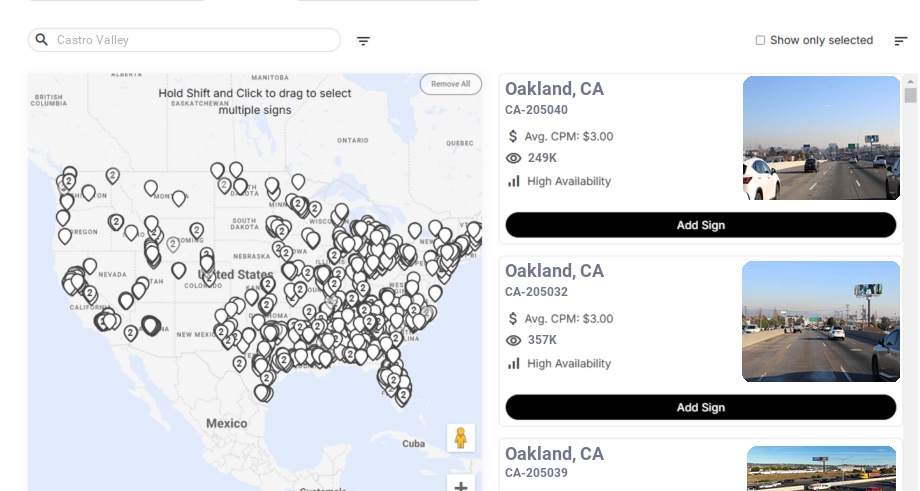



How much is a billboard in Castro Valley?
Why Choose Blip for Billboard Advertising in Castro Valley
Blip lets you launch Castro Valley ads fast and target I-580/I-880 commuters without long setup delays.
Use Castro Valley's weekday rush hours to daypart Blip campaigns for westbound mornings and eastbound evenings.
No contracts means Castro Valley businesses can test local screens near Hayward, San Lorenzo, and Dublin with flexible budgets.
Track Castro Valley billboard performance in real time and shift spend toward the corridors driving more calls and visits.
Blip's creative tools help Castro Valley brands build sharp, freeway-ready ads for family shoppers, commuters, and Lake Chabot weekend traffic.
Frequently Asked Questions About Billboard Advertising in Castro Valley
How much does a billboard cost near Castro Valley, California with Blip?
With Blip, you control exactly how much you spend on Castro Valley billboards by setting a daily budget that fits your business, and the platform automatically keeps your campaign within that amount. Each ad is a brief “blip” on rotating digital billboards near Castro Valley, California, and you only pay for the individual blips you receive. Because pricing is based on when and where your ads run and on advertiser demand, you can start with a modest budget and scale up only when you’re ready.
Where can I advertise with Blip near Castro Valley, California?
There are 15 digital billboards serving the Castro Valley area from three nearby cities, all within about 10 miles: San Lorenzo, Hayward, and Dublin. These locations align with the main travel patterns of Castro Valley residents and tap into some of the busiest traffic segments in Alameda County. Together, they form a network of billboards near Castro Valley that keeps your message in front of drivers as they move between home, work, and regional destinations.
What kind of traffic do Castro Valley, California billboards reach near Blip locations?
I-580 is the primary east–west spine near Castro Valley, connecting Oakland and the central Bay Area to Dublin, Pleasanton, and the Central Valley, and recent Caltrans traffic counts show segments routinely carrying 180,000–210,000 vehicles per day on average. Billboards in San Lorenzo and Hayward near I-880 also capture heavy commuter and shopping traffic, with daily volumes often in the 170,000–200,000 vehicles per day range. Dublin billboards reach travelers near the I-580/I-680 interchange, one of the most heavily used junctions in the East Bay.
When is the best time to run Blip ads near Castro Valley, California?
Castro Valley is a classic commuter community, so strong weekday peaks happen during the morning commute from 6:30–9:30 a.m. and the evening commute from 4:00–7:30 p.m. Using Blip, campaigns can concentrate impressions during these windows to reach commuters at scale, then dial back during mid-day if your budget is limited. Weekends are also useful for shopping, dining, sports, and family activities across the East Bay and Tri-Valley.
Who is the Castro Valley, California audience for Blip billboard ads?
Castro Valley has roughly 66,000–67,000 residents, strong household purchasing power, and median household income typically reported between $135,000 and $145,000. Around 50–55% of residents age 25+ hold a bachelor’s degree or higher, and over 60% of households are family households. That makes the area a strong fit for premium services, healthcare, education, home services, and family-focused campaigns.
Do I need a contract to advertise with Blip in Castro Valley?
No, Blip has no long-term contracts or minimum commitments. You can start, pause, or stop your campaign at any time.
How fast can I launch a billboard campaign with Blip in Castro Valley?
You can have your campaign live in minutes. Create a free account, select your locations, set your budget, upload your design, and start running once approved.
Where can I advertise with Blip in Castro Valley?
Blip has digital billboards in Castro Valley. You can browse available locations on a map, choose the ones that fit your audience, and start advertising right away.
Still have questions? Launch a campaign in minutes — no contracts, no commitments.
Start Your CampaignCastro Valley Billboard Advertising Guide
Castro Valley sits at a powerful crossroads in the East Bay, surrounded by high-traffic freeways, regional job centers, and affluent residential neighborhoods. With 15 digital billboards serving the Castro Valley area from nearby San Lorenzo, City of Hayward, and City of Dublin, we can use Blip to reach daily commuters, families, and local shoppers with hyper-targeted, flexible campaigns that match how people actually move through the region. These billboards near Castro Valley give local businesses and regional brands a way to stay visible across the most heavily traveled corridors that residents use every day.
Understanding the Castro Valley Area Market
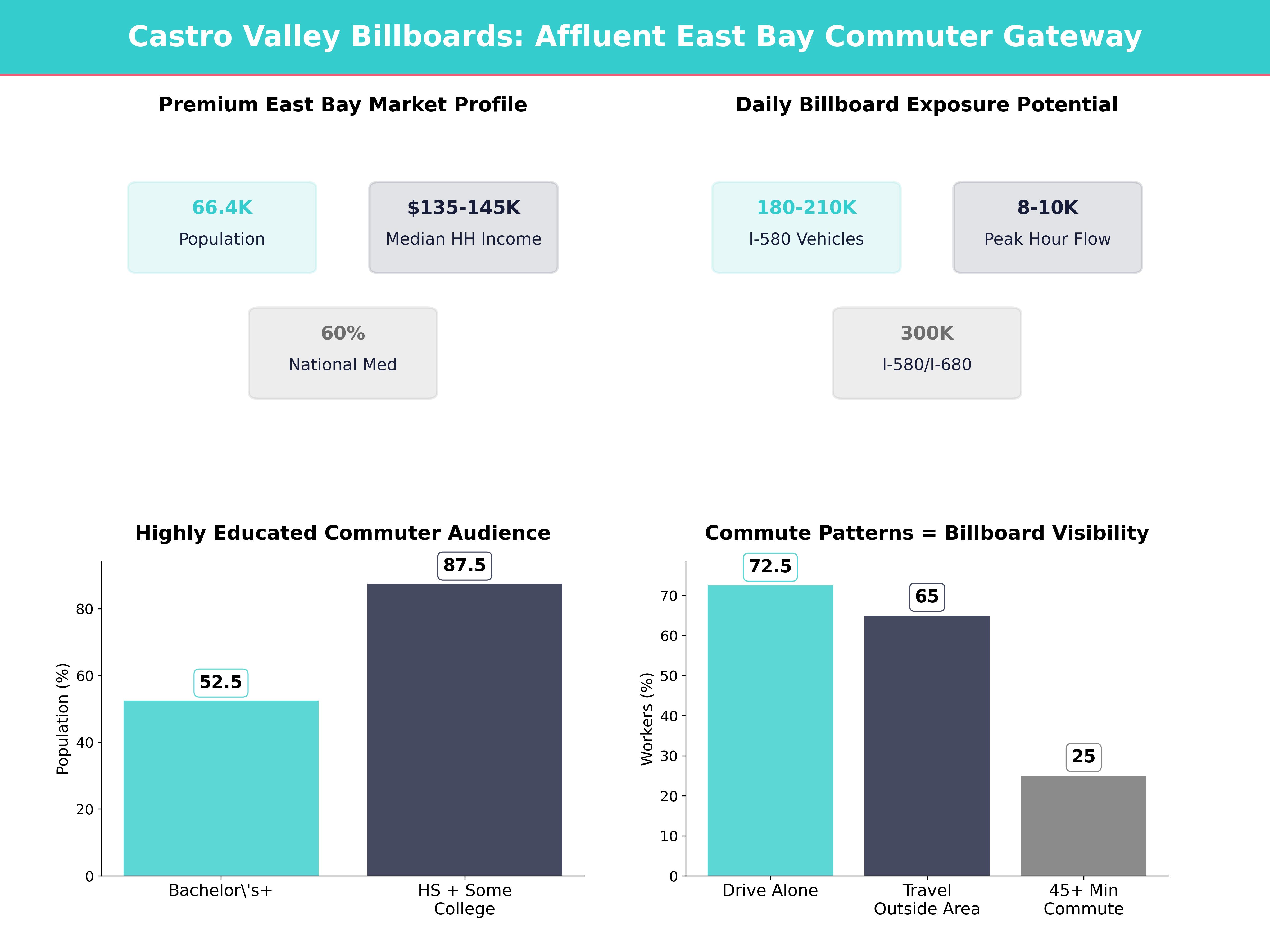
Castro Valley is an unincorporated community in Alameda County with roughly 66,000 residents and strong household purchasing power. Recent community profiles and regional planning data show:
- Population in the Castro Valley area: about 66,000–67,000 residents (mid‑2020s estimates place it around 66,400).
- Median household income: typically reported between $135,000 and $145,000, placing Castro Valley roughly 35–45% above the California median and more than 60% above the national median.
- Educational attainment: around 50–55% of residents age 25+ hold a bachelor’s degree or higher, and roughly 85–90% have at least a high school diploma plus some college or an associate degree.
- Housing and families: owner-occupancy rates tend to be in the 70–75% range, and over 60% of households are family households, indicating a stable, family-oriented, and relatively affluent base.
- Age structure: many profiles show a strong presence of adults in the 35–54 age band (prime earning years) and children under 18, which supports youth- and family-focused services.
Across Alameda County, total taxable sales regularly exceed $40 billion per year, and communities like Castro Valley, Hayward, City of San Leandro, and Dublin make up a significant share of that consumer and business spending, according to county and city economic reports. The nearby Alameda County government and Alameda County Transportation Commission frequently highlight the I‑580/I‑880 corridor as one of the most economically important in the region, which is why Castro Valley billboards placed along these routes can efficiently reach high-value consumers.
Castro Valley’s unincorporated status means many residents rely on neighboring cities—especially Hayward, San Leandro, City of Oakland, and City of Pleasanton/City of Dublin—for jobs, shopping, healthcare, and entertainment. In many commuter surveys, 60–70% of workers in similar East Bay suburbs travel to jobs outside their home community. Key implications for advertisers:
- Residents regularly travel beyond Castro Valley for work and services, making nearby billboards especially effective.
- Higher incomes and education levels support premium services (healthcare, financial, home improvement, specialty retail, B2B).
- Family-oriented demographics support campaigns for schools, activities, food, and local attractions.
For local background and planning context, it’s useful to review resources from Alameda County, the Castro Valley/Eden Area Chamber of Commerce Castro Valley Municipal Advisory Council East Bay Times and the local Castro Valley Forum.
Where Our Billboards Reach People Near Castro Valley
We have 15 digital billboards serving the Castro Valley area from three nearby cities, all within about 10 miles:
- San Lorenzo (about 3.8 miles away)
- Hayward (about 6.7 miles away)
- Dublin (about 8.7 miles away)
These locations align with the main travel patterns of Castro Valley residents and tap into some of the busiest traffic segments in Alameda County, as documented by agencies like Caltrans District 4 and the Metropolitan Transportation Commission. Together, they form a network of billboards near Castro Valley that keeps your message in front of drivers as they move between home, work, and regional destinations.
Freeways and Major Corridors
-
I-580 (MacArthur Freeway)
I-580 is the primary east–west spine near Castro Valley, connecting Oakland and the central Bay Area to Dublin, Pleasanton, and the Central Valley. Recent Caltrans traffic counts show segments of I‑580 in the Castro Valley–Hayward–Dublin stretch routinely carrying 180,000–210,000 vehicles per day on average, with weekday peaks even higher.- Morning: heavy westbound traffic toward Oakland/San Francisco; some segments see 8,000–10,000 vehicles per hour during peak commute windows.
- Evening: heavy eastbound traffic toward Dublin/Pleasanton and beyond, capturing both East Bay commuters and long-distance Central Valley traffic.
-
I-238 / I-880 Corridor (San Lorenzo & Hayward)
I-238 links Castro Valley to I-880, a major north–south route through the East Bay. Caltrans data often cites daily traffic volumes on I‑880 in the San Leandro–Hayward corridor in the 170,000–200,000 vehicles per day range. Billboards in San Lorenzo and Hayward near I-880 capture:- Castro Valley residents heading to jobs in Oakland, San Leandro, and City of Fremont hundreds of thousands of jobs across logistics, healthcare, technology, and education.
- Shoppers and diners moving between Castro Valley, Hayward, and San Leandro, where individual shopping centers and auto rows can each attract tens of thousands of weekly visits.
-
Dublin/Pleasanton Area (Dublin billboards)
Dublin anchors the I-580/I-680 interchange and the Tri-Valley region. The City of Dublin and Visit Tri-Valley highlight this area as a key regional destination. For Castro Valley residents, Dublin and Pleasanton are important for:- Shopping and dining at centers like Hacienda Crossings, which can draw thousands of visitors per day on busy weekends.
- Commuter transfers via the Dublin/Pleasanton BART station, which has historically seen 5,000–7,000 average weekday entries and exits.
- Professional services and medical appointments at larger office and medical campuses that serve the broader Tri‑Valley and East Bay.
Because our signs sit along these high-volume corridors, they are ideal for both:
- Outbound messaging (promoting destinations within Castro Valley, such as local businesses, schools, and events to residents leaving the area), and
- Inbound messaging (attracting visitors from Hayward, San Lorenzo, Dublin, and the broader East Bay to services and events in the Castro Valley area).
For transportation context, check regional transit details with BART (Castro Valley and nearby stations) and AC Transit for bus routes intersecting these corridors. The BART system as a whole carries over 100 million riders per year in typical pre‑pandemic years, and AC Transit has historically delivered tens of millions of annual bus trips, ensuring that many drivers and riders see corridor-based billboard messaging repeatedly. This combination of freeway and transit exposure means Castro Valley billboards can reinforce your brand with the same audiences across multiple trips each week.
How People Move in the Castro Valley Area (and When to Advertise)
Understanding when and where your audience is on the road helps us schedule Blip campaigns with precision and make billboard advertising near Castro Valley as efficient as possible.
Commute Patterns
Castro Valley is a classic commuter community, with a large majority of workers driving or carpooling to jobs elsewhere in the region:
- In similar Alameda County suburbs, 70–75% of workers commute by driving alone, 8–12% carpool, and 10–15% use public transit (primarily BART and AC Transit), according to regional transportation surveys by Alameda CTC and MTC. Castro Valley follows a similar pattern.
- Typical one-way commute times for East Bay suburban workers often fall in the 30–40 minute range, with 20–30% of commuters experiencing travel times of 45 minutes or more, which lengthens exposure windows for freeway billboards.
Typical drive times to larger job centers (outside heavy-incident days) are:
- Castro Valley to downtown Oakland: ~20–30 minutes in light traffic, often 35–45 minutes or more during peak hours.
- Castro Valley to Dublin: ~15–25 minutes, depending on I‑580 congestion.
- Castro Valley to Hayward: ~10–20 minutes, with shorter but more variable trips via local arterials.
This translates into:
-
Strong weekday peaks:
- 6:30–9:30 a.m.: Westbound I-580 (toward Oakland) and the I‑238/I‑880 corridors via San Lorenzo and Hayward can show vehicle flows in the 7,000–10,000 vehicles per hour range.
- 4:00–7:30 p.m.: Eastbound I-580 toward Castro Valley and Dublin, plus I‑880 for return commuters, consistently rank among the East Bay’s heaviest afternoon corridors.
Using Blip, we can concentrate impressions during these windows to reach commuters at scale, then dial back during mid-day if your budget is limited.
Weekend and Leisure Traffic
Weekends look different:
- Residents drive to shopping, sports, parks, and dining across the East Bay and Tri-Valley. Local attractions such as Lake Chabot Regional Park, which sees hundreds of thousands of visits per year according to the East Bay Regional Park District, generate steady weekend traffic through nearby corridors.
- Castro Valley’s proximity to regional attractions, like Lake Chabot and Redwood regional parks, plus nearby retail in Hayward and Dublin, keeps traffic moving across the area throughout the day. Major regional malls and lifestyle centers in the East Bay can log dozens of thousands of weekend visits, and a meaningful share of that traffic passes our billboard locations.
For consumer-facing businesses (restaurants, entertainment, local services), it often makes sense to:
- Increase weekend and early evening budgets.
- Run “last-minute” or “today only” offers to capture impulse decisions, especially when foot-traffic surges align with local event calendars published by outlets like Castro Valley Patch and the City of Hayward.
Tailoring Creative to Castro Valley Area Audiences
Billboard design that reflects local realities in the Castro Valley area will outperform generic messaging and help billboard advertising near Castro Valley stand out among competing messages.
Visual Style & Messaging
-
Prioritize clarity for fast freeway traffic
- Use 6–10 words of main copy maximum; at 55–65 mph, drivers typically have only 5–8 seconds to register your message.
- A single, bold image or icon (e.g., a house for real estate; a tooth for dentistry) helps drivers instantly understand the offer.
- High contrast colors (dark background with light text, or vice versa) are essential on I-580 and I-880, where speeds are high and distractions are numerous.
-
Appeal to high-income, family-oriented households
- Emphasize quality, trust, and expertise (“Board-Certified,” “Award-Winning,” “Locally Trusted Since 1998”).
- Use family-oriented imagery: parents with children, pets, or multi-generational families for healthcare, education, and home services.
- Include “near Castro Valley” or explicit local references like “Serving Castro Valley & the East Bay” to build local relevance and tap into the strong sense of place reported in community surveys by the Castro Valley/Eden Area Chamber of Commerce.
-
Highlight convenience and proximity
Many residents evaluate businesses across multiple cities (Castro Valley, Hayward, San Leandro, Dublin). Travel-time data from mapping and regional planning tools often shows that 60–70% of key destinations for Castro Valley residents are within a 15–20 minute drive.- Use lines like “10 minutes from Castro Valley,” “Exit at Foothill,” or “Next to [known landmark]” to reduce friction.
- For BART-oriented commuters, indicate “Near Castro Valley BART” or “3 minutes from Dublin/Pleasanton BART” where applicable; the Castro Valley BART station alone sees thousands of weekday riders, ensuring strong name recognition.
-
Use strong local anchors
Pivot around widely recognized local names and features:- “Serving Castro Valley, San Lorenzo & Hayward”
- “Proud to serve the East Bay since…”
- References to local schools, neighborhoods, or landmarks in supporting materials (website, landing pages) reinforce credibility and align with community pride reflected in local media like the Castro Valley Forum.
Calls to Action That Work in This Market
Given high smartphone penetration and tech familiarity in high-income Bay Area communities (where smartphone usage typically exceeds 85–90% of adults):
- Use short URLs or memorable domains (e.g., “CastroValleyLaw.com”).
- Integrate easy prompts: “Search ‘Castro Valley Orthodontics’,” “Call Today,” or QR codes on designs targeting slower local traffic.
- For fast freeway units, QR codes should be secondary; make phone, URL, or brand name the main CTA to fit within the 5–8 second reading window.
Using Blip’s Flexibility to Target the Castro Valley Area
Digital billboards with Blip let us buy time in small increments (“blips”) and tightly control when and where ads appear. For the Castro Valley area, that opens several powerful strategies for billboard advertising near Castro Valley without committing to long-term static placements.
1. Daypart Targeting
Align spend with high-value moments:
-
Morning commute focus (6:30–9:30 a.m.)
- Ideal for B2B, healthcare, education, and services that commuters might research later in the day.
- Message examples: “Book Your Checkup Today,” “Enrollment Now Open,” or “Schedule a Consultation Before Friday.”
- This window can represent 30–40% of weekday freeway exposure for white‑collar professionals in similar Bay Area corridors.
-
Evening commute focus (4:00–7:30 p.m.)
- Great for restaurants, retail, fitness, and entertainment.
- Message examples: “Dinner in 15 Minutes,” “Join Us After Work,” “Tonight Only – Happy Hour Specials.”
- Many traffic studies show that evening congestion periods can last 3 hours or more, extending exposure on I‑580 and I‑880.
-
Weekend and mid-day bursts
- Perfect for open houses, local events, and family activities.
- Use limited-time language: “This Weekend Only,” “Saturday 10–2,” “Open House Today.”
- Retail and restaurant visitation data often show 20–30% higher customer counts on weekend days compared to midweek, making time-targeted billboard bursts highly efficient.
2. Location Clustering
Because our 15 billboards are spread across San Lorenzo, Hayward, and Dublin, we can:
- Cluster near Hayward and San Lorenzo to reach Castro Valley residents commuting to Oakland, San Leandro, and Fremont—cities that together host several hundred thousand jobs across diverse industries.
- Cluster near Dublin to catch Castro Valley residents heading to the Tri-Valley for shopping and jobs, and to reach Tri-Valley residents who might travel to services near Castro Valley; the I‑580/I‑680 interchange is one of the most heavily used junctions in the East Bay, with combined daily traffic often topping 300,000 vehicles.
- Run A/B tests by using different creative on different corridors (e.g., a price-focused message in Hayward vs. a brand-focused message in Dublin) and monitoring which drives more website visits or calls. Even small changes in creative can produce 10–30% differences in response in many digital campaigns.
3. Budget Scaling
Blip’s pay-per-blip model lets us:
- Start with modest daily budgets to test which times and locations produce the best response, then reallocate.
- Scale up during critical periods (e.g., enrollment deadlines, holiday promotions, event weeks) and reduce spend in off-peak seasons without long-term contracts.
- React to real-world data and local conditions, such as traffic changes due to construction projects reported by Caltrans District 4 or local news alerts from outlets like Castro Valley Patch.
This flexibility is especially valuable for billboard rental near Castro Valley, allowing advertisers to treat out-of-home more like a digital channel—easy to turn up, down, or off as business needs change.
Industry-Specific Strategies for the Castro Valley Area
Different industries can take particular advantage of how the Castro Valley area works.
Local Healthcare & Dental
The East Bay’s family-centric and higher-income demographics are ideal for:
- Pediatric care, family physicians, urgent care
- Dental, orthodontics, oral surgery
- Vision care, chiropractic, and specialty clinics
In many higher-income suburban markets, 25–30% of household spending goes to housing, while 10–15% goes to healthcare, insurance, and personal care, and 5–10% to education and childcare. That creates a strong base for recurring, relationship-based services.
Strategy:
- Focus creative on trust, convenience, and insurance acceptance.
- Place strong emphasis on “New Patients Welcome,” “Open Evenings & Saturdays,” and “Near Castro Valley.”
- Daypart: heavy on morning and evening commutes to capture workers, plus some weekend coverage. In healthcare campaigns, consistent exposure for 6–12 weeks often correlates with more measurable uplift in appointment requests.
Education, Tutoring & Activities
With many families and competitive school culture:
- Promote K–12 tutoring, test prep, private schools, preschools, and enrichment (music, STEM, arts, sports).
- Use calendars aligned with Castro Valley Unified School District and nearby districts for back-to-school and testing seasons. CVUSD alone serves more than 9,000 students across its schools, creating a large base of parents actively seeking support services.
Strategy:
- Run campaigns 4–8 weeks before key dates (school start, SAT/ACT, AP exams, registration deadlines).
- Emphasize outcomes (“Improve Grades Before Finals,” “College-Prep Programs in the Castro Valley Area”).
- Use bright, student-focused visuals for quick recognition, and consider rotating creatives for elementary, middle, and high school audiences.
Real Estate & Home Services
East Bay and Tri-Valley markets remain competitive, with strong demand from both local and regional movers.
- Median home prices in many Castro Valley and nearby ZIP codes often range from $900,000 to $1.2 million, with some neighborhoods trending even higher, according to regional market reports from local brokerages and media outlets like the East Bay Times.
- Real estate agents, mortgage brokers, and property managers can build brand presence across commuters who live or want to live near Castro Valley.
- Home services (roofing, solar, landscaping, HVAC, remodeling) target homeowners with high home values; in similar markets, home improvement can account for 2–5% of annual household spending.
Strategy:
- Use clean, prestige-oriented designs with professional photos or icons.
- Rotate multiple creatives: one for sellers (“Thinking of Selling in Castro Valley?”) and one for buyers (“Find Your East Bay Home”).
- Heavier weekend and evening presence when people are thinking about home projects and open houses; open house activity often spikes 30–50% on Saturdays and Sundays compared with weekdays.
Restaurants, Retail & Entertainment
Residents regularly travel between Castro Valley, Hayward, and Dublin for dining and shopping. Local tourism and city economic reports from City of Hayward and City of Dublin highlight food, breweries, and shopping districts as key draws.
Strategy:
- Focus on proximity plus offer: “5 Minutes from Castro Valley,” “Kids Eat Free Tuesday,” “Happy Hour 4–6.”
- Use bright, appetizing imagery or recognizable store logos.
- Increase spend on Fridays, weekends, and early evenings; restaurant and entertainment venues often see 40–60% of weekly revenue concentrated between Friday night and Sunday.
Coordinate with local tourism and regional promotion resources like Visit Tri-Valley and city sites such as City of Hayward and City of Dublin to piggyback on broader events or seasonal promotions (wine walks, restaurant weeks, holiday festivals), many of which attract thousands of attendees. For these businesses, well-timed billboard advertising near Castro Valley can directly support special events, new locations, or menu launches.
Seasonal & Event-Driven Campaigns in the Castro Valley Area
The Castro Valley area has predictable rhythms we can leverage.
Key Seasonal Windows
-
January–March
- New-year fitness, healthcare checkups, financial planning. Many gyms and wellness businesses report 10–20% of annual signups in Q1.
- Great time for gyms, clinics, tax preparers, and financial advisors.
-
Spring (March–May)
- Home improvement, landscaping, real estate listing season. In many Bay Area markets, 35–45% of annual home listings come between March and June.
- Schools and tutoring centers can promote test prep and summer camps.
-
Summer (June–August)
- Family entertainment, camps, local attractions, restaurants. Park and recreation departments, including the East Bay Regional Park District, typically see their highest visitation numbers during these months.
- Use Dublin and Hayward locations to reach families crisscrossing the region.
-
Fall (September–November)
- Back-to-school services, after-school programs, tutoring.
- Pre-holiday promotions for retail and services; some retailers generate 25–30% of annual sales in the fall and early holiday period.
-
Holiday Season (November–December)
- Retail, entertainment, charitable campaigns, and year-end healthcare/use-it-or-lose-it benefits. Nonprofits often receive up to 30% of yearly donations in the final quarter, making awareness campaigns especially valuable.
Local Events & Community Moments
Regional media like Castro Valley Patch, the Castro Valley Forum, and the East Bay Times cover area events—fairs, school activities, and community gatherings. Annual events such as local street fairs, holiday parades, and school fundraisers can each attract hundreds to several thousand attendees.
We can:
- Run short “burst” campaigns a few days before a major event or promotion.
- Use countdown messaging: “3 Days Left,” “This Saturday Only,” “Happening Tonight.”
- Shift spend dynamically if weather or news changes (e.g., promoting indoor activities on rainy weekends or outdoor experiences during heat waves and clear-weather stretches, as reported by local outlets and city alerts).
Measuring and Improving Your Campaign
To make the most of digital billboards near the Castro Valley area, we should treat the campaign as an ongoing optimization process. Whether you are testing Castro Valley billboards for the first time or expanding an existing media mix, clear measurement helps prove value.
Tracking Response
Even though billboards don’t click, we can measure impact through:
- Unique URLs or landing pages (e.g., “/castrovalley” on your site). Businesses that use customized landing pages often see 10–30% clearer attribution from billboard campaigns.
- Promo codes exclusive to billboard viewers (“Use code CASTRO for 10% off”).
- Call tracking numbers specific to your billboard campaign; in many local service categories, phone calls still account for 50–70% of leads.
- Monitoring direct traffic, branded search volume, and call volume before, during, and after billboard flights to identify lift trends.
A/B Testing Creative
Use multiple ad designs in rotation, then:
- Compare performance by monitoring changes in website visits or inbound calls aligned to different timeframes and locations.
- Refine messaging, imagery, and calls to action based on what clearly resonates with the Castro Valley area audience. In many campaigns, simply clarifying the offer or CTA can improve response by 15–25%.
Adjusting Over Time
Because Blip lets us adjust budgets and schedules quickly:
- Scale up during proven high-response times and high-ROI seasons.
- Reallocate from underperforming corridors or dayparts to better-performing ones, using traffic and sales data together.
- Introduce new creatives for long-running campaigns to avoid “ad fatigue”—studies of outdoor and digital campaigns often show noticeable creative fatigue after 6–8 weeks of unchanged messaging.
By combining rich knowledge of how people live, work, and travel in the Castro Valley area with the flexibility of Blip’s digital billboards in nearby San Lorenzo, Hayward, and Dublin, we can build campaigns that are both highly targeted and cost-efficient. With smart scheduling, locally resonant creative, and ongoing measurement—and by tapping into resources from organizations like Alameda County, Alameda County Transportation Commission, Visit Tri-Valley, and local news outlets—billboard advertising near Castro Valley becomes a powerful, data-informed channel for growing brands, driving foot traffic, and building long-term visibility across the East Bay. Strategic billboard rental near Castro Valley gives advertisers on-demand access to prime freeway and commuter audiences, turning everyday travel patterns into consistent opportunities for awareness and response.