Billboards near Walnut Park, CA
No Minimum Spend. No Long-Term Contracts. Just Results.
Trusted by Leading Brands


Billboard advertising
near Walnut Park has never been easier



How much is a billboard near Walnut Park?
Why Choose Blip for Billboard Advertising near Walnut Park
Blip lets you launch Walnut Park ads fast and self-serve, reaching I-710 and Long Beach Blvd commuters without traditional buy barriers.
Set a flexible budget for Walnut Park and Blip delivers 7.5–10-second blips, so you control spend while testing dense Southeast LA traffic.
Daypart Walnut Park campaigns for 6–9 a.m. school runs or 4–7 p.m. freeway traffic on I-105 and I-110.
No contracts mean Walnut Park brands can pause, pivot, or scale around payday cycles, weekend shopping, and local events in South Gate and Bell Gardens.
Track Walnut Park results in real time and optimize creative for the area’s mostly Hispanic, family-focused audience near Florence Ave and Firestone Blvd.
Frequently Asked Questions About Billboard Advertising near Walnut Park
How much does a billboard cost near Walnut Park, California with Blip?
With Blip, you set your own daily budget for Walnut Park billboards, and our system automatically delivers short 7.5–10-second digital “blips” within that limit, so you only pay for the exposure you receive. The price of each blip varies based on when and where you choose to advertise and on current advertiser demand, giving you full control over your spend in the Walnut Park area. It can be tailored to almost any budget by adjusting how often your ad appears on billboards near Walnut Park, California.
Where can I advertise with Blip near Walnut Park, California?
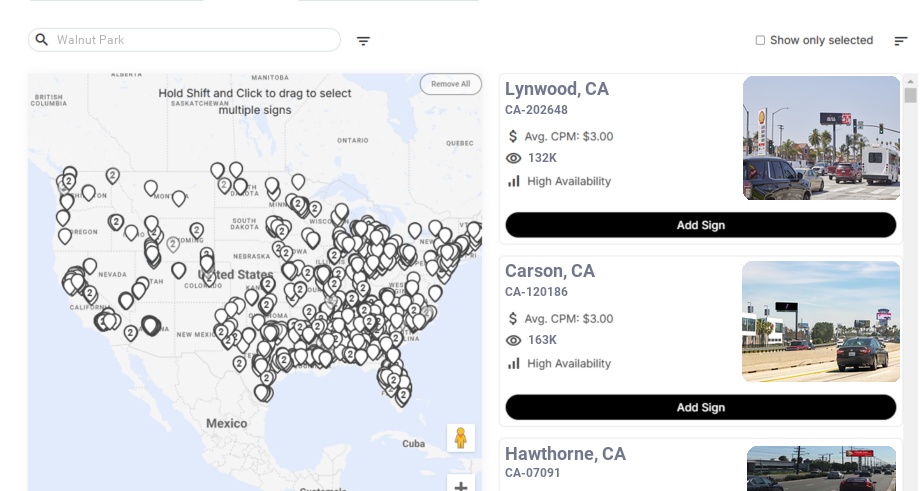
The Walnut Park area is served by 37 digital billboards from nearby cities like Bell Gardens, Lynwood, Los Angeles, South Gate, Montebello, Compton, Hawthorne, and Carson. These boards are strategically distributed across freeways and major surface streets within roughly a 10-mile radius. By choosing a mix of freeway and local street billboards, advertisers can surround the Walnut Park area audience from multiple directions.
Who can Blip reach with Walnut Park, California billboards?
The Walnut Park area sits in the heart of Southeast Los Angeles County, surrounded by dense, working-class neighborhoods and some of the busiest freeways in California. The area is over 95% Hispanic/Latino, with nearby cities like South Gate, Bell Gardens, Huntington Park, and Lynwood also showing very high Latino populations. These billboards near Walnut Park give brands a way to show up consistently in the daily lives of local residents.
What kind of traffic and commuting patterns are there around Walnut Park, California?
The Walnut Park area is bordered by high-traffic freeways and major arterials, making roadside media especially powerful. I-710 carries many segments between 160,000 and 190,000 vehicles per day, while I-110 daily volumes exceed 230,000–260,000 vehicles on central segments. Many nearby surface streets carry 25,000–45,000 vehicles per day, with average travel speeds under 30 mph during peak hours.
When is the best time to run Blip billboards near Walnut Park, California?
Peak driving windows near Walnut Park include weekday mornings from 6–9 a.m., midday from 11 a.m.–2 p.m., evening commute from 4–7 p.m., and weekends from 10 a.m.–8 p.m. These times align with school runs, errands, commuting, and shopping trips across Southeast LA. Blip’s scheduling tools can be used to run heavier bids during weekday peak hours or shift spend to weekends for retail and entertainment campaigns.
Do I need a contract to advertise with Blip near Walnut Park?
No, Blip has no long-term contracts or minimum commitments. You can start, pause, or stop your campaign at any time.
How fast can I launch a billboard campaign with Blip near Walnut Park?
You can have your campaign live in minutes. Create a free account, select your locations, set your budget, upload your design, and start running once approved.
Where can I advertise with Blip near Walnut Park?
Blip has digital billboards near Walnut Park. You can browse available locations on a map, choose the ones that fit your audience, and start advertising right away.
Still have questions? Launch a campaign in minutes — no contracts, no commitments.
Start Your CampaignWalnut Park Billboard Advertising Guide
The Walnut Park area sits in the heart of Southeast Los Angeles County, surrounded by dense, working-class neighborhoods and some of the busiest freeways in California. With 37 digital billboards serving the Walnut Park area from nearby cities like Bell Gardens Lynwood, Los Angeles, South Gate, Montebello Compton Hawthorne Carson, we can reach a powerful, primarily Hispanic audience at scale—without needing a massive media budget. These billboards near Walnut Park give brands a way to show up consistently in the daily lives of local residents. This guide walks through how to use Blip to build smart, data-driven digital billboard campaigns that connect with real people near Walnut Park where they live, work, shop, and commute.
Understanding the Walnut Park Area Market
Walnut Park is a compact but densely populated unincorporated community in Los Angeles County
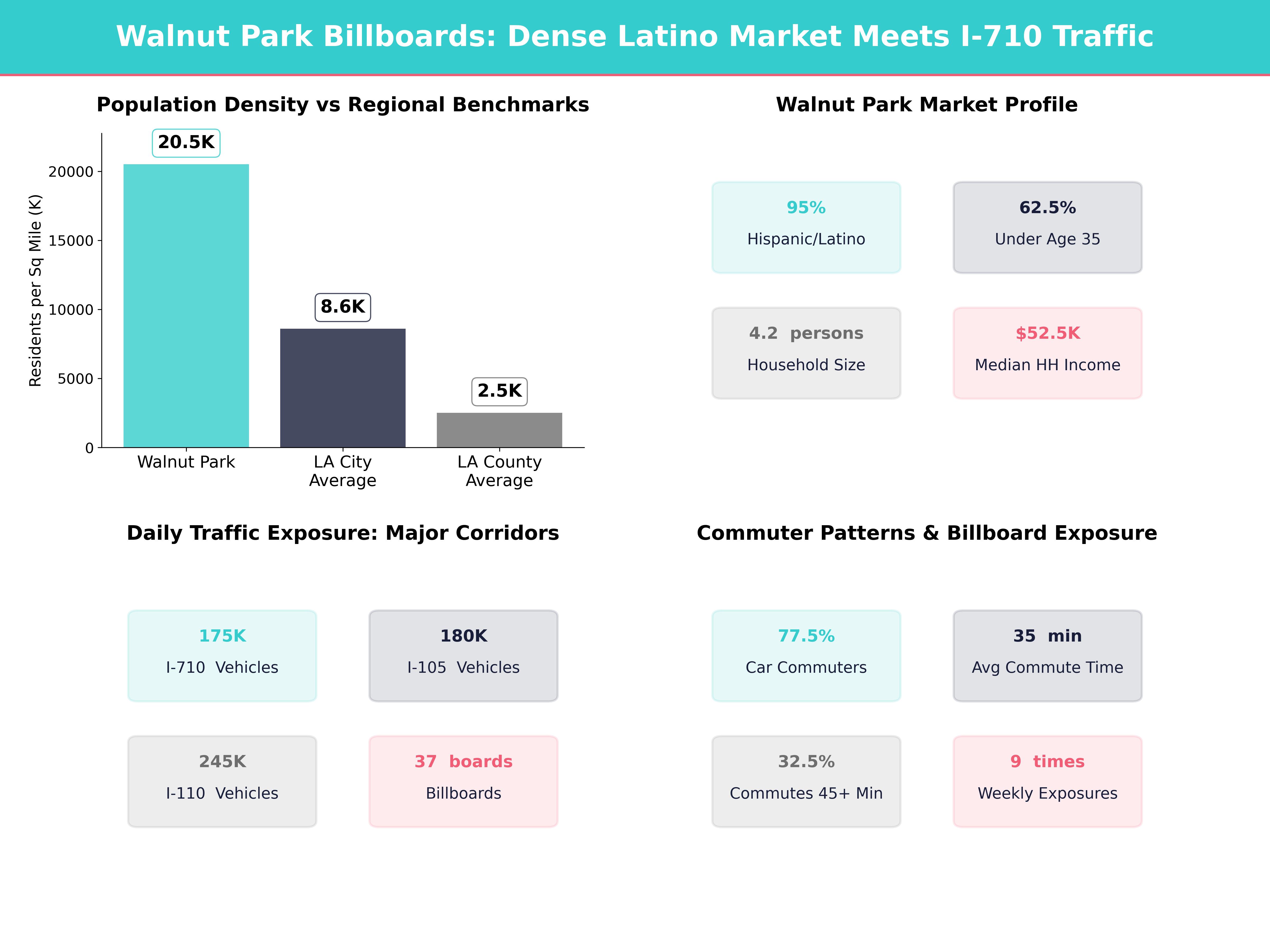
- Population: Around 16,000 residents in roughly 0.8 square miles, with population density in the 20,000–21,000 residents per square mile range—more than double the City of Los Angeles average of about 8,600 residents per square mile and far above the overall Los Angeles County density of roughly 2,500 residents per square mile.
- Household size: Average household size is approximately 4.1–4.3 persons per household, compared with about 2.8–3.0 for Los Angeles County overall. That means one billboard impression often represents an entire family decision unit, not just an individual.
- Age: Median age is in the 30–32 range, with an estimated 60–65% of residents under age 35 and roughly 25–30% under age 18. This skews your audience toward young families, students, and early-career workers—prime targets for QSR, streaming, mobile services, retail, and education.
- Ethnicity: The Walnut Park area is over 95% Hispanic/Latino, making it one of the most concentrated Latino markets in Southeast LA. Nearby cities mirror this: South Gate (~96% Latino), Bell Gardens (~96%), Huntington Park (~97%), and Lynwood (~87–90%)—a strong foundation for Spanish-first or bilingual campaigns.
- Income: Median household income in Walnut Park and adjacent communities typically falls in the $45,000–$60,000 range, below the Los Angeles County median (around $76,000). At the same time, multigenerational living is common; in many Southeast LA tracts, 10–20% of households include three or more generations, which stretches spending across groceries, auto services, discount retail, quick-service dining, and value-driven brands.
- Housing: In surrounding Southeast LA cities, renter-occupied housing often exceeds 65–70% of all units, indicating a mobile, price-sensitive audience that responds well to clear offers, promotions, and convenience.
Walnut Park is surrounded by cities like South Gate, Bell Gardens Lynwood, Compton Huntington Park—all high-density communities with similar demographic profiles. Many of these cities have population densities between 12,000 and 20,000 residents per square mile, well above the U.S. urban average. Our 37 nearby digital billboards give advertisers a way to blanket these hyper-local neighborhoods with consistent, culturally relevant messaging, making billboard advertising near Walnut Park a cost-effective way to tap into this dense consumer base.
For context on the broader region, Los Angeles County 9.7–10 million residents and the City of Los Angeles has nearly 4 million. The Walnut Park area sits directly within this massive media market, but its neighborhood-level demographics and commuting patterns allow us to target more precisely than a broad Los Angeles campaign. Regional planning agencies and transportation partners such as the Southern California Association of Governments and Los Angeles County Public Works provide ongoing data that confirms Southeast LA as one of the most travel-intense and transit-dependent zones in the county.
Traffic and Commuting Patterns Near Walnut Park
The Walnut Park area is bordered by high-traffic freeways and major arterials, which makes roadside media especially powerful.
Key Freeways
- I-710 (Long Beach Freeway): Runs just east of the Walnut Park area. Caltrans District 7 traffic counts show many segments between Long Beach and the I-5 interchange carrying 160,000–190,000 vehicles per day (annual average daily traffic, AADT), with truck traffic often exceeding 15–20% of all vehicles due to port-related freight.
- I-105 (Century Freeway): About 4–6 miles south, this major east–west corridor carries approximately 160,000–200,000 vehicles per day near Lynwood, Hawthorne, and the South Bay connections.
- I-110 (Harbor Freeway): West of the Walnut Park area, daily volumes exceed 230,000–260,000 vehicles on central segments linking the South Bay, Downtown Los Angeles, and key employment centers.
- I-5 and the I-710/I-5 junction northeast of the Walnut Park area add exposure to another 200,000+ vehicles per day on certain stretches, capturing commuters moving between Southeast LA, the San Gabriel Valley, and Downtown.
Caltrans traffic data for Los Angeles County can be explored through Caltrans District 7, which regularly updates AADT counts, truck percentages, and peak-period speeds.
Major Surface Streets
Day-to-day life near Walnut Park is dominated by busy arterials where our nearby billboards can be extremely effective, including:
- Pacific Boulevard / Santa Fe Avenue / Long Beach Boulevard corridor (connecting South Gate, Huntington Park, Lynwood, and Compton)
- Florence Avenue running east–west just north of the Walnut Park area
- Firestone Boulevard / Imperial Highway further south
- Atlantic Boulevard in nearby Bell Gardens Commerce
Many of these four- to six-lane corridors carry 25,000–45,000 vehicles per day, with average travel speeds under 30 mph during peak hours. These streets support strong flows of local traffic to shopping centers, schools, and industrial zones. In dense Southeast LA neighborhoods, surface street visibility can be just as important as freeway exposure, especially where drivers have more time to read offers at signalized intersections and engage with digital billboards near Walnut Park on repeated trips.
Commuter Behavior
From regional surveys and LA County/SCAG transportation data:
- Roughly 75–80% of workers in the Southeast LA region commute by car (driving alone or carpooling), compared to about 70–72% countywide. In some Southeast LA cities, drive-alone rates exceed 65%, and carpooling adds another 12–15%.
- Average one-way commute times in Southeast LA commonly fall in the 30–40 minute range, with many residents traveling into industrial areas in Vernon Commerce Carson, and service jobs closer to central Los Angeles. Roughly 30–35% of workers spend 45 minutes or more getting to work.
- Public transit usage is meaningful as well, with LA Metro 800,000–900,000 daily boardings range in recent years. Southeast LA corridors served by Metro bus lines and nearby rail services (such as the C Line and A Line) carry tens of thousands of riders each day across cities like South Gate, Lynwood, and Compton. You can see route maps and ridership trends at LA Metro
- Active modes (walking, biking) plus rideshare and “other” options typically account for 5–10% of trips, especially for very local journeys to schools, churches, and corner retail.
This mix of heavy auto commuting, significant transit use, and consistent local driving makes flexible digital billboards near Walnut Park a strong way to reach working families multiple times throughout the week and at multiple trip purposes—work, school, and shopping.
Where Our 37 Nearby Billboards Matter Most
Our 37 digital billboards serving the Walnut Park area are strategically distributed across neighboring cities within roughly a 10-mile radius:
- Bell Gardens (3.1 miles) – Population roughly 40,000 with density over 13,000 residents per square mile, and home to destinations like the Bicycle Hotel & Casino and busy Florence/Firestone corridors. Great for reaching shoppers visiting local casinos and shopping centers. Learn more about local happenings via the City of Bell Gardens EGP News / Local News Pasadena
- Lynwood (3.1 miles) – With around 65,000–70,000 residents and a Hispanic/Latino share near 90%, Lynwood delivers strong exposure near I-105 and Long Beach Boulevard, connecting Southeast LA to the South Bay and Downtown. City information is available from the City of Lynwood.
- Los Angeles (3.3 miles) – The city’s nearly 4 million residents and more than 2 million jobs make Southeast Los Angeles neighborhoods critical commuting corridors. These boards are especially valuable for capturing those who travel toward Downtown LA, Vernon, and central Los Angeles. Check neighborhood news via the Los Angeles Times City of Los Angeles.
- South Gate (3.4 miles) – South Gate has roughly 93,000–95,000 residents and a density of over 14,000 residents per square mile. It is a key hub for daily retail trips, anchored by South Gate Park, local corridors, and South Gate’s Azalea Regional Shopping Center City of South Gate and South Gate Chamber of Commerce.
- Montebello (5.3 miles) – With about 63,000–65,000 residents and strong retail centers such as The Shops at Montebello, this city reaches eastbound shoppers and commuters along the I-5 and SR-60 corridors. City details and event calendars are available at the City of Montebello
- Compton (6.5 miles) – Home to around 93,000–95,000 residents, major industrial and warehouse zones, and significant through-traffic on I-710, SR-91, and local arterials. Boards here reach both local workers and regional freight/trades traffic. Learn more via the City of Compton Compton Herald
- Hawthorne (8.4 miles) – With roughly 85,000–90,000 residents, Hawthorne offers exposure near I-105 and high-tech/industrial employment centers in the South Bay (including aerospace and logistics). City and business information can be found through the City of Hawthorne
- Carson (9.4 miles) – Approximately 95,000 residents and strategic proximity to the ports of Los Angeles and Long Beach. Boards here access port-adjacent logistics traffic and regional retail destinations like the SouthBay Pavilion. See more at the City of Carson and regional port information via the Port of Los Angeles and Port of Long Beach
By choosing a mix of freeways and local street billboards across these cities, we can surround the Walnut Park area audience from multiple directions, catching them near home, on their commute, and near key shopping destinations. In practice, a well-structured Southeast LA campaign using billboards near Walnut Park can easily accumulate hundreds of thousands to several million impressions per week, depending on board mix and frequency settings.
Audience Insights: Who You’re Reaching Near Walnut Park
The Walnut Park area and neighboring cities share a common profile, with nuanced differences advertisers can use:
- Hispanic/Latino majority: Many Southeast LA cities near Walnut Park have Hispanic/Latino populations above 90%, making this one of the most consistently Latino corridors in the region. For example, Huntington Park, Bell Gardens, South Gate, and Walnut Park all hover between 94–97% Latino. This supports bilingual or Spanish-first creative, especially for family-oriented brands, supermarkets, wireless providers, and financial services.
- Family-centric households: Average household sizes around 4.0–4.3 people and high proportions of children under 18 (often 25–30% of residents) mean that messages about value, education, healthcare, and family experiences (food, entertainment, schooling) tend to resonate strongly. In some Southeast LA school districts, more than 80–90% of students qualify for free or reduced-price lunch, underscoring the importance of affordability.
- Working-class, value-conscious consumers: Many residents work in logistics, manufacturing, construction, retail, hospitality, and personal services; in several nearby cities, 25–35% of workers are employed in transportation/warehousing, manufacturing, and retail trade. Price, promotions, bilingual service, and accessibility (parking, bus access, walkability) are critical selling points.
- High labor force participation: Despite lower median incomes, labor force participation among adults 25–54 in Southeast LA is often in the 70–75% range, indicating a busy, on-the-go population making frequent weekday trips.
- Local loyalty: Residents frequently shop in nearby centers in South Gate, Bell Gardens, Lynwood, and Huntington Park rather than traveling long distances. Surveys and mobile-location analyses across LA show that a majority of grocery and QSR visits occur within 3–5 miles of home. Local businesses can use billboards to firmly position themselves as “the neighborhood choice” and capture this short-radius behavior.
Local coverage and reporting from outlets like the Los Angeles Times La Opinión (a leading Spanish-language newspaper), LAist, and regional broadcasters such as ABC7 Los Angeles can help you monitor neighborhood-level issues and trends that might influence your messaging and timing for billboard advertising near Walnut Park.
Crafting Effective Creative for the Walnut Park Area
Given the local demographics and driving environment, we recommend the following creative principles:
1. Use Spanish or Bilingual Messaging
- In a market where 9 out of 10 residents are Hispanic/Latino and where Spanish is spoken at home in well over 80% of households, Spanish-language or bilingual ads can dramatically increase relevance and recall.
- Consider a primary Spanish headline with an English sub-line (or vice versa) depending on your target demographic (parents vs. teens, for example).
- Keep translations culturally authentic; avoid literal translations that sound awkward. Partner with native speakers or local copywriters when possible, or collaborate with community groups highlighted by the Los Angeles County Office of Immigrant Affairs
2. Lead With Value and Clarity
- Emphasize price points, promotions, or savings (“2x1”, “Especial de Fin de Semana”, “No Credit Needed”, etc.). In a market where median incomes are 15–30% below the county average, clear value messages strongly influence choice.
- Use large, legible numbers and high-contrast colors that can be read at 45–65 mph on freeways and 25–35 mph on arterials.
- Keep to 7–10 words maximum on the main message; simplicity is crucial on busy freeways like I-710 and I-105, where drivers typically have only 3–5 seconds to absorb your message.
3. Show Families and Community
- Visuals of multi-generational families, children, and neighborhood life align with the lived reality of many households near Walnut Park, where 40–45% of households include children.
- Local references—schools, parks, or landmarks from nearby cities (like South Gate Park Compton College, or the Lynwood Civic Center)—can help build trust and recognition.
4. Design for Quick Glance and Repetition
- High-traffic drivers often see the same digital board several times a week on their commute; regional travel surveys suggest that frequent commuters pass the same corridor at least 8–10 times per week. Use consistent core branding (logo, colors, tagline) but rotate offers or calls to action.
- Use large fonts and simple iconography. Avoid long URLs; short URLs, QR codes for slower street locations, or direct app search prompts (“Search: [Brand]”) work better.
5. Consider Time- and Context-Specific Messages
- Morning commute (6–9 a.m.): breakfast, coffee, school-oriented services, and job recruitment.
- Afternoon (3–6 p.m.): after-school programs, tutoring, fast casual dining, grocery promotions.
- Evening (6–10 p.m.): streaming entertainment, QSR dinner deals, weekend events, sports—especially during high-interest seasons for teams covered heavily by local outlets like Spectrum SportsNet and FOX 11 Los Angeles.
Blip’s flexibility means you can upload multiple creatives and test which combination of language, offer, and visual style performs best for your business, then adjust in near real time as you read results from your POS or web analytics.
Using Blip’s Dayparting to Match Local Routines
The Walnut Park area follows a rhythm shaped by work, school, and family obligations. With Blip, we can schedule your ads (“blips”) to show only at the times that align with your audience’s behavior.
Peak Driving Windows Near Walnut Park
Based on typical LA County commuting patterns and local commercial activity:
-
Weekday mornings (6–9 a.m.)
- Parents driving children to schools in South Gate, Huntington Park, Bell, Lynwood, and the Walnut Park area. In many local districts, over 80% of students arrive by car or school bus, creating intense bursts of traffic near campuses.
- Workers heading to industrial and logistics zones along I-710 and into Vernon and Commerce, where large employers collectively support tens of thousands of jobs in warehousing, food processing, and manufacturing.
-
Midday (11 a.m.–2 p.m.)
- Local errands, grocery runs, and lunch breaks. Retail data in similar LA corridors suggests that 25–35% of weekday store visits occur during this window. Ideal for restaurants, quick-service dining, and discount retailers.
-
Evening commute (4–7 p.m.)
- Heaviest traffic on I-710, I-105, and local corridors like Florence Avenue and Long Beach Boulevard, with peak-hour speeds often dropping below 25 mph on arterials.
- Great for promoting dinner options, family outings, and same-day/next-day promotions timed to payday cycles (for example, the 1st and 15th of the month, when many households receive wages or benefits).
-
Weekends (10 a.m.–8 p.m.)
- Shopping at regional centers (like Azalea in South Gate, The Shops at Montebello, or nearby plazas in Lynwood and Bell Gardens). Retail studies in LA show that 40–50% of weekly retail spend often lands on Friday–Sunday.
- Local events, church services, and recreational trips, with Sunday mornings and early afternoons showing noticeable spikes in short-distance driving.
We can use Blip’s scheduling tools to:
- Run heavier bids during weekday peak hours for commuter-focused campaigns.
- Shift spend to weekends for retail, entertainment, and service businesses that rely on Saturday–Sunday traffic.
- Avoid overnight hours unless your offer specifically benefits night-shift workers or 24/7 operations (e.g., emergency care, urgent staffing, or late-night dining), which are common in logistics and healthcare sectors serving the nearby ports and hospitals like St. Francis Medical Center in Lynwood.
Geo-Targeting Strategy: Surrounding the Walnut Park Area
The strength of our 37 billboards near Walnut Park is the ability to create a “coverage halo” around the neighborhoods you care about most.
1. Focus on Southeast LA Core for Local Businesses
If you’re a local business serving primarily the Walnut Park area and nearby communities:
- Prioritize boards in Bell Gardens, South Gate, Lynwood, and Los Angeles (Southeast area), where combined populations exceed 250,000 residents within a short drive.
- Target routes that residents are most likely to use daily: Florence Avenue, Firestone Boulevard, Long Beach Boulevard, I-710 north/south. These corridors connect neighborhoods where average trip distances often fall under 5 miles.
- Use localized calls to action such as “5 minutes from here,” “By South Gate Park,” or “Next to [well-known cross streets].” Including a simple distance marker (e.g., “2 miles ahead”) can improve navigation and recall among drivers.
2. Add Montebello and Compton for Wider Trade Areas
If your customers travel a bit farther (auto dealers, medical offices, major retail, colleges):
- Layer in boards in Montebello (capturing I-5 and SR-60 traffic) and Compton (reaching the 710/91 and local industrial employment). These cities add another 150,000–160,000 residents and tens of thousands of workers traveling from across LA County each day.
- This helps you reach both existing customers from the Walnut Park area and potential new customers coming from adjacent neighborhoods, aligning with typical “trade areas” of 8–10 miles for large-format retail, healthcare, and education.
3. Use Hawthorne and Carson for Regional Reach
For brands with a regional footprint:
- Boards in Hawthorne put you along I-105, capturing traffic between Southeast LA, Los Angeles International Airport (LAX), and the South Bay technology and aerospace corridor.
- Boards in Carson give you presence closer to the ports and major logistics corridors, ideal for B2B, employment, or shipping-related campaigns. The combined ports of Los Angeles and Long Beach move over 17 million TEUs (twenty-foot equivalent units) of cargo annually, supporting tens of thousands of direct and indirect jobs whose workers traverse these corridors daily.
Because Blip lets us choose exactly which signs to use and how often your ad appears on each one, we can fine-tune your footprint—from ultra-local Walnut Park billboards to multi-city coverage—without committing to traditional static buys or long-term minimums.
Campaign Ideas by Industry for the Walnut Park Area
Different sectors can leverage the Walnut Park area’s characteristics in distinct ways:
Retail and Grocery
- Promote weekly specials with rotating creatives synced to sale cycles. Grocery studies show that 60–70% of shoppers plan at least some purchases around promotions and flyers—digital billboards can act as an “outdoor flyer” on key routes.
- Use Spanish headlines and price-focused messaging to attract value-conscious shoppers in a market where food and housing together can consume 50% or more of many household budgets.
- Direct people to nearby centers in South Gate, Bell Gardens, or Huntington Park with simple “Turn Right on Florence Ave”–type instructions; including a clear turn and distance can increase store visits, especially within a 1–3 mile radius.
Restaurants and Quick-Service Dining
- Target morning and evening commute windows on boards along I-710 and main arterials. In many QSR chains, 40–50% of daily revenue occurs during lunch and dinner peaks—aligning impressions to those peaks helps maximize return.
- Feature breakfast combos or family dinner bundles and update them daily or weekly. Limited-time offers (LTOs) typically drive 2–5% lifts in traffic when well-promoted.
- Use weekend-heavy schedules when families are more likely to dine out; industry data often shows 15–25% higher ticket averages on weekends compared to weekdays.
Auto Dealers and Auto Services
- With many residents reliant on cars and long commutes—LA County auto ownership exceeds 1.8 vehicles per household on average and is only slightly lower in dense Southeast LA—auto repair, tire shops, and dealerships can thrive.
- Highlight financing options, “no credit / bad credit OK” messages, and bilingual support, as a significant share of local households are “credit thin” or underserved by traditional lenders.
- Use boards along I-710 and key surface streets close to your showroom or service center; auto customers will frequently travel 10–20 miles for a major purchase if they recognize a trusted brand or promotion.
Healthcare and Clinics
- Promote urgent care, dental, pediatric, and women’s health services near the Walnut Park area. Many Southeast LA neighborhoods are designated “medically underserved areas,” indicating higher-than-average patient-to-provider ratios and demand for accessible care.
- Position your facility as close, affordable, and culturally fluent (Spanish-speaking staff, family-friendly environments). In LA County, an estimated 50%+ of residents speak a language other than English at home; emphasizing language access can be a key differentiator.
- Emphasize walk-ins, extended hours, and insurance/low-cost options, particularly Medi-Cal acceptance, which covers a significant portion of children and low-income adults in the region.
Education and Training
- Community colleges, trade schools, ESL programs, and workforce training centers can reach young adults and parents. In many Southeast LA communities, more than 40–45% of adults have a high school diploma or some college but no degree—an ideal audience for certificate and short-term training programs.
- Focus on career advancement, financial aid (e.g., “Hasta 100% cubierto para quienes califican”), and flexible schedules (evening/weekend classes).
- Use boards near commuting routes toward Downtown LA and Vernon/Commerce where many job seekers travel; campus-based research often shows that 70–80% of students live within 15 miles of their school.
Events and Entertainment
- Promote festivals, concerts, and youth sports leagues near Walnut Park and surrounding cities. Event marketing case studies commonly show that 30–50% of attendance comes from people who live within 10 miles of the venue—perfect for tightly targeted billboard campaigns.
- Schedule increased impressions 3–7 days before the event, with a final push the day prior and day-of.
- Use bright, bold visuals and clear dates and times; including a short URL or event hashtag helps track digital conversation, especially when amplified by local media like LA Weekly Discover Los Angeles.
Measuring and Optimizing Campaign Performance
While billboards are primarily an upper-funnel medium, we can still track performance and optimize campaigns near the Walnut Park area using practical proxies:
1. Track Web and Search Uplift
- Watch for increases in direct traffic and branded search (e.g., searches including your brand plus “South Gate”, “Lynwood”, or “near me”) during your campaign period. A sustained 10–30% lift in branded searches while boards are live is a common success indicator.
- Use simple landing pages or vanity URLs to correlate traffic with flight dates. Even if only 5–10% of viewers respond digitally, the pattern of spikes around your scheduled times can validate impact.
2. Use Store-Level Data
- Compare weekly sales, foot traffic, or call volume for locations near Walnut Park to periods before your campaign. Look for changes in same-store sales of 5% or more during billboard flights compared to a prior 4–8 week baseline.
- If you have multiple locations, compare those within 5–10 miles of your targeted boards to those outside the immediate area. A relative lift in the billboard-covered zone is strong circumstantial evidence of effectiveness.
3. Test Creative and Scheduling
- Upload multiple versions of creatives (different languages, offers, or images) and rotate them through the same boards. Even small differences—such as switching from English-only to bilingual—can produce measurable changes; marketers often report 10–20% higher response from tailored local-language creatives.
- Adjust dayparts and see if morning vs. evening emphasis leads to better in-store results. For some categories (like QSR or coffee), morning impressions may outperform evening ones; for others (like family dining), the reverse may be true.
- Use Blip’s flexibility to quickly pause underperforming variations and double down on what works, without waiting for the end of a traditional 4- or 8-week out-of-home contract.
4. Ask Customers Directly
- Train staff to ask “How did you hear about us?” and log mentions of “billboard”, “sign on the freeway”, or specific highways/intersections. If 10–20% of new customers cite billboards during a campaign, that’s a strong indicator given the medium’s broad reach.
- Include simple survey prompts or QR codes on creatives where traffic speeds allow more time to scan (typically on slower local streets, not major freeways). QR usage surged during the last few years; many campaigns now see 2–5% of digitally engaged viewers responding via QR when placed in the right context.
Leveraging Local Context and Community Connection
Walnut Park and its neighboring communities are tightly knit and community-focused. To stand out on digital billboards near the Walnut Park area:
- Align with local events: Coordinate flights around city events in South Gate, Bell Gardens, Lynwood, and Compton. Check municipal calendars on sites like City of South Gate, City of Bell Gardens City of Lynwood, and the City of Compton 5,000–20,000+ attendees, creating natural spikes in local travel and spending.
- Support schools and youth programs: Highlight sponsorships of local high school sports, youth leagues, or scholarship programs. In communities where more than 25–30% of residents are under 18, youth-focused initiatives carry outsized goodwill and word-of-mouth impact.
- Tie into regional happenings: Major sports seasons, holidays, and cultural celebrations (e.g., Día de los Muertos, Hispanic Heritage Month, Cinco de Mayo) provide natural themes for time-limited creative. For regional inspiration and visitor trends, Discover Los Angeles offers insight into what’s happening across LA and what might influence consumer behavior.
Businesses that consistently show up in community spaces—parades, school events, local sports—tend to see stronger brand recognition, which billboards can then reinforce at scale across everyday commutes. Pairing that presence with ongoing billboard advertising near Walnut Park keeps your brand top-of-mind between those in-person touchpoints.
Putting It All Together: A Sample Strategy Near Walnut Park
To illustrate how all these elements work together, consider a local Hispanic-focused supermarket chain with a store near the Walnut Park area:
-
Board selection:
- Choose 15–20 boards in Bell Gardens, South Gate, Lynwood, and Southeast Los Angeles along I-710, Florence Avenue, Firestone Boulevard, and Long Beach Boulevard. This cluster gives access to a combined trade area of 250,000–300,000 residents within roughly a 5–7 mile radius and demonstrates how targeted billboard rental near Walnut Park can deliver broad local reach.
-
Creative:
- Bilingual Spanish-first messaging, large product images (fresh produce, meat, tortillas) and clear weekly price points (e.g., “Pollo 99¢/lb”, “3x$5 tortillas”).
- Core brand creative remains constant; prices and featured items swap out weekly, matching store circulars. Chains that synchronize billboard and in-store promotions often see 3–7% higher promo redemption versus in-store signage alone.
-
Schedule:
- Heavier weekday morning and evening buys (6–9 a.m., 4–7 p.m.) to capture commuters and school runs.
- Additional weekend focus (Friday–Sunday) for big shopping days, especially around the 1st and 15th of each month when household budgets are replenished.
-
Measurement:
- Track weekly same-store sales vs. a 4-week pre-campaign baseline, watching for category-specific lifts (e.g., meat, produce, prepared foods).
- Monitor web and search queries for brand + “South Gate”, “Lynwood”, etc., and note any 10–30% uptick while boards are live.
-
Optimization:
- If weekend sales see a strong lift—say 5–10% higher than baseline—shift additional impressions to Friday–Sunday.
- Test special holiday messaging or back-to-school themes and compare performance to regular weeks, using Blip’s ability to quickly rotate or retire creatives.
With Blip, you can start this kind of campaign at any budget level and scale up as results and revenue increase, rather than locking into large, fixed out-of-home buys. Flexible billboard rental near Walnut Park lets you experiment, learn, and reallocate spend as you discover which boards and time windows produce the best outcomes.
Next Steps for Advertising Near Walnut Park with Blip
Reaching audiences near Walnut Park means understanding dense, family-focused, primarily Hispanic neighborhoods and the busy transportation corridors that connect them. By combining:
- Data-driven board selection across the 37 digital billboards serving the Walnut Park area
- Culturally and linguistically relevant creative
- Smart dayparting around real commuter and shopping patterns
- Ongoing measurement and optimization
we can build digital billboard campaigns that punch far above their weight.
Once you clarify your core audience, target radius, and budget, we can help you select the right billboards near Walnut Park in nearby cities like Bell Gardens Lynwood, Los Angeles, South Gate, Montebello Compton Hawthorne Carson—so your message meets the Walnut Park area consumer at exactly the right place and time, backed by the density, traffic volumes, and demographic strength that make Southeast Los Angeles one of the most powerful local advertising markets in the region.