Billboards near Rio Linda, CA
No Minimum Spend. No Long-Term Contracts. Just Results.
Trusted by Leading Brands


Billboard advertising
near Rio Linda has never been easier



How much is a billboard near Rio Linda?
Why Choose Blip for Billboard Advertising near Rio Linda
Blip lets you launch Rio Linda billboards in minutes, reaching I-5 and I-80 commuters without contracts.
Set a flexible daily budget in Rio Linda and focus spend on 6-9 a.m. or 3:30-7 p.m. traffic near Sacramento.
Use Blip's real-time analytics to see what works with Rio Linda families, workers, and airport-bound drivers.
Rio Linda's farm and horse-country audience responds to clear local creative; Blip's tools make fast updates easy.
Run Rio Linda ads only on the weekend or school-bell windows, so your message hits Twin Rivers parents when traffic peaks.
Frequently Asked Questions About Billboard Advertising near Rio Linda
How much does a billboard cost near Rio Linda, California with Blip?
With Blip, you control exactly what you spend on Rio Linda billboards by setting a daily budget that fits your needs, whether you’re a small local shop or a growing brand serving the Rio Linda area. Each ad is a short 7.5–10 second “blip” on digital billboards near Rio Linda, California, and you only pay for the blips you receive. Pricing per blip changes based on when you run your ads and advertiser demand, so you can choose times that match your goals and budget.
Where can I advertise with Blip near Rio Linda, California?
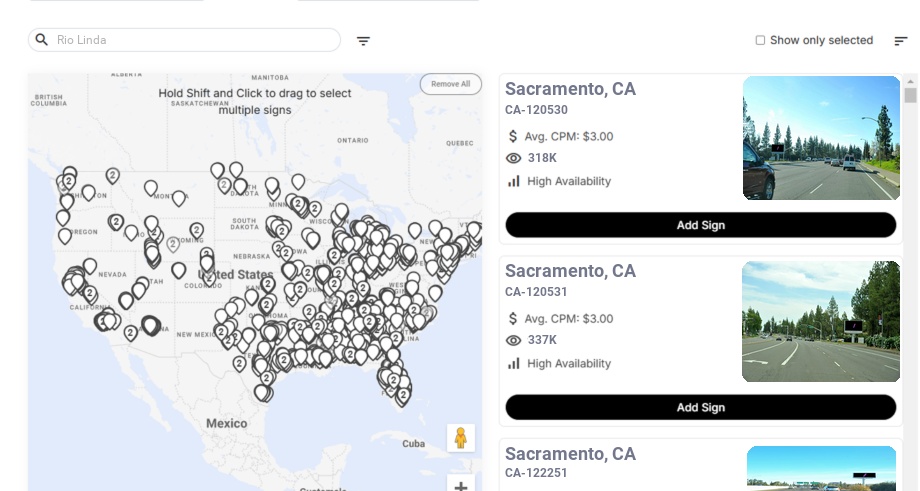
Our four digital billboards serving the Rio Linda area are located in Sacramento, within roughly 10 miles of Rio Linda. This proximity allows campaigns to capture Rio Linda residents driving toward Sacramento, Sacramento residents heading toward the airport or northern suburbs, and regional through-traffic. Digital billboards positioned along I-5 and I-80 can easily generate hundreds of thousands of weekly impressions per face.
What kind of people does Blip reach in Rio Linda, California?
Rio Linda is an unincorporated community of roughly 16,000–17,000 residents, located about 10 miles north of downtown Sacramento in northern Sacramento County. The area has a suburban–rural mix, a commuter-heavy population, and a family-focused community with a higher-than-average youth share. Northern Sacramento County also features a mix of Latino, White, Black, and Asian residents, with a strong blue-collar and service-industry presence.
When is the best time to run Blip ads in Rio Linda, California?
For the Rio Linda area, timing is especially important because of its commuter and family-oriented patterns. In many cases, advertisers see 30–50% higher effective impressions per dollar when they focus spending into the 6–9 a.m. and 3–7 p.m. windows versus running evenly 24/7. Weekend daytime can also work well for home improvement stores, family attractions, and event-driven campaigns.
What kind of billboard message works best in Rio Linda, California with Blip?
The Rio Linda area responds best to straight-forward, value-oriented creative that feels local and honest. Simple phrases like “Serving the Rio Linda area since 1998” or “Your neighbor north of Sacramento” help tie a regional brand back to local roots and signal long-term commitment. In price-sensitive categories, including specific dollar amounts or percentage savings can increase response, and ads should stay highly legible with a short, clear message.
Do I need a contract to advertise with Blip near Rio Linda?
No, Blip has no long-term contracts or minimum commitments. You can start, pause, or stop your campaign at any time.
How fast can I launch a billboard campaign with Blip near Rio Linda?
You can have your campaign live in minutes. Create a free account, select your locations, set your budget, upload your design, and start running once approved.
Where can I advertise with Blip near Rio Linda?
Blip has digital billboards near Rio Linda. You can browse available locations on a map, choose the ones that fit your audience, and start advertising right away.
Still have questions? Launch a campaign in minutes — no contracts, no commitments.
Start Your CampaignRio Linda Billboard Advertising Guide
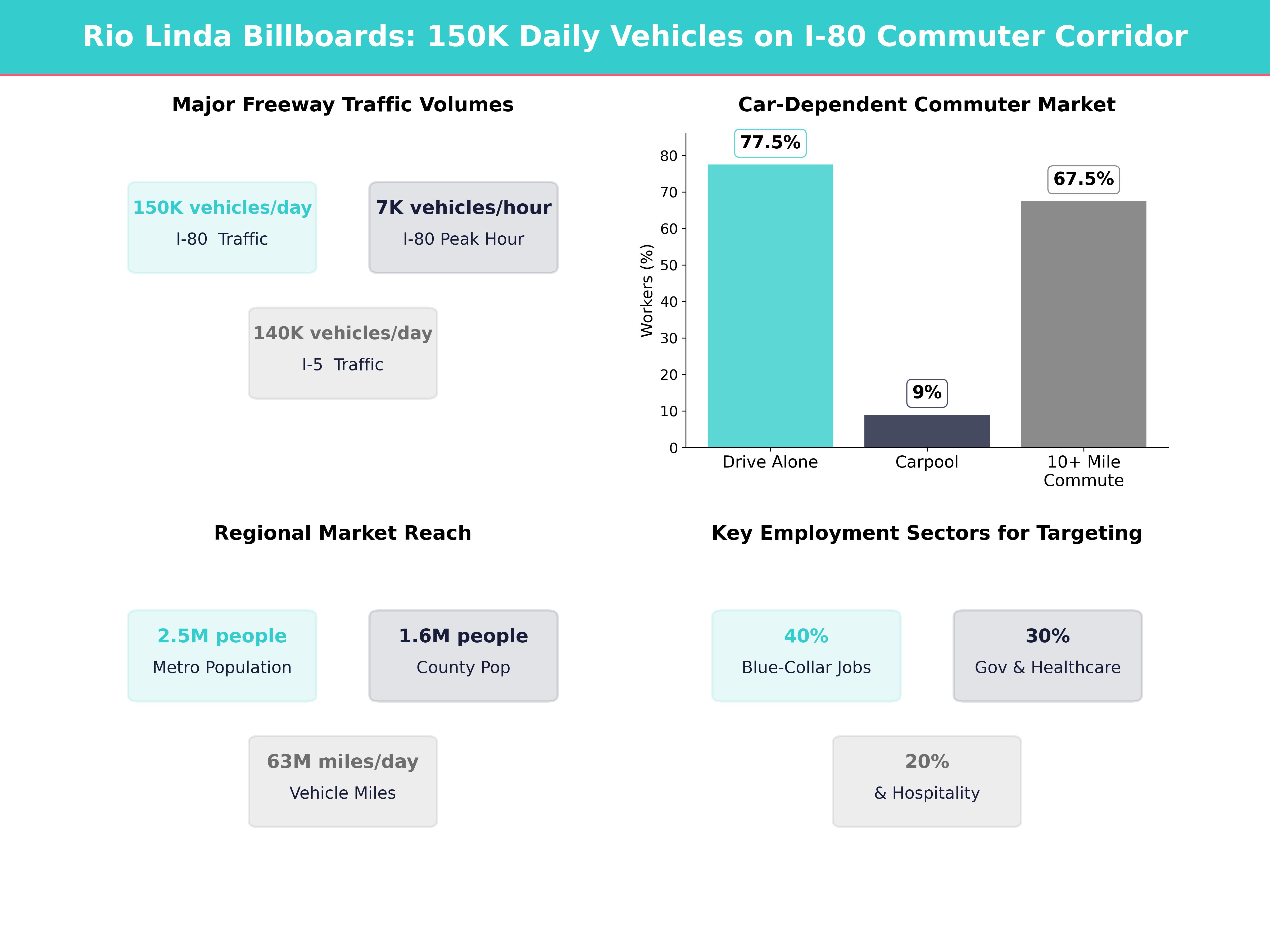
The Rio Linda area sits at a unique crossroads of suburban neighborhoods, agricultural land, and the broader Sacramento urban core. With four digital billboards nearby in Sacramento serving the Rio Linda area, advertisers can tap into a steady flow of commuters, families, and blue‑collar workers who move between Rio Linda, Natomas, North Sacramento, and downtown every day. Local transportation planners estimate that the Sacramento region sees more than 63 million vehicle miles traveled per day, and a substantial share of that moves across the I‑5 and I‑80 corridors that frame Rio Linda and North Sacramento. Below, we explore how to use those boards strategically to reach this audience with the right message, at the right time, and on the right budget, especially if you’re evaluating billboards near Rio Linda as part of your media mix.
Understanding the Rio Linda Market
Rio Linda is an unincorporated community of roughly 16,000–17,000 residents, located about 10 miles north of downtown Sacramento in northern Sacramento County. The broader Sacramento County population now exceeds 1.6 million people, and regional planning agencies project the county to surpass 1.8 million residents by the early 2030s as growth pushes into northern and western suburbs. The city of Sacramento itself has roughly 525,000 residents, making it one of the fastest‑growing large cities in California over the last decade.
The Sacramento region’s economy is anchored by government, healthcare, logistics, construction, and education. Countywide:
- Median household income is in the $80,000–$85,000 range.
- Roughly 55–60% of occupied housing units are owner‑occupied, with higher homeownership rates in outlying areas like Rio Linda.
- The Sacramento–Roseville–Folsom metro area has added more than 120,000 jobs since 2012, with particularly strong growth in healthcare and warehousing.
That means advertisers using our four nearby boards in Sacramento can reach both the close‑knit Rio Linda community and the larger regional market of over 2.5 million people in the broader Sacramento metropolitan area. When planned correctly, Rio Linda billboards can act as a bridge between hyper‑local customers and the wider commuting population that passes through these corridors each day.
Key characteristics of the Rio Linda area:
- Suburban–rural mix: Rio Linda has a strong agricultural and equestrian identity. Many properties sit on lots of 0.5–5 acres, and a meaningful share of households own horses or keep small livestock. Residents routinely drive 10–25 miles for work, shopping, and entertainment, making them highly exposed to regional corridors.
- Commuter heavy: In northern Sacramento County, more than 75–80% of workers commute by car, and around 8–10% carpool. Typical one‑way commute times run 27–30 minutes, putting drivers on I‑5, I‑80, and surface routes connecting to Sacramento, Natomas, and Roseville. The Sacramento Area Council of Governments (SACOG)
- Family‑focused community: Roughly 24–26% of residents in the Rio Linda and North Sacramento area are under age 18, a higher‑than‑average youth share compared with many urban cores. Households with children tend to spend more on groceries, quick‑serve restaurants, youth activities, healthcare, and home services—categories that over‑index in their use of out‑of‑home media.
- Diverse, working‑class demographic: Northern Sacramento County features a mix of Latino, White, Black, and Asian residents, with a strong blue‑collar and service‑industry presence. In many nearby census tracts, 35–45% of jobs are in construction, transportation, warehousing, retail, and hospitality. Messaging that is practical, price‑focused, and community‑oriented tends to resonate and generate response.
For context about how Rio Linda fits into policy and services, advertisers can review county information at the Sacramento County Sacramento Bee, as well as local broadcasters like KCRA 3, ABC10, and FOX40
Where Your Message Shows Up: Sacramento Boards Serving Rio Linda
Our four digital billboards serving the Rio Linda area are located in Sacramento, within roughly 10 miles of Rio Linda. This proximity allows campaigns to capture:
- Rio Linda residents driving toward Sacramento: Especially along corridors leading into downtown and Natomas retail zones. Rio Linda residents frequently travel south along Elkhorn Boulevard and Rio Linda Boulevard toward major arterials and freeway on‑ramps that feed I‑5 and I‑80, making these ideal corridors for billboard advertising near Rio Linda.
- Sacramento residents heading toward the airport or northern suburbs: Sacramento International Airport handled about 13 million passengers in 2019 and climbed back to more than 12 million passengers in 2023, with projections to surpass pre‑pandemic highs as new gates come online. A significant share of those travelers—and airport workers—move on I‑5 and adjacent surface streets that also serve the Rio Linda area.
-
Regional through‑traffic: I‑5 and I‑80 carry tens of thousands of vehicles per day north–south and east–west through the region. For example, Caltrans District 3 traffic counts show:
- Average daily traffic on I‑80 near North Sacramento often exceeds 150,000 vehicles per day, with peak hours contributing more than 7,000 vehicles per hour in each direction.
- I‑5 through Sacramento typically sees 130,000–150,000 vehicles per day, including airport‑bound travelers, long‑haul freight trucks, and regional commuters.
Digital billboards positioned along these corridors can easily generate hundreds of thousands of weekly impressions per face. By choosing dayparts and budgets strategically with Blip, we can zero in on peak Rio Linda–connected traffic times on these corridors: early morning, late afternoon, and weekends, when overall traffic volumes are highest and dwell time in congestion often increases. For many advertisers, this targeted reach makes billboard rental near Rio Linda a cost‑effective way to stay visible to both residents and pass‑through audiences.
Who You Can Reach In the Rio Linda Area
To plan creative and scheduling, it helps to understand who is most likely to see your message and how different types of Rio Linda billboards can align with those audiences.
1. Commuters and workers
- The majority of employed residents in northern Sacramento County work outside their immediate neighborhood, often in Sacramento, Natomas, or industrial areas along I‑5 and I‑80. In several nearby ZIP codes, more than 65–70% of workers travel at least 10 miles to their jobs.
- Many jobs are in healthcare, government, construction, logistics, and hospitality. The City of Sacramento reports that government and healthcare alone account for more than 30% of local employment, with retail and hospitality adding another 20%+. These sectors attract thousands of daily commuters from adjacent communities like Rio Linda, Elverta, and North Highlands.
- Logistics, warehousing, and distribution centers clustered near the airport and along I‑80 provide thousands of shift‑based jobs. Industrial parks in North Sacramento and Natomas employ a large base of workers on early‑morning (5–7 a.m.) and swing (3–11 p.m.) shifts, giving advertisers strong justification to invest in non‑traditional dayparts.
-
Commuters on I‑80, I‑5, and feeder roads are especially reachable during:
- 6:00–9:00 a.m. (morning work traffic)
- 3:30–7:00 p.m. (afternoon/evening return traffic)
2. Families with school‑age children
The Rio Linda area is served by the Twin Rivers Unified School District, which enrolls more than 24,000 students across its system at over 50 schools and programs. Rio Linda High School alone serves around 1,800–2,000 students in grades 9–12. That indicates strong concentrations of households with children, creating opportunities for:
- After‑school programs and tutoring
- Youth sports and camps
- Healthcare and dental practices
- Fast‑casual restaurants and family entertainment
District‑wide, Twin Rivers operates hundreds of bus routes and reports transporting thousands of students daily. When you factor in parent drop‑offs and pickups, school‑related trips can add 10–20% to local traffic volumes around bell times. Scheduling heavier impressions during school commute times (7:00–8:30 a.m. and 2:30–4:30 p.m. on weekdays) allows campaigns to intersect parent chauffeurs and school staff.
3. Equestrian and agricultural audiences
Rio Linda’s heritage as a horse and farm community remains visible in local businesses—feed stores, farriers, tack shops, equipment rentals, and small agricultural services. Within a 10‑ to 15‑minute drive of Rio Linda’s core:
- There are multiple feed and grain outlets, several equestrian boarding facilities, and numerous service providers that depend on regional drive‑by visibility.
- A sizable share of households report owning trucks, trailers, or work vehicles, and pickup truck registrations in northern Sacramento County outpace those in many central city neighborhoods.
These residents often drive to larger shopping areas in North Sacramento, Natomas, and Roseville for major purchases. They are value‑focused and often loyal to brands that recognize and respect rural lifestyles. Billboard messaging that acknowledges “horse country,” farm work, or acreage living can cut through more generic advertising and signal that a brand understands local identity.
4. Airport travelers and visitors
Sacramento International Airport is one of the fastest‑growing midsize airports in the West:
- Roughly 13 million passengers annually pre‑pandemic (2019).
- Over 12 million passengers in 2023 as demand rebounded.
- More than 13,000 on‑airport jobs when you include airlines, concessions, transportation, and support services.
A significant portion of airport users drive along I‑5 north of downtown—corridors that also serve the Rio Linda area. Peak airport traffic typically occurs in the early morning (5–9 a.m.) and late afternoon/early evening (3–7 p.m.), aligning well with commuter patterns.
Advertisers in hospitality, car rental, travel services, and attractions can leverage:
- Trip‑planning awareness (e.g., hotels, park‑and‑fly, airport shuttles, parking reservation services)
- Regional attractions promoted through Visit Sacramento and area tourism campaigns, from Old Sacramento Waterfront and the Sacramento Zoo to seasonal events like music festivals, sports tournaments, and the California State Fair at nearby Cal Expo.
Timing Your Campaign: When the Rio Linda Audience is on the Road
With Blip’s flexible scheduling, we can adjust your budget and impressions by time of day and day of week. For the Rio Linda area, timing is especially important because of its commuter and family‑oriented patterns. In many cases, advertisers see 30–50% higher effective impressions per dollar when they focus spending into the 6–9 a.m. and 3–7 p.m. windows versus running evenly 24/7. This type of precision is especially valuable for advertisers new to billboard advertising near Rio Linda who want to test the market efficiently.
Weekday patterns
-
Early morning (5:30–7:00 a.m.)
- Construction crews, logistics and warehouse workers, early‑shift hospital staff, and tradespeople heading into Sacramento or industrial corridors.
- Shift‑start times at warehouses near the airport commonly fall at 6:00 a.m., meaning thousands of workers are on the road between 5:15–5:45 a.m.
- Ideal for: coffee shops, breakfast QSRs, workwear retailers, tools/equipment, fuel stations.
-
Morning commute (7:00–9:00 a.m.)
- Broader commuter mix plus school traffic; regional counts often show a 40–60% increase in traffic volume versus off‑peak.
- Ideal for: healthcare and dental reminders, higher‑end QSR, financial services, radio/podcast promotions, small business services, and public campaigns from agencies such as Sacramento Regional Transit (SacRT)
-
Midday (11:00 a.m.–2:00 p.m.)
- Lunch traffic, service appointments, mid‑shift retail workers, and seniors running errands. For many restaurants, 25–35% of weekday revenue comes from the lunch window.
- Ideal for: lunch spots, medical and dental practices, auto services, local government or public service announcements from entities like Sacramento County
-
Afternoon/Evening commute (3:30–7:00 p.m.)
- This is typically the single busiest traffic window of the day, with freeways sometimes operating at or near capacity.
- High volume: school pickups, commuters returning to Rio Linda and other suburbs, plus after‑work shopping. Retail centers often report 40%+ of weekday sales occurring after 3 p.m.
- Ideal for: grocery stores, home improvement, family restaurants, youth activities, streaming and entertainment, and same‑day or next‑day home services.
-
Late evening (8:00–11:00 p.m.)
- Lower volume but more attention time per driver due to reduced roadside clutter and brighter board visibility.
- Ideal for: nightlife in downtown Sacramento, casinos, streaming services, delivery apps, and urgent‑care or 24‑hour services. For some advertisers, CPMs in this window can be 20–30% lower than in peak commute times.
Weekend patterns
-
Saturday daytime
- Strong volumes toward big‑box retail, home centers, equestrian supply, and leisure destinations such as the American River Parkway and shopping districts in Natomas.
- Home improvement stores routinely report weekend sales that are 1.5–2.0× weekday averages.
- Great for: home services, garden and farm supply, family attractions, seasonal promotions, and event‑driven campaigns tied to the Visit Sacramento events calendar.
-
Sunday late morning and afternoon
- Church traffic, grocery trips, and family outings; regional travel demand can spike ahead of Monday work and school.
- Effective for: restaurants, community events, health and wellness promotions, and nonprofit messaging.
Using Blip, we can allocate more budget to the exact windows that match your Rio Linda–area audience, instead of paying for every hour of the day. Over the course of a month, concentrating on 40–60 “high‑value” hours instead of 168 total hours can dramatically increase your impressions per dollar in the Rio Linda–to‑Sacramento travel shed.
Tailoring Creative to Rio Linda’s Culture and Lifestyles
The Rio Linda area responds best to straight‑forward, value‑oriented creative that feels local and honest. When designing artwork for boards serving this area, we recommend:
1. Lean into local identity
-
Reference landmarks, themes, or activities that matter locally:
- Horses, acreage, and truck culture tied to Rio Linda’s equestrian roots and agricultural parcels.
- Outdoor life along the American River Parkway and nearby recreation areas promoted by Visit Sacramento 30 miles of multi‑use trails, rafting, and cycling.
- Community school pride (e.g., Rio Linda High, Foothill area schools in Twin Rivers Unified) and local activities promoted by entities like the Rio Linda Elverta Recreation and Park District.
- Simple phrases like “Serving the Rio Linda area since 1998” or “Your neighbor north of Sacramento” help tie a regional brand back to local roots and signal long‑term commitment—a key trust driver in blue‑collar markets. These kinds of local cues often separate effective Rio Linda billboards from more generic regional campaigns.
2. Highlight clear value and utility
Given the working‑class and family demographic, clarity and practicality outperform clever but vague creative:
-
Use a strong, single value proposition:
- “Oil Change from $39.99 – 10 Min from Rio Linda”
- “Farm & Feed Supplies – Open 7 Days”
- “Same‑Day Dentistry for the Rio Linda Area”
- In price‑sensitive categories, including specific dollar amounts or percentage savings can increase response; many QSR and auto advertisers see 10–20% higher coupon or promo‑code redemption when price is clearly shown on out‑of‑home.
- Add a short supporting line only if necessary. Aim for 7–10 words total.
3. Make it legible at 60–70 mph
Drivers on I‑5 and I‑80 travel at high speeds, and Caltrans speed surveys show prevailing speeds often in the 65–70 mph range, even where posted limits are lower. For digital creative:
- Limit to 1 main image, 1 headline, and 1 call to action.
- Use high‑contrast colors: light text on dark background or vice versa.
- Keep character count low; industry best practices suggest no more than ~7 words or ~40 characters for the primary message.
-
Make phone numbers and URLs extremely simple:
- Use short domains like “BrandRio.com” or slugs like “Brand.com/RioLinda”.
- Often, a simple “Exit 525 – Left on X Street” or “Search: Brand Rio Linda” performs better than a full URL.
4. Consider bilingual or multicultural messaging
Northern Sacramento County has significant Latino and multilingual populations:
- In nearby neighborhoods, Spanish is spoken at home in 25–35% of households.
- Asian languages (including Hmong, Vietnamese, and others) are also present in parts of North Sacramento and Natomas.
Where appropriate:
- Test bilingual messaging (e.g., English + Spanish) on separate creatives and rotate them using Blip’s creative library.
- Feature diverse imagery—families, workers, and seniors that reflect actual local demographics.
- Consider aligning bilingual creative flights with cultural events and holidays promoted through local calendars and neighborhood associations.
5. Align creative with the daypart
Because we can run multiple creatives and schedule them by time:
- Morning: stress convenience, speed, and daily needs (“In & Out in 20 Minutes,” “Grab Breakfast on Your Way”).
- Afternoon commute: emphasize family, relaxation, and home (“Dinner for Under $30,” “Home Comfort Before The Next Heat Wave”). Sacramento often experiences 20–30 days per year above 100°F, so cooling, hydration, and comfort themes land strongly in summer.
- Weekend: focus on projects and experiences (“Tackle That Fence This Weekend,” “Family Fun 15 Minutes from the Rio Linda Area”).
Using Blip’s Flexibility for Data‑Driven Campaigns
Digital billboards serving the Rio Linda area give us tools far beyond static placements. We can adapt quickly to what’s working and tie outdoor performance more closely to your digital metrics.
1. Start with a test period
- Run a 2–4 week test focused on 2–3 dayparts you believe are strongest (for example, morning commute, evening commute, and Saturday daytime).
-
Use 2–4 creative variations to test:
- Value vs. brand messaging
- Different calls to action (phone vs. web vs. visit)
- English vs. bilingual versions, if applicable
-
Track lift in:
- Website sessions from the Sacramento/Rio Linda area
- Branded search volume in tools like Google Trends
- Direct inquiries and “How did you hear about us?” responses
- Many local advertisers find that even a modest test—e.g., $20–$50 per day across a few boards—can produce measurable changes in branded search and call volume within 2–3 weeks.
2. Optimize by geography and timing
Even within the Sacramento market, different boards will over‑index for Rio Linda–oriented traffic (particularly those on routes between north Sacramento, Natomas, and the airport). Work with performance data to:
- Concentrate spend on the boards and time windows generating the strongest response, often the top 30–40% of your initial placements.
- Reduce or pause lower‑performing slots with a few clicks, without contract penalties.
- Align higher‑frequency flights when your internal data shows spikes in demand—such as heat waves for HVAC businesses, paydays for retail (typically around the 1st and 15th), or start/end of school terms for youth and education services.
3. Sync campaigns with local events and seasonality
Keep an eye on:
- Rio Linda community events, school sports seasons, and holidays, as well as local programming from the Rio Linda Elverta Recreation and Park District.
- Major Sacramento events tracked by Visit Sacramento’s events calendar, including fairs, festivals, concerts, and sports tournaments at Golden 1 Center Sutter Health Park, and Cal Expo.
Examples:
- Ramp up restaurant and hospitality ads during large conventions or sports events drawing visitors through Sacramento and near the Rio Linda area. Major events can bring tens of thousands of additional visitors into the city over a single weekend.
- Push home‑improvement and farm‑supply messaging ahead of spring planting and summer heat; Sacramento’s Mediterranean climate produces a long outdoor‑work season from roughly March through October.
- Increase service and emergency‑prep ads during fire season or flood‑related news, using local coverage from outlets like the Sacramento Bee, KCRA 3, or ABC10 as context for timing.
4. Rotate offers to maintain freshness
Because digital billboards can change instantly:
- Run limited‑time discounts for 7–10 days to create urgency, then swap in new creatives.
- Rotate creative each month to align with paydays, tax‑refund season (February–April), back‑to‑school (late July–August for districts like Twin Rivers Unified), and holiday shopping (November–December).
- National out‑of‑home studies often show 15–25% higher recall for campaigns that regularly refresh copy versus a single static message left in place for months.
Industry Examples Suited to the Rio Linda Area
Many types of businesses can perform especially well on boards serving the Rio Linda area when they tailor to local behavior and think of these placements as billboards near Rio Linda rather than just generic Sacramento inventory:
- Auto & truck services: Oil changes, tire shops, diesel repair, body shops—especially those along commuter routes between Rio Linda and Sacramento. In car‑dependent regions like Sacramento County, more than 90% of households have access to at least one vehicle, and many Rio Linda–area households have two or more, driving ongoing demand for service.
- Home service providers: HVAC (vital in Sacramento’s 90–100°F summers), roofing, fencing, irrigation, and solar. Summer energy bills and heat waves regularly make local headlines, boosting response to comfort‑ and savings‑oriented ads.
- Healthcare & dental: Family doctors, urgent care, dental practices, and vision centers emphasizing convenience and proximity to the Rio Linda area. Healthcare and social assistance represent one of the largest employment sectors in Sacramento, and many providers compete directly for busy commuter families.
- Farm, ranch & equestrian services: Feed stores, farriers, vets, equipment rentals, and fencing suppliers that serve acreage and horse owners. Highlighting travel time from Rio Linda (e.g., “Just 8 Minutes from Rio Linda Blvd Exit”) can materially improve conversion.
- Education & youth programs: Charter schools, private schools, tutoring centers, sports leagues, and camps that coordinate with Twin Rivers Unified schedules. With more than 24,000 students in the district, even capturing a tiny fraction of local families can drive strong enrollment.
- Restaurants & QSR: Brands located along primary commuter corridors or near major shopping centers can prompt impulse stops; many QSR locations see 20–30% of their traffic from pass‑through customers who were not originally planning to stop until they saw a reminder.
- Local government & public services: Campaigns from Sacramento County or transportation agencies like Sacramento Regional Transit (SacRT)
Measuring Impact and Proving ROI
Because out‑of‑home doesn’t generate click‑through metrics like digital display, it is important to set clear success indicators before launch. For campaigns aimed at the Rio Linda area, we recommend:
- Branded search tracking: Monitor changes in searches for your brand name combined with “Rio Linda,” “north Sacramento,” “Natomas,” or similar terms. Many advertisers report 10–30% increases in branded search during well‑executed billboard flights.
- Website analytics: Watch for increases in direct and organic traffic from ZIP codes near Rio Linda and North Sacramento during your campaign. Spikes during your scheduled dayparts can indicate real‑time responsiveness.
- Call and form tracking: Use unique phone numbers or specific URLs on your boards, then measure call volume and form fills. For service businesses, even a 5–10% lift in weekly calls can translate into meaningful revenue.
- Retail and service uplift: Compare sales or appointment volume during campaign weeks vs. prior periods, especially for customers who live in the Rio Linda area. Track metrics like average ticket size, new‑vs‑returning customers, and appointment lead time.
- Promo codes and in‑person surveys: Short promo codes (“RIO10”) or “Mention this billboard” offers can help directly attribute conversions. Even 50–100 tracked redemptions during a month‑long campaign can validate ROI for many local advertisers.
Over time, we can adjust your Blip schedule, creative, and board mix based on these outcomes, tightening focus on the exact moments and locations that move the needle for your business.
Putting It All Together for the Rio Linda Area
To succeed with digital billboard advertising serving the Rio Linda area, we recommend this practical roadmap:
- Define your priority audience: Commuters, families, agricultural customers, or visitors passing near Rio Linda.
- Quantify your reach: Use board locations, estimated daily impressions, and Rio Linda’s population base (about 16,000–17,000 residents plus the broader Sacramento market of 1.6 million+) to set realistic goals.
- Choose your strongest dayparts: Based on when those audiences are on I‑5, I‑80, and nearby feeders—typically 6–9 a.m., 3:30–7 p.m., and key weekend windows.
- Develop 2–4 concise creatives: Each aligned to a specific daypart or offer, with legible text, strong value, and local cues that speak to Rio Linda’s suburban‑rural character.
- Launch a 2–4 week test: Across the four Sacramento boards serving the Rio Linda area, with moderate daily budget and controlled time windows, aiming to generate enough impressions to see statistically meaningful changes in calls, web visits, or store traffic. This is a smart way to trial billboard rental near Rio Linda without committing to long, inflexible contracts.
- Measure response: Using search trends, web analytics, calls, store/office traffic, and simple “How did you hear about us?” tracking.
- Refine and scale: Shift budget to top‑performing times and creatives; refresh offers monthly; align bursts with key local events or seasons using resources from Sacramento County Visit Sacramento, and local news outlets.
By combining a deep understanding of the Rio Linda community with the flexibility and precision of digital billboards near Rio Linda, we can build campaigns that not only capture attention on the road, but also translate into real, trackable business results.