Billboards near Daly City, CA
No Minimum Spend. No Long-Term Contracts. Just Results.
Trusted by Leading Brands


Billboard advertising
near Daly City has never been easier
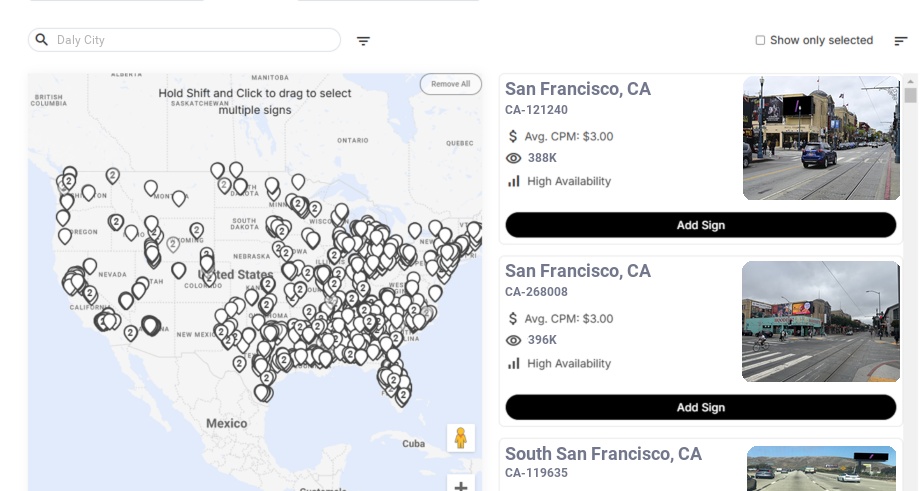



How much is a billboard near Daly City?
Why Choose Blip for Billboard Advertising near Daly City
Blip lets Daly City brands launch fast on I-280 and US-101, reaching commuters headed to San Francisco, SFO, and the Peninsula.
Set flexible budgets in Daly City and scale up for holiday shopping or back-to-school season near Serramonte and Tanforan.
Daypart your Daly City ads for 6:30-9:30 a.m. and 3:30-7 p.m. to catch repeat commuter traffic, then pause off-peak.
No contracts means Daly City advertisers can test short flights for SFO travelers, South San Francisco biotech workers, or weekend shoppers.
Blip's real-time analytics help Daly City campaigns shift spend toward the best-performing corridor as traffic moves between I-280, US-101, and BART.
Use Blip's creative tools to rotate bold, fog-friendly ads for Daly City's multilingual families and high-density neighborhoods.
Frequently Asked Questions About Billboard Advertising near Daly City
How much does a billboard cost near Daly City, California with Blip?
With Blip, you control exactly what you spend on Daly City billboards by setting a daily budget that can be as small or as large as you’re comfortable with, and Blip automatically keeps your campaign within that limit. Each “blip” is a 7.5–10 second ad display, and you only pay for the blips you receive, so your total cost over time is simply the sum of those brief, high-visibility impressions. You can adjust your budget whenever you like and choose the times of day and locations for billboards near Daly City, California, which helps you stretch every advertising dollar.
Where can I place Blip billboards near Daly City, California?
With 6 nearby Blip digital billboards in South San Francisco, Burlingame, and San Francisco, all within about 10 miles of Daly City, the page says you can reach residents, workers, and travelers moving through the area at strategic touchpoints along I‑280 and US‑101. The nearby billboard presence is concentrated along the main travel routes used by Daly City residents, so billboards near Daly City intersect with daily life rather than being one-off exposures. These placements give you strong coverage without needing boards inside the city limits itself.
Who do Daly City billboards with Blip reach in Daly City, California?
Daly City is one of the most population-dense communities in the Bay Area and a key gateway between San Francisco and the Peninsula, which makes Daly City billboards and nearby freeway placements especially efficient at capturing repeated impressions. Around 60% of Daly City residents are Asian, and roughly one-third of the total population identify as Filipino. The page also says over 60% of residents are estimated to speak a language other than English at home.
When is the best time to run billboard ads in Daly City, California with Blip?
Morning commute peaks are roughly 6:30–9:30 a.m. on weekdays, and evening peaks are around 3:30–7:00 p.m. Weekend traffic remains strong, driven by shopping, church attendance, and leisure trips to San Francisco and coastal destinations. The page also says summer and early fall bring higher tourist volumes through SFO, while the holiday season sees spikes in shopping and visiting relatives.
Do I need a contract to advertise with Blip near Daly City?
No, Blip has no long-term contracts or minimum commitments. You can start, pause, or stop your campaign at any time.
How fast can I launch a billboard campaign with Blip near Daly City?
You can have your campaign live in minutes. Create a free account, select your locations, set your budget, upload your design, and start running once approved.
Where can I advertise with Blip near Daly City?
Blip has digital billboards near Daly City. You can browse available locations on a map, choose the ones that fit your audience, and start advertising right away.
Still have questions? Launch a campaign in minutes — no contracts, no commitments.
Start Your CampaignDaly City Billboard Advertising Guide
Reaching audiences near Daly City, California with digital billboards is about understanding a dense, commuter-heavy community at the northern edge of the Peninsula, shaped by tech-driven incomes, multicultural households, and daily travel toward San Francisco and the airport. With 6 nearby Blip digital billboards in South San Francisco, Burlingame, and San Francisco (all within about 10 miles of Daly City), we can help you reach residents, workers, and travelers moving through the Daly City area at strategic touchpoints along I‑280 and US‑101. If you’re looking specifically for billboards near Daly City for flexible, data-informed campaigns, these locations give you strong coverage without needing boards inside the city limits itself.
Understanding the Daly City Area Market
Daly City is one of the most population-dense communities in the Bay Area and a key gateway between San Francisco and the Peninsula, which makes Daly City billboards and nearby freeway placements especially efficient at capturing repeated impressions.
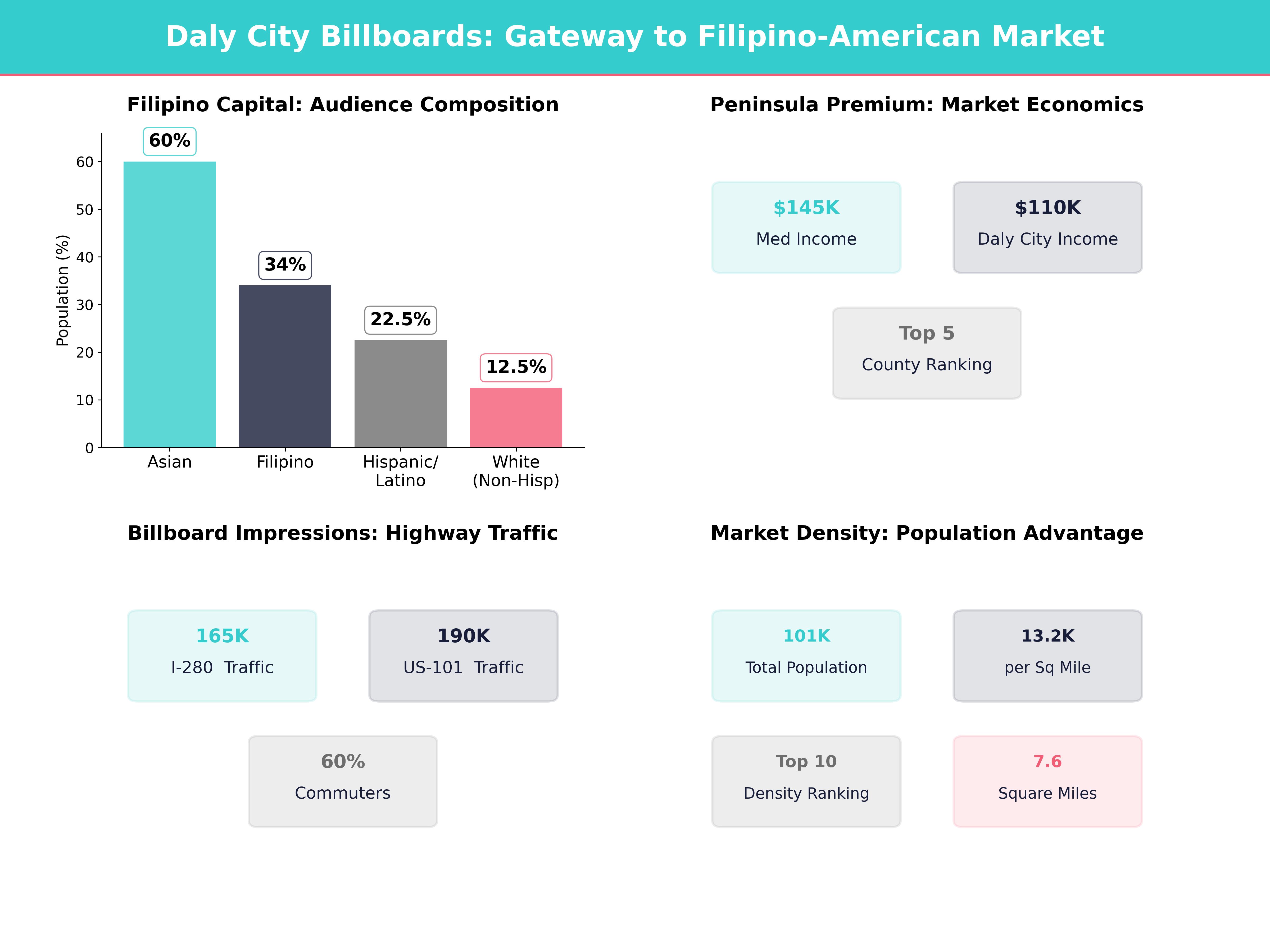
- Daly City’s population is about 101,000 residents, packed into just 7.6 square miles—over 13,200 people per square mile—placing it among the 10 most densely populated cities in California by residents per square mile.
- The broader San Mateo County, which Daly City anchors on the north end, has roughly 750,000 residents and has consistently ranked among the top 5 California counties for median household income, with countywide medians around $140,000–$150,000.
- Median household income in Daly City is in the $105,000–$115,000 range, and in nearby Burlingame it pushes closer to $150,000–$155,000, reflecting strong buying power for retail, finance, healthcare, and tech-adjacent services.
- Daly City’s labor force participation rate is typically around 65–70%, and unemployment has trended low in recent years (often in the 2–4% range), supporting steady consumer spending and stable commuting patterns.
Local government and planning resources like the City of Daly City, San Mateo County, the City of South San Francisco, and the City of Burlingame highlight continuing housing development, transit investment, and corridor improvements, all of which keep traffic and visibility high in the Daly City area, and in turn increase the value of billboard advertising near Daly City for brands that need consistent reach.
Our nearby billboard presence is concentrated along the main travel routes used by Daly City residents, ensuring that billboards near Daly City intersect with daily life rather than being one-off exposures:
- South San Francisco (about 4 miles from Daly City) along US‑101 and industrial/commercial corridors, home to a biotech cluster with over 200 life-science companies and tens of thousands of employees.
- Burlingame (about 8 miles from Daly City) capturing north–south traffic near San Francisco International Airport (SFO) and airport‑area hotels, which together support millions of overnight stays annually.
- South side of San Francisco (about 9 miles from Daly City) catching commuters going to and from downtown and SoMa, where citywide employment exceeds 700,000 jobs.
These placements allow you to reach Daly City audiences on daily commutes, airport trips, shopping runs (e.g., Serramonte Center, Tanforan, Colma shopping corridors), and regional journeys, making Daly City billboards a practical extension of your broader Bay Area media plan.
Who You’re Reaching: Demographics and Lifestyles
Daly City is highly diverse and family-oriented, with strong cultural communities that respond well to tailored messaging. Thoughtful billboard advertising near Daly City can tap into this diversity with creative that feels authentic and hyperlocal.
Ethnic and cultural composition
- Around 60% of Daly City residents are Asian, and roughly one-third of the total population (about 33–35%, or more than 30,000 people) identify as Filipino, making Daly City one of the largest Filipino communities outside the Philippines.
- About 20–25% of residents are Hispanic/Latino, representing more than 20,000 people in the city.
- White (non-Hispanic) residents make up around 10–15%, with the remainder including Black, Pacific Islander, and multiracial residents.
- Over 60% of Daly City residents are estimated to speak a language other than English at home, with Tagalog, Spanish, and Chinese dialects among the most common.
Implications for your billboard campaigns near Daly City:
- Consider inclusive imagery and representation—show families and professionals from Asian and Filipino backgrounds when appropriate.
- If your brand supports multilingual creative, Tagalog, Spanish, and Chinese can be powerful secondary line languages—especially for community events, healthcare, financial services, and education.
- Community-focused offers (church events, festivals, tutoring, clinics, local restaurants) tend to perform well in family-heavy neighborhoods like Daly City, where average household size is around 3.3–3.5 people.
Households and income
- Median household income in Daly City is in the low $100,000s, but housing costs are very high—median home values in the northern Peninsula and southern San Francisco frequently exceed $1,000,000, and many Daly City neighborhoods see typical single-family home prices in the $900,000–$1,200,000 range.
- Around 35–40% of households include children under 18, and roughly 25–30% of the population is under age 24, highlighting a strong youth and family segment.
- Many households are multigenerational: Bay Area estimates suggest 18–25% of households include three or more generations under one roof, and Daly City’s patterns are similar or higher, driven by cultural norms and high housing costs.
- Rentership is common. In several Daly City neighborhoods, 45–55% of occupied housing units are renter-occupied, supporting demand for moving services, renter’s insurance, and apartment‑friendly products.
These factors support:
- Strong demand for value-oriented offers (discounts, bundles, subscription savings) in a high-cost market.
- High interest in education, test prep, supplemental learning, and after-school activities, especially for K–12 and college-bound youth.
- Ongoing demand for home services (contractors, solar, HVAC, insurance, real estate agents) and financial products that help households manage high housing and living costs—categories that often see strong returns from well-placed Daly City billboards on commuter routes.
How Daly City Area Residents Move: Commutes and Traffic Corridors
Most Daly City residents work outside the immediate area, primarily in San Francisco and along the Peninsula corridor. Transportation and commuting analysis from regional agencies like the Metropolitan Transportation Commission, SamTrans, and Caltrain show:
- More than 60% of workers in the Daly City area commute to jobs in San Francisco or elsewhere in San Mateo and Santa Clara counties; in some estimates, 25–30% commute directly into the City and County of San Francisco.
- Daly City has some of the highest transit ridership in the region. The Daly City BART station routinely records on the order of 7,000–10,000 entries and exits per weekday, translating to over 150,000–200,000 monthly trips in typical months.
- Despite strong transit use, driving remains very common: auto mode share for work trips in the broader northern Peninsula often runs above 60–65%, combining solo drivers and carpools.
Our 6 nearby digital billboards align with the highest-traffic corridors around Daly City, so your billboard advertising near Daly City naturally fits into these daily commutes rather than relying on destination traffic only:
I‑280 and Daly City / San Francisco connection
- I‑280 near Daly City carries on the order of 150,000–180,000 vehicles per day, according to regional highway counts from agencies like Caltrans District 4.
- Many Daly City residents use I‑280 to reach downtown San Francisco, SoMa, Mission Bay, and the south Peninsula. Typical commute times into central San Francisco can run 25–45 minutes during peak hours.
- Our placements in southern San Francisco allow your brand to appear as Daly City commuters approach or return from the city, capturing multiple weekly impressions per driver.
US‑101 in South San Francisco and Burlingame
- US‑101 near South San Francisco and Burlingame routinely sees 180,000–200,000 vehicles per day, ranking it among the busiest freeway segments on the Peninsula.
- This corridor captures workers headed to the biotech cluster in South San Francisco, corporate offices in Brisbane and San Bruno, and the business parks around SFO, where tens of thousands of employees commute daily.
- Billboards in South San Francisco and Burlingame reach Daly City residents going to jobs, flights, or shopping at regional centers like The Shops at Tanforan and Burlingame’s retail corridors.
Airport and traveler traffic
- San Francisco International Airport (SFO) handled approximately 57–58 million passengers annually in strong pre‑pandemic years and has been rebuilding toward that level, with tens of millions of passengers passing through each year.
- SFO’s passenger base is a mix of domestic and international travelers; in many years, international passengers account for 25–30% of total traffic, delivering a valuable global audience moving along US‑101.
- Many Daly City residents and their visiting friends and family travel through SFO, as do tourists heading to San Francisco by way of US‑101 or I‑280. Airport‑area hotel occupancy often runs above 70–80% in peak seasons, supplying a constant flow of visitors on local freeways.
If you are targeting:
- Local residents: Focus on commute-time impressions along I‑280 and US‑101, where the average vehicle may pass your board 10–20 times per month.
- Regional shoppers and business travelers: Emphasize Burlingame boards that capture SFO and hotel corridor traffic, especially during weeks when convention or cruise passenger counts peak through San Francisco.
- San Francisco visitors staying near the airport: Use creative that offers reasons to venture north toward Daly City (restaurants, events, attractions, medical services), highlighting short drive times such as “10–15 minutes north via 101 or 280.”
Seasonality: When to Emphasize Your Campaign
The Daly City area has relatively stable traffic volumes year-round, but there are important seasonal and weekly patterns that can improve your return on ad spend and help you time billboard rental near Daly City for maximum impact.
Daily and weekly timing
- Morning commute peaks: roughly 6:30–9:30 a.m. on weekdays, as residents drive toward San Francisco and Peninsula employment centers; in many Bay Area corridors, more than 40% of daily traffic volume occurs during combined morning and evening peaks.
- Evening peaks: around 3:30–7:00 p.m., with more variability as hybrid work has grown; some corridors now see flatter peaks extending later into the evening.
- Weekend traffic remains strong, driven by shopping (e.g., Serramonte Center, which draws thousands of visitors daily and even more on holiday weekends), church attendance, and leisure trips to San Francisco and coastal destinations.
- Saturday volumes on major freeways can reach 80–95% of weekday levels, making weekends valuable for consumer-facing campaigns.
A Daly City–focused strategy might:
- Bid more heavily on weekday rush hours to reach commuters with work-related offers, financial services, or professional education.
- Increase weekend presence for retail, restaurants, events, and entertainment, when households are more likely to act on discretionary spending.
Seasonal patterns
- Summer and early fall bring higher tourist volumes through SFO and into San Francisco; in strong tourism years, hotel occupancy and visitor spending can rise 10–20% compared to winter months.
- The holiday season (November–December) sees spikes in shopping and visiting relatives, especially in multigenerational communities like Daly City. Retail sales in the Bay Area commonly rise 20–30% above average monthly levels during peak holiday weeks.
- Back-to-school (August–September) and tax season (January–April) provide strong windows for education, financial, and professional services; many tax preparers see 50–60% of their annual client volume in that four‑month window.
- Cultural and religious holidays important to Filipino, Latino, and Asian communities drive attendance at church events, festivals, and family gatherings, creating timely opportunities for community-facing campaigns.
With Blip’s flexible scheduling, you can:
- Dial up impressions during these seasonal windows without committing to a full-year static placement.
- Run short, high-intensity bursts (for example, 2–3 weeks) for events or promotions when local shopping or travel volumes are projected to spike.
- Maintain a low-level “always-on” presence near Daly City with occasional bursts around big sale weekends (Memorial Day, Labor Day, Black Friday) or key cultural holidays.
Creative Strategy for the Daly City Area: What Works on the Board
The local environment in the Daly City area has a few unique characteristics that should shape your creative whenever you invest in billboard advertising near Daly City.
1. Design for fog and low light
Daly City is famous for fog and overcast skies—its nickname as the “Gateway to the Peninsula” often comes with a gray backdrop. In summer months, some coastal and hillside areas can see fog on 50–70% of days.
- Use high contrast: bright colors (yellows, whites, light blues, neon accents) against dark backgrounds read best through fog.
- Favor bold, simple shapes: avoid thin typefaces and low-contrast color combinations like dark red on black.
- Consider slightly larger type sizes than you might use in sunnier markets so letters remain legible at 300–500 feet in low visibility.
2. Keep copy minimal and direct
At typical highway speeds (40–65 mph), audiences have about 6–8 seconds to process your message; research on roadside advertising suggests comprehension drops sharply when messages exceed 7–10 words.
Aim for:
- 7 words or fewer in the main headline.
- 1 clear call to action (CTA): “Exit at X,” “Book at [short URL],” “Call [short number].”
- One primary brand element (logo or name) at large scale, plus one supporting visual.
3. Local cues and neighborhood references
Daly City residents are proud of their community and identity.
- References to Daly City, Westlake, Top of the Hill, or nearby landmarks (e.g., Serramonte, St. Francis, Mission Street, Skyline Plaza) signal that you understand the local area.
- Filipino cultural references—when appropriate and authentic—can resonate strongly: celebrations, food, community gatherings, and family-oriented imagery.
- Consider pairing visuals with local sports (49ers, Giants, Warriors) or Bay Area motifs (Golden Gate Bridge, cable cars, coastal skyline) for broad appeal.
4. Multilingual possibilities
Where relevant:
- Use a bilingual headline (e.g., English and Tagalog or English and Spanish) for community events, clinics, and local services; limit each language to a short phrase.
- Keep translations short and impactful; avoid dense blocks of text in multiple languages.
- Consider rotating multiple language versions of the same creative to see which drives more web traffic or inquiries from Daly City ZIP codes.
By leveraging Blip’s digital platform, you can rotate different language versions in the same campaign to see which performs better at driving web or in-store responses, and then shift 60–80% of impressions to the best-performing variant.
Strategic Placements Near Daly City: Matching Message to Location
Our 6 digital billboards serving the Daly City area are positioned to capture different trip purposes and mindsets. Tailor your campaigns accordingly so that each placement works together as a network of billboards near Daly City rather than in isolation.
South San Francisco (about 4 miles from Daly City)
Ideal for:
- Daly City residents commuting to biotech, logistics, and corporate jobs in South San Francisco and Brisbane; the South San Francisco biotech hub alone supports tens of thousands of daily workers.
- Workers and visitors heading toward San Bruno shopping centers, The Shops at Tanforan, and local hotels along El Camino Real and near the South San Francisco BART station.
- Heavy daytime traffic from industrial parks and office campuses, where peak hour volumes can reach 8,000–10,000 vehicles per lane in each direction on US‑101 segments.
Best use cases:
- B2B services (IT, staffing, commercial insurance) targeting local employers and their employees.
- Quick-serve restaurants, cafes, and convenience retail pitched as “on your way to work or home,” especially effective when timed around breakfast and lunch.
- Healthcare and dental services positioned as convenient to both Daly City and South San Francisco, highlighting drive times of 10–20 minutes from major neighborhoods.
Burlingame (about 8 miles from Daly City)
Ideal for:
- Airport-bound traffic: Daly City residents and their guests heading to and from SFO; airport access roads can see tens of thousands of vehicles daily.
- Business travelers and tourists using airport hotels and rental cars; SFO’s hotel submarket includes dozens of properties with thousands of rooms.
- Shoppers visiting Burlingame Avenue and nearby retail corridors, where weekend foot traffic can significantly exceed weekday levels.
Best use cases:
- Hotels, parking services, shuttle operators, and travel-related offers aiming to reach tens of thousands of airport travelers per day.
- Restaurants and entertainment, using messaging like “10 minutes north in the Daly City area” or “Exit toward Daly City for family dining.”
- High-value professional services (cosmetic dentistry, elective medical, legal, financial planning) aimed at affluent Peninsula travelers and residents, where median household incomes often exceed $150,000.
San Francisco placements (about 9 miles from Daly City)
Ideal for:
- Daly City residents commuting into San Francisco’s downtown and waterfront, where daily inbound vehicle counts into the city can exceed 300,000 across bridges and freeway portals.
- City visitors who may stay or explore on the south side of San Francisco and then move through the Daly City area via I‑280 or Mission Street.
- Workers in SoMa, Mission Bay, and Civic Center, who represent a large concentration of tech, healthcare, and government employment.
Best use cases:
- Event promotion (concerts, conferences, festivals) that expect Daly City and Peninsula attendees; large Bay Area events can draw 10,000–50,000 people over a weekend.
- Higher education, trade schools, and professional programs drawing from both San Francisco and Daly City; many city campuses enroll thousands of Peninsula and South Bay students.
- Brands wanting both Daly City residents and San Francisco urban professionals in one buy, maximizing reach across two high-income, high-density markets.
Campaign Ideas by Business Type
Local retailers and restaurants
- Focus boards closer to South San Francisco and Burlingame, where Daly City residents frequently shop and dine on weekends; regional malls and big-box centers often report Saturday sales 20–40% higher than typical weekdays.
- Use directional CTAs: “5 miles north near Daly City,” “Next exit toward Daly City,” or “Exit [number] for Daly City dining.”
- Run dayparted campaigns around meal times (11 a.m.–2 p.m., 5–8 p.m.) with lunch and dinner specials, using limited-time offers to drive same-day visits.
Healthcare and wellness providers
- Daly City has significant demand for family medicine, dental, optical, and specialty clinics, with many residents willing to travel a few extra miles for quality care in a region where appointment wait times can stretch into several weeks.
- Emphasize convenience (“Near Daly City BART,” “10 minutes from Daly City via I‑280”), extended hours, or multilingual staff—especially Tagalog- and Spanish-speaking providers.
- Time campaigns around enrollment periods for Covered California and employer plans, flu season (often peaking October–February), and back-to-school physicals and vaccinations.
Professional services (real estate, finance, legal)
- Highlight local expertise in the Daly City area: “Serving Daly City families since [year]” or “Specializing in Peninsula and San Francisco markets.”
- For real estate, promote current average home prices or success metrics (e.g., “Homes sold 15–20% over asking” or “Average 10 days on market”), which reflect the competitive northern Peninsula market.
- Schedule heavier presence during spring and early summer homebuying seasons, when listings and buyer activity typically peak, and just before tax deadlines (January–April) for tax, accounting, and financial planning services.
Education, tutoring, and test prep
- Promote after-school programs and weekend tutoring to commuter parents driving through South San Francisco and San Francisco boards; many local families spend thousands of dollars annually on supplemental education.
- Use calendar-driven campaigns: back-to-school (Aug–Sep), pre-SAT/ACT/AP seasons (Jan–Apr), and summer programs (May–Jul).
- Emphasize results and convenience (“Near Daly City, easy access from I‑280,” “5 minutes from Daly City BART”), using short URLs and QR codes to capture interest while the parent is in the car.
Events, nonprofits, and community organizations
- Use short, focused flights 1–3 weeks before the event, with increasing frequency as the date approaches; most event ticket sales spike in the final 7–10 days.
- Include simple date, location, and a short URL or QR-friendly link; avoid clutter.
- Tap cultural holidays and regional events heavily celebrated in the Daly City area (Filipino festivals, church events, school fairs, local parades). Partnering with community centers, churches, and schools can boost attendance and word-of-mouth.
Using Blip’s Flexibility to Win in the Daly City Area
Blip’s platform allows you to buy only the impressions you want, when and where you want them. For the Daly City area, that means you can tailor by corridor, time, and budget to match how people actually move and to make billboard rental near Daly City as efficient as possible for your goals.
1. Target by board and corridor
- Emphasize South San Francisco boards for Daly City commuters and local workers, especially if your customers live in Daly City but work in office or biotech parks.
- Add Burlingame placements when you want SFO and airport hotel traffic, capturing tens of thousands of monthly impressions from visitors who may not see other media.
- Layer in San Francisco boards for maximum coverage of Daly City commuters heading into the city and back, increasing frequency among high-value professional audiences.
2. Dayparting for commuter-heavy exposure
- Set higher bids for 7–9 a.m. and 4–7 p.m. on weekdays to dominate key commute windows, when a high share of freeway traffic is work-related.
- Reduce or pause during late-night hours if your audience is less active then, reallocating those dollars to peak times to improve effective reach.
- For nightlife or entertainment campaigns, reverse this strategy and emphasize evenings and weekends, when bars, venues, and restaurants in both Daly City and San Francisco see their highest volumes.
3. Budget control and flighting
- Start with a test budget over 2–4 weeks, evenly split between South San Francisco, Burlingame, and San Francisco boards, to gather comparative data by corridor.
- Use performance indicators—web traffic from Daly City and adjacent ZIP codes, coupon redemptions, direct inquiries, and call volume—to decide where to concentrate spend; shifting even 20–30% of impressions from weaker to stronger boards can noticeably improve ROI.
- Create “pulses”: higher-intensity weeks around holidays, paydays (1st and 15th), and community events, while keeping baseline visibility at a lower, steady spend so your brand remains familiar when promotions ramp up.
Measuring and Optimizing in the Daly City Area
To make your Daly City–area campaign as effective as possible, connect your billboard activity to measurable outcomes.
Simple tracking ideas
- Use unique short URLs or landing pages tied to specific creatives (e.g., “/dalycity” vs. “/101south”), and monitor which one drives more sessions and form fills from target ZIP codes.
- Include distinct promo codes for morning vs. evening creatives, or for different board clusters (e.g., “SSF10” vs. “BURL10”).
- Track spikes in direct brand searches in the Daly City area during your flight dates using your web analytics tools; many advertisers see noticeable lifts of 10–30% in branded search during well‑timed billboard campaigns.
A/B testing with creative rotations
With digital billboards, you can run multiple creative versions simultaneously and rotate them:
- Test “price-focused” vs. “benefit-focused” headlines; in many retail campaigns, price‑led creatives can outperform by 15–25% in short-term conversions, while benefit-led creatives can build stronger long-term recall.
- Compare bilingual vs. English-only creative, especially in areas with high Tagalog and Spanish use.
- Evaluate which CTA works better: “Visit us near Daly City” vs. “Exit at [X] for [Brand],” and then allocate 60–80% of impressions to the winner.
After 2–4 weeks, use the data you have—web analytics, store visitation patterns, inbound calls, and campaign‑specific codes—to refine the winning message and allocate more budget to the best-performing boards and time windows.
Helpful Local Resources for Planning
To enrich your local understanding and align your campaign with what’s happening around Daly City, we recommend:
- City information and planning: City of Daly City
- County-level data and initiatives: San Mateo County
- Neighboring cities and corridor planning:
-
Transit and transportation:
- SamTrans for bus routes and ridership in the Daly City–San Mateo County corridor
- San Francisco Municipal Transportation Agency (SFMTA) for city traffic and transit context
- BART for Daly City BART ridership, schedules, and system maps
- Caltrain for Peninsula rail commuter patterns
- Caltrans District 4 for highway traffic counts and construction alerts on I‑280 and US‑101
-
Regional tourism and visitor trends:
- San Francisco Travel Association
- San Mateo County / Silicon Valley Convention and Visitors Bureau
-
Local and regional news to time your campaigns with events and issues:
- San Francisco Chronicle
- San Mateo Daily Journal
- Daly City news on KRON4
By combining these insights with Blip’s flexible digital billboard capabilities, we can help you build highly targeted, data-informed campaigns that effectively reach and engage audiences traveling through the Daly City area—whether they are commuting, shopping, visiting family, or catching a flight—while making the most of billboards near Daly City for measurable business results.