Billboards near Albany, CA
No Minimum Spend. No Long-Term Contracts. Just Results.
Trusted by Leading Brands


Billboard advertising
near Albany has never been easier
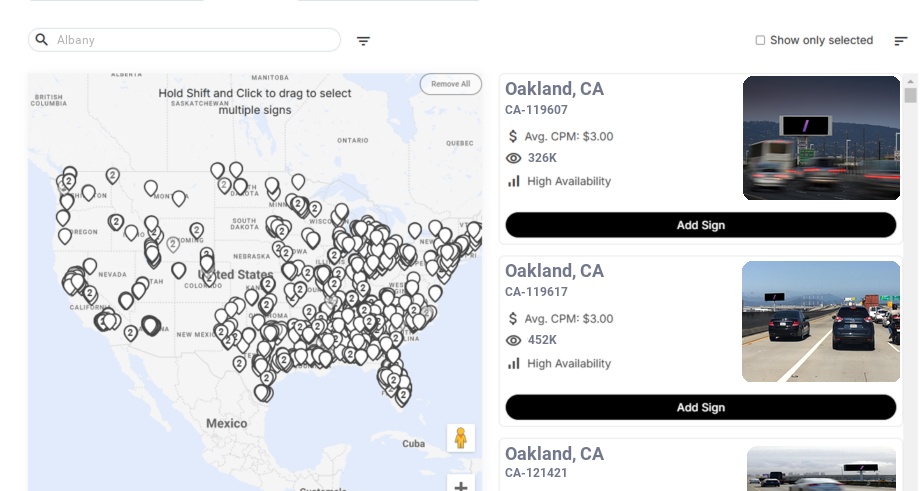



How much is a billboard near Albany?
Why Choose Blip for Billboard Advertising near Albany
Blip lets you launch Albany billboards fast, reaching I-80/I-580 commuters and San Pablo Ave shoppers without media-buying hassles.
In Albany, flexible budgets mean you can start small and scale with the commuter rush, UC Berkeley traffic, and weekend Bay Trail visitors.
Daypart your Albany campaign for rush hour, lunch, or evening return trips, so your ads meet drivers stuck on I-80 and San Pablo Ave at the right time.
No contracts with Blip make Albany testing easy—try messages for Solano Ave, UC Berkeley, or family-focused neighborhoods and adjust anytime.
Real-time analytics help Albany brands see what’s working across Berkeley, Oakland, and San Francisco-bound traffic, then shift spend fast.
Frequently Asked Questions About Billboard Advertising near Albany
How much does a billboard cost near Albany, California with Blip?
With Blip, you control exactly how much you spend on Albany billboards by setting a daily budget that Blip automatically follows, so you can advertise on digital billboards near Albany, California on any budget. Each “blip” is a brief ad display, and you only pay for the individual blips you receive, with costs varying based on when and where you choose to appear and current advertiser demand. That means your total campaign cost is simply the sum of those blips over time.
Where can I advertise with Blip near Albany, California?
There are 23 nearby digital billboards serving the Albany area, with placements concentrated along the core travel paths around Berkeley, San Pablo, Oakland, and San Francisco. The main corridors highlighted are the I-80/I-580 Corridor, San Pablo Avenue, and the Berkeley/Oakland urban grid. These locations are designed to intercept commuters, shoppers, students, and visitors moving through the East Bay.
Why is Albany, California a good market for billboard advertising with Blip?
Albany is compact and concentrated, with about 20,000 residents in just 1.8 square miles, creating strong repeat impressions for billboard campaigns. The area is also affluent and highly educated, with median household income around $120,000–$125,000 and over 70% of adults holding a bachelor’s degree or higher. More than 30% of households include children under 18, which adds to the local word-of-mouth effect.
What kind of traffic do Albany, California billboards with Blip reach?
Albany-area billboards can reach heavy traffic on the I-80/I-580 corridor, where daily volumes are commonly in the 200,000–260,000 vehicle range and some segments exceed 270,000 vehicles per day. San Pablo Avenue near Albany frequently sees 20,000–30,000 vehicles per day, and peak speeds can dip to 10–20 mph, creating strong dwell time. The page also says these boards intercept an estimated 500,000+ daily vehicle trips across the multi-city corridor.
When should I run Blip ads on Albany, California billboards?
The page recommends dayparting campaigns around the morning commute, midday, evening commute, and weekends. Morning traffic runs from 6:30–9:30 a.m., midday is strong for lunch and errands, and evening congestion from 3:30–7:30 p.m. is ideal for family, food, and after-work messaging. Weekend traffic is more spread out and can be especially useful for entertainment, recreation, and shopping campaigns.
Do I need a contract to advertise with Blip near Albany?
No, Blip has no long-term contracts or minimum commitments. You can start, pause, or stop your campaign at any time.
How fast can I launch a billboard campaign with Blip near Albany?
You can have your campaign live in minutes. Create a free account, select your locations, set your budget, upload your design, and start running once approved.
Where can I advertise with Blip near Albany?
Blip has digital billboards near Albany. You can browse available locations on a map, choose the ones that fit your audience, and start advertising right away.
Still have questions? Launch a campaign in minutes — no contracts, no commitments.
Start Your CampaignAlbany Billboard Advertising Guide
Albany, California sits at the heart of a dense, affluent, and highly mobile corridor between Berkeley, Oakland, San Pablo, and San Francisco. With 23 nearby digital billboards serving the Albany area, we can help brands tap into daily commuter flows, university-driven traffic, and neighborhood shopping and dining patterns with precision. Below, we walk through how to plan a data-driven, high-impact digital billboard campaign near Albany using Blip’s flexibility, whether you’re exploring billboard advertising near Albany for the first time or scaling existing buys.
Understanding the Albany Area Market
Albany is compact and concentrated, which is ideal for billboard impact. When you invest in Albany billboards, this density can quickly translate into repeat impressions and memorable campaigns.
- Population density: About 20,000 residents live in just 1.8 square miles, a density of roughly 11,000–12,000 people per square mile, making it one of the more compact communities in the inner East Bay. High density boosts the chances that the same people repeatedly pass key corridors, which is ideal for frequency-based billboard campaigns.
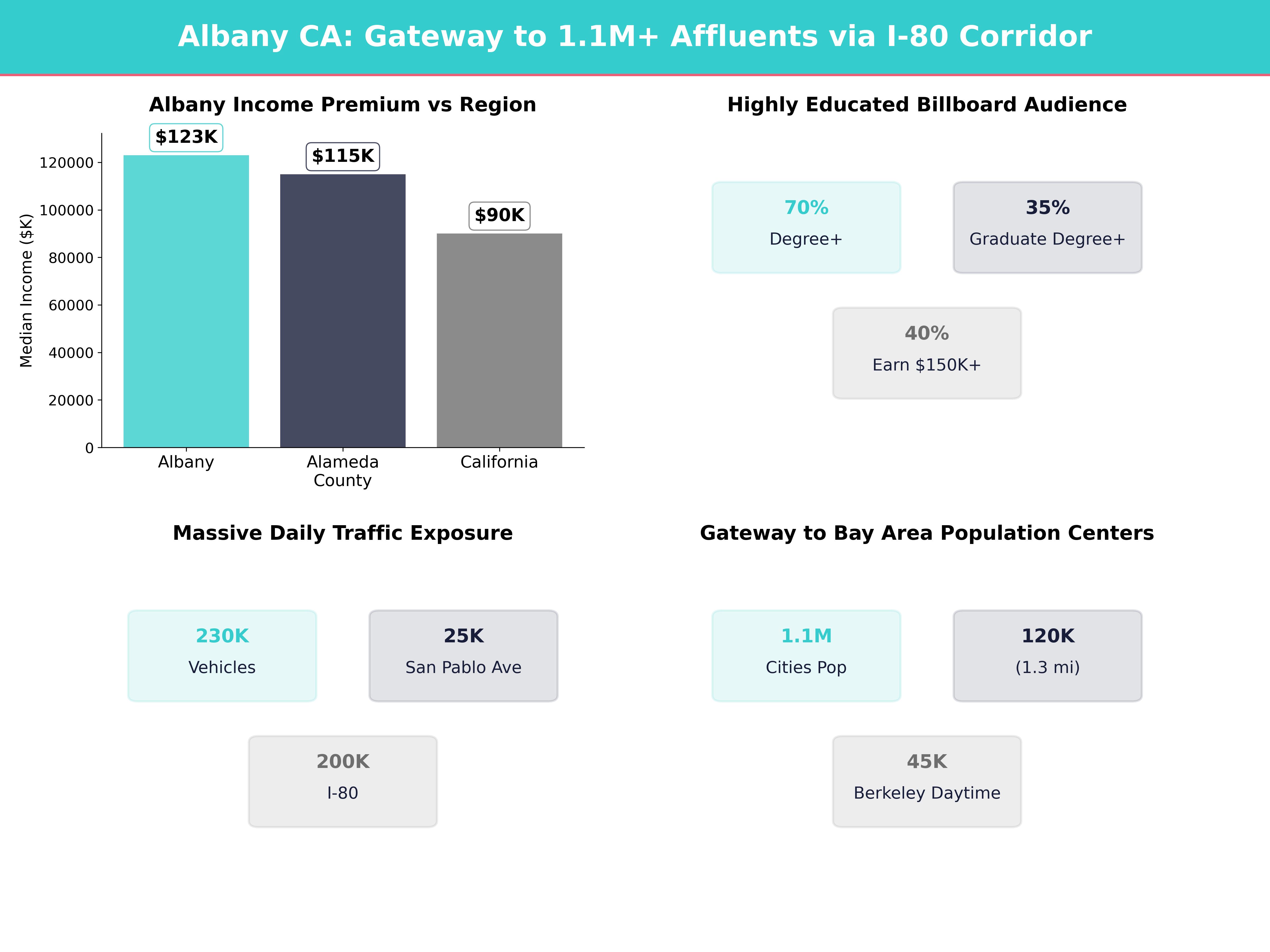
- Affluence: Median household income in Albany is around $120,000–$125,000, compared with a California median near $90,000 and an Alameda County median around $115,000. More than 40% of households earn $150,000 or more annually, supporting discretionary spending on dining, health, education, and premium retail.
- Education levels: Over 70% of adults in Albany hold a bachelor’s degree or higher, and more than 35% hold a graduate or professional degree. This skews audiences toward professional, scientific, educational, and technology occupations, with a strong appetite for information-rich, values-driven messaging and brand storytelling.
- Family orientation: Albany’s schools are a major draw. The Albany Unified School District serves roughly 3,500 students across multiple campuses, and more than 30% of households include children under 18. High participation in PTA programs, youth sports, and enrichment activities creates strong networks where billboard messages can be reinforced through word-of-mouth and local digital channels.
Albany is formally a small city, but practically part of a much larger, continuous East Bay sub-region. Nearby cities where our billboards are located—Berkeley, San Pablo, Oakland, and San Francisco—form the real-world travel shed for Albany residents and visitors. The combined population of these adjacent cities exceeds 1.1 million people, giving brands reach far beyond Albany’s city limits while still feeling hyper-local when you choose billboards near Albany.
For context on the broader civic environment and economic development priorities, advertisers can review planning and transportation data from the City of Albany, City of Berkeley, City of Oakland, and City of San Pablo.
Where Albany-Area Traffic Really Flows
Most Albany residents and visitors don’t stay inside Albany’s borders all day. They regularly move through high-traffic corridors where our digital billboards are positioned, creating ideal placements for billboard advertising near Albany:
- I-80 & I-580 Corridor (Berkeley, San Pablo, Oakland):
According to Caltrans District 4, average annual daily traffic volumes on the I-80/I-580 segment skirting the Albany area are commonly in the 200,000–260,000 vehicles per day range, with some segments exceeding 270,000 vehicles per day near the MacArthur Maze. This is one of the busiest freeway corridors in Northern California and consistently ranks as a top congestion hotspot in the Bay Area. - San Pablo Avenue (State Route 123):
San Pablo Avenue, which runs through Albany’s western edge, carries a mix of local shoppers, commuters, and service workers. Segments near Albany frequently see 20,000–30,000 vehicles per day, and typical peak-period speeds can dip to 10–20 mph, creating strong dwell time and repeat exposures for drivers, bus riders, and cyclists. - Berkeley/Oakland urban grid:
The nearby urban streets of Berkeley and Oakland host dense local and student traffic. The City of Berkeley notes that more than 50% of residents commute by modes other than driving alone, with bike mode share around 9%, walk share near 16%, and transit near 19%—some of the highest non-auto rates in the state. Even with this multimodal mix, major arterials like Shattuck Avenue, Telegraph Avenue, and Ashby Avenue still see tens of thousands of vehicles per day, plus heavy bus and bike volumes.
Our 23 digital billboards serving the Albany area are concentrated along these core travel paths, especially around:
- Berkeley (1.3 miles from Albany) – population about 120,000, daytime population boosted by 45,000+ UC Berkeley
- San Pablo (4.9 miles from Albany) – a key working-class and service corridor with roughly 30,000 residents and strong pass-through traffic between I-80 and central Contra Costa County.
- Oakland (7.2 miles from Albany) – the East Bay’s largest city with around 430,000–440,000 residents, a major job center, and busy regional attractions like Jack London Square and the Oakland Arena.
- San Francisco (8.3 miles from Albany) – roughly 800,000–810,000 residents plus hundreds of thousands of daily inbound commuters and visitors.
Strategically, you are not just reaching Albany residents—you are intercepting an estimated 500,000+ daily vehicle trips and substantial bus, bike, and pedestrian flows that move through this multi-city corridor, maximizing the reach of Albany billboards placed along these routes.
Commuters, Transit, and When to Target Them
Albany’s workforce is highly commuter-based:
- More than 60% of employed residents work outside Albany, with major destinations including Berkeley, Oakland, Emeryville, and San Francisco.
- Typical one-way commute times fall in the 30–45 minute range; roughly 25–30% of workers spend more than 45 minutes getting to work, especially those traveling across the Bay Bridge or down to Silicon Valley.
- Mode share in nearby Berkeley and Oakland shows strong transit, bike, and walk commuting, amplified by regional agencies such as BART and AC Transit, which together move more than 450,000 riders on an average weekday across their systems.
Key patterns to leverage with time-based scheduling in Blip:
- Morning commute (6:30–9:30 a.m.):
Heavy flows toward Berkeley, Oakland, Emeryville, and across the Bay Bridge to San Francisco. On I-80/I-580, peak-direction volumes can exceed 10,000 vehicles per lane per day, with congestion often beginning before 7:00 a.m. Use straightforward, high-contrast offers and commute-relevant messages (coffee, breakfast, transit connections, productivity tools). Short messages can reach both drivers and bus riders stuck in slow traffic. - Midday (11:00 a.m.–2:00 p.m.):
Strong local circulation for lunch, errands, and campus activity near UC Berkeley 15–25% drop from peak a.m. volumes, and parking turnover in commercial districts like Solano Avenue and Berkeley’s Downtown remains high. This is prime time for restaurants, retailers, medical offices, and local services wanting to reach people while they’re deciding where to go next. - Evening commute (3:30–7:30 p.m.):
Return flows toward Albany and neighboring residential areas. Evening congestion on I-80 through Berkeley and Albany is routinely cited by the Metropolitan Transportation Commission as one of the region’s most delay-prone segments, with average travel speeds sometimes below 25 mph. Promote family activities, events, groceries, food delivery, and after-work services when people are planning dinner, shopping, and leisure. - Weekends:
Weekend traffic volumes on I-80 through the East Bay often reach 70–90% of weekday peaks, with more discretionary trips. Albany’s residents frequently visit nearby attractions such as the Berkeley Marina Golden Gate Fields, and San Francisco destinations. Weekend traffic patterns are more spread out between late morning and early evening, ideal for entertainment, recreation, and shopping campaigns.
With Blip, we can daypart campaigns so your ads appear more frequently during these high-value windows rather than spreading budget thin across low-impact hours like late night or mid-afternoon weekdays, making billboard rental near Albany more efficient.
For more detailed local commute and traffic initiatives, advertisers can reference transportation planning resources from the Alameda County Transportation Commission and 511 SF Bay.
Tapping Into UC Berkeley and the Academic Ecosystem
Just south of Albany, UC Berkeley 45,000 students, faculty, and staff:
- Approximately 32,000+ students (undergraduate and graduate).
- Around 14,000 faculty and staff.
- Tens of thousands of additional annual visitors for campus tours, lectures, conferences, and athletic events.
This academic community heavily influences the Albany area:
- A sizable share of students, postdocs, and staff live, shop, or dine in Albany and adjacent neighborhoods like North Berkeley and El Cerrito; student surveys show that 60–70% of undergraduates live off campus, many within a few miles.
- Student spending is concentrated in food, entertainment, transportation, and technology. National campus studies indicate undergraduates can spend $3,000–5,000 per year on discretionary purchases beyond tuition and housing, much of it in nearby business districts.
- Academic calendar cycles (midterms, finals, move-in, graduation) shape local demand and foot traffic, especially along transit-connected corridors.
When aiming at this audience:
- Focus creatives on value, convenience, and local culture—quick meals under $15, discounts with student IDs, late-night hours, and study-friendly spaces.
- Emphasize walkable access from campus or transit lines (BART, AC Transit). For example, the nearby North Berkeley BART and El Cerrito Plaza BART stations together handle 10,000+ average weekday entries.
-
Align campaign flights with:
- August–September: Move-in and semester start, when tens of thousands of students and families arrive and make first-time local purchasing decisions.
- Late November–December & April–May: Holiday and graduation periods, with spikes in restaurant, retail, and lodging demand from visiting families.
- Summer sessions: Smaller but steady flow of students and visitors; UC Berkeley’s summer enrollment typically reaches 15,000+ students, including international visitors.
Positioning on billboards serving the Albany and Berkeley area lets you catch students biking or driving to campus, commuting faculty, and visiting families traveling via I-80 or San Pablo Avenue. This makes billboard advertising near Albany particularly effective for brands that rely on student and faculty traffic.
Tourism, Events, and Visitor Traffic Near Albany
Though Albany itself is low-key, it sits between major visitor destinations:
- Berkeley: The Visit Berkeley tourism bureau highlights UC Berkeley, the arts scene, the Berkeley Marina, and award-winning dining as core draws. Berkeley’s hotel market commonly records hundreds of thousands of room nights sold per year, with overall visitor spending contributing hundreds of millions of dollars to the local economy.
- Oakland: Visit Oakland reports that Oakland hosts iconic attractions such as the Oakland Arena, the Oakland Museum of California, and the First Friday arts events. Pre-pandemic, Oakland saw on the order of 3–4 million visitors annually, with visitor spending surpassing $700 million in peak years.
- San Francisco: San Francisco Travel 2023, San Francisco welcomed approximately 23–24 million visitors, who spent around $8–9 billion in the city, plus billions more in the broader Bay Area.
A significant share of these visitors:
- Travel along I-80/I-580 between the North Bay, Sacramento Valley, and San Francisco.
- Stay in East Bay hotels (often at 10–30% lower room rates than San Francisco) while visiting San Francisco and Berkeley.
- Use popular recreation corridors like the San Francisco Bay Trail that passes near Albany’s shoreline.
This makes Albany-area billboards an efficient way to:
- Announce attractions and events across Berkeley, Oakland, and San Francisco.
- Direct traffic to hotels, entertainment districts, and waterfronts on both sides of the Bay.
- Reinforce brand visibility for regional chains and tourism partners targeting both locals and visitors.
Key times to consider heavier spend:
- Spring and fall: High tourism and event activity as UC Berkeley is in full session, major festivals occur in Oakland and San Francisco, and weather is ideal for outdoor recreation.
- Summer: Family travel, outdoor events, and festivals drive strong weekend and early evening volumes; the Bay Area’s peak visitor season often sees hotel occupancies above 80% in core markets.
- Weekends and holidays: Bay Trail recreation, waterfront events, and city festivals increase volumes. On popular holiday weekends, I-80 through Berkeley and Albany can experience 20–30% higher traffic than typical weekends.
For specific event calendars and visitor data, advertisers can monitor Visit Berkeley, Visit Oakland, San Francisco Travel Berkeleyside and the East Bay Times.
Local Identity: What Resonates With Albany-Area Audiences
Albany and adjacent neighborhoods in Berkeley, North Oakland, and El Cerrito share a distinctive local culture:
- Strong focus on sustainability and the environment. Albany’s shoreline parks, the Albany Bulb San Francisco Bay Trail make walking, biking, and outdoor recreation daily habits. Regional surveys show that 40–50% of East Bay residents rate environmental and climate issues as “very important” in local decision making.
- High engagement with local politics and community issues, reported by outlets like Berkeleyside, the East Bay Times, and the Albany community news page 70% in major elections, indicating a civically active population.
- Preference for authentic, community-rooted brands over generic corporate messaging. Surveys of Bay Area consumers regularly show that more than 60% prefer businesses that identify as local or independently owned, especially in food, retail, and personal services.
For creatives serving the Albany area:
- Highlight local ties (“Serving East Bay families since 2005,” “Locally owned near Solano Avenue”) and social impact (donations to local schools or environmental groups).
- Use imagery featuring Bay shoreline, bicycles, transit, and neighborhood streets rather than generic cityscapes. Tie visuals to well-known spots like Solano Avenue, the Albany Bulb, or Golden Gate views from the Berkeley Marina
- Lean into values: sustainability, education, social good, and inclusion. For example, highlight renewable energy use, fair labor, or scholarship programs if relevant.
- When relevant, refer to recognizable local landmarks ( Solano Avenue Stroll Lake Merritt) to build trust and relevance.
Key Corridors and How to Use Them Strategically
Our 23 digital billboards serving the Albany area are positioned to intercept different audience segments depending on your goals. Consider these regional corridors and align creative accordingly when planning billboard rental near Albany:
1. I-80/I-580 Near Berkeley and San Pablo
Audience:
- Long-distance commuters between Contra Costa County, the North Bay, and San Francisco/Oakland. I-80 is a primary link for more than 200,000 daily cross-county commuters in the northern Bay Area.
- Commercial drivers and logistics workers connecting the Port of Oakland, Richmond’s port facilities, and regional distribution centers.
- Regional shoppers and visitors traveling between major retail hubs such as Bay Street Emeryville Hilltop by the Bay
Best for:
- Regional brands (banks, healthcare systems, auto dealers, retail chains) seeking broad East Bay and cross-Bay awareness.
- E-commerce brands seeking broad Bay Area awareness and upper-funnel brand recognition.
- Tourism campaigns directing travelers to waterfronts, attractions, and downtowns throughout the Bay.
Messaging tips:
- Keep text extremely concise (ideally 6–10 words and fewer than 40 characters).
- Use bold brand identifiers and clear calls to action (exit numbers, website, or a short URL). For example, “Exit Central Ave • Albany Solar Savings.”
- Rely on high-contrast color schemes that remain readable through fast or congested traffic conditions and varied weather (fog, glare).
2. Arterials Near Berkeley and Oakland
Audience:
- Albany and Berkeley residents on shorter trips along San Pablo Avenue, Solano Avenue, Gilman Street, Ashby Avenue, Shattuck Avenue, and Telegraph Avenue.
- UC Berkeley students and faculty traveling by bus, bike, scooter, or car between campus and housing, often making multiple trips per day through the same corridors.
- Local workers and shoppers visiting grocery stores, coffee shops, gyms, and clinics.
Best for:
- Restaurants, coffee shops, and grocery stores aiming to capture spur-of-the-moment decisions; food-service studies show that 50–60% of diners choose their destination within two hours of a visit.
- Fitness centers, health clinics, and personal services where convenience and proximity matter more than deep discounting.
- Local events, classes, and cultural institutions (theaters, galleries, museums) in Berkeley, Albany, and North Oakland.
Messaging tips:
- Include directional cues (“Just off San Pablo Ave,” “5 minutes from Solano Ave,” “Near Downtown Berkeley BART”) since average speeds of 20–30 mph allow slightly more detailed information than freeways.
- Emphasize time-sensitive offers (“Tonight only,” “Happy hour 4–7 p.m.,” “Weekend sale”) that can convert nearby audiences within the same day.
- Use creative variations for weekday vs. weekend or lunch vs. evening periods, and track which time windows deliver the best response using custom URLs or promo codes.
3. San Francisco-Facing Boards
Audience:
- Albany-area residents heading into San Francisco for work or entertainment; in the broader East Bay, well over 100,000 commuters per day cross the Bay Bridge.
- Reverse commuters and visitors returning to the East Bay in the afternoons and evenings.
- Tourists staying in San Francisco but visiting East Bay attractions via BART or by car.
Best for:
- Brands with footprints on both sides of the Bay (restaurants, venues, retail, coworking spaces) that want to reinforce familiarity regardless of trip direction.
- Employers recruiting talent from the East Bay for San Francisco offices; tech, finance, and health firms frequently draw from a Bay-wide labor pool.
- Entertainment and nightlife, including venues in SoMa, the Mission, Downtown Oakland, and Berkeley’s arts district.
Messaging tips:
- Reference cross-bay convenience (“15 minutes across the bridge*” with fine print referencing off-peak travel, “Easy BART access from Downtown Berkeley”) to reduce perceived distance.
- Pair out-of-home with digital campaigns targeting the same commute corridor (e.g., geofenced mobile ads around Transbay Transit Center and downtown BART stations).
- Use brand assets and visuals recognizable in both markets (Bay Bridge, skyline silhouettes, Ferry Building, or East Bay hills).
Using Blip’s Tools for Albany-Area Precision
Blip’s platform makes it possible to treat the Albany area as its own micro-market within the larger Bay Area. We encourage advertisers to:
- Geographically cluster boards:
Group billboards serving the Albany, Berkeley, and North Oakland area to saturate a compact radius where your customers live and shop. In a 3–5 mile radius, residents may pass your boards 2–4 times per day, quickly building reach and frequency. This kind of clustering is especially useful if you’re testing billboards near Albany for the first time and want measurable saturation. - Daypart aggressively:
Use morning/afternoon commute windows, lunch hours, and weekend blocks. For example, a Solano Avenue restaurant may focus 80% of impressions between 11:00 a.m. and 2:00 p.m. and 4:30 p.m. to 8:30 p.m., when restaurant industry data shows that 70–75% of daily traffic and revenue typically occur. -
Run multiple creatives simultaneously:
Test variations by:- Neighborhood call-out (“Near Solano” vs. “Near North Berkeley BART”).
- Offer type (percent discount vs. BOGO vs. event-based). Retail testing often shows that BOGO offers can lift response by 10–20% over equivalent percentage discounts.
- Value proposition (local, sustainable, affordable, premium). Track which message aligns best with the East Bay’s values-driven consumer base.
-
Align with local calendars:
Sync campaigns with:- The city’s community events from the City of Albany and surrounding cities’ event calendars such as Berkeley’s Civic Arts events
- UC Berkeley academic and sports calendars, including home football games at California Memorial Stadium, which can draw 40,000–60,000 attendees per game.
- Regional festivals and holidays highlighted by local outlets like Berkeleyside and East Bay Times, including the Solano Avenue Stroll
Creative Best Practices for High-Impact Albany-Area Campaigns
To maximize ROI on billboards serving the Albany area, we recommend:
- Big fonts, bright contrast:
Design for quick comprehension at 55–65 mph on freeways and 25–35 mph on arterials. Outdoor advertising standards suggest letters at least 18–24 inches tall on freeway boards and strong contrast ratios (e.g., dark text on light background). - One main message:
Aim for a single core idea plus one call to action. For example:
“Solano Ave Brunch • This Weekend • [BrandName].com”
Studies of out-of-home readability show that messages with 7 words or fewer are significantly more likely to be fully processed in a single pass. - Local language and references:
Phrases like “East Bay-made,” “Solano Ave favorite,” or “Just off San Pablo Ave” anchor your brand in the community’s mental map and can increase recall among residents who identify strongly with neighborhood names. - Visuals that reflect the area:
Shoreline, bikes, farmers’ markets, and campus scenes will feel more authentic than generic stock photography. Incorporating recognizable silhouettes (Golden Gate Bridge, East Bay hills, UC Berkeley’s Campanile) can boost visual recognition. - Short, memorable URLs or QR codes:
Use URLs that can be remembered after a single passing glance (ideally 10–15 characters). For slow-moving corridors (like San Pablo Avenue or near busy intersections), QR codes can also be effective when designed with high contrast and placed at least 2–3 feet wide on large-format billboards.
Measuring Success in the Albany Area
While billboards themselves don’t track clicks, we can tie impact to measurable outcomes:
- Trackable URLs and promo codes:
Use Albany-specific codes or URLs to distinguish billboard-driven traffic (e.g., “/albany,” “/solano,” or “ALBANY10”). If even 3–5% of your weekly web sessions use these paths or codes, that can represent a strong out-of-home contribution and help you gauge the return on billboard rental near Albany. - Time-based lifts:
Compare web traffic, store visits, or call volume during your scheduled Blip dayparts versus other times. A 10–30% uplift in metrics during billboard flight windows—holding other marketing constant—is a good indicator of impact. - Geo-specific performance:
Check whether site traffic or app installs from ZIP codes around Albany, Berkeley, El Cerrito, Emeryville, and North Oakland rise during your campaign flights. For many local businesses, a 5–15% increase in visits or transactions from nearby ZIP codes during the campaign period is a realistic benchmark.
As you refine targeting and creatives, allocate more of your budget to the dayparts, corridors, and messages that align with these measurable responses. Over several weeks, this iterative optimization can substantially lower your cost per incremental visit or lead and improve the efficiency of billboard advertising near Albany.
By leveraging the dense, educated, and mobile population in the Albany area—as well as the 23 nearby digital billboards in Berkeley, San Pablo, Oakland, and San Francisco—we can build campaigns that punch far above the city’s size. With thoughtful timing, hyper-local messaging, and iterative testing, your brand can become a familiar part of everyday life for people who live in, work near, and regularly travel through the Albany area, making billboards near Albany a powerful component of your overall marketing mix.