Billboards near East Palo Alto, CA
No Minimum Spend. No Long-Term Contracts. Just Results.
Trusted by Leading Brands


Billboard advertising
near East Palo Alto has never been easier
How much is a billboard near East Palo Alto?
Why Choose Blip for Billboard Advertising near East Palo Alto
Blip lets you launch East Palo Alto billboards self-serve, so you can reach US-101 commuters and Dumbarton Bridge traffic in minutes.
Set flexible daily budgets for East Palo Alto and scale up for peak 6:30-9:30 a.m. and 3:30-7 p.m. commute windows.
No contracts means East Palo Alto brands can test ads near San Carlos, then shift fast as traffic or demand changes.
Blip’s real-time analytics help you see what works in East Palo Alto as shoppers, students, and tech workers move through the corridor.
Use Blip’s creative tools to build bilingual East Palo Alto ads that speak to diverse families, renters, and Peninsula commuters.
Frequently Asked Questions About Billboard Advertising near East Palo Alto
How much does a billboard cost near East Palo Alto, California with Blip?
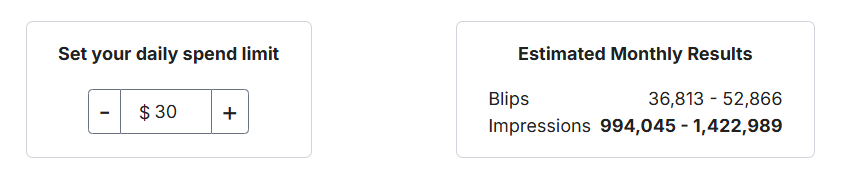
With Blip, you control exactly what you spend on East Palo Alto billboards by setting a daily budget that can be adjusted anytime, so your campaign always stays within your comfort zone. Each ad is a brief 7.5–10 second “blip,” and you only pay per blip, meaning every dollar goes directly toward real exposure on digital billboards near East Palo Alto, California. The price of each blip changes based on when and where you choose to run your message and on advertiser demand, so you can tailor your strategy to busy drive times or quieter periods.
Where can I advertise with Blip near East Palo Alto, California?
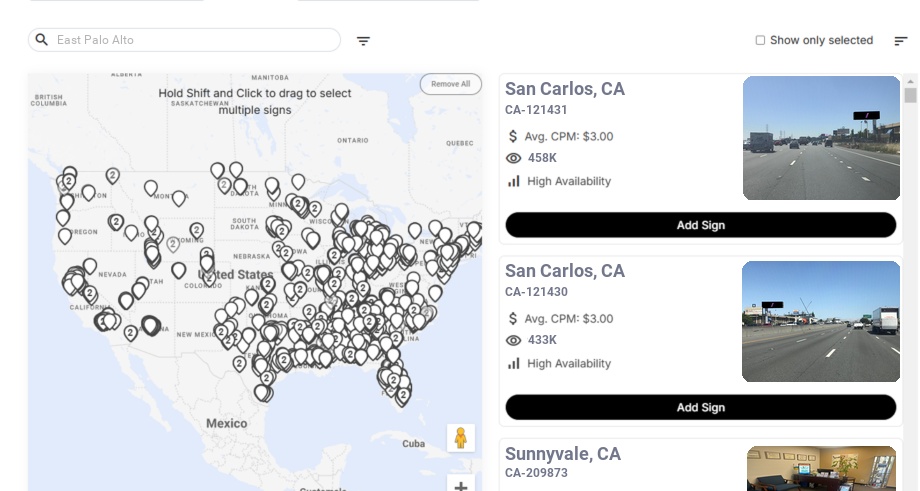
With three digital billboards near East Palo Alto—located in nearby San Carlos—we can help advertisers tap into the busy US‑101 corridor and surrounding surface streets that tens of thousands of local residents and workers use every day. Our three digital billboards serving the East Palo Alto area are located about 6.6 miles away in San Carlos—well within the normal commute and shopping radius for local residents. San Carlos sits directly on US‑101 and El Camino Real (CA‑82), giving campaigns broad reach across the Peninsula.
What kind of people does East Palo Alto, California billboard advertising with Blip reach?
East Palo Alto is a compact but dense city with outsized influence in the mid‑Peninsula, with about 30,000–31,000 residents and a median age around 31–32 years. Roughly 60–65% of residents identify as Hispanic or Latino, and more than 65% of residents speak a language other than English at home. The area also has a large daytime population of commuters, contractors, and service workers moving through the East Palo Alto area.
What are the best times to run East Palo Alto, California billboards with Blip?
Peak congestion on US‑101 typically runs 6:30–9:30 a.m. and 3:30–7:00 p.m. on weekdays, with speeds often dropping below 25 mph in the heaviest segments. We can also target school‑related windows, such as 7:30–8:30 a.m. and 2:30–4:00 p.m., when families are on the road for drop‑offs and pick‑ups. Evening and weekend windows for retail and entertainment, such as 5:00–9:00 p.m. Friday–Sunday, are also strong options.
Why are East Palo Alto, California billboards a good fit for local businesses with Blip?
This mix lends itself to value‑driven offers, workforce‑focused campaigns, and financial services messaging. With household sizes close to 4 people and a relatively young median age, messaging near East Palo Alto should reflect kids and teens, multi‑generational households, and community events. These realities make billboard advertising near East Palo Alto particularly powerful for brands focused on families, education, and essential services.
Do I need a contract to advertise with Blip near East Palo Alto?
No, Blip has no long-term contracts or minimum commitments. You can start, pause, or stop your campaign at any time.
How fast can I launch a billboard campaign with Blip near East Palo Alto?
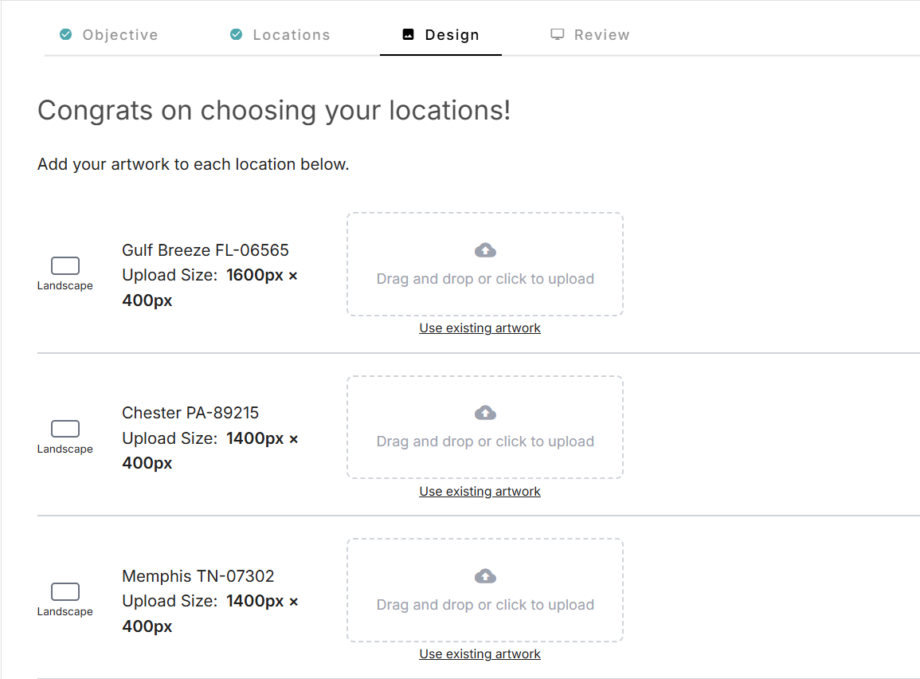
You can have your campaign live in minutes. Create a free account, select your locations, set your budget, upload your design, and start running once approved.
Where can I advertise with Blip near East Palo Alto?
Blip has digital billboards near East Palo Alto. You can browse available locations on a map, choose the ones that fit your audience, and start advertising right away.
Still have questions? Launch a campaign in minutes — no contracts, no commitments.
Start Your CampaignEast Palo Alto Billboard Advertising Guide
The East Palo Alto area sits at the heart of Silicon Valley’s daily flow of commuters, shoppers, and students. With three digital billboards near East Palo Alto—located in nearby San Carlos—we can help advertisers tap into the busy US‑101 corridor and surrounding surface streets that tens of thousands of local residents and workers use every day. Below, we explore how to use those locations strategically to reach audiences near East Palo Alto with data‑driven, high‑impact campaigns, and how to approach billboard advertising near East Palo Alto in a way that fits local needs.
Understanding the East Palo Alto Area Market
East Palo Alto is a compact but dense city with outsized influence in the mid‑Peninsula:
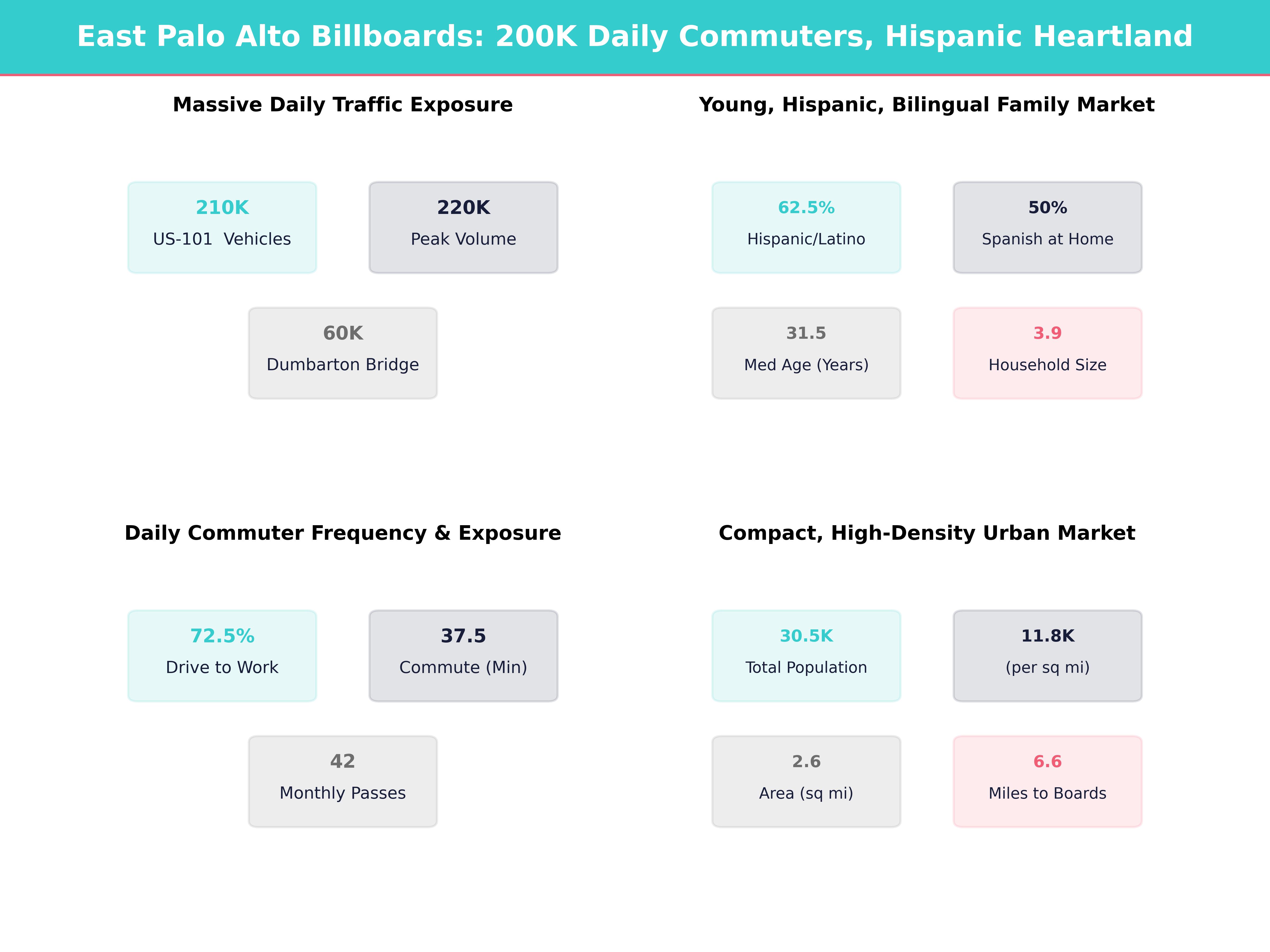
- Population: About 30,000–31,000 residents as of 2020–2023 estimates, packed into just 2.6 square miles, for a population density of roughly 11,500–12,000 people per square mile—more than double the overall density of San Mateo County.
- Age: The median age is around 31–32 years, several years younger than California’s statewide median (about 37 years), which means a larger share of working‑age adults and children.
- Households: Average household size is close to 3.8–4.0 people, compared to about 2.9 for California overall, reflecting a high concentration of families and multi‑generational households.
- Income mix: Median household income is in the high‑$80,000s to low‑$90,000s, but with significant variation—some long‑time residents on fixed or modest incomes, and a growing segment employed in higher‑paying tech and professional jobs in nearby cities like Palo Alto and Menlo Park.
Housing conditions also shape the market:
- More than 60% of housing units are renter‑occupied, vs. roughly 44% statewide, which often correlates with higher residential turnover and interest in services related to moving, insurance, and financial stability.
- Over 40% of renter households are considered cost‑burdened (spending more than 30% of income on housing), which increases sensitivity to pricing, discounts, and flexible payment options.
The East Palo Alto area is also deeply tied to neighboring employment centers:
- Major employers nearby include Meta’s headquarters in Menlo Park, Stanford University and Stanford Hospital in Palo Alto, and a wide array of tech and biotech firms scattered along US‑101 and in Redwood City and San Mateo—many of which are highlighted by regional business organizations and economic reports from San Mateo County.
- According to regional surveys from the City of East Palo Alto San Mateo County, a large share of residents commute out of the immediate area for work, often using US‑101, the Dumbarton Bridge (CA‑84), and surface routes to Palo Alto, Redwood City, San Carlos, and Mountain View.
- Recent transportation profiles for the county show roughly 70–75% of workers driving to jobs (alone or in carpools), 8–10% using public transit, and the rest walking, biking, or working from home.
For advertisers, this means:
- A resident audience that skews younger and family‑oriented, with more than one‑quarter of residents under age 18.
- A large daytime population of commuters, contractors, and service workers moving through the East Palo Alto area, many of them spending 30–45 minutes or more on one‑way trips.
- Strong cross‑border movement between San Mateo County, Santa Clara County, and the East Bay, with more than 100,000 daily trips crossing between the Peninsula and East Bay via bridges such as Dumbarton and San Mateo.
When we place digital messages on billboards near East Palo Alto, especially on high‑traffic corridors near San Carlos, we intercept this constant flow of residents and workers as they move between home, office, school, and shopping. That combination of volume and relevance is what makes East Palo Alto billboards such a strong option for regional and hyperlocal brands alike.
Where Our Billboards Reach the East Palo Alto Area
Our three digital billboards serving the East Palo Alto area are located about 6.6 miles away in San Carlos—well within the normal commute and shopping radius for local residents, many of whom regularly travel 5–15 miles for work, school, and major retail. For businesses looking for billboards near East Palo Alto without paying premium downtown Palo Alto rates, this nearby San Carlos inventory offers an efficient alternative.
San Carlos, profiled by the City of San Carlos, sits directly on:
- US‑101, the main north–south freeway through the Peninsula, connecting San Francisco to San Jose.
- El Camino Real (CA‑82), the historic main street running parallel to US‑101, lined with retail, services, and restaurants and served by both Caltrain and SamTrans bus routes.
According to Caltrans District 4 traffic data, typical average daily traffic (ADT) volumes near San Carlos are:
- US‑101 near San Carlos: around 190,000–210,000 vehicles per day, with weekday peaks often exceeding 220,000 in combined directions.
- El Camino Real near San Carlos: often 35,000–45,000 vehicles per day, depending on the segment and proximity to major intersections and retail clusters.
These volumes place this stretch of US‑101 among the most heavily traveled freeway sections in the Peninsula, meaning a single 4‑week digital campaign can generate millions of impressions even at modest share‑of‑voice levels for billboard advertising near East Palo Alto.
Because much of that traffic is traveling between San Jose, Mountain View, Palo Alto, East Palo Alto, Menlo Park, Redwood City, and San Mateo, billboards in San Carlos reliably reach:
- East Palo Alto residents commuting north or south to jobs in tech, healthcare, education, and construction.
- Workers from the South Bay and San Francisco passing near East Palo Alto daily—regional commute studies show more than 60% of workers in San Mateo County commute across city or county lines.
- Shoppers headed to big box stores, dining corridors, and regional retail centers along US‑101 and El Camino Real, including destinations such as Stanford Shopping Center and downtown Redwood City, frequently covered in outlets like Palo Alto Online and the San Mateo Daily Journal.
By targeting dayparts and days of the week that align with East Palo Alto area commute patterns, advertisers can effectively “shadow” local residents as they leave home and re‑enter the neighborhood, maximizing the value of East Palo Alto billboards even when the structures themselves are a few miles away.
Who You’re Reaching: Demographics & Lifestyles
The East Palo Alto area stands out from neighboring cities in important ways that should shape your creative and targeting.
Ethnic and cultural diversity
East Palo Alto is one of the most diverse communities in the Peninsula:
- Roughly 60–65% of residents identify as Hispanic or Latino.
- Around 15% identify as Black or African American—several times higher than the averages in San Mateo and Santa Clara counties.
- A notable Pacific Islander community (especially Tongan and Samoan) and a smaller but visible Asian population are reflected in city cultural events and community organizations highlighted by the City of East Palo Alto
- More than 65% of residents speak a language other than English at home, and over 50% speak Spanish at home, with many households bilingual across generations.
Implications for your campaign:
- Bilingual or Spanish‑forward messaging can dramatically expand reach; in similar Bay Area markets, Spanish‑language or bilingual out‑of‑home campaigns have shown 10–20% higher recall in Latino audiences than English‑only equivalents.
- Culturally resonant visuals—featuring real local families, community gatherings, or neighborhood imagery—will likely outperform generic Silicon Valley stock photography, especially for brands trying to build trust.
- Messages that emphasize community support, opportunity, and upward mobility tend to connect well in a city known for its resilience and activism, where local surveys show education, housing, and public safety consistently ranking among top resident priorities.
Income and occupation mix
Although the broader Peninsula is one of the wealthiest regions in the U.S., the East Palo Alto area includes:
- Households working in tech and professional jobs at nearby employers, often earning $120,000+ per year.
- Service, logistics, construction, healthcare, education, and public‑sector workers who support those industries, many in the $40,000–90,000 income range.
- Long‑term residents facing high housing costs and cost‑of‑living pressure; regional reports from San Mateo County show that basic cost‑of‑living for a family of four in the county can exceed $130,000 per year when housing, childcare, transportation, and healthcare are included.
This mix lends itself to:
- Value‑driven offers (discounts, payment plans, financing) that still feel aspirational—ads that combine savings with quality or status are especially effective where budgets are tight but aspirations are high.
- Workforce‑focused campaigns (job recruitment, training programs, trade schools), particularly when featuring wage ranges, benefits, and training; MTC and local workforce data show more than 25% of workers in the broader area are in occupations that do not require a four‑year degree.
- Financial services messaging around credit building, banking access, and remittances, targeting the estimated 7–10% of households in parts of the Bay Area who are unbanked or underbanked.
Family and community orientation
With household sizes close to 4 people and a relatively young median age, messaging near East Palo Alto should reflect:
- Kids and teens: roughly one in four residents is under 18, creating strong demand for after‑school programs, sports, tutoring, and youth services.
- Multi‑generational households: in many homes, three generations share space, which increases the need for healthcare, insurance, legal services, and large‑format retail for bulk purchases.
- Community events: festivals, church gatherings, school fundraisers, and city programs—often covered by outlets like Palo Alto Online and the San Mateo Daily Journal—draw hundreds or thousands of attendees, making event‑driven creatives especially timely and relevant.
These realities make billboard advertising near East Palo Alto particularly powerful for brands focused on families, education, and essential services.
Key Travel Patterns and How to Target Them
To maximize relevance to people in the East Palo Alto area, we recommend aligning your flighting and budgets with real‑world movement patterns.
Morning and evening commutes
Regional transportation data from Caltrans and the Metropolitan Transportation Commission show:
- Peak congestion on US‑101 typically runs 6:30–9:30 a.m. and 3:30–7:00 p.m. on weekdays, with speeds often dropping below 25 mph in the heaviest segments.
- In San Mateo County, average one‑way commute times often land in the 30–35 minute range, but many East Palo Alto area workers traveling to the South Bay or San Francisco regularly experience 45–60 minute trips.
- East Palo Alto area commuters frequently travel north toward Redwood City/San Mateo and south toward Mountain View/Sunnyvale, with Caltrain and SamTrans providing alternatives but the majority still driving.
With flexible digital billboard scheduling, we can:
- Concentrate impressions during these peak commute windows, when effective impressions per play are highest due to slower traffic and higher congestion.
- Shift budgets to the heaviest traffic days (often Tuesday–Thursday), which traffic counts show can have 5–10% more volume than Mondays and Fridays.
- Run different creatives in morning vs. evening (e.g., hiring message in the morning, retail or food promo in the evening), matching the fact that purchase‑oriented decisions spike after 4:00 p.m. in many consumer categories.
Cross‑bay traffic
The East Palo Alto area sits just west of the Dumbarton Bridge (CA‑84), a critical East Bay–Peninsula link regularly carrying 60,000–70,000 vehicles per day according to bridge and corridor studies highlighted by the Metropolitan Transportation Commission. Bridge users are often:
- Tech workers commuting from Fremont, Union City, Newark, and Hayward to Silicon Valley campuses.
- Service and construction workers crossing to Peninsula jobsites, many starting work between 6:00–8:00 a.m. and returning between 2:30–5:00 p.m..
- East Bay residents visiting Peninsula retail, healthcare, or events, especially major weekend events at Stanford or coastal recreation areas promoted by the San Mateo County/Silicon Valley tourism bureau.
Even though our boards are in San Carlos, they still reach a slice of this cross‑bay audience as they fan out north and south along US‑101. For campaigns that draw from both sides of the Bay—such as colleges, medical centers, and large employers—this combined reach is valuable:
- A worker who crosses Dumbarton and turns north on US‑101 will typically pass through the San Carlos segment within 20–30 minutes.
- Over the course of a month, a five‑day‑per‑week commuter will generate approximately 40–44 one‑way trips past potential billboard viewing zones, allowing multiple exposures per person.
Weekend and leisure traffic
Tourism and recreation in the mid‑Peninsula are driven by:
- Stanford University events (sports, performances, conferences), highlighted on Stanford’s events pages, which can draw 10,000–50,000 attendees on major game days and thousands more for graduations and festivals.
- Outdoor attractions like the Baylands Nature Preserve, managed by the City of Palo Alto, the San Mateo County parks system promoted by San Mateo County Parks, and coastal destinations featured by the San Mateo County/Silicon Valley tourism bureau.
- Regional shopping, dining, and nightlife across Palo Alto, Redwood City, and San Carlos, where weekend foot and vehicle traffic often exceeds weekday off‑peak levels.
Weekend freeway volumes often remain high—especially late morning to early evening Saturday and Sunday, when midday traffic can match or exceed weekday mid‑day volumes. Driver mindset shifts from “get to work” to “what should we do, buy, or eat today?” This is prime inventory for:
- Restaurants and quick‑service brands—industry data show dining decisions are often made within 5–15 minutes of a stop, making short‑distance directional messages particularly effective.
- Entertainment and events, especially when time‑bound (“This Saturday only,” “Game day parking here”).
- Automotive services and big‑ticket retail (appliances, furniture, electronics), which tend to see 20–30% of weekly sales on weekends.
For any of these weekend‑focused categories, digital billboard advertising near East Palo Alto—through the San Carlos units—helps you influence plans right before people exit for shopping, dining, and recreation.
Seasonality in the East Palo Alto Area
Seasonality on the Peninsula is driven more by school calendars, tech company rhythms, and holidays than by weather, which stays relatively mild (typical highs 58–78°F year‑round).
Back‑to‑school and graduation cycles
East Palo Alto area families are tied into:
- Ravenswood City School District, serving K–8 students in East Palo Alto and eastern Menlo Park and highlighted on the district’s website.
- Sequoia Union High School District, which serves approximately 10,000+ students across the mid‑Peninsula.
- Nearby private/charter schools and higher‑ed institutions such as Stanford and community colleges.
Key windows:
- Late July–September: back‑to‑school shopping, tutoring, extracurricular signups, and sports registrations. Many families make multiple major shopping trips in this 4–6 week period.
- April–June: graduation, celebrations, prom, and college enrollment deadlines. Local high schools often graduate hundreds of seniors per campus, and Stanford’s commencement brings in tens of thousands of visitors.
These are ideal times for:
- Retailers marketing school supplies, apparel, and electronics, particularly when promoting bundles or tax‑time/refund‑time offers.
- Education and training providers (K–12 tutoring, language schools, colleges, trades) that can align billboard campaigns with enrollment pushes and FAFSA deadlines often highlighted by school districts and local news.
- Event venues, florists, photographers, and catering—categories that commonly see 20–40% of annual revenue clustered around graduation and wedding seasons.
Tech and business calendars
The Silicon Valley tech cycle typically features:
- Heavy hiring and projects early in the year (Q1–Q2), when many firms have just renewed budgets.
- Budget flush and year‑end campaigns in Q4, particularly in October–December.
- Major conferences and product launches staggered throughout the year, with larger spikes around spring and fall.
For B2B and recruitment campaigns near the East Palo Alto area, consider:
- Q1/Q2: emphasize hiring, training, and new services—regional recruitment platforms often report application spikes of 15–25% in January–March.
- Q3: maintain brand presence, especially for essential services like healthcare, education, and home services as families settle into school routines.
- Q4: lean into promotional offers, retention campaigns, and holiday hiring, when retailers, logistics firms, and delivery companies can add 10–30% more seasonal workers.
Major holidays and cultural events
Given the East Palo Alto area’s diversity, advertisers can benefit from acknowledging:
- Hispanic and Latino cultural holidays (e.g., Día de los Muertos, Three Kings Day), which spur spending on food, gifts, and services within many of the 60–65% of households that identify as Latino.
- Black community celebrations (e.g., Juneteenth, Black History Month), which often include city‑ or county‑supported events, speakers, and performances.
- Pacific Islander cultural festivals and church‑centered gatherings, which can draw attendees from across San Mateo, Santa Clara, and Alameda counties.
Pairing short‑run, holiday‑specific creatives with flexible digital billboard flighting allows you to align messages with what residents are seeing and sharing on local channels such as Palo Alto Online and local community organizations featured by the city. This is especially effective when timed with short‑term billboard rental near East Palo Alto designed to drive attendance and same‑week sales.
Creative Best Practices for the East Palo Alto Area
To resonate with viewers while they travel near East Palo Alto, your design choices should reflect both the realities of freeway viewing and local culture.
Design for fast freeway glances
With vehicles moving at 55–65 mph on US‑101 (and sometimes slower in congestion):
- Keep total text to 7 words or fewer whenever possible; studies across digital out‑of‑home formats show recall drops significantly as copy exceeds about 8–10 words.
- Use large, high‑contrast fonts (light text on dark background or vice versa), aiming for letter heights that remain legible at 400–600 feet of viewing distance.
- Avoid clutter; 1–2 key elements (logo, short line, simple image) usually outperform busy layouts, often increasing recall by 20–30% in industry tests.
- Make phone numbers and URLs optional; a short memorable URL or brand name works better. If you need a call‑to‑action, use simple phrases like “Exit 5 miles north” or “Apply today.”
Local and inclusive imagery
Reflect the East Palo Alto area accurately:
- Feature diverse models—Latino, Black, Pacific Islander, and multi‑generational families—to mirror the city’s demographic reality where no single racial group comprises a majority of the population.
- Highlight recognizable regional cues (Baylands, Dumbarton Bridge, Peninsula skyline, Stanford’s red‑roof architecture) rather than generic “tech campus” images.
- If you use Spanish or bilingual copy, ensure professional translation and culturally appropriate phrasing; small translation errors can significantly reduce trust and response among the 50%+ of households that speak Spanish at home.
Value‑focused copy
Given the area’s cost‑of‑living pressure:
- Lead with clear value propositions: “$0 down,” “Free estimate,” “No‑cost consultation,” “Scholarships available.” Value‑oriented headlines often deliver higher call and web‑visit rates than brand‑only messages in middle‑income markets.
- Spell out savings where possible (“Save $50,” “Up to 40% off”), especially around paydays, tax refund season (February–April), and back‑to‑school.
- Time‑bound offers (“This weekend only,” “Ends Friday”) pair particularly well with flexible scheduling because you can exactly match billboard dates to your promotion.
Testing multiple creatives
Digital billboards make it easy to run variations:
- A/B test English‑only vs. bilingual copy and compare response rates (unique URLs, coupon codes, or call volumes).
- Try different value props (price discount vs. payment plan vs. added service like “free delivery”).
- Test lifestyle imagery (families vs. individual professionals vs. students) to see which best aligns with your actual customer mix.
Then analyze which messages align with your highest‑performing periods—online or in‑store—to optimize future flights. Because this format allows quick swaps, it’s particularly well‑suited for iterative billboard advertising near East Palo Alto, where you can adapt quickly as you learn.
Using Blip’s Flexibility to Target the East Palo Alto Area
Because you buy digital billboard time by the “blip” (a single 7.5–10 second display), you can be highly intentional about exactly when and how you reach people traveling near East Palo Alto.
Dayparting around local routines
We can structure your campaign around:
- Commute windows for awareness and recruitment (e.g., 6:30–9:30 a.m. and 3:30–7:00 p.m.), corresponding to the heaviest US‑101 and CA‑82 volumes identified by Caltrans.
- School‑related windows, such as 7:30–8:30 a.m. and 2:30–4:00 p.m., when families are on the road for drop‑offs and pick‑ups across districts like Ravenswood and Sequoia Union.
- Evening and weekend windows for retail and entertainment, such as 5:00–9:00 p.m. Friday–Sunday, when leisure and dining trips spike.
Because traffic patterns on US‑101 can change during holidays, long weekends, and major local events (Stanford football games, festivals promoted by San Mateo County, etc.), we can temporarily increase or decrease bids to match real‑time demand, shifting more spend into days where real‑world impressions are 10–20% higher than average.
Geo‑strategy with nearby boards
Although the physical boards are in San Carlos, we can:
- Focus on placements that best capture north–south flows including East Palo Alto area commuters, especially those heading to and from major job clusters in Redwood City, Palo Alto, and Mountain View.
- Pair your billboard flights with other marketing channels geofenced around East Palo Alto, Menlo Park, and Palo Alto to create a “surround” effect, increasing cross‑channel frequency to 5–7 exposures per person within a campaign window.
- Emphasize directional cues that feel relevant to East Palo Alto area travel patterns (e.g., “10 minutes south,” “Next exit north”) if your destination is along the US‑101 or El Camino Real corridor.
This kind of geo‑strategy effectively turns San Carlos units into functional East Palo Alto billboards in the eyes of your target audience, since they see the creative as they enter and leave the area.
Budget control for growing businesses
Because you can start with modest daily budgets and scale up:
- Local businesses—from independent restaurants and auto shops to clinics and nonprofits—can access the same high‑traffic freeway inventory historically used only by large brands, even with starting budgets as low as a few dollars per day.
- You can spike budget for key dates (grand openings, special events, registration deadlines) and keep a low‑level “always on” presence the rest of the month, a strategy that often improves long‑term brand recall by 10–15% compared with purely burst campaigns.
- Performance metrics like cost per thousand impressions (CPM) can be monitored over time; freeway digital boards along US‑101 often deliver CPMs competitive with or lower than many local print and premium digital placements, especially when you buy tightly targeted dayparts.
This flexibility makes billboard rental near East Palo Alto accessible for growing businesses that want to test out‑of‑home without committing to long‑term, fixed‑price contracts.
Industry‑Specific Strategies for the East Palo Alto Area
Different sectors can use the East Palo Alto area’s characteristics to their advantage.
Education and training
Ideal for:
- Community colleges, trade schools, and universities.
- Tutoring centers, test prep, language schools, and coding bootcamps.
Tactics:
- Run campaigns near enrollment deadlines, financial aid cutoffs, and start‑of‑term dates, which are often promoted on local institution calendars and news outlets like the San Mateo Daily Journal.
- Emphasize upward mobility and support: “Career training with childcare,” “Scholarships for East Palo Alto area residents,” “GED and ESL classes near you.” Bay Area workforce reports show that workers who complete short‑term training can boost earnings by 20–40% over several years.
- Use bilingual messaging and show real local students in your creative; in areas where more than 60% of households speak a non‑English language at home, bilingual materials typically show stronger engagement.
Healthcare and wellness
Ideal for:
- Clinics, urgent care, dental offices, mental health providers, and wellness centers.
Tactics:
- Highlight convenience and accessibility: “Walk‑in care, evenings & weekends,” “Telehealth in English & Spanish.” Health surveys in San Mateo County note that transportation and scheduling are key barriers to care, especially for lower‑income families.
- Time campaigns around open enrollment seasons (typically November–January) and back‑to‑school physicals (July–September), when demand spikes.
- Use reassuring, community‑focused messaging: “Trusted by East Palo Alto area families since 2005,” “Serving over 5,000 local patients each year” (if accurate), to build trust in a market where personal recommendations and local reputation matter heavily.
Retail and food
Ideal for:
- Regional retailers, grocery stores, furniture and appliance stores, and auto dealers.
- Restaurants and fast‑casual concepts along the US‑101 and El Camino Real corridors.
Tactics:
- Push limited‑time promotions on weekends and paydays (typically around the 1st and 15th of each month), when spending in many working‑class neighborhoods can increase by 20–30% versus mid‑cycle days.
- Include simple directional cues: “Next exit south,” “2 miles ahead on El Camino Real,” or “5 minutes from US‑101,” especially if your business is directly off the freeway or a major arterial.
- Test bilingual offers, especially for family‑size value meals, groceries, and bulk items; grocers and restaurants that explicitly promote value to families of 4–6 people often perform well in high‑household‑size markets.
Employment and workforce
Ideal for:
- Tech and logistics employers, construction companies, staffing agencies, and public sector hiring.
Tactics:
- Focus on commute windows when workers are thinking about job satisfaction and future plans; commuter surveys show that more than 50% of job‑switching decisions are considered during commute times.
- Highlight real pay and benefits: “Up to $30/hr + full benefits,” “Overtime available,” “Union jobs with training.” Listings that include specific pay ranges typically see more clicks and applications than those without.
- Consider targeted campaigns during tech layoff cycles or seasonal hiring surges—timing your spend with labor market trends covered in local outlets like Palo Alto Online and regional business news, so your message appears just as workers are re‑evaluating options.
Across all of these verticals, using East Palo Alto billboards as a recurring touchpoint helps reinforce your brand among residents and commuters who see your messages multiple times per week.
Local Sensitivities and Regulatory Considerations
While our billboards are in San Carlos, it is important to respect the broader standards and expectations of communities near East Palo Alto.
Community‑conscious content
East Palo Alto has a strong tradition of community organizing and advocacy, often chronicled by the City of East Palo Alto
- Avoid content that could be perceived as predatory toward vulnerable communities (e.g., high‑interest loans without clear disclosures, misleading credit repair offers); local watchdogs and media frequently highlight such issues.
- Be cautious with political or issue advertising; maintain clarity and transparency, and consider that many local residents receive information from trusted sources like community organizations and faith‑based groups.
- Consider partnership messages that support local causes, nonprofits, or educational initiatives—e.g., “Proud supporter of East Palo Alto youth programs”—which can improve brand favorability and reduce the risk of backlash.
Regulation and approvals
Outdoor advertising is governed primarily by:
- Local zoning and sign ordinances in cities like San Carlos and along the US‑101 corridor, administered by agencies such as the City of San Carlos.
- State‑level rules overseen by Caltrans and other agencies, which set standards for digital brightness, content restrictions, and safety.
We ensure our inventory complies with these requirements, but advertisers should:
- Avoid prohibited categories (e.g., certain tobacco or adult content) and be aware that some cities restrict cannabis advertising near schools and youth facilities.
- Keep creative within decency and safety guidelines (no simulated traffic signs, emergency lights, or overly distracting animation). Caltrans safety studies emphasize minimizing driver distraction—short, static or minimally animated creatives perform best.
- Allow sufficient lead time for legal review of sensitive content (financial, healthcare, or political) to ensure all required disclaimers and disclosures are visible at freeway speeds.
These considerations apply to any billboard rental near East Palo Alto, whether you’re a national brand or a small local organization.
Measuring Impact and Iterating
Digital billboards serving the East Palo Alto area work best when we treat them as a measurable, optimizable channel.
Tracking responses
Because people can’t click a billboard, we recommend:
- Using memorable, trackable URLs or QR codes unique to your campaign; even if only 1–3% of exposed viewers visit, that can represent hundreds or thousands of incremental visits given the hundreds of thousands of daily impressions available on US‑101.
- Promoting discount codes only seen on billboards (e.g., “EPA10” or “101SAVE”).
- Monitoring web traffic by time and geography to see if spikes align with your flight schedule—many analytics platforms allow you to filter by city (East Palo Alto, Palo Alto, Menlo Park, Redwood City, San Carlos) and by hour of day.
Aligning with other campaigns
Performance improves when your billboard presence:
- Mirrors themes from your social media, local radio, and print campaigns, reinforcing key messages across channels.
- Uses similar visuals and phrases so viewers easily make the connection; consistent creative across channels has been shown in marketing studies to increase brand recognition by up to 20–30%.
- Reinforces any stories or coverage in local media (e.g., a feature in the San Mateo Daily Journal or Palo Alto Online), helping turn earned media into sustained awareness.
Continuous optimization
With flexible digital scheduling and easy creative swaps, we can:
- Start with 2–3 creatives tailored to the East Palo Alto area and rotate them evenly to build a performance baseline.
- Shift budget toward the ones that correlate with higher calls, web visits, signups, or store traffic; even a 5–10% performance difference between creatives can justify re‑allocation.
- Refresh designs every 4–8 weeks to combat creative fatigue, even if the core offer stays consistent. In high‑frequency environments like US‑101, fresh creative can restore attention and maintain effectiveness across longer campaigns.
By combining high‑traffic digital billboards near San Carlos with a deep understanding of the East Palo Alto area’s people, travel patterns, and culture, we can build campaigns that are both efficient and genuinely local. With precise control over timing, budget, and creative, advertisers of any size can secure a visible presence along one of the Bay Area’s most important corridors and speak directly to the communities that live, work, and travel near East Palo Alto through targeted billboard advertising near East Palo Alto.