Billboards near Santa Monica, CA
No Minimum Spend. No Long-Term Contracts. Just Results.
Trusted by Leading Brands


Billboard advertising
near Santa Monica has never been easier



How much is a billboard near Santa Monica?
Why Choose Blip for Billboard Advertising near Santa Monica
Blip lets you launch Santa Monica billboards fast, reaching I-10 and Santa Monica Blvd commuters without contracts or long setup.
Set flexible daily budgets for Santa Monica and let Blip auto-control spend as beach traffic, tourism, and weekday commutes change.
Use dayparting in Santa Monica to hit weekday rush, West Hollywood nightlife, or weekend Pier crowds at the right time.
Track Santa Monica blips in real time, then shift budget toward the Westside-to-Hollywood corridor when results improve.
Blip's creative tools make Santa Monica ads pop with bold, mobile-first designs for high-income residents and design-savvy visitors.
Frequently Asked Questions About Billboard Advertising near Santa Monica
How much does a billboard cost near Santa Monica, California with Blip?
With Blip, you set your own daily budget for Santa Monica billboards, and our system automatically keeps your digital ads within that limit. Each “blip” is a 7.5–10 second display, and you pay only for the individual blips you receive, so you can start small and scale up as you see results. Costs for billboards near Santa Monica, California are based on when and where your ads run and current advertiser demand in the Santa Monica area.
Where can I advertise with Blip near Santa Monica, California?
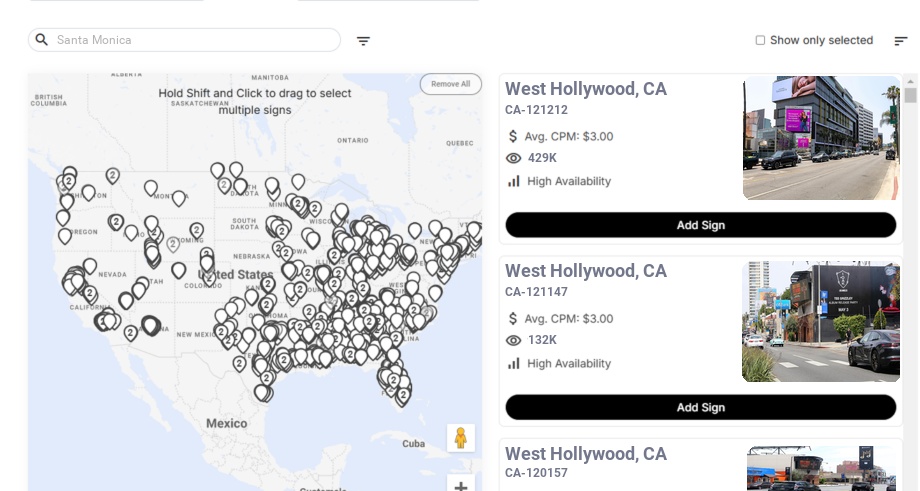
Our 4 digital billboards serving the Santa Monica area are located in nearby West Hollywood, about 7–8 miles away. These Santa Monica billboards sit on a crucial cross-town corridor between the Westside and Hollywood/Beverly Hills. Positioning your message on these boards lets you extend your reach beyond the beachfront and downtown Santa Monica streets to influence people while they’re in “going out,” “commuting,” or “exploring LA” mode.
What kinds of people see Santa Monica, California billboards?
Santa Monica sits at the intersection of beach lifestyle, tech, tourism, and high-income residential living, making the Santa Monica area one of Southern California’s most valuable advertising markets. Roughly 70–75% of visitors are domestic, while 25–30% are international, creating a uniquely cosmopolitan audience with high propensity to spend on experiences, dining, and shopping. The daytime population swells well beyond resident counts as tens of thousands of workers commute into Santa Monica’s offices, health facilities, and retail corridors each weekday.
When is the best time to run Blip ads near Santa Monica, California?
Morning (6–10 a.m.) brings heavy eastbound and cross-town commuting, while evening (3–8 p.m.) brings strong westbound and cross-town flows as people leave work and head to the beach, gyms, restaurants, or events. Weekends are especially important because tourism and leisure dominate, and sunny weekends in peak season can see beach-area traffic increase by double-digit percentages compared with off-season baselines. Summer months also increase impressions for late-afternoon and early-evening blips, since Santa Monica’s peak visitor season typically runs late spring through early fall.
Do I need a contract to advertise with Blip near Santa Monica?
No, Blip has no long-term contracts or minimum commitments. You can start, pause, or stop your campaign at any time.
How fast can I launch a billboard campaign with Blip near Santa Monica?
You can have your campaign live in minutes. Create a free account, select your locations, set your budget, upload your design, and start running once approved.
Where can I advertise with Blip near Santa Monica?
Blip has digital billboards near Santa Monica. You can browse available locations on a map, choose the ones that fit your audience, and start advertising right away.
Still have questions? Launch a campaign in minutes — no contracts, no commitments.
Start Your CampaignSanta Monica Billboard Advertising Guide
Santa Monica sits at the intersection of beach lifestyle, tech, tourism, and high-income residential living—making the Santa Monica area one of Southern California’s most valuable advertising markets. With digital billboards serving the Santa Monica area from nearby City of West Hollywood
Understanding the Santa Monica Area Market
Santa Monica is compact but powerful as a marketing hub:
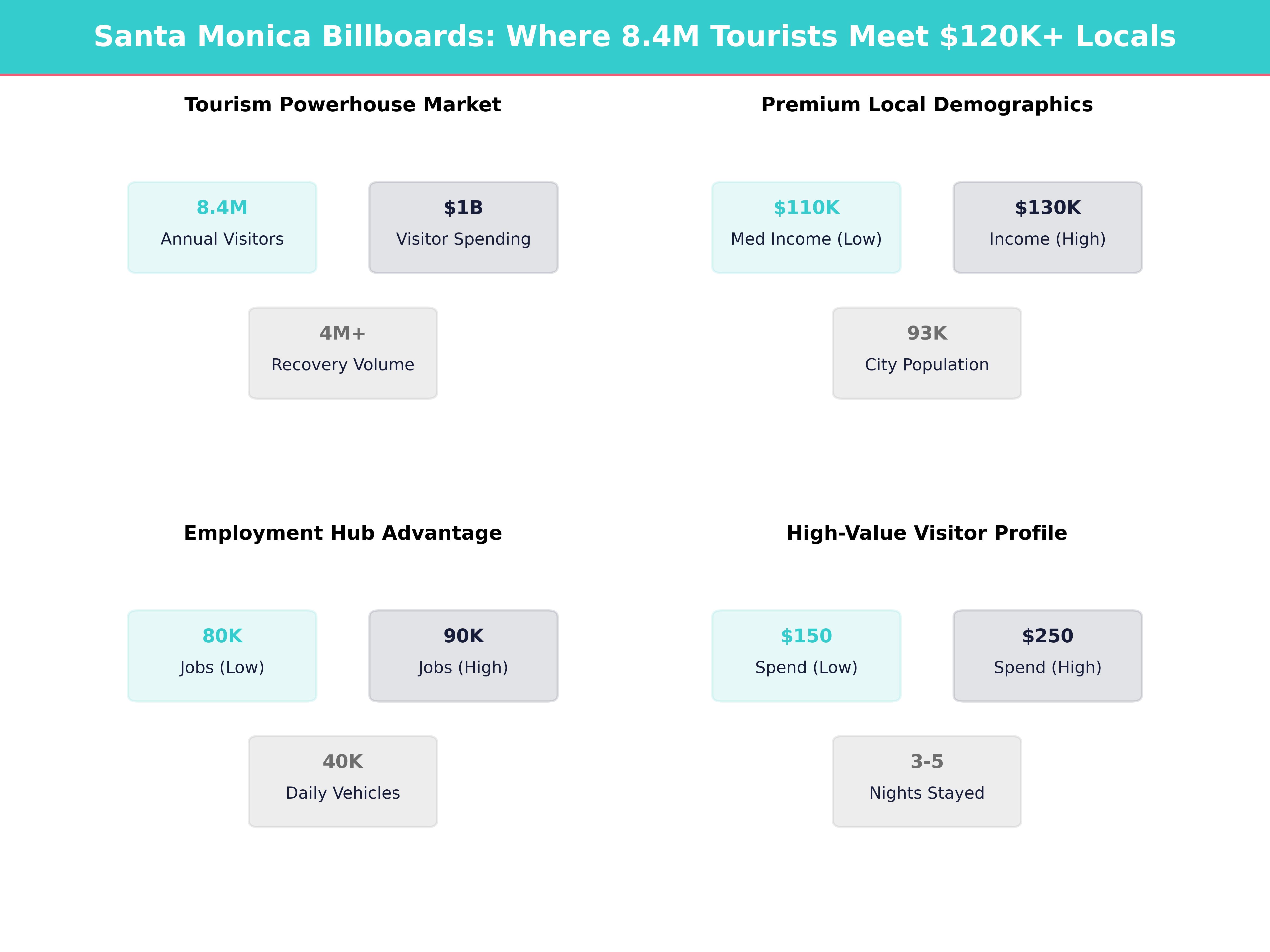
- The city’s population is just under 100,000 residents (about 93,000–94,000 according to recent estimates from the City of Santa Monica), yet it attracts massive daily inflows of workers and visitors.
- According to Santa Monica Travel & Tourism
- Roughly 70–75% of visitors are domestic, while 25–30% are international, creating a uniquely cosmopolitan audience with high propensity to spend on experiences, dining, and shopping.
- Santa Monica’s median household income is significantly higher than the California average; city economic snapshots routinely show median household income in the six figures, with several coastal ZIP codes (such as 90401, 90402, and 90403) posting median incomes above $110,000–$130,000.
- The daytime population swells well beyond resident counts as tens of thousands of workers commute into Santa Monica’s offices, health facilities, and retail corridors each weekday.
Our 4 digital billboards serving the Santa Monica area are located in nearby West Hollywood, about 7–8 miles away. These Santa Monica billboards sit on a crucial cross‑town corridor between the Westside and Hollywood/Beverly Hills, capturing:
- Westside residents traveling to nightlife, dining, and entertainment in West Hollywood and Hollywood.
- Creative, media, and tech workers commuting between Santa Monica’s “Silicon Beach” offices and central LA job centers.
- Visitors staying in Hollywood or West Hollywood and traveling toward the beach.
If you’re exploring billboard advertising near Santa Monica, this corridor offers high-volume, repeat exposure in both directions of travel. West Hollywood is one of the densest cities in California, with roughly 35,000–36,000 residents in just under 2 square miles according to weho.org
Positioning your message on these boards lets you extend your reach beyond the beachfront and downtown Santa Monica streets to influence people while they’re in “going out,” “commuting,” or “exploring LA” mode. For brands comparing different billboard rental near Santa Monica options, these placements can efficiently cover both Santa Monica and central LA patterns in a single buy.
Key Audiences in the Santa Monica Area
When planning creative and scheduling, it helps to think of the Santa Monica area as a set of overlapping, high-value audiences.
1. Tech and Creative Professionals
Santa Monica is a core part of “Silicon Beach,” alongside Venice and Playa Vista. Major digital, entertainment, and startup employers draw thousands of well-paid professionals every day.
- Local economic reports from the City of Santa Monica show that professional, scientific, technical services; information; and arts/entertainment/media account for a large share of the more than 80,000–90,000 jobs in the city—nearly as many jobs as there are residents.
- Office and coworking concentration near the 3rd Street Promenade, Colorado Avenue, and the Bergamot arts district means steady commuter flows along the I‑10, Olympic Boulevard, and Santa Monica Boulevard corridors.
- Many workers live in central LA neighborhoods like Hollywood, West Hollywood, and Mid-City—exactly the trajectories where our West Hollywood boards are positioned. Regional commute data show tens of thousands of daily trips between the Westside and central Los Angeles employment centers.
What this means for your campaign:
- B2B and SaaS: Promote software tools, coworking spaces, conferences, or professional services during weekday commute peaks, when 60–70% of roadway volume is work-related.
- Recruiting: Highlight hiring messages for tech, creative, and healthcare roles to capture professionals traveling near Santa Monica and West Hollywood, where average educational attainment is high (well over 50% of adults with a bachelor’s degree or higher in many nearby ZIP codes).
- Premium consumer brands: High-end fitness, skincare, finance apps, and luxury goods resonate with this higher-income group, who spend disproportionately on health, wellness, and experiences according to local visitor and consumer‑spending analyses.
2. Tourists and Visitors
According to Santa Monica Travel & Tourism
- Spend heavily on dining, shopping, and activities—recent tourism impact reports show per‑visitor daily spending often in the $150–$250 range on lodging, food and beverage, retail, and entertainment.
- Cluster around the Santa Monica Pier, 3rd Street Promenade, and Ocean Avenue hotels, where occupancy can exceed 70–80% on peak weekends.
- Often extend stays to Hollywood, Beverly Hills, and West Hollywood, or split lodging between those areas. Tourism profiles show that multi‑destination trips are common, with a large share of visitors staying 3–5 nights in the region.
Our boards near West Hollywood let you influence visitors as they:
- Travel from Hollywood/West Hollywood hotels to the beach—a corridor that sees heavy weekend volumes as visitors drive the 7–10 miles from central LA to the coast.
- Explore nightlife and dining east of the 405, especially on Thursday–Sunday evenings when bar and restaurant districts in West Hollywood see their highest foot and vehicle traffic.
- Decide how to spend their time and money during multi-day trips, when roughly half of visitor spending typically goes to food, beverage, and retail.
Good fits:
- Attractions and experiences in the Santa Monica area (tours, museums, adventure sports), especially those around the Santa Monica Pier and downtown that want the reach of Santa Monica billboards without paying beachfront premiums.
- Restaurants and bars near the beach or in adjacent neighborhoods like Venice, Main Street, or the West Hollywood Strip.
- Hotels encouraging mid-trip upgrades or future bookings, especially when hotel occupancy is above 70% and travelers are seeking added experiences.
- Retail, especially fashion and lifestyle aligned with West LA aesthetics, where average transaction values skew higher than many other LA submarkets.
3. Local Residents and Families
Santa Monica residents are highly engaged in local issues, health-conscious, and brand-aware:
- The City’s official site, santamonica.gov, highlights sustainability, mobility, and community well-being as core policy priorities, with initiatives around electric mobility, bike infrastructure, and climate action.
- City participation data show strong turnout for local programs and events—from farmers markets that draw thousands weekly to city‑sponsored cultural programming—indicating a population that responds to local messaging.
- Residents frequently travel east for work, schools, shopping, and entertainment, passing through corridors where our West Hollywood boards can reach them. Regional traffic counts on the I‑10 and major boulevards show substantial two‑way flows, with weekday daily traffic into and out of the Westside measured in the hundreds of thousands of vehicles.
Strong verticals for this audience:
- Healthcare (clinics, dentists, wellness centers), especially those emphasizing preventive care, pediatrics, and wellness services that appeal to health‑oriented households.
- Education (private schools, tutoring, universities, and continuing education), targeting families in ZIP codes where a high share of households include children under 18 and a large percentage of adults hold college degrees.
- Home services serving the Westside (remodeling, solar, landscaping), aligned with high median home values in Santa Monica and adjacent areas, where typical single‑family homes often exceed $1.5–$2 million.
- Local events (farmers markets, festivals, cultural events, charity runs) that fit into the robust calendar listed on santamonica.gov and similar local calendars.
Traffic Patterns: When to Run Your Blips
Understanding travel flows between Santa Monica and central LA is crucial for using Blip’s dayparting and budgeting tools effectively, especially if you’re timing billboard advertising near Santa Monica to align with real-world movement.
Weekday Patterns
Regional transportation data from agencies like LA Metro
- Morning (6–10 a.m.): Heavy eastbound and cross-town commuting as Santa Monica area residents and Westside workers head toward studios, agencies, and offices in Hollywood, West Hollywood, Beverly Hills, and Downtown LA. In many corridors, 30–40% of daily vehicle volume occurs in the combined morning and evening peak windows.
- Midday (10 a.m.–3 p.m.): Lighter but high-value traffic—freelancers, tourists, shoppers, and service professionals. This window is ideal for tourism, dining, and errands-oriented messaging since visitors often make same‑day decisions in these hours.
- Evening (3–8 p.m.): Strong westbound and cross-town flows as people leave work and head to the beach, gyms, restaurants, or events. Entertainment districts in West Hollywood and Santa Monica typically see their highest combined vehicle and foot activity in the 5–9 p.m. range.
Campaign ideas with Blip:
- Run commuter-focused messages (e.g., B2B, hiring, productivity apps) during weekday rush hours, when exposure frequency is highest among working professionals.
- Emphasize tourism, shopping, and leisure between late morning and afternoon as visitors plan the rest of their day and locals run errands.
- Schedule nightlife and dining messages from late afternoon into late evening to catch West Hollywood and Santa Monica area social traffic, especially Thursday through Saturday.
Weekend and Seasonal Patterns
- Weekends: Tourism and leisure dominate. Congestion increases on routes between Hollywood/West Hollywood and the Santa Monica area as visitors head for the pier and beaches. Sunny weekends in peak season can see beach‑area traffic increase by double‑digit percentages compared with off‑season baselines.
- Summer months: Longer daylight hours and higher visitor volumes increase impressions for late-afternoon and early-evening blips. Santa Monica’s peak visitor season typically runs late spring through early fall, when hotel occupancy and daily beach counts are highest.
- Events: Concerts and festivals at the Santa Monica Pier, civic events listed on santamonica.gov’s event calendar, Pride and entertainment events in West Hollywood highlighted on weho.org
Use Blip’s flexibility to:
- Increase bids on weekends during peak tourist seasons (e.g., summer and holiday periods).
- “Pop up” extra impressions around major local events, concerts, or festivals that push large single‑day attendance figures into the tens of thousands.
- Dial back spend on slower days or timeframes that don’t match your audience, such as very late nights if your offering is family- or commuter‑focused.
Crafting Creative That Fits the Santa Monica Area
The Santa Monica area combines coastal lifestyle, design-conscious consumers, and an information-saturated environment. To stand out:
Visual Style
- Lean into clean, modern design: Minimalist layouts, generous white space, and simple iconography mirror local brand aesthetics used by many Westside startups and creative agencies.
- Use bold color contrast: High sun and varied viewing angles demand high-contrast combinations (e.g., dark navy + white, deep teal + yellow), improving legibility at 50–60 mph travel speeds.
- Evoke the coastal lifestyle without clichés: Subtle cues—sunset palettes, ocean accents, palm silhouettes—work better than generic beach clip-art and align with the visual language used in many Santa Monica Travel & Tourism City of Santa Monica campaigns.
Messaging Guidelines
- Keep copy to 7 words or fewer when possible; traffic often moves fast in the Santa Monica–West Hollywood corridor, and studies of roadside readability show that shorter messages significantly increase recall.
- Speak to aspirations: Wellness, creativity, sustainability, and experiences resonate strongly in West LA, where a large share of residents and visitors prioritize lifestyle and values in purchasing decisions.
- Specificity beats generic claims: Use clear value props like “15-minute urgent care near the Pier” or “Same-day delivery to Santa Monica area ZIPs.” Including a concrete benefit or time frame improves response and is easier to process at a glance.
Examples:
-
For a fitness studio serving the Santa Monica area:
- “Stronger by Summer – First Class Free”
-
For a restaurant near the beach:
- “Oceanfront Brunch • Walkable From the Pier”
-
For a SaaS company:
- “LA Teams Ship Faster With [Brand]”
Localization Without Misleading
Because our boards are near Santa Monica rather than inside city limits, phrase your localization carefully:
- Strong: “Serving the Santa Monica area”
- Strong: “Minutes from Santa Monica Pier”
- Strong: references to “billboards near Santa Monica” or “West Hollywood boards serving Santa Monica” when describing your placement.
- Avoid: “Located in Santa Monica” if your location is actually in another neighborhood such as Venice, West LA, or West Hollywood.
This builds trust and aligns with how residents and visitors actually move across the region.
Using Blip Strategically for the Santa Monica Area
Blip’s “pay-per-blip” model and flexible scheduling are especially powerful in a fragmented, high-cost media market like Greater Los Angeles, making it a practical way to manage billboard rental near Santa Monica.
Target High-Value Time Windows
Allocate more budget to:
- Weekday morning and evening rush hours for commuter-heavy messaging, when corridor traffic volumes are at their daily peak.
- Weekend late mornings and afternoons for tourism and family activities, when beach‑bound traffic and visitor footfall in downtown Santa Monica rise sharply.
- Event-adjacent slots (2–3 hours before concerts, sports, or festivals) to capture pre-event decision-making and last‑minute plans.
Reduce or test lower bids during:
- Midday weekdays if your offer is commuter-specific and less relevant to tourists or remote workers.
- Very late-night hours unless targeting nightlife or 24/7 services, which may benefit from the lower competition and lower CPMs in those windows.
Run A/B Creative Tests
Because you can rotate multiple creatives:
- Test different calls-to-action: “Book Tonight,” “Scan to Save 20%,” or “Visit Us on Main Street.”
- Experiment with different localization phrases: “Near Santa Monica” vs. “Serving the Santa Monica area.”
- Compare lifestyle imagery vs. product imagery to see what drives more direct responses.
Use web analytics, promo codes, or unique URLs to infer which creatives correlate with spikes in site traffic or sales. Local media coverage in outlets like the Santa Monica Daily Press Santa Monica Mirror can also amplify campaigns you are testing on billboards.
Layer with Other Channels
The Santa Monica area is highly digital. Pair your digital billboards with:
- Paid search campaigns targeting “Santa Monica [your category]” terms, capturing the high-intent users that often search while already in the neighborhood and have just seen Santa Monica billboards on their drive.
- Geo-fenced social ads around Westside, Hollywood, and West Hollywood, using radius targeting around major hubs like the Pier, 3rd Street Promenade, and the West Hollywood nightlife district.
- Coverage in local outlets such as the Santa Monica Daily Press Santa Monica Mirror, LAist, or regional TV and radio stations to build credibility and social proof.
Your board presence reinforces awareness while digital channels capture active intent.
Industry-Specific Strategies for the Santa Monica Area
Restaurants, Bars, and Hospitality
- Target visitors staying in Hollywood or West Hollywood who are heading to the Santa Monica area for the day—hotel corridors in these neighborhoods house thousands of rooms, with weekend occupancy rates frequently above 70–80%.
- Use clear, simple offers: “Sunset Happy Hour Near Santa Monica Pier, 4–7 PM.” Time‑anchored messages align with how visitors structure their day.
- Run heavier schedules Thursday–Sunday, aligning with social and leisure patterns, when dining and nightlife spending typically peaks.
Healthcare and Wellness
- The Santa Monica area is known for wellness-oriented residents and workers, with a large cluster of medical offices, fitness studios, and holistic wellness providers.
- Highlight speed and convenience: “Same-Day PT Appointments Serving the Santa Monica Area.” Messages that emphasize quick access resonate with busy professionals and families.
- Run weekday daytime and early evening campaigns, when appointment-setting behavior is highest and people are most likely to call or book online.
Retail and E-commerce
- Promote flagship locations on the Westside and experiential stores that match Santa Monica’s lifestyle focus, especially near the 3rd Street Promenade and Main Street.
- Offer QR-code discounts or limited-time sales; West LA consumers are used to digital-first engagement and often research purchases on their phones while out.
- Align with major shopping periods: back-to-school, holiday season, and long-weekend sales, when regional spending can spike by double-digit percentages over typical weeks.
Real Estate and Home Services
- Westside and Hollywood home prices remain among the highest in the region, making each lead valuable; median home values in many Santa Monica and adjacent neighborhoods commonly exceed $1.5 million.
- Aim at commuters and residents with messages like “Thinking of Selling? Free Home Valuation Near Santa Monica.” High‑frequency exposure over regular routes builds familiarity.
- Run consistently over several weeks to build recognition and trust—home-related decisions have longer cycles, and repeated billboard impressions reinforce your brand alongside open‑house signs and online listings.
Cultural and Regulatory Considerations
Santa Monica area residents care deeply about quality of life, environment, and civic engagement. Respecting that context helps your brand:
- Sustainability and social responsibility land well; if your business has green initiatives or community projects, share them succinctly (for example, “100% renewable-powered facility” or “Local charity partner in Santa Monica”).
- Avoid cluttered, aggressive, or fear-based messaging that clashes with the area’s brand and local values, as reflected in city priorities around livability and mental well‑being.
For broader context on local policies and priorities, you can review:
- City initiatives and planning via santamonica.gov, including mobility, climate, and economic recovery plans.
- Nearby policy discussions and events on weho.org
Even if your creative doesn’t reference policy directly, aligning tone and values with local expectations builds goodwill and credibility.
Putting It All Together
To maximize impact from digital billboards serving the Santa Monica area:
- Define your primary audience: commuters, visitors, residents, or a specific niche like tech workers or families, using local data (income, visitor mix, home values) to refine your target.
- Choose timeframes strategically using Blip’s scheduling tools, mapping your audience’s real-world movement between Santa Monica and central LA and leaning into proven peak windows.
- Design bold, minimal creative tailored to bright, fast-moving conditions and design-savvy viewers who are accustomed to high production values from local brands.
- Localize honestly and clearly with phrases like “serving the Santa Monica area” and concrete distance or landmark references, such as minutes from the Pier or Promenade, so your billboard advertising near Santa Monica feels relevant and trustworthy.
- Test, measure, and iterate, rotating creatives and adjusting bids based on performance, seasonality, and major local events highlighted on santamonica.gov and weho.org
By combining data-driven timing with localized, lifestyle-aware messaging, digital billboards near Santa Monica can become a powerful, flexible pillar of your marketing strategy across the Westside and greater Los Angeles, whether you are running a short test campaign or managing ongoing billboard rental near Santa Monica.