Billboards near Cupertino, CA
No Minimum Spend. No Long-Term Contracts. Just Results.
Trusted by Leading Brands


Billboard advertising
near Cupertino has never been easier
How much is a billboard near Cupertino?
Why Choose Blip for Billboard Advertising near Cupertino
Blip lets you launch Cupertino billboards yourself and reach Apple Park commuters on US-101, I-280, and Lawrence Expressway in minutes.
Set flexible budgets for Cupertino and scale up around Levi’s Stadium game days or Stevens Creek traffic when demand spikes.
No contracts means you can test Cupertino ads for tech workers, families, or shoppers near Santa Clara and keep only what works.
Use dayparting in Cupertino to hit 7:30-10 a.m. arrivals and 4-7 p.m. departures from Apple campuses and nearby offices.
Track Cupertino campaign results in real time with Blip, then shift spend fast as weekday commute patterns or event traffic change.
Blip’s creative tools help Cupertino ads stay sharp for a tech-savvy audience, with clean designs built for fast-moving South Bay roads.
Frequently Asked Questions About Billboard Advertising near Cupertino
How much does a billboard cost near Cupertino, California with Blip?
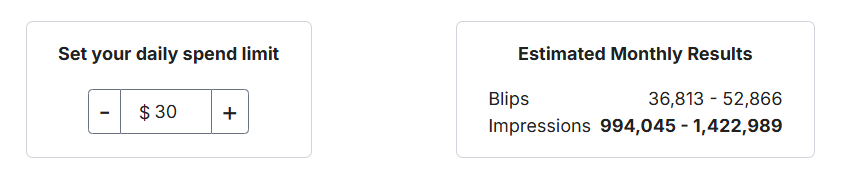
With Blip, you set your own daily budget for Cupertino billboards, and our pay-per-blip model ensures you only pay for the brief 7.5–10 second ad displays you actually receive. Costs per blip change based on time, location, and advertiser demand, so you can start small, then scale up when you see what works. If you’ve ever wondered, How much is a billboard near Cupertino, California? the answer is: exactly as much as you want to spend.
Where can I advertise with Blip near Cupertino, California?
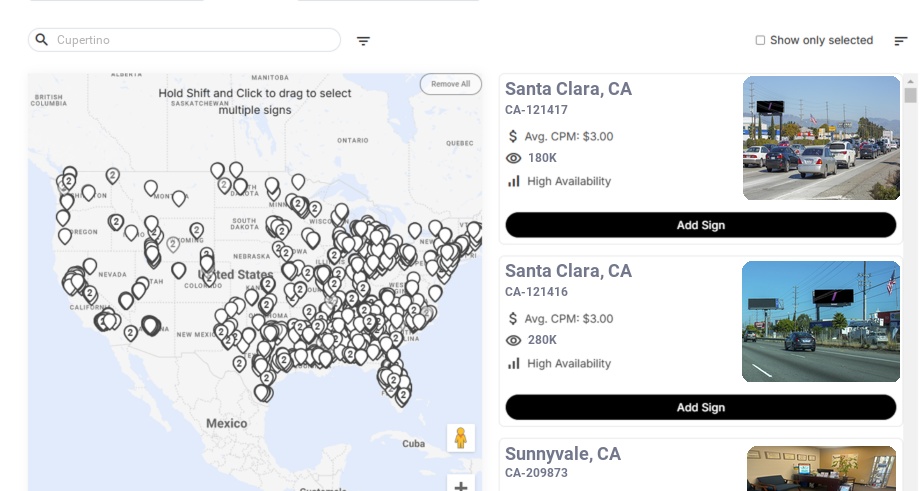
Our digital billboards serving the Cupertino area are located in nearby Santa Clara, about 6.8 miles away. This positions your message along heavily traveled commuter and shopping corridors that Cupertino residents and workers frequently use, giving you the impression volume of a major freeway with the audience quality of a tight Cupertino trade area. For brands searching for billboards near Cupertino without paying core-Cupertino real estate premiums, these placements offer a powerful balance of reach and efficiency.
What kind of audience will my Blip billboard reach in Cupertino, California?
Cupertino sits at the heart of Silicon Valley, surrounded by some of the most educated, high-income, and tech-savvy audiences in the country. An estimated 70–75% of adults in Cupertino hold a bachelor’s degree or higher, and median household income is typically reported above $200,000. Many commuters work for global brands like Apple, NVIDIA, Intel, Google, and other Silicon Valley firms clustered along the US‑101, I‑280, and Lawrence Expressway corridors.
When is the best time to run billboard ads in Cupertino, California with Blip?
Tech launches, developer conferences, and corporate events often cluster from April–June and September–November, bringing heightened attention to tech news and local events. Back-to-school and exam / college application seasons are strong windows for tutoring centers, enrichment programs, test prep, and family services. Levi’s Stadium events can also bring 40,000–70,000 visitors per event, creating high-impact bursts for time-bound messaging.
What should I say on a billboard in Cupertino, California to get attention?
Messaging should be smart and efficient, because a tech-oriented audience appreciates clarity, brevity, and value. Aim for 6–10 words max of primary text and use a single, bold call to action. Clean, minimalist layouts and data or value statements tend to resonate well in this market.
Do I need a contract to advertise with Blip near Cupertino?
No, Blip has no long-term contracts or minimum commitments. You can start, pause, or stop your campaign at any time.
How fast can I launch a billboard campaign with Blip near Cupertino?
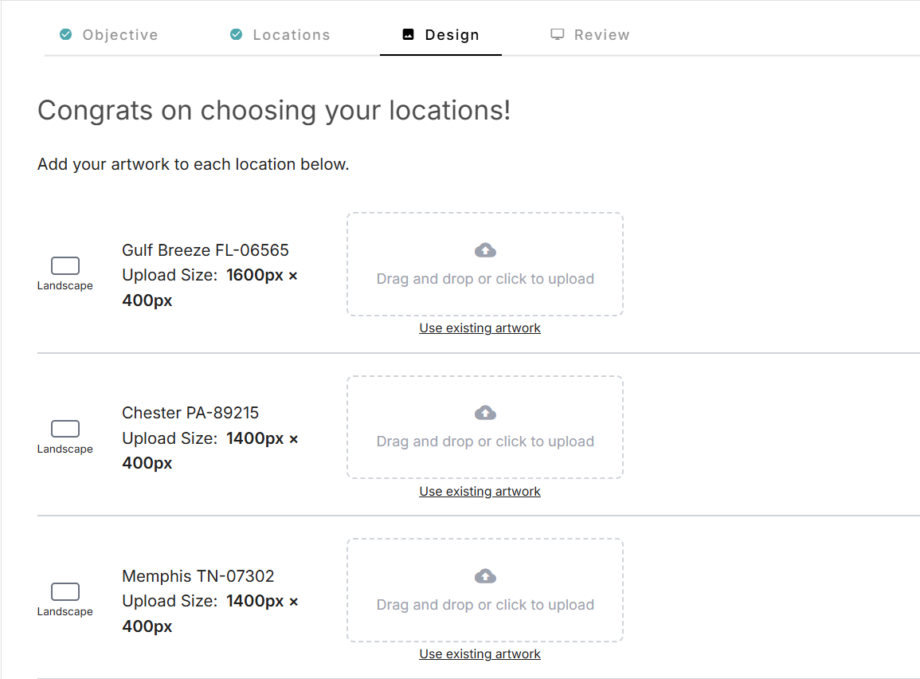
You can have your campaign live in minutes. Create a free account, select your locations, set your budget, upload your design, and start running once approved.
Where can I advertise with Blip near Cupertino?
Blip has digital billboards near Cupertino. You can browse available locations on a map, choose the ones that fit your audience, and start advertising right away.
Still have questions? Launch a campaign in minutes — no contracts, no commitments.
Start Your CampaignCupertino Billboard Advertising Guide
Cupertino sits at the heart of Silicon Valley, surrounded by some of the most educated, high-income, and tech-savvy audiences in the country. With three nearby digital billboards serving the Cupertino area from Santa Clara, we can use precision targeting, flexible budgets, and smart scheduling to put your brand in front of commuters, residents, and employees moving between major tech campuses, retail centers, and residential neighborhoods. For brands searching for billboards near Cupertino without paying core-Cupertino real estate premiums, these placements offer a powerful balance of reach and efficiency.
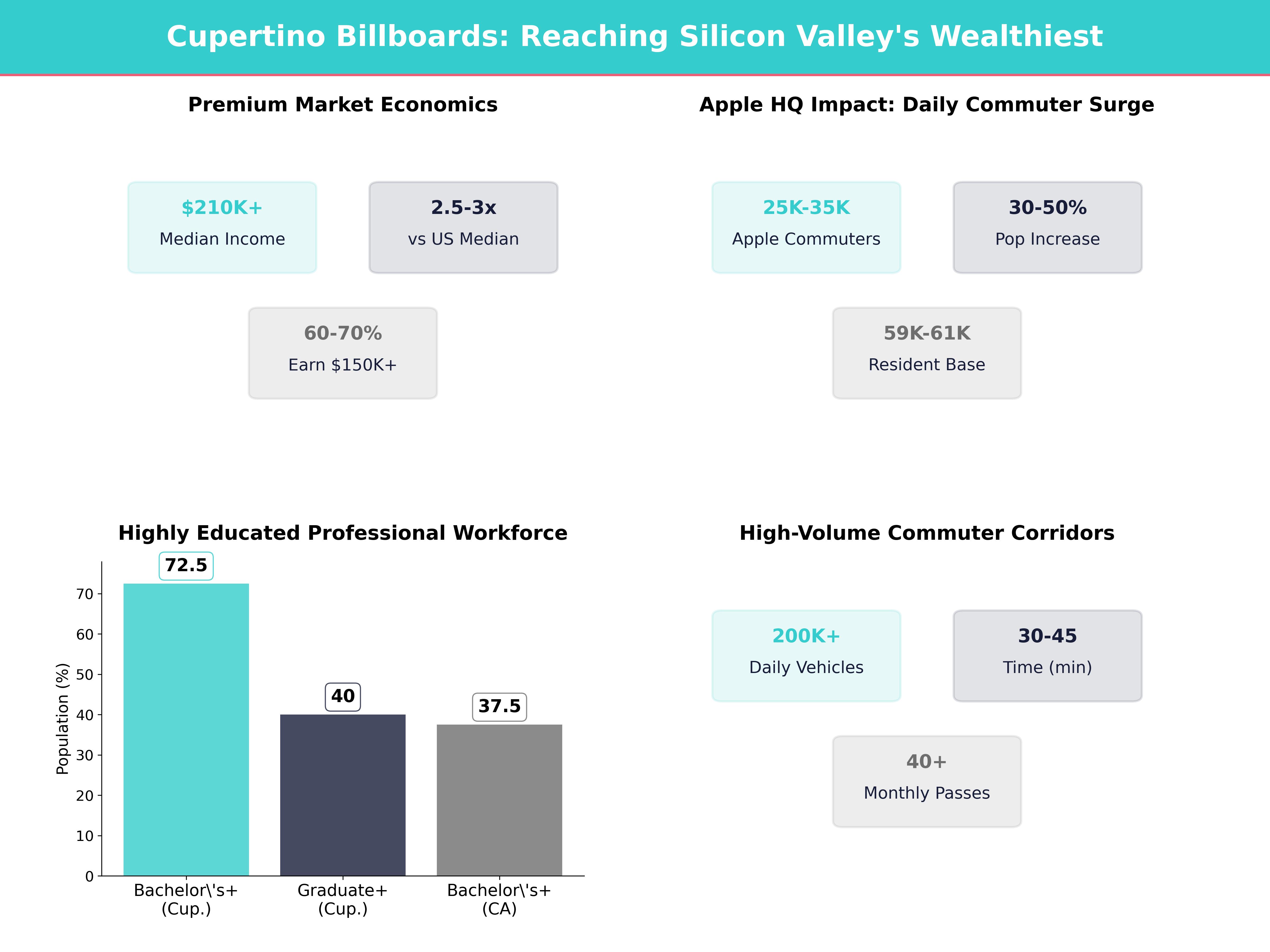
Market Snapshot: Why the Cupertino Area Is High-Value
Cupertino is a relatively small city by population but enormous by economic impact, which makes Cupertino billboards especially valuable for regional and national advertisers:
- The City of Cupertino reports a population of roughly 59,000–61,000 residents, and city planning documents note that the daytime population can increase by 30–50% due to commuters and visitors to major employers such as Apple.
- Santa Clara County
- Cupertino’s median household income is commonly cited at $210,000–$230,000, more than 2.5–3 times the U.S. median, placing it among the top-earning cities in the U.S.
- Nearby City of Santa Clara
- Apple’s headquarters at Apple Park and its nearby campuses host an estimated 25,000–35,000 employees in and around Cupertino on a typical weekday, drawing workers and visitors from across the Bay Area.
Our digital billboards serving the Cupertino area are located in nearby Santa Clara, about 6.8 miles away. This positions your message along heavily traveled commuter and shopping corridors that Cupertino residents and workers frequently use, giving you the impression volume of a major freeway with the audience quality of a tight Cupertino trade area.
Key nearby assets that influence traffic and audience mix include:
- Apple Park and the Apple Infinite Loop campus (major tech employment hub with tens of thousands of daily badge swipes)
- Retail corridors like Stevens Creek Boulevard, which runs from Cupertino into Santa Clara and San Jose and carries tens of thousands of vehicles per day according to local transportation counts
- Nearby venues in Santa Clara such as California’s Great America, Levi’s Stadium, and Mission College, which together attract millions of visits annually and pull regional visitors from across Northern California
- Regional agencies like City of Cupertino and City of Santa Clara
For advertisers interested in billboard advertising near Cupertino, this means a small geographic footprint but outsized exposure to high-spending consumers, decision-makers, and tech talent. Local economic reports frequently show:
- Six-figure median home values well above $2 million in Cupertino neighborhoods
- Tech and professional services accounting for 40–50%+ of local employment
- Regional visitor spending in Santa Clara County in the multi‑billion‑dollar range annually, much of it concentrated around major attractions and shopping corridors your boards can reach
Audience & Demographic Insights for the Cupertino Area
Understanding who you’re reaching is crucial for crafting the right billboard messaging and getting the most from any billboard rental near Cupertino.
Based on recent local and regional data for Cupertino and Santa Clara County:
-
Education
- An estimated 70–75% of adults in Cupertino hold a bachelor’s degree or higher, compared with roughly 35–40% statewide.
- More than 40% of adults have graduate or professional degrees, over double the national share, according to regional higher-education and workforce statistics.
-
Income
- Median household income in Cupertino is typically reported above $200,000, with some recent estimates in the $220,000–$230,000 range.
- Roughly 60–70% of households earn more than $150,000 per year, and a substantial share earn $250,000+.
- Nearby Santa Clara’s median household income is also high, often in the $140,000–$160,000 range, with more than 40% of households above $150,000.
-
Age
- Strong concentration of working-age adults 25–54, typically making up 45–50% of the population.
- Families are common: in many Cupertino neighborhoods, 35–45% of households include children under 18, supported by highly ranked local schools.
-
Ethnicity & Language
- Cupertino has a large Asian population, with many local estimates indicating 60–70% of residents identifying as Asian, especially of Chinese and Indian origin.
- In many neighborhoods, over 60% of households speak a language other than English at home, with Chinese (Mandarin and Cantonese), Hindi, and other Indian languages especially prominent.
-
Industries
- Tech, engineering, finance, and professional services dominate employment; regional labor data show well over half of working residents in management, business, science, and arts occupations.
- Many commuters work for global brands like Apple, NVIDIA, Intel, Google, and other Silicon Valley firms clustered along the US‑101, I‑280, and Lawrence Expressway corridors.
What this means for your billboard strategy:
- Messaging should be smart and efficient. A tech-oriented audience appreciates clarity, brevity, and value. Overly gimmicky or vague messages are less effective.
- High-price and premium offers are appropriate. Luxury goods, high-end services, B2B SaaS, financial services, and advanced education offerings fit the local income and professional profile.
- Multilingual nuance can be powerful. English-first creative is usually best for clarity at highway speeds, but selectively incorporating short, clear lines or cultural references relevant to local communities can help certain campaigns (e.g., education, local services, healthcare).
Commuter Patterns and Where Our Boards Fit In
Even though our digital billboards are physically in Santa Clara, they sit on corridors that Cupertino residents and workers use daily. For marketers evaluating billboards near Cupertino, understanding these commuter flows helps ensure your message is seen repeatedly by the right people.
Key transportation and commute realities:
-
According to VTA and regional transportation data, Santa Clara County sees hundreds of thousands of daily vehicle trips along major corridors like US‑101, I‑280, and Lawrence Expressway.
- Segments of US‑101 and I‑280 in the South Bay commonly report 200,000–300,000 average daily vehicles, giving billboards along these routes extremely high potential impressions.
- Commute times are often 30–45 minutes each way for many workers traveling between Cupertino, Santa Clara, San Jose, Sunnyvale, and Mountain View, with some commutes extending to 60 minutes or more on heavy days.
- Tech campuses frequently have core arrival windows between 7:30–10:00 a.m. and departure waves between 4:00–7:00 p.m., creating extended peak-period exposure windows.
- Traffic increases significantly on event days at Levi’s Stadium, which can host 60,000–70,000 attendees for NFL games and major concerts. These events often push traffic volumes on adjacent routes well above normal weekday averages.
When we deploy campaigns on digital billboards serving the Cupertino area from Santa Clara, we can:
- Capture morning inbound traffic from San Jose, Santa Clara, Milpitas, and further east heading toward Apple Park and other Cupertino job centers.
- Capture evening outbound traffic as people return from Cupertino toward Santa Clara, San Jose, and Milpitas.
- Reach shoppers traveling to and from retail hubs along Stevens Creek Boulevard and nearby shopping centers like Westfield Valley Fair and Santana Row, which together attract tens of millions of visits annually according to local tourism and retail reports.
Using Blip’s flexible tools, we can bias your impressions toward times and boards that align with these commuter flows, such as:
- Heavier weighting on weekday rush hours for B2B, tech recruiting, and professional services.
- Increased presence on weekends and midday for retail, restaurants, and entertainment targeting local families and visitors.
Seasonality and Timing: When to Push Harder
The Cupertino area’s tech-heavy calendar and school-driven family patterns create distinct marketing windows for billboard advertising near Cupertino.
Consider these timing insights:
-
Tech Product Cycles & Conferences
- Many tech launches, developer conferences, and corporate events cluster from April–June and September–November, coinciding with major industry keynotes and local conferences in San Jose and Santa Clara convention venues.
- These periods bring heightened attention to tech news via outlets like The Mercury News, San José Spotlight
-
School Calendar
- Cupertino’s high-performing schools (highlighted by Cupertino Union School District and Fremont Union High School District) regularly rank near the top in California on standardized test scores and college readiness metrics.
- Back-to-school (late July–September) and exam / college application seasons (October–March) are strong windows for tutoring centers, enrichment programs, test prep, and family services. Local high schools often report 90%+ of graduates attending college, which supports demand for college counseling and test prep advertising.
-
Holiday & Travel Periods
- Thanksgiving to New Year’s drives increased retail, restaurant, and travel activity. Local tourism agencies estimate that holiday periods can boost retail sales in major shopping districts by 20–40% compared with typical months.
- Summer months see more tourism, local outings, and family entertainment usage across Santa Clara County’s attractions, including California’s Great America and parks promoted by Santa Clara County Parks
-
Game & Event Days in Santa Clara
- Levi’s Stadium events (NFL games, concerts, soccer matches, special events) can bring 40,000–70,000 visitors per event, many of whom travel along the same freeways and arterials your boards are on.
- Targeting these days with time-bound messaging can yield high-impact bursts for entertainment, hospitality, rideshare, and quick-service restaurants.
We can adjust your schedule dynamically to invest more budget during these high-opportunity windows and scale back during quieter periods, without long-term contracts, making billboard rental near Cupertino as nimble as digital media.
Creative Best Practices for a Sophisticated Tech Audience
Cupertino-area viewers are surrounded by professional design every day—from app interfaces to hardware packaging to campus signage. Your billboard creative must keep up for Cupertino billboards to perform at their full potential.
Design principles that work particularly well here:
-
Lead with one core idea
- Aim for 6–10 words max of primary text. Studies of roadside readability show noticeable drops in comprehension beyond 10–12 words at highway speeds.
- Use a single, bold call to action (e.g., “Book a Demo,” “Order Tonight,” “Enroll Now”).
-
Visuals that feel modern and premium
- Clean, minimalist layouts; strong contrast; high-resolution imagery.
- Avoid clutter, clipart, and overly busy backgrounds, which can reduce recall by 20–30% in fast-moving traffic tests.
- Think in line with the visual language seen at Apple Park or major tech brands.
-
Data and value statements resonate
-
Highlight specific results or proof points:
- “Cut cloud costs by 30%”
- “Over 1,000 Cupertino families served”
- “Trusted by 500+ Bay Area companies”
- Numbers speak strongly to an analytical audience and can increase perceived credibility by 10–20 percentage points in brand-lift studies.
-
Highlight specific results or proof points:
-
Local relevance boosts trust
-
Call out your local presence explicitly:
- “Serving the Cupertino area since 2010”
- “Now open near Stevens Creek & Lawrence”
- Feature recognizable local photos (skyline views, Apple Park-style visuals, South Bay hills) as long as they remain simple and high-contrast on a billboard. Local references can lift engagement and recall by 15–25% compared with generic creative.
-
Call out your local presence explicitly:
-
Tech-friendly calls to action
-
Short URLs and QR codes can work, but ensure:
- The URL is short and readable at a glance.
- QR codes are large enough and contrasted sharply against the background.
- For high-speed roads, emphasize memorable brand names/phrases over complex URLs; roadside testing often shows 2–3 seconds of readable exposure for a typical driver.
-
Short URLs and QR codes can work, but ensure:
With Blip, you can easily upload multiple creatives and A/B test variations (different headlines, colors, value props) to see which perform best.
Strategic Use of Our Santa Clara Boards to Reach Cupertino
Although the structures themselves are in Santa Clara, their 6.8-mile proximity positions them ideally for reaching a Cupertino area audience, functioning effectively as Cupertino billboards for both awareness and response campaigns.
We can use this to our advantage in several ways:
-
Bridge Messaging
-
Connect Santa Clara and Cupertino in your copy:
- “From Santa Clara to the Cupertino area, we’ve got your IT covered.”
- “Cupertino-area families—visit our new Santa Clara campus.”
-
Connect Santa Clara and Cupertino in your copy:
-
Directional & Proximity Messaging
-
For physical locations, call out approximate distance:
- “Just 8 minutes west toward Cupertino”
- “2 miles from Stevens Creek & Lawrence”
-
For physical locations, call out approximate distance:
-
Commuter Repetition
- Many workers pass the same stretches of road twice per day, 5 days per week—roughly 40+ passes per month past the same location.
- By appearing consistently during peak commute times, your message can generate dozens of weekly impressions per individual commuter, building strong recall and driving up brand familiarity.
Because Blip lets you choose where and when your ads appear, we can favor boards and dayparts most aligned with Cupertino-bound or Cupertino-originating traffic, and adjust quickly as we learn which patterns perform best for your billboard advertising near Cupertino.
Campaign Ideas by Industry
To make the most of the Cupertino area’s profile, here are specific strategies by vertical that work particularly well with billboards near Cupertino:
Tech & B2B SaaS
- Target audience: Executives, engineers, product managers, IT leaders.
-
Tactics:
- Run ads during weekday commute windows (7–10 a.m., 4–7 p.m.) when a large share of the 25,000–35,000 Apple and nearby campus workers are on the road.
- Emphasize metrics and outcomes: “Ship features 30% faster,” “Reduce downtime by 50%,” “Cut support tickets by 40%.”
- Sync messages with major industry events or Apple-related launch periods to ride trending topics reflected in coverage from outlets like The Mercury News and regional tech publications.
Education & EdTech
- Target audience: Parents of K–12 students, adult learners, international families.
-
Tactics:
- Schedule heavier spend around back-to-school and exam seasons, when local families typically invest more in education and enrichment.
- Promote after-school programs, SAT/ACT prep, coding camps, and STEM academies—especially relevant in a city where 90%+ of high school graduates move on to college.
- Highlight success metrics: “95% of our students accepted to top-50 universities,” “Average score increase of 150+ points on standardized tests,” or “Serving 500+ Cupertino-area students each year.”
Local Services (Healthcare, Legal, Financial, Home Services)
- Target audience: High-income professionals and families.
-
Tactics:
- Focus on trust, expertise, and convenience: “Evening appointments available,” “Serving the Cupertino area for 20+ years,” “Rated 4.8/5 by local patients.”
- Promote benefits relevant to busy schedules (telehealth, online booking, weekend service).
- Emphasize local credentials and affiliations with Bay Area institutions and hospitals promoted by the County of Santa Clara
Retail, Dining, and Entertainment
- Target audience: Residents, workers, and visitors exploring Santa Clara and Cupertino area amenities.
-
Tactics:
- Use time-sensitive offers: “Happy hour 4–6 p.m.,” “This weekend only,” or “Tonight’s concert specials.”
- Increase frequency on Fridays, weekends, and event days at Levi’s Stadium or California’s Great America, when nearby venues can add tens of thousands of extra visitors to local roads.
- Capture Apple and tech campus employees heading home or to lunch by focusing on 11 a.m.–2 p.m. and 4–7 p.m. rotations.
Recruitment & Employer Branding
- Target audience: Engineers, designers, data scientists, operations teams.
-
Tactics:
- Promote competitive compensation or unique benefits: “Total comp up to $300k+,” “Work remote 3 days/week,” “Employee stock plans from day one.”
- Tie in with local identity: “Build the future with us, right here in the Cupertino area.”
- Use memorable, concise job categories: “Now hiring senior engineers,” “Design leaders wanted,” with links or QR codes to a careers page.
Leveraging Blip’s Flexibility for the Cupertino Area
Because Blip sells digital billboard space by the “blip” (a single ad play), we can build campaigns that are highly adaptive to Cupertino-area dynamics and make billboard rental near Cupertino easy to scale up or down.
-
Dayparting
- Concentrate budget in specific hours—commute rush, lunch, evenings, weekends—based on your audience.
- Example: A restaurant pushing 11 a.m.–2 p.m. and 5–8 p.m., Monday–Saturday, or an EdTech brand emphasizing 3��9 p.m. when parents are more available.
-
Geographic focus
- Allocate more impressions to specific boards serving routes commonly used by Cupertino residents and Cupertino-area workers.
- Adjust distribution quickly if you find certain corridors convert better, based on your website analytics and in-store data.
-
Budget control and ramp-up
- Start with a modest daily budget to test messaging (e.g., enough for 50–100 daily blips, which could translate to 1,500–3,000 plays per month depending on pacing), then scale up on the best-performing creative and time windows.
-
Creative rotation & testing
-
Rotate 3–5 creatives to test different:
- Headlines (value-focused vs. emotional appeal)
- Calls to action (visit site, visit store, call, scan QR)
- Offers (percent discounts, free trials, limited-time promos)
- Iterative testing like this can improve response metrics by 20–50% over the life of a campaign compared with a single static creative.
-
Rotate 3–5 creatives to test different:
Over time, you can refine your mix to the most effective creative, boards, and time slots for the Cupertino area, turning nearby Santa Clara inventory into a consistently performing network of Cupertino billboards.
Measuring Impact and Optimizing Over Time
While digital billboards don’t track individual viewers, we can connect the dots using:
-
Time-based analytics
- Compare website traffic, calls, or app activity during your scheduled ad windows vs. non-ad windows. A noticeable 10–30% lift during your active windows is a strong signal of impact.
- Watch for lifts in direct and branded search (people typing your brand name into search engines) once your campaign begins, especially in the first 2–4 weeks.
-
Location-based metrics
- Retailers and restaurants can track POS data from customers in ZIP codes near Cupertino and Santa Clara and look for sales or visit increases of 5–15% during campaign periods.
- Service providers can ask new leads a simple source question: “How did you hear about us?” and track what share—often 10–20% for local brands—mention “billboard” or “sign on the freeway.”
-
Campaign iteration
- If a specific billboard/time combo correlates with stronger results, reallocate more of your budget there.
- Refresh creative every 6–12 weeks to avoid fatigue, and more often if promoting time-limited offers. Many advertisers see renewed engagement spikes of 10–20% immediately after a creative refresh.
By combining these metrics with knowledge of local patterns—weekly traffic cycles, school schedules, tech events, and Santa Clara County news from outlets like The Mercury News and San José Spotlight
By thoughtfully leveraging our three digital billboards serving the Cupertino area from nearby Santa Clara, aligning your messaging with local demographics and commute patterns, and using Blip’s flexible tools, we can build out-of-home campaigns that match the sophistication and pace of Silicon Valley itself, while giving you efficient, high-impact access to billboards near Cupertino.