Billboards in Shiloh, OH
No Minimum Spend. No Long-Term Contracts. Just Results.
Turn heads in the Shiloh area with flexible, budget-friendly digital Shiloh billboards. Blip makes it easy to launch, control, and track eye-catching campaigns on billboards near Shiloh, Ohio, so your message shines exactly when and where you want.
Trusted by Leading Brands


How much is a billboard in Shiloh?
Billboards in other Ohio cities
Shiloh Billboard Advertising Guide
Situated just northwest of Dayton, the Shiloh, Ohio area gives advertisers access to a dense mix of suburban neighborhoods, busy commuter routes, regional shoppers, and workers traveling in and out of the Dayton core. Within about a 5–6 mile radius, there are tens of thousands of residents and daily commuters using the major corridors that connect Harrison Township, north Dayton, and downtown. With three Blip digital billboards near Shiloh serving the area from nearby Dayton (within about 5–6 miles), we can help you reach local residents and through‑traffic with flexible, data‑driven campaigns that fit virtually any budget, all while keeping your message highly visible with billboard advertising near Shiloh.
Why the Shiloh, Ohio Area Is a Powerful Billboard Market
The Shiloh area sits in Harrison Township in Montgomery County, directly adjacent to the City of Dayton. That geography makes it a natural crossroads between suburban households and the larger Dayton economy, especially for people who live in the township but work, shop, or seek healthcare in Dayton. For advertisers, this makes Shiloh billboards uniquely effective at connecting neighborhood audiences with regional activity centers.
Key regional numbers that matter for advertisers:
- Shiloh and Harrison Township together give you access to an immediate trade area of roughly 22,000–25,000 residents, based on recent township and regional planning estimates.
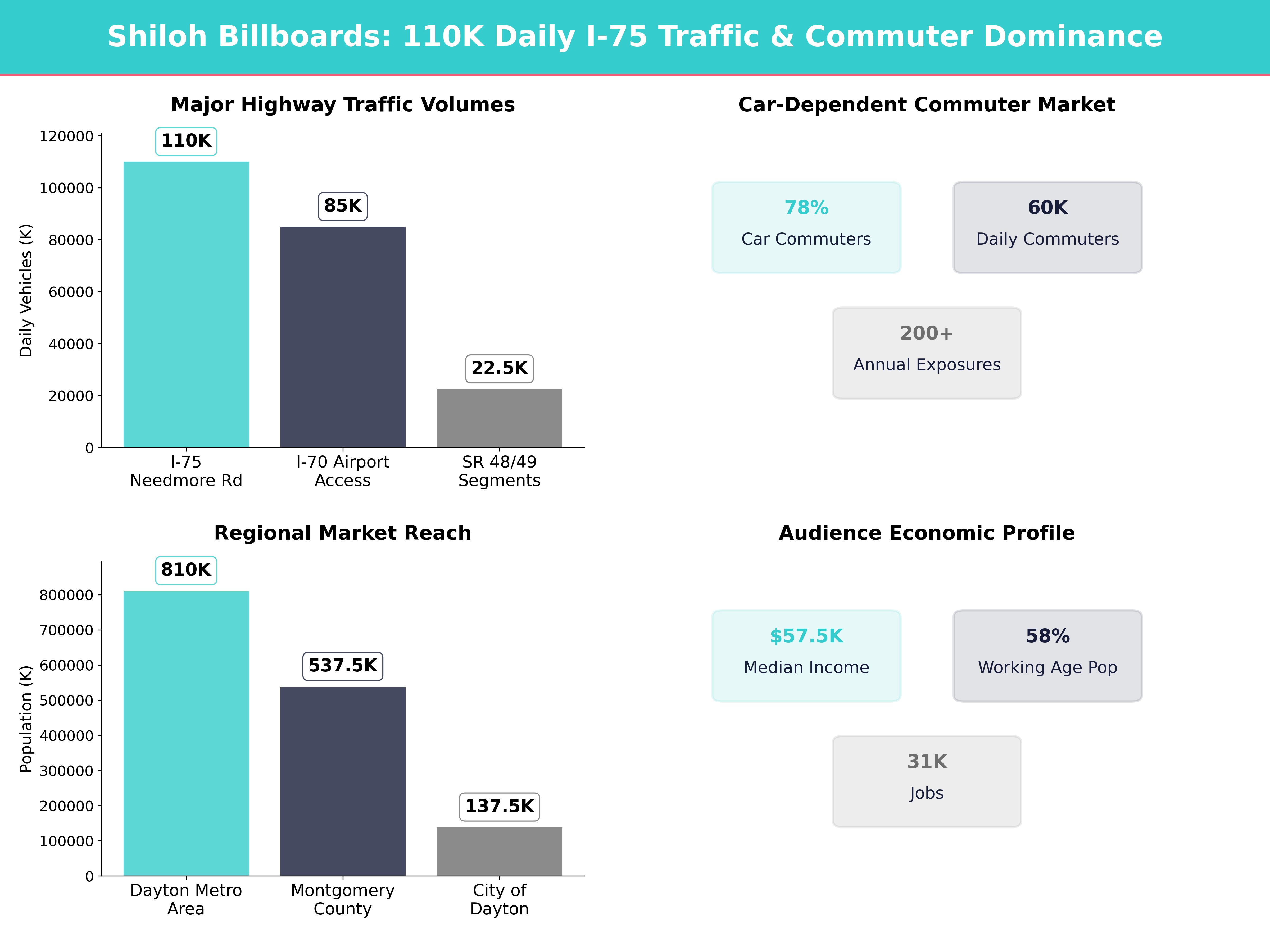
- Montgomery County’s population is about 535,000–540,000 residents, while the broader Dayton metropolitan area hosts roughly 800,000–820,000 people.
- The nearby City of Dayton has about 135,000–140,000 residents, and local estimates show that well over 60,000 people commute into Dayton on a typical weekday for work, school, and services.
-
Major highways around Dayton, including I‑75 and I‑70, routinely carry between 70,000 and 120,000 vehicles per day on key segments, according to Ohio Department of Transportation traffic counts from the past few years ( Ohio DOT District 7
- On I‑75 near the Needmore Road interchange, average daily traffic often exceeds 110,000 vehicles.
- On I‑70 near the Dayton International Airport 80,000–90,000 vehicles per day range.
Because our three digital billboards are situated in Dayton but within roughly 10 miles of Shiloh, you can:
- Capture commuters traveling between northern suburbs and downtown Dayton, where inbound lanes alone can carry 3,000–5,000 vehicles per hour during peak rush times.
- Reach shoppers heading to big‑box retail corridors and regional malls such as the Dayton Mall, the Mall at Fairfield Commons, and key power centers along Miller Lane and North Main Street.
- Keep your brand in front of households that regularly drive into Dayton for work, school, events, or healthcare.
Instead of treating Shiloh as an isolated suburb, we can use Blip to position your message into the daily flow of the larger Dayton economy while still speaking directly to local needs and identity, making billboard advertising near Shiloh both efficient and locally relevant.
Understanding Who You Can Reach Near Shiloh
To build effective creative and scheduling strategies, it helps to understand who lives and works in the Shiloh area and its surroundings. The market blends established, value‑oriented neighborhoods with workers tied into regional employers, which is exactly the audience most businesses want when considering billboards near Shiloh.
Demographics and household profile
Based on the latest regional estimates for Harrison Township, Shiloh, and northern Dayton:
-
Age mix
- Roughly 23–25% of residents are under age 18, indicating a strong base of families with children.
- Around 55–60% are between 18 and 64 (working age).
- About 15–18% are 65 or older, creating meaningful demand for healthcare, financial services, and senior‑focused offerings.
-
Household income
- Median household income in the Shiloh/Harrison Township area is in the $40,000–$45,000 range.
- Montgomery County overall sits closer to $55,000–$60,000, signaling that many nearby households have moderate but stable spending power.
- In practical terms, that means a large share of households are budgeting carefully for everyday expenses, and price‑sensitive offers tend to perform well.
-
Housing
- In Harrison Township and north Dayton, a substantial share of housing units are single‑family homes, but 40–50% of occupied units are renter‑occupied apartments, duplexes, or multi‑family buildings along major corridors.
- This mix supports both long‑time homeowners and more transient renters—ideal for services that benefit from high neighborhood turnover (apartments, insurance, furniture, quick‑service restaurants).
-
Education
- In the broader Montgomery County region, roughly 30–35% of adults have completed an associate degree or some college, and around 20–25% hold a bachelor’s degree or higher.
- Local education levels are supported by proximity to institutions like the University of Dayton (udayton.edu), with about 11,000+ students and thousands of employees, and Sinclair Community College (sinclair.edu), which serves more than 18,000 students annually.
What this means for your campaign:
- Value‑oriented messaging and promotions often perform well, especially for family‑oriented products and services.
- Clear, everyday benefits (“Save on auto repair this week”) resonate more strongly than luxury‑first messages, given that many households are in mid‑income brackets.
- Educational framing (“Free consultation,” “First class free,” “No‑cost assessment”) can appeal to working adults looking to upskill and older residents seeking trusted guidance.
Employment and commuting patterns
The Dayton region has a diverse employment base, including healthcare, manufacturing, defense, logistics, and education. Within a 20–25 minute drive of Shiloh, key employers include:
- Premier Health and Kettering Health hospital systems (Premier Health, Kettering Health), which together employ more than 25,000 people across the region.
- Wright-Patterson Air Force Base ( wpafb.af.mil 30,000–32,000 military, civilian, and contractor jobs—making it one of the largest single‑site employers in Ohio.
- Educational institutions like the University of Dayton and Sinclair Community College, which collectively employ several thousand faculty and staff in addition to serving tens of thousands of students.
- Manufacturing and logistics operations along I‑75 and I‑70, including industrial parks and distribution centers that collectively support tens of thousands of regional jobs.
Region‑wide, well over 80% of workers drive to work, and roughly 75–78% commute alone by car. Average commute times hover around 20–23 minutes, with many Shiloh‑area residents regularly traveling into Dayton or nearby employment hubs such as Vandalia, Huber Heights, and Riverside.
Implications for advertisers:
- Morning and evening drive times are prime windows to reach working adults—often twice per day as they make the same trip five days a week.
- Service businesses (auto care, healthcare clinics, financial services) can successfully target commuters with “on your way to work” or “on your way home” messaging.
- Recruiting campaigns can highlight proximity and commute convenience (“15 minutes from home,” “Easy Dayton commute”), which is especially compelling in a market where typical one‑way commute times are under 25 minutes and Shiloh billboards can reinforce the message daily.
Key Travel Corridors Serving the Shiloh Area
Our digital billboards are placed in and around Dayton, within roughly 5.4 miles of Shiloh, near some of the region’s busiest arteries. These boards function as high‑impact billboards near Shiloh for both local residents and regional travelers. While board locations can change over time, advertisers typically benefit from visibility along:
- Interstate 75 (I‑75) – The north–south backbone of western Ohio. Segments around Dayton see estimated volumes between 90,000 and 120,000 vehicles per day. During peak morning and evening rush, individual travel lanes can carry 1,500–2,000 vehicles per hour.
- Interstate 70 (I‑70) – Running east–west just north of the Dayton core, generally carrying 70,000–90,000 vehicles per day on key stretches.
- Major surface routes such as Ohio State Routes 48 and 49 and connecting arterials that feed into I‑75 and I‑70, where typical daily counts often reach 15,000–30,000 vehicles depending on the segment.
Because Shiloh sits just northwest of Dayton’s urban core, traffic patterns tend to follow predictable flows:
- Morning: Residents from the Shiloh area and beyond head south and southeast toward downtown Dayton, major hospitals, and corporate campuses. Inbound volumes on key arterials can increase 30–40% compared with off‑peak hours.
- Midday: Shoppers and service‑seekers travel between neighborhoods, business districts, and retail centers, creating steady errand and appointment traffic.
- Evening: Commuters return north and west, often making stops for groceries, quick‑service restaurants, and errands on the way home—an ideal window for “tonight” offers.
By choosing Blip billboards that line these flows, you can treat every daily commute as a predictable, repeatable opportunity to reinforce your message for the same drivers 5 days a week and 200+ times per year, maximizing the value of billboard advertising near Shiloh.
Timing Your Blip Campaign Around Local Patterns
One of the key advantages of Blip is that you only pay for the “blips” (individual ad plays) you schedule. That means timing is as strategic as your creative, and you can align with how people in and around Shiloh actually use the roads.
Here are regional patterns to consider when setting dayparts and budgets:
Weekday vs weekend dynamics
Local transportation and planning data show clear peaks in weekday traffic volumes:
-
Weekdays
- Morning rush: roughly 6:30–9:00 a.m., with the sharpest peaks often between 7:15–8:30 a.m.
- Midday: 11:00 a.m.–1:30 p.m. (errands, lunch, medical appointments).
- Evening drive: 3:30–6:30 p.m., when volumes can rival or exceed the morning peak.
- Ideal for commuters, B2B services, healthcare, education, and recruitment ads that rely on regular repetition.
-
Weekends
- Traffic shifts later in the morning, often building between 9:30 a.m. and 2:00 p.m., then again from 4:00–7:00 p.m. for dining and entertainment.
- Strong for retail, restaurants, entertainment, auto dealers, and events; regional shopping trips can last 2–4 hours, increasing exposure opportunities as people crisscross the area.
If your goal is to reach Shiloh‑area families:
- Emphasize late afternoon and early evening on weekdays and mid‑morning through afternoon on weekends.
- Consider heavier weekend delivery during seasonal retail peaks (back‑to‑school sales in August, holiday shopping in November–December), when retail traffic can spike 20–40% over baseline.
If you’re targeting workers and commuters:
- Allocate more budget to weekday rush hours, where the same audience passes your boards day after day.
- Use short, high‑frequency bursts to own a commute window (for example, 7–9 a.m. or 4–6 p.m.) rather than spreading too thin across the entire day.
Seasonal opportunities
The Dayton and Montgomery County area experiences four distinct seasons, with weather and local activity shaping when people are on the road:
- Winter (Dec–Feb): Average high temperatures in the 30s–40s°F and annual snowfall around 20 inches push more activity into daylight hours and early evening. This is a strong season for indoor activities, healthcare, tax prep, and auto service (tires, batteries, heating).
- Spring (Mar–May): As temperatures climb into the 50s–70s°F, traffic tied to home improvement, landscaping, and recreational outings increases. Home improvement and landscaping spending often rises sharply in this period, making it a prime window for contractors and garden centers.
- Summer (Jun–Aug): With school out and average highs in the 80s°F, families travel more for parks, pools, and regional attractions. The Dayton Convention & Visitors Bureau highlights a steady stream of festivals, concerts, and events (daytoncvb.com), and local parks and recreation areas routinely report usage increases of 20–30% over winter levels.
- Fall (Sep–Nov): Back‑to‑school shopping, college sports, and early holiday prep drive steady commuting and retail activity. Regional surveys show that a significant share of households begin holiday shopping as early as October, creating strong opportunities for retailers and educational programs.
With Blip, you can easily adjust schedules by season, week, or even day, without reprinting or re‑installing static vinyl—making it simple to respond to local weather, school calendars, and event schedules and to keep your billboards near Shiloh aligned with real‑time demand.
Creative Strategies That Resonate Near Shiloh
Digital billboards near the Shiloh area need to grab attention quickly while fitting the local context. A few principles stand out for this market.
Keep copy simple and benefit‑driven
Drivers typically have 6–8 seconds to read and process your message at highway speeds. In that window:
- Lead with clear benefits or offers (“Oil Change $39,” “New Patients: $0 Exam”), which match the value focus of many local households.
- Limit to 7 words or fewer when possible, and avoid stacking long sentences.
- Use a strong call to action that can be remembered without writing it down (“Exit at Main St,” “Search: DAYTON DENTAL”).
Example structures:
- “Back Pain? Walk‑In Clinic 10 Min Away”
- “New Tires Today. Payments as Low as $25/mo”
- “Need a Job? Now Hiring in Dayton – Apply Online”
In tests across many markets, concise messages like these often achieve higher recall rates than more complex creative, especially when paired with well‑placed Shiloh billboards on commuter routes.
Use bold colors and local cues
Color and imagery should stand out against Ohio’s seasonal palette:
- High‑contrast combos (dark text on light background or vice versa) are easier to read from 500–1,000 feet away.
- Avoid overly detailed photos; opt for a single strong image or icon that can be recognized in a split second.
Local cues to consider:
- Visual nods to Dayton landmarks—such as the downtown skyline, the Great Miami River, or popular venues highlighted by the Dayton Convention & Visitors Bureau—signal that you are a true local presence.
- Phrases like “Serving the Shiloh area” or “Minutes from Shiloh” help neighbors understand the convenience, especially when they know their typical drive is 10–15 minutes.
- For events, referencing specific Dayton or Montgomery County venues and districts adds credibility (“Downtown Dayton,” “near the Dayton RiverScape MetroPark”).
Tailor creative by direction and daypart
Because drivers are often either heading toward Dayton or back toward the suburbs, you can align your message with their likely mindset:
-
Inbound (toward Dayton) in the morning
- “Grab Coffee on Your Way In”
- “Need a Better Commute? Now Hiring Closer to Home”
-
Outbound (toward Shiloh and nearby suburbs) in the evening
- “Dinner Tonight? Kids Eat Free”
- “Open Until 8 p.m. – Stop By on Your Way Home”
With Blip, you can upload multiple creatives and assign them to specific boards, times of day, or days of the week, so inbound commuters don’t see the same message as outbound traffic if that doesn’t fit your strategy. This flexibility makes digital billboard rental near Shiloh especially powerful for advertisers who want to customize by audience and time.
Using Blip Tools to Target the Shiloh Area
Our three digital billboards serving the Shiloh area from Dayton give you flexibility in where, when, and how often your ads appear, without the fixed monthly costs of traditional static boards. If you’ve ever considered billboard rental near Shiloh but were concerned about long‑term contracts, Blip’s model is designed to lower that barrier.
Geographic targeting
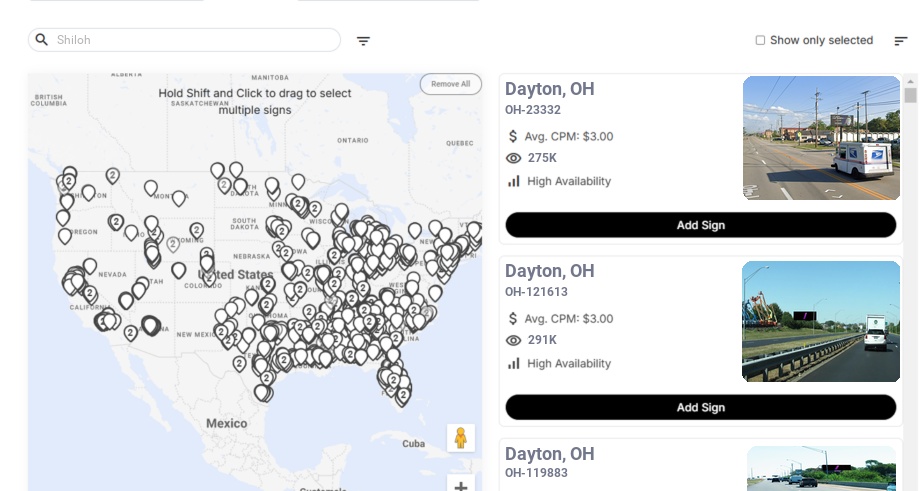
You can choose boards that best align with:
- North–south commuter flows (for Shiloh residents heading into central Dayton for work or school).
- Access routes to key retail centers and healthcare clusters used by Harrison Township and north Dayton residents.
- Corridors connecting to I‑70 and I‑75, capturing regional traffic that still includes many Shiloh‑area drivers and visitors.
By selecting location‑specific boards near Dayton that sit within about 10 miles of Shiloh, you effectively anchor your brand within the daily routines of local residents, even though the boards themselves are physically in nearby cities. This approach gives you the reach of metro‑level billboard advertising near Shiloh with the precision of neighborhood targeting.
Budget control and bidding
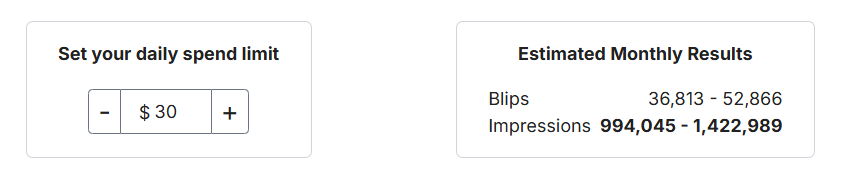
Instead of paying a flat monthly fee, you set:
- A total campaign budget (often starting as low as $5–$10 per day).
- A maximum bid per blip, which influences how often your ad appears relative to others on the same sign and daypart.
This model is ideal for:
- Small businesses in the Shiloh area testing billboard advertising for the first time, who might begin with a few hundred dollars over a month.
- Regional advertisers who want to layer Shiloh‑area reach into a larger Dayton‑metro strategy.
- Seasonal and event‑based campaigns that only need short, targeted bursts of visibility (for example, 2–4 weeks leading up to an event).
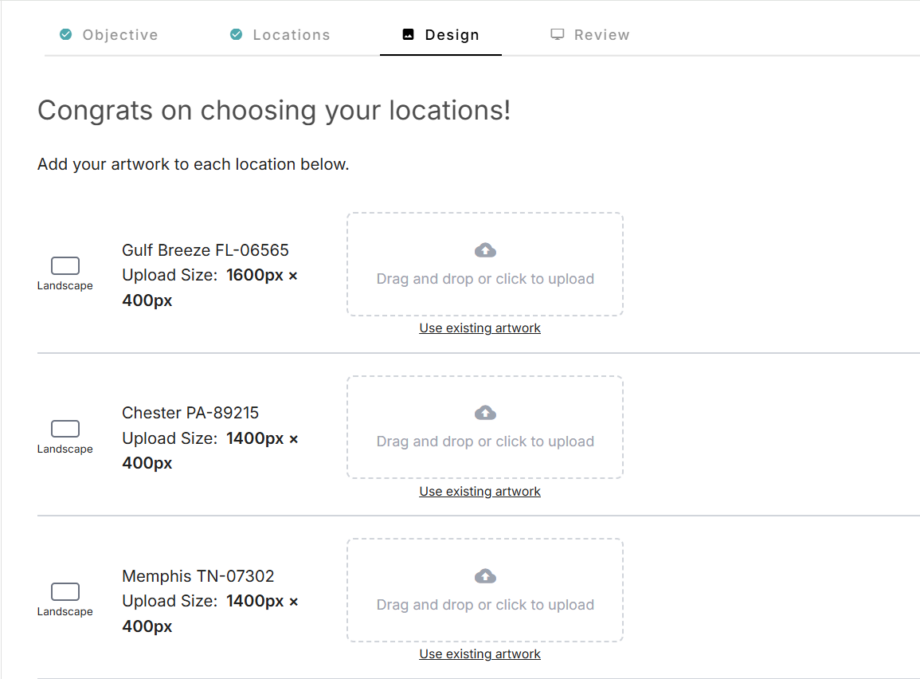
Rotating and testing creatives
Since uploading additional creatives has no printing cost, you can:
- Run A/B tests with different headlines or offers and compare performance by impressions, clicks (if paired with digital), or store traffic.
- Rotate seasonal versions (back‑to‑school, holidays, tax season) to match local buying cycles.
- Localize copy (“Serving the Shiloh area” vs. “Serving North Dayton”) and see what drives more response.
We recommend starting with 2–4 creative variations and rotating them evenly for at least 2–4 weeks to gather meaningful impressions—often tens of thousands to hundreds of thousands of plays—before making decisions.
Sample Strategies by Business Type
To make these concepts concrete, here are ways different advertisers can leverage Blip billboards near the Shiloh area.
Local retail and service businesses
Ideal for: auto repair shops, salons, hardware stores, pet services, independent restaurants.
Strategy:
- Focus on boards that commuters from Shiloh pass when entering or leaving Dayton, particularly along I‑75 and SR‑48/49, where local traffic can exceed 20,000 vehicles per day.
- Target weekday evenings and weekends for family‑oriented purchases, when households are running errands or dining out.
-
Use price‑driven, time‑sensitive offers:
- “Oil Change $39 – 10 Minutes from Shiloh Area”
- “Dog Grooming This Weekend – Call Today”
Measure by:
- Unique promo codes shown only on the billboard.
- Asking “How did you hear about us?” at checkout and recording responses.
- Short URL or memorable keyword for online tracking.
Healthcare and dental practices
Ideal for: primary care clinics, urgent care, dental offices, optometrists, physical therapy.
Strategy:
- Emphasize accessibility and extended hours; many local patients prefer care within 10–15 minutes of home or work.
- Run consistently during commuting hours and lunch, when people are thinking about health errands.
-
Highlight insurance acceptance, walk‑ins, or new‑patient incentives:
- “Urgent Care Close to Home – Open 8–8”
- “New Patients: Free Whitening Kit – Near Shiloh Area”
Layer with:
- Local partnerships and listings on Montgomery County and local township resources (Montgomery County official site, Harrison Township), as well as local hospital and clinic directories, so your billboard advertising near Shiloh is reinforced by strong online and community visibility.
Education and training providers
Ideal for: community colleges, trade schools, tutoring centers, childcare and preschools.
Strategy:
- Target adults considering upskilling, parents of school‑age children, and recent grads. In Montgomery County, a sizable share of adults—roughly one‑third—have some college but no degree, making them prime candidates for certificate and degree programs.
- Increase frequency around enrollment deadlines or back‑to‑school season (late July through September).
-
Use clear, value‑oriented copy:
- “Career Training in 12 Months – Enroll Now”
- “Affordable Preschool Near Shiloh Area – Limited Spots”
Direct drivers to:
- Simple URLs or QR codes (also used on other media) to track billboard‑driven inquiries, and measure how many new leads mention seeing your message “on the Dayton billboard.”
Events, tourism, and entertainment
Ideal for: festivals, concerts, museums, sports teams, seasonal attractions.
Strategy:
- Leverage Dayton’s active events calendar promoted by the Dayton Convention & Visitors Bureau (daytoncvb.com) and regional venues. Major events like air shows, festivals, and concerts can draw tens of thousands of attendees from across Montgomery County and adjacent counties.
- Run heavier schedules in the 2–4 weeks before major events, with intensity peaking in the final 7–10 days.
-
Use big, bold visuals and simple “When + Where” details:
- “Dayton Air Show – July 20–21 – Get Tickets Now”
- “Family Fun Night – This Saturday, 7 p.m., Dayton”
Focus on:
- Weekend daytime and early evening, when families are making last‑minute plans.
- Board locations on routes people from the Shiloh area use to reach downtown or event venues, ensuring your Shiloh billboards become part of their habitual planning routes.
Hiring and workforce campaigns
Ideal for: manufacturers, logistics firms, healthcare systems, call centers, retailers.
Strategy:
- Target boards that reach Shiloh‑area commuters headed toward industrial parks and business districts along I‑75 and I‑70.
-
Emphasize pay, benefits, and commute convenience:
- “Now Hiring – $20/hr + Benefits – 10 Min from Shiloh Area”
- “Tired of Long Commutes? Work in Dayton”
Coordinate with:
- Job listings on local news and community sites such as Dayton Daily News (daytondailynews.com), WHIO (whio.com), and WDTN ( wdtn.com
Measuring and Improving Your Campaign
Billboard advertising in the Shiloh area doesn’t have to be guesswork. With digital billboards and Blip’s analytics, we can bring performance thinking to an inherently high‑impact medium.
Track what you can
Combine Blip impression data—which can reach tens or hundreds of thousands of plays per month per campaign—with:
- Unique promo codes or offers only shown on billboards.
- Dedicated phone numbers or extensions.
- Short, memorable URLs or landing pages.
- “How did you hear about us?” questions in forms or at point of sale.
Over time, compare:
- Different creative messages (for example, price‑focused vs. benefit‑focused).
- Different dayparts (morning vs evening vs weekend).
- Different campaign dates (e.g., pre‑holiday vs off‑season).
Even simple tracking can reveal that certain combinations—like evening/weekend schedules for restaurants—generate significantly more redemptions than others when tied to well‑placed billboards near Shiloh.
Optimize based on patterns
As trends emerge:
- Shift budget toward the boards, times, and messages that correlate with more calls, website visits, or in‑store traffic.
- Retire underperforming creatives and test new variations, updating your artwork in hours instead of weeks.
- Use weather or seasonal cues (e.g., snowstorms, heat waves) to adjust messaging in real time for services like HVAC, auto repair, or indoor entertainment.
Because there is no printing lag, you can:
- Launch new artwork quickly around breaking news, local sports, or sudden demand shifts featured by outlets like Dayton Daily News or WHIO.
- Run short, intense campaigns tied to limited‑time offers—like a 3‑day sale or a single‑weekend event—without committing to a full month.
Bringing It All Together for the Shiloh Area
The Shiloh, Ohio area benefits from the traffic, employment, and cultural gravity of nearby Dayton while maintaining its own identity as a close‑knit, value‑oriented community. With three Blip digital billboards serving the Shiloh area from just a few miles away in Dayton, advertisers of all sizes can:
- Reach thousands of daily commuters and families on their regular routes, many of whom pass the same signs 10 or more times per week.
- Tailor messaging, timing, and locations to specific goals and budgets, from low daily spends to larger, metro‑wide campaigns.
- Test, learn, and refine campaigns quickly, without committing to long‑term static placements.
By combining localized creative (“serving the Shiloh area”), smart scheduling around commuter and seasonal patterns, and disciplined measurement, we can help you turn high‑visibility digital billboards near Shiloh into a consistent, cost‑effective driver of awareness, foot traffic, and sales throughout Harrison Township, Montgomery County, and the greater Dayton region.