Billboards in Azusa, CA
No Minimum Spend. No Long-Term Contracts. Just Results.
Turn heads in the Azusa area with Azusa billboards that fit any budget. Blip makes it easy to launch eye-catching campaigns on digital billboards near Azusa, California, giving you flexible control, real-time results, and big impact without the big‑brand price tag.
Trusted by Leading Brands


How much is a billboard in Azusa?
Why Choose Blip for Billboard Advertising in Azusa
Blip lets Azusa brands launch fast and budget what they need for I-210, I-10, and I-605 commuters—no contract required.
In Azusa, Blip dayparting hits APU and Citrus College traffic at morning rush and class-change peaks, not wasted hours.
Set a flexible Azusa budget in Blip and scale with demand from Azusa Avenue, Arrow Highway, and Foothill Boulevard shoppers.
Blip real-time analytics help Azusa advertisers shift spend toward the best freeway and corridor impressions as traffic moves.
Use Blip creative tools to test bilingual ads for Azusa's family-heavy, Hispanic/Latino audience and local event surges.
Frequently Asked Questions About Billboard Advertising in Azusa
How much does a billboard cost near Azusa, California with Blip?
Where can I advertise with Blip near Azusa, California?
Who can Azusa billboards reach in the local market?
What kind of traffic do Azusa-area billboards get with Blip?
When is the best time to run billboard ads near Azusa, California?
Do I need a contract to advertise with Blip in Azusa?
How fast can I launch a billboard campaign with Blip in Azusa?
Where can I advertise with Blip in Azusa?
Still have questions? Launch a campaign in minutes — no contracts, no commitments.
Start Your CampaignAzusa Billboard Advertising Guide
The Azusa area sits at the gateway between the San Gabriel Mountains and the dense suburbs of eastern Los Angeles County 400,000–800,000 weekly impressions, meaning a well-placed Azusa-area buy can reach 1–2 million impressions per month with coordinated coverage.
Understanding the Azusa Area Market
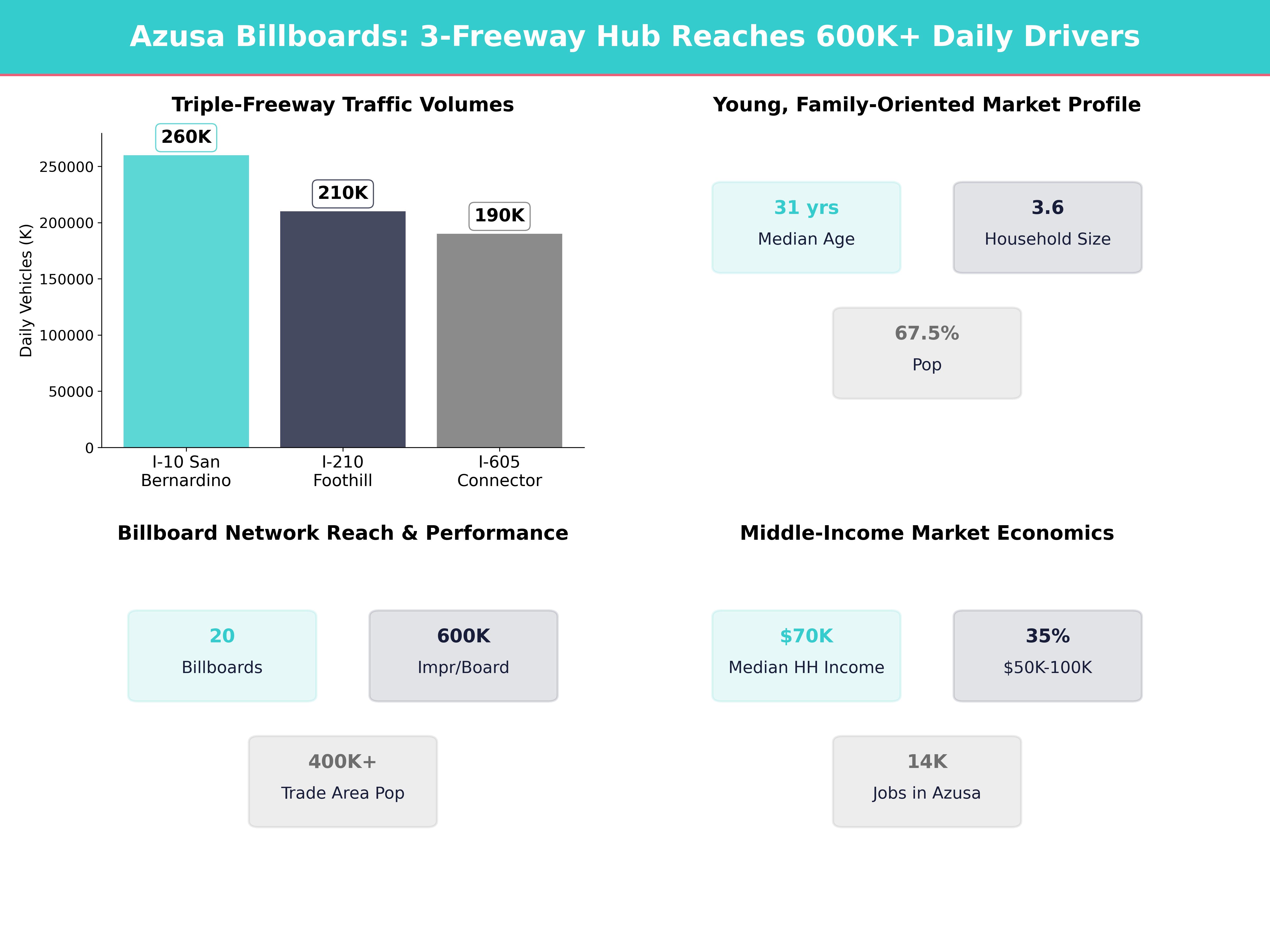
Azusa is a compact but influential city in the San Gabriel Valley. According to recent city and regional estimates, Azusa’s population is around 49,000–50,000 residents, while the broader San Gabriel Valley holds roughly 2.0–2.1 million people spread across more than 30 cities. The city’s official site, the City of Azusa, highlights its role as both a residential community and an employment and education hub, with more than 14,000 jobs based in the city itself. That mix of residents, workers, and students means Azusa billboards and nearby freeway placements can influence daily routines for tens of thousands of people.
Key local anchors include:
- Azusa Pacific University (APU) and Citrus College, together serving well over 20,000 students combined across undergraduate, graduate, and continuing education programs, creating strong weekday traffic and housing, banking, and food-service demand.
- A growing mix of industrial and logistics facilities clustered around nearby Irwindale and Baldwin Park. The City of Irwindale reports that industrial and manufacturing uses account for over 60% of its developed land, with thousands of daily employee trips into the area.
- Retail centers and auto-oriented commercial strips along Azusa Avenue, Arrow Highway, and Foothill Boulevard that serve Azusa’s roughly 14,000–15,000 households plus shoppers from Covina and Glendora.
The Azusa area also sits along several critical transportation corridors that our nearby billboards tap into. According to Caltrans and regional transportation summaries:
- I-210 Foothill Freeway near Irwindale: annual average daily traffic (AADT) volumes typically in the 190,000–210,000 vehicles per day range through this segment, translating to roughly 5.7–6.3 million vehicle trips per month.
- I-10 San Bernardino Freeway near Baldwin Park and El Monte: one of the region’s busiest freeways, with AADT often exceeding 260,000 vehicles per day, or more than 7.8 million vehicle trips per month.
- I-605 north–south connector near Baldwin Park and El Monte: generally around 160,000–190,000 vehicles per day, or approximately 4.8–5.7 million vehicle trips per month.
- Major arterials such as Arrow Highway, Azusa Avenue (CA-39), Puente Avenue, and Francisquito Avenue that carry heavy local traffic between Azusa, Covina, Baldwin Park, and La Puente. Typical multi-lane arterials in this corridor see 25,000–45,000 vehicles per day, which supports neighborhood-focused campaigns and frequency-driven branding.
These corridors allow campaigns on nearby billboards to efficiently reach people who live, work, shop, or attend school in the Azusa area, even if the structures are technically in adjacent cities. The City of Covina City of Baldwin Park, City of El Monte, and City of La Puente all point to regional connectivity and freeway access as key economic drivers, underscoring how audiences naturally flow across city boundaries and how billboard advertising near Azusa can influence trips that span multiple cities.
For local context, it’s useful to follow regional coverage from outlets like the San Gabriel Valley Tribune and LAist’s San Gabriel Valley coverage San Gabriel Valley Economic Partnership
Who You’re Reaching: Demographics & Audience Segments
The Azusa area offers a diverse, youthful, and family-oriented audience:
- Age: Azusa’s median age is about 30–32 years, younger than the U.S. average (around 38). Nearby cities like Baldwin Park, El Monte, and La Puente also sit near the 31–34 range. This skew toward younger adults means a high concentration of digital-native consumers; surveys of Southern California residents under 35 consistently show 80%+ smartphone ownership and 70%+ daily social media use, which pairs well with billboard campaigns that drive online actions.
- Households: Average household sizes in Azusa and the surrounding San Gabriel Valley are typically 3.4–3.8 people per household, compared with around 2.6 nationally. In Azusa’s primary ZIP code (91702), more than 30% of households include children under 18, reinforcing the importance of family-focused messaging and value propositions.
- Ethnicity: Azusa and nearby cities have a strong Hispanic/Latino majority, often 60–75% of residents. In Baldwin Park and La Puente, that share can exceed 75%, with significant bilingual (English/Spanish) populations. Asian communities, including Chinese, Filipino, and Vietnamese residents, account for 15–25% of the population in some San Gabriel Valley cities, especially to the south and west, creating opportunities for multicultural campaigns.
- Education: The presence of APU and Citrus College draws a large student population and education professionals, adding daytime density and a steady influx of 18–34-year-olds. Across the San Gabriel Valley, more than 30–35% of adults have completed some college or higher, and student enrollment at local K–12 districts like Azusa Unified School District and Covina-Valley Unified School District routinely exceeds 10,000–15,000 students per district, fueling daily school-related traffic.
- Income: Many households fall into middle-income brackets. In nearby areas like Covina, median household incomes cluster around $70,000–85,000, while Baldwin Park and El Monte often fall in the $55,000–70,000 range. Azusa itself tends to sit in the $65,000–75,000 band, with a substantial share of households (often 30–40%) earning between $50,000 and $100,000 annually, supporting both value-oriented and aspirational offerings.
Commuting patterns reinforce the strength of out-of-home advertising. Regional surveys show that 70–80% of workers in the eastern San Gabriel Valley commute by car, van, or truck, and typical one-way commutes run 28–35 minutes, providing multiple daily exposure opportunities to consistent billboard placements.
These characteristics suggest several high-potential segments:
- Commuting Families: Parents commuting along I-210, I-10, and I-605, often with school-aged children and busy schedules. In Los Angeles County, more than 60% of workers leave home between 5:30–9:30 a.m., making morning and late-afternoon dayparts especially valuable.
- Students & Young Professionals: College and university students commuting between Azusa, Covina, La Puente, and beyond, plus early-career professionals in healthcare, education, logistics, and light manufacturing. Local higher-ed institutions together attract over 25,000–30,000 people (students, faculty, staff) on a typical weekday.
- Local Service Buyers: Residents making frequent local trips for groceries, auto repair, banking, healthcare, and quick-serve restaurants. Shopping and errands typically account for 20–25% of vehicle trips in suburban Southern California, according to regional travel surveys.
- Faith & Community Networks: Azusa and surrounding communities host dozens of churches and community organizations, many drawing hundreds to thousands of attendees on Sundays and midweek evenings, producing reliable weekend and evening travel surges.
When we design creative for the Azusa area, we should plan for a bilingual, family-heavy, price-sensitive but aspirational audience that is highly responsive to clear value, convenience, and community-oriented messaging.
Where Our Billboards Are & How They Serve the Azusa Area
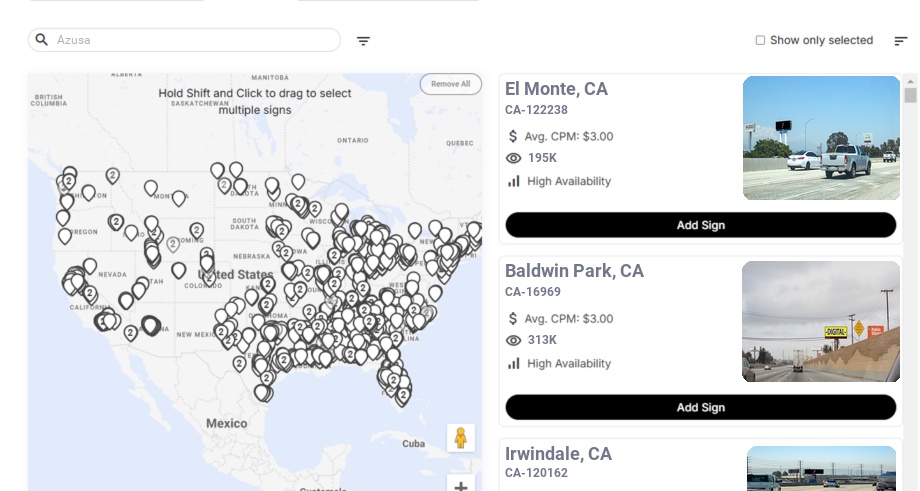
Our 20 digital billboards serving the Azusa area are strategically placed in nearby cities within about 10 miles, covering a combined trade area population of well over 400,000 residents plus hundreds of thousands of daily commuters. This network effectively functions as a ring of billboards near Azusa that captures freeway and surface-street traffic in every direction:
- Irwindale (approx. 4.7 miles from Azusa)
Ideal for reaching Azusa-area commuters using I-210, Arrow Highway, and local industrial corridors. The City of Irwindale notes its workforce swells well beyond its small residential base of roughly 1,500–2,000 residents, meaning a high ratio of inbound commuters and repeat impressions for workers. - Covina (approx. 5.4 miles)
Captures east–west traffic between Azusa, Glendora, and West Covina, as well as shoppers heading to regional retail centers. The City of Covina 50,000 and promotes the downtown and major corridors that generate strong lunch, evening, and weekend traffic. - Baldwin Park (approx. 6.3 miles)
A critical vantage point on I-10 and surface streets feeding into the Azusa area, with significant logistics and industrial employment. The City of Baldwin Park highlights a population near 72,000 and more than 2,000 businesses, contributing to robust daily trip volumes. - El Monte (approx. 8.3 miles)
A high-density city and key I-10/I-605 interchange point, amplifying your reach into denser portions of the San Gabriel Valley while still touching Azusa-area commuters. The City of El Monte estimates its population at over 110,000, with some of the region’s highest residential densities and correspondingly high traffic counts on local arterials. - La Puente (approx. 8.9 miles)
Strong local retail corridors and neighborhood traffic that overlap with Azusa-area shopping and work trips. The City of La Puente serves a community of roughly 40,000 residents within just a few square miles, creating dense coverage for neighborhood-focused campaigns.
By blipping your ads across multiple locations, we can follow the actual travel paths of Azusa-area residents instead of relying only on billboards immediately adjacent to the city boundary. In practice, multi-location campaigns in similar corridors often generate 30–50% more unique reach and 20–30% higher frequency than single-location buys at the same budget, making this style of billboard advertising near Azusa both efficient and scalable.
Ready to reach your audience in Azusa?
Start Your Campaign →Traffic Patterns & Dayparting Strategy
To maximize results with Blip’s flexible scheduling, it helps to align your campaign with how people move through the Azusa area. In Los Angeles County commuter studies, weekday traffic volumes on major freeways can vary by 40–60% between peak and off-peak times, which directly impacts CPM and visibility.
Weekday Morning (5:30–9:30 a.m.)
- Heavy inbound traffic from Azusa and surrounding neighborhoods onto I-210, I-10, and major arterials. Morning directional flows often reach 110–130% of midday volumes on key segments.
- Students heading to APU, Citrus College, and local high schools. K–12 start times between 7:30–8:30 a.m. and college class blocks beginning at 8:00 a.m. translate to distinct spikes between 7:00–9:00 a.m.
-
Best for:
- Coffee shops, breakfast QSR, gas stations, transit parking, and rideshare promotions.
- Service businesses targeting professionals (dental, medical, legal, insurance).
- B2B services aimed at industrial and logistics operations in Irwindale and Baldwin Park, where shift changes often occur around 6:00–7:00 a.m.
Midday (10:00 a.m.–3:00 p.m.)
- Local errands, retail trips, healthcare appointments, and student travel between classes. Regional data shows that 25–30% of daily vehicle trips occur outside traditional commute peaks, driven by shopping and personal business.
- Lower CPM opportunities due to slightly decreased congestion compared to rush hours, which can reduce cost per thousand impressions by 10–25% on some boards.
-
Best for:
- Retail sales, grocery offers, auto repair, and home services.
- Restaurants promoting lunch specials or quick-service value meals, especially between 11:00 a.m.–1:30 p.m.
Evening Commute (3:30–7:30 p.m.)
- High outbound traffic from job centers in Irwindale, Baldwin Park, El Monte, and central Los Angeles back toward the Azusa area. Evening peak volumes on key freeways frequently match or exceed morning peaks, with speeds often dropping below 30 mph, increasing dwell time.
- Strong overlap with shopping and dining decisions. Studies of Southern California drivers show that 60–70% of weekday dining-out decisions are made within a few hours of the meal, making this window critical for restaurants and entertainment.
-
Best for:
- Restaurants, breweries, and entertainment venues promoting tonight-only or happy-hour specials.
- Big-ticket purchases (autos, furniture, electronics) and appointment-based services (gyms, salons) that benefit from payday and evening decision cycles.
Late Evening & Night (8:00 p.m.–12:00 a.m.)
- Ideal for brand-building at efficient costs and for nightlife/entertainment messaging. Off-peak hours can deliver impressions at 20–40% lower effective rates compared with prime commute windows.
- Visibility is excellent because digital billboards stand out after dark; contrast and brightness levels are tuned for nighttime conditions, which can boost ad recall in some studies by 10–20% versus daytime viewing.
-
Best for:
- Streaming services, nightlife, casinos, and 24-hour or late-night businesses.
- Faith communities and nonprofits promoting weekend events.
With Blip, you can daypart your campaign—only paying for “blips” during the time blocks that matter most to your audience, rather than buying entire days or weeks that include low-value impressions. Many advertisers find that concentrating 60–80% of budget into 2–3 high-performing dayparts yields stronger response than evenly spreading spend across all hours.
Seasonal & Event-Based Opportunities
The Azusa area has predictable seasonal rhythms and local events that we can leverage:
-
Academic Calendar:
- Late August–September and January: new semester rush for APU and Citrus College, when thousands of students move in, register for classes, and set up banking, phone plans, and routines. Schools in the Azusa Unified School District and Covina-Valley Unified School District also bring tens of thousands of K–12 students back to campus, increasing morning and afternoon traffic by 10–15% over summer levels.
- Great windows for student housing, textbooks, tech, banking, fitness, and food service promotions.
-
Holiday Retail Season (November–December):
- High shopping traffic toward regional malls (e.g., Plaza West Covina, Eastland Center 20–30% higher foot traffic and sales volumes in this period compared to average months.
- Ideal for retailers, e-commerce, and gift-related services, as well as auto dealers capitalizing on year-end incentives.
-
Spring & Summer Outdoor Season:
- Azusa sits near outdoor attractions like the San Gabriel Canyon and the Angeles National Forest. Warm months see significant increases in weekend recreational trips; Southern California outdoor recreation participation can rise 30–40% between winter and peak summer.
- Warm-weather promotions for recreation, auto service (AC checks, tires), and tourism work especially well. The regional tourism site Discover Los Angeles frequently highlights San Gabriel Mountains recreation, reinforcing Azusa’s role as a gateway.
-
Local Festivals & Community Events:
- City-sponsored events listed on the City of Azusa events calendar and fairs throughout the San Gabriel Valley draw anywhere from a few hundred to several thousand attendees each. Neighboring cities such as Covina, Baldwin Park, and El Monte similarly publish event lineups that create localized traffic spikes.
- Use short, high-frequency bursts on nearby billboards in Covina, Irwindale, and Baldwin Park to promote dates, times, and directions. For single-weekend events, concentrating 70–90% of impressions in the 5–7 days beforehand is often more effective than long lead times.
By pairing Blip’s on-demand scheduling with these seasonal spikes, you can increase frequency right when decision-making peaks and taper spending in slower periods, keeping your effective cost per acquisition as low as possible.
Crafting Effective Creative for the Azusa Area
Given fast-moving freeway and arterial traffic, your creative should be ruthlessly clear and locally resonant. Studies of digital billboard effectiveness commonly find that drivers have 6–8 seconds to absorb a message, and that ads with fewer than 7 words enjoy significantly higher recall. This is especially important when you’re investing in Azusa billboards that must work hard within a short viewing window.
1. Simplicity and Readability
- Aim for 6–8 words or fewer of main copy, which aligns with research showing that concise messages can increase comprehension by up to 30% at highway speeds.
- Use large, high-contrast fonts (e.g., white or bright yellow on dark backgrounds).
- Focus on one main idea per design: a sale, a location, or a slogan—not all three equally.
2. Bilingual & Culturally Relevant Messaging
Because Hispanic/Latino communities often make up 60–75% of the population in many Azusa-area cities:
-
Consider dual-language creative, especially for family services, retail, and food brands.
- Example: English headline with a Spanish sub-line, or alternating English and Spanish creatives in rotation.
- In bilingual Southern California neighborhoods, advertisers frequently report 10–20% higher engagement with bilingual or Spanish-inclusive messaging for family-facing products.
- Use culturally relevant imagery (family gatherings, local scenery, familiar foods) without relying on stereotypes. Featuring recognizable local backdrops (San Gabriel Mountains, Foothill Boulevard, downtown Covina) can help anchor your brand to the community.
3. Clear Geography Cues
Since the billboards serving the Azusa area may be in neighboring cities:
-
Emphasize proximity and recognizable landmarks:
- “Minutes from Azusa Pacific University on [Street Name]”
- “Near I-210 & Azusa Ave – Next to [Known Retailer]”
- Include city names that locals use commonly (Azusa, Covina, Baldwin Park, Irwindale, El Monte, La Puente) to help people instantly place your business. Local surveys show that directional cues (“2 miles ahead,” “Next exit”) improve intent-to-visit by 10–15% compared with non-specific creative.
4. Calls to Action That Match Driving Behavior
-
For commuters, prioritize frictionless actions:
- Short URLs or memorable domains
- Brand names easy to search later
- “Exit at [Name]” or “Next Right on [Street]”
-
For awareness-focused campaigns, lean into strong brand cues:
- Logo prominence
- Distinctive colors and graphic styles that carry over to your website and social media.
- Brands that maintain consistent design across out-of-home and digital channels often see 20–25% higher brand recall than those with disjointed visuals.
5. Multiple Creatives for Message Sequencing
Blip’s flexibility lets you run multiple designs simultaneously:
-
Use 3–5 rotating creatives to:
- Highlight different product categories (e.g., auto sales, service, financing).
- Test bilingual vs. English-only messaging.
- Alternate branding and offer-focused messages.
- Campaigns that test at least two creative concepts and optimize mid-flight commonly improve response metrics (site visits, calls, coupon redemptions) by 15–30% over “set-it-and-forget-it” approaches.
Ready to reach your audience in Azusa?
Start Your Campaign →Matching Billboard Locations to Business Types
Different industries can benefit from different clusters of our boards serving the Azusa area. The combined daily traffic on the freeway and arterial system touching these boards comfortably exceeds 600,000–700,000 vehicles per day, creating ample room for precise targeting and cost-effective billboard rental near Azusa.
Retail & Restaurants
- Focus on boards in Covina, Baldwin Park, and La Puente to intercept shoppers headed to regional malls and local plazas. Plaza West Covina alone draws millions of visits per year, and major corridors like Francisquito and Amar Road see steady neighborhood traffic.
- Use drive-time cues: “2 miles ahead,” “Exit [Name], then 3 minutes north.” Local research suggests that simple distance cues can lift store visitation by 5–10% when added to otherwise similar creative.
Education & Student-Focused Brands
- Target morning and afternoon dayparts near Irwindale and Covina, capturing students commuting to APU, Citrus College, and nearby high schools. Combined enrollment at high schools in the immediate corridor (Azusa, Gladstone, Covina, Northview, and others) exceeds 8,000–10,000 students, plus faculty and staff.
- Perfect for student housing, banking, mobile plans, fitness, tutoring, and campus-adjacent retailers. Student-focused campaigns often see higher response when timed during the first 2–3 weeks of each term and around midterm/finals periods.
Automotive (Dealers, Repair, Car Washes)
- Boards on freeway approaches in Baldwin Park and El Monte work well for large, high-ticket decision-making. Southern California is heavily auto-oriented, with vehicle ownership rates often above 1.8 vehicles per household in suburban areas, and roughly 85–90% of households having at least one vehicle.
- Use strong price points, limited-time offers, and “Same-Day Service” messages to grab attention during commute hours. Auto advertisers in similar corridors frequently allocate 50–70% of their out-of-home budget to high-traffic freeway boards to maximize reach.
Healthcare & Professional Services
- Daytime and early evening impressions in Irwindale and Covina are ideal for promoting clinics, dental offices, optometrists, and legal or financial services used by Azusa-area families.
- Emphasize convenience and trust: “Same-day appointments,” “Open late,” “Se habla español.” Healthcare providers that advertise extended hours and same-day availability often see appointment volume increases of 10–20% during campaign periods in commuter markets.
Local Government, Nonprofits, and Faith Organizations
- Boards near La Puente, Baldwin Park, and El Monte can reach large family audiences for community campaigns. These cities together represent more than 220,000 residents, many of whom regularly travel into and through Azusa.
- Use clear, event-focused creative: date, time, location, and a short URL or QR-friendly domain. For public-information campaigns (vaccinations, census-style outreach, emergency alerts), digital billboards can deliver broad awareness quickly; short, high-frequency runs of 1–2 weeks can achieve strong saturation.
Using Blip’s Flexibility to Your Advantage
Blip’s approach to digital billboards is designed for precision and control, making it an accessible way to test and scale billboard advertising near Azusa without committing to long-term contracts:
- Set Your Own Budget:
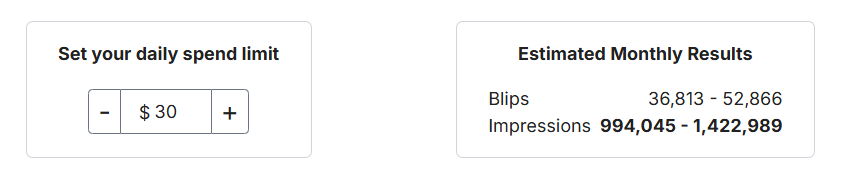
Instead of committing to multi-thousand-dollar monthly contracts, you select a daily or total campaign amount, sometimes starting at just a few dollars per day, and compete for available “blips” (individual ad displays). Many small businesses begin with test budgets in the $10–20 per day range, gathering data before scaling. - Choose Exact Boards:
You can select which of the 20 digital billboards serving the Azusa area best match your customer patterns—focusing on Irwindale for industrial workers, Covina for shoppers, or Baldwin Park for I-10 commuters. Over time, shifting spend toward the top 3–5 highest-performing faces often improves cost-efficiency. - Daypart & Day-of-Week Targeting:
Concentrate spend on weekday rush hours, weekend retail windows, or late evenings—whatever matches your business. For many local advertisers, concentrating 60–80% of impressions on 3–4 key dayparts yields the best balance of awareness and action. - Creative Testing:
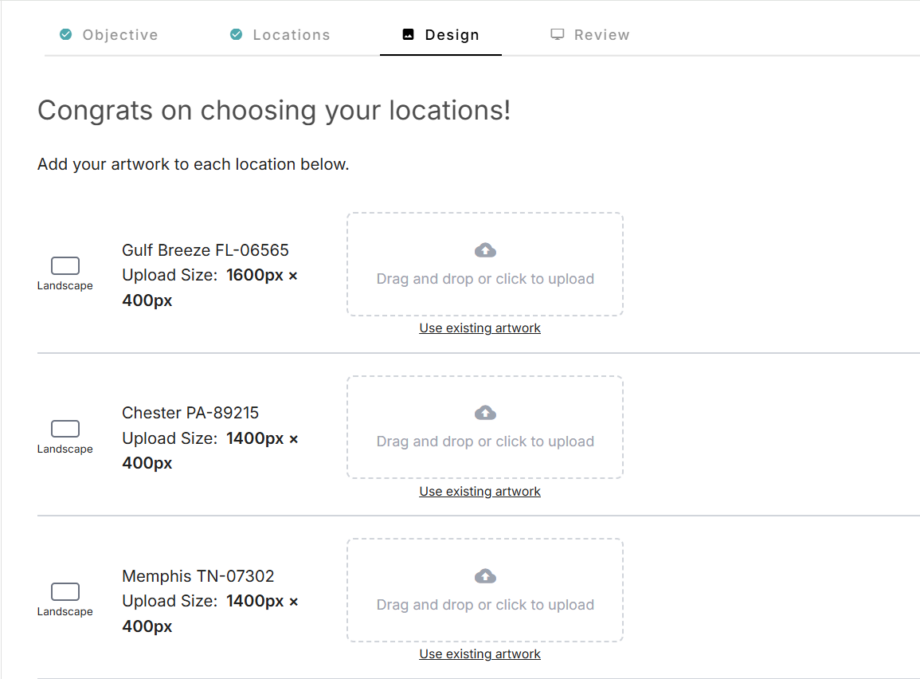
Quickly swap or add new creatives and compare performance by monitoring downstream metrics like website traffic, call volume, or in-store sales. Marketers who refresh creative at least every 4–6 weeks typically sustain higher engagement than those who run the same artwork for months at a time.
This level of control is particularly powerful in a dense, commuter-driven environment like the Azusa area, where a modest but well-focused budget can generate a high share of voice during the exact times your audience is on the road and make billboard rental near Azusa feel both flexible and low-risk.
Measuring Success & Optimizing Over Time
Because billboards serving the Azusa area are typically part of an omni-channel mix, we recommend:
- Use Time-Based Tracking:
Align your Blip schedule with analytics data (Google Analytics, POS data, call logs). For instance, if you run commuter-hour blips on weekdays, check whether web sessions or store visits from Azusa-area ZIP codes (e.g., 91702) spike during or after those windows. Even simple time-of-day comparisons—before vs. during campaign—can reveal 5–15% lifts tied to your flights. - Promo Codes & Vanity URLs:
Use short, memorable URLs like “BrandNameAzusa.com” or codes like “AZUSA10” to attribute billboard-driven conversions. Many local advertisers see 10–30% of redemptions or traffic during campaigns associated with billboard-specific codes when they are clearly promoted. - A/B Test Creatives:
Run two versions of your messaging—e.g., English-only vs. bilingual or price-focused vs. brand-focused—and rotate them equally. Then compare which version correlates with better response. In practice, winner creatives often outperform the original baseline by 15–25% on key metrics. - Adjust Locations by Performance:
If you see stronger results when targeting boards in Baldwin Park and El Monte, shift more of your budget there while keeping a baseline presence near Irwindale and Covina. Reallocating spend toward the top-performing half of your locations can improve overall return on ad spend by 10–20%.
Local media and municipal sources like the City of Azusa, LA Metro San Gabriel Valley Economic Partnership Foothill Transit Metrolink
By understanding how people live, work, and travel in the Azusa area—and by leveraging the flexibility of digitally powered billboards in nearby Irwindale, Covina, Baldwin Park, El Monte, and La Puente—we can craft campaigns that deliver targeted impressions, sharp messaging, and measurable results for any business seeking billboards near Azusa or testing scalable billboard advertising near Azusa.
Ready to reach your audience in Azusa?
Start Your Campaign →