Billboards in Covina, CA
No Minimum Spend. No Long-Term Contracts. Just Results.
Turn heads with eye-catching Covina billboards using Blip’s flexible, self-serve platform. Pick your favorite billboards in Covina, California, set any budget, and launch in minutes with full control, real-time insights, and creative options that keep your message shining.
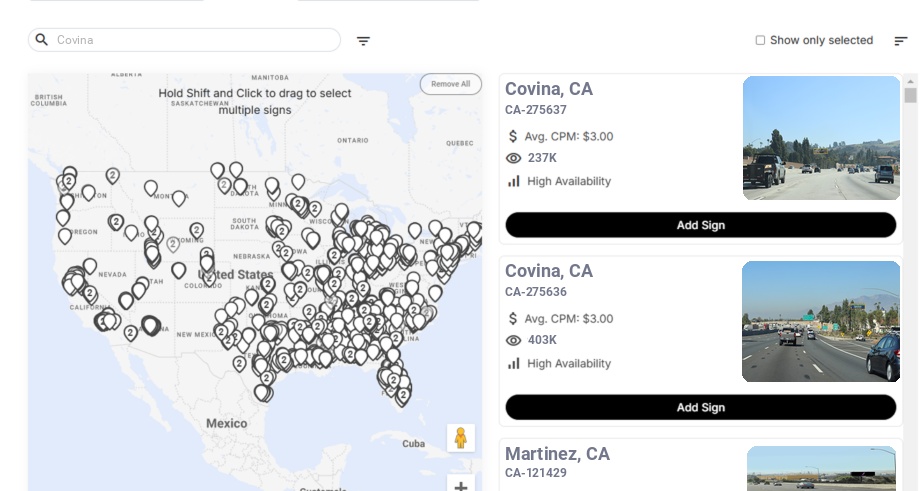
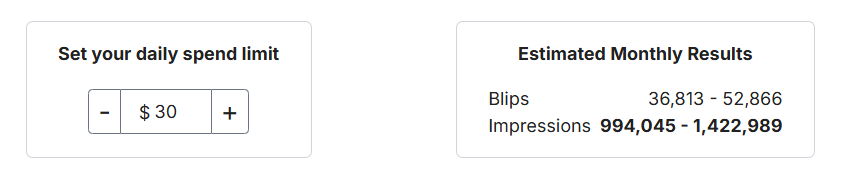
How much is a billboard in Covina?
Billboards in other California cities
Covina Billboard Advertising Guide
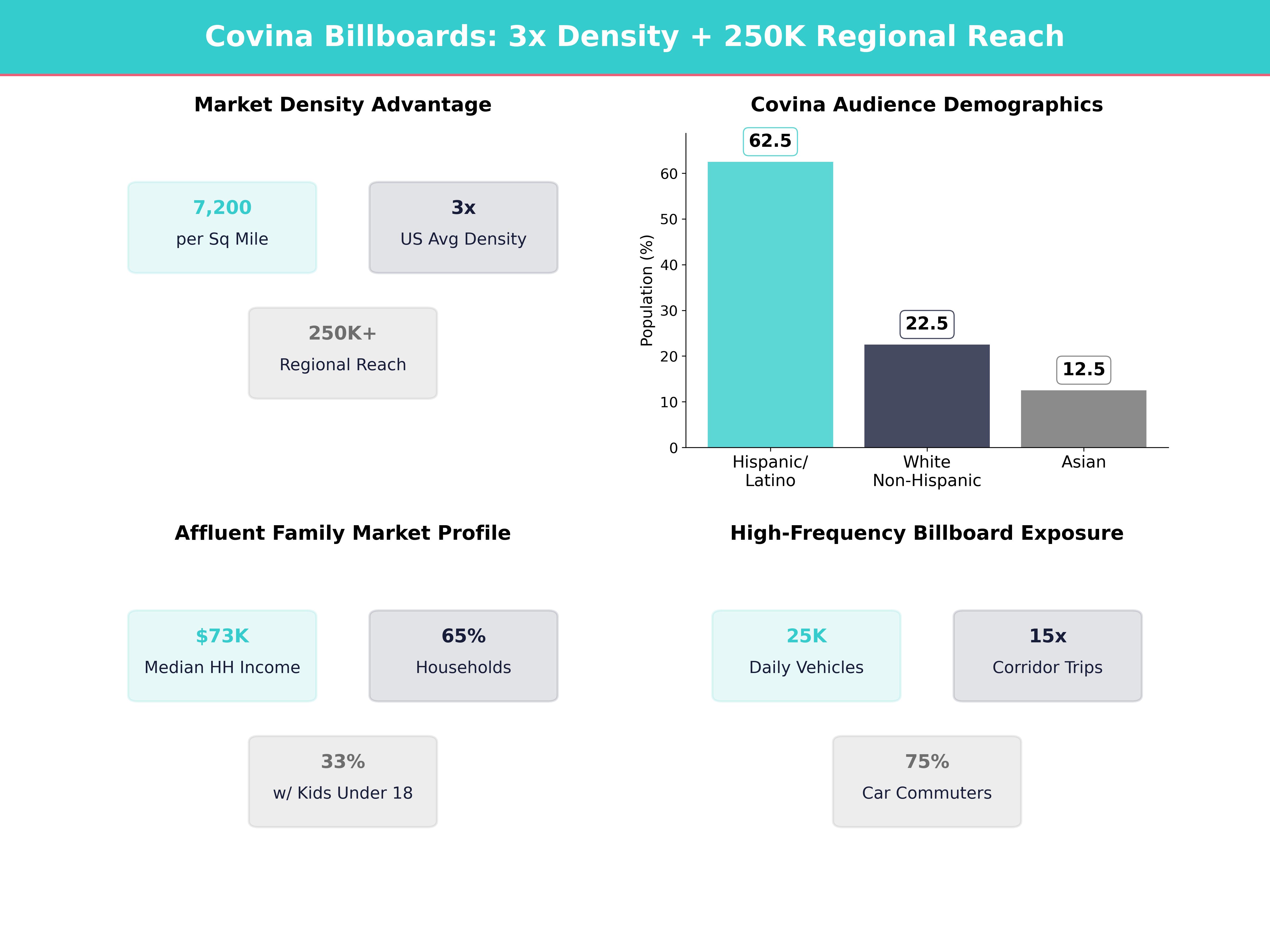
Covina, California sits in the heart of the San Gabriel Valley 51,000 residents in just over 7 square miles (more than 7,200 residents per square mile, nearly 3× the U.S. average density), plus heavy pass‑through traffic from neighboring cities like West Covina, Glendora, Azusa, and Baldwin Park, Covina offers dense, repeat exposure for smart digital billboard campaigns. The broader San Gabriel Valley is home to more than 2 million residents, and Covina sits close to the geographic center of that population. When we pair those local dynamics with Blip’s flexible scheduling and budgeting tools, advertisers can achieve a highly efficient presence along some of the San Gabriel Valley’s most traveled corridors, making Covina billboards a compelling part of any regional strategy.
Understanding the Covina Market
Covina is a classic “suburban hub” city: compact, commuter‑oriented, and packed with neighborhood retail, which makes billboards in Covina especially effective for both daily‑needs brands and longer‑term awareness campaigns.
Key context points from recent local and regional data:
- Population & density: Covina’s population is about 51,000–52,000 residents, with a population density over 7,000 people per square mile, making it substantially denser than both California overall (about 250 people per square mile) and Los Angeles County’s average.
- Regional catchment: Covina is bordered by West Covina (population ~109,000), Glendora (~52,000), Azusa (~50,000), and Baldwin Park (~72,000). Realistically, your billboards will be seen by well over 250,000 people who regularly move through this cluster of cities; daily trip data across these communities often shows residents making 3–4 vehicle trips per day on average.
- Age profile: The median age in Covina is around 36 years, slightly younger than the national median, with roughly one‑quarter of residents under 18 and a sizeable working‑age population in the 25–54 band.
- Household income: Median household income sits in the low‑ to mid‑$70,000s, with a significant share of households in the $50,000–100,000 band and a meaningful higher‑income segment above $100,000. About 55–60% of occupied housing units are owner‑occupied, signaling a stable base of long‑term residents.
- Employment & commuting: In many San Gabriel Valley cities, 70–80% of workers commute by car, and typical one‑way commute times run 30–35 minutes. Covina residents frequently travel west toward job centers in West Covina, El Monte, Pasadena, and Downtown LA, creating regular, predictable exposure to roadside media and increasing the value of Covina billboard advertising along major routes.
- Transit access: Covina connects to the 10 and 210 freeways via major arterials and has an important Metrolink stop, the Covina Downtown Station tens of thousands of weekday riders systemwide, and Covina is one of the more active stations in the central San Gabriel Valley, making it a focal point for park‑and‑ride commuters.
The City of Covina emphasizes its “One Mile Square and All There” identity, highlighting a walkable downtown, active local business base, and civic events calendar on the official city site hundreds of small businesses, and the city reports high attendance at annual events that routinely draw thousands of visitors.
For us as advertisers, this means two things:
- We can reach a high‑frequency local audience that sees the same boards day after day on short, repeat trips—many residents drive the same corridors 10–20 times per week.
- We can also reach transient regional drivers heading between freeways, shopping centers, schools, and medical campuses, where daily traffic volumes on key arterials often exceed 20,000–30,000 vehicles per day.
We want to build campaigns that speak to both, using Covina billboards as a consistent touchpoint for these overlapping audiences.
Audience & Demographic Insights for Messaging
Covina’s demographic profile has clear implications for creative tone, language, and offers, and it should directly inform how you approach billboard rental in Covina.
Ethnic and linguistic mix
- Covina’s population is majority Hispanic/Latino (roughly 60–65% in recent city and school‑district‑area data), with strong Mexican‑American and Central American communities.
- Asian populations (including Filipino, Chinese, Vietnamese, and others) make up roughly 10–15%.
- White (non‑Hispanic) residents comprise around 20–25%, with the balance made up of Black, multiracial, and other groups.
- In many San Gabriel Valley school districts, 30–40% of students are classified as English learners or bilingual, which reflects high everyday use of both English and Spanish at home.
Implications for billboard messaging:
- Bilingual or Spanish‑forward creative can significantly increase engagement. In similar Southern California markets, Spanish‑language or bilingual ads often deliver 10–30% higher response rates for family‑oriented products, local services, and retail.
- Family‑centric visuals—kids, multigenerational households, community events—tend to resonate strongly in markets where over one‑third of households have children under 18.
- Avoid overly niche cultural references; instead, use broad, inclusive visuals that reflect Hispanic and multiethnic families seen throughout the San Gabriel Valley.
Household structure and lifestyle
- A large share of households include children; public schools like Covina-Valley Unified School District and Charter Oak Unified School District serve thousands of K‑12 students across multiple elementary, middle, and high schools each year.
- In many nearby cities, 60–70% of households are family households, with average household sizes around 3 persons and family sizes over 3.5 persons—numbers that are similar in Covina.
- Many residences are single‑family homes, townhomes, or small apartment complexes, with a mix of longtime owners and renters. Local real estate data for Covina frequently shows home values and rents higher than national averages, which influences disposable income and spending priorities.
Messaging implications:
- Emphasize convenience, savings, and proximity: “5 minutes from downtown Covina,” “Just off Citrus Ave,” “Near the Covina Metrolink.” In compact cities where most everyday trips are under 15 minutes, messages that highlight “right here” location consistently outperform generic creative and make better use of billboards in Covina.
- Highlight after‑school and weekend solutions: tutoring centers, youth sports, family dining, healthcare, car care, and home services. Surveys of suburban families often show 30–40% of discretionary spending going into children’s activities, food away from home, and transportation.
- For higher‑ticket items (autos, home improvement, financial services), focus on trust, longevity, and community: “Serving Covina families since 1995,” “Local San Gabriel Valley experts.” Longevity claims (“20+ years in business”) help reduce perceived risk in middle‑income markets.
Income and spending behavior
- With median household income in the mid‑$70,000s, Covina sits in a solid middle‑income band. More than half of households likely fall between $50,000 and 125,000 in annual income.
-
Regional consumer‑expenditure surveys for Southern California consistently show large budget shares going to:
- Groceries and quick‑serve dining (often 12–15% of household budgets)
- Auto maintenance, fuel, and upgrades (transportation can be 15–20% of spending)
- Healthcare and dental (especially for families with children)
- Youth activities and education
- Home improvement and furnishings
Messaging recommendations:
- Promote value‑driven offers (discounts, bundles, financing) rather than pure luxury positioning. “From $X per month” and “$0 down” messages often outperform generic brand awareness in similar income bands.
- Use clear, specific numbers: “$49 new patient exam,” “Oil change from $39.99,” “Save 20% this weekend.” Ads with explicit price points typically see higher recall and action rates than those without, especially when reinforced repeatedly through Covina billboard advertising.
- Consider time‑limited promos aligned with pay periods; for example, heavier promotion around the 1st and 15th of each month, when many households receive paychecks or benefits. Retailers often report noticeable sales lifts in these windows.
Traffic Patterns and Prime Advertising Times
Covina’s geography and commuting patterns drive when and where we should prioritize impressions, and they’re central to planning cost‑efficient billboard rental in Covina.
Weekday commuting
-
Many residents commute west toward job centers in West Covina, El Monte, Pasadena, and Downtown LA via:
- Major east‑west routes like Badillo Street, Arrow Highway, and San Bernardino Road.
- North‑south connectors such as Citrus Avenue, Azusa Avenue (Route 39), and Barranca Avenue.
- Local traffic counts on comparable San Gabriel Valley arterials often range from 20,000 to over 35,000 vehicles per day, especially near freeway access or commercial clusters.
- Rush hour volumes spike roughly 6:30–9:00 a.m. and 3:30–7:00 p.m., with speeds often dropping to 20–30 mph at key intersections—ideal conditions for digital billboard visibility.
Strategy with Blip:
- For work‑related offers (B2B services, higher education, training, car dealerships), we should concentrate impressions in weekday AM and PM rush, when commuters are most captive.
-
Use drive‑time‑specific calls to action:
- AM: “Order coffee ahead – Exit at Citrus,” “Schedule your appointment before 10 a.m. for same‑day care.”
- PM: “Dinner in 10 minutes – pick‑up off Arrow Hwy,” “Beat weekend crowds—book your service now.”
- In similar suburban markets, reallocating 20–30% more budget into rush‑hour dayparts has been associated with higher lead volume per dollar for commute‑relevant offers.
Midday and local errand traffic
-
Midday (10:00 a.m.–2:00 p.m.), traffic includes:
- Parents with young children
- Seniors
- Shift workers
- Local business trips and service calls
- Destinations include Plaza West Covina, Citrus Plaza, grocery centers, healthcare offices, and downtown Covina retail. Centers like Plaza West Covina report millions of annual visits, concentrating a large share of regional shopping trips within a few nearby corridors.
Strategy with Blip:
- For grocery, dining, medical, salons, gyms, and quick services, run stronger schedules during late morning and midday, when errand traffic peaks.
- Tailor creative to “today” actions: “Walk‑in welcome now,” “Lunch special until 2 p.m.,” “Same‑day appointments.”
- In many local service categories, same‑day or next‑day wording can increase conversion intent by 10–20% compared to generic messaging.
Evening and weekend patterns
- Downtown Covina’s Citrus Avenue corridor has a notable nightlife and dining scene highlighted by the city and local outlets like the San Gabriel Valley Tribune. Events and weekend evenings can attract hundreds to thousands of visitors over a single night.
- Entertainment draws include the Covina Center for the Performing Arts
- Regional studies often find that over 40% of restaurant revenue and a large share of entertainment spend occur from Friday evening through Sunday.
Prime times:
- Friday 4:00–9:00 p.m.
- Saturday late morning through evening
- Sunday midday to early evening
Use these windows to promote:
- Restaurants and bars
- Entertainment, live shows, and events
- Weekend retail promotions
- Faith‑based or community programs (especially Sunday morning to early afternoon), as many congregations draw hundreds of attendees each weekend.
Key Corridors and Landmarks to Consider
While specific Blip board locations may vary, we can think in terms of functional zones and traffic flows to get the most out of Covina billboards in each area.
1. Downtown Covina & Citrus Avenue
- Anchors: City Hall, Downtown Covina
- Audience: Local residents, commuters parking and walking to the train, weekend diners and eventgoers. Downtown events and “shop local” initiatives often pull in visitors from across Covina and neighboring cities, yielding repeat weekly foot traffic and special‑event surges.
- Best for: Restaurants, coffee shops, boutiques, salons, entertainment, local services.
Creative tips:
- Use landmarks in your copy: “Just off Citrus,” “2 blocks from Downtown Covina Station,” “Across from City Hall.”
- Encourage walk‑in behavior: “Park once, visit us and your favorite downtown spots.”
- In compact districts where most visitors park within a 5‑minute walk of their destination, location‑anchored messages (“1 block from Citrus Ave”) tend to drive higher in‑person follow‑through.
2. Arrow Highway / Badillo Street / San Bernardino Road corridor
- Major east‑west routes connecting Covina with Glendora, Azusa, and West Covina.
- Mix of auto service, light industrial, retail, and residential pockets.
- High daily vehicle counts, often 20,000–30,000+ vehicles per day on key segments in the San Gabriel Valley, with heavier volumes near freeway access and major intersections.
Best for:
- Automotive (repair, tires, car wash, dealerships)
- Trades and home services
- Healthcare and urgent care
- Discount retail and grocery
We can lean into commute‑friendly copy like “On your way home?” or “Next right after Citrus.” For categories like auto care, studies of similar corridors show that location‑specific, “on your route” messaging can increase service inquiries by 15–25%.
3. North–south connectors (Citrus Ave, Azusa Ave, Barranca Ave)
- Connect north Covina neighborhoods with the 10 and 210 freeway access points.
- Heavy school traffic: high school and middle school parents, buses, and student drivers, especially during 7–9 a.m. and 2–4 p.m. windows.
- Strong weekday AM and PM peaks, with local traffic counts on similar north–south roads commonly exceeding 15,000–25,000 vehicles per day.
Best for:
- Schools, tutoring, test prep
- Youth sports and camps
- Healthcare and dental
- Quick‑serve dining and coffee
Align creative with school schedules: “After school special 3–6 p.m.,” “Get braces before the new school year.” Across suburban markets, campaigns time‑aligned with school calendars often see higher response from households with children, especially in late summer and spring.
Seasonal and Event‑Driven Opportunities
Covina’s civic calendar and regional patterns give us several natural “spikes” for billboard value and help you time Covina billboard advertising for maximum impact.
Back‑to‑school and graduation
- School calendars for Covina‑Valley and Charter Oak Unified generally run late August/early September through early June.
- Each district enrolls thousands of students, and combined with nearby districts, the immediate area serves tens of thousands of K‑12 students within a short drive.
-
Key windows:
- Late July–September: Back‑to‑school shopping, after‑school programs, tutoring, health checkups, dental visits, youth sports sign‑ups.
- April–June: Graduation parties, senior photos, college prep, summer camps.
We can schedule heavier Blip buys in these windows, testing different messages:
- “Enroll before August 31 and save 10%.”
- “Back‑to‑school eye exams – book this week.”
- “Congrats Class of 20XX – custom grad banners in 24 hours.”
Businesses that cluster 20–30% more impressions into these school‑related periods often see stronger short‑term spikes in inquiries from parents.
Holiday retail and services
- November–December brings increased shopping at regional centers like Plaza West Covina and local Covina retailers. Regional mall and shopping‑center data commonly show double‑digit percentage increases in foot traffic during these months.
- Traffic on major arterials often rises, and people are more open to “discovery” of new places as they shop, dine, and visit family.
Ideas:
-
Phase creative:
- Early November: “Holiday layaway / financing available.”
- Black Friday/Cyber Monday: “3‑day sale this weekend.”
- December: “Last‑minute gifts 5 minutes from here.”
- Service providers can promote end‑of‑year offers: insurance use‑it‑or‑lose‑it benefits, elective medical procedures, home improvement. Many medical and dental offices report notable upticks in appointments as patients try to use remaining benefits before year‑end.
Civic and community events
The city regularly promotes events such as:
- Covina Christmas Parade
- Summer concerts and movies in the park
- Downtown Covina festivals and car shows
These events can attract hundreds to several thousand attendees, depending on scale and weather. You can monitor the City of Covina events calendar Spectrum News 1 SoCal to align your campaigns:
- Restaurants: “Parade day: show this ad on your phone for a free drink.”
- Retailers: “Festival weekend sale—walk from Citrus Park to us in 2 minutes.”
- Nonprofits: Event sponsorship shout‑outs and donation CTAs.
Building a 7–10 day run‑up of impressions before major events can maximize awareness while residents are still planning their weekend and ensures your billboard rental in Covina is working hardest when attention is highest.
Creative Best Practices Tailored to Covina
To take full advantage of Covina’s viewing conditions and audience, we should design creative with these specifics in mind.
Design for close‑range, medium‑speed traffic
Most Covina‑area roads are 35–45 mph arterials with relatively frequent lights. That means:
- Drivers have roughly 4–8 seconds of view time.
- Many will see the same board multiple times per week on repeated trips.
Guidelines:
- Limit to 7–10 words of main text; creative audits of high‑performing out‑of‑home ads consistently show fewer than 10 words.
- Use high‑contrast color combinations that stand out even in bright Southern California sun (e.g., dark text on light background or vice versa).
- Feature one clear focal point (logo, product, or face), not a collage. Overly complex creatives reduce recall, especially at 40+ mph.
- Keep website/QR codes short and legible; prioritize short URLs or brand names rather than long paths. In many roadside tests, QR codes only perform well when they cover at least 5–7% of the display height and have high contrast.
Leverage bilingual and culturally relevant creative
Given Covina’s demographics:
- Test English vs. Spanish vs. bilingual creatives using separate Blip campaigns and compare impression‑to‑response patterns. In other Southern California campaigns, bilingual rotations have improved engagement by 10–25% among Hispanic‑majority audiences.
- Use culturally resonant imagery without stereotypes: family gatherings, local parks, downtown scenes, familiar San Gabriel Valley backdrops.
- For essentials (healthcare, financial services, schools), make sure contact info and key benefits are understandable in both languages across your creative rotation. Even simple elements like “Llámanos hoy / Call us today” can meaningfully broaden reach.
Anchor your message in place and time
Place‑oriented copy tends to perform very well in compact cities like Covina:
- “On Citrus Ave near Badillo”
- “Across from Covina High”
- “By the Covina Metrolink Station”
Time‑oriented urgency helps convert frequent, repeat exposure into action:
- “This weekend only”
- “Today until 7 p.m.”
- “Enroll by Friday”
Blip’s scheduling tools let you deploy multiple versions of time‑sensitive creative (e.g., “Sale starts Friday,” “Ends Sunday”) and automatically rotate them by day, which can increase urgency and drive more timely responses.
Using Blip’s Flexibility for Covina‑Focused Strategies
Because Blip sells billboard time by the “blip” rather than fixed monthly contracts, we can match our spend to Covina’s real‑world rhythms and fine‑tune Covina billboard advertising with data over time.
Dayparting: Match your impressions to behavior
For Covina, some practical daypart strategies:
-
Morning rush (6–9 a.m.)
Perfect for:- Coffee, breakfast, and quick‑serve dining
- Car care services (“Drop off before work”)
- Healthcare and urgent care (“Same‑day appointments if you call before 9 a.m.”)
Morning commuters in similar markets often represent 30–40% of weekday traffic volume on key arterials.
-
Midday (10 a.m.–2 p.m.)
Ideal for:- Seniors and stay‑at‑home parents
- Clinics, salons, gyms
- Retail and restaurants promoting lunch deals
Many local businesses report strong lunchtime revenue spikes, especially near office and retail clusters.
-
Afternoon school‑run (2–4 p.m.)
Use for:- Tutoring, test prep, after‑school programs
- Youth sports, music lessons, enrichment classes
During the school year, these windows align with hundreds to thousands of daily student pick‑ups across Covina‑area campuses.
-
Evening (4–8 p.m.)
Focus on:- Dinner, entertainment, live events
- Retail promotions
- Home services (book for weekends/evenings)
Household‑level research shows peak family decision‑making around dinner and evening hours, a prime moment to influence where they dine, shop, or schedule services.
By creating separate Blip campaigns for each daypart, we can test which windows generate the best outcomes for your business and reallocate spend toward the highest‑performing slots.
Short bursts and “takeovers” for events and promos
Covina residents are highly habitual in their driving patterns. A short, high‑frequency burst can make a big impact:
- Run a 3–7 day “takeover” with higher bids around a major sale or event (grand opening, concert, festival).
- Saturate Thursday–Sunday for weekend events or restaurant promos, capturing the 40%+ of weekly discretionary spending that often happens over the weekend.
- Use a countdown strategy: “3 days left,” “2 days left,” “Ends tonight.” Countdown creatives can significantly increase urgency and have been associated with double‑digit percentage lifts in short‑term response.
A/B testing creatives across nearby boards
In a compact market like Covina, we can test:
- Offer‑based variations: “$25 off” vs. “15% off”
- Language: English vs. Spanish
- Creative style: product‑focused vs. people‑focused
- Place‑anchored vs. generic (“On Citrus Ave” vs. “In Covina”)
Monitor website traffic, call volume, coupon codes, or in‑store redemptions aligned to your flight dates, and adjust your creative rotation accordingly. Even simple tests that shift 10–20% of impressions to a new creative can reveal which message resonates best and help refine future billboard rental in Covina.
Vertical‑Specific Ideas for Covina Advertisers
To make this tangible, here are tailored approaches for common advertiser types in Covina and the surrounding San Gabriel Valley.
Local Retail and Restaurants
- Promote lunch and dinner specials aligned with commute times and weekend peaks. In many suburban cores, over half of weekly restaurant visits occur from Thursday through Sunday.
- Use references like “Downtown Covina,” “Near Citrus & Badillo,” or “5 minutes from Plaza West Covina.”
- Run heavier schedules Thursday–Sunday and ahead of paydays, when discretionary spending typically rises.
Example campaign:
- Creative A (English, weekday lunch focus): “Lunch under $10 in Downtown Covina – Exit Citrus.”
- Creative B (Spanish, weekend focus): “Especiales de fin de semana – A minutos de aquí.”
- Schedule: A runs Mon–Fri 10 a.m.–2 p.m., B runs Fri–Sun 11 a.m.–8 p.m.
Restaurant operators who push time‑bound offers (“Happy hour 4–6 p.m.”) on digital billboards often see more targeted traffic during those windows.
Healthcare, Dental, and Wellness
- Covina and neighboring cities host numerous clinics, urgent cares, and specialty offices serving a combined population of well over 300,000 nearby residents.
- Emphasize same‑day or next‑day appointments, extended hours, and insurance acceptance. In many patient surveys, convenience and speed rank as top decision drivers.
- Use trust‑building claims: “Serving Covina families for 20+ years,” “Local bilingual staff.”
Schedule heavier impressions:
- Early in the week (Mon–Wed), when people are most likely to schedule appointments.
- Early morning and early evening, catering to commuters.
- Campaigns that highlight walk‑in availability or “Open late” can attract those who cannot attend daytime appointments.
Education, Tutoring, and Youth Programs
- Align with the school calendar and exam seasons. Many families make decisions about tutoring and extracurriculars 4–8 weeks before school starts and 1–2 months before major testing periods.
- Speak to parents directly: “Raise math grades this semester,” “SAT prep in Covina.”
- Promote summer camps and programs 2–3 months before school lets out; early‑bird sign‑ups can represent a significant share of total enrollment.
Use Blip to:
- Increase bids during after‑school drive times (2–5 p.m.) when parents are in the car with their children.
- Run countdown creatives before key deadlines (enrollment cutoffs, early‑bird discounts), reminding families weekly or even daily.
Auto Services and Dealerships
- Arterials like Arrow Highway are natural fits for auto messages, where volumes can reach tens of thousands of vehicles per day.
- Highlight specific services and turnaround times: “Smog check in 15 minutes,” “Same‑day brake service,” “Free inspection with oil change.”
- For dealerships, promote monthly specials, low APR offers, and certified pre‑owned inventory targeting budget‑conscious households, which make up a large portion of the local market.
Run stronger schedules:
- Weekends, when car shopping and test drives peak. Many dealerships report higher weekend lead volumes versus weekdays.
- Early morning weekdays, emphasizing drop‑off service for auto repair and maintenance (“Drop off by 9 a.m., pick up after work”).
Home Services (HVAC, Plumbing, Roofing, Solar)
- Covina’s single‑family homes create a large homeowner base across a radius of just a few miles. In similar suburbs, more than half of housing units are owner‑occupied.
- Use weather triggers: hotter months are prime for AC and solar; winter rains for roofing and waterproofing. Southern California heat waves and storm systems often generate surges in emergency calls for these trades.
- Emphasize locality: “Covina‑based,” “San Gabriel Valley specialists,” “Family‑owned.”
With Blip, scale up during:
- Heat waves or seasonal temperature spikes (watch local forecasts from outlets like ABC7 Los Angeles or NBC Los Angeles).
- Stormy periods for roofing, gutters, and emergency services.
- Short, intense campaigns of 7–14 days during peak weather events can outperform generic always‑on spending for these categories.
Political, Civic, and Nonprofit Campaigns
Covina’s compact size means:
- High message saturation is possible with relatively modest budgets, because the same residents pass the same boards multiple times daily.
- Voters and residents can see your messaging dozens of times over a campaign cycle on regular routes.
Use Blip to:
- Target early voting windows, registration deadlines, and key ballot dates.
- Rotate creatives to address specific issues (public safety, schools, small business support) that resonate locally.
- Promote community events, town halls, and fundraising drives with date‑specific creative. In small‑city contexts, clear event details (date, time, location) on billboards have been linked to higher turnout compared to digital‑only promotion.
Bringing It All Together
Covina’s dense, commuter‑oriented layout, family‑heavy demographics, and active downtown create a rich environment for digital billboard campaigns. By:
- Understanding who lives and drives here (predominantly middle‑income, multiethnic families in a city with 7,000+ residents per square mile),
- Aligning schedules with real traffic patterns (school runs, commute peaks, weekend outings across corridors that can see 20,000–30,000+ vehicles per day),
- Designing concise, bilingual‑friendly creative anchored in local landmarks and time‑sensitive offers,
- And leveraging Blip’s flexibility to test, refine, and scale around events and seasons,
we can turn Covina’s roads and corridors into a high‑performing, cost‑efficient advertising channel.
When we approach the market with this level of local nuance, digital billboards in Covina don’t just generate impressions—they become a dependable engine for store visits, calls, sign‑ups, and long‑term brand recognition across Covina and the wider San Gabriel Valley, and a core tool for businesses that rely on Covina billboard advertising to grow.