Billboards in Riverside, CA
No Minimum Spend. No Long-Term Contracts. Just Results.
Turn curious drivers into new customers with eye-catching Riverside billboards. Blip lets you launch flexible, budget-friendly campaigns on digital billboards in Riverside, California, giving you complete control, real-time insights, and the freedom to start or stop anytime.
Billboard advertising
in Riverside has
never been easier
HERE'S HOW IT WORKS
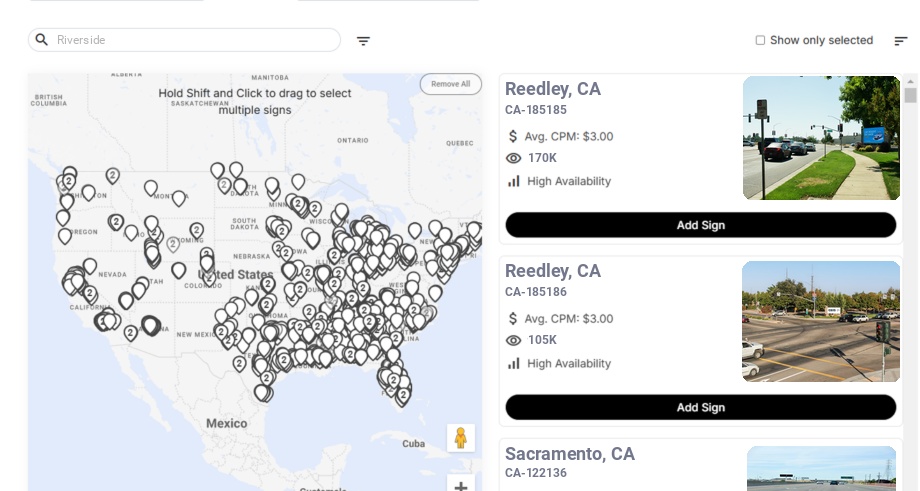
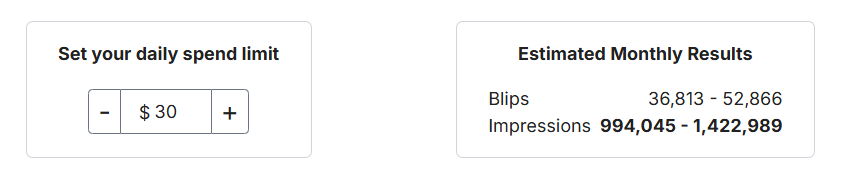
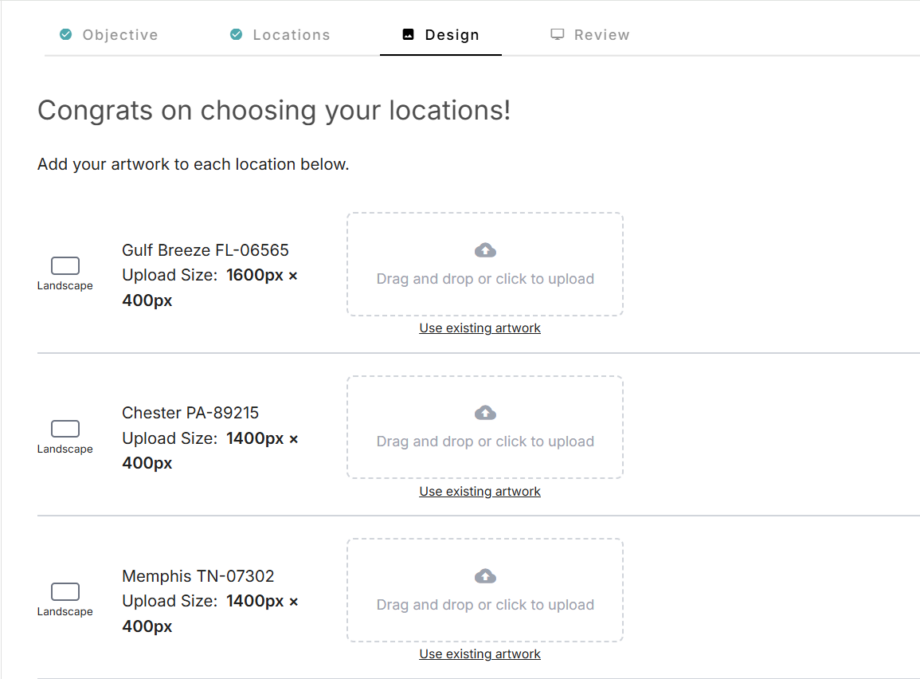
How much is a billboard in Riverside?
Billboards in other California cities
Riverside Billboard Advertising Guide
Riverside, California sits at the heart of the Inland Empire—a region that has grown into one of the most important logistics, education, and healthcare hubs in Southern California. With high freeway usage, a young and diverse population, and strong commuter flows to neighboring counties, Riverside is tailor‑made for targeted digital billboard campaigns. Using Blip, we can tap into these patterns with precise timing, geo‑targeting, and creative testing to turn impressions into measurable results, making Riverside billboards a powerful part of a broader marketing mix.
Understanding the Riverside Market
Riverside is one of Southern California’s largest cities and economic engines:
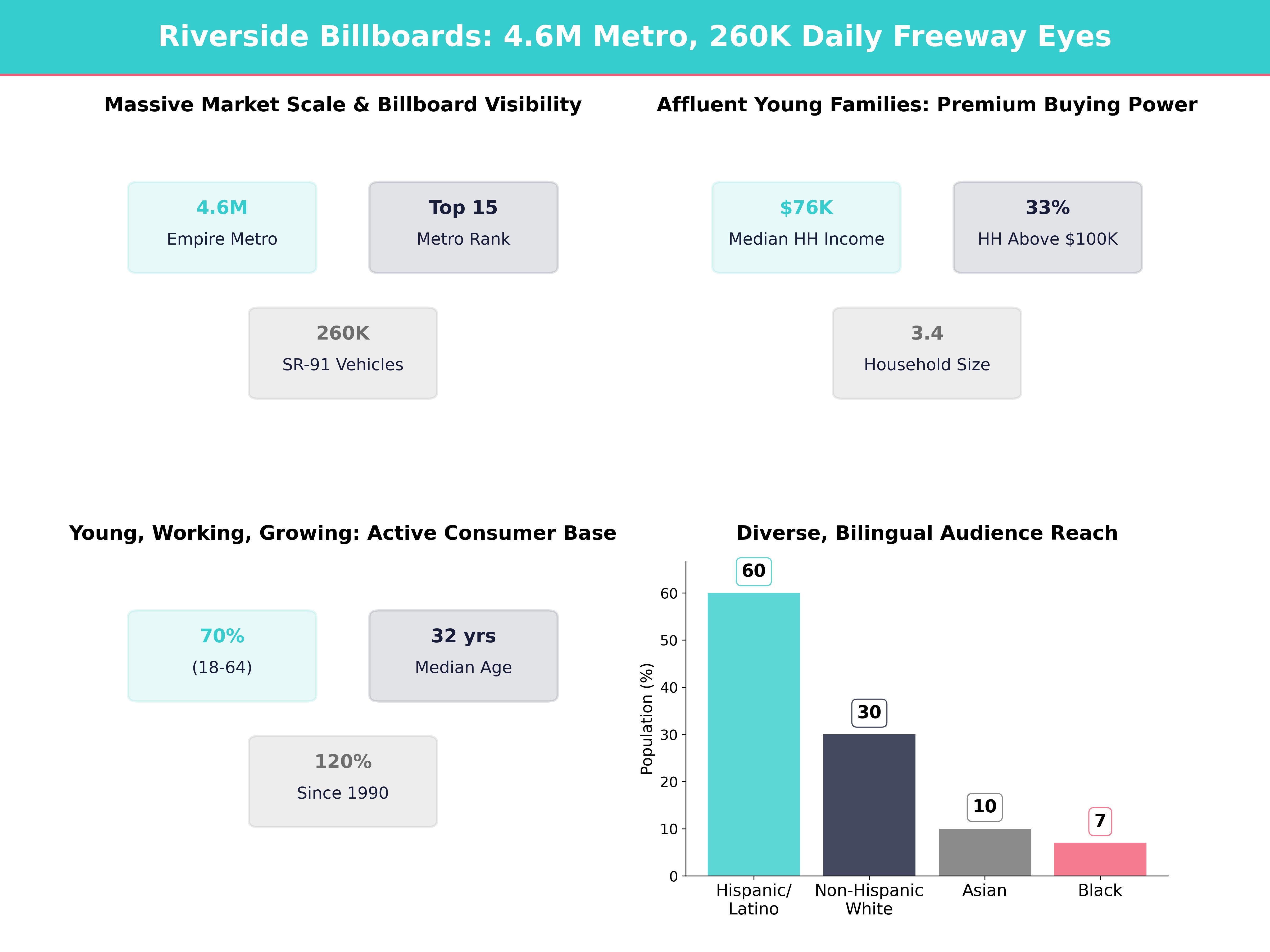
- The City of Riverside has over 320,000 residents, placing it among the 15 largest cities in California and roughly the 60 largest in the U.S.
- Riverside County
- The broader Inland Empire (Riverside–San Bernardino) now exceeds 4.6 million residents, making it one of the top 15 largest metro areas in the country.
- Nearly 68–70% of residents are in their working years (ages 18–64), creating a strong base of commuters and consumers for employment, education, and retail offers.
- Household incomes are solid but varied: median household income in the city is in the $72,000–$76,000 range, with roughly 1 in 3 households above $100,000 and a sizable share under $60,000—ideal for clear audience segmentation and tiered offers.
- Average household size is around 3.3–3.4 persons, higher than the U.S. average (about 2.5), reinforcing the relevance of family‑focused messaging for billboards in Riverside.
Key local economic drivers include:
- Education: University of California, Riverside, California Baptist University, the Riverside Community College District (including Riverside City College, with 18,000+ students), and multiple private and vocational schools.
- Healthcare: Riverside is a hub for regional hospitals and medical centers, including facilities within the Riverside University Health System and major private systems, employing many thousands of clinicians and support staff.
- Logistics and warehousing: The Inland Empire hosts more than 600 million square feet of industrial and logistics space, with Riverside playing a key role in distribution for the ports of Los Angeles and Long Beach and for major e‑commerce employers.
- Government and public sector: City, county, courts, and schools such as Riverside Unified School District and Alvord Unified. Riverside Unified alone serves roughly 40,000 students and employs 4,000+ staff, including teachers, administrators, and support roles.
This mix means that campaigns using Riverside billboard advertising can successfully target:
- Students and young professionals (tens of thousands of college students plus recent graduates)
- Blue‑collar and logistics workers in and around major warehouse corridors
- Healthcare and education professionals commuting across the region
- Young families and multigenerational households across west and east Riverside
Digital billboards let us speak differently to these groups at different times and in different corridors.
Demographics and Cultural Insights for Messaging
Riverside’s identity is distinctly family‑oriented, multicultural, and upwardly mobile:
- Residents are predominantly Hispanic/Latino—around 55–60% of the population—followed by non‑Hispanic White at roughly 25–30%, Asian communities around 7–10%, and Black residents around 6–7%, depending on the neighborhood.
- The median age hovers around 31–32 years, several years younger than the California median (about 37), reflecting a strong base of young adults and families with children.
- Around 40–45% of residents speak a language other than English at home, with Spanish by far the most common; in some west‑side and central ZIP codes, Spanish‑speaking households exceed 60%. Bilingual or Spanish‑forward messaging is often a performance multiplier on major corridors.
- Educational attainment is mixed: roughly 1 in 4 adults has a bachelor’s degree or higher, while a significant share has “some college” or an associate degree—ideal for campaigns promoting certifications, degree completion, and trade programs.
- Homeownership rates hover near 55–60%, higher than many urban parts of Los Angeles County, supporting demand for home services, remodeling, and financial products.
Implications for creative and copy:
- Bilingual advantage: Consider English‑dominant copy with a strong Spanish support line, or reverse depending on your offer and target area. For example: a headline in English with a clear Spanish call to action (“Llama hoy,” “Sin contrato,” “Se habla español”). In heavily Hispanic corridors, you can test fully Spanish creative against bilingual to see which lifts calls or site visits.
- Family‑centric framing: With average household sizes over 3 people and many homes with children under 18, highlight value, safety, education, and family experiences. Phrases like “for your family,” “this weekend with the kids,” or “back‑to‑school savings” tend to resonate.
- Education & aspiration: With UCR, CBU, RCC, and other institutions nearby, messages about “career upgrades,” “certifications,” “degree completion,” and “future‑proof skills” align well with local aspirations, especially for first‑generation college students.
- Faith‑oriented and community themes: Riverside leans more traditional than coastal LA/OC, with strong church networks and faith‑based schools. Messaging for nonprofits, faith communities, private schools, and family‑values brands can be very effective when respectful and authentic.
We should align our visual language with Inland Empire culture: clear, bold, straightforward creatives for Riverside billboards; photos of real people who look like Riverside; and clean offers driven by value and convenience.
Traffic Patterns and High‑Impact Corridors
Riverside is defined by three major freeways, all managed in part by Caltrans District 8:
- State Route 91 (SR‑91): The main west‑east commuter artery connecting Riverside with Corona, Orange County, and Los Angeles. Segments through Riverside and Corona often reach 220,000–260,000 vehicles per day.
- Interstate 215 (I‑215): Runs north‑south through the Inland Empire, linking Riverside with San Bernardino, Moreno Valley, and points north, carrying roughly 140,000–170,000 vehicles per day on many central stretches.
- State Route 60 (SR‑60): Another major east‑west route, connecting to the San Gabriel Valley and the broader Inland Empire, typically serving 160,000–190,000 vehicles per day near Riverside.
Supplemented by arterials like Magnolia Avenue, University Avenue, Mission Inn Avenue, La Sierra Avenue, and Van Buren Boulevard, these routes move a large share of local and regional traffic. The Western Riverside Council of Governments and Riverside County Transportation Commission regularly report that the 91 and 60 corridors are among the most heavily traveled commuter routes in the region, reinforcing why billboards in Riverside along these freeways can deliver such strong daily impression counts.
Key patterns that affect campaign strategy:
-
Heavy commuter flows:
- Morning peak: roughly 6:00–9:00 a.m. (westbound 91 toward Corona/Orange County; northbound 215; westbound 60).
- Evening peak: roughly 3:30–7:00 p.m. (eastbound back into Riverside, Moreno Valley, and nearby cities).
Average one‑way commute times for Riverside residents often reach 32–35 minutes, with many super‑commuters traveling 45–60 minutes each way.
- High driving mode share: Close to 90% of Riverside workers commute by car, either driving alone or carpooling, according to regional transportation studies and Riverside Transit Agency data. Transit, biking, and walking collectively account for only about 5–7% of all work trips.
- Regional weekend traffic: 91, 60, and 215 also carry heavy weekend leisure traffic to and from coastal destinations, outlet centers, casinos, and regional attractions like the Galleria at Tyler and downtown events, often pushing volumes near or above weekday averages on Saturdays.
How we can leverage this with Blip:
- Direction‑conscious messaging: Aim “drive‑to work” offers westbound in the morning and “on your way home” offers eastbound in the evening. For example, a recruitment message “Start at $24/hr – Apply Tonight” timed to eastbound 91 in the evening.
- Dayparting rush hours: Use Blip’s scheduling tools to concentrate spend in the 6–9 a.m. and 3:30–7 p.m. windows on weekdays for commuter‑oriented campaigns, where impressions per dollar are highest for working‑age audiences.
- Weekend targeting: For retail, dining, entertainment, and attractions, focus impressions on Friday evening through Sunday, particularly on 91 and 60 corridors where shopping and recreation trips spike.
Local resources like the Riverside Transit Agency and City of Riverside transportation pages can help corroborate peak‑time patterns, park‑and‑ride usage, and planned road projects that may temporarily shift flows and inform where to emphasize Riverside billboard advertising.
Event and Seasonal Timing in Riverside
Riverside’s calendar provides multiple “built‑in” opportunities to time campaigns for maximum impact.
Key annual and seasonal highlights:
- Festival of Lights at the Mission Inn:
From late November through early January, downtown Riverside becomes a regional destination. The Festival of Lights at the Mission Inn draws an estimated 700,000–800,000 visitors each season, with some years surpassing 1 million according to city reports. This spikes evening and weekend traffic in and around downtown, the Mission Inn district, and the 91 corridor. -
University calendars:
UCR enrolls more than 26,000 students and 4,000+ faculty and staff, and California Baptist University enrolls over 11,000 students. Riverside City College adds another 18,000+, and other campuses push total higher‑ed enrollment in the city above 40,000. Key moments:- Move‑in and orientation periods (late August/September)
- Homecoming and major athletic events (drawing thousands of visitors on select weekends)
- Finals and graduation (May/June), when tens of thousands of family members visit the city
- Retail and tax seasons:
Income tax refunds in February–April, back‑to‑school (late July–September), and holiday shopping (November–December) are all especially active periods in Riverside’s big‑box corridors such as Magnolia, La Sierra, and around Galleria at Tyler. National and regional retail data typically show 20–30% higher sales volumes in these windows compared with off‑season months, which is when many brands increase their billboard rental in Riverside to capture additional demand. - Weather and lifestyle:
Riverside averages more than 275 sunny days per year, with hot, dry summers that routinely see 40–60 days per year at 90°F+ and a number of days exceeding 100°F. This keeps people in cars and in air‑conditioned environments—shopping centers, gyms, theaters, and indoor venues—boosting the value of road‑side placements during extreme heat.
How to convert this into strategy with Blip:
- Pre‑event build‑up: Start campaigns for Festival of Lights, graduations, or major events 2–4 weeks in advance, then intensify frequency the week before and during peak weeks. For major downtown events promoted by the City of Riverside or Visit Riverside, align your schedule with published event calendars.
- Short “bursts” around key dates: Take advantage of Blip’s flexibility to run high‑frequency bursts (e.g., 7–10 days) for time‑sensitive promotions: grand openings, clearance sales, concerts at the Fox Performing Arts Center, or special weekends. Short bursts can dramatically lift recall and direct response during critical windows.
-
Align creative with season:
- Summer: emphasize cooling, indoor fun, auto care, home services, and hydration; tie offers to heat waves forecast by local outlets like ABC7 Los Angeles or NBC Los Angeles when they affect Riverside.
- Fall: back‑to‑school, sports, home improvement, and flu‑season healthcare for families and college students.
- Winter: holidays, gifting, financial services, and health benefits enrollment, especially during open enrollment periods promoted by local healthcare providers.
Strategic Audience Targeting Across the City
Riverside’s neighborhoods and sub‑areas function like micro‑markets:
-
Downtown & Mission Inn area
- Audience: young professionals, government workers, tourists, eventgoers, and legal/office workers at city, county, and justice centers.
- Foot traffic during major events can jump by 50–100% versus typical weekends, according to downtown event reports.
- Best for: dining, nightlife, entertainment, cultural attractions, services catering to office workers, legal and financial services.
- Timing: weekday 8 a.m.–6 p.m. for office crowd; evenings/weekends during Festival of Lights and events promoted on the Downtown Riverside
-
University & Canyon Crest / UCR Area
- Audience: UCR students, faculty, and staff; nearby residents; visiting families.
- UCR alone supports more than 26,000 students and 4,000+ employees, generating tens of thousands of daily trips in and out of the area during the academic year.
- Best for: student housing, food delivery, mobile apps, tutoring, test prep, coffee shops, gyms, nightlife, and services like banking and healthcare geared to young adults.
- Timing: weekday daytime and early evening; heavy activity at semester start, midterms, and finals, when student demand spikes.
-
Magnolia, Arlington, and La Sierra Corridors
- Audience: middle‑income families, shoppers, commuters from the western neighborhoods, and visitors to the Galleria at Tyler area.
- The Galleria at Tyler and surrounding retail often see weekend visitor counts in the tens of thousands per day during peak seasons.
- Best for: big‑box retail, quick‑service restaurants, automotive, healthcare, family entertainment, and churches.
- Timing: weekday commute windows plus Saturday midday and early afternoon when shopping trips peak.
-
Industrial & Logistics Zones (near 215/60)
- Audience: logistics and warehouse workers, tradespeople, commercial drivers, and industrial staff commuting from surrounding cities.
- Many logistics facilities operate 2–3 shifts per day, with worker counts ranging from a few hundred to several thousand per site.
- Best for: recruitment, trade schools, B2B services, equipment, blue‑collar‑friendly financial services like credit unions and insurance.
- Timing: early mornings (5–8 a.m.) and shift change times (afternoons and late evenings).
With Blip, we can concentrate impressions around specific boards that best reach each micro‑market, then adjust based on performance metrics like call volume, web traffic by ZIP code, and in‑store visits, ensuring billboard rental in Riverside is tightly aligned with where your audiences actually move.
Creative Best Practices for Riverside Billboards
To reach drivers moving at freeway speeds and on busy arterials, creatives must be fast, bold, and relevant. These principles apply whether you are testing a single board or running a full Riverside billboard advertising program.
We recommend:
-
Ultra‑simple messaging
- 6–8 words max.
- One main idea and one clear call to action.
- Example for a family dental office:
“Same‑Day Appointments. Se Habla Español. Exit Magnolia.” - Given average freeway speeds of 55–65 mph, viewers often have 3–6 seconds to absorb your message—too much text sharply reduces comprehension.
-
Local references and landmarks
- Use directional cues tied to Riverside geography: “Near Galleria at Tyler,” “By UCR,” “Off 91 at La Sierra.”
- Mention well‑known anchors—Mission Inn, Riverside Plaza, Tyler, or major cross streets.
- This can significantly improve action rates; local advertisers often report 10–30% higher response when clear location cues are included.
-
Spanish and bilingual support
-
In heavily Hispanic areas or for Spanish‑speaking audiences, test:
- Fully Spanish creatives.
- English headline + Spanish subline.
- Use Blip’s reporting to A/B test which mix yields better results (e.g., more calls or website visits during the campaign). With over half the population identifying as Hispanic/Latino, even service brands that are English‑dominant can benefit from adding “Se habla español.”
-
In heavily Hispanic areas or for Spanish‑speaking audiences, test:
-
High‑contrast visuals
- Bright colors and bold fonts stand out in Riverside’s frequent bright sun and long daylight hours.
- Avoid thin scripts or light colors on bright backgrounds; opt for high contrast (e.g., dark text on light background or vice versa).
- Use photos that reflect Riverside’s diversity and family orientation: multi‑generational groups, young families, and professionals.
-
Time‑sensitive countdowns
- “Ends Sunday,” “This Weekend Only,” “Enroll by Sept 15.”
- Run these higher‑urgency creatives in short bursts, timed via Blip to the final days of your promotion. Short, urgent campaigns can generate noticeable spikes in calls and searches during the final 48–72 hours.
Because digital billboards on Blip can rotate multiple creatives, we can run a mini‑suite of 3–5 variations: one bilingual, one “value” focused, one “location” focused, etc., and phase out underperformers based on real‑time or weekly results. This testing approach helps you understand what types of Riverside billboard advertising drive the highest engagement.
Leveraging Blip’s Flexibility in Riverside
Blip’s model of buying individual “blips” (showings) allows us to adapt quickly to Riverside’s dynamic patterns and makes billboard rental in Riverside accessible even for smaller, locally owned businesses.
Key tactics:
-
Dayparting based on intent
- Mornings: commuters, trades, parents doing school drop‑off along routes to local campuses and K‑12 schools in districts like Riverside Unified and Alvord Unified.
- Midday: retirees, shift workers, students, stay‑at‑home parents running errands and appointments.
- Evenings: commuters heading home, families going out to eat, students heading to classes, gyms, or nightlife.
- Weekends: shoppers, churchgoers, events, day‑trip traffic drawn by listings on Visit Riverside and the City of Riverside events calendars.
-
Budget concentration
- Instead of a thin presence all day, compress budget into the specific hours when your audience is most active in a particular corridor. For example, concentrate 60–70% of impressions into commuter peaks for recruitment or home services.
-
Rapid creative swaps
- If a special sells out, a concert date changes, or a tax‑season promo ends, we can swap to a new creative without the printed‑vinyl lag of traditional billboards. This agility is especially valuable around weather events, road closures, or last‑minute promotions mentioned by local news outlets like The Press‑Enterprise.
-
Granular local testing
- Run one creative primarily along 91 and another along 60/215 to see which corridor is more profitable, then double down there.
- Test different offers by neighborhood (e.g., financing options in owner‑occupied areas, discounts or flexible hours in student‑heavy districts) and compare response rates by ZIP code.
Industry‑Specific Ideas for Riverside
Because Riverside’s economy is diverse, some category‑tailored strategies perform especially well here.
Education and Training
With multiple colleges and many residents who are first‑generation college students:
- Promote degree completion programs, trade schools, language classes, and certification prep on routes frequently traveled by working adults—especially 91, 60, and 215 where commuting learners may see your message twice a day.
- Use headlines like “Finish Your Degree at Night,” “HVAC Certification in 6 Months,” or “Nursing Assistant Programs in Riverside.”
- Time campaigns heavily around August–October and January–February, when college and vocational enrollments typically spike and when financial aid and new‑year goal‑setting are top of mind.
- Highlight flexible formats: many adult learners in Riverside juggle 30–40 hour workweeks with school, so phrases like “Evening & Online Classes” or “Weekend Programs” can significantly increase response.
Healthcare and Medical Services
Riverside’s large family population and strong healthcare presence create opportunities for:
- Primary care, urgent care, pediatric, dental, vision, and behavioral health campaigns targeting families and commuters.
- Messages such as “Same‑Day Pediatric Appointments,” “Open Late & Weekends,” or “Walk‑In Urgent Care: Riverside.”
- Focus on high‑traffic routes near hospitals and medical offices, and emphasize convenience, bilingual staff, and insurance acceptance.
- During flu season and open enrollment (often October–January), consider running higher‑frequency campaigns aligned with public‑health messages from organizations like Riverside University Health System.
Home Services and Trades
With a large stock of single‑family homes and ongoing growth in new developments:
- Plumbers, HVAC, solar, roofing, landscaping, and pest control can thrive with strong local presence. Riverside’s hot summers and occasional wind/rain events drive repeated demand for HVAC and roofing in particular.
- Connect campaigns to heat waves (“AC Struggling? Call Tonight.”), storm seasons, or utility rate changes publicized by local utilities and media.
- Drive calls and form fills with simple, benefit‑led creatives and a visible phone number or vanity URL. Home services often see high call‑through rates when phone numbers are short and prominent, especially on well‑placed Riverside billboards near residential corridors.
Retail, Dining, and Entertainment
Riverside’s major shopping districts and downtown entertainment create robust campaign opportunities:
- Promote restaurants, quick‑service chains, and local eateries with “3 Minutes Ahead on Magnolia,” “Kids Eat Free Tuesdays,” or “Exit La Sierra – Galleria at Tyler.”
- For venues like the Fox Performing Arts Center or local theaters, run short bursts 1–3 weeks before shows, targeted by time of day and weekend peaks when people are planning nights out.
- Highlight local pride: “Riverside‑Owned,” “Inland Empire’s Favorite,” or references to local news outlets if you’ve received recognition, such as “Voted Best of Inland Empire.”
- Tie messaging to major local or regional events (sports games, parades, festivals) highlighted by Visit Riverside and city event calendars, which can push nearby restaurant and bar traffic up by 20–40% on event days.
Hiring and Workforce Recruitment
Logistics, healthcare, education, and public agencies in Riverside all face ongoing hiring needs:
- Use billboards as a top‑of‑funnel driver for campaigns like “Drivers Start at $24/hr + Benefits,” “Now Hiring Nurses in Riverside,” or “Teach in Riverside – Apply Today.”
- Aim these messages at commute corridors early in the morning and evening. Workers in logistics and healthcare often leave home before 6 a.m., so early morning impressions are especially valuable.
- Link to short, memorable URLs or QR codes that are large enough to scan from a distance for slower arterials. On arterials where speeds are 25–40 mph, larger QR codes can be effective; on freeways, prioritize simple URLs or “Text RIVJOBS to ####.”
Measuring, Iterating, and Aligning with Local Media
To get the most from Blip campaigns in Riverside, we should treat digital billboards as a measurable, optimizable channel.
Measurement ideas:
- Track direct response during campaign windows: unique URLs, campaign‑specific promo codes, special phone numbers, and dedicated landing pages linked to your Riverside billboard advertising.
- Watch for local search lift: increases in branded Google searches or map lookups from Riverside and surrounding ZIP codes (such as 92501, 92503, 92507, 92508) while your campaign runs.
- Monitor store or office traffic patterns, especially during time blocks when your blips are scheduled, to spot 10–20% swings that correlate with campaign bursts.
-
Coordinate with other channels:
- Align billboard messages with radio, streaming audio, or local TV buys that cover the Inland Empire market.
- Mirror creatives used in local news display ads, social campaigns, or sponsorships of community events listed on the City of Riverside or Riverside Arts & Culture calendars to reinforce message frequency.
- Consider cross‑promotions with events and attractions featured on Visit Riverside to piggyback on their marketing reach.
Iterate using Blip:
- Start with a test phase (2–4 weeks) focused on one or two corridors and 2–4 creatives.
- Drop underperforming creatives and reallocate impressions to top performers, aiming for measurable improvements (e.g., 15–30% higher response from your best‑performing creative).
- Expand coverage geographically once we understand which messages resonate best with Riverside audiences and which corridors drive the most efficient cost per lead or sale, then scale billboard rental in Riverside accordingly.
By understanding Riverside’s demographic profile, commute patterns, neighborhood micro‑markets, and seasonal rhythms, we can use Blip’s flexibility to design digital billboard campaigns that are both cost‑efficient and highly visible. With data‑driven timing, tailored creative, and local relevance grounded in resources from the City of Riverside, Visit Riverside, and local media, we can reach Riverside drivers at the exact moments and places where they are most ready to act, maximizing the impact of billboards in Riverside for brands of all sizes.