Billboards near Franklin Square, NY
No Minimum Spend. No Long-Term Contracts. Just Results.
Trusted by Leading Brands


Billboard advertising
near Franklin Square has never been easier



How much is a billboard near Franklin Square?
Why Choose Blip for Billboard Advertising near Franklin Square
Blip lets Franklin Square advertisers launch fast on Hempstead Turnpike and Southern State Parkway commuter traffic—no sales calls, just self-serve access.
Use flexible Blip budgets in Franklin Square to reach family households and NYC commuters without locking into a long contract.
Daypart Franklin Square ads for 6:30-9:30 a.m. school runs and 4:30-7:30 p.m. return traffic to match peak drive times.
Track Franklin Square performance in real time, then shift spend when weekend trips to Green Acres Mall or Roosevelt Field spike.
Blip's creative tools make it easy to refresh Franklin Square messages for back-to-school, holiday shopping, or bilingual neighborhood audiences.
Frequently Asked Questions About Billboard Advertising near Franklin Square
How much does a billboard cost near Franklin Square, New York with Blip?
With Blip, you choose your own daily budget for Franklin Square billboards, and your ads play in short 7.5 to 10-second “blips” on rotating digital displays serving the Franklin Square area. You only pay for the advertising you receive, and the price of each blip adjusts based on when and where you choose to advertise and on current advertiser demand. Since your total cost is simply the sum of all the blips you receive, you stay in control and can change your budget at any time.
Where can I advertise with Blip near Franklin Square, New York?
There are 28 digital billboards serving the Franklin Square area from nearby Hempstead, just about 3.2 miles away, as well as other high-traffic corridors within roughly a 10-mile radius. While units are not physically located inside Franklin Square itself, they cover the main arteries that Franklin Square residents use daily. These include Hempstead Turnpike (NY-24), the Southern State Parkway, and nearby local connectors in Hempstead and surrounding communities.
Why is Franklin Square, New York a good market for billboard advertising?
Franklin Square sits at a powerful crossroads of Long Island suburbia and New York City commuting culture. Franklin Square itself has a population of about 32,000 residents packed into just over 3.0 square miles, creating a density that rivals many small cities. Nassau County’s median household income is around $126,500, and estimates for Franklin Square run slightly higher in the $130,000–$135,000 range.
What kinds of people will see Blip billboards near Franklin Square, New York?
The Franklin Square area is a classic commuter suburb with a heavily family-oriented population and high car ownership. In Nassau County overall, roughly 80% of workers commute by car, and Franklin Square follows similar patterns, concentrating eyeballs on nearby roadways where the digital billboards are located. The area also has a large share of households with children and strong homeownership, which supports categories like home services, financial services, and healthcare.
When is the best time to run billboard ads near Franklin Square, New York?
The Franklin Square area has distinct traffic and lifestyle rhythms, and flexible digital scheduling lets you align a Blip campaign to those patterns. Morning commute hours from 6:30 to 9:30 a.m. and evening commute hours from 4:30 to 7:30 p.m. are especially strong, and weekend midday can be prime for retail and dining. The page also recommends running short, high-frequency bursts during relevant dayparts instead of spreading impressions evenly 24/7.
Do I need a contract to advertise with Blip near Franklin Square?
No, Blip has no long-term contracts or minimum commitments. You can start, pause, or stop your campaign at any time.
How fast can I launch a billboard campaign with Blip near Franklin Square?
You can have your campaign live in minutes. Create a free account, select your locations, set your budget, upload your design, and start running once approved.
Where can I advertise with Blip near Franklin Square?
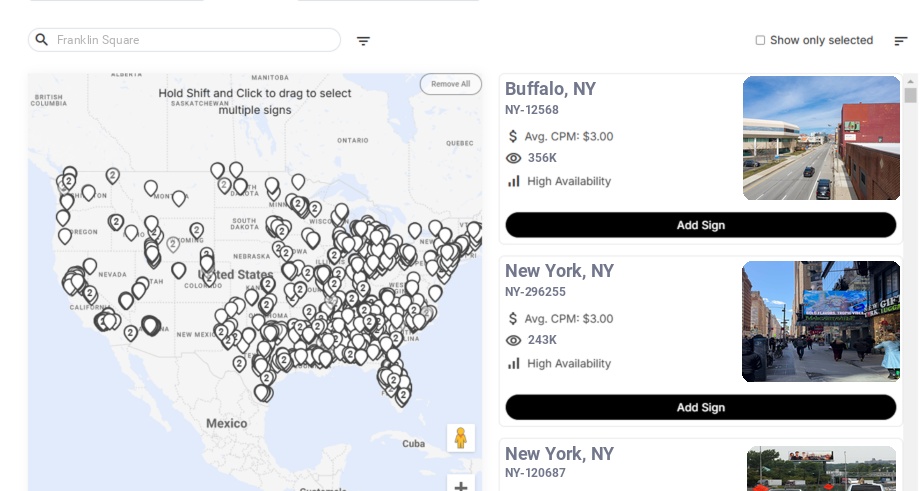
Blip has digital billboards near Franklin Square. You can browse available locations on a map, choose the ones that fit your audience, and start advertising right away.
Still have questions? Launch a campaign in minutes — no contracts, no commitments.
Start Your CampaignFranklin Square Billboard Advertising Guide
Franklin Square, New York, sits at a powerful crossroads of Long Island suburbia and New York City commuting culture. With 28 digital billboards serving the Franklin Square area from nearby Hempstead, we can help local and regional advertisers tap into a dense, affluent, and highly mobile audience that sees outdoor media all day long—on their way to work, school, shopping, and recreation. For advertisers actively searching for billboards near Franklin Square, this cluster of units delivers consistent visibility along the exact corridors residents use every day.
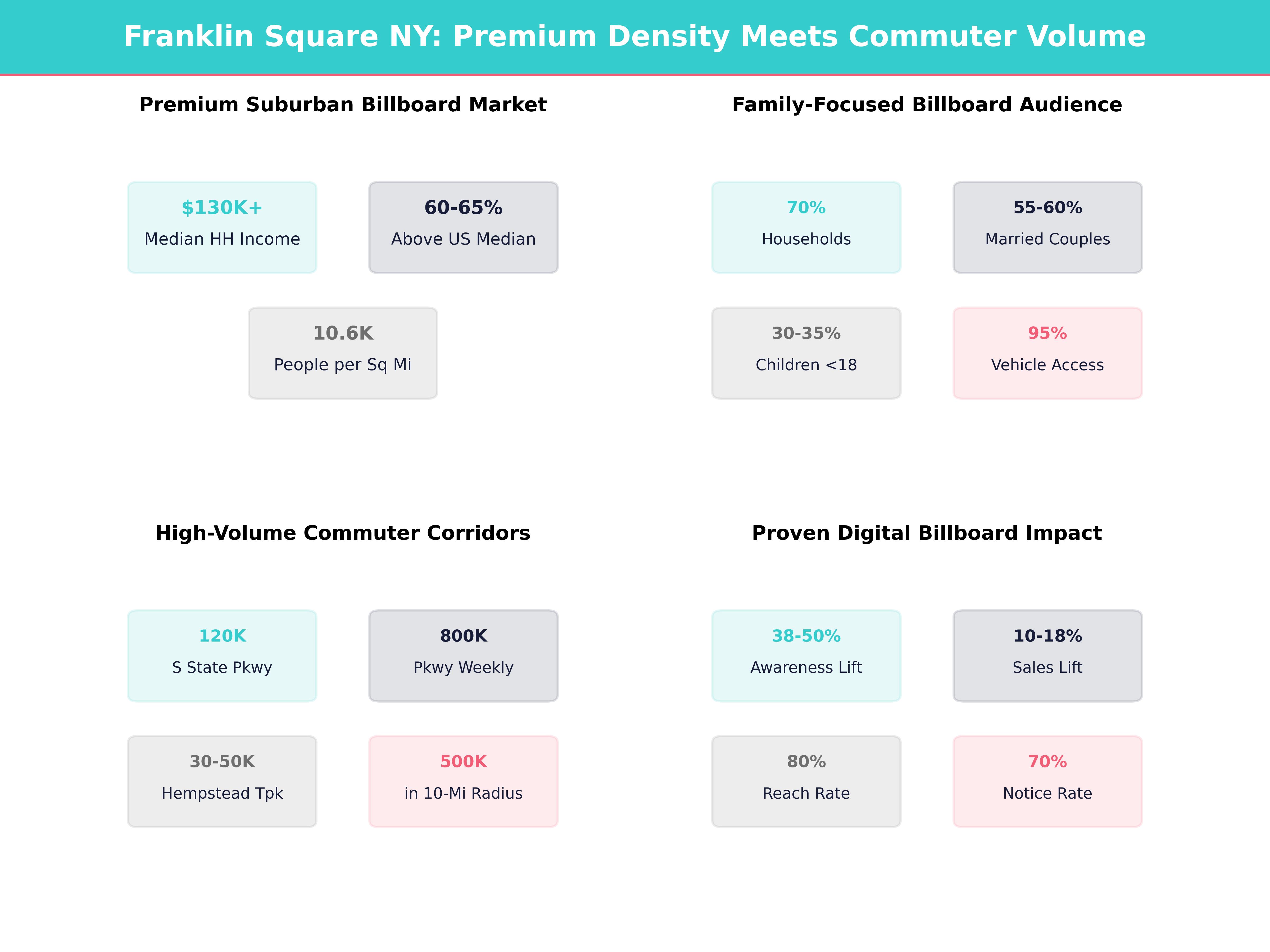
Industry research from organizations such as the Outdoor Advertising Association of America (OAAA) consistently shows that digital billboards can increase brand awareness by 38–50% and drive average sales lifts of 10–18% for local businesses when paired with other media. In commuter-heavy suburbs like those surrounding Franklin Square, OOH campaigns routinely achieve weekly reach levels above 80% of adults within 5–10 miles of the units, making billboard advertising near Franklin Square a cost‑efficient way to stay visible in a cluttered media environment.
Why the Franklin Square Area Is Prime for Digital Billboards
Franklin Square is part of the Town of Hempstead in Nassau County, one of the most populated suburban counties in the United States. According to local government data and regional planning sources:
- The Town of Hempstead has roughly 793,000 residents, making it the largest township in New York State and accounting for more than half of Nassau County’s total population of about 1.39 million.
- Franklin Square itself has a population of about 32,000 residents, packed into just over 3.0 square miles—more than 10,600 people per square mile, a density that rivals many small cities and far exceeds the U.S. suburban average (often below 4,000 per square mile).
- Nassau County’s median household income is around $126,500, and estimates for Franklin Square run slightly higher, in the $130,000–$135,000 range—roughly 60–65% higher than the current U.S. median household income.
- Homeownership is strong in the area; in many Franklin Square–adjacent Census tracts, 75–80% of occupied housing units are owner‑occupied, which supports higher‑ticket categories like home services, financial services, and healthcare.
For local context and planning resources, advertisers can reference the Town of Hempstead and Nassau County websites, as well as regional tourism information from Discover Long Island. These resources are especially useful when planning Franklin Square billboards that need to align with neighborhood activity, tourism surges, and municipal calendars.
This combination of density, income, and proximity to New York City makes digital billboards near Franklin Square a smart choice for:
- Local retailers and restaurants that rely on repeat visits from the 12,000+ local households
- Professional services (law, finance, healthcare) serving a commuter base where roughly 1 in 4 workers travel to New York City or Queens
- Education, nonprofits, and faith organizations in a township that includes more than 40 public schools and numerous parochial schools
- Regional brands seeking Long Island penetration without Manhattan prices; CPMs for digital billboards in Nassau County are often 30–50% lower than comparable inventory in New York City boroughs while still accessing millions of weekly impressions
Understanding the Franklin Square Audience
To build an effective campaign serving the Franklin Square area, we should design around who actually lives and travels here.
Households and income
- Franklin Square’s population is heavily composed of families; over 70% of households are family households, and about 55–60% are married‑couple households. A significant share—roughly 30–35% of all households—have children under 18 at home.
- Median household income in the Franklin Square area is estimated in the low‑ to mid‑$130,000s, placing it among the higher‑income communities in Nassau County and nearly double the New York State median.
- A large share of households earn $150,000+ annually, and a meaningful slice—often 15–20%—exceeds $200,000, making the area particularly attractive for premium and specialty offerings.
- Car ownership is high—more than 95% of households have access to at least one vehicle, and a majority have two or more vehicles, reflecting a commuter culture and strong reliance on local roads and parkways.
Commuting realities
The Franklin Square area is a classic commuter suburb:
- In Nassau County overall, roughly 80% of workers commute by car (driving alone or carpooling), and only 10–12% rely primarily on public transit. Franklin Square behaves similarly, which concentrates eyeballs on nearby roadways where our digital billboards are located.
- A large share of residents commute to jobs in New York City, western Nassau, and Queens. In some nearby ZIP codes, 25–30% of employed residents work in New York City or in boroughs other than Nassau and Suffolk.
- Local residents commonly use the Southern State Parkway, Cross Island Parkway, and Hempstead Turnpike (NY‑24), as well as nearby Long Island Rail Road (LIRR) stations in Garden City, Stewart Manor, and Hempstead operated by the MTA LIRR.
- Average commute times for Nassau County residents hover around 35–40 minutes, with a sizable segment experiencing commutes of 45 minutes or more. That translates into extended, repeated daily exposure to outdoor media near Franklin Square—often 10+ hours per week spent in vehicles or on transit.
Cultural diversity
Nassau County, and Franklin Square specifically, are diverse and changing:
- Around 23–25% of Nassau County residents are foreign‑born, and more than 30% of residents speak a language other than English at home.
- The Franklin Square area features long‑established Italian, Irish, and Greek communities, alongside growing Hispanic and Asian populations; in nearby tracts, Hispanic and Latino residents now account for 20%+, and Asian residents for 10–12% of the population.
- Age distribution is balanced: a solid youth base (roughly 20–22% under 18), a large working‑age segment (about 60% between 18 and 64), and a meaningful senior population (15–18% aged 65+), which sustains categories from pediatrics and tutoring to senior care and medical specialties.
That diversity suggests several creative options:
- English‑dominant campaigns with simple, universally understandable imagery
- Occasional bilingual English/Spanish messages for inclusive appeal, especially for healthcare, retail, and public‑service themes
- Community‑focused messaging that references shared local touchpoints: schools, youth sports, local parishes, and civic events
Local news outlets like Newsday and the Franklin Square-Elmont Herald Franklin Square Public Library and community notices on the Town of Hempstead website.
Where Our Billboards Reach Drivers near Franklin Square
Our 28 digital billboards serving the Franklin Square area are concentrated in nearby Hempstead, just about 3.2 miles away, as well as other high‑traffic corridors within roughly a 10‑mile radius. Within that radius are more than 500,000 residents of western and central Nassau County, plus significant through‑traffic from Queens. This makes them ideal for advertisers specifically seeking billboards near Franklin Square without having to rely on Manhattan‑area pricing.
While units are not physically located inside Franklin Square itself, they cover the main arteries that Franklin Square residents use daily:
- Hempstead Turnpike (NY‑24) – A central east–west corridor running just south of Franklin Square, connecting to Elmont, West Hempstead, and East Meadow. Depending on segment, average daily traffic can range from roughly 30,000 to 50,000 vehicles, translating into 210,000–350,000 vehicle trips per week.
- Southern State Parkway – One of Long Island’s primary commuter parkways, often carrying over 120,000 vehicles daily across multiple segments—more than 800,000 weekly vehicle trips. Many Franklin Square drivers use nearby interchanges to access work, shopping, and leisure destinations.
- Key local connectors in Hempstead and surrounding communities that pull shoppers, workers, and students from Franklin Square, Elmont, West Hempstead, and Garden City; together, these neighboring communities add another 80,000–100,000 residents into your potential audience.
By selecting billboards strategically along these routes, advertisers can:
- Reach Franklin Square residents multiple times per day (morning and evening commutes, school runs, errands), often achieving frequency levels of 15–25 weekly impressions per commuter when schedules are concentrated in rush‑hour dayparts
- Capture visitors traveling to nearby retail hubs like Green Acres Mall, Roosevelt Field Village of Hempstead, each drawing tens of thousands of visitors per week and surging during holidays and back‑to‑school periods
- Build brand familiarity with both local households and through‑traffic from Queens and other parts of Nassau County; OOH studies show that over 70% of drivers frequently notice roadside digital billboards and over 40% report visiting a business they saw advertised on a billboard
For additional transportation and traffic context, advertisers can review regional roadway and safety information from the New York State Department of Transportation Region 10. Understanding these traffic flows is especially useful when planning billboard advertising near Franklin Square that depends on commuter exposure.
Timing Your Campaign for Maximum Impact
The Franklin Square area has distinct traffic and lifestyle rhythms. With flexible, digital scheduling, we can align your Blip campaign to those patterns.
Traffic analytics on suburban arterials similar to Hempstead Turnpike show that peak hours can run 2–3 times higher in volume than mid‑day, and weekend retail peaks can generate 20–30% more trips to major shopping corridors compared with typical weekdays. Structuring your schedule to match those surges can significantly improve cost‑per‑impression for any Franklin Square billboards in your media mix.
Weekday patterns
-
Morning commute (6:30–9:30 a.m.)
- LIRR commuters and drivers heading west toward Queens and NYC
- Parents doing school drop‑offs at local public and parochial schools; district enrollment data for nearby communities suggests thousands of students traveling daily within a 3–5‑mile radius.
- Ideal for: coffee shops, quick‑service restaurants, fitness studios, transit‑oriented services, financial services (“Plan your future on your way to work”).
-
Midday (11:00 a.m.–2:00 p.m.)
- Local errands, lunch trips, seniors, at‑home workers heading out; in many suburban markets, 20–25% of all daily trips occur in this window.
- Ideal for: healthcare providers, local restaurants, home services, retail, legal and medical practices targeting flexible‑schedule visitors.
-
Afternoon school and work traffic (2:30–5:30 p.m.)
- Parents picking up kids, after‑school activities, part‑time job shifts
- Ideal for: youth sports programs, tutoring, after‑school activities, quick dinners, family attractions.
-
Evening commute and errands (4:30–7:30 p.m.)
- Return traffic from NYC and western Nassau; evening peak volumes on parkways like Southern State can be 30–40% higher than mid‑day levels.
- Ideal for: grocery and big‑box retail, restaurants, entertainment, home services, political campaigns.
Weekend behavior
-
Weekends see heavy travel to shopping centers, parks, beaches, and religious services:
- Saturday midday and afternoon are prime for retail and dining; regional mall data often shows Saturday capturing 30–35% of weekly visits.
- Sunday mornings align with a strong churchgoing population and family activities; in the Town of Hempstead, there are dozens of houses of worship within a short drive of Franklin Square.
- Spring and summer see additional traffic to beaches and parks promoted by Discover Long Island, leading many Nassau residents past our units; local tourism sources estimate Long Island attracts over 10 million visitors annually, with a heavy concentration between May and September.
We recommend:
- Weighting impressions to weekday rush hours if you’re targeting commuters; concentrating 60–70% of your budget into morning and evening peaks can substantially increase effective reach among working adults.
- Shifting more budget to weekends if you’re a retailer, restaurant, or attraction; many stores see 25–40% of weekly sales over Saturday–Sunday.
- Running short, high‑frequency “bursts” during relevant dayparts instead of spreading impressions evenly 24/7; advertisers often see better response when they focus campaigns into 2–4 week high‑intensity flights around key dates.
Creative Strategies That Resonate near Franklin Square
Digital billboards serving the Franklin Square area should respect both commuter attention limits and local sensibilities.
Design for quick reading
On busy corridors like Hempstead Turnpike and nearby parkways, drivers typically have 6–8 seconds to view a message:
- Use 6–8 words max of main copy. Research from OAAA suggests that designs in this range can improve message recall by up to 40% compared with cluttered layouts.
- Rely on one focal image and one clear call‑to‑action.
- High‑contrast colors (white/yellow on dark, or dark on light) read best at a glance; contrast increases legibility distance by 20–30%.
- Keep logos large and uncomplicated; think of your logo as a roadside signature that people can recognize even at 500–600 feet away.
Speak to the suburban family mindset
Given the area’s strong family orientation and above‑average income, creatives that highlight:
- Safety, reliability, and quality (especially for home services, healthcare, and auto)
- Family‑friendly value (“Kids eat free Tuesdays,” “Family dental care close to home”)
- Time‑saving convenience (“Book online in 60 seconds,” “Same‑day appointments”)
tend to resonate very strongly. Survey data from suburban OOH campaigns indicate that over 60% of parents recall ads that directly reference family benefits or time savings, and over 50% say such ads influence where they shop or dine.
Leverage hyper‑local references
Because Franklin Square and Hempstead share strong neighborhood identities, localized copy can lift engagement:
- Call out nearby intersections or landmarks: “5 minutes from Franklin Ave & Hempstead Tpke”
- Reference local schools, parks, or teams in a tasteful, non‑infringing way: “Proud to support local student‑athletes”
- Reflect local news and seasonal rhythms gleaned from sources like Newsday or the Franklin Square-Elmont Herald. You can also align messaging with community events listed on Nassau County Parks and Town of Hempstead calendars.
Consider multicultural cues
To acknowledge the area’s cultural diversity:
- Keep at least one design fully English to ensure maximum clarity.
- Consider bilingual English/Spanish designs for campaigns aimed at broader regional audiences; in communities where 20%+ of residents speak Spanish at home, bilingual ads can improve message comprehension among those audiences by 30–40%.
- Use inclusive imagery that reflects a range of ages and ethnic backgrounds without stereotyping.
Using Local Events and Seasonality to Your Advantage
The Franklin Square area, along with neighboring Hempstead, is full of seasonally driven activity. With digital billboards, we can adjust your messages as often as you need to match what’s happening on the ground.
School calendars, tourism data, and local retail trends all support strong seasonal patterns: for example, many Long Island retailers report 20–30% of annual revenue in November–December, and local youth programs often see enrollment spikes of 40–60% during back‑to‑school periods.
Spring & summer
- Little League, soccer, and other youth sports ramp up in March–June; youth leagues across Hempstead often register hundreds to thousands of participants, pulling families to fields several times per week.
- Outdoor dining, landscaping, home improvements, and wedding season kick in; home improvement spending can increase 15–25% in spring compared with winter months.
- Local events and cultural festivals across the Town of Hempstead and Nassau County draw added traffic. Outdoor events listed on Nassau County Parks and Discover Long Island calendars bring in visitors from across the region.
Use this time for:
- Rotating creatives for seasonal services (AC tune‑ups, landscaping, outdoor furniture, graduation catering).
- Event‑countdown messages (“Franklin Square street fair this Saturday – Join us!”).
- Tourism and leisure promotions connected to nearby beaches and attractions highlighted on Discover Long Island.
Back‑to‑school & fall
- Back‑to‑school shopping peaks in late August and early September; national retail benchmarks suggest that households with children can spend $800–$1,300 per student on supplies, clothing, and electronics, much of it timed to this window.
- Youth programs, tutoring centers, and extracurricular activities see enrollment surges; local providers frequently report that half or more of their annual sign‑ups occur in August–September and January.
- Fall religious holidays and community events increase family‑focused travel.
Consider:
- Short, date‑specific flights for enrollment deadlines or specials—10–21 day windows are common for driving urgency.
- Offers that recognize family budgets (“Back‑to‑school bundle savings,” “Student discounts”).
Holiday season (November–December)
- Nassau County households traditionally spend heavily on holiday gifts, dining, and travel; regional retail analyses estimate that holiday sales can account for 25–30% of annual revenue for many brick‑and‑mortar stores.
- Traffic remains high near major retail corridors and malls accessible from the Franklin Square area—locations like Roosevelt Field and Green Acres Mall typically extend hours and report foot‑traffic gains of 30–50% versus non‑holiday periods.
Make use of:
- Limited‑time promotions (“3‑day sale,” “Book before Dec 15 and save 20%”).
- Sequential creative: a teaser in early November, then urgency messages closer to key shopping days such as Black Friday and the final two weekends before Christmas.
Sample Strategies by Business Type
To make all of this more concrete, here are practical ways advertisers can structure campaigns serving the Franklin Square area.
Local restaurant or café
- Target: Residents of Franklin Square, Elmont, and West Hempstead within a 5–7‑mile radius, encompassing 80,000–100,000 residents.
-
Schedule:
- Heavy weekday coverage 6:30–9:30 a.m. (breakfast/coffee) and 4:30–7:30 p.m. (dinner), when traffic volumes and “what to eat” decisions spike.
- Weekends 11:00 a.m.–7:00 p.m. for brunch and family dining, aligning with peak restaurant visitation hours that can represent 35–40% of weekly covers.
-
Creative:
- Single, appetizing food image; large logo; simple call to action: “Exit at Hempstead Tpke – 2 minutes ahead.”
- Limited‑time offers rotated weekly: “Kids eat free Wednesdays,” “Game‑day wing special.” Short‑term offers can increase response rates by 20–30% compared with evergreen creative.
Home services (HVAC, plumbing, roofing)
- Target: Homeowners in Franklin Square and neighboring Nassau communities where three‑quarters or more of households own their homes.
-
Schedule:
- All weekdays, 7:00 a.m.–6:00 p.m., with heavier weighting during peak season (heatwaves, cold snaps, storm seasons). Weather‑triggered campaigns often see call volume lifts of 25–40% when aligned with extreme conditions.
-
Creative:
- Problem–solution framing: “No A/C? We’re nearby. Call 516‑XXX‑XXXX.”
- Trust signals: “Serving local families for 25+ years,” “Licensed & insured in Nassau County.” Including local credentials can increase consumer trust metrics by 10–20 percentage points in surveys.
Healthcare provider (urgent care, dentist, specialist)
- Target: Families and commuters in the Franklin Square area. Within a 10‑minute drive, you can access a catchment area of 40,000–60,000 residents.
-
Schedule:
- Weekdays 7:30–10:00 a.m. and 4:00–7:00 p.m., weekends 10:00 a.m.–4:00 p.m., reflecting common appointment and walk‑in times.
-
Creative:
- Emphasize convenience: “Walk‑in urgent care, open 8–8 daily – Franklin Square area.” Extended hours (evenings and weekends) are a key differentiator for over 50% of patients choosing urgent care over primary care.
- Highlight insurance acceptance and new‑patient openings; clear messages about “Most major insurance accepted” help reduce friction and increase response.
Education and youth programs
- Target: Parents of school‑age children. In and around Franklin Square, that audience can represent 6,000–8,000 children within a 10‑minute drive.
-
Schedule:
- Heaviest in late July–September (back‑to‑school) and January–February (mid‑year sign‑ups), when many programs see their top two annual enrollment spikes.
-
Creative:
- Countdowns: “Fall registration ends Aug 31.” Deadline‑driven messaging can increase sign‑ups by 15–25% compared with open‑ended promotions.
- Clear benefits: “Boost grades. Local tutoring near Franklin Square.” Emphasize measurable outcomes (test prep scores, graduation rates, college admissions) when possible.
Measuring and Optimizing Your Campaign
To get the most from digital billboards serving the Franklin Square area, we should:
-
Define a local success metric
- Website visits from Nassau County ZIP codes around Franklin Square; even a 10–20% lift in local sessions during flight periods is a strong indicator of OOH effectiveness.
- Phone calls or form fills tagged as coming from “Long Island – Franklin Square area.”
- In‑store comments (“How did you hear about us?”) and coupon redemptions; many local advertisers find that 15–30% of new customers first learn about them via outdoor ads.
-
Coordinate with other channels
- Run similar visuals across billboards, local newspaper ads (e.g., Franklin Square-Elmont Herald), and social media. Cross‑channel consistency has been shown to increase ad recall by up to 2–3x.
- Use consistent phrasing (“Near Franklin Square on Hempstead Tpke”) to help people connect the message and recognize that they are seeing the same billboard advertising near Franklin Square that appeared in their mailers or social feeds.
-
Test and refine
- Start with 2–3 creative variations and watch which time windows and messages correlate with higher response. In many campaigns, one version will outperform others by 20–40% on key metrics.
- Adjust dayparts and creative after 2–4 weeks based on what you observe. For example, if calls spike after evening commute hours, shift more impressions to that window.
-
Align with the local calendar
- Build a simple 12‑month plan that flags key Franklin Square and Hempstead events, school schedules, and seasonal peaks. Use local calendars from Town of Hempstead, Nassau County Parks, and community listings in Newsday.
- Use digital billboards’ flexibility to swap artwork in days—not weeks—when promotions or market conditions change; many operators allow creative changes with 24–48 hours notice at no additional production cost. This flexibility is especially valuable if you treat your placements as ongoing billboard rental near Franklin Square and want to keep messages fresh.
By combining a detailed understanding of the Franklin Square area with flexible, data‑driven digital billboard placements nearby, we can deliver campaigns that feel hyper‑local, respect commuters’ time, and drive measurable business results. Whether you’re a small business on Franklin Avenue or a regional brand expanding across Nassau County, billboards serving the Franklin Square area can become one of your most efficient and visible marketing tools, reaching tens of thousands of potential customers every week right where they live, work, and travel. For organizations exploring billboard rental near Franklin Square for the first time or optimizing long‑running campaigns, these placements offer a powerful way to stay in front of the community day after day.