Billboards near Tonawanda, NY
No Minimum Spend. No Long-Term Contracts. Just Results.
Trusted by Leading Brands


Billboard advertising
near Tonawanda has never been easier



How much is a billboard near Tonawanda?
Why Choose Blip for Billboard Advertising near Tonawanda
Blip lets Tonawanda advertisers launch fast on I-190 and I-290 commuter corridors without sales calls or delays.
Set a daily cap in Tonawanda and Blip keeps your campaign on budget while reaching Buffalo-to-Niagara Falls traffic.
Use dayparting in Tonawanda to hit weekday rush hours, Canal Fest weekends, or late-evening shoppers on Niagara Falls Blvd.
No contracts in Tonawanda means you can test River Road industrial traffic and shift anytime based on what works.
Track Tonawanda results in real time, then tweak creative for school commuters, GM plant shifts, or winter drive times.
Blip's creative tools help Tonawanda ads stand out with bold, local messaging for Sheridan Drive, Kenmore Ave, and the riverfront.
Frequently Asked Questions About Billboard Advertising near Tonawanda
How much does a billboard cost near Tonawanda, New York with Blip?
With Blip, you can advertise on Tonawanda billboards for any budget by setting a daily amount you’re comfortable with, and Blip automatically keeps your campaign within that limit. Each “blip” is a 7.5–10 second ad on digital billboards near Tonawanda, New York, and you only pay for the blips you receive, so your total cost is simply the sum of each brief display. Many small and mid-size advertisers start with daily caps in the $20–$100 range and then scale up once they see measurable response.
Where can I advertise with Blip near Tonawanda, New York?
Tonawanda sits at a strategic crossroads of residential neighborhoods, heavy industry, and commuter corridors between Buffalo and Niagara Falls. With five nearby digital billboards serving the Tonawanda area from Buffalo, advertisers can use Blip to tap into dense daily traffic, loyal local shoppers, and cross-border visitors moving along the Niagara River corridor. For businesses specifically searching for billboards near Tonawanda, this cluster of inventory effectively functions as a local network reaching drivers in and out of the city every day.
What kind of people does Tonawanda, New York billboard advertising reach?
We should design campaigns around the people most likely to see our boards serving the Tonawanda area: commuters, industrial workers, local families, and students. The Tonawanda area typically has a median age in the 42–45 range, a household income around $55,000–$65,000, and a strong base of homeowners. It also includes school and college traffic from the Kenmore–Town of Tonawanda School District and the nearby University at Buffalo.
When is the best time to run Blip billboards in Tonawanda, New York?
Weekday morning commute and weekday afternoon/evening are key windows for reaching drivers in the Tonawanda area, and weekend daytime hours are valuable for shoppers and families. Weekday peak-period volumes on these corridors can be 30–40% higher than mid-day off-peak traffic, and Friday evening and Saturday mid-day hours often see 10–20% more traffic on shopping corridors like Niagara Falls Blvd. Because Blip allows us to adjust budgets and schedules as we go, we can ramp up spending during peak commuting hours and tone it down during lower-traffic periods.
What traffic and population conditions make Tonawanda, New York good for billboard advertising?
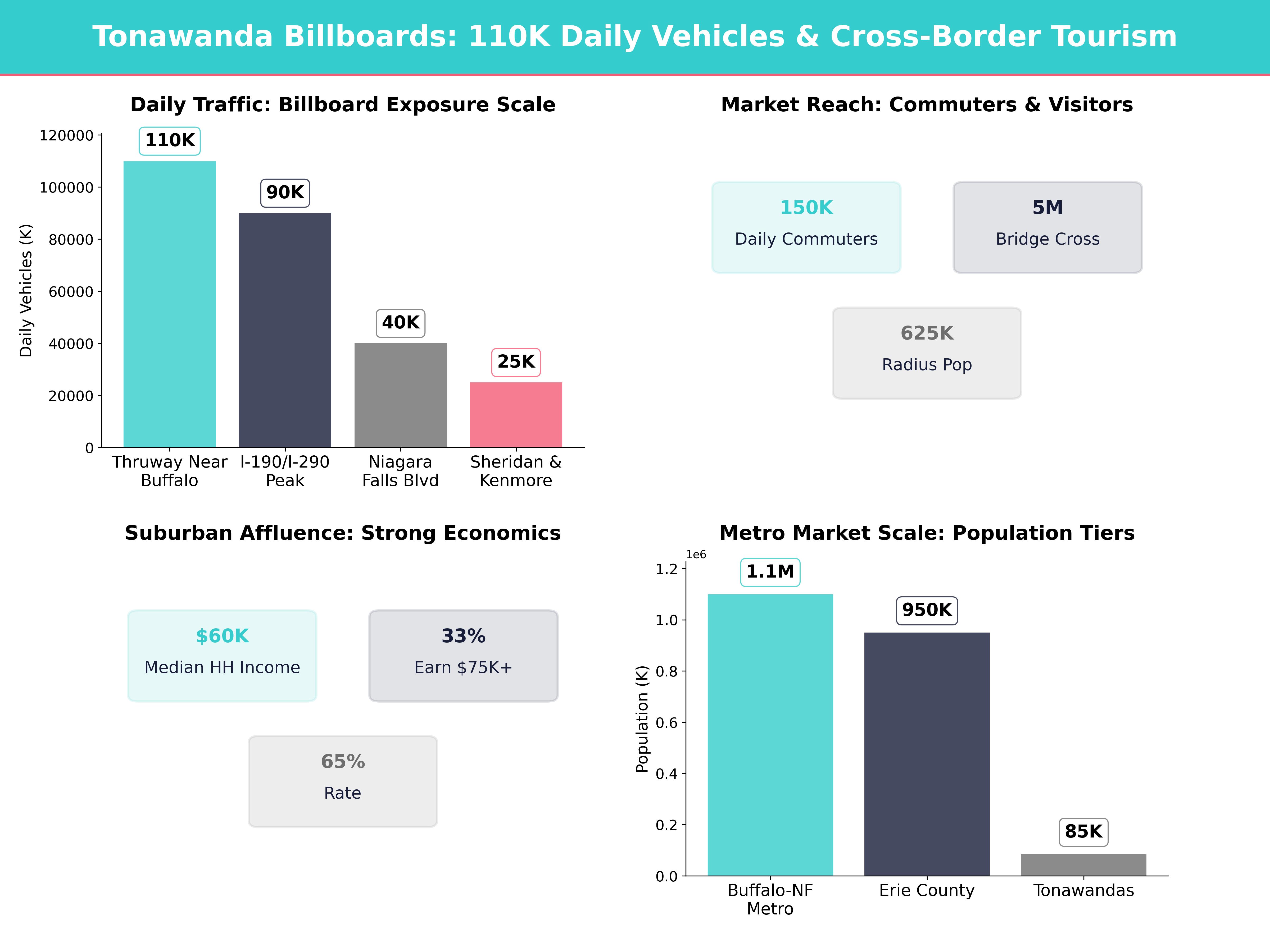
Erie County as a whole has about 950,000 residents, and the wider Buffalo–Niagara Falls metro is home to over 1.1 million people, giving campaigns near Tonawanda broad regional reach and frequency. For advertisers, this means a billboard campaign near Tonawanda doesn’t just speak to local residents, it also intercepts the roughly 150,000+ daily commuters who live, shop, or study in Tonawanda, Buffalo, Amherst, Niagara Falls, and surrounding suburbs. Strategic billboard rental near Tonawanda lets you repeatedly reach this commuter base at predictable times and locations.
Do I need a contract to advertise with Blip near Tonawanda?
No, Blip has no long-term contracts or minimum commitments. You can start, pause, or stop your campaign at any time.
How fast can I launch a billboard campaign with Blip near Tonawanda?
You can have your campaign live in minutes. Create a free account, select your locations, set your budget, upload your design, and start running once approved.
Where can I advertise with Blip near Tonawanda?
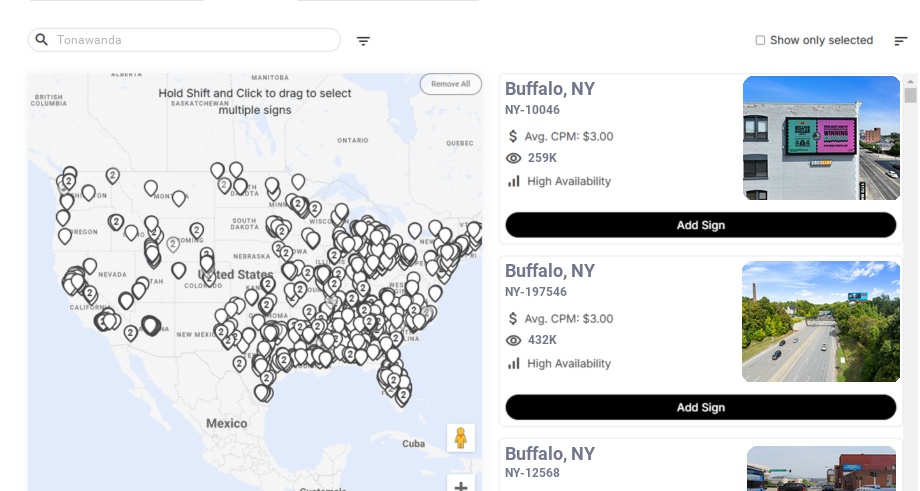
Blip has digital billboards near Tonawanda. You can browse available locations on a map, choose the ones that fit your audience, and start advertising right away.
Still have questions? Launch a campaign in minutes — no contracts, no commitments.
Start Your CampaignTonawanda Billboard Advertising Guide
Tonawanda sits at a strategic crossroads of residential neighborhoods, heavy industry, and commuter corridors between Buffalo and Niagara Falls. With five nearby digital billboards serving the Tonawanda area from Buffalo, advertisers can use Blip to tap into dense daily traffic, loyal local shoppers, and cross-border visitors moving along the Niagara River corridor. For businesses specifically searching for billboards near Tonawanda, this cluster of inventory effectively functions as a local network reaching drivers in and out of the city every day.
Understanding the Tonawanda Advertising Market
The “Tonawandas” (the City of Tonawanda and the Town of Tonawanda Erie County. Erie County as a whole has about 950,000 residents, and the wider Buffalo–Niagara Falls metro is home to over 1.1 million people, giving campaigns near Tonawanda broad regional reach and frequency. When you invest in billboard advertising near Tonawanda, you tap into this combined city, county, and metro audience on a daily basis.
Additional scale and density context:
- The Town of Tonawanda has a population density around 3,200–3,400 residents per square mile, and the City of Tonawanda around 4,000–4,200 residents per square mile, well above the national average of roughly 94 residents per square mile for all U.S. land area.
- Within a 10–12 mile radius of Tonawanda’s center, you can reach roughly 600,000–650,000 residents, including large parts of Buffalo, Amherst, Niagara Falls, and North Tonawanda
Key local context:
-
Municipal anchors
- City of Tonawanda – compact, waterfront, and walkable, with neighborhoods clustered along the Erie Canal and Niagara River.
- Town of Tonawanda
-
County and regional partners
- Erie County, NY – countywide planning, public works, and tourism support.
- Visit Buffalo Niagara – the regional tourism bureau promoting attractions, sports, and festivals that regularly push visitors through the Tonawanda–Buffalo corridor.
- Regional hub – Downtown Buffalo
- Cross-border influence – The Buffalo–Niagara region welcomes millions of visitors annually. The NEXUS and Peace Bridge corridors
For advertisers, this means a billboard campaign near Tonawanda doesn’t just speak to local residents. It also intercepts the roughly 150,000+ daily commuters who live, shop, or study in Tonawanda, Buffalo, Amherst, Niagara Falls, and surrounding suburbs and move through the same interstate and arterial routes day after day. Strategic billboard rental near Tonawanda lets you repeatedly reach this commuter base at predictable times and locations.
Who You’re Reaching in the Tonawanda Area
We should design campaigns around the people most likely to see our boards serving the Tonawanda area: commuters, industrial workers, local families, and students. When planning billboards near Tonawanda, think in terms of these core groups and how often they pass your message.
Demographic highlights (City + Town area, recent estimates):
-
Population mix
- Median age in the Tonawanda area typically runs in the 42–45 range, several years older than the U.S. median of about 38, signaling a strong base of established households.
- Household sizes average around 2.2–2.4 people, with a large share of one- and two-person households and a solid base of homeowners (often 60–70% of occupied housing units).
- The population skews slightly older than nearby Buffalo, with roughly 18–20% of residents age 65+, supporting products and services for retirees and caregivers.
-
Income & spending
- Median household income typically falls in the $55,000–$65,000 range for the combined City + Town area, with many neighborhoods in the Town of Tonawanda reaching the upper end of that range.
- Around 30–35% of households earn $75,000+, giving advertisers a healthy middle-income and upper-middle-income audience for autos, home improvement, and healthcare.
- Residents spend heavily on essentials: regional consumer expenditure profiles suggest 35–40% of household budgets go to housing and utilities, 12–15% to transportation, and 10–13% to food away from home and local entertainment—key billboard categories.
-
Education & students
- The Kenmore–Town of Tonawanda School District serves about 6,800–7,000 students across multiple elementary, middle, and high schools, plus specialty programs.
- The nearby University at Buffalo (North Campus, just east of Tonawanda) enrolls roughly 32,000 students (about 21,000 undergraduates and 11,000 graduate and professional students), many of whom commute through corridors served by Buffalo billboards.
- Other nearby higher-ed institutions—including Buffalo State University, Canisius University, and Niagara University—add another 15,000–20,000 students within easy driving distance of the Tonawanda area.
Workforce context:
- The GM Tonawanda Engine Plant employs roughly 1,000–1,400 workers on multiple shifts, drawing employees from across Erie and Niagara Counties and pushing steady traffic along River Road and I‑190.
- Industrial and logistics employers along River Road, in the Sheridan Drive corridor, and in nearby Buffalo industrial parks support thousands of additional jobs in manufacturing, warehousing, and distribution.
- Healthcare, education, retail, and public sector jobs in Buffalo and Amherst bring Tonawanda residents past our Buffalo-based boards every weekday. In Erie and Niagara Counties combined, healthcare and education account for roughly 20–25% of all jobs, with professional services, retail, and hospitality adding another 30–35%.
- Regional labor data indicate that around 75–80% of workers in the area commute by car, truck, or van, and average commute times of 20–25 minutes mean repeated daily exposure to the same billboard inventory.
This mix favors campaigns for:
- Automotive (dealers, repair, tire shops)
- Home services (roofing, HVAC, lawn care, remodeling)
- Healthcare (clinics, dentists, urgent care, eye care)
- Education and training (local colleges, trade schools, certificate programs)
- Quick-service restaurants and coffee near commuter corridors
Traffic Patterns and How to Time Your Campaign
The Tonawanda area is knitted together by major corridors that channel drivers past Buffalo’s digital billboards. We can use Blip’s scheduling tools to align bids with these flows so your Tonawanda billboards appear when and where they matter most.
Key corridors influencing billboard exposure:
- I‑190 & I‑290:
These interstates move traffic between Niagara Falls, Tonawanda, and Buffalo, with Average Annual Daily Traffic (AADT) commonly in the 60,000–90,000 vehicles per day range on key segments. On the busiest stretches near the I‑290/I‑190 interchange, volumes can exceed 100,000 vehicles per day in peak months, according to recent New York State Department of Transportation traffic counts. Billboard advertising near Tonawanda that targets these drivers can quickly build regional frequency. - I‑90 (NYS Thruway) and the I‑290 interchange:
Carries a mix of long-distance and freight traffic and daily commuters from the northern and eastern suburbs. Thruway traffic near Buffalo regularly surpasses 110,000 vehicles per day, with heavy truck traffic providing consistent exposure for B2B and industrial advertisers, per the New York State Thruway Authority. - Niagara Falls Boulevard (US‑62) and Delaware Avenue:
Major commercial routes connecting the Town of Tonawanda, Amherst, and Buffalo retail nodes, including the Boulevard Mall and surrounding plazas. Segments of Niagara Falls Blvd near the mall often see 30,000–40,000 vehicles per day, ideal for messages promoting retail, dining, and automotive. - Sheridan Drive & Kenmore Avenue:
Dense with residential and commercial activity, feeding into Buffalo-bound routes. These arterials generally carry 15,000–25,000 vehicles per day, at speeds that make QR codes and more detailed offers feasible on boards nearby.
Daily and weekly patterns:
- Weekday peak-period volumes on these corridors can be 30–40% higher than mid-day off-peak traffic.
- Friday evening and Saturday mid-day hours often see 10–20% more traffic on shopping corridors like Niagara Falls Blvd compared with typical weekdays, making weekends valuable for retail and entertainment campaigns.
Dayparting strategy recommendations:
Using these patterns, we can structure Blip campaigns to buy impressions when they matter most:
-
Weekday morning commute (6:30–9:30 a.m.):
- Targets: Tonawanda residents heading to jobs and schools in Buffalo, Amherst, and Niagara County—potentially 30,000–40,000 vehicles moving south and east across the main interstates and arterials in these windows.
- Best for: Coffee, breakfast spots, transit and parking services, healthcare reminders (“Get your flu shot today”), live events happening that evening.
-
Weekday afternoon and evening (3:00–7:30 p.m.):
- Targets: Commuters returning to the Tonawanda area, families planning dinner, errands, and activities; evening commute volumes can match or exceed the morning peak.
- Best for: Grocery and restaurant offers, gyms, home services, family entertainment, after-work events.
-
Late evening (8:00–11:00 p.m., especially Thu–Sat):
- Targets: Diners, nightlife, entertainment-goers splitting time between Buffalo and the Tonawanda area. Regional entertainment venues often see 25–35% of weekly attendance concentrated Thu–Sat evenings.
- Best for: Bars, live music, casinos, movie theaters, bowling alleys, late-night food.
-
Weekends (10:00 a.m.–6:00 p.m.):
- Targets: Shoppers and families making regional trips, including Canadian visitors and tourists exploring the waterfront and nearby attractions promoted by Visit Buffalo Niagara.
- Best for: Retail sales events, tourist attractions, festivals, real estate open houses.
Because Blip allows us to adjust budgets and schedules as we go, we can ramp up spending during peak commuting hours and tone it down during lower-traffic periods. Many advertisers find that concentrating 60–70% of impressions into peak drive times can improve cost-per-response while still maintaining off-peak presence for awareness.
Seasonal Opportunities in the Tonawanda Area
Tonawanda’s economy and traffic patterns change significantly with the seasons. We can plan campaigns around these shifts to stay relevant and visible and to get more from your billboard rental near Tonawanda throughout the year.
Winter (December–March)
- The Buffalo–Niagara region often records 80–100+ inches of snow in a season, and late-afternoon sunsets (before 5:00 p.m. in December and January) mean more visibility for bright digital boards during commutes.
- Winter driving conditions can slow freeway speeds to 30–45 mph, increasing dwell time and legibility for digital creatives.
-
Focus on:
- Snow removal, auto repair, tire shops, and heating services—categories that can see 20–30% of annual revenue in winter months.
- Holiday retail and New Year promotions for gyms and wellness; many fitness centers see membership inquiries spike 30–50% in early January.
- School closings and event updates near the Tonawanda area, which can be paired with time-sensitive creatives and synchronized with alerts from outlets like WGRZ and WIVB
Spring (April–June)
- Road construction season ramps up as temperatures rise. New York State and local governments typically schedule a large share of paving and bridge work between April and October, altering commute patterns and increasing travel times on certain routes by 10–25%.
- Home improvement and garden centers nationwide often generate 30–40% of annual sales in the spring quarter.
-
Focus on:
- Home improvement, landscaping, roofing, and exterior services—ideal for homeowners in the Tonawanda area preparing for summer who regularly pass Tonawanda billboards on their daily drives.
- Spring sports, youth programs, and recreation marketing tied to local parks and facilities promoted by Erie County and the Town of Tonawanda
- College enrollment pushes and trade-school campaigns targeting local grads and parents as graduation season approaches.
Summer (July–August)
- Signature regional events, including the Canal Fest of the Tonawandas, dramatically increase foot and vehicle traffic. Canal Fest has historically drawn 100,000+ visitors over its run in strong years, concentrating activity along the riverfront and nearby streets. Learn more and align messages with the official Canal Fest of the Tonawandas schedule.
- The broader Buffalo–Niagara region hosts dozens of festivals and waterfront events each summer, and Visit Buffalo Niagara regularly highlights activities that attract local families and tourists alike.
- Hotel occupancy across the metro area often peaks in July–August, with summer months accounting for 30–35% of annual leisure visitor nights.
-
Focus on:
- Festivals and entertainment tied to Canal Fest and riverfront activities; check local calendars from the City of Tonawanda and Town of Tonawanda
- Ice cream shops, patios, amusement parks, boat rentals, and outdoor attractions.
- Back‑to‑school promotions beginning in late July and August, when families ramp up spending on apparel, tech, and school supplies.
Fall (September–November)
- Routines normalize around school and work; commuting becomes highly predictable again. School-year travel patterns can add 10–15 minutes to certain morning runs as buses and parent drop-offs increase congestion.
- Healthcare providers often see flu-shot and wellness checkups rise sharply from September through November, with some clinics administering 40–50% of their annual flu vaccinations in this window.
- Retailers begin holiday push planning; national data show that 40%+ of consumers start holiday shopping before November.
-
Focus on:
- Education, tutoring, and after-school programs coordinated with the Kenmore–Town of Tonawanda School District calendar.
- Healthcare (flu shots, checkups), insurance, and financial planning.
- Retail and service offers targeting homeowners before winter (roofing checks, furnace tune-ups, insulation).
With Blip, we can set different creatives for each season and schedule them to go live or pause automatically, instead of rebooking an entire static campaign. Advertisers often see higher engagement when they update creative at least 3–4 times per year to match these seasonal shifts.
Creative Strategies That Work Near Tonawanda
Drivers moving between Tonawanda and Buffalo typically have only a few seconds to absorb a message. Our creatives should respect that reality so every impression from billboard advertising near Tonawanda has the best chance to be remembered.
Design for fast comprehension
- Word count: Aim for 7 words or fewer on the main message whenever possible; studies of outdoor recall consistently show sharp drop-offs beyond 10–12 words.
- Font size: Use large, high-contrast fonts. Drivers on I‑190 or I‑290 often travel 55–65 mph, leaving roughly 3–6 seconds of viewing time at typical billboard distances.
- Contrast: Bright, bold colors stand out particularly well against gray winter skies and nighttime backgrounds, which can account for 50%+ of viewing time in mid-winter.
- Branding: Place your logo or name large and high-contrast; avoid tiny tags in corners. For awareness campaigns, ensure your brand occupies at least 15–20% of the creative area.
Use local cues to “prove” you’re nearby
Residents in the Tonawanda area respond well to hyperlocal references. Consider:
- Mentioning well-known corridors: “Near Niagara Falls Blvd & Sheridan” or “Minutes from the Tonawanda area riverfront.”
- Referencing local traditions: “Before Canal Fest… stop by for dinner” (scheduled to run in the weeks leading up to and during the event).
- Highlighting proximity: “5 minutes from the Tonawanda area” or “One exit from I‑290.”
- Citing nearby landmarks promoted by Visit Buffalo Niagara or local municipalities, such as “by the canal,” “near the river,” or “between Kenmore & Tonawanda.”
Example concepts tailored to the market
-
Home services
- “Roof Ready for Lake-Effect Snow? Call [Brand].”
- “Tonawanda Area Siding & Windows – Book Before Winter.”
-
Automotive
- “Check Engine Light On? Exit in Buffalo, Save in Tonawanda Area.”
- “New Tires Before Snow Hits the Tonawanda Area – [Dealer Name].”
-
Healthcare
- “Flu Shots Today – Walk In, Be Home by Dinner.”
- “New Dentist Serving the Tonawanda Area – Accepting Patients.”
We can run A/B tests by rotating two creatives (for example, one price-focused and one benefit-focused) and tracking which coincides with stronger web traffic or calls. Many advertisers aim for at least 50,000–100,000 impressions per creative variant before judging performance to ensure statistically meaningful results.
Aligning With Local Media and News Cycles
To maximize impact, we can coordinate billboard messaging with what local audiences are already seeing and hearing.
Key outlets to watch:
- The Buffalo News – regional news and sports that shape daily conversation.
- WGRZ (Channel 2), WKBW (Channel 7), and WIVB (Channel 4)
- Local government updates from the Town of Tonawanda City of Tonawanda – for infrastructure, events, and public notices.
- Regional event and tourism calendars from Visit Buffalo Niagara and Erie County – for festivals, sports, and cultural programming.
Strategies:
- Weather-triggered themes: When storms, cold snaps, or heat waves dominate the news, we can emphasize relevant offers (heating repairs, snow tires, emergency plumbing). In particularly harsh weeks, inbound calls for service businesses can jump 20–40%, so pairing demand surges with clear billboard messaging matters.
- Sports tie-ins: Buffalo Bills and Sabres seasons create high emotional engagement. TV ratings for key Bills games regularly rank in the top of all U.S. markets on a per-capita basis. Legally safe, non-trademarked references like “Score Big Tonight” or “Game Day Specials” timed around games can resonate while staying compliant.
- Public works & detours: If a major route near Tonawanda is under construction, use messaging like “Avoid the Backup – Order Online Tonight” or “Use Our Niagara Falls Blvd Entrance.” Even minor detours can divert 5–15% of daily traffic onto alternate routes, creating short-term opportunities near specific boards.
Because Blip allows near-real-time updates, we can adjust campaigns as local stories and conditions change—sometimes within hours—rather than being locked into one static message for months.
Using Blip’s Flexibility for Tonawanda-Area Goals
The five digital billboards serving the Tonawanda area from Buffalo give us the ability to dial targeting and budgets up or down based on our specific objectives. Whether you are testing billboard rental near Tonawanda for the first time or scaling an existing media mix, this flexibility is key.
Objective: Drive foot traffic from commuters
-
Focus on time blocks:
- 7:00–9:00 a.m. and 4:00–7:00 p.m., Monday–Friday, which together can account for 50–60% of weekday traffic on many routes.
-
Run location-focused creatives:
- “On Your Way Home to the Tonawanda Area? Dinner at [Restaurant], Exit [X].”
-
Monitor:
- Register receipts by ZIP code, mobile check-ins, or “How did you hear about us?” prompts. Even a 5–10% lift in transactions from target ZIPs during the campaign window is a useful success indicator.
Objective: Build brand awareness for a service-area business
- Run lighter but consistent coverage throughout the day, 7 days a week—often 10–14 hours per day of periodic impressions.
-
Rotate 2–3 creatives:
- Brand awareness, testimonial/award, and limited-time offer.
-
Use a long campaign horizon:
- 8–12 weeks lets repetition work, especially in a market where many residents drive the same routes daily. Outdoor industry benchmarks suggest that 8+ exposures per person per month significantly improve brand recall.
Objective: Promote a limited-time event or sale
- Concentrate impressions in the 7–14 days leading up to the event.
-
Increase share of voice during:
- Evenings and weekends, when people make discretionary plans; for many retail categories, 60–70% of weekly sales occur Friday–Sunday.
-
Include urgency:
- “This Weekend Only,” “Ends Sunday,” or “Tonight – Live on the Waterfront.”
Blip’s budget controls allow us to specify a maximum daily spend and campaign dates so we can protect overall media budgets while saturating key windows. Many small and mid-size advertisers start with daily caps in the $20–$100 range and then scale up once they see measurable response.
Measuring Success in the Tonawanda Area
We should define success before a campaign starts. In a commuter-driven market like the Tonawanda area, multiple metrics work well and can help you understand which billboards near Tonawanda perform best for your goals:
-
Web analytics:
- Track direct and brand-search traffic during campaign periods; a 10–30% lift in direct or branded search while billboards are running is common for effective campaigns.
- Use vanity URLs (e.g., “BrandName.com/Tonawanda”) or QR codes on creative aimed at lower-speed roads like Sheridan Drive or Delaware Avenue.
-
Call and lead tracking:
- Dedicated phone numbers or extensions for billboard offers.
- “Mention this ad for…” codes to attribute redemptions. Response rates of 0.1–0.5% of exposed audience can be very strong for higher-ticket services like autos or home improvement.
-
In-store data:
- ZIP code capture at checkout can reveal lifts in customers from Tonawanda, Kenmore, or North Buffalo.
- Short surveys (“Did you see our billboard near Buffalo?”) at point of sale; even if only 5–10% of customers respond, the data provides directional insight.
Pairing these measures with flight dates and dayparts helps us refine which boards, times, and messages generate the strongest response from the Tonawanda-area audience. Over 2–3 campaign cycles, this feedback loop can significantly improve return on ad spend.
Local Compliance and Community Fit
Digital billboards near the Tonawanda area operate under New York State and local ordinances. While Blip manages the technical and legal compliance of the displays, we should consider community expectations:
- Avoid content that could be perceived as overly graphic, distracting, or politically inflammatory, especially around schools and residential corridors. Family-oriented suburbs like the Tonawandas have high shares of households with children (roughly 25–30%), and community sentiment can impact brand perception.
- Be sensitive during local emergencies or tragedies; we can pause or swap creatives quickly through Blip when circumstances call for it, often within the same day.
-
When possible, support community initiatives:
- Sponsoring youth sports, local charities, or Canal Fest activities and highlighting that support on billboards can improve brand perception. Surveys of local audiences often show 60–70% of residents view community-supporting businesses more favorably.
- Checking community calendars and notices from the Town of Tonawanda City of Tonawanda, and Erie County helps ensure our messages feel aligned with local priorities and key dates.
Putting It All Together
Advertising on digital billboards serving the Tonawanda area gives us access to a stable, commuting-heavy, community-focused audience along some of western New York’s most important corridors. By:
- Understanding the demographics and routines of Tonawanda-area residents,
- Aligning creatives with seasonal and daily traffic patterns,
- Using Blip’s flexible scheduling and budgeting tools, and
- Measuring outcomes rigorously,
we can build campaigns that not only reach hundreds of thousands of impressions per month across the Buffalo–Tonawanda corridor, but also drive tangible results for local and regional businesses. For any business evaluating billboard advertising near Tonawanda, this approach turns a regional set of boards into a highly local, results-focused channel.
With just a few well-crafted creatives and a smart schedule, we can turn those daily drives near Tonawanda into consistent new customers.