Billboards in Solvay, NY
No Minimum Spend. No Long-Term Contracts. Just Results.
Trusted by Leading Brands


Billboard advertising
in Solvay has never been easier
How much is a billboard in Solvay?
Why Choose Blip for Billboard Advertising in Solvay
Blip's self-serve platform lets you launch in Solvay fast and target I-690 and west-side arterials without sales delays.
Use Blip in Solvay to daypart commuter ads for 6-9 a.m. and 3-6 p.m., reaching the Syracuse travel shed when traffic peaks.
No contracts or minimums in Solvay make it easy to test fair-season and Destiny USA traffic, then adjust your budget anytime.
Blip-optimized campaigns can auto-shift spend across Solvay, I-81, and fairgrounds routes to match your goals and budget.
Track Solvay billboard performance in real time and refine creative for college, commuter, and New York State Fair audiences.
Frequently Asked Questions About Billboard Advertising in Solvay
How much does a billboard cost in Solvay with Blip?
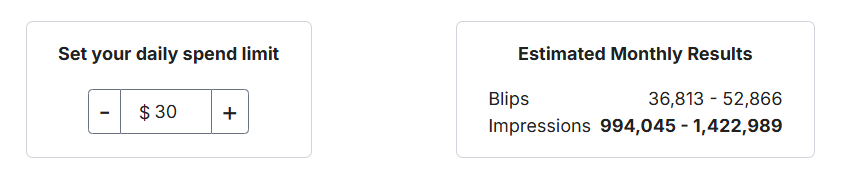
With Blip, billboard advertising in Solvay is designed to be flexible and affordable. You set a daily budget, and Blip’s algorithm uses it to bid for open ad slots on rotating digital billboards, so you only pay when your ad actually displays. Each display, called a blip, runs for about 7.5 to 10 seconds, with pricing that can start as low as $0.01 per display.
Where can I advertise with Blip in Solvay, New York?
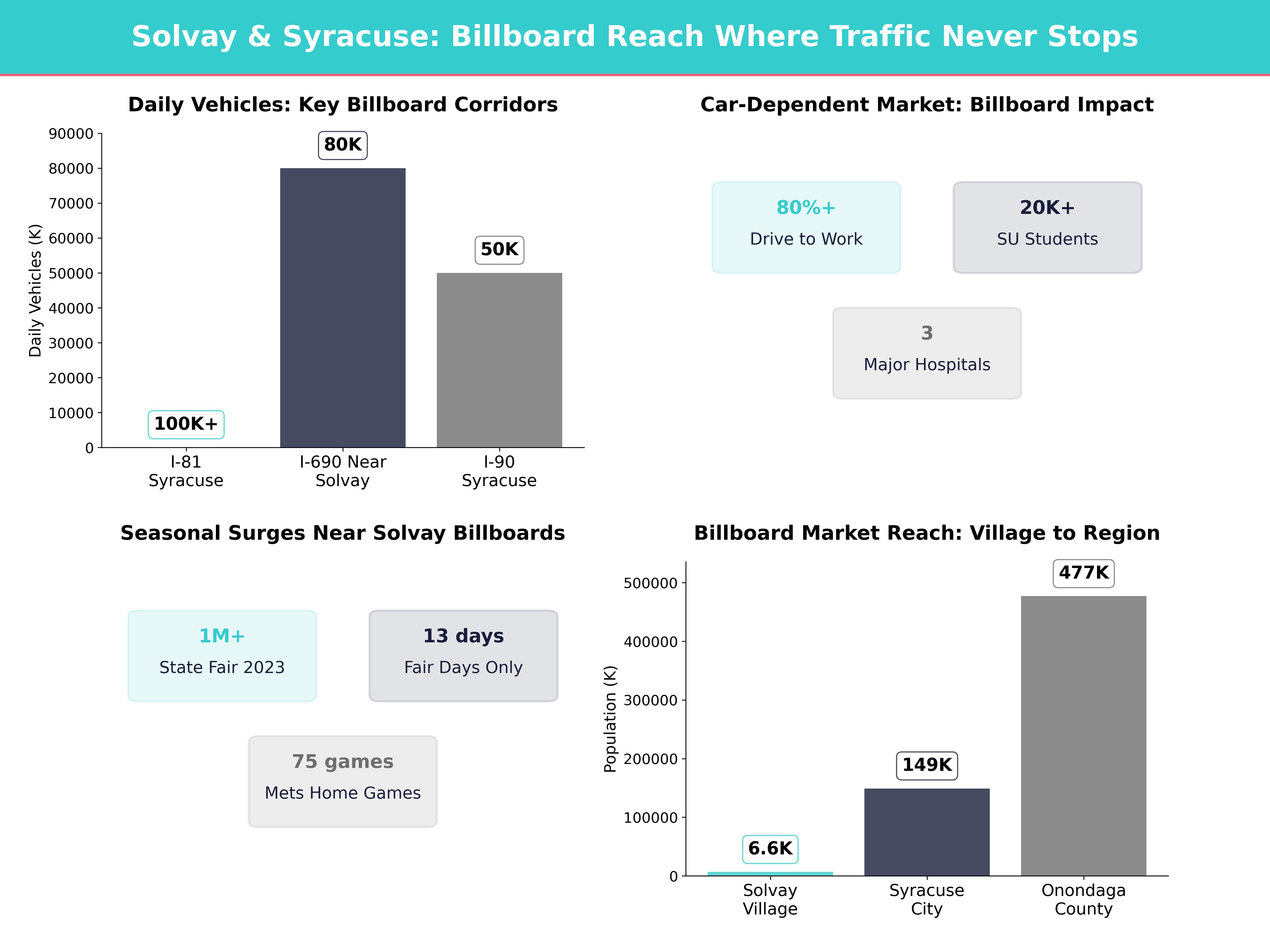
If we want broad weekday reach in Solvay, we should prioritize I-690, which is the defining corridor for Solvay and commonly carries roughly 70,000 to 90,000 vehicles per day nearby. I-81 is the strongest north-south corridor in the Syracuse area, and core Syracuse segments exceed 100,000 annual average daily vehicles. State Fair Boulevard, Route 5, West Genesee Street, and local connectors through Solvay and Geddes matter when we want neighborhood conversion instead of pure reach.
Who does Solvay, New York billboard advertising with Blip reach?
A billboard near Solvay does not only reach 6,645 village residents. It also taps into the 148,620 people in Syracuse, the 476,516 people in Onondaga County, and the steady flow of visitors using west-side highways to reach major destinations such as Destiny USA and the New York State Fair. Because more than 80% of county workers commute in personal vehicles, roadside media remains highly effective for both reach and repetition.
When is the best time to run Solvay, New York billboard ads with Blip?
Late August and early September are the biggest seasonal opportunity in this market because the Great New York State Fair creates a concentrated 13-day burst of visitation. We should start many fair-related campaigns 1 to 2 weeks before the event, not only during the event itself. Winter also matters because Syracuse typically records more than 100 inches of snow in a season, and in December sunset arrives before 5 p.m., making illuminated digital billboards especially noticeable during the late afternoon commute.
Can I start a small Blip campaign in Solvay, New York without a contract?
There are no minimums or contracts, so you can start small, adjust your budget anytime, and pause when you need to. That makes it easy to try billboard advertising in Solvay without a big upfront commitment. We can begin with a focused cluster of boards, watch the data, refine the creative, and then add surrounding corridors once we know what is resonating.
Do I need a contract to advertise with Blip in Solvay?
No, Blip has no long-term contracts or minimum commitments. You can start, pause, or stop your campaign at any time.
How fast can I launch a billboard campaign with Blip in Solvay?
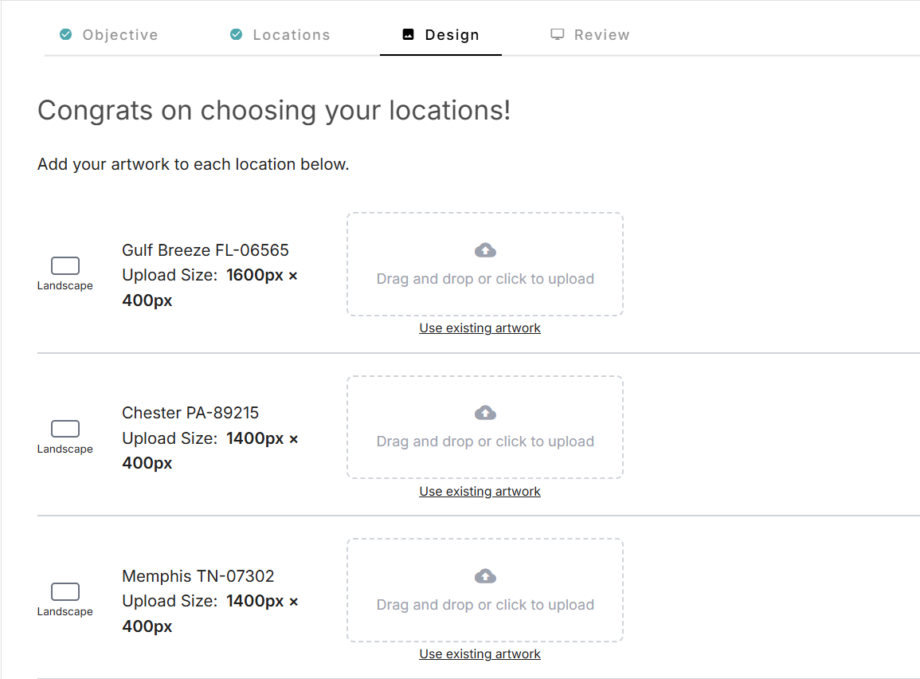
You can have your campaign live in minutes. Create a free account, select your locations, set your budget, upload your design, and start running once approved.
Where can I advertise with Blip in Solvay?
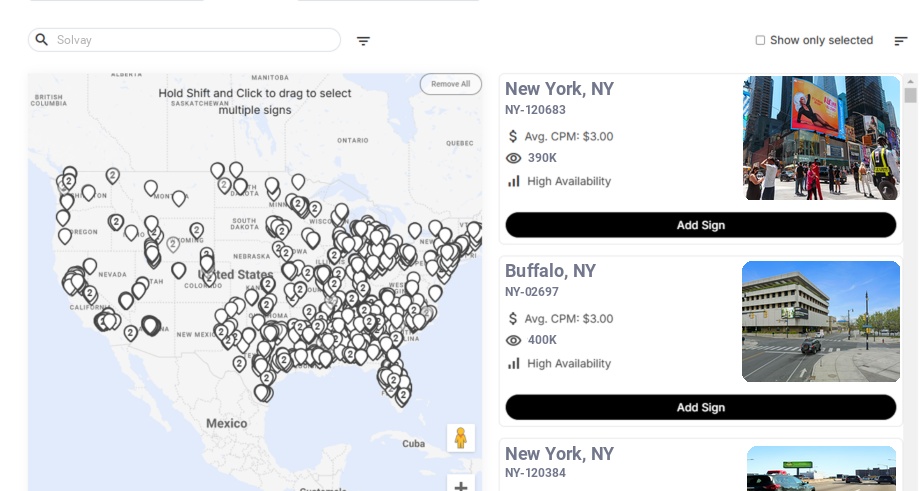
Blip has digital billboards in Solvay. You can browse available locations on a map, choose the ones that fit your audience, and start advertising right away.
Still have questions? Launch a campaign in minutes — no contracts, no commitments.
Start Your CampaignSolvay Billboard Advertising Guide
Solvay 6,645 residents at the 2020 Census, but it borders Syracuse, a city of 148,620, and sits within Onondaga County 476,516 residents. Road travel dominates daily life in Central New York, and Solvay is minutes from I-690, the New York State Thruway, downtown Syracuse, Destiny USA, which has about 2.4 million square feet of retail and entertainment space, and the New York State Fair, which drew 1,016,330 visitors in 2023. That combination gives us dependable year-round local frequency, plus major seasonal spikes from tourism, college sports, fairs, festivals, and regional shopping.
Solvay, New York Market Overview
A small village with metro-scale reach
We should think of Solvay as a west-side gateway rather than a village-only buy. The village sits beside Syracuse, the Town of Geddes, and the broader retail and employment corridors that stretch toward Camillus, downtown, and the north side. That matters because a billboard near Solvay does not only reach 6,645 village residents. It also taps into the 148,620 people in Syracuse, the 476,516 people in Onondaga County, and the steady flow of visitors using west-side highways to reach major destinations such as Destiny USA and the New York State Fair.
This is an especially useful setup for advertisers that need efficient local awareness. Restaurants, medical practices, injury law firms, home services, retail centers, colleges, entertainment venues, and employers all benefit when one campaign can touch multiple trip types in the same geography. In Solvay, those trip types include school runs, work commutes, shopping trips, fair visits, and cross-county travel.
Economic drivers and travel behavior
The local economy is broader than many advertisers assume. We have strong anchors in healthcare, higher education, retail, public employment, logistics, and manufacturing, with 3 major hospital systems and 3 colleges such as SUNY Upstate Medical University St. Joseph’s Health, Crouse Health, Syracuse University, Le Moyne College, and Onondaga Community College feeding daily movement across the metro.
For billboard planning, the most important mobility fact is simple: personal vehicles dominate commuting in Onondaga County. More than 80% of workers commute in cars, including driving alone and carpooling, even with service from Centro. That means roadside media remains highly effective for both reach and repetition. A message seen on the way to work, then again on the way home, can build familiarity quickly in a market where routines are established and recurring.
The near-term growth story is also unusually significant for Central New York. Empire State Development and Micron Technology describe the planned Clay semiconductor project as up to $100 billion in investment over 20-plus years, with nearly 9,000 direct jobs and nearly 50,000 total jobs. Even before the full project takes shape, that level of announced investment changes hiring patterns, contractor demand, housing conversations, and north-side traffic expectations. For billboard advertisers in Solvay, that means today’s west-side and central corridors can also function as early positioning plays for tomorrow’s larger regional market.
Key Traffic Corridors Around Solvay, New York
Interstate 690 and the west-to-downtown spine
According to the New York State Department of Transportation, I-690 is the defining corridor for Solvay. Nearby segments commonly carry roughly 70,000 to 90,000 vehicles per day, and volumes increase as the roadway approaches the downtown interchange complex. This is the route that ties Solvay to downtown Syracuse, the university and hospital districts, and the west-side retail and event zone.
We should prioritize I-690 when we want broad weekday reach. Consumer services, restaurants, urgent care, auto dealers, insurance brands, legal services, and major retailers all benefit here because commuters see the same message repeatedly. I-690 is also valuable for event advertising because it channels travelers headed to Destiny USA, The Great New York State Fair, NBT Bank Stadium, and downtown venues such as The Oncenter Landmark Theatre
Interstate 81 and the regional north-south flow
I-81 is the strongest north-south corridor in the Syracuse area, and core Syracuse segments exceed 100,000 annual average daily vehicles. That makes it one of the region’s most important billboard routes for top-of-funnel awareness. It connects northern suburbs, downtown, the hospital district, Syracuse University, and traffic bound for Syracuse Hancock International Airport.
Advertisers with regional ambitions should treat I-81 as a reach multiplier. Hospitals, colleges, employers, apartment communities, financial institutions, and entertainment brands can all use it effectively. If our goal is to reach residents across multiple submarkets rather than only the west side, I-81 should usually be in the mix.
Interstate 90, Route 695, and west-side decision points
The New York State Thruway Authority reports that I-90 near Syracuse commonly operates in the 40,000 to 60,000 AADT range, depending on segment. That traffic includes long-distance travelers, regional business visitors, truck traffic, and motorists deciding where to stop, eat, shop, or stay. For hotels, attractions, casinos, regional healthcare systems, and business services, Thruway-adjacent digital boards can intercept travelers before they commit to an exit.
Route 695, also known as Veterans Memorial Highway, is smaller but still important. NYSDOT counts place it above 20,000 vehicles per day on key segments, and it functions as a connector between I-90, I-690, and the fairgrounds area. We should use this corridor when we want to catch drivers in decision mode, especially for hospitality, quick-service dining, fuel and convenience, and local attractions.
State Fair Boulevard, Route 5, and local west-side arterials
Not every effective Solvay campaign needs interstate scale. State Fair Boulevard, Route 5, West Genesee Street, and local connectors through Solvay and Geddes matter when we want neighborhood conversion instead of pure reach. These roads feed the fairgrounds, west-side retail, residential districts, and commuting routes toward downtown.
Local arterials are especially useful for advertisers whose customers convert close to home. Home improvement companies, dentists, pharmacies, fitness centers, small retailers, and community banks often perform better when we choose boards tied to familiar local roads rather than only the biggest highway. In Solvay, that is important because west-side residents often make repeat trips within the same few miles, which increases message frequency and recall.
Audience Segments We Can Reach in Solvay, New York
Daily commuters and local households
The core Solvay audience is still the everyday Central New York driver. Because more than 80% of county workers commute in personal vehicles, we can reach people on predictable daily patterns. That is ideal for brands that need repetition rather than one-time exposure.
This segment includes office workers headed downtown, trade workers moving between job sites, healthcare employees traveling to major campuses, and suburban families handling school, errands, and shopping. We should consider these drivers the foundation of most Solvay campaigns because they create consistent weekday impressions all year.
Students, faculty, and campus visitors
Higher education meaningfully expands the audience beyond permanent residents. Syracuse University enrolls more than 20,000 students, and Le Moyne College adds more than 3,000 more. Onondaga Community College adds another large student population on the southwest side of the county, creating regular movement between campuses, apartments, downtown, and retail areas.
This audience is important for apartment marketing, telecom, banking, food and beverage, entertainment, healthcare, tutoring, and recruiting. We should also remember that student travel is not limited to class days. Move-in periods, parents’ weekends, graduation, and game days all bring additional visitors onto local roads.
Shoppers, tourists, and event audiences
Solvay benefits from several high-profile destinations clustered nearby. Destiny USA contains about 2.4 million square feet of retail and entertainment space, which makes it a major traffic generator for the west side. The New York State Fairgrounds span roughly 375 acres, and the annual fair runs for 13 days. In 2023, fair attendance reached a record 1,016,330 visitors.
Those are billboard-friendly conditions. Retailers, restaurants, family attractions, hotels, rideshare and parking services, entertainment brands, and public-awareness campaigns can all leverage the west-side event corridor. We can also extend the reach of those campaigns by referencing nearby destinations such as Rosamond Gifford Zoo, Onondaga Lake Park The Oncenter Everson Museum of Art, and the Erie Canal Museum
Healthcare, logistics, and industrial workers
Another important Solvay audience is the working population tied to healthcare, warehousing, transportation, and manufacturing. The Syracuse core includes three major hospital systems, namely SUNY Upstate Medical University St. Joseph’s Health, and Crouse Health, within a compact travel area. West-side and north-side roads also serve logistics and industrial trips, especially as businesses prepare for the long-term impact of Micron’s planned investment.
For advertisers, this segment responds well to practical offers. Hiring campaigns, trade schools, workwear, credit unions, auto services, quick meals, pharmacies, and injury law often fit especially well. If our objective is recruitment, west-side and north-side route selection can be more important than downtown prestige.
Seasonal and Timing Opportunities in Solvay, New York
Late summer around the Solvay, New York fair corridor
Late August and early September are the biggest seasonal opportunity in this market. The Great New York State Fair creates a concentrated 13-day burst of visitation, and the 1,016,330 attendance figure from 2023 shows the scale. Traffic builds before opening day as vendors, staff, and early visitors move into the area, and it remains elevated during teardown and post-fair travel.
We should start many fair-related campaigns 1 to 2 weeks before the event, not only during the event itself. That approach works for hotels, entertainment venues, restaurants, rideshare services, retail promotions, and local attractions trying to catch visitors extending their stay in Syracuse. It also works for regional awareness campaigns that want high-volume impressions while out-of-town traffic is elevated.
Fall college return and sports traffic in Solvay, New York
The fall semester brings a second major advertising window. Syracuse University move-in, returning students, football weekends, and downtown activity all lift traffic across the metro. Syracuse football typically brings 6 or 7 home games in a season, and each one creates a useful mix of alumni, parents, students, and casual fans.
This is when we should emphasize restaurants, bars, apartments, banks, telecom, apparel, urgent care, and entertainment. Game-day messaging can be especially effective on routes feeding downtown and the university district. We can also use west-side boards to catch fans heading toward pregame plans, shopping stops, or postgame entertainment.
Winter visibility and holiday spending in Solvay, New York
Winter changes how drivers experience the market. Syracuse is famous for lake-effect weather and typically records more than 100 inches of snow in a season, averaging about 127 inches annually. In December, sunset arrives before 5 p.m., which means illuminated digital billboards become even more noticeable during the late afternoon commute.
We should lean into high-contrast creative and heavier evening dayparts during winter. Holiday retail, healthcare, automotive repair, heating services, and indoor entertainment all benefit from this pattern. Weather can also slow traffic on some days, which increases dwell time and gives short messages more opportunity to register.
Spring and summer family activity in Solvay, New York
After winter, the market shifts back toward recreation and family outings. The Syracuse Mets play 75 regular-season home games at NBT Bank Stadium, and warm-weather travel lifts attendance at the zoo, parks, downtown events, and shopping centers. Spring also brings graduation-related traffic from local colleges, while summer brings festivals, weddings, and day trips throughout the county.
For timing, we should think beyond only rush hour in these months. Midday, early evening, and weekend placements often become more valuable when families are traveling for recreation instead of commuting to work. Campaigns for attractions, restaurants, family entertainment, and community events usually perform best when we adapt to that seasonal shift.
Billboard Design Tips for the Solvay, New York Market
Creative that fits Central New York conditions
Design in Solvay should reflect Central New York’s weather, driving habits, and local identity. Because this market deals with snowbanks, gray skies, early winter darkness, and fast-moving interstate traffic, we should favor strong contrast, bold typography, and simple layouts. Dark blues, saturated reds, bright whites, and warm orange accents tend to hold up better than pale or low-contrast palettes in this environment.
Local relevance also matters. Creative that references the fairgrounds, the west side, downtown Syracuse, college sports energy, or family-friendly destinations often feels more immediate than generic regional messaging. We do not need to overdo local slang, but we should sound like we understand how people actually move around the area.
Messaging that matches local purchase behavior
In Solvay, practical offers often outperform abstract brand language. Residents and commuters respond well when we make the next step obvious and local.
- For home services, we should use direct, trust-building copy that emphasizes speed, reliability, or emergency help, because many conversions come from nearby households making quick decisions.
- For retail and restaurants, we should use destination cues such as “near the Fairgrounds,” “west side,” or “minutes from downtown,” because local geography helps drivers decide quickly.
- For hiring campaigns, we should mention shifts, pay, benefits, or location clarity, including language such as “1st shift,” “2nd shift,” or “west-side location,” because industrial and service workers often respond to specificity.
- For event promotion, we should tie the message to the season, including fairs, football weekends, holiday outings, or summer family activities, because timing is a major part of local relevance.
We should also remember that drivers here often see the same board repeatedly. That makes consistency useful. A clean message shown for 2 to 4 weeks can build strong familiarity in a market with repeat commuting patterns.
Regional Strategies Around Solvay, New York
Solvay, Geddes, and the west-side commuter belt
This is the right strategy zone when our goal is practical local conversion. West-side boards are strong for home services, grocery, casual dining, urgent care, auto repair, storage, and value retail. They work because they align with the rhythms of local residents rather than only regional pass-through traffic.
We should especially prioritize this submarket when the business serves customers within a short drive, such as a clinic, contractor, or neighborhood retailer. Frequency matters more than broad countywide prestige in these cases.
Downtown Syracuse and University Hill
Downtown and the university-hospital district deserve a different strategy. This area is denser, more event-driven, and more mixed in audience composition. We can reach professionals, students, patients, visitors, convention attendees, and sports fans in a relatively compact footprint.
This is usually the best zone for law firms, hospitals, apartments, entertainment venues, financial services, nightlife, colleges, and regional employers. If our campaign needs a more urban, high-activity feel, downtown and University Hill placements can complement west-side boards very well.
North-side growth corridors tied to Solvay, New York reach
The north side, including airport access and the Clay-Liverpool direction of travel, is increasingly important because of long-term business expansion. The Syracuse Hancock International Airport, warehouse and distribution traffic, and Micron-related interest make these roads valuable for B2B services, staffing, hospitality, real estate, and recruiting.
For Solvay-based campaigns, north-side placements often make sense when we want to extend beyond the immediate west side without going fully countywide. This is where we can connect today’s commute patterns with tomorrow’s growth story.
Countywide campaigns that blend local and regional intent
Some advertisers should not choose only one zone. A multi-area approach often works best when we need both repetition and scale. For example, a healthcare system might combine west-side commuter boards with downtown boards, while a destination retailer might pair Solvay-area boards with Thruway and I-81 coverage.
That strategy is especially effective in Onondaga County because major destinations are close enough to overlap. A resident might commute past Solvay, shop near Destiny, attend an event downtown, and visit a college campus in the same week. Billboards work well here because the same people circulate through multiple high-value corridors.
Using Blip Tools in Solvay, New York
When we want precise Solvay, New York placement control
Manual selection is useful when the route itself is the strategy. If we specifically want boards near I-690, the fairgrounds, or west-side arterials, we can hand-pick those locations and concentrate spend where local decision-making happens. That approach is ideal for store openings, event promotions, neighborhood services, and fair-season campaigns.
Dayparting also matters in this market. We should often weight commuter messaging toward 6 to 9 a.m. and 3 to 6 p.m., while retail and entertainment messaging may perform better later in the day or on weekends.
When we want efficient regional coverage in Solvay, New York
Blip-optimized campaigns make sense when we want the platform to spread budget across multiple audience pockets, such as Solvay, downtown Syracuse, and north-side approaches. That is especially helpful for advertisers who know their target audience but do not want to manually map every corridor.
This can be an efficient way to test whether our best response comes from commuter boards, event boards, or broader regional reach. Because each digital display lasts 7.5 to 10 seconds, creative clarity still matters, but the optimization engine can help us find the right mix of boards and times.
How we should test, learn, and scale in Solvay, New York
Solvay is a strong market for structured testing because audiences overlap but contexts differ. We can run one message for west-side commuters, a second for downtown eventgoers, and a third for student-heavy routes, then compare the results in real time.
A few practical ways to use Blip well here include the following.
- We can launch with a modest budget because digital billboard buying on Blip starts at $0.01 per display, which makes localized testing realistic.
- We can rotate creative by season, including fair creative in late summer, hiring creative in fall, and weather-driven service messaging in winter.
- We can use artwork tools to build several local variants quickly, which is helpful when we want one campaign to reference the fairgrounds, downtown, or the west side without redesigning from scratch.
Getting Started with Billboard Rental in Solvay, New York
Start with the goal, then match Solvay, New York routes to it
The simplest way to start is to define what we actually need the campaign to do. If the goal is awareness, we should usually begin with I-690, I-81, or a mix of both. If the goal is foot traffic for a west-side business, local arterials and Solvay-area commuter boards may be more useful than the region’s biggest highway board. If the goal is event attendance, we should focus on fairgrounds, downtown, and entertainment travel patterns.
This step matters because Solvay can support very different billboard strategies. The same geography can work for a neighborhood contractor, a countywide hospital system, or a regional tourism brand, but not with the same board mix.
Evaluate each billboard by context, not only by map pin
When we review locations, we should ask a few practical questions before we rent anything.
- We should confirm whether the board faces inbound or outbound traffic, because direction can matter as much as raw volume.
- We should check what destination the driver is approaching, because a board seen before a retail exit behaves differently from one seen after the destination has passed.
- We should think about trip purpose, because weekday commuters, weekend fair visitors, and college traffic do not respond to the same message.
- We should consider repetition, because some lower-speed local boards can outperform a larger highway board when our business depends on nearby households.
Launch small, learn fast, and expand in Solvay, New York
Traditional billboard buying often feels slow, sales-driven, and inflexible. A self-serve digital approach is easier for this market because Solvay advertisers often need to move with the calendar, whether that means fair season, football weekends, hiring pushes, winter weather, or a retail promotion. We can start small, adjust quickly, and expand once we see which routes and times match our goals.
In practical terms, that means we do not need to overcommit on day one. We can begin with a focused cluster of boards, watch the data, refine the creative, and then add surrounding corridors once we know what is resonating. In a market like Solvay, where local traffic and regional traffic overlap so often, that flexibility is a meaningful advantage.