Billboards in Palmyra, NY
No Minimum Spend. No Long-Term Contracts. Just Results.
Trusted by Leading Brands


Billboard advertising
in Palmyra has never been easier



How much is a billboard in Palmyra?
Why Choose Blip for Billboard Advertising in Palmyra
Blip’s self-serve setup lets Palmyra brands launch fast on NY 31, NY 21, or near Exit 43 without a sales delay.
Set flexible budgets in Palmyra and pay only when your ad plays—ideal for commuter traffic and Erie Canal season.
Daypart Palmyra ads for 6-9 a.m. and 3-6 p.m. to reach Route 31 drivers, school households, and workers on the move.
No contracts make Palmyra testing easy, so you can shift from village local reach to Thruway traveler demand anytime.
Track Palmyra campaigns in real time and move spend toward the corridors driving results, from NY 31 to NY 21.
Use Blip creative tools to build clear Palmyra ads for fair week, harvest season, and heritage visitors at Historic Palmyra.
Frequently Asked Questions About Billboard Advertising in Palmyra
How much does a billboard cost in Palmyra with Blip?
With Blip, billboard advertising in Palmyra is designed to be flexible and affordable. Each 7.5-to-10-second display, or “blip,” starts at just $0.01, and the cost can vary based on time of day, location, and advertiser demand. Your total cost is simply the sum of your individual blip costs over time, giving you control over both your spend and your reach.
Where can I advertise with Blip in Palmyra, New York?
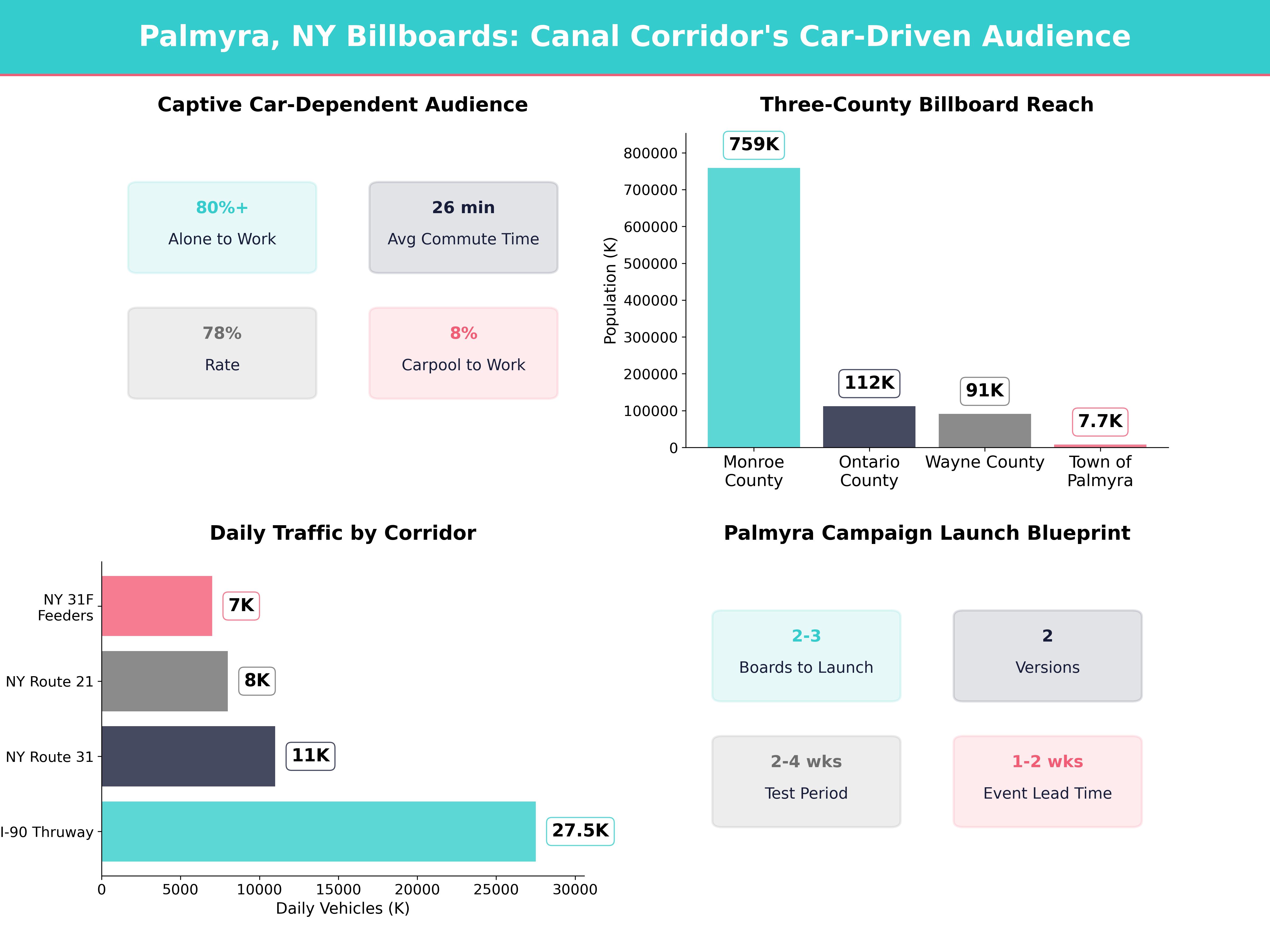
Palmyra sits on New York State Route 31, New York State Route 21, the historic Erie Canal, and a short drive from the New York State Thruway Authority corridor at Exit 43. According to recent New York State Department of Transportation traffic count maps, segments of NY 31 in and around Palmyra generally run in the 10,000 to 12,000 AADT range. Nearby Thruway segments typically land around 25,000 to 30,000 AADT, which gives advertisers access to both local and regional traffic.
What kind of people do Palmyra billboards reach?
At the local level, the Town of Palmyra has about 7,700 residents, while Wayne County has 91,283. Recent American Community Survey estimates for Wayne County show that more than 80% of workers drive alone to work, the average commute is about 26 minutes, and homeownership is near 78%. That mix creates strong reach for commuters, families, homeowners, retirees, and seasonal visitors throughout the year.
When is the best time to run Blip ads in Palmyra?
Canal navigation season usually runs from about May to October, or roughly 5 months, and that period expands the audience base with canal users, cyclists, weekend drivers, and heritage tourists. The Way County Fair and fall harvest season also create strong short-burst opportunities. In a market like Palmyra, weekday commuter windows around 6:00 to 9:00 a.m. and 3:00 to 6:00 p.m. are often more efficient than an all-day schedule when the goal is household reach.
Do I need a contract to advertise with Blip in Palmyra?
No, Blip has no long-term contracts or minimum commitments. You can start, pause, or stop your campaign at any time.
How fast can I launch a billboard campaign with Blip in Palmyra?
You can have your campaign live in minutes. Create a free account, select your locations, set your budget, upload your design, and start running once approved.
Where can I advertise with Blip in Palmyra?
Blip has digital billboards in Palmyra. You can browse available locations on a map, choose the ones that fit your audience, and start advertising right away.
Still have questions? Launch a campaign in minutes — no contracts, no commitments.
Start Your CampaignPalmyra Billboard Advertising Guide
Palmyra 7,700 town residents, a village core of roughly 3,500 people, and a broader Wayne County 91,283. We also benefit from a highly car-oriented environment, because Palmyra sits on New York State Route 31, New York State Route 21, the historic Erie Canal New York State Thruway Authority corridor at Exit 43. For advertisers, that mix creates dependable visibility with commuters, families, heritage travelers, and seasonal visitors throughout the year.
Palmyra Market Overview
Palmyra’s advertising value comes from location as much as population. We are positioned about 25 miles east of Rochester, within easy reach of Monroe County, which has about 759,000 residents, and close enough to southern Ontario County, which has about 112,000 residents, to pull traffic from multiple directions. That makes Palmyra less of an isolated rural market and more of a crossroads community inside the larger Rochester-Finger Lakes travel shed.
Demographics and household profile in Palmyra
At the local level, the Town of Palmyra 7,700 residents, while Wayne County has 91,283. Recent American Community Survey estimates for Wayne County show that more than 80% of workers drive alone to work, carpooling is around 8%, and the average commute is about 26 minutes. Wayne County also has a homeownership rate near 78%, which is important for advertisers in home improvement, banking, healthcare, insurance, lawn care, and automotive services.
We also see a balanced age mix that supports broad-reach outdoor messaging. In Wayne County, about 21% of residents are under 18, and roughly 20% are 65 or older. That means Palmyra billboard campaigns can speak to school households, established homeowners, retirees, and multigenerational families without needing radically different media plans for each group.
Economic signals that matter for Palmyra billboards
Palmyra’s economy is shaped by practical, everyday categories. We see demand from agriculture, food and beverage, manufacturing, logistics, healthcare, education, small retail, and local services. Nearby institutions such as Rochester Regional Health, Newark-Wayne Community Hospital, Palmyra-Macedon Central School District, Gananda Central School District, and Wayne-Finger Lakes BOCES help create recurring weekday travel patterns.
For billboard advertisers, this profile usually favors clear offers over abstract branding alone. We often do best in Palmyra when we promote a concrete action, such as a sale, a hiring push, a medical appointment, a grand opening, a weekend event, or a directional message tied to a nearby route or exit.
Key Traffic Corridors for Palmyra Billboards
Palmyra’s road network is compact, but it is deceptively powerful for outdoor advertising. A handful of corridors carry most of the town’s daily movement, and each one attracts a different mix of drivers.
NY 31 through Palmyra
According to recent New York State Department of Transportation traffic count maps, segments of NY 31 in and around Palmyra generally run in the 10,000 to 12,000 AADT range. This is the town’s primary east-west spine, and it connects Palmyra with nearby Macedon Newark
That matters because NY 31 is ideal for high-frequency local visibility. We should look here when the goal is repeat exposure for:
- Retail and dining, because daily commuters and errand runners use this corridor repeatedly.
- Healthcare and home services, because residents make decisions close to home and often act within the same day.
- Financial services and insurance, because frequent impressions help familiarity in slower-consideration categories.
- Auto dealers, repair shops, and tire stores, because the route naturally reaches drivers already in vehicle-minded contexts.
I-90 and Exit 43 near Manchester
Palmyra is roughly 6 miles north of Thruway Exit 43 in nearby Manchester. Traffic on I-90 in this area is much higher than on local surface roads, with nearby Thruway segments typically landing around 25,000 to 30,000 AADT, according to New York State Thruway Authority reporting and state traffic data.
This corridor gives us a very different audience than village-center Palmyra. Thruway-facing or Thruway-adjacent billboard strategies work best for:
- Hotels, attractions, and tourism operators, because travelers need quick directional cues before or just after an interchange.
- Regional healthcare providers, because specialty visits often pull patients from multiple counties.
- Colleges and training programs, because a Thruway audience covers a larger recruiting radius.
- Big-ticket retail, because furniture, powersports, flooring, and appliance buyers may travel farther for the right offer.
NY 21 through the village and south to Manchester
NY 21 is Palmyra’s main north-south connector, and local count stations typically show volumes in the 7,000 to 9,000 AADT range near the village and on approaches toward Manchester. This corridor links Palmyra to the Thruway area, southern retail trips, and local business traffic.
We usually like NY 21 for advertisers that need both local repetition and regional capture. Good fits include:
- Medical and dental practices, because patients often travel north-south across townships.
- Hiring campaigns, because workers in agriculture, warehousing, and manufacturing commonly use this route.
- Grocery, pharmacy, and convenience, because it intercepts habitual weekly travel.
- Church, nonprofit, and community events, because the road serves a deeply local audience.
NY 31F and western feeder routes toward Macedon and Gananda
To the west, NY 31F and connecting roads toward Macedon Gananda Central School District area create another useful feeder pattern. Traffic here is lighter than on Route 31, but local segments can still fall in the 6,000 to 8,000 AADT range. That is enough volume to matter when we want to narrow our targeting to westbound commuters, school households, and shoppers moving toward Monroe County job centers.
This western side is especially valuable for businesses that draw from both Palmyra and Rochester’s eastern suburbs. We should consider it for:
- Home improvement and contractors, because homeowners in this belt often compare multiple providers.
- Family entertainment and casual dining, because weekend travel is common.
- Real estate and new-home marketing, because area households are stable, vehicle-based, and attentive to location.
- Gym, wellness, and personal services, because recurring commuter exposure helps drive trial.
Palmyra Audience Segments
A good Palmyra billboard strategy starts by recognizing that this is not a one-audience market. We can reach several useful segments at once, but each segment responds best to slightly different timing and creative.
Daily commuters and regional shoppers in Palmyra
Wayne County’s drive-alone rate of 80%+ is one of the most important numbers for outdoor planning here. In a market where most workers commute by car and the average trip to work takes about 26 minutes, billboards become part of the daily routine rather than an occasional touchpoint.
These commuters are ideal for repeat-exposure categories such as banking, auto service, urgent care, wireless, quick-serve dining, and everyday retail. We should especially think about the westbound and eastbound flows on Route 31, because Palmyra sits between local needs and larger regional shopping patterns.
Families, homeowners, and household decision-makers in Palmyra
With homeownership near 78%, Palmyra is fertile ground for practical household advertising. We can reach people making decisions about roofs, windows, HVAC, gutters, landscaping, pest control, insurance, and pediatric or family healthcare. The county’s age mix also helps here, because about 21% of residents are children and roughly 20% are seniors.
That mix rewards billboard messages built around trust, convenience, and local relevance. “Serving Wayne County,” “Family-owned,” “Minutes from Palmyra,” and “Schedule today” often fit this audience better than flashy, urban-style branding.
Tourists, heritage travelers, and weekend visitors in Palmyra
Palmyra has unusual tourism depth for a town of its size. It sits on the New York State Canal Corporation 524 miles, and along the Empire State Trail, which runs 750 miles statewide. The Erie Canal corridor itself has been a travel magnet since 1825, and the Erie Canalway Trail covers roughly 360 miles.
Palmyra also has a distinctive heritage draw. The Book of Mormon was first published here in 1830, and Historic Palmyra 5 museums that help anchor village visitation. Because the Hill Cumorah Pageant ended in 2020, tourism is now less concentrated into a single blockbuster event and more spread across the broader spring-to-fall visitor season. For billboard advertisers, that creates a longer, steadier window for promoting museums, lodging, restaurants, antiques, farm markets, and day-trip destinations through Wayne County Tourism.
Students, school households, and young workers in Palmyra
Palmyra does not function like a major college town, but school-based traffic still matters. Palmyra-Macedon Central School District, Gananda Central School District, Wayne-Finger Lakes BOCES, and nearby Finger Lakes Community College help generate morning and afternoon movement, youth activities, first-job commuting, and family scheduling.
This segment is especially relevant for:
- Athletic training, tutoring, and youth programs, because parents are already moving along predictable routes.
- Fast casual dining and takeout, because after-school timing matters.
- Entry-level hiring, because younger workers respond well to short, direct job messages.
- Telecom and consumer services, because younger households are receptive to quick value-based offers.
Agricultural, manufacturing, and logistics workers around Palmyra
Wayne County’s economy has deep roots in fruit growing, packing, distribution, and light manufacturing. That gives Palmyra billboard advertisers access to early-shift workers, truck traffic, seasonal labor, and business decision-makers moving between orchards, industrial sites, and service providers.
Recruiting, equipment sales, ag services, workwear, insurance, and B2B messaging can all perform well here, especially when the creative is plainspoken and location-specific.
Seasonal and Timing Opportunities in Palmyra
Palmyra is a market where timing genuinely changes outcomes. The audience mix in January is not the same as the audience mix in July, and we should plan around that.
Canal season and summer travel in Palmyra
The canal navigation season usually runs from about May to October, or roughly 5 months. During that period, canal users, cyclists, weekend drivers, and heritage tourists noticeably expand the audience base. This is when we should increase visibility for tourism, dining, local events, lodging, retail, and family attractions.
Summer campaigns also benefit from heavier Thursday-through-Sunday weighting. Weekend movement matters more in canal markets than many advertisers expect.
Fair week, festivals, and event-driven bursts near Palmyra
The Wayne County Fair 1856, is one of the clearest short-burst opportunities in the local calendar. Fair traffic creates concentrated interest in food, entertainment, ag services, apparel, family activities, and community sponsorships.
Palmyra also benefits from seasonal village events, canal-themed programming, and heritage travel. For these shorter windows, we usually do best when we start messaging 1 to 2 weeks ahead of the event, intensify the campaign during the event itself, and then immediately swap to the next seasonal offer.
Harvest season across Wayne County
Fall is especially important in Wayne County because apple season, harvest retail, and agritourism elevate weekend travel. This is when farm markets, cider producers, bakeries, roadside retail, home services, and heating companies can all benefit from strong directional boards and timely creative.
September and October are also good months for local branding because visual cues such as orchards, produce, harvest colors, and family outings feel native to the market rather than forced.
Winter weather, holidays, and school rhythms in Palmyra
From late fall through winter, we should simplify creative and lean into urgency. Snow, early darkness, and wet-road driving reduce the time people give to complex messages. This is a strong season for healthcare, tax prep, winter tires, HVAC, urgent home repair, and holiday retail.
School-year commuting patterns also matter. We generally see the best weekday commuter windows around 6:00 to 9:00 a.m. and 3:00 to 6:00 p.m. In a market like Palmyra, those dayparts are often more efficient than an all-day schedule when the goal is household reach.
Billboard Design Tips for the Palmyra Market
Palmyra rewards creative that feels grounded, useful, and unmistakably local. We should not design for a generic metro audience if our goal is to win attention here.
Use imagery that feels native to Palmyra and Wayne County
Canal blue, orchard green, harvest red, and clean white backgrounds tend to feel credible in this market. We can also use imagery tied to village character, such as canal scenes, historic architecture, farm landscapes, apples, family activities, and practical service visuals.
That does not mean every design needs a barn or a lock wall. It means we should create ads that look like they belong in Wayne County. If the creative feels like it was copied from a downtown big-city campaign, it can miss the emotional tone of Palmyra.
Write for local road speeds and local decision-making
Drivers on rural stretches of Route 31 and Route 21 are often moving at 45 to 55 mph, while Thruway traffic is generally moving at 65 mph. That means we should keep copy short, with a strong headline, a clear offer, and one simple action.
In Palmyra, local shorthand often works well. Phrases such as “On Route 31,” “Near Exit 43,” “In Palmyra,” “East of Macedon,” and “Minutes from Newark” give drivers immediate context. Large numerals are especially effective for prices, dates, exit numbers, and distance cues.
Lean into practical value, trust, and familiarity
Palmyra audiences often respond well to straightforward messaging. We should favor:
- Service credibility, such as years in business, same-day appointments, or countywide service.
- Family-oriented language, because the market has many homeowner households.
- Directional convenience, because drivers are making route-based decisions.
- Event urgency, because seasonal windows can be short.
We should also build for winter readability. High contrast, bold fonts, and uncluttered layouts matter even more when roads are gray, skies are dim, and attention is divided.
Regional Strategies Around Palmyra
Even in a small geography, sub-area strategy matters. We should not treat every board around Palmyra as interchangeable.
Village-center Palmyra
Boards near the village center work best for local services, dining, community events, and repeat-frequency branding. This is where we should focus when success depends on familiarity and same-day action. For example, a restaurant special, a medical office opening, or a local bank promotion fits well in the village zone.
West toward Macedon and Monroe County
Moving west helps us capture Palmyra residents who commute toward Monroe County and businesses that want both Wayne County and east-suburban Rochester exposure. This region is especially useful for healthcare groups, home services, higher-ticket retail, and recruitment for employers that draw beyond one town.
South toward Manchester, the Thruway, and Ontario County
Palmyra’s connection to Exit 43 is a major advantage. Southbound placements and Thruway-oriented boards are better for regional capture, travel services, hotels, attractions, and destination retail. If we want to pull customers from beyond Wayne County, this is often the first expansion zone to add.
East toward Newark and the rest of Wayne County
Newark is only about 8 miles east of Palmyra on Route 31, and that makes the eastern corridor ideal for countywide service businesses, hospital systems, legal services, insurance, and event marketing. If our business serves residents across Wayne County rather than just Palmyra, eastbound and westbound coverage together usually outperform a single-town approach.
Using Blip Tools in Palmyra
Blip’s value in a place like Palmyra is that we can act on local nuance instead of buying broad exposure we do not need. The platform makes the market’s small-but-distinct patterns easier to use.
Build separate schedules for Palmyra commuters and Palmyra visitors
We should treat commuter traffic and visitor traffic as different campaigns. A weekday schedule focused on 6:00 to 9:00 a.m. and 3:00 to 6:00 p.m. fits banking, healthcare, auto service, and recruiting. A Thursday-through-Sunday schedule fits canal tourism, dining, museums, events, and agritourism.
That kind of separation is especially helpful in Palmyra because the market’s audience mix changes so much by day and season.
Rotate creative by corridor and season
Palmyra is a good market for creative variation. We can run one message near village routes, another near Exit 43, and a third during fair week or fall harvest. Blip’s artwork and scheduling tools make that practical without forcing a long traditional buying cycle.
For example, we might use a commute-focused “Schedule Today” message on Route 31, a directional “Near Exit 43” message near the Thruway, and a seasonal “This Weekend in Palmyra” message during canal season.
Expand only after the Palmyra data confirms the fit
Because Blip gives us real-time reporting, we can start narrow, study delivery, and then scale. In a compact market like Palmyra, that matters. We do not need to assume which corridor will perform best. We can test, compare, and shift budget toward the route, direction, and daypart that fit our actual goal.
Getting Started with Billboard Rental in Palmyra
Renting a billboard in Palmyra works best when we start with a local map and a local purpose. The right board for a village restaurant is not the right board for a regional healthcare brand or a tourism campaign.
Start with a clear Palmyra objective
Before we choose locations, we should decide whether we want:
- Repeated local awareness in Palmyra itself.
- Regional traveler capture near the Thruway.
- Countywide household reach across the Route 31 corridor.
- Seasonal event attendance tied to fair, canal, or harvest traffic.
- Recruiting visibility for workers already driving the route.
A clear objective makes board selection much easier.
Score each billboard location against local decision points
In Palmyra, we should evaluate each board by asking five practical questions.
- How much traffic uses this route each day?
- Is the board positioned before or after the decision point?
- Does the audience match our buyer, patient, diner, or applicant?
- Is the travel speed slow enough for our message length?
- Does the creative feel local to that specific stretch of road?
A village board can outperform a higher-volume regional board if the business depends on immediate local action. The reverse can also be true for destination brands.
Launch a manageable test, then optimize
We usually recommend starting with 2 to 3 carefully chosen boards, 2 creative versions, and a 2- to 4-week test period. That gives us enough time to compare commuter-heavy routes, seasonal dayparts, and different calls to action without overcommitting.
Once we see which route and schedule match the goal, we can expand into adjacent zones such as Macedon, Manchester, or Newark.
Why Palmyra advertisers often prefer a self-serve approach
Traditional billboard buying in smaller regional markets often means slower quoting, rep-by-rep inventory checks, and less flexibility when timing changes. In Palmyra, where opportunities can hinge on fair week, harvest weekends, school calendars, or a short hiring push, that rigidity can be a real disadvantage.
A self-serve approach lets us compare boards visually, align the buy with actual Palmyra travel patterns, and make fast changes when conditions shift. That is especially useful in a market where a campaign might need to pivot from weekday commuting to weekend tourism, or from summer canal traffic to winter service demand, without waiting on a long traditional process.