Billboards in Yonkers, NY
No Minimum Spend. No Long-Term Contracts. Just Results.
Trusted by Leading Brands


Billboard advertising
in Yonkers has never been easier
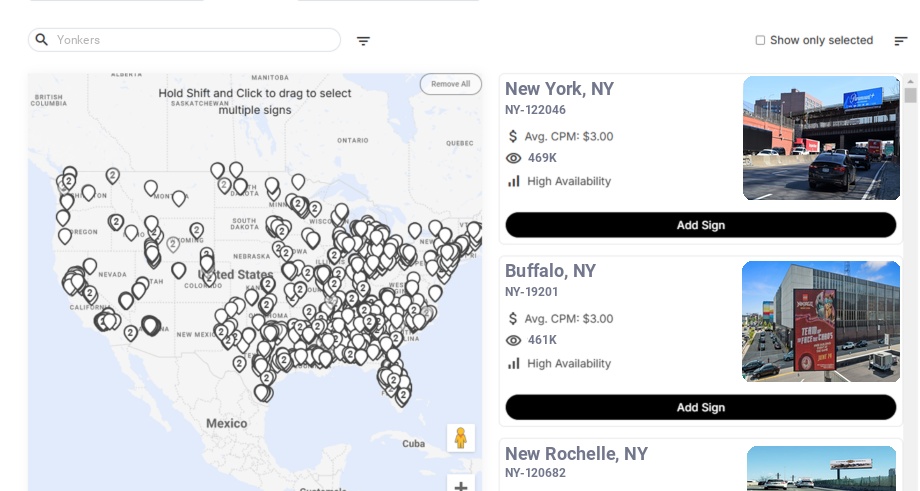



How much is a billboard in Yonkers?
Why Choose Blip for Billboard Advertising in Yonkers
Blip lets Yonkers brands launch fast on I-87 and Central Park Ave with self-serve control, so you reach commuters without the usual billboard hassle.
Set a flexible budget in Yonkers and focus on Cross County Parkway or Saw Mill rush-hour traffic—Blip keeps spend capped while you test what works.
No contracts mean you can target Yonkers shoppers near Cross County Center and Ridge Hill for weekend bursts, then pause or shift anytime.
Use Blip’s real-time analytics in Yonkers to see which parkway or waterfront boards drive results, then adjust by daypart for morning and evening traffic.
Blip’s creative tools make it easy to tailor Yonkers ads for schools, bilingual households, and Empire City Casino weekends—without production delays.
Frequently Asked Questions About Billboard Advertising in Yonkers
How much does a billboard cost in Yonkers, New York with Blip?
With Blip, you control exactly what you spend on Yonkers billboards by setting a daily budget that can be as small or as large as you like, and Blip automatically keeps your campaign within that limit. Each 7.5–10 second “blip” runs on digital billboards in Yonkers, New York, and you only pay for the blips you receive. Pricing for each blip depends on when and where you choose to show your ad, as well as advertiser demand, so you can tailor your approach to busy times or quieter hours.
Where can I advertise with Blip in Yonkers, New York?
Yonkers’ location means it captures both regional through-traffic and local trips: I‑87, parkways, and major arterials together can see hundreds of thousands of vehicle trips per day passing within city limits. I‑87 / New York State Thruway, Saw Mill River Parkway, Cross County Parkway, and Central Park Avenue are all major corridors for Yonkers billboard advertising. You can also target downtown and waterfront-adjacent roads for lifestyle, dining, and nightlife campaigns.
Why is Yonkers, New York a strong market for Blip billboard ads?
Yonkers sits at the crossroads of Westchester County and New York City, making it a powerful—but often underrated—market for digital billboard advertisers. With more than 210,000–215,000 residents and a daytime population that swells as workers and shoppers move through the city, Yonkers functions as both a residential hub and a regional destination. Thousands of residents commute daily into Manhattan and the Bronx, and major corridors like the New York State Thruway and Central Park Avenue channel well over 100,000 vehicles per day through the city.
What kinds of Yonkers, New York audiences can Blip reach with billboards?
Yonkers’ diversity is one of its biggest advantages for advertisers, with about 25–27% of residents under age 20 and roughly one-quarter to one-third under 25. The city is broadly around 35–40% Hispanic or Latino, roughly 30–35% White, and approximately 15–20% Black or African American, with a significant share of residents speaking a language other than English at home. This means bilingual or Spanish-language creatives can perform well, especially in southwest and central Yonkers and along South Broadway and Getty Square.
When is the best time to run Blip billboards in Yonkers, New York?
Blip campaigns in Yonkers can be timed to local life, with morning commuter windows from 6–10 a.m., afternoon school traffic from 2–4 p.m., and evening travel from 4–9 p.m. The page also notes that school drop-off between 7–9 a.m. and pick-up from 2–4 p.m. can guide hyper-relevant messaging. For entertainment and nightlife, Thursday–Sunday evenings are especially strong, when casino and dining traffic is highest.
Do I need a contract to advertise with Blip in Yonkers?
No, Blip has no long-term contracts or minimum commitments. You can start, pause, or stop your campaign at any time.
How fast can I launch a billboard campaign with Blip in Yonkers?
You can have your campaign live in minutes. Create a free account, select your locations, set your budget, upload your design, and start running once approved.
Where can I advertise with Blip in Yonkers?
Blip has digital billboards in Yonkers. You can browse available locations on a map, choose the ones that fit your audience, and start advertising right away.
Still have questions? Launch a campaign in minutes — no contracts, no commitments.
Start Your CampaignYonkers Billboard Advertising Guide
Yonkers, New York sits at the crossroads of Westchester County and New York City, making it a powerful—but often underrated—market for digital billboard advertisers. With more than 210,000–215,000 residents and a daytime population that swells as workers and shoppers move through the city, Yonkers functions as both a residential hub and a regional destination. Thousands of residents commute daily into Manhattan and the Bronx, and major corridors like the New York State Thruway and Central Park Avenue channel well over 100,000 vehicles per day through the city. Layer in dense retail centers, several major schools and colleges, and a growing waterfront residential base, and we can use Blip’s flexibility to reach highly diverse audiences at very specific times and locations with Yonkers billboards that meet people where they actually live, work, and shop.
Below, we’ll walk through how to think about Yonkers as a billboard market, how to tailor creative and timing, and how to align our Blip campaigns with real local behavior and data so that Yonkers billboard advertising becomes a predictable, scalable part of your local marketing mix.
Understanding the Yonkers Market
Yonkers is New York’s third-largest city by population, behind New York City and Buffalo. Recent estimates put Yonkers’ population at roughly 210,000–212,000 residents, up from around 196,000 in 2010—growth of nearly 8–9% over a little more than a decade, reflecting steady growth and an increasingly urban profile. The city encompasses about 18 square miles, with many neighborhoods exceeding 7,000–10,000 residents per square mile, making it one of the most densely populated cities in the state outside New York City and a natural fit for dense coverage using billboards in Yonkers.
Key local context:
- Proximity to NYC: Yonkers borders the Bronx and is less than 15 miles from Midtown Manhattan and only 2–3 miles from some northern Bronx neighborhoods. Thousands of Yonkers residents work in New York City; a significant share of employed residents spend 30+ minutes on their work commute.
- Economic profile: Median household income in Yonkers is in the low-to-mid–$70,000s, with some estimates placing it around $72,000–78,000. Neighborhoods in northeast Yonkers and areas along Central Park Avenue skew above the citywide median, while parts of southwest Yonkers and Hudson River–adjacent neighborhoods show more economic diversity. Roughly 15–20% of residents live below the federal poverty line, creating opportunities for both value-focused messages and premium/luxury offerings.
- Housing & density: Around 50–55% of households are renter-occupied, with a large share living in multifamily buildings. With more than 7,000 people per square mile citywide—and significantly higher density in southwest Yonkers—Yonkers combines mid-rise multifamily housing, single-family neighborhoods, and large apartment complexes, ideal for campaigns targeting renters, families, and multigenerational households.
- Employment base: Yonkers supports roughly 60,000–70,000 jobs across healthcare, education, retail, hospitality, and light industry. Major employers include Yonkers Public Schools, healthcare systems, and large retail centers.
- Government & civic activity: The City of Yonkers maintains up-to-date information on development, business resources, and events. The city’s Department of Planning & Development
For advertisers, this means:
- We can reach both “bedroom community” commuters and local shoppers in a single, compact geography using a well-planned mix of Yonkers billboards across different corridors.
- We should segment messaging geographically based on income, language, and lifestyle, as some ZIP codes show median household incomes 40–60% higher than others.
- We can rely on a robust local economy and ongoing redevelopment (waterfront, downtown, and retail corridors) to support a wide range of campaigns, from value retail to high-end services.
- High household density and renter share create strong potential for services like internet/phone, healthcare, education, and home services that benefit from frequent, repeated impressions, which digital billboard rental in Yonkers can deliver cost-effectively.
Traffic, Commuter Patterns, and Prime Corridors
To maximize impact with Blip, we want to think like a Yonkers commuter and shopper. Yonkers’ location means it captures both regional through-traffic and local trips: I‑87, parkways, and major arterials together can see hundreds of thousands of vehicle trips per day passing within city limits. This makes these corridors the backbone of Yonkers billboard advertising for brands that want consistent daily reach.
Major roadways and daily patterns:
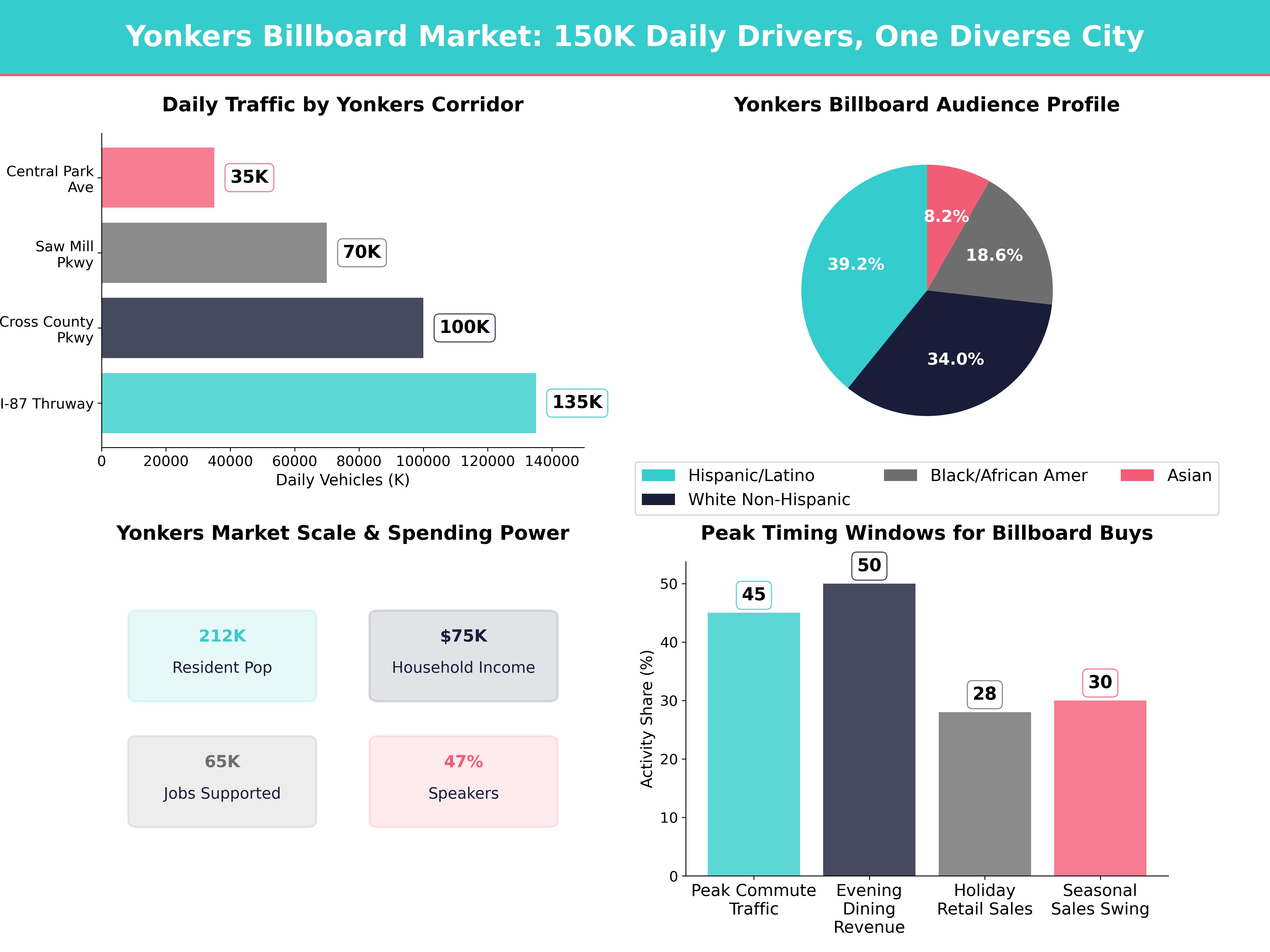
- I‑87 / New York State Thruway: Cuts through Yonkers north–south and carries heavy commuter and truck traffic between the Bronx, Yonkers, and points north. State transportation data and regional planning studies indicate segments through Yonkers often see 120,000–150,000 vehicles per day (AADT). This is a high-impact corridor for regional or citywide campaigns aimed at both Westchester and New York City workers and a prime location for flagship billboards in Yonkers.
- Saw Mill River Parkway: A key commuter route on the western side of Yonkers with strong AM southbound and PM northbound peaks. Many segments in southern Westchester carry 60,000–80,000 vehicles per day, skewing toward higher-income drivers commuting to NYC and White Plains. Ideal for professional services, higher-income targeting, and workday-related messages.
- Bronx River Parkway & Sprain Brook Parkway: Common paths for commuters heading to White Plains, southern Westchester, and Manhattan. AM peak volumes can double typical off-peak volumes, with strong directionality (south in the morning, north in the evening), which makes Blip’s dayparting especially valuable.
- Cross County Parkway: Connects major shopping areas (Cross County Center, Ridge Hill access) and I‑87. Some stretches in the Yonkers area approach 90,000–110,000 vehicles per day, with traffic spikes around shopping hours, weekends, and holidays.
- Central Park Avenue (NY‑100): One of Yonkers’ main commercial spines, with auto dealerships, strip malls, and big-box retail. Vehicle counts on busy stretches can easily exceed 30,000–40,000 vehicles per day, and the traffic is more local than purely commuter, making it ideal for retail and service messaging.
Rail & transit influences:
- The MTA Metro-North Hudson Line serves at least four stations in or near Yonkers (Glenwood, Yonkers, Ludlow, and nearby Riverdale in the Bronx). Systemwide, the Hudson Line carries tens of thousands of riders on a typical weekday, and Yonkers is one of the larger intermediate stops. Many riders access stations by car, bus, biking, or rideshare—adding traffic to surrounding arterials such as Warburton Avenue, Main Street, and Buena Vista Avenue.
- Local bus routes operated under the Bee-Line System (coordinated by Westchester County) provide more than 25 million rides annually countywide, with numerous routes converging on Yonkers hubs like Getty Square, South Broadway, and Yonkers Avenue. These nodes see strong pedestrian volumes at school hours, work shift changes, and weekend shopping periods.
How we can use this with Blip:
- Directional targeting via dayparts: Schedule southbound-focused creative on I‑87 and parkways in the 6–9 a.m. window (e.g., Manhattan-bound commuters), and northbound/return-home messaging 4–7 p.m. (e.g., gyms, restaurants, family activities). Peak travel windows can account for 40–50% of daily traffic on some corridors.
- Retail-focused flights on Cross County Pkwy and Central Ave: Concentrate impressions around lunchtime (11 a.m.–2 p.m.) and early evening (4–7 p.m.), plus heavier weekend schedules to catch shopping and entertainment trips to major centers like Cross County Center and Ridge Hill
- Neighborhood-level targeting: Use boards near downtown Yonkers and the waterfront for nightlife, dining, and events; boards along the eastern commercial corridors for auto, home services, and big-box retail; and boards near the Bronx border to tap cross-borough shoppers and commuters. With flexible billboard rental in Yonkers through Blip, you can mix and match locations to mirror these real-world patterns.
Demographics and Audience Insights
Yonkers’ diversity is one of its biggest advantages for advertisers. The city’s population mix by age, race/ethnicity, income, and language allows for segmented campaigns that resonate with distinct communities and take full advantage of the flexibility digital Yonkers billboards offer.
Age & family structure:
- About 25–27% of residents are under age 20, and roughly one-quarter to one-third are under 25, indicating a large youth and student population.
- Approximately 30–35% of households include children under 18, providing a strong base for education, kids’ activities, family entertainment, and youth-focused services.
- Seniors (65+) comprise roughly 14–17% of residents, creating demand for healthcare, senior living, financial planning, and in-home services.
- Average household size is around 2.6–2.8 people, with many multigenerational households—particularly in neighborhoods with larger immigrant communities.
Ethnic & linguistic diversity:
While exact shares vary by data source, Yonkers is broadly:
- Around 35–40% Hispanic or Latino (with large Dominican, Puerto Rican, Mexican, and Central American communities).
- Roughly 30–35% White (non-Hispanic).
- Approximately 15–20% Black or African American.
- Around 5–10% Asian, with growing South Asian and East Asian communities.
- A significant share—often cited around 45–50% of residents—speaks a language other than English at home, with Spanish the most common non-English language.
This implies:
- Bilingual or Spanish-language creatives can perform well, especially in southwest and central Yonkers and along South Broadway and Getty Square.
- Inclusive imagery and representation are essential—families of different backgrounds, multigenerational households, and messaging that feels authentically local.
- We can test English-only vs. bilingual creatives using Blip’s multiple-creative rotation to see which produce more engagement (measured via matched web traffic, offer codes, or store visits).
Education and schools:
- The Yonkers Public Schools district, one of the largest in New York State, serves roughly 25,000–27,000 students across more than 40 schools and programs, according to Yonkers Public Schools.
- The district employs several thousand staff and educators, making education one of the city’s largest employment sectors.
- Several private and parochial schools add thousands more students, and nearby colleges and universities in Westchester and the Bronx expand the regional student base.
We can leverage the academic calendar and daily school traffic (drop-off between 7–9 a.m., pick-up from 2–4 p.m.) for hyper-relevant messaging, especially on corridors like Yonkers Avenue, Mile Square Road, and Central Park Avenue that serve multiple schools. For brands focused on youth and family audiences, this school-driven movement can guide which billboards in Yonkers you prioritize.
Economic Drivers and Key Verticals
Understanding Yonkers’ economic base helps us prioritize which industries can gain the most from digital billboards and which sectors stand to benefit most from Yonkers billboard advertising.
Retail and shopping:
- The Cross County Center and adjacent retail areas collectively draw millions of visits annually from Yonkers, Westchester, and the Bronx. Cross County Center alone includes more than 80 stores and restaurants spread across over 1 million square feet of retail space, according to Cross County Center.
- Ridge Hill 1+ million square feet of open-air retail, entertainment, and dining, including a cinema and family attractions.
- Central Park Avenue features dense clusters of auto dealerships, furniture stores, quick-service restaurants, and big-box retailers, drawing steady volumes of local shoppers and comparison buyers from across lower Westchester.
- Combined, these retail districts help make retail trade one of the largest employment categories in Yonkers and a major generator of weekend and holiday traffic.
Implications for campaigns:
- Retailers and restaurants can use “minutes away” or exit-based messaging on nearby highways to capture impulse visits; empirical retail studies suggest 10–20% of shoppers can be influenced by in-route advertising when deciding where to stop.
- Auto dealers can tap commuter routes with financing offers and new-model launches, timed around weekends and month-end sales pushes, when sales often spike 20–30% over typical weeks.
- Service businesses (salons, gyms, dentists, optometrists) can concentrate impressions within 3–5 miles of their locations via Blip’s local board selection, reflecting typical consumer travel radii for everyday services.
Waterfront & development:
- The Yonkers waterfront along the Hudson River has seen substantial redevelopment, including thousands of new residential units delivered or in the pipeline over the past decade, new retail and dining, and upgrades around the Yonkers Pier and train station. The city highlights ongoing projects on yonkersny.gov
- Downtown and waterfront neighborhoods have added significant numbers of market-rate and luxury apartments, often with advertised rents above the city median, indicating a growing segment of higher-income renters and young professionals.
- As new residents move into luxury rentals and condos, advertisers in home services, furnishings, finance, and healthcare have an opportunity to reach high-intent audiences likely to spend on move-in needs within the first 30–90 days of occupancy.
Casinos, entertainment, and hospitality:
- Empire City Casino by MGM Resorts millions of visitors per year, drawing large regional crowds from NYC, Westchester, Connecticut, and beyond. Its gaming, dining, and event offerings contribute to steady evening and weekend traffic on I‑87 and surrounding roads like Yonkers Avenue and Central Park Avenue.
- Seasonal attractions and events promoted by Westchester County Tourism and I LOVE NY bring added visitors for arts, dining, parks, and outdoor activities. Westchester County typically records millions of visitor nights annually, a portion of which flow through Yonkers hotels, restaurants, and entertainment venues.
- Local cultural institutions and events—such as waterfront concerts, community festivals, and downtown markets often promoted by the Yonkers Downtown/Waterfront Business Improvement District
This supports:
- Entertainment, nightlife, and event advertising, especially Thursday–Sunday evenings, when casino and dining traffic is highest.
- Package deals (dining + entertainment) and time-limited promotions that we can run only on days with expected spikes (concert nights, casino events, or waterfront festivals).
- Hotel and short-stay advertising aimed at visitors who might extend casino or event trips into overnight stays.
Media Landscape and Local Culture
To make campaigns credible and relevant, we should speak the same language as local news and cultural outlets and ensure Yonkers billboard advertising feels as local and timely as the media Yonkers residents already trust.
Local media & information sources:
- The City of Yonkers regularly posts news, permits, and event details, and maintains department pages such as Parks, Recreation & Conservation
- Lohud / The Journal News
- Yonkers Times News 12 Westchester amplify local happenings, community leaders, and neighborhood stories, often reaching tens of thousands of local readers and viewers each week.
- Local digital forums and neighborhood social media groups further shape perceptions of businesses, with online review platforms indicating that many Yonkers residents check ratings and recommendations before visiting new places.
We can align with this environment by:
- Referencing neighborhoods (e.g., “Near Getty Square,” “on Central Ave,” “by the waterfront”) so ads feel specific, not generic, mirroring how local outlets describe locations.
- Timing creatives to major local stories or events—school openings, waterfront festivals, or big development milestones highlighted on yonkersny.gov or in local news.
- Considering partnerships or cross-promotions, such as featuring local nonprofits, school teams, or event sponsorship language in rotating creatives to tap into community pride and make your use of Yonkers billboards feel community-focused rather than purely promotional.
Seasonality and Timing Strategy
Yonkers has four distinct seasons, with travel, shopping, and outdoor activity shifting significantly across the year. Retail and service businesses often see 20–40% swings in monthly sales between peak and off-peak seasons, so aligning Blip campaigns to these cycles is critical and can significantly improve the ROI of billboard rental in Yonkers.
Winter (Dec–Feb):
- Holiday shopping at Cross County Center, local shops, and big-box stores spikes in late November and December, with some retailers generating 25–30% of annual sales in this period.
- Evening and weekend traffic to malls and entertainment venues increases, while January often shows softer but still steady traffic for returns, post-holiday sales, and services.
- Weather events (snow, cold snaps) can shift behavior toward indoor activities and local trips.
- Ideal for: gift guides, holiday promotions, winter healthcare (flu shots, urgent care), legal and tax prep awareness, and home services like heating and plumbing.
Spring (Mar–May):
- Families prepare for graduations, proms, and end-of-school-year activities, driving spending on clothing, beauty, and events.
- Real estate listings across Westchester commonly rise in spring, with open houses and move-in activity peaking from April to June.
- Home improvement spending typically accelerates; regional data show that home and garden categories can see double-digit percentage increases versus winter months.
- Ideal for: landscapers, contractors, real estate agents, moving/storage, outdoor venues, and seasonal recreation.
Summer (Jun–Aug):
- School is out; roughly 25,000+ public-school students and thousands more private-school students are on break, and families look for camps, childcare, and local activities.
- Travel increases; some commuting dips, especially around major holidays and long weekends, but weekend leisure traffic and trips to the Hudson waterfront, parks, and casinos rise.
- Parks and recreation programs run by Yonkers Parks, Recreation & Conservation
- Ideal for: day camps, summer programs, attractions, waterfront restaurants, concerts, tourism offers, and home services like cooling and outdoor projects.
Fall (Sep–Nov):
- Back-to-school for 25,000+ public-school students drives spending on clothing, tech, furniture, and tutoring; many retailers report notable sales spikes in August–September.
- Sports seasons, college application cycles, and health checkups (dental, vision, physicals) surge.
- Holiday ramp-up begins by late October with Halloween, followed by early holiday shopping, often starting with promotional events around November.
- Ideal for: education services, healthcare providers, sports and fitness programs, and early holiday promotions.
With Blip, we can adjust:
- Budgets by season: Increase bids and frequency during peak sales windows (holidays, back-to-school, spring home improvement); reduce but maintain a presence in shoulder seasons for brand continuity.
- Dayparts: Align with school schedules (morning drop-off, afternoon pick-up), game nights, and major events (e.g., waterfront festivals or casino promotions).
- Creative rotation: Run distinct seasonal creatives without production or posting delays, swapping out designs as soon as new offers or seasonal lines are ready.
Creative Best Practices for Yonkers Billboards
To stand out amidst busy traffic and urban scenery, we should design with Yonkers’ real-world conditions in mind—high-speed corridors, dense signage, and a diverse, time-pressed audience. These best practices apply whether you’re booking a single board or building a larger Yonkers billboard advertising presence across multiple neighborhoods.
1. Hyper-local language and landmarks
- Use directional cues: “Next exit off I‑87,” “Just off Central Ave,” “3 minutes from Cross County Center,” or “near Empire City Casino
- Reference widely known locations: “Near Getty Square,” “by the Yonkers waterfront,” “around Empire City Yonkers Gateway Center
- Consider neighborhood-specific creatives if we’re targeting multiple boards—e.g., one version tailored for southwest Yonkers commuters, another for Northeast Yonkers shoppers, or a special version for waterfront/downtown audiences.
2. Bilingual and inclusive messaging
- Test English-only vs. English/Spanish creatives, especially on boards serving south Yonkers and corridors linking to the Bronx, where Spanish-speaking households can exceed 50% in some census tracts.
-
Keep bilingual text concise; prioritize brand, offer, and clear CTA. For example:
- “Low-cost urgent care. / Atención médica rápida y económica.”
- Use visuals that reflect Yonkers’ diverse population—families, seniors, and working professionals from different backgrounds, including Afro-Latino, Caribbean, and South Asian communities.
3. Short, bold, and legible
- Aim for 7 words or fewer of primary text, as drivers on I‑87 or parkways often have only 3–5 seconds to absorb a message.
- High contrast (light text on dark backgrounds or vice versa) is essential in fast-moving traffic; avoid cluttered backgrounds that blend into urban scenery.
- Use large fonts and avoid intricate script styles, particularly on high-speed corridors like I‑87 and the parkways; reserve finer detail for slower roads and intersection-adjacent boards.
4. Context-aware CTAs
- For commuter boards: “Call now,” “Text for an appointment,” or a short URL that’s memorable; mobile studies indicate that over 80% of adults carry a smartphone, so response can happen immediately.
- For local-shopping boards: “Turn right at next light,” “Exit 4, then left,” or “This weekend only,” keyed to nearby intersections or ramps.
- Use vanity URLs, QR codes (for slower roads or near intersections), or short codes to make response tracking easier, especially along slower city streets or near shopping centers.
5. Rotating creatives for testing
Blip lets us upload multiple creatives and see which ones drive better responses. We can:
- Test headline variants: Price-focused vs. benefit-focused messaging; often, even small headline tweaks can shift response rates by 10–20%.
- Test language mix: Different levels of Spanish/English balance to see what resonates in different corridors.
- Test audience focus: Family-oriented image vs. professional/individual-focused image; compare performance in family-heavy neighborhoods vs. commuter-heavy parkway boards.
Industry-Specific Strategies for Yonkers
Different sectors can leverage Yonkers’ patterns in distinct ways, tying campaigns to known traffic flows and demographic concentrations. Because Blip lets you buy digital billboard rental in Yonkers by the “blip,” each industry can scale up or down quickly as demand changes.
Healthcare & urgent care
- Concentrate impressions on commuter corridors in the 7–9 a.m. and 4–7 p.m. windows, when a majority of weekday vehicle trips occur.
- Highlight quick access (“Walk-in, no appointment”) and proximity to major roads (“5 minutes from I‑87, Exit X”).
- Run flu, COVID, or sports physical campaigns tied to school calendars and winter months; urgent care facilities typically see noticeable visit spikes (often 20–40%) in late fall and winter.
- Target neighborhoods with higher senior concentrations and renters for services such as home health aides, telehealth, or clinics reachable via Bee-Line routes.
Education, tutoring, and youth programs
- Target boards near major school commuting routes (Central Ave, Yonkers Ave, South Broadway, Bronx River Parkway approaches).
-
Align with:
- Back-to-school (Aug–Sep), when families ramp up educational spending.
- Report card periods and state test prep (late winter and spring), when tutoring demand rises.
- Summer camp sign-ups (Feb–June), when many camps fill 60–80% of spots.
- Use parent-focused language emphasizing safety, outcomes, and convenience (“5 minutes from Yonkers High School
Real estate and home services
- Use I‑87 and parkway boards to reach higher-income commuters considering moves within Westchester, many of whom are in the $100,000+ household income range.
- Highlight key metrics: “3-bed homes from $X,” “No-fee rentals,” “Waterfront living in Yonkers.” Housing listings data show that waterfront and new-construction units often command rents or prices 10–30% above city medians.
- For contractors and home services, emphasize localness (“Serving Yonkers & Westchester since [year]”) and quick scheduling, as home-improvement interest peaks in spring and early summer.
- Consider creative that speaks to renters becoming first-time buyers, given Yonkers’ 50%+ renter share.
Restaurants, nightlife, and entertainment
- Target evening and weekend dayparts, especially along routes leading to the waterfront, Empire City Casino Cross County Center and Ridge Hill
- Promote specials tied to events covered by local outlets like Lohud News 12 Westchester—sports games, concerts, festivals—when restaurants often see double-digit percentage bumps in traffic.
- Rotate creatives for lunch vs. dinner vs. late night, using value messaging for lunch and experience-focused messaging for dinner and nightlife.
- Add “Free parking,” “Near Metro-North,” or “Right off I‑87” to lower friction for visitors traveling from outside Yonkers.
Legal, financial, and professional services
- Focus on high-traffic commuter routes for white-collar and middle-income audiences, especially on I‑87, Saw Mill, Sprain, and Bronx River corridors.
- Keep messaging trust-oriented and clear: “Injury? Call [Name], Yonkers’ local firm,” “Tax help in Yonkers—Evenings & Saturdays.”
- Time heavier flights around tax season (Jan–Apr), end-of-year planning (Oct–Dec), or when local news foregrounds related topics (e.g., housing, small business relief, traffic accidents).
- Highlight local presence (“Office in downtown Yonkers,” “Across from City Hall”) to differentiate from Manhattan or out-of-county competitors.
Using Blip’s Tools Effectively in Yonkers
Blip’s core strengths—location selection, budget control, dayparting, and creative rotation—are especially powerful in a compact but complex market like Yonkers. Together, they make Yonkers billboard advertising more accessible to businesses of all sizes.
1. Strategic board selection
-
Choose boards on:
- I‑87 and key parkways for regional reach and commuters, capturing segments that may see 100,000+ vehicles daily.
- Central Park Ave and Yonkers Ave for local shoppers and service seekers.
- Downtown and waterfront-adjacent roads for lifestyle, dining, and nightlife campaigns.
- Consider running separate campaigns (or creative sets) by corridor to tailor messages to commuters vs. shoppers vs. residents.
2. Smart bidding and budgeting
- Increase bids during high-value windows (rush hours, evenings, weekends) on premium roads, where impression quality is highest and on-the-way-to-purchase behavior is more likely.
- Lower bids to capture efficient off-peak impressions—late night for 24/7 services, midday for retirees or shift workers, who together make up a meaningful share of the population.
- Use the ability to pause or ramp budgets in real time around weather (e.g., heat waves, snowstorms), events (waterfront concerts, casino events), or inventory needs (e.g., push extra ads during a warm weekend for an outdoor venue or ice cream shop).
3. Dayparting aligned to local life
- Morning (6–10 a.m.): Commuters, parents, students—perfect for coffee, news, transit services, education, healthcare, and traffic-dependent offers like breakfast QSRs.
- Midday (10 a.m.–3 p.m.): Seniors, at-home workers, and shoppers—ideal for healthcare, retail, and daytime events; note that seniors (about 15% of residents) are more likely to run errands in this window.
- Afternoon school window (2–4 p.m.): Parents picking up kids—tutoring, after-school programs, fast food, family services, and pediatric care.
- Evening (4–9 p.m.): Return commuters, dining, entertainment—restaurants, gyms, casinos, and events; many restaurants and entertainment venues report 40–60% of daily revenue in this block.
- Late night: 24-hour businesses, delivery, urgent care, and nightlife; casino and late-night dining traffic continues past midnight on Fridays and Saturdays.
4. Dynamic and time-limited campaigns
- Run countdown creatives for openings, limited-time sales, or events (“3 Days Left to Enroll,” “Tonight Only at the Waterfront”), capitalizing on urgency.
- Tie creatives to game days, local festivals, or city events promoted on yonkersny.gov
- Quickly pivot creative in response to local news or weather (e.g., promoting indoor fun during cold snaps or outdoor dining during warm weekends).
Measuring and Optimizing a Yonkers Campaign
To extract the full value of Yonkers billboards, we should plan how we’ll measure performance from the start. Many local businesses see the strongest impact when billboards support existing digital and in-person touchpoints.
Baseline measurement ideas:
- Track direct traffic to a short, campaign-specific URL and monitor changes during campaign periods; even 5–10% lifts can represent meaningful new business.
- Use promo codes unique to billboard campaigns (“YONKERS20”) for in-store or online redemption.
- Capture call volume to a tracking phone number used only on billboard creatives, then compare volumes by corridor and daypart.
- Monitor changes in Google Business Profile views and direction requests for locations near your chosen boards; lifts in direction requests often correlate strongly with in-person visits.
- For multi-location businesses, compare performance across stores with and without nearby boards to estimate incremental impact.
Ongoing optimization:
- Compare performance by corridor (I‑87 vs. Central Ave vs. waterfront routes) and shift budget to the best-performing areas. You may find, for example, that a Central Ave board drives more walk-ins per dollar than a parkway board, even if the parkway has higher overall impressions.
- Test creative variants—headlines, images, language mix—and prioritize those driving more calls, visits, or website activity. Aim for at least 2–4 weeks of data per creative variation for more reliable comparisons.
- Adjust dayparts based on observed response patterns: if calls spike after 7 p.m., extend evening coverage; if lunchtime visits rise, bias impressions earlier in the day.
- Use short, periodic surveys (“How did you hear about us?”) to validate that a measurable share of new customers is coming from billboard exposure; many local advertisers report 10–30% of new walk-ins citing “saw your sign/billboard” when prompted.
By combining Yonkers’ rich demographic diversity, high commuter volumes, and active retail and entertainment ecosystems with Blip’s fine-grained control, we can craft campaigns that feel unmistakably local and deliver measurable results across seasons, corridors, and customer segments. Whether you are testing billboard rental in Yonkers for the first time or scaling an established presence with multiple billboards in Yonkers, these strategies provide a roadmap for making every impression count.