Billboards in Clarence, NY
No Minimum Spend. No Long-Term Contracts. Just Results.
Trusted by Leading Brands


Billboard advertising
in Clarence has never been easier
How much is a billboard in Clarence?
Why Choose Blip for Billboard Advertising in Clarence
Blip lets Clarence brands launch fast on Transit Road and Main Street, reaching Buffalo commuters and regional shoppers without the usual barriers.
Clarence families drive year-round; Blip's dayparting puts your ad on morning and evening routes when school, work, and errands peak.
No contracts in Clarence means you can test Transit Road retail traffic, then shift budget when the numbers prove it.
Track Clarence campaigns in real time and optimize around winter snow, back-to-school, and weekend shopping spikes.
Use Blip's creative tools to build bold, simple ads that stand out on Clarence's fast-moving commuter corridors.
Frequently Asked Questions About Billboard Advertising in Clarence
How much does a billboard cost in Clarence, New York with Blip?
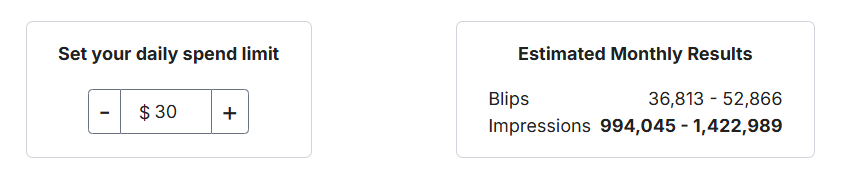
With Blip, you choose exactly how much you want to spend on Clarence billboards by setting a daily budget that can be adjusted anytime. Each ad “blip” is a brief 7.5 to 10-second display, and you only pay for the blips you receive, similar to pay-per-click online ads. Prices per blip vary based on when and where your ad appears and on local advertiser demand, so Blip automatically works within your budget to maximize your exposure on billboards in Clarence, New York.
Where can I advertise with Blip in Clarence, New York?
Transit Road (NY-78) is one of Western New York’s dominant north–south commercial arterials, running along Clarence’s western edge and continuing through Amherst, Lancaster, and beyond. NYSDOT traffic counts along Transit Road in the Clarence/Amherst corridor typically range from 27,000 to more than 38,000 vehicles per day. Main Street (NY-5) also runs through Clarence and into Amherst and the City of Buffalo, with traffic volumes generally in the 18,000–24,000 vehicles per day range.
Is Clarence, New York a good market for Blip billboard ads?
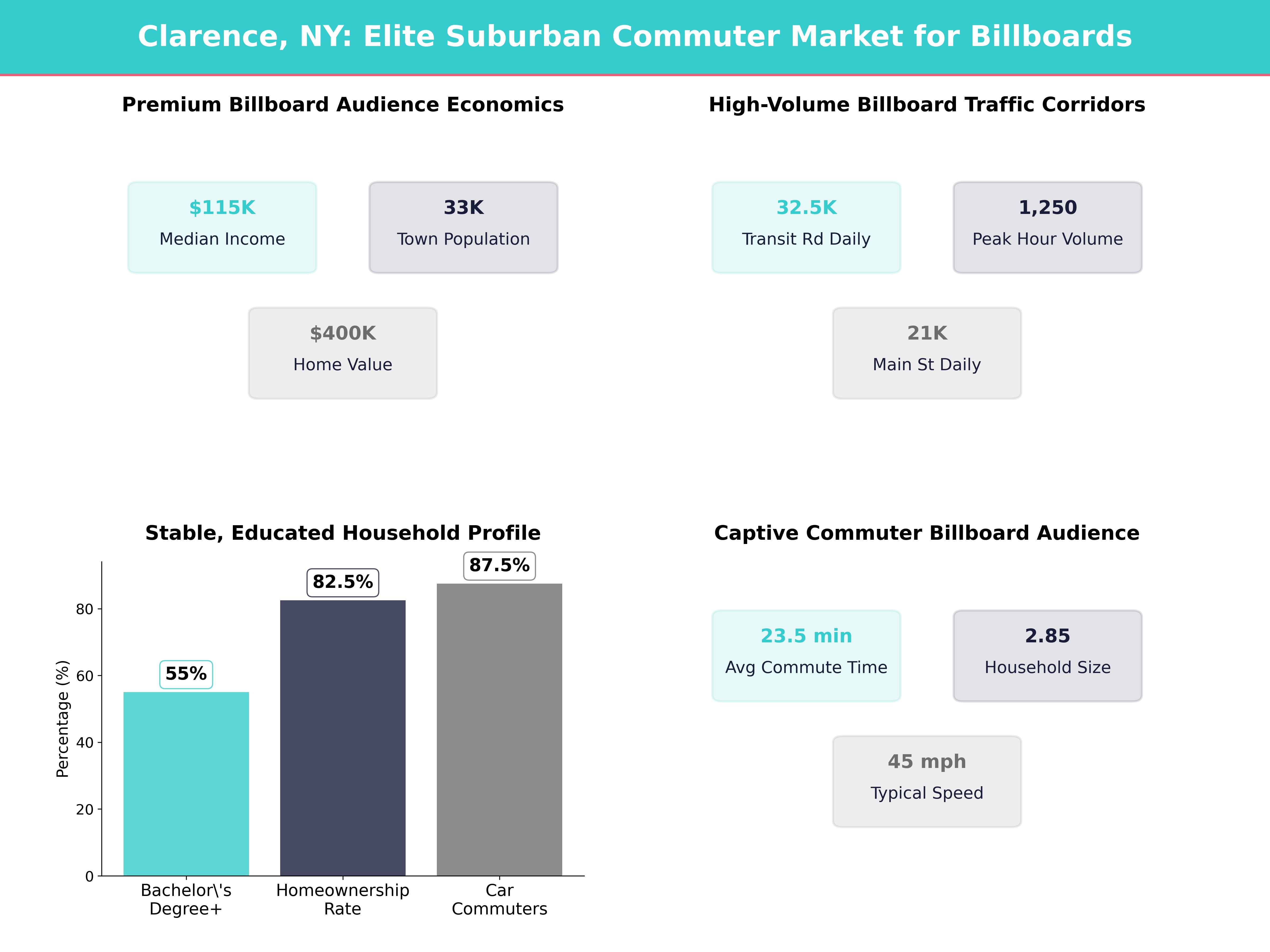
Clarence, New York combines small-town affluence with big-city proximity, making it a powerful niche market for digital billboard advertising. It is a fast-growing suburb about 15–20 minutes northeast of downtown Buffalo, giving access to high-income households, heavy commuter traffic, and regional shoppers traveling some of Western New York’s busiest corridors. Clarence is also a town of roughly 33,000 residents with population growth of more than 15% since 2000.
When should I run billboard ads in Clarence, New York with Blip?
Morning peak hours roughly 7:00–9:00 a.m. and evening peaks 4:00–6:30 p.m. dominate the main corridors. For family and leisure-focused campaigns, late afternoons and evenings, plus heavy weekend coverage, are recommended. The page also notes that Blip’s dayparting lets advertisers align campaigns with the highest-value hours on the road.
Who are the main audiences for Clarence, New York billboard advertising?
Clarence’s demographics and land use patterns shape how we should think about target audiences, and the town skews strongly toward family households. Many residents are adults in their 30s to 60s, which are prime earning and home-owning years. The area also includes affluent suburban families, commuters and working professionals, and regional shoppers and visitors.
Do I need a contract to advertise with Blip in Clarence?
No, Blip has no long-term contracts or minimum commitments. You can start, pause, or stop your campaign at any time.
How fast can I launch a billboard campaign with Blip in Clarence?
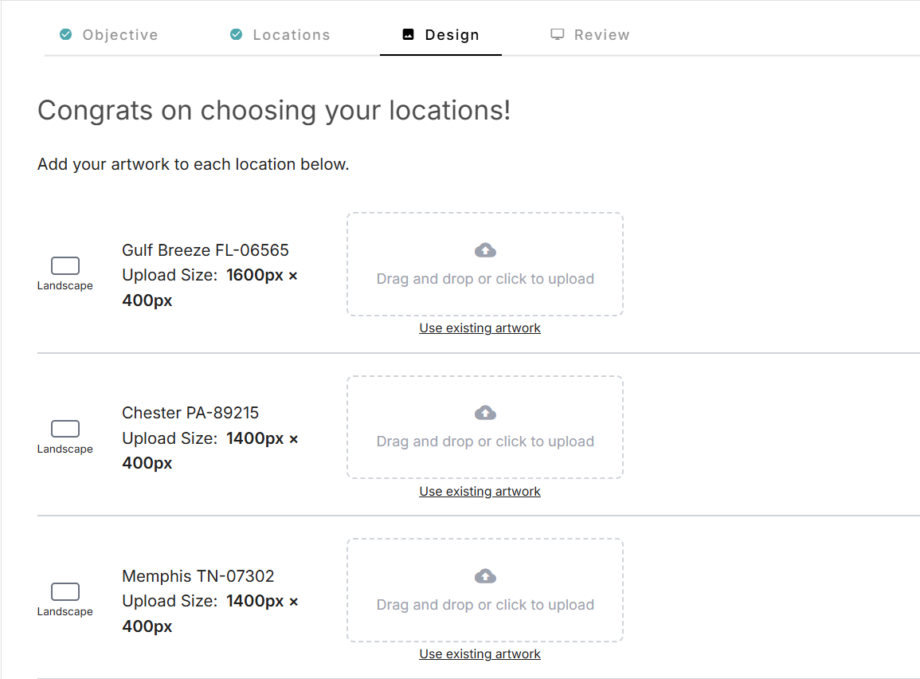
You can have your campaign live in minutes. Create a free account, select your locations, set your budget, upload your design, and start running once approved.
Where can I advertise with Blip in Clarence?
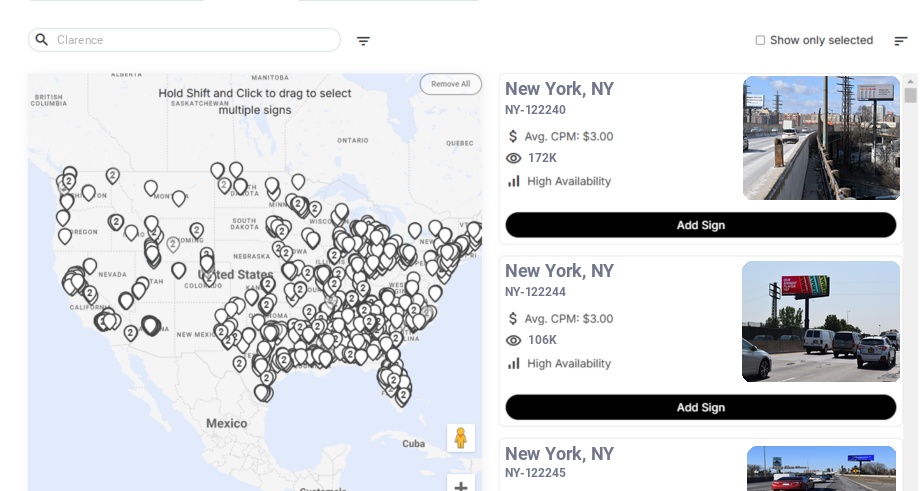
Blip has digital billboards in Clarence. You can browse available locations on a map, choose the ones that fit your audience, and start advertising right away.
Still have questions? Launch a campaign in minutes — no contracts, no commitments.
Start Your CampaignClarence Billboard Advertising Guide
Clarence, New York combines small‑town affluence with big‑city proximity, making it a powerful niche market for digital billboard advertising. As a fast‑growing suburb about 15–20 minutes northeast of downtown Buffalo, Clarence gives us access to high‑income households, heavy commuter traffic, and regional shoppers traveling some of Western New York’s busiest corridors. With Blip, we can use precise location and timing controls to tap into these patterns efficiently and turn Clarence billboards into a consistent, measurable driver of local business.
Understanding the Clarence Market
Clarence is a town of roughly 33,000 residents in the northeastern corner of Erie County. Town and county planning documents note that Clarence’s population has grown by more than 15% since 2000, outpacing many nearby suburbs and reflecting its reputation as one of the most desirable communities in the Buffalo area. The town’s profile and planning information are regularly updated by the Town of Clarence and Erie County.
Key local characteristics:
- Affluent households – Clarence consistently ranks among the top Erie County towns for income. Median household income is commonly reported in the $110,000–$120,000 range, well above the county overall. Homeownership rates hover around 80–85%, with many neighborhoods of larger single‑family homes, particularly in areas like Clarence Center and along Main Street east of Transit Road.
- Commuter suburb – Roughly 85–90% of employed residents commute by car, with average one‑way commute times around 22–25 minutes toward Buffalo, Amherst, and Cheektowaga. Main commuter corridors include Transit Road (NY‑78) and Main Street (NY‑5), which link Clarence to major job centers, retail hubs, and the airport.
- Retail and dining hub – Transit Road, which forms the western border of Clarence, is one of the region’s most active commercial strips. Local planning sources describe it as a primary commercial spine, with multiple power centers, auto dealers, and restaurants drawing shoppers from across Erie County. Retail trade and food service businesses along the Transit/Main corridors help support hundreds of local jobs and millions of dollars in annual sales.
- Stable, family‑oriented community – Clarence’s schools are a major draw. The Clarence Central School District enrolls roughly 4,300–4,600 students across its schools and routinely posts graduation rates above 95%, with a large share of graduates moving on to 2‑ and 4‑year colleges. This attracts families with disposable income for after‑school activities, youth programs, enrichment services, and private lessons.
Educational attainment is also high: in many Clarence neighborhoods, 50–60% of adults hold a bachelor’s degree or higher, supporting strong demand for professional services, financial products, and higher‑end retail that respond well to Clarence billboard advertising.
Locally trusted information sources include the Town of Clarence (town website), regional tourism via Visit Buffalo Niagara, and local news like The Buffalo News (buffalonews.com) and The Clarence Bee ( clarencebee.com
For advertisers, this adds up to a core story: Clarence is a high‑value, family‑focused, car‑dependent suburb with sustained growth and strong spending power, where well‑placed billboards in Clarence can reliably reach residents as they move through their daily routines.
Traffic Flows and High‑Impact Corridors
To leverage Blip’s location‑based tools, we first need to understand how people move through Clarence and its surroundings. Local traffic conditions and projects are tracked by the New York State Department of Transportation and Erie County.
1. Transit Road (NY‑78)
Transit Road is one of Western New York’s dominant north–south commercial arterials, running along Clarence’s western edge and continuing through Amherst, Lancaster, and beyond.
- NYSDOT traffic counts along Transit Road in the Clarence/Amherst corridor typically range from 27,000 to more than 38,000 vehicles per day, depending on the segment and nearby intersections.
- Even modest sections routinely exceed 1,000–1,500 vehicles per hour during weekday peak periods.
- The corridor features multiple major shopping nodes (big‑box clusters, car dealerships, sit‑down restaurants, and fast‑casual chains) that keep volumes strong from early morning through late evening, with weekend traffic often rivaling or exceeding weekday volume.
For Blip campaigns, this corridor is ideal when we want to:
- Capture regional shoppers heading to retail centers that serve not only Clarence but also Amherst, Lancaster, and the broader Buffalo metro.
- Reach commuters traveling between Clarence and employment hubs like Amherst, Cheektowaga, and downtown Buffalo.
- Promote auto, dining, home improvement, and financial services positioned as convenient along their normal route.
We should prioritize clear, high‑contrast messaging, especially for drivers moving at 40–50 mph, where viewing windows are typically 5–7 seconds. Transit is also where much of our Clarence billboard advertising inventory will deliver the broadest mix of local and regional audiences.
2. Main Street (NY‑5)
Main Street (Route 5) runs roughly east–west through Clarence and into Amherst and the City of Buffalo.
- NYSDOT figures show traffic volumes in the Clarence/Amherst segment generally in the 18,000–24,000 vehicles per day range.
- This translates into several hundred vehicles per hour even in off‑peak periods, with higher flows during commute and school‑drop‑off times.
- Main Street connects residential neighborhoods, office clusters, and small‑business districts, including Clarence Center and Harris Hill, giving us a mix of local and through traffic.
This is a prime corridor for:
- Local professional services (dentists, doctors, attorneys, financial advisors).
- Community institutions (schools, churches, nonprofits).
- Boutique retail and dining appealing to both residents and upscale visitors.
Messaging can lean more community‑centric here—highlighting local ownership, proximity (“5 minutes east of Transit Road”), and neighborhood relevance. References to familiar destinations like Clarence Center, Harris Hill, or the Town Park can enhance recall and make Clarence billboards on this route feel like part of the local streetscape rather than generic regional signage.
3. Feeder Roads and Nearby Anchors
Secondary roads like Clarence Center Road, Greiner Road, and Roll Road feed traffic toward the Main and Transit corridors. While these roads may carry 5,000–10,000 vehicles per day each, most of that volume ultimately converges on the higher‑traffic arterials where Blip boards are typically positioned.
We should also consider major regional anchors just outside Clarence that affect traffic flows:
- Buffalo Niagara International Airport, about 8–10 miles away in Cheektowaga, serves on the order of 4 million passengers annually, according to the NFTA
- Eastern suburbs retail clusters in Amherst and Williamsville—such as major shopping plazas and lifestyle centers—further amplify traffic on approach roads like Transit and Main.
- Regional attractions and events promoted by Visit Buffalo Niagara and covered by outlets such as The Buffalo News increase visitor traffic through the eastern suburbs during concert nights, sporting events, and festivals.
When planning, we can time and place campaigns to intersect travelers headed to these broader destinations, not just those stopping within Clarence itself, maximizing the impact of billboard rental in Clarence for both local and regional brands.
Audience Insights and Target Segments
Clarence’s demographics and land use patterns shape how we should think about target audiences.
The town skews strongly toward family households, with a significant share of residents under 18 and many households containing school‑aged children. At the same time, the area includes a notable population of adults in their 30s to 60s—prime earning and home‑owning years.
Affluent Suburban Families
With high homeownership, strong schools, and above‑average income, Clarence is full of households making large, long‑term spending decisions.
Many estimates place:
- Average household size around 2.7–3.0 persons.
- Home values significantly above the county average, with many single‑family homes valued in the $300,000–500,000+ range.
- A large share of dual‑income households, supporting higher discretionary spending on services and experiences.
Relevant categories:
- Real estate (agents, mortgage lenders, home builders, remodelers).
- Home services (roofing, HVAC, landscaping, snow removal).
- Financial planning, insurance, and wealth management.
- Private education, tutoring, music/arts lessons, youth sports, and camps.
Key messaging principles:
- Emphasize trust, quality, and longevity: “Trusted by Clarence families since 1998,” “Serving Amherst & Clarence homeowners.”
- Highlight convenience and time‑savings: “Service calls in Clarence same day,” “5 minutes from Transit & Main.”
- Feature family‑friendly visuals and seasonal household milestones (back‑to‑school, winter prep, summer recreation).
Commuters and Working Professionals
Many Clarence residents work in and around Buffalo, Amherst, or Cheektowaga, often in professional or managerial roles. Regional labor data indicate that in the Buffalo metro area, over half of workers are employed in sectors like education, health care, professional services, finance, and retail—roles that align with commuting patterns from suburbs like Clarence.
Morning peak hours (roughly 7:00–9:00 a.m.) and evening peaks (4:00–6:30 p.m.) dominate the main corridors.
Ideal verticals:
- Career training and higher education.
- Healthcare providers near employment centers.
- Gyms, fitness studios, and wellness services near commuter routes.
- Quick‑service restaurants and coffee shops.
We should tailor commuter‑focused creatives to moments of decision:
- Morning: “Coffee in 2 miles on Transit,” “Stop in today, open 8 a.m.–6 p.m.”
- Evening: “Dinner tonight? Exit at Transit & Main,” “Walk‑in urgent care open until 9 p.m.”
Blip’s dayparting lets us turn these ideas into precise time‑based buying strategies, keeping billboard rental in Clarence tightly aligned with the highest‑value hours on the road.
Regional Shoppers and Visitors
Clarence’s commercial corridors draw in visitors from all over Erie County and nearby communities. According to hospitality and tourism reports compiled by Visit Buffalo Niagara, Erie County welcomes millions of visitors annually, with visitor spending measured in the billions of dollars. A substantial portion of those trips involve shopping, dining, and services in the eastern suburbs.
Visitor drivers:
- Transit Road retail and dining.
- Seasonal attractions and events in Clarence and neighboring towns (e.g., local festivals, markets, and sports tournaments).
- Proximity to Amherst and the broader Buffalo region, promoted through Visit Buffalo Niagara.
For this group, we should:
- Emphasize destination appeal: “Worth the drive,” “Your weekend stop in Clarence.”
- Use clear directional calls to action: “Next right on Transit,” “Exit at [landmark], 1 mile ahead.”
- Feature offers that differentiate from closer‑to‑home options: unique experiences, specialty products, or standout quality.
Seasonality and Timing in Clarence
Western New York’s climate and community calendar are crucial for billboard planning. Clarence experiences distinct, often dramatic seasonal shifts that influence traffic patterns, consumer behavior, and visibility. Local conditions and alerts are tracked by agencies like Erie County and regional media.
Winter (December–March)
Clarence, like the rest of Erie County, sees significant snowfall and prolonged periods of overcast skies.
- The Buffalo‑area climate typically brings 80–100 inches of snow per year, with multiple lake‑effect events.
- Average high temperatures in January and February often sit around 30–32°F, with many days of below‑freezing wind chills.
- Shorter daylight windows (fewer than 9 hours of daylight at the darkest point of winter) affect both driving behavior and billboard visibility.
Implications for campaigns:
- Visibility and legibility become even more critical: use high‑contrast colors (light text on dark backgrounds or vice versa) and minimal copy—ideally 6–10 words.
-
Service categories that perform well:
- Snow removal, plowing, and winterization services.
- Auto repair, tire shops, and collision centers.
- Heating/HVAC, roofing, and emergency home services.
- Encourage advance planning: promote tax services, early spring remodeling, and auto dealership “year‑end” or “new‑year” offers.
We can use Blip to increase impressions during daylight hours, when winter driving conditions make nighttime messages less comfortable to engage with for some drivers.
Spring (April–May)
As snow melts, residents focus on home projects and outdoor activities.
- Hardware and home improvement retailers often report double‑digit percentage increases in sales during spring months compared to winter.
- Youth sports registrations, landscaping bookings, and renovation inquiries tend to spike between March and May.
Consider:
- Launching early‑spring teaser campaigns in March: “Booking April installs now,” “Spring cleanup slots filling fast.”
- Increasing frequency on weekends, when many residents shop for materials and services.
- Aligning with local programming at parks and facilities listed on the Town of Clarence recreation pages.
Summer (June–August)
Summer is prime time for outdoor recreation, travel, and community events.
Local drivers:
- Families on school vacation—Clarence schools typically release in late June, adding thousands of school‑aged children and parents to daytime traffic patterns.
- Out‑of‑town visitors, including former residents returning for visits.
- Day trips to regional attractions promoted by Visit Buffalo Niagara.
Winning categories:
- Restaurants, ice cream shops, and casual dining.
- Entertainment venues, festivals, and community events.
- Tourism, hotels, and local attractions.
- Real estate and home upgrades timed to the moving season (summer is often the busiest home‑sale period, with many markets seeing 30–40% of annual sales in late spring and summer).
We can shift budget toward evenings and weekends, aligning with leisure trips and social outings, and mirror event calendars highlighted by The Clarence Bee and Visit Buffalo Niagara’s events listings.
Fall (September–November)
Back‑to‑school and early holiday planning dominate this period.
Key opportunities:
- Schools, tutoring centers, music and arts programs.
- Retailers promoting early holiday shopping or pre‑winter sales.
- Fitness and wellness providers targeting “new routine” mindsets as school years restart.
- Healthcare providers focusing on flu shots and preventive care; public health advisories from Erie County often encourage vaccinations beginning in September and October.
With Blip, we can tighten schedules around recurring school commute patterns starting in early September, then gradually transition into holiday‑focused messaging by late October and November so Clarence billboard advertising stays closely aligned with what local families are thinking about each month.
Event‑Driven Campaigns and Local Culture
Clarence retains a strong small‑town identity, reflected in recurring community events, youth sports, and local fundraisers. Community calendars from the Town of Clarence and coverage in The Clarence Bee
Ways to tap into this:
- Tie messaging to events and notices found on the town calendar and local coverage.
- Align campaigns with regional happenings promoted through Visit Buffalo Niagara’s events listings.
For example:
- Promote restaurants or dessert spots around local festivals, markets, or youth sports tournaments at town parks.
- Support nonprofit campaigns (“Proud sponsor of Clarence youth sports”) to build community goodwill.
- Time retail and hospitality ads around major regional events in nearby Buffalo, capturing visitors driving through Clarence or staying in suburban accommodations.
Blip’s ability to adjust schedules quickly allows us to build short, intense bursts of impressions just before and during specific events—without committing to long static rentals, which gives billboard rental in Clarence added flexibility compared with traditional long‑term placements.
Creative Strategy: Designing for Clarence Drivers
Once we understand who we’re speaking to and when, we can craft artwork that resonates on Clarence’s roads.
Message Positioning
-
Highlight local relevance
Phrases like “Serving Clarence & Amherst,” “Minutes from Transit & Main,” or “Your Clarence neighbor since 2005” help differentiate regional advertisers from generic national brands and reflect the way local outlets like The Clarence Bee and The Buffalo News talk about neighborhood identity. -
Speak to life stages
- Families: after‑school needs, safety, reliability, convenience.
- Homeowners: protecting and improving their largest investment.
- Professionals: saving time, simplifying routines, or enhancing status.
-
Use proof and specificity
- “Rated 4.8 stars by local customers.”
- “Over 3,000 Clarence homeowners served.”
- “Located across from [well‑known local landmark].”
Specific metrics build trust in a market where residents are used to researching decisions and often comparing multiple providers.
Visual Considerations
- Big, simple, and bold – At typical suburban speeds, most drivers have 5–7 seconds to view a board. Aim for one main image, one short headline (ideally 7 words or fewer), and a clear call‑to‑action.
-
Contrast against seasonal backgrounds:
- Winter: use saturated colors that stand out against snow and gray skies.
- Summer: ensure text is still highly legible amid green trees and longer daylight glare.
- Localized imagery – Incorporate recognizable visual cues like small‑town streetscapes, suburban homes, or regional landscapes without cluttering the design. Images of family activities, home exteriors, or familiar intersections resonate with Clarence’s identity.
Calls‑to‑Action
Digital billboards are best for simple, memorable actions:
- “Exit at Transit Road.”
- “Call today: 555‑1234.” (Keep phone numbers to 10–12 characters at most on screen.)
- “Search: ‘Clarence [service]’.”
- “Visit [ShortURL].com.”
Given Clarence’s commuter base, “on the way” and “tonight” CTAs work especially well—“Stop on your way home,” “Tonight only—live music at 7.”
Using Blip’s Controls: Dayparting, Budgeting, and Rotation
Blip’s platform allows us to buy exposure in small time “blips” and precisely control when and where our ads appear. In Clarence and its neighboring corridors, we can turn this flexibility into a strategic advantage.
Dayparting Tactics
-
Commuter Focus – For B2B services, gyms, or drive‑thru restaurants:
- Concentrate spend on 7–9 a.m. and 4–6:30 p.m. Monday–Friday, when traffic counts on major corridors can be 40–60% higher than mid‑day lulls.
-
Family and Leisure Focus – For dining, entertainment, and retail:
- Prioritize late afternoons and evenings (3–9 p.m.), plus heavy weekend coverage, when errands and outings spike.
-
Appointment‑Based Services – For dentists, salons, and clinics:
- Run heavier in early week (Monday–Wednesday) promoting same‑week bookings.
- Use morning and mid‑day slots when customers are planning their day.
We can also swap creatives by time of day—e.g., a coffee shop runs breakfast ads in the morning and dessert or dinner promotions in the evening, all on the same screens.
Budget Allocation
Because Clarence’s core corridors concentrate much of the local traffic, we can:
- Start with a tighter geographic focus (e.g., specific boards on Transit and Main that match our customer base).
- Allocate higher budgets to peak travel windows rather than spreading thinly across all hours; for some advertisers, concentrating 60–70% of impressions into high‑value periods produces stronger response.
- Use test bursts—short, higher‑intensity campaigns (e.g., 2–3 weeks) to measure impact around specific promotions or seasons such as back‑to‑school or holiday shopping.
Over time, we can adjust bids and schedules to match performance indicators such as store visits, phone inquiries, and web traffic patterns.
Creative Rotation and Testing
Blip lets us rotate multiple creatives simultaneously. In a focused market like Clarence, we can use this to learn quickly:
-
Test two or three variants:
- Different headlines addressing the same offer.
- Localized vs. more generic messaging.
- Image‑heavy vs. text‑forward designs.
-
Compare performance using:
- Time‑bounded store promotions (“Mention ‘Transit’ ad for 10% off”).
- Unique URLs or QR codes (short and simple).
- Different phone extensions or text keywords.
Even 3–4 weeks of rotation can reveal what resonates best with Clarence drivers and help refine how we use Clarence billboards over time.
Industry‑Specific Ideas for Clarence Advertisers
To make the market more actionable, here are tailored approaches for some common advertiser types in and around Clarence.
Home Services and Contractors
Target: Homeowners with mid‑to‑high household incomes across Clarence, Amherst, and Lancaster. In many Clarence neighborhoods, owner‑occupied single‑family homes make up over 80% of housing units, and typical home ages range from 20 to 50+ years, supporting steady demand for maintenance and upgrades.
Tactics:
- Focus boards along Transit and Main where these residents travel daily.
- Time heavier spending in spring and fall for exterior work; winter for emergency repairs.
- Use simple proof points: “Over 500 Clarence roofs replaced,” “24/7 emergency service—call now.”
- Reference local landmarks or towns (Clarence Center, Harris Hill, Amherst) to signal familiarity with local housing stock and weather conditions.
Auto Dealers and Repair Shops
Target: Commuters and families using Transit Road and Main Street. In the Buffalo‑Niagara region, private vehicle ownership is the norm, with well over 90% of households having access to at least one vehicle in many suburban communities.
Tactics:
- Highlight location convenience: “On Transit just north of Main,” “2 miles ahead on NY‑5.”
-
Align ad flights with seasonal auto needs:
- Winter: snow tires, maintenance, remote starters.
- Spring: inspections and repairs post‑winter.
- Summer and fall: new model launches and trade‑in offers.
- Run higher frequency during end‑of‑month and holiday sale periods, when many dealerships see 20–30% of monthly sales in the final week.
- Emphasize quick service: “Oil change in 30 minutes,” “Same‑day appointments.”
Healthcare and Wellness
Target: Families and professionals prioritizing local, accessible care. Clarence’s high insurance coverage rates and emphasis on family health support strong utilization of local providers.
Tactics:
- Emphasize ease of access: “Walk‑in urgent care on Transit,” “Evening appointments available.”
- Use trust cues: “Serving Clarence families for 20+ years,” “Board‑certified specialists.”
-
Tie campaigns to seasonal needs:
- Fall: flu shots, back‑to‑school physicals.
- Winter: urgent care and respiratory illness.
- Spring/Summer: sports medicine, physical therapy.
- Coordinate with health advisories and seasonal reminders shared by Erie County and local news outlets.
Restaurants, Cafés, and Entertainment
Target: Residents and visitors seeking convenient dining and leisure options. In many suburban corridors, food‑away‑from‑home spending can account for 40–50% of household food budgets, particularly among higher‑income families.
Tactics:
- Use daypart‑specific ads (breakfast, lunch, dinner, late‑night).
- Target weekend evenings and event days when traffic includes more discretionary outings.
- Feature simple visuals—signature dish, logo, and “1 mile ahead on Main.”
- Coordinate with coverage in local outlets like The Clarence Bee Visit Buffalo Niagara
- Promote limited‑time offers tied to local events or holidays: “Show your game ticket for 10% off,” “After the festival, join us on Transit.”
Local Retail and Professional Services
Target: Households and small businesses across Clarence and neighboring towns.
Tactics:
- Position offers as “shop local” and embed community pride—Clarence residents often show strong support for locally owned businesses, as highlighted in neighborhood features and profiles in local media.
- Use urgency around tax season, school calendars, and holiday shopping.
- Promote free consultations, introductory discounts, or limited‑time bundles to spark first visits.
- Reference proximity (“Across from [local school],” “Next to [known plaza]”) to reduce perceived friction.
Measuring and Optimizing in a Suburban Market
Clarence’s scale actually makes measurement more manageable: small shifts in awareness can translate into noticeable changes in incoming business.
Recommended measurement approaches:
- Match campaign windows to internal data: Compare weekly or monthly traffic during billboard flights to historical baselines. A 5–10% lift in calls or store visits is often noticeable for local operators.
- Ask every new customer how they heard about you; track the percentage that mention “billboard” or “sign on Transit/Main.” Over time, you can compare that share during Blip campaigns vs. off periods.
- Use landing pages and unique URLs: e.g.,
yourbrand.com/clarenceoryourbrand.com/transitto monitor campaign‑linked website visits. - Combine with local digital campaigns (search, social) targeting Clarence and nearby ZIP codes so your brand appears multiple times to the same audience; multi‑touch campaigns often outperform single‑channel efforts by 20–30% or more in response metrics.
With Blip, we can quickly adjust:
- Increase or decrease bids by location depending on observed response.
- Shift budgets between corridors (e.g., Transit vs. Main) as we identify better‑performing routes.
- Swap creative concepts within days based on feedback and real‑world outcomes.
By aligning our Blip campaigns with Clarence’s traffic patterns, seasonal rhythms, and community priorities, we can turn digital billboards into a highly efficient, hyper‑local branding and response engine. The town’s combination of high‑income households, commuter traffic, and strong local identity rewards advertisers who show up consistently along Transit Road and Main Street with simple, relevant, and distinctly local messages—reinforced by the data and insights drawn from trusted local sources throughout Western New York and powered by flexible, data‑driven billboard rental in Clarence.