Billboards near Kenmore, NY
No Minimum Spend. No Long-Term Contracts. Just Results.
Trusted by Leading Brands


Billboard advertising
near Kenmore has never been easier
How much is a billboard near Kenmore?
Why Choose Blip for Billboard Advertising near Kenmore
Blip lets you launch Kenmore billboards fast on I-190 and I-290 commuter flows, with self-serve control from day one.
Set flexible budgets in Kenmore and pay only for the blips you run—ideal for testing Buffalo shoppers on Niagara Falls Boulevard.
Use dayparting in Kenmore to hit 7–9 a.m. and 3–6 p.m. commutes, plus game-day traffic to downtown Buffalo and KeyBank Center.
No long-term contracts mean Kenmore advertisers can scale up for back-to-school, winter storms, or Bills home games, then pause anytime.
Track real-time results in Kenmore and shift spend toward routes like Delaware, Elmwood, and Kenmore Avenue when traffic performs best.
Blip's creative tools make it easy to tailor bold Kenmore messages for family neighborhoods, retail corridors, and seasonal Western New York campaigns.
Frequently Asked Questions About Billboard Advertising near Kenmore
How much does a billboard cost near Kenmore, New York with Blip?
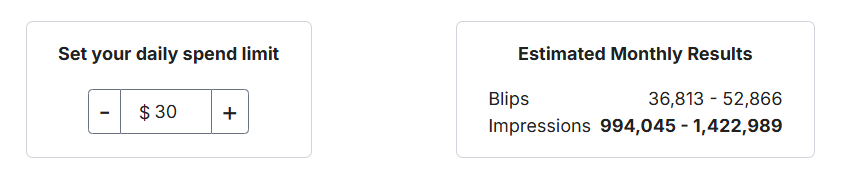
With Blip, you control exactly what you spend on Kenmore billboards by setting a daily budget that can be adjusted anytime, so you’re only paying for the 7.5–10 second ad displays, or “blips,” you actually receive. Because pricing is based on when and where you choose to run your message and on advertiser demand, you can start small, test different times and locations, and scale up as you see results from billboards near Kenmore, New York. With Blip’s pay-per-blip model, you can launch flexible, targeted digital billboard advertising in the Kenmore area on virtually any budget.
Where can I advertise with Blip near Kenmore, New York?
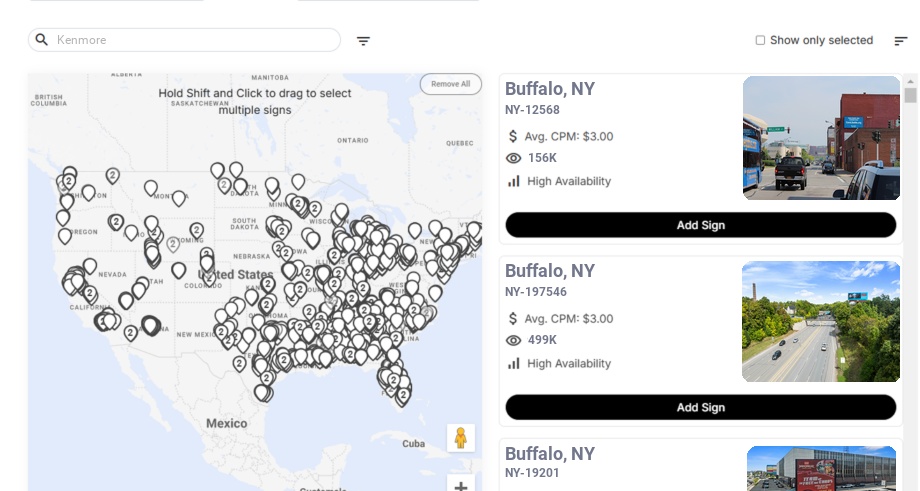
There are 6 nearby digital billboards in Buffalo serving the Kenmore area, helping you capture daily traffic moving between the Village of Kenmore, the Town of Tonawanda, and downtown Buffalo. Because these placements are within about 5–10 miles of Kenmore, they can intersect morning and afternoon commuter flows, shoppers, and event traffic. Nearby billboard options also include North and Northwest Buffalo placements, downtown and near-waterfront approaches, and interstate-adjacent boards near I-190 and I-290 corridors.
When is the best time to run Blip ads near Kenmore, New York?
Weekday vehicle volumes typically peak in the 7–9 a.m. and 3–6 p.m. windows, making those strong times for digital billboard scheduling near Kenmore. Around the Kenmore area, morning commute, lunch and mid-day errands, and evening commute traffic all create useful dayparts for advertisers. With Blip, you can increase blip frequency around peak times and focus your budget on the 4–6 hours per day when traffic is heaviest.
What kind of people do Kenmore billboards reach?
The Village of Kenmore has roughly 15,000 residents in less than 1.5 square miles, creating a dense local audience with a population density of around 10,000 residents per square mile. The broader Kenmore–Tonawanda area is a compact, commuter-heavy, middle-income, family-oriented market connected to Buffalo’s job centers and attractions. Roughly 25–30% of residents are under age 20 and around 15% are age 65+, creating opportunities to speak to both families and caregivers.
What roads and traffic do billboards near Kenmore, New York reach?
I-190 and I-290 are key corridors serving the Kenmore area, with annual average daily traffic ranging from 60,000–90,000 vehicles per day on key stretches. NY 266, NY 265, and Kenmore Avenue also function as primary surface routes, with typical AADT volumes often reaching 15,000–25,000 vehicles per day. Nearby commercial streets like Delaware Avenue, Elmwood Avenue, and Niagara Falls Boulevard see heavy retail and commuter volumes, especially around major shopping centers and business districts.
Do I need a contract to advertise with Blip near Kenmore?
No, Blip has no long-term contracts or minimum commitments. You can start, pause, or stop your campaign at any time.
How fast can I launch a billboard campaign with Blip near Kenmore?
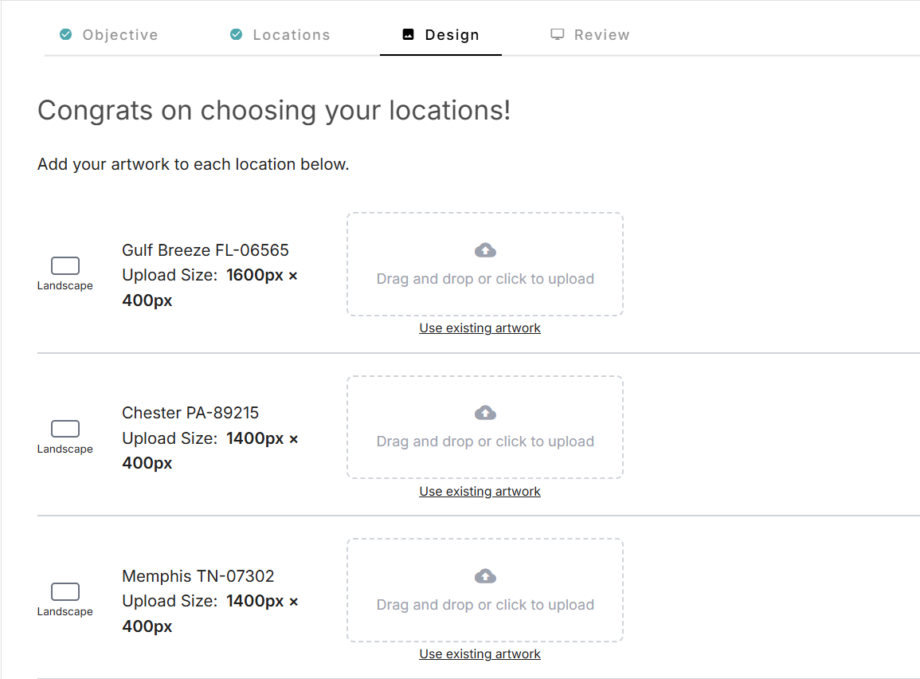
You can have your campaign live in minutes. Create a free account, select your locations, set your budget, upload your design, and start running once approved.
Where can I advertise with Blip near Kenmore?
Blip has digital billboards near Kenmore. You can browse available locations on a map, choose the ones that fit your audience, and start advertising right away.
Still have questions? Launch a campaign in minutes — no contracts, no commitments.
Start Your CampaignKenmore Billboard Advertising Guide
The Kenmore area sits at the heart of one of Western New York’s most active commuter and retail corridors. With 6 nearby digital billboards in Buffalo serving the Kenmore area, we can help you capture daily traffic moving between the Village of Kenmore, the Town of Tonawanda downtown Buffalo—precisely when and where your audience is on the road. For advertisers looking for billboards near Kenmore that still tap into the broader Buffalo metro, these placements offer high-impact, everyday visibility.
Understanding the Kenmore–Buffalo Market
The Kenmore area combines dense residential neighborhoods with easy access to major employment and entertainment centers, making it an ideal environment for Kenmore billboards that reach both local residents and regional commuters:
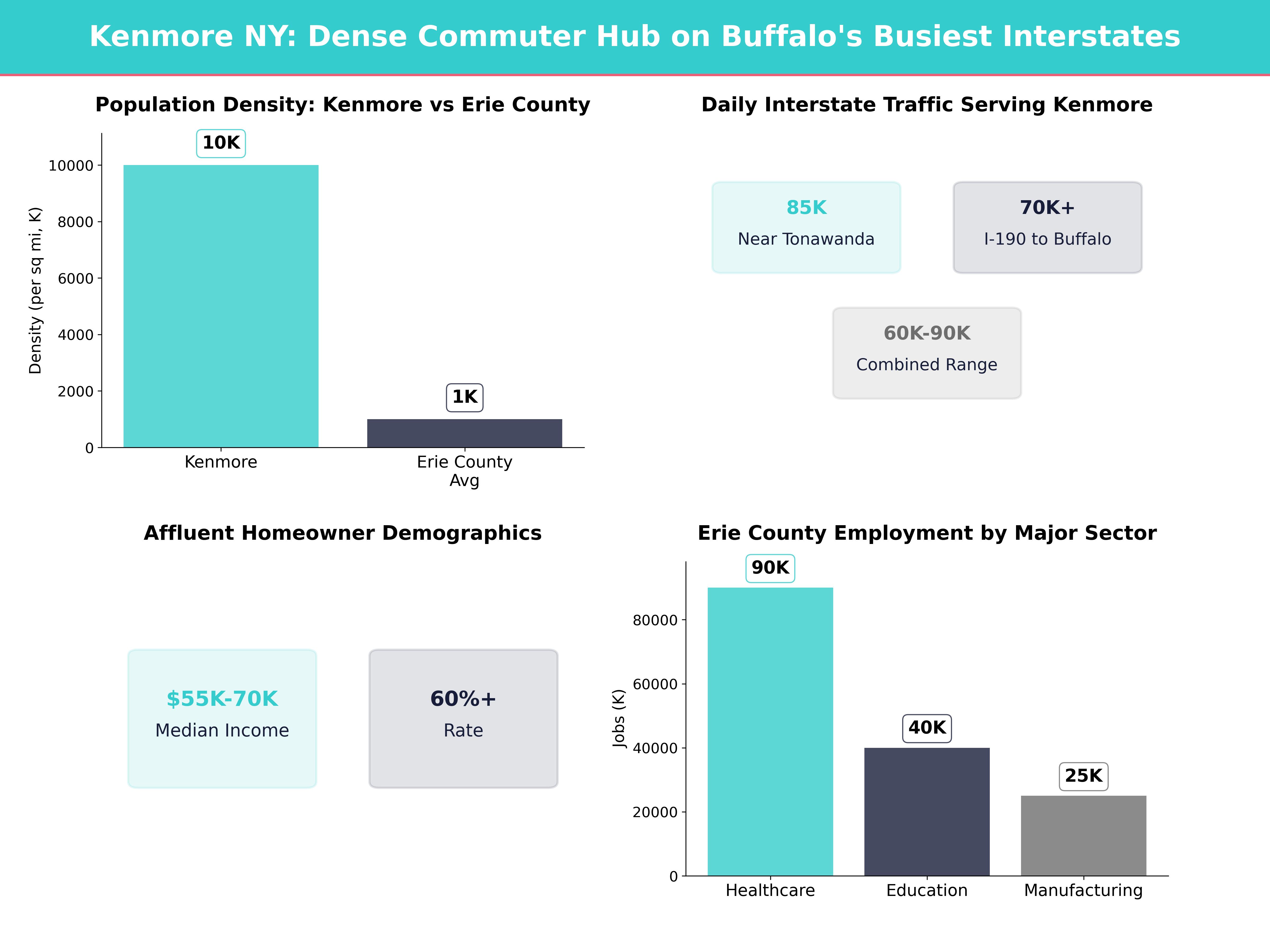
- The Village of Kenmore itself has roughly 15,000 residents in less than 1.5 square miles, translating to a population density of around 10,000 residents per square mile—significantly higher than the overall Erie County average of under 1,000 residents per square mile.
- Just to the south, the City of Buffalo has about 278,000 residents, while the Buffalo–Niagara Falls metro region is home to around 1.1 million people, accounting for nearly 60% of Western New York’s total population.
- Median household income in the broader Kenmore–Tonawanda area generally falls in the $55,000–$70,000 range, aligning with a solid middle‑income, owner‑occupied market where homeownership rates often exceed 60% in nearby neighborhoods.
- Commute times are manageable and consistent: typical one‑way commute times in the Kenmore–Tonawanda–Buffalo corridor average around 19–22 minutes, with more than 75% of workers driving alone and another 8–10% carpooling, feeding substantial daily traffic past key billboard locations.
- According to regional economic profiles from Erie County and the Buffalo Niagara Partnership, healthcare, education, financial services, logistics, and advanced manufacturing are major employment sectors. In Erie County, healthcare and social assistance alone support over 90,000 jobs, education services more than 40,000, and manufacturing around 25,000, drawing daily commuters past our Buffalo billboards and through the Kenmore area.
Useful local references for understanding the community include the Village of Kenmore, Town of Tonawanda, City of Buffalo, and the regional tourism site Visit Buffalo Niagara. For broader county‑level context, advertisers can also review resources from Erie County government to guide more effective billboard advertising near Kenmore.
What this means for advertisers:
You’re working with a compact, commuter-heavy, middle‑income, family-oriented market that is tightly connected to Buffalo’s job centers and attractions. In the Kenmore–Tonawanda area, roughly 25–30% of residents are under age 20 and around 15% are age 65+, creating opportunities to speak to both families and caregivers. Messaging near the Kenmore area performs best when it speaks to:
- Working professionals commuting to and from Buffalo’s downtown and medical corridors
- Families in the Kenmore–Tonawanda neighborhoods, where average household sizes are typically around 2.3–2.5 people
- College students and staff tied to nearby campuses (like the University at Buffalo’s South Campus, Buffalo State University, and other city colleges)
- Local shoppers headed to Niagara Falls Boulevard, Elmwood Avenue, downtown Buffalo, and suburban retail hubs in Amherst and Tonawanda
Key Traffic Corridors Serving the Kenmore Area
Our boards near Buffalo can tap into the traffic patterns that define daily life around Kenmore, giving billboard advertising near Kenmore exposure along the routes residents use most:
- I‑190 and I‑290:
New York State Department of Transportation (NYSDOT) traffic counts show annual average daily traffic (AADT) on key stretches of these interstates ranging from 60,000–90,000 vehicles per day. Some segments of I‑290 near the Town of Tonawanda regularly exceed 85,000 vehicles daily, while I‑190 segments approaching downtown Buffalo see 70,000+ vehicles. A large share of these drivers live or work in the Kenmore and Tonawanda area. - NY 266 (River Road), NY 265 (Military Road), and Kenmore Avenue function as primary surface routes connecting the Kenmore area to Buffalo’s riverfront industrial areas, North Buffalo, and the I‑190. On these arterials, typical AADT volumes often reach 15,000–25,000 vehicles per day, depending on the segment.
- Nearby commercial streets like Delaware Avenue, Elmwood Avenue, and Niagara Falls Boulevard see heavy retail and commuter volumes, especially around major shopping centers and business districts. Along Niagara Falls Boulevard in Amherst and Tonawanda, daily traffic on some stretches can exceed 30,000 vehicles, driven by big‑box retail, grocery, and restaurant clusters.
Because our 6 Buffalo billboards are within about 5–10 miles of Kenmore, we can position your messages to intersect:
- Morning and afternoon commuter flows to and from downtown Buffalo, where employment centers such as the Buffalo Niagara Medical Campus alone support more than 16,000 workers and students.
- Shoppers traveling between Kenmore, Amherst, the Town of Tonawanda, and Buffalo’s commercial districts, where large-format retail stores draw regional visitors from multiple counties.
- Event and game-day traffic heading to downtown venues and the waterfront. KeyBank Center, home of the Buffalo Sabres and Bandits, can host crowds of 18,000+ for major games and concerts, creating notable traffic spikes on event days.
For more detail on regional traffic and projects, you can follow NYSDOT Region 5 and local road updates from Erie County. Transit‑oriented advertisers may also find route and ridership information from NFTA Metro helpful when coordinating cross‑channel campaigns that complement your Kenmore billboards.
When to Run Your Blips Near Kenmore
Digital billboards let us adjust schedules to match real-life routines. Around the Kenmore area, audience behavior follows predictable patterns that mirror broader Buffalo–Niagara mobility data, where weekday vehicle volumes typically peak in the 7–9 a.m. and 3–6 p.m. windows. Smart timing is one of the best ways to get more value from billboard rental near Kenmore.
Weekday patterns
-
6–9 a.m. – Morning commute into Buffalo and nearby campuses. In many Buffalo‑area corridors, 35–40% of daily vehicle trips occur before 10 a.m. Ideal for:
- Service businesses (plumbing, HVAC, home services) addressing problems people notice at home before work
- Healthcare and dental practices promoting same‑day or before‑work appointments
- Quick-serve breakfast, coffee, and convenience targeting the 60–70% of commuters who stop for food or beverages at least occasionally on their way to work
-
11 a.m.–2 p.m. – Lunch and mid‑day errands. Many urban retail and restaurant districts see 15–20% of daily sales in this window:
- Restaurants and cafés promoting lunch specials or takeout
- Retail offers and daily specials for workers and nearby residents
- Medical and dental offices targeting same‑day/next‑day bookings and walk‑in services
-
3–7 p.m. – Evening commute and after‑school traffic. Local traffic counts often show a second daily peak here:
- Family-oriented brands as schools in the Kenmore‑Town of Tonawanda Union Free School District, which educates thousands of students, dismiss for the day
- Grocery, big‑box, and local retailers capturing after‑work shopping (evening visits often account for 40%+ of daily grocery traffic)
- Fitness centers and after‑school activities targeting parents and teens
Weekend patterns
- Retail corridors near the Kenmore area are busiest late morning through early evening on Saturdays, typically 11 a.m.–5 p.m., and early afternoon on Sundays, as many families consolidate errands and shopping trips into one or two outings.
-
Downtown Buffalo, Canalside, and the waterfront draw more visitors during:
- Sabres, Bandits, and other arena events at KeyBank Center, where regular-season NHL attendance often averages 15,000–17,000 fans per game.
- Summer festivals and outdoor concerts. Visit Buffalo Niagara reports that peak summer months can drive hundreds of thousands of visits to waterfront districts like Canalside.
- Major regional events promoted by Visit Buffalo Niagara and highlighted by local outlets such as The Buffalo News and WGRZ.
With Blip, we can:
- Increase your blip frequency around peak times (e.g., only during commuting hours), concentrating your budget on the 4–6 hours per day when traffic is heaviest.
- Focus higher bids on game days, holidays, or special events that align with your audience. For instance, Bills home games at nearby Highmark Stadium can draw crowds of 70,000+, boosting regional travel before and after kickoff.
- Run always‑on, low‑budget coverage for brand awareness, then layer in bursts of high-intensity exposure during key sales periods like back‑to‑school, Black Friday, or tax season.
Tailoring Creative to the Kenmore Area Audience
Because residents in the Kenmore area frequently travel into Buffalo and nearby suburbs, your creative should feel both hyper‑local and regionally relevant so that billboards near Kenmore look and sound like part of daily life.
1. Keep it simple and bold
Drivers typically have 6–8 seconds to absorb a message:
- Use no more than 7–10 words of main copy; studies of roadside advertising show that recall drops sharply once you exceed about 10–12 words.
- Prioritize 1 primary CTA (e.g., “Exit Now on Delaware” or “Book Today – Kenmore Area”), as single‑focus messages can improve recall by up to 30% compared with crowded layouts.
- Use high‑contrast color pairings (e.g., dark blue + white, black + yellow) that remain legible in snow, rain, and low winter light—conditions Buffalo experiences frequently, with average annual snowfall of roughly 90–100 inches.
2. Localize for trust and recognition
Kenmore area residents respond well to real local signals, which is critical when you’re investing in billboard advertising near Kenmore:
- Mention neighborhood landmarks: “Serving the Kenmore–Tonawanda area,” “Minutes from Kenmore Avenue,” or “Near Delaware & Kenmore.”
-
Feature recognizable visuals:
- Buffalo skyline or grain elevators in the distance
- Suburban streetscapes or family homes reflecting Kenmore and Tonawanda neighborhoods
- Include distance-based calls to action, like “3 miles ahead on Niagara Falls Blvd” for retail destinations. Location cues like distance or exit numbers can increase response rates by 10–20% in many OOH campaigns.
3. Reflect seasons and local culture
Western New Yorkers are very season-aware, and it shows in their behavior:
-
Winter (Dec–Mar) – Heavy snow and early sunsets (sunset before 5 p.m. for much of December and January):
- Focus on clear, bright colors and larger fonts.
- Emphasize services related to home heating, auto care, indoor recreation, and tax preparation; local tax preparers often see 30–40% of annual volume in the last 6 weeks before April filing deadlines.
-
Spring (Apr–May) – Home improvement and graduation season:
- Home services, landscaping, roofing, and contractors perform well as homeowners tackle projects after months of snow and freeze.
- Highlight graduation gifts, formalwear, and event venues as high schools and colleges such as University at Buffalo and Buffalo State University hold ceremonies.
-
Summer (Jun–Aug) – Tourism and festival peak:
- Promote attractions, restaurants, summer camps, and outdoor activities; Buffalo Niagara International Airport 4–5 million passengers per year, with summer months among the busiest.
- Use event‑driven creative keyed to local festivals and waterfront activities that can draw tens of thousands of attendees over a weekend.
-
Fall (Sep–Nov) – Back-to-school and football:
- Target families, educators, and college students. Area school districts and colleges collectively bring tens of thousands of students back each fall.
- Promote school supplies, tutoring, fitness, cold‑weather prep, and football‑themed offers aligned with the Buffalo Bills and local high school sports.
Aligning creative with the local calendar can lift recall and engagement significantly—often by 15–25%—especially when paired with schedule adjustments using Blip.
Using Nearby Buffalo Boards to Reach Specific Segments
Our 6 digital billboards in Buffalo serving the Kenmore area can be strategically chosen to emphasize particular segments and maximize the impact of your Kenmore billboards:
-
North and Northwest Buffalo placements
- Best for Kenmore and Town of Tonawanda residents commuting into the city via Delaware Avenue, Kenmore Avenue, or Elmwood Avenue.
- Ideal for businesses along Delaware Avenue, Elmwood Avenue, and Niagara Falls Boulevard that rely on customers within a 5–10 mile radius.
-
Downtown and near‑waterfront approaches
- Reach Kenmore area residents attending events, nightlife, or working downtown, where office employment and government jobs cluster in a relatively compact central business district.
- Great for entertainment venues, bars, restaurants, and cultural institutions like museums and theaters that depend on both city workers and suburban visitors.
-
Interstate-adjacent boards (near I‑190/I‑290 corridors)
- Capture regional through‑traffic that still shops or works near the Kenmore area, including drivers coming from Niagara County, Amherst, and other suburbs.
- Strong for regional brands, healthcare systems, and auto dealers, which often draw customers from 20–30 miles away.
With Blip’s location tools, we can constrain campaigns to only show on the boards that intersect your best audience flows, instead of paying for impressions that don’t touch the Kenmore area. This selective targeting helps small and mid‑sized advertisers operate with efficiency similar to large national brands and makes billboard rental near Kenmore more cost-effective.
Campaign Ideas by Business Type
Below are practical ways advertisers can leverage our boards near Buffalo to target the Kenmore area and get more out of billboard advertising near Kenmore.
Local Retailers & Restaurants
- Run lunch and dinner campaigns on weekdays from 11 a.m.–2 p.m. and 4–7 p.m. with calls-to-action like “Tonight in the Kenmore area – Kids Eat Free.” Many casual dining restaurants see over half of daily revenue during these two windows.
- Promote limited‑time offers tied to local events publicized through outlets like The Buffalo News, WGRZ, and WKBW, then spike your budget during those event windows.
-
Use separate creatives for:
- “Weekday Workers” (office‑friendly messaging emphasizing speed, online ordering, and delivery)
- “Weekend Families” (family meals, promotions, or kids’ activities), as weekend family traffic can be 20–30% higher than weekday evenings in some retail corridors.
Home Services & Contractors
The Kenmore area’s housing stock includes many older homes that require ongoing upkeep—many properties were built before 1960, and a significant share before 1940:
- Emphasize emergency and seasonal services: “Frozen pipe?” in winter, “Roof leaking?” in spring. In cold‑weather regions like Buffalo, freeze–thaw cycles and lake‑effect snow contribute to higher demand for roofing, plumbing, and foundation repair.
- Schedule increased impressions around early morning and evening commutes, when homeowners are most likely thinking about unresolved problems they noticed before work or returning home.
- Use “Serving the Kenmore–Tonawanda area” messaging to emphasize quick response and local expertise. Local, proximity‑based messaging can help improve call rates, especially in neighborhoods where residents value contractors within a 10–15 minute drive.
Healthcare, Dental, and Professional Services
- Highlight proximity: “5 minutes from Kenmore Avenue” or “Serving patients in the Kenmore–Buffalo area.” Many patients prefer providers within 5–7 miles of home or work.
- Promote new patient offers, same‑day urgent care, or extended hours on evenings/weekends. In many markets, roughly 25–30% of urgent care visits occur outside traditional 9–5 hours.
- Time campaigns near open enrollment periods (typically Oct–Dec) and back‑to‑school season (Aug–Sep), when families are selecting providers and scheduling physicals, dental cleanings, and vaccinations.
Education & Youth Programs
With strong family presence in the Kenmore area and multiple nearby schools:
-
Run Back-to-School and Summer Program campaigns from:
- Mid‑July to early September (school prep), when families finalize supplies, clothing, and activities.
- March to June (summer camp signups), which is when many camps secure 60–70% of their registrations.
- Hyper-focus on weekday 3–7 p.m. to reach parents on school pick‑up routes and after‑school errands, especially along main corridors like Delaware Avenue, Kenmore Avenue, and Colvin Boulevard.
- Consider partnering billboard messaging with digital campaigns targeting ZIP codes associated with the Kenmore‑Town of Tonawanda Union Free School District.
Events, Arts & Entertainment
Buffalo’s vibrant event scene frequently draws Kenmore area residents downtown:
- Use Blip’s dayparting to show event countdown creatives only during the 7–11 days leading up to an event, increasing intensity on the last 72 hours, when ticket sales often spike by 20–40%.
- Integrate dynamic elements like “This Saturday 7 PM – Downtown Buffalo” where appropriate to encourage immediate action.
- Coordinate messaging with promotional pushes from organizations like Visit Buffalo Niagara and local venues, and consider syncing flight dates with media coverage in outlets such as The Buffalo News and local TV stations.
Optimizing With Blip’s Flexible Tools
Our platform allows advertisers targeting the Kenmore area to behave more like performance marketers, even on giant screens, and to fine‑tune billboard rental near Kenmore based on real results:
-
Budget control down to the dollar
Start with as little as a few dollars per day and observe:- Which boards deliver the most impressions during your key hours; for example, you might see 50–70% of impressions clustering around peak commute times.
- How different creative messages perform alongside other channels (search, social, etc.), watching for lifts in direct traffic and conversions in Kenmore‑adjacent ZIP codes.
-
Dayparting and date targeting
Activate or pause campaigns by:- Time of day (e.g., only 6–10 a.m. weekdays) to align with specific commuting patterns.
- Specific days (e.g., Fri–Sun for weekend retail), when some categories—restaurants, entertainment, home improvement—can see 30–50% higher sales than mid‑week.
- Short seasonal windows (e.g., 10‑day tax promotion in April or 2‑week sales events), making it possible to concentrate spend when purchase intent is highest.
-
Creative testing (A/B)
Run two or more creatives simultaneously near the Kenmore area:- Test different offers (“$50 Off” vs. “Free Consultation”) to see which drives a larger lift in calls or web visits.
- Vary imagery (product-focused vs. people-focused). In many OOH campaigns, simple A/B tests can uncover 10–25% performance differences between concepts.
- After initial results, direct more budget to the highest-performing message and further refine color, font size, and CTA.
Measuring Impact in the Kenmore Area
While out‑of‑home advertising doesn’t use clicks, we can still measure impact in practical ways for campaigns focused on billboards near Kenmore:
-
Correlate with web analytics
Watch for increases in:- Direct website visits and branded search volume (“[Your Brand] Kenmore”), especially during and immediately after campaign windows.
- Calls or form fills from ZIP codes in and around the Kenmore area (such as 14217, 14223, 14207, and 14216).
- Local traffic to location pages or “directions” clicks, which often rise 10–30% during effective OOH campaigns.
-
Use trackable offers
- Promo codes specific to “KENMORE” or “RIVERROAD,” allowing you to attribute redemptions directly to local billboard activity.
- Landing pages or phone numbers used only in your billboard campaign. Unique URLs and call‑tracking numbers make it easier to calculate cost per lead or cost per visit.
-
Monitor foot traffic and sales
- Compare sales or walk‑ins during campaign periods vs. typical weeks. Retailers frequently see 5–20% lifts in sales during well‑timed OOH flights.
- Ask new customers, “How did you hear about us?” and track the responses in a simple spreadsheet or POS system.
- If you operate multiple locations, compare performance of Kenmore‑adjacent stores with those outside the billboard exposure area.
By layering these insights with Blip’s impression reports and scheduling data, we can refine your approach to reach the Kenmore area more efficiently each month, shifting budget toward the times, boards, and messages that consistently deliver results from billboard advertising near Kenmore.
By pairing the dense, commuter‑heavy Kenmore area with strategically placed digital billboards in nearby Buffalo, we can build campaigns that are precise, flexible, and budget‑friendly. With localized messaging, smart scheduling, and ongoing optimization, advertisers of any size can tap into daily life along one of Western New York’s most traveled corridors and convert regular Kenmore–Buffalo trips into measurable business outcomes through well‑planned billboard rental near Kenmore.