Billboards near Queens, NY
No Minimum Spend. No Long-Term Contracts. Just Results.
Trusted by Leading Brands


Billboard advertising
near Queens has never been easier
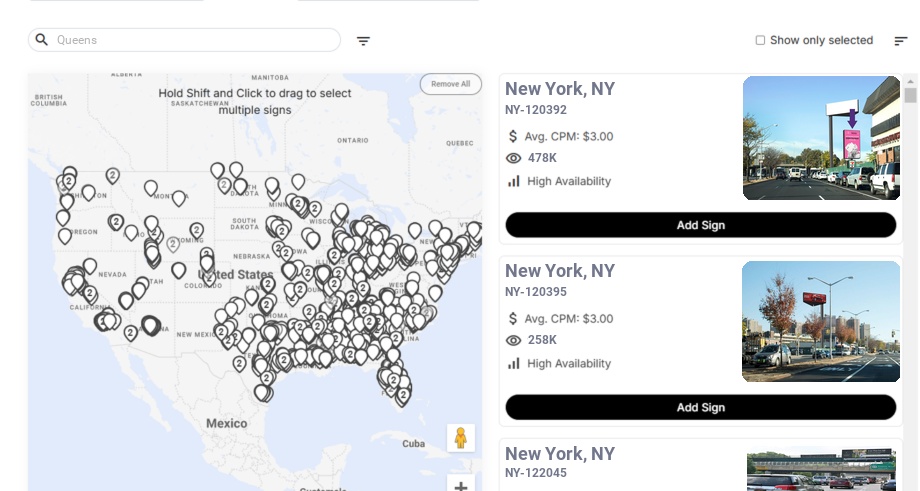



How much is a billboard near Queens?
Why Choose Blip for Billboard Advertising near Queens
Blip lets you launch Queens billboards fast and self-serve, reaching commuters on the BQE, LIE, and Grand Central Parkway without a long setup.
Set flexible budgets in Queens and pay only for the blips you use—great for testing rush-hour reach near JFK, LaGuardia, and Flushing.
Use dayparting on Blip to hit Queens weekday commuters, midday shoppers in Jamaica, and weekend crowds heading to Citi Field or the U.S. Open.
No contracts means you can run Queens campaigns for seasonal spikes, then pause or pivot as airport traffic and borough travel patterns change.
Track Queens results in real time and shift spend toward routes and creatives that perform best across Flushing, Jackson Heights, and Long Island City.
Blip’s creative tools help you tailor quick, eye-catching ads for Queens’ multilingual audience and high-speed highway views in just a few words.
Frequently Asked Questions About Billboard Advertising near Queens
How much does a billboard cost near Queens, New York with Blip?
With Blip, you control exactly what you spend on Queens billboards by setting a daily budget that can be adjusted any time, so your ads in the Queens area always stay within your comfort zone. Each “blip” is a brief 7.5–10 second slot on digital billboards near Queens, New York, and you only pay for the blips you receive, similar to pay-per-click online ads. Costs per blip vary based on when and where your ads run and current advertiser demand, but Blip’s pay-per-blip model means every dollar goes directly toward showing your message.
Where can I advertise with Blip in Queens, New York?
With 170 digital billboards near Queens—primarily in nearby New York City, Brooklyn, and Hempstead—we can help you build flexible, data-informed campaigns and billboard advertising near Queens that follow your audience across their daily journeys. Our digital billboards serving the Queens area are primarily located in New York, New York, Brooklyn, New York, and Hempstead, New York. These locations align with high-traffic roadways and transit feeders that serve Queens residents and visitors.
What makes Queens, New York a strong market for billboard advertising?
Queens is the largest New York City borough by land area and the second-largest by population, with around 2.4 million people living there. The borough’s scale and its position between Manhattan, Brooklyn, and Long Island make the Queens area a prime zone for high-frequency out-of-home exposure. This constant circulation means advertisers can use digital billboards near Queens to hit residents at scale and influence purchase decisions throughout greater New York.
When is the best time to run Blip ads near Queens, New York?
Weekday rush hours, roughly 6:30–10:00 a.m. and 4:00–7:30 p.m., are especially valuable because MTA ridership data show peak hours can be 40–50% higher than midday baselines on key commuter routes. Midday is good for stay-at-home parents, freelancers, shift workers, students, and tourists, while evenings and late night are ideal for nightlife, entertainment, food delivery, streaming, and quick-service restaurants. Weekend traffic often skews toward shopping, family activities, and leisure trips.
Who should use billboard advertising near Queens, New York?
Queens has about 2.4 million residents and a balanced age mix, with roughly 60% in prime working ages 18–64. It is also highly diverse, with over 160 languages spoken locally and no single ethnic group holding a majority. That makes billboard advertising near Queens a strong fit for brands using bilingual or multilingual messaging, inclusive imagery, and segmented creative for different product tiers.
Do I need a contract to advertise with Blip near Queens?
No, Blip has no long-term contracts or minimum commitments. You can start, pause, or stop your campaign at any time.
How fast can I launch a billboard campaign with Blip near Queens?
You can have your campaign live in minutes. Create a free account, select your locations, set your budget, upload your design, and start running once approved.
Where can I advertise with Blip near Queens?
Blip has digital billboards near Queens. You can browse available locations on a map, choose the ones that fit your audience, and start advertising right away.
Still have questions? Launch a campaign in minutes — no contracts, no commitments.
Start Your CampaignQueens Billboard Advertising Guide
Queens is one of the most diverse and commercially dynamic places in the country, and digital Queens billboards serving the Queens area give brands a way to reach residents, commuters, and travelers as they move between boroughs and Long Island. With 170 digital billboards near Queens—primarily in nearby New York City, Brooklyn, and Hempstead—we can help you build flexible, data-informed campaigns and billboard advertising near Queens that follow your audience across their daily journeys.

Why the Queens Area Is a Billboard Powerhouse
Queens is the largest New York City borough by land area (about 108 square miles) and the second-largest by population. Around 2.4 million people live in Queens, contributing to New York City’s total population of roughly 8.5 million, according to profiles from NYC.gov and the Office of the Queens Borough President
The borough’s scale and its position between Manhattan, Brooklyn, and Long Island make the Queens area a prime zone for high-frequency out-of-home exposure and a natural fit for Queens billboards that catch people moving in every direction.
A few key demand drivers:
-
Commuting intensity
- Before the pandemic, more than 1 million NYC residents crossed a county line for work every day, and Queens was a major contributor to that flow.
- The MTA has reported pre-pandemic weekday ridership of about 5.5 million subway trips and 2.1 million bus trips systemwide. In 2023, average weekday subway ridership rebounded to roughly 3.6 million trips, and buses to about 1.4 million trips**, maintaining millions of daily movements connecting Queens with Manhattan, Brooklyn, and Nassau County.
- Bridges and crossings that serve Queens—such as the Ed Koch Queensboro Bridge Robert F. Kennedy Bridge 100,000–150,000 vehicles per day on typical weekdays, based on traffic counts referenced by NYC DOT
-
Air travel and tourism
- John F. Kennedy International Airport 62.6 million passengers in 2019, and Port Authority data show the airport returning to tens of millions of passengers annually as travel recovers, making it one of the busiest international gateways in the country.
- LaGuardia Airport 31 million passengers in 2019 and continues to grow following its multi‑billion‑dollar redevelopment. Combined, JFK and LaGuardia regularly process 70+ million passengers in a strong travel year.
- Citywide, NYC & Company 56 million in recent years, with pre‑pandemic peaks above 65 million. Queens captures a meaningful share of these visitors thanks to its 120+ hotels, Flushing Meadows Corona Park Citi Field, and the USTA Billie Jean King National Tennis Center
-
Retail and small business density
- Queens is home to tens of thousands of businesses and more than 60,000 small businesses across sectors such as retail, food service, logistics, healthcare, and professional services, according to business counts referenced by the Queens Chamber of Commerce and Queens Economic Development Corporation.
- Commercial hotspots like Flushing, Jackson Heights, Astoria, Long Island City, and Jamaica fuel billions of dollars in annual consumer spending. For example, retail corridors such as downtown Flushing and Jamaica Center each draw tens of thousands of pedestrians on a busy shopping day, supported by subway and bus hubs highlighted by the MTA.
- Many of these workers and customers commute across boroughs or into Nassau County daily—exactly the routes where our digital billboards are concentrated.
This constant circulation means advertisers can use digital billboards near Queens and other Queens billboards not only to hit residents at scale, but to influence purchase decisions throughout greater New York’s $900‑billion‑plus metro economy, as described in regional economic summaries from NYCEDC
Understanding the Queens Audience
Crafting effective billboard advertising near Queens starts with understanding who you’re talking to. According to city and borough profiles from the Office of the Queens Borough President NYC government:
-
Population size and structure
- About 2.4 million residents, representing roughly 28% of New York City’s total population.
-
A balanced age mix:
- About one‑quarter of residents are under 18.
- Roughly 60% fall into prime working ages 18–64.
- Seniors 65+ account for around 15%, a share that has been slowly rising as New Yorkers age in place.
-
Diversity
- Roughly 46–48% of Queens residents are foreign‑born, one of the highest shares of any large county in the U.S., as highlighted by the Queens Borough President
- Over 160 languages are spoken locally. Major language communities include Spanish, Chinese (Mandarin and Cantonese), Korean, Bengali, Russian, Urdu, and many more, which is why the borough is often branded “the world’s borough” by organizations such as Discover Queens.
- No single ethnic group holds a majority: large communities of Asian, Hispanic/Latino, Black, and White residents make the audience inherently multicultural.
-
Income and spending power
- Median household income hovers around $70,000–$75,000, close to or slightly above the overall New York City median, with substantial variation between neighborhoods (from below $50,000 in some areas to well over $100,000 in others).
- Hundreds of thousands of households have disposable income suitable for mid‑market and premium brands, while others are highly price‑sensitive, creating room for both value and luxury positioning.
- Queens residents collectively drive several tens of billions of dollars in annual retail, dining, and service spending, according to retail market assessments from NYCEDC Queens Chamber of Commerce.
What this means for your campaigns serving the Queens area:
- Consider bilingual or multilingual messaging
Short bilingual messages (e.g., English + Spanish; English + Chinese) can be powerful near Queens. In neighborhoods such as Jackson Heights and Corona, Spanish speakers make up 50%+ of residents; in Flushing and parts of Bayside, Asian language communities can represent 40–60% of the local population, making language‑specific creative especially relevant. Keep translations short and legible at a distance. - Feature inclusive imagery
Use visuals that reflect a broad range of ages, ethnicities, and family types. Ads that “look like Queens” tend to feel more relevant and perform better in brand‑lift and recall studies reported by out‑of‑home industry groups and reinforced by case studies covered in outlets like QNS.com. - Segment by product tier
With both budget‑sensitive and affluent enclaves, you can use different creatives to highlight value pricing on some boards while emphasizing premium quality or luxury positioning on others. For example, neighborhoods close to luxury rentals and condos in Long Island City or Astoria have seen median rents climb above $3,000 per month, while other areas retain more moderate rent levels.
Key Travel Corridors and Where Our Boards Fit
Our 170 digital billboards serving the Queens area are primarily located in:
-
New York, New York (Manhattan and the broader city core, ~6.2 miles from Queens)
Ideal for:- Targeting Queens residents commuting to Manhattan jobs. Pre‑pandemic, about 1 million commuters entered Manhattan’s central business districts each workday, with Queens supplying a substantial share via subway, bus, and bridges, according to data referenced by NYCEDC
- Reaching tourists staying in Manhattan hotels but visiting Queens attractions or airports like Citi Field and the USTA Billie Jean King National Tennis Center
- Branding for businesses in Queens that want to be seen as “citywide players” and tap into Manhattan’s high‑spend consumer and business audiences.
-
Brooklyn, New York (~8.6 miles from Queens)
Ideal for:- Reaching drivers and transit riders between Queens, Brooklyn, and Lower Manhattan. Cross‑borough commuters number in the hundreds of thousands on a typical weekday, supported by subway lines such as the G, J, M, L, N, R, W, and 7 connections highlighted by the MTA.
- Tapping into younger demographics and creative professionals who live in Brooklyn but work or socialize near Queens. Brooklyn and Queens together account for nearly 5 million residents, forming a dense bi‑borough market for lifestyle and entertainment brands.
- Promoting nightlife, dining, and culture that appeals across both boroughs—such as venues in Williamsburg, Greenpoint, and Long Island City that share overlapping audiences.
-
Hempstead, New York (~9.8 miles from Queens)
Ideal for:- Connecting Queens‑based businesses with Long Island customers who travel toward the city for work or recreation along corridors like the Long Island Expressway (I‑495) and Grand Central Parkway. These roadways carry hundreds of thousands of vehicles per day between Nassau County and NYC, according to corridor summaries from NYSDOT Region 10.
- Promoting regional services (healthcare, education, auto dealers, home improvement) that draw from both Queens and Nassau County.
- Capturing weekend and leisure traffic between the city and the suburbs, including visitors heading to beaches, malls, and major retailers.
Strategically, these locations align with high‑traffic roadways and transit feeders that serve Queens residents and visitors, including:
- Bridges and tunnels leading to Manhattan, such as the Ed Koch Queensboro Bridge Robert F. Kennedy Bridge Queens–Midtown Tunnel tens of thousands to over 100,000 daily vehicle crossings.
- Arterial roads connecting Queens to Brooklyn and Nassau County, including the Brooklyn‑Queens Expressway, Belt Parkway, and Long Island Expressway, as maintained by NYSDOT and NYC DOT.
- Corridors used by airport traffic heading to/from JFK and LaGuardia, where Port Authority of New York and New Jersey counts show tens of thousands of daily vehicle trips during peak travel periods.
We can help you align specific boards to your audience’s most likely travel paths—commuters, airport travelers, or suburban‑city crossers—so your impressions are concentrated where movement is densest and your billboards near Queens deliver maximum value.
Timing Your Campaign in the Queens Area
With digital, you decide when your message appears. The Queens area has clear temporal patterns you can leverage, reflecting both commuting and airport travel waves described by the MTA and Port Authority:
-
Weekday rush hours (approx. 6:30–10:00 a.m. and 4:00–7:30 p.m.)
- MTA ridership data show that peak hours can be 40–50% higher than midday baselines on key commuter routes, which translates into especially valuable exposures during these windows.
- Ideal for: Commuter‑focused messaging—B2B services, financial institutions, education, job recruitment, and mass‑market consumer brands.
- Use concise calls‑to‑action like “This week only,” “On your way home, stop at…,” or “Now hiring in the Queens area.”
-
Midday (10:00 a.m.–3:00 p.m.)
- Good for: Stay‑at‑home parents, freelancers, shift workers, service workers, students, and tourists. Midday ridership remains substantial—often 60–70% of peak volumes on many subway and bus lines—providing cost‑efficient reach.
- Promote lunch specials, weekday retail offers, medical appointments, and attractions that benefit from off‑peak visitors.
-
Evenings and late night (7:30 p.m.–midnight)
- Focus on: Nightlife, entertainment, food delivery, streaming, and quick‑service restaurants. Evening entertainment districts such as Astoria and Long Island City experience noticeable spikes in foot traffic and transit usage on Thursday–Saturday evenings, as covered in local outlets like NY1 Queens and QNS.com.
- In neighborhoods feeding into Queens nightlife, spotlight bars, lounges, theaters, and live events.
-
Weekend patterns
- Saturday traffic often skews toward shopping, family activities, and leisure trips. Retail and entertainment destinations in Queens and nearby Long Island see strong Saturday afternoon peaks, with some malls and big‑box centers reporting 20–30% of weekly visits on weekends.
- Sunday has strong relevance for grocery, big‑box retail, religious and community events, and sports content—especially during baseball season at Citi Field or the U.S. Open at the USTA Billie Jean King National Tennis Center
With Blip-style tools, you can:
- Concentrate spending on key dayparts instead of paying for 24/7 exposure.
- Increase your “blips” during a product launch, sale, or event, then reduce once awareness is built.
- Run different creatives by day of week—e.g., weekday commuter messages vs. weekend family offers—aligned with the real behavior patterns you see in your own POS or website traffic data.
Creative Strategies That Resonate Near Queens
In a visually noisy environment like New York, strong creative is essential. For boards serving the Queens area:
-
Simplicity wins
- Aim for 6–8 words max plus a logo and a single visual focal point. Traffic traveling at 30–50 mph often has only 3–6 seconds of viewing time per impression.
- Use high contrast: bright text on dark backgrounds or vice versa.
- Avoid dense paragraphs and small logos; drivers have only a few seconds.
-
Location-based relevance
- Reference proximity in ways like “Minutes from Queens,” “Near JFK & LaGuardia,” or “Serving the Queens area.” When you choose billboards near Queens, location callouts help audiences quickly connect your message to their daily routes.
- For casinos, malls, or attractions outside the borough, show clear distance or exit numbers (e.g., “30 minutes from Queens via LIE”). Highway wayfinding tests show that including simple distance cues can increase recall by 10–20 percentage points compared with generic branding.
-
Use cultural and seasonal hooks
- Align with local events highlighted by NYC & Company QNS.com, the Queens Daily Eagle, or NY1 Queens.
-
Reference:
- Lunar New Year, Diwali, and other major cultural holidays celebrated by Queens communities, which can draw tens of thousands of participants to neighborhood celebrations.
- Mets season at Citi Field (regular season home attendance often exceeds 2 million fans per year), U.S. Open tennis in Flushing Meadows (over 700,000 spectators in strong years), and summer concerts in Flushing Meadows Corona Park
- Rotate creative to match these moments (e.g., “Post-game drinks near Queens” during Mets home games or “Explore Queens food after the U.S. Open”).
-
Language strategy
- Keep multilingual lines very short; do not simply double your English copy length. With average viewing times under 6 seconds, cluttered text dramatically reduces legibility.
-
Consider:
- English headline; secondary line in another language.
- Rotating separate language creatives by time of day, aligned to neighborhood usage patterns—for instance, running more Spanish copy on routes serving Corona, Jackson Heights, and Elmhurst, and more Chinese or Korean copy on routes feeding Flushing and Bayside.
-
Clear calls-to-action that are easy to recall
- Use memorable URLs, short promo codes (“QUEENS20”), and distinct brand names. Billboards often generate “second‑screen” responses on mobile devices; short, unique phrases are easier to type on a phone.
- For phone numbers, include only if they’re very short or vanity numbers; otherwise, prioritize web/app mentions.
Using Blip Tools to Target the Queens Area
Digital billboards near Queens, offered as flexible billboard rental near Queens, give you precise control:
-
Budget flexibility
- Set a daily or total budget that fits your goals, from small tests to large regional pushes. Many businesses start with a few hundred dollars spread across several boards to gather baseline performance data.
- Start with a modest spend spread across several boards to identify high‑performing routes, then reallocate to the best locations as you observe where web traffic, store visits, or calls spike.
-
Geographic selection
- Choose boards in Manhattan that primarily capture Queens commuters traveling via bridges, tunnels, and major subway hubs like Times Square–42 St and Grand Central–42 St.
- Add Brooklyn locations that align with cross‑borough traffic, especially along the BQE and Williamsburg/Greenpoint bridge approaches.
- Extend into Hempstead to reach Long Island residents likely to shop or work in the Queens area, including those traveling to JFK LaGuardia
- Create tiers: “core Queens commuter” boards vs. “regional reach” boards to manage frequency and budget by audience value and tailor your billboard advertising near Queens accordingly.
-
Creative rotation and testing
-
Run multiple creatives simultaneously to A/B test different:
- Offers (percent‑off vs. dollar‑off)
- Visuals (product‑focused vs. lifestyle)
- CTAs (website vs. app vs. in‑store visit)
- After a few weeks, compare performance using your own metrics (web traffic from Queens, store visits, promo code usage) and pause underperforming versions. Marketers often see 10–30% performance swings between best‑ and worst‑performing creatives, so ongoing testing materially improves ROI.
-
Run multiple creatives simultaneously to A/B test different:
-
Event and weather responsiveness
-
Adjust schedule or creative around:
- Major storms (promote delivery, streaming, or indoor entertainment). New York City sees about 120–130 rainy days per year, according to climatology summaries referenced by the National Weather Service New York office, making weather‑adaptive messaging particularly useful.
- Heat waves (cold beverages, pools, cooling services).
- Big games or cultural events that drive spikes in traffic—for example, Mets home stands, the U.S. Open, parades, or street festivals promoted by NYC Parks NYC & Company
-
Adjust schedule or creative around:
Campaign Ideas by Industry Near Queens
Here are practical concepts tied to how people move through the Queens area and its surroundings:
Retail & E‑commerce
- Use Manhattan and Brooklyn boards to highlight “Free same‑day delivery to the Queens area” or “Pick up in Queens—order online.” E‑commerce and same‑day delivery have become standard expectations in NYC, where more than 80% of households have internet access and dense neighborhoods enable fast logistics.
- On Hempstead‑area boards, promote “City style, Queens prices—worth the drive” to attract suburban shoppers to Queens outlets, discount centers, or specialty retailers, especially when combined with limited‑time promotions during holiday peaks.
Restaurants, Groceries, and Food Delivery
-
During evening rush hours near Manhattan and Brooklyn boards:
- “Dinner in 20 minutes once you’re near Queens—Order now, arrive to hot food.” This pairs well with app‑based delivery, which has seen double‑digit annual growth in dense urban markets like NYC.
-
Weekends:
- “Brunch near Queens this weekend—Scan & reserve” (paired with a short URL or QR in static contexts like nearby print ads and social media).
- Highlight neighborhood food districts—Astoria for Mediterranean, Jackson Heights for South Asian and Latin American cuisines, and Flushing for East Asian dining—often featured in guides from NYC & Company Discover Queens.
Real Estate and Home Services
-
For new developments or rentals near Queens:
- Highlight commute savings: “Cut your commute to 20 minutes—Live near Queens, work in Midtown.” Many Queens–Manhattan commutes fall within 20–35 minutes by subway, a major selling point versus outer‑suburban travel times.
-
Home services (contractors, HVAC, landscaping) can target Hempstead and city boards with:
- “Trusted home pros for the Queens area—Book today.”
- Emphasize local credibility by referencing service footprints—“Serving Queens for 20+ years”—which resonates in neighborhoods with high homeownership pockets such as parts of Eastern Queens.
Healthcare and Education
-
Use daytime boards to reach parents and seniors:
- “Top‑rated urgent care serving the Queens area—Open 7 days.” Queens hosts major healthcare providers such as NYC Health + Hospitals/Elmhurst and NYC Health + Hospitals/Queens, as well as extensive private clinic networks.
- “Trade programs one subway ride from Queens—Enroll this semester.” Institutions like CUNY Queens College and LaGuardia Community College draw tens of thousands of students each year, many commuting via subway and bus.
- Time enrollment and screening campaigns with back‑to‑school periods and health awareness months, supported by local coverage from outlets like QNS.com or NY1 Queens.
Tourism, Entertainment, and Events
-
For museums, arenas, and cultural centers near Queens:
- Target Manhattan tourists with “Don’t miss Queens—NYC’s most diverse food & culture, one train away.” Attractions such as MoMA PS1, The Museum of the Moving Image Flushing Meadows Corona Park NYC & Company
- Align creatives with visitor peaks reported by NYC & Company 10–30% above off‑season levels.
- Promote major events like the U.S. Open, New Year’s and Lunar New Year celebrations, street fairs, and cultural festivals that draw tens of thousands of attendees to Queens on single days.
Measuring and Optimizing Performance
To make the most of digital billboards serving the Queens area:
-
Define concrete KPIs before launch
- Web sessions from Queens and adjacent ZIP codes (e.g., 113, 114, 111, 110 series).
- Promo code usage (e.g., “QUEENS10”).
- Store foot traffic during scheduled campaign hours, measured via POS timestamps or footfall analytics.
- App installs or signups from New York IP addresses or device locations. Many advertisers see 5–15% lift in these metrics during well‑timed, high‑frequency out‑of‑home flights.
-
Match schedules to behavior data
-
Use your own POS or analytics to identify:
- Peak sales hours by day of week.
- ZIP codes that over‑index for your business.
- Then weight your blip schedule and board selection toward when and where your best customers move—for example, increasing impressions during rush hours if 60–70% of your revenue occurs after 4 p.m., or shifting to weekends if in‑store traffic spikes Saturday–Sunday.
-
Use your own POS or analytics to identify:
-
Iterate regularly
-
Plan 4–8 week cycles:
- Weeks 1–2: Broader spread across multiple boards and creatives to establish baselines.
- Weeks 3–4: Shift spend to better‑performing corridors (e.g., routes with stronger conversion or store traffic correlations).
- Weeks 5–8: Refine creative and dayparts, test higher‑frequency bursts during promotions or holidays.
- This cadence mirrors how many local advertisers in NYC optimize campaigns reported in case studies shared by NYCEDC
-
Plan 4–8 week cycles:
-
Stay plugged into local context
-
Follow Queens Borough President updates NYC.gov, and local news like Queens Daily Eagle, QNS.com, and NY1 Queens for:
- Roadwork and transit changes affecting traffic patterns, such as subway line repairs or bridge lane closures.
- New developments, rezoning, or events that may shift where people travel—for example, new housing in Long Island City or major commercial projects in Jamaica discussed at Queens Community Board 1 meetings.
- Community issues that might inform culturally sensitive creative choices, ensuring your messaging stays in tune with neighborhood sentiment.
-
Follow Queens Borough President updates NYC.gov, and local news like Queens Daily Eagle, QNS.com, and NY1 Queens for:
By combining an understanding of Queens’ people and movement patterns with the flexibility of digital billboards in nearby New York, Brooklyn, and Hempstead, we can help you build campaigns that deliver timely, targeted, and measurable impact across the Queens area through well-planned Queens billboards and billboard advertising near Queens.