Billboards near Garden City, NY
No Minimum Spend. No Long-Term Contracts. Just Results.
Trusted by Leading Brands


Billboard advertising
near Garden City has never been easier



How much is a billboard near Garden City?
Why Choose Blip for Billboard Advertising near Garden City
Blip lets Garden City advertisers launch fast and reach Hempstead Turnpike, Meadowbrook Parkway, and Roosevelt Field traffic without a long setup.
Set a flexible budget in Garden City and pay only for the blips you use—ideal for testing college, commuter, and shopper routes.
Use dayparting in Garden City to hit LIRR commuters at dawn, shoppers midday, and weekend crowds at Roosevelt Field or Eisenhower Park.
No contracts means Garden City brands can pause for off-peak weeks and scale up for holidays, graduation season, and back-to-school rushes.
Track Garden City campaign results in real time and shift creative fast when demand spikes near medical corridors or major shopping corridors.
Blip’s creative tools help tailor bold, simple ads for Garden City families, students, and high-income commuters on fast-moving roads.
Frequently Asked Questions About Billboard Advertising near Garden City
How much does a billboard cost near Garden City, New York with Blip?
With Blip, you set your own daily budget and only pay for the digital ad "blips" you receive on Garden City billboards, making it easy to advertise in the Garden City area on any budget. Each blip is a brief 7.5–10 second display, and the price of each one adjusts based on when and where you choose to appear and current advertiser demand, so you stay in full control of your spend. Blip gives you a flexible, pay-per-blip solution on billboards near Garden City, New York, letting you start small, test what works, and scale your presence as you grow.
Where can I advertise with Blip near Garden City, New York?
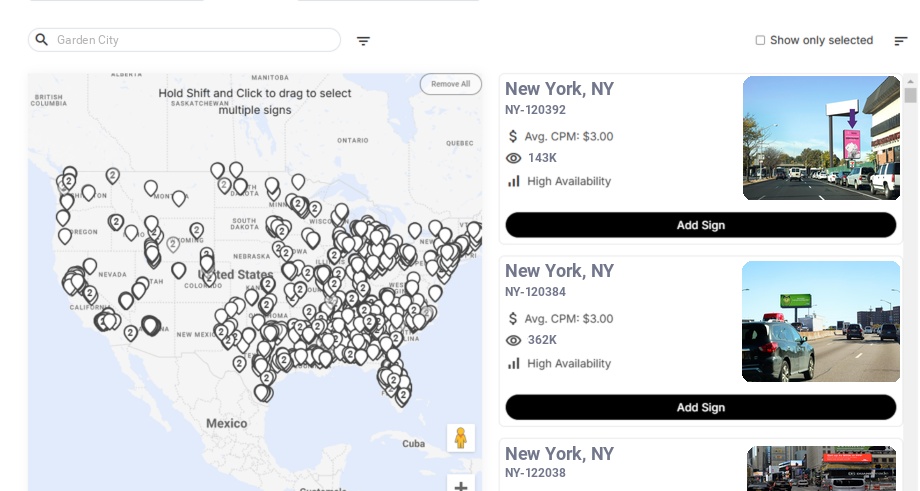
There are 22 digital billboards near Garden City, primarily in nearby Village of Hempstead. This footprint gives you flexible, cost-efficient billboard rental near Garden City without needing to lock into long-term static contracts. Many of the boards are positioned along high-traffic approaches and nearby communities within about 10 miles of the village.
Who can I reach with Garden City billboards?
The Garden City area offers one of Long Island’s most attractive audiences for digital billboard advertising because it has affluent households, regional shopping destinations, colleges, medical centers, and a dense commuter network. Campaigns near Garden City can reach a high-income, education-focused, family-oriented audience plus a large share of regional shoppers and commuters who travel through the area daily. The surrounding market also includes students, healthcare visitors, and commuters to NYC and other job hubs.
When is the best time to run Blip ads near Garden City during the day?
Weekday morning traffic runs from 6:30–9:15 a.m. for school drop-offs, LIRR station access, and white-collar commuters. Midday from 11:00 a.m.–2:00 p.m. is strong for lunch, shopping, and medical appointments, while the evening rush from 3:30–7:00 p.m. captures after-school activity and return commuters. Weekend peaks are 11:00 a.m.–6:00 p.m. on Saturdays and noon–5:00 p.m. on Sundays.
What roads near Garden City get the most billboard traffic with Blip?
Hempstead Turnpike (NY-24) is a major east-west arterial that often reaches 50,000+ vehicles on weekdays in sections near Hofstra and Nassau University Medical Center. Stewart Avenue and Old Country Road can see 35,000–45,000 vehicles per day near Roosevelt Field, and the Meadowbrook State Parkway near Old Country Road can exceed 80,000 vehicles per day. Jericho Turnpike also carries 30,000–40,000 vehicles per day across retail, office, and commuter traffic.
Do I need a contract to advertise with Blip near Garden City?
No, Blip has no long-term contracts or minimum commitments. You can start, pause, or stop your campaign at any time.
How fast can I launch a billboard campaign with Blip near Garden City?
You can have your campaign live in minutes. Create a free account, select your locations, set your budget, upload your design, and start running once approved.
Where can I advertise with Blip near Garden City?
Blip has digital billboards near Garden City. You can browse available locations on a map, choose the ones that fit your audience, and start advertising right away.
Still have questions? Launch a campaign in minutes — no contracts, no commitments.
Start Your CampaignGarden City Billboard Advertising Guide
With its mix of affluent households, regional shopping destinations, colleges, medical centers, and a dense commuter network, the Garden City area offers one of Long Island’s most attractive audiences for digital billboard advertising. With 22 digital billboards near Garden City—primarily in nearby Village of Hempstead—we can help you reach drivers, shoppers, students, and commuters moving through this high‑value market with flexible, data‑driven campaigns. Whether you’re exploring billboard advertising near Garden City for the first time or scaling an existing presence, this guide will help you make the most of local inventory.
Understanding the Garden City Area Market
Garden City is a prosperous village in central Nassau County, anchored by major retail, education, and healthcare hubs that draw visitors from across Long Island. This makes Garden City billboards especially powerful for brands that want to tap into both local residents and regional visitors.
-
Population & households
- Garden City’s population is roughly 23,000–24,000 residents, with about 7,800–8,000 households and an average household size a little over 3.0 people.
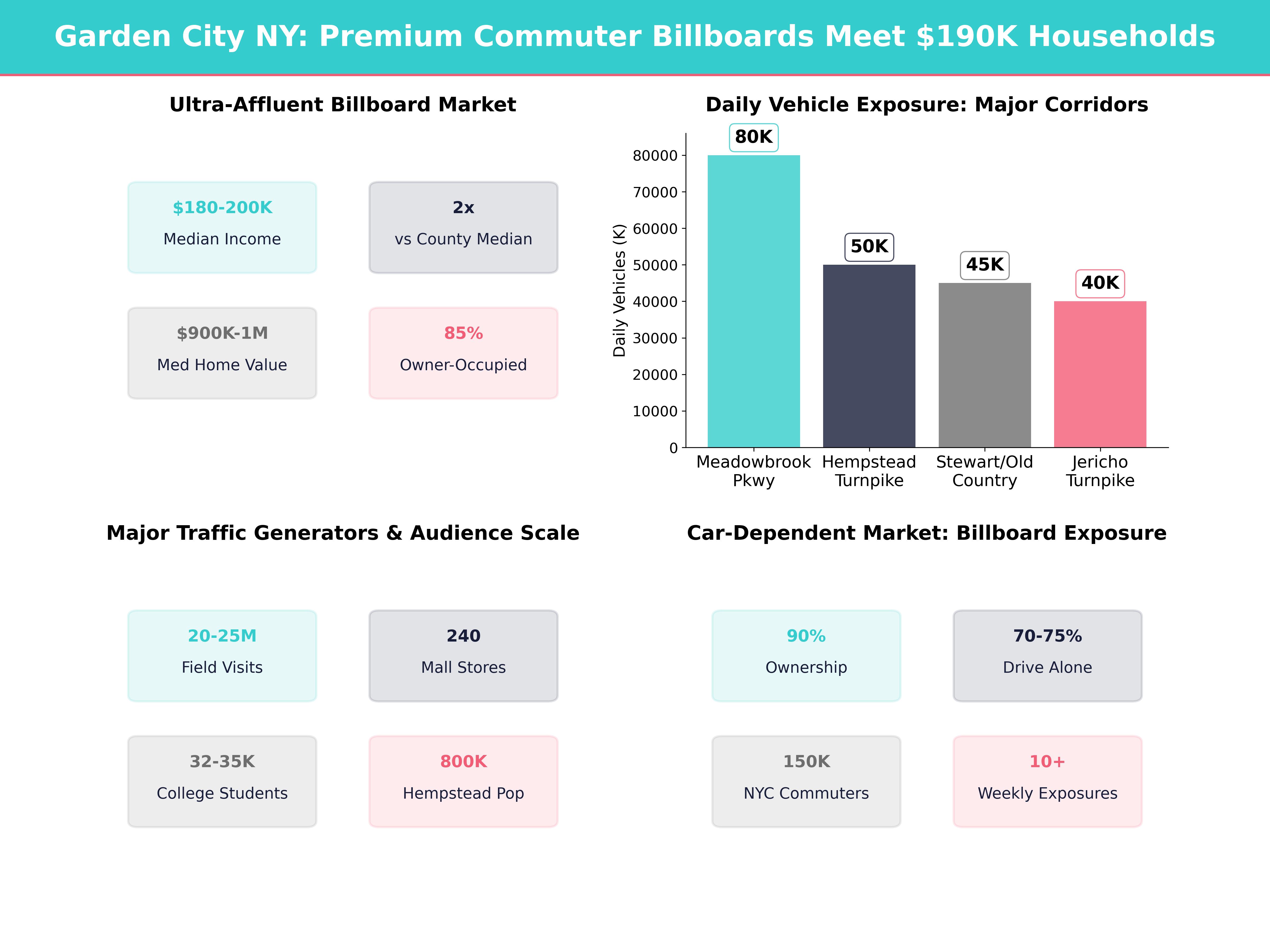
- Median household income is well over $150,000; recent village‑level estimates often place it between $180,000 and $200,000, which is more than 2x the median household income for Nassau County overall.
- Owner‑occupancy in Garden City exceeds 85% of occupied housing units, and the median home value is commonly estimated around $900,000–$1.1 million, underlining the area’s high asset base.
-
The broader Town of Hempstead, which surrounds Garden City and where many of our billboards are located, has nearly 800,000 residents and more than 280,000 households, making it the largest township in New York State.
- Source: Town of Hempstead and Village of Garden City.
-
Economic anchors near Garden City
- Roosevelt Field, one of the largest malls in the U.S. with over 240 stores and more than 2.3 million square feet of retail, regularly reports 20–25 million shopper visits per year, drawing from Nassau, Queens, Suffolk, and Brooklyn.
-
Colleges and universities in and near the Garden City area:
- Adelphi University in Garden City enrolls roughly 7,000–8,000 students, including about 5,000 undergraduates and 2,000–3,000 graduate students, plus more than 1,000 faculty and staff.
- Hofstra University in nearby Hempstead has around 10,000–11,000 students, including 6,000–7,000 undergraduates and 3,000–4,000 graduate and law students.
- Nassau Community College enrolls approximately 15,000+ students in credit programs, with additional thousands in continuing education and workforce training.
- Major healthcare and office corridors cluster around Stewart Avenue, Old Country Road, and the Meadowbrook Parkway, where nearby facilities and office parks collectively employ tens of thousands of workers. Large medical anchors within a few miles—such as NYU Langone Hospital—Long Island in Mineola and Nassau University Medical Center in East Meadow—each handle tens of thousands of inpatient and emergency visits per year.
- The nearby Nassau Hub redevelopment area, including the Coliseum and adjacent projects, is planned to add millions of square feet of mixed‑use space over the next decade, increasing employment and visitor traffic in the immediate Garden City vicinity and further strengthening the impact of billboard advertising near Garden City.
-
Tourism & regional draw
- According to Discover Long Island, Long Island welcomes around 10 million visitors annually, generating several billion dollars in visitor spending; Nassau County captures a substantial share of these trips thanks to its central location and retail/entertainment assets.
- Nassau County parks such as Eisenhower Park host hundreds of permitted events and tournaments each year, from concerts and festivals to golf outings and youth sports, bringing repeat foot and vehicle traffic past nearby roadways.
- Roosevelt Field, Nassau County parks, and events at nearby venues like the Mitchel Field Complex and the Nassau Veterans Memorial Coliseum draw tens of thousands of attendees during peak events and steady weekend and evening traffic near Garden City.
What this means for advertisers: campaigns near Garden City can reach a high‑income, education‑focused, family‑oriented audience plus a large share of regional shoppers and commuters who travel through the area daily. When you invest in billboard rental near Garden City, you’re accessing one of Long Island’s most efficient markets for premium products and services.
How People Move Near Garden City: Traffic & Commuter Patterns
To maximize impact on our digital billboards serving the Garden City area, it helps to understand how and when people travel.
-
Car ownership & driving culture
- Nassau County is heavily car‑dependent. Recent local transportation surveys indicate that over 90% of households own at least one vehicle, and more than 45% own two or more vehicles.
- Approximately 70–75% of employed residents commute by driving alone, with another 8–10% carpooling. Transit (LIRR and buses) typically accounts for 10–15% of work trips, with walking and biking making up a small remainder.
- This creates consistent vehicular exposure along arterials and parkways that pass near Garden City, with daily traffic counts on major roads often exceeding 40,000–60,000 vehicles per day (AADT)—ideal conditions for high‑frequency billboard advertising near Garden City.
-
Key commuter corridors near Garden City
- Hempstead Turnpike (NY‑24) – Major east–west arterial running through Hempstead, Uniondale, and East Meadow, heavily used by commuters, students, and shoppers. In sections near Hofstra and Nassau University Medical Center, average daily traffic often reaches 50,000+ vehicles on weekdays.
- Stewart Avenue & Old Country Road – High‑traffic commercial corridors near Roosevelt Field and office/medical complexes. Segments near the mall frequently see 35,000–45,000 vehicles per day, with weekend peaks around major shopping periods.
- Meadowbrook State Parkway & Wantagh State Parkway – Primary north–south parkways feeding into the Roosevelt Field and Eisenhower Park area. Typical weekday volumes on the Meadowbrook near Old Country Road can exceed 80,000 vehicles per day, rising further around holidays and summer weekends.
- Jericho Turnpike (NY‑25) – Another major commercial and commuter corridor just north of Garden City, with many segments carrying 30,000–40,000 vehicles per day across retail, office, and through‑commuter traffic.
-
Rail commuting
- The Garden City area is served by multiple Long Island Rail Road (LIRR) lines via nearby stations such as Garden City Mineola Hempstead
- Pre‑pandemic weekday boardings at Mineola Station alone were commonly estimated in the 7,000–8,000 daily rider range, with Hempstead and Garden City together adding several thousand more. While ridership has fluctuated, recent MTA reports show LIRR system usage recovering to 70–80% of pre‑2020 levels on many weekdays.
- Many riders drive to stations and use nearby parking lots, generating additional roadside impressions near access roads and feeder arterials like Franklin Avenue, Stewart Avenue, and Washington Street.
-
Peak traffic times
- Weekday morning: 6:30–9:15 a.m. (school drop‑offs, LIRR station access, and white‑collar commuters). On some key approaches, volumes during this window can account for 25–30% of daily traffic.
- Midday: 11:00 a.m.–2:00 p.m. (lunch, shopping, medical appointments). Retail and medical corridors often see a 10–15% bump in traffic vs. early afternoon non‑peak periods.
- Evening rush: 3:30–7:00 p.m. (after‑school activities, return commute, Roosevelt Field and restaurant traffic). For many commuters, evening peak travel times are slightly longer than morning peaks, resulting in extended billboard exposure.
- Weekend peaks: 11:00 a.m.–6:00 p.m. Saturdays and noon–5:00 p.m. Sundays, driven by retail, family outings, youth sports, and events at Eisenhower Park or the Nassau Hub. Major holiday shopping weekends can push mall‑area traffic up by 20–30% above typical volumes.
With Blip, we can bias your campaign toward the specific times of day and days of week when your exact audience is most likely to be driving near Garden City, ensuring your Garden City billboards are working hardest when attention and traffic are highest.
Who You Can Reach Near Garden City
The Garden City area sits at the intersection of several high‑value audience segments:
-
Affluent suburban families
- In Garden City, the share of married‑couple households with children under 18 typically exceeds 40%, far above what you see in many urban neighborhoods.
- Educational attainment is high: in many nearby census tracts, 60–70% of adults hold a bachelor’s degree or higher, supporting demand for premium services and extracurriculars.
- High spending on home services, financial planning, automotive upgrades, travel, and extracurriculars is reflected in local retail and service mix: luxury auto dealers, private schools, and specialized healthcare are all within a short drive.
-
Students and young professionals
- Combined enrollment across Adelphi, Hofstra, and Nassau Community College exceeds 32,000–35,000 students, plus 5,000+ faculty and staff.
- Many live in off‑campus housing or commute from elsewhere in Nassau and Queens, using corridors like Hempstead Turnpike, the Meadowbrook Parkway, and Clinton Street on a near‑daily basis.
- Students are heavy users of quick‑service dining, fitness, tutoring, technology, and entertainment—categories that benefit from repeated billboard impressions along their daily routes.
-
Retail and dining shoppers
- Roosevelt Field and adjacent shopping centers such as The Gallery at Westbury Plaza million square feet of retail space.
- Regional shopping centers like these often generate 1,500–2,500 visits per parking space per year, translating into tens of millions of annual trips through nearby intersections.
- Shoppers often make multi‑stop trips (mall + big box + dining), increasing total roadside impressions and providing multiple opportunities for a billboard message to influence where they eat, which stores they visit, or which errands they add to their trip.
-
Healthcare visitors
- Facilities within a 5–7 mile radius—including NYU Langone Hospital—Long Island, Nassau University Medical Center, and numerous specialty practices—serve hundreds of thousands of outpatient visits annually.
- Healthcare visitors often travel from across Nassau and Queens, using major roadways like Hempstead Turnpike, the Meadowbrook Parkway, and Merrick Avenue. These trips are typically pre‑planned and recurring (follow‑up and therapy visits), creating sustained exposure over weeks or months.
- These visitors are often decision‑makers for household healthcare and related services like pharmacies, medical supplies, and senior care.
-
Commuters to NYC and other job hubs
- Nassau County sends well over 150,000 commuters into New York City on a typical weekday via both LIRR and roadways; Garden City and its neighbors contribute a significant share of these trips.
- Many Garden City area residents work in Manhattan, Queens, or along major Long Island employment corridors such as the Route 110 corridor and the Jericho Turnpike office clusters.
- They see roadside media during morning/evening drives to and from parkways and LIRR stations, with some individuals passing the same billboard 10+ times per week, supporting brand recall and response.
Knowing which of these segments matters most to your business lets us shape location, timing, and creative to match, and to decide exactly which billboards near Garden City should carry your message.
Strategic Use of Our 22 Digital Billboards Near Garden City
We have 22 digital billboards serving the Garden City area, with many positioned in nearby Hempstead—just 1.8 miles from the village center—plus other nearby communities within about 10 miles. This footprint gives you flexible, cost‑efficient billboard rental near Garden City without needing to lock into long‑term static contracts.
Here’s how to think about using that footprint:
-
Cover the “daily life” loop
-
Focus on units along:
- Routes to and from Roosevelt Field and nearby shopping centers, where weekend foot traffic can spike by 20–40% compared with weekdays.
- Arterials connecting Garden City with Hempstead, Uniondale, Mineola, and Westbury, where typical residents may make 3–5 round trips per day for work, school, errands, and activities.
- Corridors used by students traveling to Adelphi, Hofstra, or Nassau Community College; together they create thousands of additional daily trips past our inventory during the academic year.
- Strategy: design campaigns that follow a resident from home → school/work → shopping → home, reinforcing your message multiple times per week and aiming for 5–10 weekly impressions per frequent traveler where possible.
-
Focus on units along:
-
Pair local and regional boards
- Use boards closest to Garden City for hyper‑local, brand‑building messages (“Trusted by Garden City families since 1995”) targeted toward the 20,000+ residents and nearby office workers who move through the area daily.
- Layer in nearby boards toward the east and west for regional acquisition (drawing customers from East Meadow, Westbury, or Valley Stream into your Garden City area location). These adjacent communities together add another 150,000+ residents within a short drive time.
- By combining local and regional coverage, you can build both awareness (reaching broad audiences) and directional response (driving visits from specific feeder communities).
-
Vary messaging by direction of travel
-
When boards face traffic heading toward Garden City:
- Promote visits: “Exit at [road] for Garden City’s new showroom.” Directional messages frequently see higher immediate response rates, especially when placed within 1–3 miles of the destination.
-
When boards face traffic leaving the area:
- Promote digital or long‑consideration actions: “Scan later – compare refinance rates tonight.”
- Testing different directional messages and noting changes in web traffic or footfall can help you identify which side of a commute produces the strongest ROI.
-
When boards face traffic heading toward Garden City:
Even without static placements inside the village itself, coverage on high‑traffic approaches to Garden City keeps your brand highly visible where people actually spend time driving, allowing Garden City billboards to influence decisions well before customers arrive.
Timing Your Campaign: Seasonality in the Garden City Area
The Garden City area experiences distinct seasonal patterns that can dramatically influence campaign performance.
-
Winter (January–March)
-
Post‑holiday retail slows, with some local merchants experiencing 10–20% lower sales compared with November–December, but:
- Gyms, healthcare providers, tax preparers, and financial planners see increased demand tied to New Year’s resolutions and tax season; some tax firms report 30–40% of annual client activity occurring between February and mid‑April.
- Snow or bad weather can increase driving on main arterials vs. side streets, which favors well‑placed digital boards on primary corridors like Hempstead Turnpike and Old Country Road.
- Advertisers in automotive (tires, repairs), home heating, and urgent care can capitalize on weather‑triggered demand spikes of 20–50% on extreme weather days.
-
Post‑holiday retail slows, with some local merchants experiencing 10–20% lower sales compared with November–December, but:
-
Spring (April–June)
- Graduation season for Adelphi, Hofstra, and Nassau Community College brings thousands of visiting family members on campus over a few concentrated weekends.
- Home improvement, landscaping, and real estate listings surge; local listing data commonly show spring inventory and transaction volumes running 20–30% higher than winter.
- Sports leagues, proms, and end‑of‑school events create family spending peaks across apparel, beauty, dining, and photography.
- Tactic: run countdown or date‑specific creative (“Book by June 15 and save 15%”) to tie into fixed academic and event calendars.
-
Summer (July–August)
-
Many residents travel to beaches and vacation destinations like Jones Beach State Park and the nearby City of Long Beach, but:
- Local shopping, dining, and entertainment stay strong on weekends; beach and park‑bound traffic along the Meadowbrook and Wantagh State Parkways can spike 20–30% on clear‑weather Saturdays.
- Families look for camps, tutoring, and back‑to‑school prep; many local retailers report back‑to‑school spending in late summer rivaling or exceeding typical months.
- Tactic: use dayparting to emphasize evenings and weekends, when local trips and outings are most common, and to reach both stay‑cationers and beachbound day‑trippers.
-
Many residents travel to beaches and vacation destinations like Jones Beach State Park and the nearby City of Long Beach, but:
-
Fall (September–December)
- Back‑to‑school, college move‑ins, and a strong retail ramp‑up dominate September and October. Local schools and colleges together enroll tens of thousands of students, meaning heavy traffic around campuses and school zones.
- Roosevelt Field and nearby shopping districts become peak holiday destinations; many retailers generate 25–30% of annual sales between Thanksgiving and year‑end.
- Tactic: scale budgets gradually from September, peaking from Black Friday through late December with promotion‑specific creative and higher impression frequency. On key days like Black Friday and the two Saturdays before Christmas, mall‑area traffic can exceed normal weekend levels by 40% or more.
Blip’s flexibility lets you increase or decrease budget by season, so you invest most heavily when your category sees the greatest response and your billboards near Garden City have the best chance to convert impressions into visits.
Crafting Effective Creative for the Garden City Area
In an educated, high‑income suburban market, your message must be clean, credible, and immediately useful.
Core creative principles
-
Keep it ultra‑simple
- Aim for 7–10 words max; roadside readability studies consistently show comprehension drops sharply once you exceed 10–12 words.
- Use one core idea per design (e.g., “Same‑Day Orthodontics – Garden City Area”).
- Ensure your brand name or logo is readable at a distance in under 2 seconds; at 40–50 mph, drivers cover 60–75 feet per second, leaving only 4–6 seconds of viewing time.
-
Design for fast‑moving traffic
- Large, high‑contrast fonts (sans‑serif works best) can increase legibility distance by 20–30% compared with thin or script fonts.
- Avoid thin scripts and busy backgrounds, which can cut recognition rates nearly in half at highway speeds.
- Use a maximum of 2–3 colors plus a brand accent so key information stands out even in poor weather or low light.
-
Use local references carefully
-
Phrases like:
- “Trusted by Garden City area families”
- “Near Roosevelt Field”
- “Minutes from the Meadowbrook Parkway”
- Including well‑known local landmarks builds trust and improves recall; campaigns that reference nearby destinations often see higher response because they anchor your brand in a concrete location.
-
Phrases like:
-
Highlight value or differentiation
- For an affluent audience, quality, service, and convenience matter as much as price; surveys of high‑income suburban consumers routinely rank time‑savings and expertise above simple discounts.
-
Examples:
- “Same‑day crowns, nights & weekends”
- “Private SAT prep, 5 minutes from Garden City area schools”
- “Luxury SUV detailing while you shop near Roosevelt Field”
-
Integrate digital calls‑to‑action
-
Use simple, memorable URLs or keywords:
- “Book at SmithOrtho.com”
- “Text GARDENCITY to 555‑123 for a quote”
- QR codes can work at slower intersections, but avoid relying on them where traffic moves at parkway speeds. Reserve scannable elements for locations where average speeds are 25–35 mph and where vehicles may stop at signals.
-
Use simple, memorable URLs or keywords:
Tailored Strategies by Industry
Here are sample approaches for common advertiser types near the Garden City area:
Retail and Restaurants
-
Target:
- Peak shopping hours near Roosevelt Field and surrounding plazas, when weekend visit counts can be 1.5–2x typical weekday levels.
-
Strategy:
- Run heavier schedules Friday–Sunday, with lunch and dinner peaks for restaurants (roughly 11:30 a.m.–2:00 p.m. and 5:30–8:30 p.m.).
-
Highlight:
- Limited‑time offers
- New store openings
- Curbside pickup or reservations
- Consider tying creative to major calendar events promoted by Roosevelt Field or community happenings listed on Nassau County’s event calendars.
-
Example message:
- “New in the Garden City area – Modern Italian. Exit now for dinner.”
- “Back‑to‑school sale near Roosevelt Field – This weekend only.”
Professional Services (Law, Finance, Real Estate)
-
Target:
- Morning and evening commute on major arterials and parkways, when 60–70% of daily workers are on the road.
-
Strategy:
- Focus on credibility, years of experience, and specialization; professional‑services clients often require multiple impressions over several weeks before taking action.
-
Include:
- Simple phone number
- Short URL (e.g., GardenCityLaw.com)
- Align messaging with tax season, home‑buying peaks, and estate‑planning seminars promoted through outlets like Newsday or Garden City Patch.
-
Example message:
- “Estate Planning for Garden City area families – Call 516‑XXX‑XXXX.”
- “Thinking of selling? Garden City area home values are up. Find out how much.”
Healthcare and Dental
-
Target:
- Midday and early evening (appointments and after‑school visits), when many practices see 50–60% of daily patient volume.
-
Strategy:
- Emphasize convenience, same‑day appointments, and insurance acceptance.
- Coordinate bursts of messaging around flu season, sports seasons (orthopedics), or back‑to‑school checkups using public‑health updates from the Nassau County Department of Health
-
Example message:
- “Pediatric dentist 5 minutes from Garden City area schools – New patients welcome.”
- “Urgent care near Hempstead Turnpike – Open late, walk‑ins OK.”
Education, Tutoring, and Enrichment
-
Target:
- Family commute times, after‑school hours, and weekends, when parents are transporting kids to activities—many families make several trips per week along the same routes.
-
Strategy:
- Speak to achievement and outcomes, especially given the academic profile of the area where well over half of adults hold college degrees.
- Plan flight dates around report‑card periods, SAT/ACT test dates, and registration deadlines highlighted by local districts and institutions such as Garden City Public Schools and nearby colleges.
-
Example message:
- “SAT scores up 150+ points – Classes near Garden City area.”
- “Music lessons for Garden City area kids – Enroll this month.”
Events, Venues, and Attractions
-
Target:
- Two‑ to three‑week window leading up to event dates, with heaviest weight in the final 7–10 days, when intent to attend spikes.
-
Strategy:
- Use countdowns and day‑specific messaging; event campaigns that add a specific date or “this weekend” callout typically see higher response.
- Tie creative to popular venues such as Eisenhower Park, the Mitchel Field Complex, or the Nassau Veterans Memorial Coliseum.
-
Example message:
- “Festival at Eisenhower Park – This Saturday 12–6 – Free parking.”
- “Open House at Adelphi area campus – Register now.”
Using Blip’s Flexibility to Your Advantage
Digital billboards near Garden City give you controls traditional static boards can’t match. While we won’t walk through platform mechanics here, there are several strategic levers smart advertisers use:
-
Dayparting
-
Show more ads:
- Weekday mornings for commuter‑focused services.
- Afternoons for healthcare and errands.
- Evenings and weekends for dining, retail, and entertainment.
- Reduce spend during low‑relevance hours (e.g., very late night for most local services) to stretch your budget and improve your effective cost‑per‑thousand impressions (eCPM).
-
Show more ads:
-
Budget control
- You can set daily or total budgets and adjust them as you see performance or seasonality shift. For example, some local advertisers allocate 50–60% of their annual out‑of‑home budget to Q4 and 20–25% to Q2 to match retail and home‑services peaks.
- Ramp up during high‑stakes periods (back‑to‑school, tax season, holidays) and scale back when your category is quieter, using real‑time performance signals like web visits, calls, or store traffic.
-
Creative rotation and testing
-
Run multiple designs and:
- Emphasize different offers (price vs. convenience vs. quality).
- Test different local references (“near Roosevelt Field” vs. “near the Meadowbrook Parkway”).
- Over time, keep the best‑performing messages and retire the rest. Even simple A/B tests—such as comparing two headlines over 2–4 weeks—can yield 10–30% improvements in response.
-
Run multiple designs and:
-
Geographic layering
- Start with billboards closest to Garden City for brand familiarity.
- Add boards in neighboring areas where your customers commonly originate (Hempstead, Uniondale, Westbury, East Meadow), creating a funnel into your business. These adjacent communities expand your reach to an additional 200,000+ residents within roughly a 15–20 minute drive of Garden City.
- Use separate creatives for “local” versus “coming from out of town” audiences, reflecting different motivations and trip patterns.
Integrating Local Media and Community Context
To get the most from digital billboard advertising near Garden City, align your campaign with local information channels and community rhythms.
-
Local news and information
- Outlets like Newsday and local sites such as Garden City Patch shape community conversations and reach tens of thousands of Nassau County readers every day.
-
Coordinate billboard messaging with:
- Stories about school rankings, property values, or community events.
- Your own PR or sponsorship announcements, timed to coincide with features, openings, or award recognitions.
-
Government and civic calendars
- Check calendars from the Village of Garden City, Town of Hempstead, and Nassau County.
-
Time campaigns with:
- Village fairs and seasonal celebrations that can draw hundreds to thousands of attendees.
- Park events (e.g., at Eisenhower Park), which regularly bring in regional visitors on weekends.
- Public meetings or initiatives relevant to your industry, such as small‑business programs, environmental cleanups, or health fairs.
- Aligning your visibility with these civic moments helps you tap into existing community attention and traffic surges.
-
Community sponsorships
-
If you sponsor local sports teams, school programs, or non‑profits, extend that goodwill with billboard creative:
- “Proud sponsor of Garden City area youth sports.”
- “Supporting Adelphi and Hofstra students since 2005.”
- Mentioning partnerships with recognizable entities—like local PTAs, youth leagues, or charities featured on Garden City Public Schools or municipal pages—can significantly improve brand favorability among residents.
-
If you sponsor local sports teams, school programs, or non‑profits, extend that goodwill with billboard creative:
This blend of hyper‑local relevance and high‑visibility placements near Garden City helps your brand feel like a true part of the community, not just another ad, and maximizes the value you get from billboard rental near Garden City.
Putting It All Together
To build an effective digital billboard campaign near the Garden City area with us, we recommend:
- Define your primary audience
Families, students, commuters, or regional shoppers? Garden City’s 23,000+ residents, 30,000+ students, and hundreds of thousands of nearby workers and visitors offer different opportunities, and your answer drives location and timing. - Choose priority corridors
Focus first on Hempstead‑area and other nearby boards that align with your customers’ daily routes to Garden City and its key destinations (Roosevelt Field, local schools, LIRR stations, and medical centers), where many drivers pass the same locations dozens of times per month. - Align timing with behavior and seasonality
Use dayparting and calendar planning around school cycles, holidays, and major shopping periods. Allocate more impressions in months when your category historically sees 20–30% higher demand and scale back in off‑peak windows. - Develop clear, locally grounded creative
Short messages, bold visuals, and references to recognizable landmarks or routes. Aim for designs that can be fully read and understood in under 4 seconds at typical corridor speeds. - Test, learn, and refine
Rotate multiple creatives, watch your business metrics (calls, web traffic, visits), and gradually concentrate spend on the best performers. Even modest improvements in billboard effectiveness—say 10–15% higher response—compound significantly over thousands or millions of impressions.
By combining data about how people live and move around the Garden City area with the flexibility of our 22 digital billboards nearby, we can build campaigns that are not only visible, but genuinely persuasive and profitable for your business. Whether you describe your plan as using Garden City billboards, billboard advertising near Garden City, or flexible billboard rental near Garden City, the strategy above will help you turn that local reach into measurable results.