Billboards in Brooklyn, NY
No Minimum Spend. No Long-Term Contracts. Just Results.
Trusted by Leading Brands


Billboard advertising
in Brooklyn has never been easier
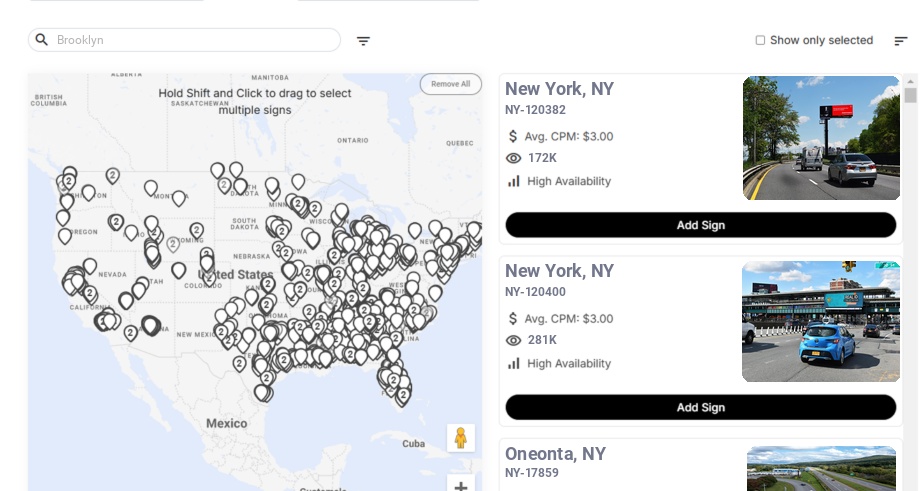



How much is a billboard in Brooklyn?
Why Choose Blip for Billboard Advertising in Brooklyn
Blip lets you launch Brooklyn billboards in minutes, reaching BQE and Belt Parkway commuters without sales calls or setup delays.
Use Brooklyn's rush-hour peaks to your advantage with Blip dayparting—run ads inbound to bridges in the morning and outbound at night.
No contracts mean you can test Brooklyn neighborhoods like Williamsburg, Downtown Brooklyn, and Coney Island, then shift fast.
Blip's real-time analytics help you see what works in Brooklyn near Barclays Center, so you can adjust before the next concert or game.
Create and swap Brooklyn creatives quickly with Blip's tools, from bilingual messages in Sunset Park to summer promos for Coney Island.
Frequently Asked Questions About Billboard Advertising in Brooklyn
How much does a billboard cost in Brooklyn, New York with Blip?
With Blip, you can advertise on Brooklyn billboards on any budget by setting a flexible daily amount that Blip will never exceed. Each “blip” is a short, 7.5–10 second ad on rotating digital billboards in Brooklyn, New York, and you only pay for the blips you receive. Prices per blip change based on when and where your ad appears and current advertiser demand, so your total cost is simply the sum of all your blips over time.
Where can I place Blip billboards in Brooklyn, New York to reach the most traffic?
Some key corridors to consider include the Brooklyn-Queens Expressway (BQE / I-278), the Belt Parkway, Flatbush Avenue, Atlantic Avenue, and Fourth Avenue. The Brooklyn, Manhattan, and Williamsburg Bridges are also ideal for visibility, and certain sections of the BQE routinely record average annual daily traffic in the 150,000–180,000 vehicle range. These routes are strong for reaching cross-borough commuters, regional drivers, and visitors arriving from other boroughs.
What kind of audience does Brooklyn, New York billboards reach with Blip?
Brooklyn is one of the most densely populated, culturally diverse, and heavily traveled urban areas in the United States. On a typical weekday, more than 3.9 million people live, work, or attend school in Brooklyn, and millions more pass through its bridges, highways, and transit hubs. The borough is also linguistically diverse, with many community districts where more than 40% of residents speak a language other than English at home.
When is the best time to run a billboard campaign in Brooklyn, New York?
Typical commuter peaks are roughly 6:30–9:30 a.m. in the morning and 4:00–7:30 p.m. in the evening. Midday, from 11:00 a.m.–2:00 p.m., is strong for shoppers, errand runners, tourists, and food-service decisions. With digital boards, you can choose boards in these zones and schedule your “blips” to coincide with the most valuable traffic windows.
Can Blip help with seasonal billboard advertising in Brooklyn, New York?
Yes, Brooklyn has strong seasonal and event-driven opportunities that can push neighborhood traffic 20–50% above typical levels. Summer traffic peaks around Coney Island, while events like Barclays Center shows, the West Indian American Day Carnival, and the Brooklyn Marathon create concentrated audience spikes. With Blip, you can pre-plan seasonality by scheduling heavier spend around key weekends and events, then scaling back between them.
Do I need a contract to advertise with Blip in Brooklyn?
No, Blip has no long-term contracts or minimum commitments. You can start, pause, or stop your campaign at any time.
How fast can I launch a billboard campaign with Blip in Brooklyn?
You can have your campaign live in minutes. Create a free account, select your locations, set your budget, upload your design, and start running once approved.
Where can I advertise with Blip in Brooklyn?
Blip has digital billboards in Brooklyn. You can browse available locations on a map, choose the ones that fit your audience, and start advertising right away.
Still have questions? Launch a campaign in minutes — no contracts, no commitments.
Start Your CampaignBrooklyn Billboard Advertising Guide
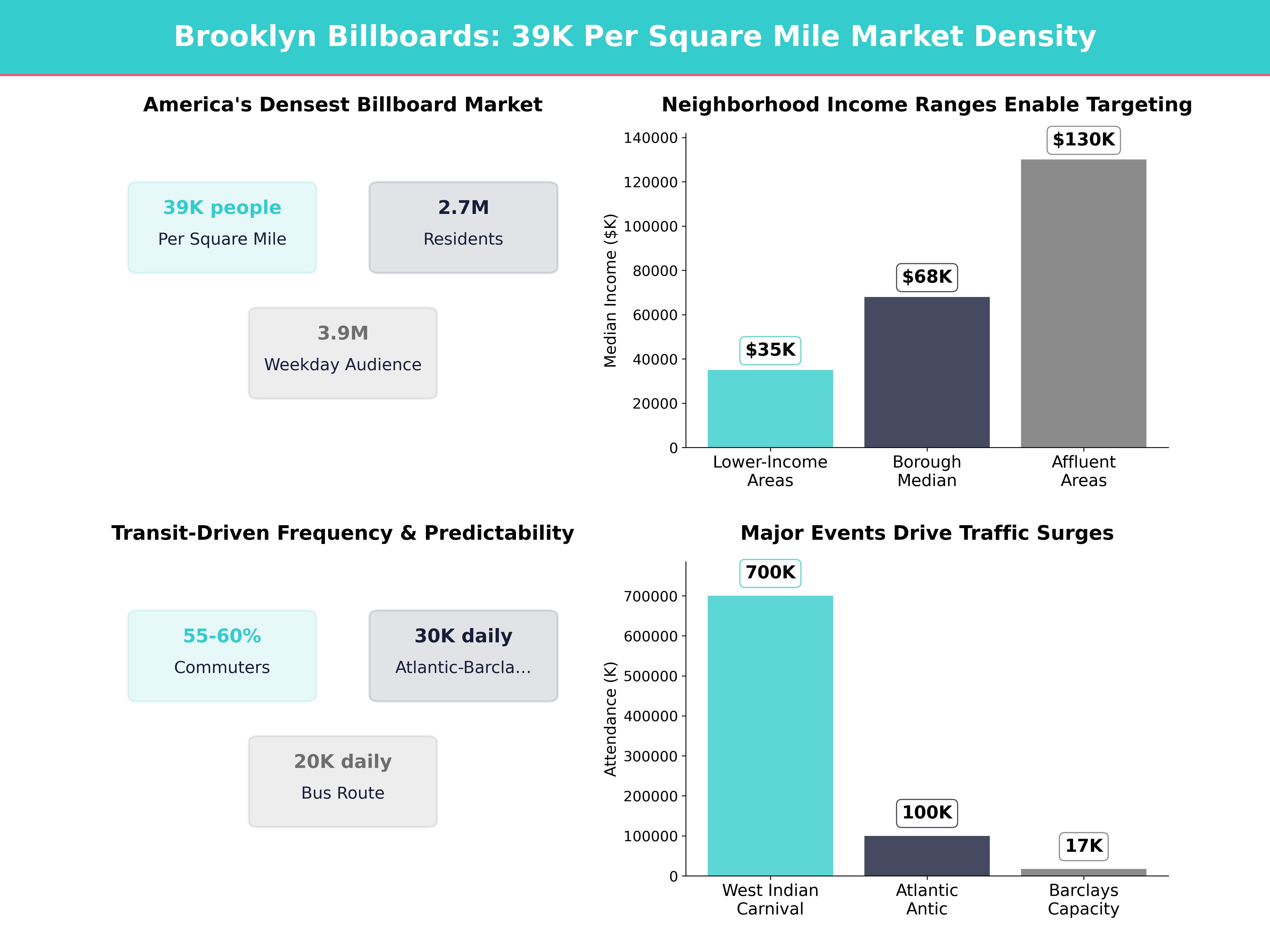
Brooklyn is one of the most densely populated, culturally diverse, and heavily traveled urban areas in the United States, and that makes it fertile ground for high-impact digital billboard campaigns. With roughly 2.7 million residents in just 69 square miles (about 39,000 people per square mile) and constant inflow from Manhattan, Queens, Long Island, and tourists, our message doesn’t just get seen—it gets absorbed multiple times a day by the same key audiences. On a typical weekday, more than 3.9 million people live, work, or attend school in Brooklyn, and millions more pass through its bridges, highways, and transit hubs. In this guide, we’ll look at how to leverage Brooklyn’s unique patterns of movement, demographics, and culture to design and schedule digital billboard campaigns that work harder for every dollar, and how to choose the right Brooklyn billboards to support those goals.
Understanding the Brooklyn Audience
Brooklyn is larger than many major U.S. cities in its own right. If it were its own city, its population of about 2.7 million would rank around 3rd or 4th in the country—larger than cities like Chicago or Houston. That population is exceptionally diverse in age, income, and culture:
- Population: approximately 2.73–2.75 million people in recent counts.
- Median age: roughly 35–36 years, compared with a national median around 38, meaning a strong mix of young professionals, families, and students.
- Household income: borough-wide median household income in the high $60,000s (roughly $68,000–$72,000), with large gaps between neighborhoods. In some census tracts of Brooklyn Heights, Park Slope, and Williamsburg, median household incomes exceed $130,000, while in parts of Brownsville and East New York they can fall below $35,000.
- Education: in many North and Brownstone Brooklyn neighborhoods, more than 50% of adults hold a bachelor’s degree or higher, compared with under 25% in some South and East Brooklyn areas—important for segmenting messaging (professional services vs. price-sensitive offers).
- Car ownership: across Brooklyn, only about 44–46% of households have access to a car, and in several central and northern neighborhoods, 50–60% of households do not own a vehicle at all. In contrast, car ownership exceeds 60–70% in many South and East Brooklyn communities.
The borough is also linguistically diverse: in many Brooklyn community districts, more than 40% of residents speak a language other than English at home, and in some areas that figure tops 60%. The most common languages include Spanish, Russian, Chinese, Haitian Creole, Yiddish, Arabic, and Bengali. That informs both messaging and neighborhood targeting; in community districts like Sunset Park, Borough Park, and parts of Flatbush and Bensonhurst, bilingual or culturally tailored creatives can significantly outperform generic ones, especially when paired with well-placed billboards in Brooklyn that are visible on key local corridors.
Tourism is another major factor. New York City welcomed more than 60 million visitors annually in the years before the pandemic, rebounding to over 62 million visitors in 2023 according to NYC Tourism + Conventions (formerly NYC & Company). Brooklyn has evolved into a must-visit borough within that total. The borough’s tourism arm at Explore Brooklyn
For advertisers, this means we aren’t just speaking to residents; we’re also reaching:
-
Daily commuters heading to and from Manhattan and Queens.
- Across the East River crossings, hundreds of thousands of people travel daily via the Brooklyn, Manhattan, and Williamsburg bridges.
-
Regional drivers from Long Island and New Jersey using the Brooklyn-Queens Expressway (BQE) and Belt Parkway.
- Individual segments of these highways can carry more than 150,000–180,000 vehicles per day.
- Tourists staying in Brooklyn hotels or visiting major attractions, many of whom concentrate in just a few neighborhoods and corridors.
- Students from large institutions like Brooklyn College, Pratt Institute, NYU Tandon School of Engineering, Medgar Evers College, and others, which collectively enroll well over 70,000 students in Brooklyn.
How People Move Through Brooklyn
To plan effective digital billboard schedules and placements, we need to understand how people move.
According to New York City’s own transportation data from NYC DOT and the MTA:
-
Commute modes:
- In Brooklyn, roughly 55–60% of workers commute primarily by public transit.
- About 20–25% drive alone or carpool.
- The remainder walk or bike to work, reflecting the borough’s dense, walkable neighborhoods.
-
Transit ridership:
- Brooklyn subway stations collectively handle hundreds of thousands of entries every weekday.
- Major hubs like Atlantic Ave–Barclays Center, Jay St–MetroTech, and Borough Hall each see tens of thousands of weekday entries; Atlantic Ave–Barclays Center alone logs well over 30,000 average weekday turnstile entries.
- Key neighborhood stations such as Bedford Ave (L), Dekalb Ave (B/Q/R), and Court St–Borough Hall (2/3/4/5/R) also rank among the busier stations in the system.
-
Bus ridership:
- Brooklyn’s bus network is one of the busiest in the city, with several routes moving more than 20,000 riders per weekday and borough-wide ridership well into the hundreds of thousands daily.
-
Roadway volumes:
- Major roadways like the BQE (I-278) and Belt Parkway carry hundreds of thousands of vehicles per day across different segments, with peak-hour speeds often dropping well below 20 mph due to congestion—ideal conditions for billboard visibility.
Some key corridors to consider when planning campaigns:
-
Brooklyn-Queens Expressway (BQE / I-278)
- Connects Brooklyn with Queens, Staten Island, and the Verrazzano-Narrows Bridge.
- Certain sections in Brooklyn routinely record average annual daily traffic (AADT) in the 150,000–180,000 vehicle range.
- Serves heavy regional and commuting traffic, often with daily congestion during peak times and frequent slowdowns even outside rush hours.
- Ideal for reaching cross-borough commuters, logistics/fleet drivers, and visitors arriving from other boroughs via high-visibility Brooklyn billboards.
-
Belt Parkway
- Loops along southern Brooklyn and connects to JFK Airport.
- Several stretches see daily traffic volumes above 140,000 vehicles.
- High volumes of regional drivers, airport traffic, and Brooklyn–Queens–Long Island movements.
- Strong for campaigns targeting suburban or airport-related audiences and summer beachgoers headed to Coney Island and the Rockaways.
-
Flatbush Avenue, Atlantic Avenue, and Fourth Avenue
- Among Brooklyn’s most important arterials, with traffic counts on many segments in the tens of thousands of vehicles per day.
- Connect dense residential neighborhoods with Downtown Brooklyn, the Manhattan and Brooklyn bridges, and the Barclays Center.
- Excellent for reaching city drivers, taxis, and ride-share traffic moving between residential zones and commercial cores, as well as people heading to events and shopping districts.
-
Bridges: Brooklyn, Manhattan, and Williamsburg Bridges
- Carry a combined total of several hundred thousand vehicles and a large volume of cyclists and pedestrians every day, according to NYC DOT bridge traffic data.
- Ideal for brands that want to be visible to both boroughs’ audiences, especially Manhattan-bound professionals and Brooklyn-bound visitors.
With digital billboards, we can choose boards in these zones and schedule our “blips” to coincide with the most valuable traffic windows—like morning inbound commutes or evening outbound congestion—without paying for off-peak impressions that don’t match our goals. This flexibility is a major advantage of Brooklyn billboard advertising compared with more rigid traditional media buys.
Timing: When to Run Your Digital Billboard Campaigns in Brooklyn
Brooklyn is a 24/7 environment, but certain windows are particularly valuable depending on our goal. Traffic data from NYC DOT and transit ridership patterns from the MTA both show pronounced peaks.
Typical commuter peaks (subject to variation by route and season):
- Morning rush: roughly 6:30–9:30 a.m. on major roadways like the BQE, Belt Parkway, and approaches to bridges, with some corridors peaking closer to 8:00–9:00 a.m.
- Evening rush: roughly 4:00–7:30 p.m., often with heavier congestion than the morning and average speeds dropping sharply on expressways and main arterials.
- Midday: 11:00 a.m.–2:00 p.m., strong for shoppers, errand runners, tourists, and food-service decisions.
Using Blip’s dayparting tools, we can align spend with these windows:
-
Brand awareness / mass reach:
- Focus heavily on both morning and evening rush on high-traffic routes.
- Supplement with midday in tourist-heavy areas (DUMBO, Williamsburg waterfront, Coney Island), where footfall can spike on weekends and holidays by 20–40% over weekday baselines.
-
Retail & restaurant promotions:
- Lunchtime: 11:00 a.m.–2:00 p.m. for same-day lunch offers and quick-service restaurants—especially along commercial strips where office workers and students cluster.
- Evening / weekend: 4:00–9:00 p.m. Thursday–Sunday for happy hour, dinner, and nightlife, coinciding with some of the busiest periods for neighborhoods like Williamsburg, Park Slope, and Downtown Brooklyn.
-
B2B / professional services:
- Morning inbound traffic to Manhattan and Downtown Brooklyn: 7:00–10:00 a.m. on bridge approaches and key arterials, aligning with office arrival times.
- Late afternoon 3:00–6:00 p.m. to catch professionals leaving work and thinking about services such as finance, healthcare, legal, and education.
-
Event-based advertising (concerts, sports, festivals):
- 3–5 hours before event start times near venues like Barclays Center or Coney Island.
- Morning-of reminders for ticketed events and same-day sales, particularly on weekends.
Digital boards allow us to adjust scheduling in near real time: if we see a weather system moving in, a transit strike, or a major news event shifting traffic patterns (all of which are frequently covered by NYC.gov, the MTA, and local outlets like Brooklyn Paper), we can shift budget toward or away from particular dayparts.
Neighborhood-by-Neighborhood Strategy
Because Brooklyn’s neighborhoods differ dramatically in demographics and behavior, we should think of the borough as multiple micro-markets rather than a single homogeneous area. Data from Brooklyn community district profiles shows that median incomes, age structures, car ownership, and languages spoken can swing by 30–50 percentage points between adjacent areas. Choosing the right mix of billboards in Brooklyn for each of these micro-markets is essential to maximizing relevance and ROI.
North Brooklyn: Williamsburg, Greenpoint, Bushwick
- Younger population, with many tracts where 45–60% of residents are between 20–40 years old.
- High renter share—often 70–80% of households—and above-average household incomes, especially along the waterfront where median incomes regularly exceed $100,000.
- Strong nightlife, dining, arts, and music scenes; Williamsburg and Bushwick are among Brooklyn’s highest concentrations of bars and restaurants per square mile.
- High volume of cyclists, pedestrians, and ride-share vehicles, plus the Williamsburg Bridge and L train corridors that collectively serve tens of thousands of daily riders.
Best uses:
- Lifestyle brands, fashion, tech, music, food & beverage launches.
- Limited-time drops, openings, and events timed to evenings and weekends when weekend foot traffic can outpace weekdays by 20–30%.
- Creatives that are bold, design-forward, and culturally aware, leveraging the area’s reputation as a trend-setting hub.
Brownstone Brooklyn & Downtown: Brooklyn Heights, DUMBO, Cobble Hill, Boerum Hill, Park Slope, Downtown Brooklyn
- High-income professionals and families; median household incomes in several of these neighborhoods often exceed $120,000–$150,000.
- Major office and institutional presence in Downtown Brooklyn (courts, universities, government offices), which has added thousands of residential units and millions of square feet of office space in the last decade according to Brooklyn Chamber of Commerce reports.
- Heavy subway usage and bridge traffic—Downtown Brooklyn is one of the most interconnected transit nodes in the city, with over a dozen subway lines and key bus routes.
- Tourist hotspots: Brooklyn Heights Promenade
Best uses:
- Financial services, healthcare, education, law, real estate, and premium retail.
- Family-oriented offerings (schools, camps, kids’ activities) and cultural institutions like the Brooklyn Museum and Brooklyn Academy of Music, which each attract hundreds of thousands of visitors per year.
- Messages emphasizing quality, reliability, and service, plus clean, minimalist visuals that project trust and sophistication.
Central Brooklyn: Crown Heights, Bed-Stuy, Prospect Lefferts Gardens, Flatbush
- Very diverse communities with strong Caribbean, African American, and other immigrant populations; in some tracts, over 60% of residents are foreign-born or speak a language other than English at home.
- Mix of middle-income and working-class neighborhoods, with median household incomes commonly in the $45,000–$75,000 range but with pockets of higher-income residents near Prospect Park and new developments.
- Prospect Park, the Brooklyn Museum, and the Brooklyn Botanic Garden together receive well over 3–4 million visits annually, driving periodic surges in local traffic.
Best uses:
- Local businesses, community services, healthcare, education, and nonprofit messaging.
- Bilingual or community-specific creatives (e.g., Caribbean themes on Eastern Parkway during West Indian American Day Carnival
- Emphasis on neighborhood identity, affordability, and inclusion.
South & East Brooklyn: Coney Island, Sheepshead Bay, Bensonhurst, Bay Ridge, Canarsie, East New York
- Higher car ownership, with many neighborhoods where 60–70% or more of households have at least one vehicle, and strong use of Belt Parkway and major arterials like Shore Parkway and Cropsey Avenue.
- Mix of long-time residents, immigrant communities, and visitors to Coney Island and Sheepshead Bay waterfronts.
- Coney Island alone can attract hundreds of thousands of visitors on peak summer weekends; the beach has counted over 4 million summer visitors in strong seasons, and nearby attractions like the aquarium add to that volume.
- Seasonal swings are pronounced, with summer foot and vehicle traffic significantly higher than winter baselines.
Best uses:
- Automotive, home services, big-box retail, and regional brands that draw from a larger geography, including Staten Island, Queens, and Long Island.
- Seasonal campaigns (summer attractions, back-to-school, holiday shopping) that mirror the surge in summer and late-year traffic.
- High-impact, simple creatives that can be read at highway speeds and remain legible in bright sun.
By combining boards across these zones in a Blip campaign, we can run borough-wide campaigns that still respect neighborhood nuance—varying creatives by locale while maintaining a consistent brand presence. This neighborhood-by-neighborhood approach is at the heart of effective Brooklyn billboard advertising, ensuring each board speaks directly to the people who pass it most often.
Seasonality and Event-Driven Opportunities
Brooklyn’s calendar is packed with events that concentrate audiences and create powerful contextual opportunities for billboard messaging. Event days can push neighborhood traffic 20–50% above typical levels, particularly around major venues and festival routes.
Some of the largest recurring events:
-
Barclays Center events
- Home of the Brooklyn Nets and a constant rotation of concerts and sporting events.
- Seating capacity: around 17,000 for basketball and similar for concerts; major tours and playoff games can sell out multiple nights in a row.
- The arena hosts more than 200 events annually, pulling millions of visits per year from across the region.
- See schedules at Barclays Center.
-
Coney Island summer season
- Beaches, Luna Park, the Coney Island Boardwalk, and the Brooklyn Cyclones at Maimonides Park generate strong traffic from Memorial Day through Labor Day.
- Luna Park alone hosts hundreds of thousands of visitors every summer, and Coney Island’s fireworks nights and festivals can spike evening foot traffic dramatically.
- The Nathan’s Hot Dog Eating Contest on July 4 can attract tens of thousands of attendees on-site plus national TV coverage, creating a major branding moment for visible advertisers.
-
West Indian American Day Carnival (Labor Day Weekend)
- Held along Eastern Parkway and organized by the West Indian American Day Carnival Association
- Historically draws hundreds of thousands of participants and spectators—some estimates range from 700,000 to over 1 million over the course of the weekend—making it one of the largest Caribbean celebrations in North America.
- Perfect for culturally specific, celebratory creative near Central Brooklyn corridors.
-
Brooklyn Book Festival, Northside Festival, Atlantic Antic, and others
- The Brooklyn Book Festival can draw 25,000+ attendees in a single weekend near Downtown Brooklyn and Brooklyn Borough Hall.
- Atlantic Antic
- These and similar events, often covered by outlets like the Brooklyn Daily Eagle Brooklyn Paper, drive concentrated foot and vehicle traffic ideal for hyper-local campaigns.
-
Brooklyn marathons and the NYC Marathon route through Brooklyn
- Long stretches of the TCS New York City Marathon run through Brooklyn, particularly along Fourth Avenue and in Williamsburg/Greenpoint.
- The marathon draws more than 50,000 runners and over 1 million spectators citywide, with a significant share in Brooklyn.
- Ideal for brands that sponsor fitness, nutrition, or community causes, and for cause-based campaigns.
Seasonal considerations:
-
Winter (December–February):
- Earlier sunsets mean more impressions in darkness during rush hours—excellent for bright, high-contrast creative that stands out against longer nights.
- Holiday travel and shopping can increase traffic at major retail corridors by 20–30%.
- Focus on holiday retail, events, healthcare (flu season, urgent care), and indoor activities (gyms, museums, entertainment).
-
Spring (March–May):
- Strong for home services, tax prep, graduations, and outdoor leisure.
- Visitor numbers at parks, gardens, and waterfronts rise steadily; for example, cherry blossom season at the Brooklyn Botanic Garden can attract tens of thousands of visitors over a few weekends.
- Events at Prospect Park and outdoor dining begin to pick up, especially in late April and May.
-
Summer (June–August):
- Tourism and beach traffic peak; weekends and holidays can see double the usual visitor counts at destinations like Coney Island.
- Evening activity shifts later, with boardwalk and waterfront crowds staying out past sunset.
- Creative benefits from bright colors, summer imagery, and short, punchy offers tied to nightlife, concerts, and outdoor experiences.
-
Fall (September–November):
- Back-to-school, cultural season openings, and major sports (NBA, college sports, high school leagues).
- Many arts institutions launch new seasons in September and October, increasing traffic around Downtown Brooklyn and cultural corridors.
- Politically active season in election years—issue campaigns and advocacy can see strong returns as voter engagement rises, especially in neighborhoods with historically high turnout.
With Blip, we can pre-plan seasonality by scheduling heavier spend around key weekends and events, then scaling back between them, rather than keeping a flat spend curve year-round. This approach helps ensure that your Brooklyn billboard advertising is always aligned with real-world audience surges.
Creative Strategy for Brooklyn Billboards
Brooklyn drivers and pedestrians are bombarded with visual stimuli: street art, storefronts, transit ads, and digital screens. On major corridors, a viewer might see dozens of messages in just a few minutes. To stand out, our creative should be ruthlessly simple and context-aware, especially when we’re investing in premium Brooklyn billboards that sit on the borough’s busiest roadways.
Key principles:
-
Limit text and elevate a single message.
- Aim for 7–10 words or fewer; studies of out-of-home effectiveness consistently show recall drops sharply beyond 10–12 words.
- One main call-to-action (CTA): “Visit Today on Flatbush & 5th,” “Order Now – Free Delivery in Brooklyn,” or “Enroll by June 30.”
-
Design for quick comprehension at speed.
- High-contrast colors (e.g., white/yellow on dark backgrounds or vice versa), which remain legible at 40–60 mph and in variable weather.
- Large, bold fonts—avoid thin or overly stylized type that breaks up when viewed from 300–600 feet.
- One focal image or icon; avoid collages and small detail that get lost at distance.
-
Localize when relevant.
- Reference specific neighborhoods: “Serving Bed-Stuy & Crown Heights,” “New in Williamsburg,” “Bay Ridge’s Go-To Dentist.”
- Include local imagery sparingly—Brooklyn Bridge, Coney Island, or Prospect Park—but ensure they don’t compete with your key message or brand name.
-
Language and culture.
- In neighborhoods with strong non-English speaking populations, consider bilingual creative (e.g., English + Spanish, Russian, or Chinese) where space allows, especially in areas where 40–60% of residents speak those languages at home.
- Be respectful and accurate with cultural references; poorly executed “local slang” can backfire and harm brand perception.
-
Match creative to context and time.
- Near Barclays Center: emphasize events, entertainment, sports tie-ins, and late-night options.
- Near business districts (Downtown Brooklyn, MetroTech, DUMBO): highlight professional services, coworking, enterprise apps, and lunch/delivery options.
- During rush hours: keep layout even simpler, as audiences are moving fast and often distracted by congestion—one big headline, one logo, one CTA.
-
A/B test with multiple creatives.
- Use several variants rotating across the same set of boards and time windows.
- Monitor which creative lines up with higher web visits, promo code redemptions, or store traffic; even a 10–20% improvement in response rate can substantially improve ROI at scale.
Because Blip sells by the “blip” (a single play of your ad) rather than long-term fixed rotations, we can quickly shift weight to the best-performing creative without renegotiating long-term contracts, testing multiple concepts over a matter of days rather than months. This makes it much easier to continually refine how you use billboards in Brooklyn as you learn what resonates with your target audiences.
Using Data and Local Media to Refine Campaigns
Brooklyn’s richness means we should continually refine our campaigns based on real-world feedback rather than “set it and forget it.” We can pair billboard activity with metrics from:
- Website analytics (spikes in direct and branded search traffic during and immediately after campaign windows).
- Coupon or promo-code redemptions by ZIP code, revealing which neighborhoods respond best.
- POS data from specific locations (e.g., stores closer to certain corridors showing 5–15% sales lifts during campaigns).
- Foot-traffic analytics if we have access to such tools, to measure changes in visits to brick-and-mortar locations.
Local information sources can help us anticipate changes in behavior:
- NYC.gov – Brooklyn Borough President & Community Boards
- NYC DOT for traffic advisories, construction, and street closures that might change patterns for weeks or months at a time.
- MTA for service disruptions and planned work that push more riders to cars or alternative routes, temporarily boosting highway and bridge volumes.
- Local news outlets such as Brooklyn Paper, the Brooklyn Daily Eagle News 12 Brooklyn for neighborhood-level stories and events that don’t always show up on citywide calendars.
- Business resources like the Brooklyn Chamber of Commerce and local business improvement districts (BIDs) for economic trends, business openings, and street activations.
When we see an area getting new development (e.g., a cluster of new residential towers, a major retail opening, or a rezoned corridor), that often precedes changes in traffic and demographics—an ideal time to secure visibility with digital boards nearby, potentially locking in exposure before competition increases. Smart use of these data sources can guide where billboard rental in Brooklyn will have the highest long-term impact.
Budgeting and Scaling with Blip in Brooklyn
Brooklyn media can be expensive in traditional formats, with some static billboards or multi-month transit packages costing tens of thousands of dollars per month. Blip’s flexible buying model allows us to scale up or down in much smaller increments:
- We choose a daily or campaign budget and only pay for actual ad plays (blips), which can be bought for a few dollars at a time depending on location and demand.
- We can distribute our spend across multiple boards in different neighborhoods for reach, or concentrate on a few locations for frequency.
- We can bid more aggressively on peak times (e.g., 8–9 a.m. and 5–6 p.m.) and bid less for off-peak, stretching the budget while still maintaining presence.
For example:
-
A local restaurant group might:
- Concentrate 70% of its daily budget on boards near Downtown Brooklyn and Williamsburg from 4–8 p.m.
- Allocate 30% on lunchtime hours near business corridors like Court Street, Flatbush Avenue, and Atlantic Avenue.
- Track results via same-day reservations and delivery orders from nearby ZIP codes.
-
A home services company (HVAC, roofing, plumbing) might:
- Focus spending along the Belt Parkway and BQE during weekends and late afternoon weekdays, when homeowners are more likely to respond.
- Increase bids ahead of forecast heatwaves or cold snaps, using weather reports from outlets like NYC.gov and News 12 Brooklyn.
-
A startup with a limited budget might:
- Run a “burst” strategy: heavy exposure for one or two weeks around a product launch, then low-level always-on presence afterward.
- Select 5–10 high-impact boards rather than dozens, focusing on corridors where their likely early adopters live or work (e.g., North Brooklyn and DUMBO for tech-focused brands).
Because we are not locked into long monthly or annual contracts, we can pivot budgets quickly if we see one area or time window performing better than another—shifting, for example, from a bridge-focused commuter strategy to a Belt Parkway and Coney Island strategy as summer approaches. This flexibility is especially valuable for advertisers testing billboard rental in Brooklyn for the first time and looking to learn quickly without overcommitting.
Putting It All Together
To create a high-performing digital billboard campaign in Brooklyn, we should:
-
Define audiences and geographies clearly.
- Residents vs. tourists; drivers vs. transit riders; specific neighborhoods vs. borough-wide.
- Use demographic data from local planning and community profiles to match your core customer to specific districts.
-
Select corridors that match those audiences.
- BQE and Belt Parkway for regional drivers and airport traffic.
- Atlantic/Flatbush/Fourth Avenues and bridge approaches for local and commuter traffic.
- Boards near Coney Island or Barclays Center for events, tourism, and sports.
-
Align dayparts with behavior.
- Rush hours for commuters; lunchtime for quick-service restaurants; evenings and weekends for entertainment, nightlife, and family activities.
- Adjust to event schedules and seasonal shifts in daylight and tourism.
-
Craft simple, localized creatives.
- One clear message per board, culturally aware, and designed for fast comprehension at speed and at distance.
- Leverage neighborhood names, local landmarks, and bilingual messaging where it will resonate.
-
Time campaigns with Brooklyn’s seasonal and event calendar.
- Leverage summer attractions, sports seasons, parades, marathons, and festivals for contextual relevance, layering message and timing for maximum impact.
-
Use testing and data to iterate.
- Run A/B creative tests, adjust locations and times in response to performance, and incorporate insights from local traffic, sales, and media data.
- Reallocate budget toward corridors and time windows showing measurable lifts in web traffic, store visits, or conversions.
By combining Brooklyn-specific insights with Blip’s flexible, data-responsive digital billboard platform, we can build campaigns that cut through the noise and connect powerfully with one of the most dynamic urban audiences in the world—turning dense population, heavy traffic, and rich cultural life into measurable marketing results, and getting the most from every Brooklyn billboard in your media mix.