Billboards in DeWitt, NY
No Minimum Spend. No Long-Term Contracts. Just Results.
Trusted by Leading Brands


Billboard advertising
in DeWitt has never been easier



How much is a billboard in DeWitt?
Why Choose Blip for Billboard Advertising in DeWitt
Blip lets DeWitt ads launch fast on I-481 and I-690 commuter traffic—self-serve control, no sales calls.
In DeWitt, set budgets that fit your goals and reach Erie Blvd East shoppers without long contracts.
Daypart your Blip campaign in DeWitt for 7-9 a.m. commutes, lunch runs, or 3-7 p.m. campus traffic.
Track real-time results in DeWitt and shift spend when State Fair, SU games, or graduation traffic spikes.
Use Blip's creative tools to make DeWitt billboards bold for snowy winters and clear for busy retail corridors.
Frequently Asked Questions About Billboard Advertising in DeWitt
How much does a billboard cost in DeWitt, New York with Blip?
With Blip, you set a daily budget that works for you, and your ad appears on DeWitt billboards in short, 7.5–10 second “blips,” so you only pay for the advertising you actually receive. Prices for billboards in DeWitt, New York adjust based on when and where you choose to advertise and on real-time advertiser demand, giving you control over both exposure and cost. Your total spend is simply the sum of each blip purchased over time, and you can change your budget whenever you like.
Where can I advertise with Blip in DeWitt, New York to reach local drivers?
DeWitt sits at the crossroads of some of Central New York’s busiest commuter and shopping corridors, including I‑481, I‑690, and Erie Boulevard East. NYSDOT data for recent years shows many I‑481 segments around DeWitt carrying 55,000–70,000 vehicles per day, and I‑690 near downtown can carry 75,000–85,000 vehicles per day. Erie Boulevard East is a major commercial corridor with traffic commonly in the 22,000–30,000 vehicles per day range, with some retail-dense sections spiking even higher on Saturdays.
When is the best time to run Blip billboards in DeWitt, New York?
Traffic in the Syracuse–DeWitt area follows typical commuter patterns: weekday AM peaks around 7–9 a.m. and PM peaks around 4–6 p.m., where volumes can be 30–50% higher than mid-day baselines on major freeways. Midday is good for lunch and errand traffic, while afternoon and evening hours are best for outbound drivers who are more likely to act on “stop on the way home” messages. For nightlife and entertainment, night placements can work well, especially Thursdays through Saturdays and on game or concert nights.
What kind of audience do DeWitt, New York billboards reach?
DeWitt is a town of roughly 28,000 people and skews somewhat more suburban and affluent than the core city. Median household income in DeWitt is commonly estimated in the $75,000–80,000 range, and around 45–50% of adults hold a bachelor’s degree or higher. The area also has a strong college and healthcare presence, with Le Moyne College in town and Syracuse University just west of the border.
Why should I use Blip for billboard advertising in DeWitt, New York during seasonal events?
DeWitt shares Syracuse’s snowy climate, and winter conditions reduce visual contrast while making backlit digital billboards stand out more. Seasonal events like the New York State Fair, college move-in and graduation periods, and winter holiday shopping can all spike traffic and demand across the region. The page recommends running heightened activity around fair dates, college calendar peaks, and key holiday shopping windows to capture those audience surges.
Do I need a contract to advertise with Blip in DeWitt?
No, Blip has no long-term contracts or minimum commitments. You can start, pause, or stop your campaign at any time.
How fast can I launch a billboard campaign with Blip in DeWitt?
You can have your campaign live in minutes. Create a free account, select your locations, set your budget, upload your design, and start running once approved.
Where can I advertise with Blip in DeWitt?
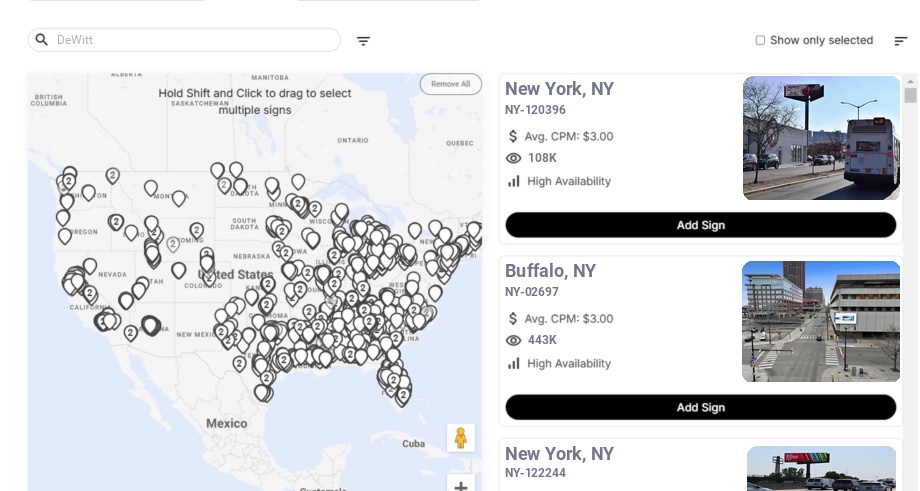
Blip has digital billboards in DeWitt. You can browse available locations on a map, choose the ones that fit your audience, and start advertising right away.
Still have questions? Launch a campaign in minutes — no contracts, no commitments.
Start Your CampaignDeWitt Billboard Advertising Guide
DeWitt, New York sits at the crossroads of some of Central New York’s busiest commuter and shopping corridors. With I‑481 wrapping the town, I‑690 feeding directly into downtown Syracuse, and Erie Boulevard East running straight through its retail spine, DeWitt gives billboard advertisers a chance to reach both affluent suburban households and the broader Syracuse metro on their daily routines. Using Blip’s flexible, pay‑per‑“blip” model, we can zero in on the times, locations, and audiences that matter most across this compact but high‑traffic market, making DeWitt billboards a highly efficient part of a wider Syracuse‑area media plan.
Understanding the DeWitt Market
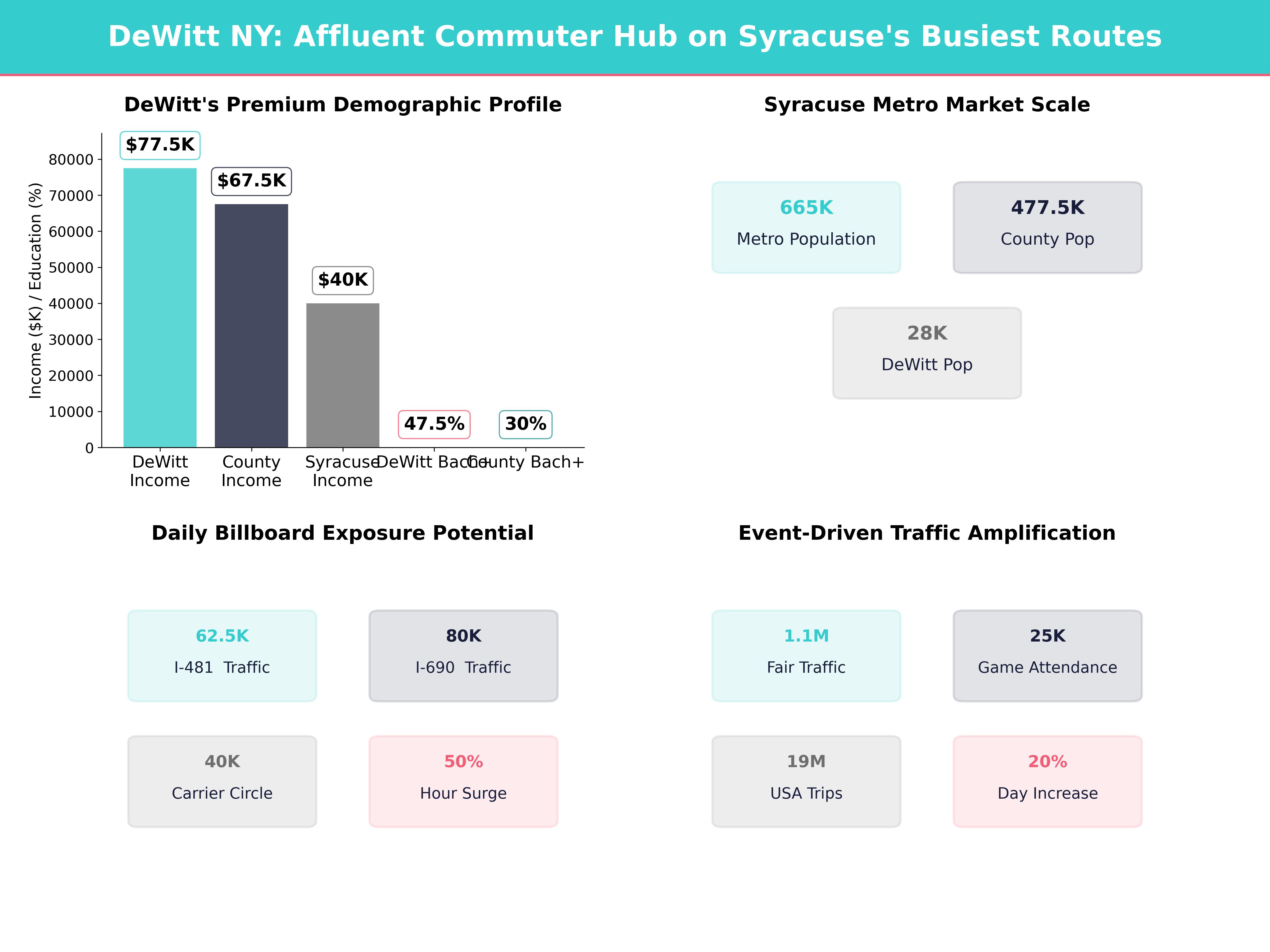
DeWitt is a town of roughly 28,000 people, forming part of the eastern side of the Syracuse urban area. The wider Syracuse metropolitan area counts around 660,000–670,000 residents, with the core City of Syracuse at about 147,000 residents, according to recent regional planning and local government estimates from sources such as the City of Syracuse and Onondaga County
Within that, DeWitt skews somewhat more suburban and affluent than the core city:
- Town of DeWitt population: approximately 27,500–28,500 residents
- Onondaga County population: roughly 475,000–480,000 residents
- Median household income in DeWitt is commonly estimated in the $75,000–80,000 range, versus roughly $65,000–$70,000 for Onondaga County overall and closer to the low‑$40,000s for the City of Syracuse.
- Around 45–50% of DeWitt adults hold a bachelor’s degree or higher, noticeably above the countywide average in the mid‑30% range, supported by nearby higher‑education institutions and professional employers.
Two higher‑education hubs shape the audience:
- Le Moyne College (within DeWitt), a private Jesuit college, enrolls about 3,300 students (roughly 2,500 undergraduates and 800 graduate students) and employs several hundred faculty and staff. Learn more via Le Moyne College.
- Syracuse University, just west of DeWitt’s border in the city, enrolls around 21,000–22,000 students (about 15,000 undergraduates and 6,000–7,000 graduate/professional students) and employs over 5,000 faculty and staff, according to figures shared by Syracuse University.
This means that from late August through early May, well over 30,000 students plus tens of thousands of faculty, staff, and visiting families are moving along DeWitt’s corridors every day, atop the resident base. Well‑placed billboards in DeWitt can tap this constant turnover of viewers with both brand and response campaigns.
The Syracuse area is also a regional healthcare hub. Major systems such as Upstate University Hospital 11,000 employees), Crouse Health (roughly 3,000 employees), and St. Joseph’s Health draw patients and staff from across Central New York, much of it via I‑481, I‑690, and Erie Boulevard. Billboard rental in DeWitt along these approaches is a practical way to stay visible to this professional audience.
Key implications for creative and targeting:
- We are speaking to educated, comparison‑shopping consumers who respond well to clear value propositions, professional visuals, and credible proof points (reviews, awards, local affiliations).
- A noticeable portion of traffic is college‑connected—making DeWitt a strong market for education, housing, food, entertainment, and early‑career recruiting campaigns. College‑age adults (18–24) represent roughly 15–20% of the Syracuse city population during the academic year.
- The area’s mix of families, professionals, and retirees—with many neighborhoods where homeownership rates exceed 65–70%—supports campaigns for healthcare, financial services, home improvement, and automotive services.
For local context and planning resources, we can reference the Town of DeWitt and county‑wide information from Onondaga County, along with regional transportation and demographic studies from the Syracuse Metropolitan Transportation Council
Key Traffic Corridors and Placement Strategy
Digital billboards in and around DeWitt benefit from heavy regional traffic, not just local trips. New York State Department of Transportation (NYSDOT) counts for the DeWitt–Syracuse area show annual average daily traffic (AADT) on key freeways commonly in the 60,000–85,000 vehicles per day range, depending on segment and direction, with some arterial surface roads handling 20,000–35,000 vehicles per day. This volume means DeWitt billboards can deliver metro‑scale reach while keeping the focus tightly local.
Important corridors to think about when structuring Blip campaigns:
-
I‑481 (North–South Beltway)
- Wraps around DeWitt and connects to the New York State Thruway (I‑90) to the north and I‑81 to the south.
- NYSDOT data for recent years shows many I‑481 segments around DeWitt carrying 55,000–70,000 vehicles per day, with interchanges near I‑690 and NY‑5 among the busiest.
- Carries commuters from eastern suburbs (e.g., Manlius, Fayetteville, Jamesville) toward Syracuse employment centers.
- Ideal for reaching suburban professionals, medical staff, and government workers heading toward downtown or University Hill.
Targeting implication:
- Focus budget on weekday morning (6–9 a.m.) northbound and westbound commute patterns and afternoon (3–7 p.m.) outbound flows, when commuter volumes are typically 40–60% higher than late‑evening baselines.
- Promote services with clear “on‑the‑way home” hooks: groceries, pharmacies, fitness, automotive, and quick‑service restaurants, especially since regional trip surveys show that over half of weekday shopping stops are made on commute routes rather than from home.
-
I‑690 (East–West into Downtown Syracuse)
- One of the main arteries into downtown Syracuse and the Inner Harbor.
- Near downtown interchanges, I‑690 can carry 75,000–85,000 vehicles per day, making it one of the highest‑volume roadways in Central New York.
- Strong exposure to office workers, students, event‑goers, and people visiting hospitals and Downtown Syracuse attractions.
Targeting implication:
-
Use dayparting to concentrate impressions around:
- Morning commute: professional services, B2B, healthcare recruiting.
- Lunchtime: dining offers, downtown attractions, retailers near city center.
- Evenings & weekends: entertainment, sports bars, family activities, and events at the JMA Wireless Dome or Landmark Theatre 2,000–20,000+ attendees on major dates.
-
Erie Boulevard East (NY‑5)
- A major commercial corridor running through DeWitt with strip centers, car dealers, big‑box stores, and restaurants.
- NYSDOT counts on Erie Blvd E between DeWitt and Syracuse commonly fall in the 22,000–30,000 vehicles per day range, with some retail‑dense sections spiking even higher on Saturdays.
- Heavily used for shopping trips and local errands rather than pure commuting; regional surveys often show that arterial retail corridors capture 30–40% of weekday consumer trips.
Targeting implication:
- Great for retail and service call‑to‑action messaging (“Turn right at the next light,” “2 miles ahead on Erie Blvd E”).
- Saturdays and early evenings are prime for retail; weekdays 11 a.m.–7 p.m. for errands and after‑work traffic. Billboard rental in DeWitt along Erie Boulevard is particularly effective for businesses that rely on spur‑of‑the‑moment visits.
-
Carrier Circle / Thruway Proximity
- Carrier Circle is a hotel and business node near the I‑90 interchange, serving travelers and logistics.
- Traffic counts near Carrier Circle and the I‑90 ramps often reach 35,000–45,000 vehicles per day, reflecting both local and long‑distance travel.
- Billboards near Interstate access points can tap into through‑traffic headed to Destiny USA (which has reported 18–20 million visitor trips per year in pre‑pandemic years), downtown Syracuse, and regional attractions.
Targeting implication:
- Advertisers in hospitality, tourism, dining, and attractions should time blips to weekends, holidays, and event dates, capturing out‑of‑town visitors coming off the Thruway. Weekend hotel occupancy in the Syracuse area can climb 10–20 percentage points above weekday baselines during major events, according to regional tourism reports from Visit Syracuse.
We can monitor roadway‑related updates via NYSDOT Region 3 and local coverage from outlets like syracuse.com, CNYCentral, and NewsChannel 9 / LocalSYR
Seasonality, Weather, and Event‑Driven Campaigns
DeWitt shares Syracuse’s famously snowy climate. Long‑term weather records for the Syracuse area show average annual snowfall in the 115–130 inch range, with some recent winters pushing totals above 140 inches, making it one of the snowiest larger cities in the United States. The region averages roughly 160–170 days per year with measurable precipitation and many overcast days, which affects visibility and commuting behavior.
Weather and daylight considerations:
-
Winter (late November–March)
-
Snow, slush, and gray skies reduce visual contrast; we should design creatives with:
- High‑contrast color palettes (bold white text, bright accent colors against dark backgrounds).
- Large fonts and minimal copy (ideally 6–8 words or fewer).
- Evening commutes happen mostly in darkness from roughly November through February. Around the winter solstice, Syracuse sunsets occur near 4:30 p.m., meaning a large share of 3–7 p.m. commuters are driving in dusk or full dark. Backlit digital billboards stand out in these conditions and can see noticeably higher recall than static signs based on national OOH studies.
-
Snow, slush, and gray skies reduce visual contrast; we should design creatives with:
-
Summer (June–August)
- Sunlight hours stretch from around 5:25 a.m. sunrise to 8:45–9:00 p.m. sunset at the peak.
- Average high temperatures climb into the mid‑70s to low‑80s°F, and tourism data from Visit Syracuse shows summer as one of the highest periods for hotel stays and attraction visits.
- People spend more time outdoors, traveling to lakes, parks like Green Lakes State Park, and festivals.
Strategy: Shift more budget to weekends and early evenings, especially for recreation, tourism, and seasonal services (landscaping, home improvement, outdoor dining). Outdoor‑oriented categories can see 20–30% higher response when messaging aligns with seasonal behavior (e.g., patio dining, boating, hiking). Aligning these shifts with billboard rental in DeWitt lets advertisers capture increased summer leisure travel through town.
Key seasonal events impacting traffic and audience:
-
New York State Fair (late August–early September)
- Held at the NYS Fairgrounds in Geddes, just west of Syracuse.
- In recent years, total attendance has typically ranged from 900,000 to 1.3 million visitors over the 13‑day run; some peak days exceed 100,000 attendees.
- While the fairgrounds are not in DeWitt, regional hotel, dining, and retail demand spikes, with visitors driving through DeWitt corridors from I‑90, I‑81, and I‑481.
Billboard strategy:
- Run 2–4 weeks of heightened activity around fair dates.
- Feature lodging, dining, shopping, and local attraction offers targeted to I‑690 and major connector routes. Hotel markets around Syracuse can see double‑digit percentage increases in average daily rate and occupancy during the Fair period, so competition for visitor spend is intense. DeWitt billboards give brands a way to reach these visitors before they reach downtown or the Fairgrounds.
-
College Calendar (Le Moyne & Syracuse University)
- Move‑in and orientation (late August), family weekends (fall), homecoming, and graduation (May) drive surges in visiting families. Syracuse University’s commencement alone can bring 10,000–15,000 visitors into the city over a single weekend, and Le Moyne’s ceremonies add additional hundreds to thousands.
- Basketball season (November–March) at Syracuse University is a major regional draw; big games can attract 20,000–30,000 fans to the JMA Wireless Dome, causing traffic peaks several hours before and after games.
Billboard strategy:
-
For hotels, restaurants, campus‑adjacent businesses, and student housing, ramp up impressions during:
- Late August–September (back to school)
- October family weekends
- March–April decision and visit season for prospective students
- Graduation weekends in May
- Time sports‑themed creatives around game schedules and traffic windows (3–4 hours before tipoff and after games). On those days, traffic volumes on I‑690 and streets feeding University Hill can rise 15–25% versus typical evenings. Carefully timed billboard rental in DeWitt ensures brands are front‑of‑mind as fans travel between hotels, restaurants, and venues.
-
Winter & Holiday Shopping Season
- Local retail centers and Destiny USA pull in shoppers across the region, especially November–December. Destiny USA has reported holiday‑season foot traffic surges of 30% or more above non‑holiday months in some years.
- Regional retail sales data and surveys consistently show that November and December account for around 20–25% of annual retail sales for many categories.
Billboard strategy:
- Promote limited‑time sales with countdowns (“5 days left,” “This weekend only”).
- Use early‑morning and evening commutes to remind consumers of holiday deals as they plan shopping trips.
- Consider frequency bursts on Black Friday weekend, the first two weekends of December, and the week leading into Christmas, when parking lots and corridors like Erie Blvd E experience some of their highest traffic of the year. In these windows, billboards in DeWitt can become a key driver of in‑store and online holiday conversions.
Tailoring Creative to DeWitt Audiences
Because DeWitt audiences are highly mobile and often on multi‑purpose trips (work–school–shopping–sports), our creatives must be instantly understandable and locally relevant. National OOH research often shows that drivers have only 5–8 seconds to process a billboard; designs in DeWitt should assume similar or slightly shorter windows on freeway segments. This is especially important when competing billboard rental in DeWitt targets the same high‑value commuters.
Core creative principles for DeWitt:
-
Hyper‑local references
- Mention landmarks like Erie Blvd, Carrier Circle, ShoppingTown/District East, or “near Le Moyne College.”
- Use directional cues: “Exit at Carrier Circle,” “1 mile ahead on Erie Blvd E,” or “Next right after Thompson Rd.”
- Local phrasing builds trust and can improve recall; surveys by local tourism boards and business groups in similar markets often show that local references increase perceived relevance by 15–20%.
-
Weather‑smart design
-
In winter, use:
- Big, bold fonts (at least equivalent of 18–24 inches on‑board lettering, which translates to very large on‑screen typography).
- High‑contrast color pairings: white/yellow on navy, black, or deep green.
- In summer, bright color schemes that play well against sunny glare and greenery.
- Avoid thin serif fonts and low‑contrast palettes; legibility tests suggest that strong sans‑serif type can remain readable at 55–65 mph from 400–600 feet away, while lighter fonts lose clarity much sooner.
-
In winter, use:
-
Audience‑specific messaging:
-
Students and young professionals
- Focus on convenience, price, and social proof (“Student discount,” “Open late,” “Rated #1 on campus for…”).
- Roughly one in five city residents are in the 18–29 age band, with thousands commuting between DeWitt, University Hill, and downtown.
- Call out transit‑accessible locations; local buses through Centro carry millions of passenger trips annually in the Syracuse region and link DeWitt to campuses and shopping.
-
Healthcare and education workers
- Syracuse is a regional healthcare and education center (Upstate University Hospital, Crouse, St. Joseph’s, SU, Le Moyne, Onondaga Community College). Combined, these institutions employ tens of thousands of staff who often work shifts that start or end outside the traditional 9–5 window.
- Staffing and recruiting campaigns can emphasize sign‑on bonuses (often in the $5,000–$20,000 range for in‑demand roles), flexible schedules, and tuition benefits, which are top decision factors in healthcare job‑choice surveys.
-
Families and homeowners
- DeWitt’s suburban neighborhoods mean strong potential for home services, childcare, after‑school activities, and family healthcare. Many nearby school districts show graduation rates in the mid‑ to high‑90% range, underscoring a strong family and education culture.
- Emphasize trust (“Serving DeWitt for 20+ years”), guarantees, and easy contact (“Call today, appointments in 24 hours”).
- Family‑oriented offers (urgent care with extended evening hours, same‑day dental appointments, or 24‑hour emergency services) align well with commuter billboard views.
-
-
Keep one clear call‑to‑action
-
Use short, direct CTAs such as:
- “Book at ExampleHotel.com”
- “Text DEWITT to 55555”
- “Visit us at Erie & Thompson”
- Avoid more than one action per creative; people see the board for a few seconds at highway speed. OOH best‑practice studies consistently show that ad recall and response drop when more than 1–2 key elements (headline + CTA) compete for attention. This is especially true on high‑speed corridors where DeWitt billboards must work hard in minimal viewing time.
-
Use short, direct CTAs such as:
Using Blip Tools Strategically in DeWitt
Blip allows us to buy digital billboard time one “blip” at a time and control when and where our messages run. In a compact market like DeWitt, that flexibility translates into very targeted local domination when we use it thoughtfully. Instead of committing to long, inflexible contracts, advertisers can treat DeWitt billboard advertising as an agile, test‑and‑learn channel.
1. Dayparting by commute and purpose
Traffic in the Syracuse–DeWitt area follows typical commuter patterns: weekday AM peaks around 7–9 a.m. and PM peaks around 4–6 p.m., where volumes can be 30–50% higher than mid‑day baselines on major freeways.
-
Morning (6–9 a.m.)
- Reach commuters heading into downtown Syracuse, hospitals, and campuses.
-
Best for:
- Coffee shops, breakfast spots, and convenience stores on the route.
- Professional services and B2B brand awareness.
- Recruitment messages targeting medical, education, and office workers commuting along I‑481 and I‑690.
-
Midday (11 a.m.–2 p.m.)
- Capture lunch and errand traffic.
-
Ideal for:
- Quick‑service restaurants, cafes, and local dining.
- Retailers on Erie Blvd E or near Carrier Circle.
- Healthcare clinics and same‑day service providers who see walk‑ins spike over the lunch hour.
-
Afternoon/Evening (3–7 p.m.)
- Heaviest outbound traffic; people are more likely to act on “stop on the way home” messages.
-
Great for:
- Gyms and fitness studios (gym check‑ins often peak between 4–7 p.m. on weekdays).
- Grocery, pharmacy, and big‑box shopping.
- After‑school activities and youth sports programs aimed at families leaving work and school.
-
Night (7–11 p.m.)
- Lower traffic but high attention for entertainment, bars, and late‑night dining, especially Thursdays–Saturdays and on game or concert nights.
- Consider higher frequency but shorter bursts around event start and end times.
2. Geographic focus
Within Blip’s inventory, we can choose boards that align tightly with our business location or audience habits:
- Retailers on or near Erie Blvd East should prioritize boards that face inbound shopping traffic from I‑481 and outbound traffic from Syracuse. For many businesses, even a 5–10% lift in weekend traffic from well‑placed CTAs can translate into substantial incremental revenue.
- Service providers serving all of Onondaga County might select boards near I‑481/I‑690 interchanges to maximize reach, as those nodes touch tens of thousands of unique daily commuters.
- Campus‑focused campaigns (for Le Moyne or Syracuse University) should favor routes connecting DeWitt to University Hill and downtown, plus boards near major student housing clusters and Centro park‑and‑ride locations. Choosing the right billboards in DeWitt for each of these goals is often the difference between broad exposure and wasted impressions.
3. Budget and bidding tactics
- Start with a test budget spread across multiple locations and dayparts for 7–14 days, long enough to observe patterns across weekdays vs. weekends.
-
Once we identify times and locations with higher engagement (based on website visits, calls, coupon redemptions, or store traffic), we can:
- Increase bids for those “high‑ROI” slots, potentially concentrating 60–70% of spend into the top‑performing windows.
- Reduce or pause underperforming dayparts and boards.
- Embrace the idea of micro‑bursts: buy heavier frequency during key weekends (State Fair, graduation, holiday shopping, major concerts or games) and lighter schedules during off‑peak periods. Short, high‑frequency bursts of 3–7 days often outperform low‑frequency, always‑on buys for promotional campaigns. This flexible approach to billboard rental in DeWitt lets advertisers match spend to real‑world demand cycles.
Vertical‑Specific Tips for DeWitt Advertisers
Different industries can exploit DeWitt’s travel and demographic patterns in distinct ways.
Retail & Restaurants
-
DeWitt’s proximity to Destiny USA, big‑box clusters on Erie Blvd, and new redevelopment projects (like the District East at the former ShoppingTown Mall) creates strong retail competition. Destiny USA alone has reported over 200 retail and dining tenants and visitor counts approaching 20 million trips annually in strong years.
-
Use billboards to:
- Highlight unique advantages: local ownership, specialty inventory, premium service, or faster turnaround.
- Promote time‑sensitive offers: “Today only,” “This weekend,” or “Ends Sunday.” Short‑window promotions can drive 2–3x higher redemption rates than evergreen offers.
- Anchor directions to known intersections: “Next to Wegmans on E Genesee,” or “Across from [ShoppingTown/District East].”
-
Consider a two‑creative approach:
- Awareness creative: brand message, logo, product category.
- Promo creative: rotating discount or event.
With Blip, we can A/B test these creatives by alternating them and monitoring response via unique URLs, promo codes, or incremental sales. Even small changes (e.g., adding “Today only”) can shift response rates by 10–30%. For retailers, DeWitt billboard advertising can serve as both a branding tool and a direct response driver when paired with compelling offers.
Higher Education & Training
- With Le Moyne College in town and multiple regional institutions (including SUNY campuses and Onondaga Community College) competing for students, visibility in DeWitt is valuable. The wider Central New York region hosts tens of thousands of college students across all institutions.
-
Use billboards to:
- Advertise open houses, info sessions, and application deadlines, especially in the October–January undergraduate recruitment window and March–June for adult and graduate programs.
- Promote graduate programs, certificate programs, and online degrees for working adults; regional adult‑learner and continuing‑ed enrollment can represent 20–30% of total headcount at some institutions.
- Reinforce messaging on local news sites like syracuse.com by running parallel billboard campaigns. Cross‑channel campaigns often see higher brand recall (by 10–20 percentage points) compared with single‑channel efforts.
Healthcare & Professional Services
- Syracuse is the medical hub for Central New York; many staff and patients pass through DeWitt daily. Combined employment at Upstate, Crouse, St. Joseph’s, and related facilities exceeds 20,000 workers, plus thousands of daily patient and visitor trips.
-
Effective billboard uses:
- Recruitment campaigns for nurses, techs, and administrative staff featuring specific salary ranges (e.g., “RNs from $35/hr + $10,000 bonus”), benefits, and clear application URLs. Health systems that advertise concrete numbers tend to see higher application volumes than those using generic language.
- Awareness for specialty clinics, urgent care, dental, and vision centers in DeWitt and nearby suburbs, highlighting wait times (“Walk‑ins welcome, average wait under 20 minutes”) or extended hours.
- Clear directional CTAs: “Turn right at Widewaters Pkwy,” “Exit at 3E, 2 minutes off I‑481,” or “Next to Wegmans DeWitt,” which are proven to boost navigation‑based visits.
For these sectors, precisely targeted billboards in DeWitt along medical commute routes can help employers and practices stand out in a competitive hiring and patient‑acquisition landscape.
Tourism, Attractions, and Hospitality
-
DeWitt functions as a convenient base for visitors heading to:
- Destiny USA
- The NYS Fairgrounds
- Downtown Syracuse arts and dining
- Finger Lakes wineries and lakes to the south and west
- According to regional tourism reports, Central New York tourism spending totals hundreds of millions of dollars annually, with summer and early fall as peak seasons. Hotel occupancy in the Syracuse area can rise into the 70–80% range during major events versus 50–60% in shoulder seasons.
-
Hotels, attractions, and dining can:
- Run heavier schedules on summer weekends, State Fair dates, and big sports weekends (e.g., SU football and basketball, major concerts at the Dome).
- Use creative that ties into coverage from Visit Syracuse and local sports or event calendars, as visitors frequently rely on those resources when planning trips.
- Emphasize ease: free parking, easy access from I‑481/I‑690, free breakfast, pet‑friendly rooms, or family‑friendly amenities. Amenities like free breakfast or parking can sway 30–40% of hotel choice decisions for family travelers in survey data.
Because so many visitors approach Syracuse from the east and northeast, strategic billboard rental in DeWitt is often one of the earliest chances to influence their lodging and dining choices.
Measuring and Optimizing DeWitt Campaigns
To make the most of our Blip spend, we should treat every campaign as an experiment and track what works. Even simple measurement frameworks can identify 20–40% efficiency gains when budgets are shifted toward proven performers. This mindset turns DeWitt billboard advertising into a continually improving channel rather than a static line item.
1. Tie creatives to trackable actions
- Use short URLs (e.g., yourbrand.com/dewitt) or QR codes for local campaigns that drive to landing pages. Even if only 1–3% of viewers respond directly, that still represents meaningful incremental traffic at high‑volume intersections.
- Create billboard‑specific promo codes (“DEWITT10”) and track redemption counts online and in‑store.
- Ask new customers “How did you hear about us?” and record responses for at least a few weeks after launch; in many local markets, 10–25% of new customers cite outdoor or “signs” as a discovery source when asked directly.
2. Align with digital analytics
- Watch for traffic spikes from the DeWitt–Syracuse area in your web analytics during campaign periods, focusing on ZIP codes like 13214, 13057, 13206, and surrounding areas.
-
Compare on vs. off periods:
- If site sessions from local ZIP codes rise during active billboard weeks by even 5–15%, that’s a strong signal of impact relative to baseline.
- Coordinate messaging with social and search campaigns; reinforcing the same headline and offer across channels tends to improve ad recall and click‑through rates by 10–20%, based on common multi‑channel marketing benchmarks.
3. Adjust based on time and event performance
-
Test different dayparts for at least 5–7 days each, then:
- Shift more budget into the hours that precede your highest walk‑in or online conversion times. For example, if 60% of daily sales happen between 4–8 p.m., weight your blips to the 2–6 p.m. window.
-
For event‑driven campaigns (State Fair, graduations, sales weekends), compare:
- Sales and foot traffic during event weeks with and without billboards. Track metrics like average ticket size, total transactions, or website bookings.
- If results are positive—e.g., 10%+ uplift in revenue or leads—consider making those event windows annual “high‑intensity” Blip campaigns and locking in creative concepts that proved effective.
By understanding how DeWitt’s commuters move, how its weather and seasons affect visibility, and how regional events reshape traffic patterns, we can build digital billboard campaigns that punch above their weight. With Blip’s ability to target specific boards, times, and budgets, advertisers in DeWitt can use data‑driven strategy—not just guesswork—to reach the right drivers at the right moment and turn everyday traffic into measurable business results through smart, flexible use of DeWitt billboards.