Billboards in Hempstead, NY
No Minimum Spend. No Long-Term Contracts. Just Results.
Trusted by Leading Brands


Billboard advertising
in Hempstead has never been easier



How much is a billboard in Hempstead?
Why Choose Blip for Billboard Advertising in Hempstead
Blip lets you launch fast on Hempstead's Hempstead Turnpike and Southern State Parkway corridors, reaching dense commuter traffic without a traditional buy.
In Hempstead, daypart your ads for 6-9 a.m. LIRR rush or 3-7 p.m. school runs to catch the audiences moving through Nassau County.
No contracts or minimums mean you can test Hempstead campaigns near Roosevelt Field, Hofstra, and UBS Arena, then shift budget to what works.
Blip's real-time analytics help you see what's driving response in Hempstead, so you can adjust for summer Jones Beach traffic or holiday retail peaks.
Use Blip's creative tools to build bilingual, high-contrast ads for Hempstead's diverse audience and busy 3-5 second viewing windows.
Frequently Asked Questions About Billboard Advertising in Hempstead
How much does a billboard cost in Hempstead, New York with Blip?
With Blip, advertising on Hempstead billboards is flexible and affordable because you only pay per “blip”—a 7.5 to 10-second ad display—rather than locking into a large traditional contract. You choose your daily budget during campaign setup, and Blip automatically keeps your ads within that amount, so you stay in control. The cost per blip varies based on the times you select, the locations of billboards in Hempstead, New York, and real-time advertiser demand.
Where can I advertise with Blip in Hempstead, New York?
Hempstead billboards can reach audiences along major traffic corridors and near high-value destinations across central Nassau County. Key roadways include Hempstead Turnpike, Meadowbrook State Parkway, Southern State Parkway, and local arterials around Hempstead Avenue and Fulton Avenue. Nearby destinations like Roosevelt Field, Hofstra University, Nassau Community College, and UBS Arena also create strong opportunities for billboard exposure.
When is the best time to run Blip ads on Hempstead billboards?
The best timing depends on your audience, but Hempstead has predictable weekday commute windows and strong weekend and seasonal spikes. Morning commute, afternoon school run, and evening commute are all important dayparts, and the page notes that evening commute is often the highest traffic volume period on major Hempstead corridors. For summer traffic, campaigns can be ramped up on Fridays, Saturdays, and holiday weekends to catch beach and leisure travel.
Why is Hempstead, New York a strong market for billboard advertising?
Hempstead sits at the heart of Nassau County and is one of the most densely populated, diverse, and economically active communities on Long Island. With nearly 800,000 residents in the Town of Hempstead, plus commuter and visitor traffic flowing between Queens and eastern Long Island, digital Hempstead billboards can generate consistent, high-intent impressions. The area also has major institutions, retail traffic, and multiple major corridors that create strong daily audience reach.
What kind of audience can Blip reach on Hempstead billboards?
Hempstead reaches a mix of higher-income suburban households, price-sensitive urban neighborhoods, students, commuters, seniors, and diverse multilingual communities. The area includes more than 30,000 students across Hofstra University, Nassau Community College, and Adelphi University, plus large numbers of daily commuters and shoppers. In the Village of Hempstead and Uniondale, many residents speak a language other than English at home, so bilingual creative can be especially effective.
Do I need a contract to advertise with Blip in Hempstead?
No, Blip has no long-term contracts or minimum commitments. You can start, pause, or stop your campaign at any time.
How fast can I launch a billboard campaign with Blip in Hempstead?
You can have your campaign live in minutes. Create a free account, select your locations, set your budget, upload your design, and start running once approved.
Where can I advertise with Blip in Hempstead?
Blip has digital billboards in Hempstead. You can browse available locations on a map, choose the ones that fit your audience, and start advertising right away.
Still have questions? Launch a campaign in minutes — no contracts, no commitments.
Start Your CampaignHempstead Billboard Advertising Guide
Hempstead sits at the heart of Nassau County and is one of the most densely populated, diverse, and economically active communities on Long Island. With nearly 800,000 residents in the Town of Hempstead, plus commuter and visitor traffic flowing between Queens and eastern Long Island, digital Hempstead billboards can generate consistent, high-intent impressions for both local and regional advertisers. Below, we share how we can use Hempstead’s unique patterns—traffic flows, demographics, local institutions, and seasonality—to build smarter, more profitable Blip campaigns and make the most of Hempstead billboard advertising opportunities.
Understanding the Hempstead Advertising Landscape
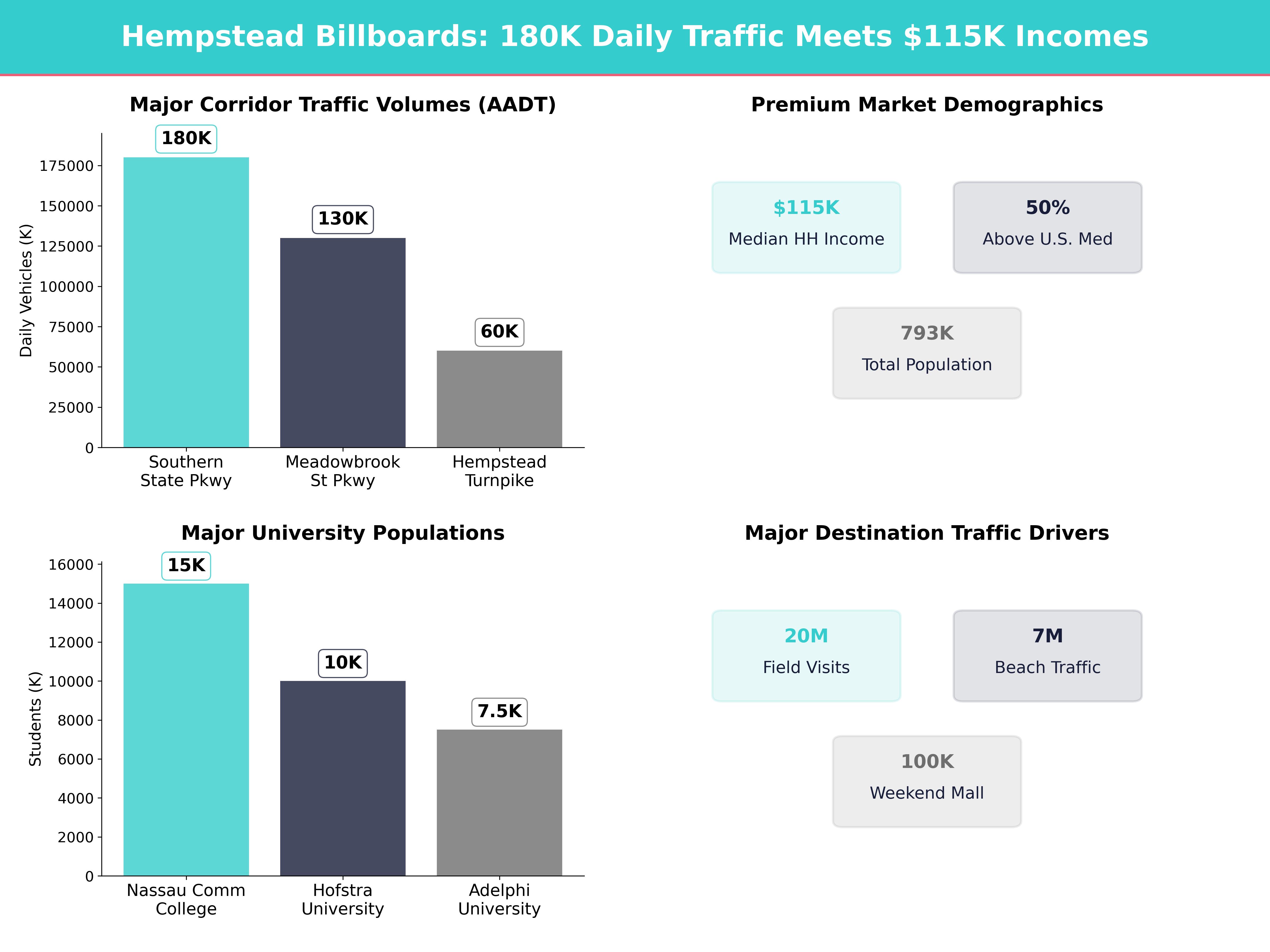
The Town of Hempstead is the largest township in the United States, with about 793,000 residents as of 2020, spread across more than 20 incorporated villages and numerous hamlets. The Village of Hempstead itself has roughly 59,000 residents in only about 3.7 square miles, giving it a density of more than 15,000 people per square mile, which is closer to a small city than a typical suburb. This density, combined with multiple major corridors, creates a powerful canvas for digital billboard messaging and ensures that well-placed billboards in Hempstead reach substantial daily audiences.
Key contextual points for advertisers:
- Regional role: Hempstead anchors central Nassau County and connects New York City to the rest of Long Island. Nassau County has about 1.39 million residents, and the Town of Hempstead accounts for roughly 57% of that total. East–west traffic flows between Queens and Suffolk along major arterials, while north–south flows tie in coastal communities and beaches, creating ideal circulation patterns for Hempstead billboards.
- Commuter culture: In Nassau County, roughly 80–85% of workers commute out of their home municipality, and over 60% drive alone to work, with a typical commute time of around 33–35 minutes. Thousands of residents commute daily to Manhattan and Queens via the Long Island Rail Road (LIRR) and major highways such as the Meadowbrook State Parkway and Southern State Parkway, creating predictable weekday impression windows that make Hempstead billboard advertising particularly efficient.
- Institutional hubs: Nearby Hofstra University (Hofstra University, about 10,000 students), Nassau Community College (Nassau Community College, around 15,000 students including part‑time), and Adelphi University (Adelphi University, about 7,500 students) create a steady stream of young, tech-savvy consumers around Hempstead and Garden City. Combined, these institutions bring 30,000+ students and thousands of staff and visitors into the area during the academic year.
- Retail gravity: The area around Roosevelt Field ( Roosevelt Field 250 stores across roughly 2.4 million square feet of retail—draws 20+ million visits annually from across Long Island, Queens, and Brooklyn.
Useful local references as you plan:
- Town government: Town of Hempstead
- Village government: Village of Hempstead
- County-wide info: Nassau County
- Regional tourism: Discover Long Island
- Local news: Newsday and Long Island Herald – Hempstead
We can leverage Blip’s flexibility—controlling when, where, and how frequently our ads appear—to line up our campaigns with these geographic and behavioral realities and get more value from any billboard rental in Hempstead.
Who We’re Reaching: Demographics & Local Consumer Behavior
Hempstead’s demographic profile is fundamentally different from Manhattan, Brooklyn, or the Hamptons—and that matters for billboard creative and targeting as we plan Hempstead billboard advertising campaigns.
Population & income
- The Town of Hempstead holds roughly 793,000 residents, or about 57% of Nassau County’s total population (~1.39 million).
- Median household income in the Town of Hempstead is around $110,000–$115,000, which is about 40–50% higher than the U.S. median and 10–15% above the New York State median. In many south‑shore and central neighborhoods, homeownership rates exceed 75%, and average household size is roughly 3.0 people.
- In the Village of Hempstead, median household income is closer to $60,000–$65,000, with significantly higher renter occupancy (often 60%+ of occupied housing units) and more working-class households. Poverty rates in parts of the village are 2–3 times higher than in nearby affluent communities such as Garden City or Rockville Centre.
Implications for campaigns:
- We can segment creative based on which corridors primarily reach higher-income suburbs (e.g., Garden City, Rockville Centre, Merrick, Bellmore, East Meadow) versus those closer to urban, price-sensitive neighborhoods (e.g., Village of Hempstead, Uniondale, Freeport).
- Higher-income corridors skew toward dual-income households with multiple vehicles; in Nassau County, more than 90% of households have access to at least one vehicle and roughly 60% have two or more, supporting auto, home improvement, and discretionary retail messaging.
- Price framing, offers, and featured products can be adjusted by zip code using Blip’s location targeting—premium positioning in higher‑income zones and value-focused messaging in more budget-conscious areas.
Diversity & language
Hempstead is one of the most diverse communities on Long Island:
- In the Village of Hempstead, more than 60% of residents identify as Black or African American or Hispanic/Latino, and no single racial or ethnic group forms a majority.
- In many Village of Hempstead and Uniondale census tracts, over 45–50% of residents were born outside the United States, and 50–60% speak a language other than English at home.
- Spanish is the primary non‑English language, but there are also significant Caribbean (including Haitian Creole) and Central American communities, plus growing West African and South Asian populations.
Implications for billboard messaging:
- Bilingual creative (English/Spanish) can significantly increase resonance on boards that primarily face residential streets and local business districts. In similar New York metro markets, bilingual OOH campaigns have been shown to improve recall by 15–25% among Hispanic audiences compared with English-only ads.
- Short Spanish headlines—5–7 words—paired with English support text often perform best in quick-view environments.
- For campaigns around immigration law, community health, remittances, or ethnic grocery and restaurant offerings, we should consider fully Spanish creative on boards near Village of Hempstead, Uniondale, Freeport, and Elmont, where Spanish-speaking populations can exceed 35–40% of residents.
Age & life stage
- Hempstead and surrounding areas have a substantial family demographic. In many Town of Hempstead neighborhoods, 30–35% of households include children under 18, and public school districts in and around Hempstead enroll tens of thousands of students each year.
- College-aged and young adult populations concentrate around Hofstra, Nassau Community College, and Adelphi, as well as in more urban parts of the village. Combined daily campus populations (students, faculty, and staff) near Hempstead and Garden City can exceed 40,000 people on busy weekdays.
- The region also has a sizable senior population; in Nassau County, about 17–18% of residents are age 65+, creating steady demand for healthcare, financial services, and home maintenance.
Implications:
- Family-oriented advertisers (healthcare, daycare, K–12 schools, insurance, quick-service restaurants) should prioritize rush-hour and weekend impressions on boards near residential areas and school corridors, aligning with school start/end times (typically 7–9 a.m. and 2–4 p.m.).
- Higher-education, nightlife, entertainment, and technology advertisers should focus impressions near campus approaches and along major corridors connecting campuses to housing, malls, and transit, particularly in evening and weekend dayparts when students are most active.
Mapping Traffic Flows: Where Billboard Impressions Matter Most
Successful campaigns in Hempstead start with understanding daily movement patterns. While specific Blip board locations will vary, the main traffic arteries don’t change. Across central Nassau, annual average daily traffic (AADT) on key parkways and arterials commonly exceeds 100,000 vehicles per day, translating into millions of monthly impression opportunities for billboards in Hempstead.
Key roadways and corridors
-
Hempstead Turnpike (NY-24)
- A major east–west arterial passing near Hofstra University, the Nassau Veterans Memorial Coliseum/Hub area, and several large commercial clusters.
- Depending on the segment, AADT on Hempstead Turnpike often ranges between 40,000 and 60,000 vehicles per day, with weekday peaks. This can translate into 1.2–1.8 million vehicle trips per month past well-positioned boards.
- Heavy mix of student traffic, local commuters, and retail shoppers.
-
Ideal for campaigns focused on:
- Colleges and trade schools
- Quick-service restaurants and coffee
- Retail sales and local events
-
Use Blip’s dayparting to prioritize:
- 7–10 a.m. (class and work commutes)
- 3–7 p.m. (return commutes, after-class activities)
-
Meadowbrook State Parkway
- Major north–south connector from the Northern State Parkway and Southern State Parkway down to Jones Beach State Park.
- NYSDOT traffic counts typically show AADT in the 110,000–130,000 vehicles per day range on central segments near Roosevelt Field and the Nassau Hub.
- Summer weekends can see traffic volumes 20–30% higher than typical weekdays as beachgoers head to the shore.
-
Perfect for:
- Summer events, beach-related retail, food & beverage
- Amusement, attractions, and hospitality
- With Blip, we can ramp up impressions on Fridays, Saturdays, and holiday weekends in May–September to catch leisure traffic.
-
Southern State Parkway
- Critical east–west route for commuters heading between Queens and Suffolk County, passing through or near several Town of Hempstead communities.
- AADT on busy segments often exceeds 150,000–180,000 vehicles per day, making it one of the most heavily traveled roads on Long Island.
- Captures a broad cross-section of Nassau’s workforce across income levels and industries.
-
Ideal for:
- General brand awareness
- Auto dealers, insurance, financial services
- Political and public service messaging
-
NICE Bus & local arterials
- The Nassau Inter-County Express (NICE) bus system (NICE Bus) carries more than 20 million riders per year across Nassau County, with several high-frequency routes serving Hempstead Transit Center and nearby corridors.
- Key bus routes through Hempstead can see thousands of boardings per weekday, driving repeated exposures for pedestrians and drivers alike.
- High visibility corridors like Hempstead Avenue, Fulton Avenue, and downtown village streets experience consistent bus and car traffic at lower speeds (often 25–35 mph), increasing viewing time for digital billboards.
- For local service businesses (law firms, tax prep, clinics, dental offices), we recommend focusing on boards that face lower-speed urban streets where dwell time is higher and repeat local exposure is common.
-
LIRR feeder traffic
- The Hempstead LIRR station ( Hempstead Station – MTA MTA LIRR).
- The Hempstead Branch carries tens of thousands of riders on an average weekday, with peak trains arriving in the 6–9 a.m. and 4–7 p.m. windows.
- Roads feeding the station—along with parking lots that can hold hundreds of vehicles—experience increased morning and evening traffic.
- Tailor creative to commuters (time-saving services, mobile apps, financial services, food and beverage near stations) and use short, action-oriented copy that leverages a 3–5 second viewing window.
Proximity to high-value destinations
- Roosevelt Field ( Roosevelt Field 20+ million visits annually. During peak holiday periods (mid‑November through December), daily foot traffic can swell to 70,000–100,000+ visitors on weekends, boosting OOH exposure on nearby roads.
- UBS Arena in Elmont ( UBS Arena 17,250 fans for hockey and up to 19,000 for concerts. The venue hosts 100–150+ events per year, with event nights pushing 10,000–18,000 attendees, many arriving by car and shuttle.
- Jones Beach State Park (Jones Beach State Park), one of New York’s most visited beaches, typically sees 6–7 million visitors per year. Concerts at the Northwell Health at Jones Beach Theater (Northwell Health at Jones Beach Theater) add 10,000–15,000 attendees per show across dozens of summer events.
We can time Blip flights to concentrate impressions around event windows:
- 2–4 hours before Islanders games or concerts at UBS Arena, when inbound traffic is heaviest.
- Weekends and summer holidays leading to Jones Beach, especially late mornings (9 a.m.–noon) for beach‑bound traffic and late afternoon/early evening for return trips.
- Major retail holidays (Black Friday, Super Saturday, back‑to‑school in August/September) around Roosevelt Field and surrounding shopping centers.
Seasonality: When to Turn Up (or Down) the Volume
The Hempstead market doesn’t behave like Manhattan’s year-round. Local rhythms—school calendars, tourism, and weather—affect who sees our billboards and what they care about, and they should inform how we structure billboard rental in Hempstead.
Winter (January–March)
- Commuter traffic remains steady; Nassau County employment levels mean that 70%+ of adults are in the labor force, and most continue commuting through winter.
- Storms and early sunsets mean more impressions occur in the dark. In December and January, sunset can be as early as 4:30 p.m., so evening rush hour is largely after dark.
- Winter weather increases demand for home services, auto repair, and healthcare; emergency room and urgent care visits typically rise during flu season.
-
Best for:
- Gyms and wellness (New Year’s resolutions; gym sign‑ups often spike 30–50% in January).
- Tax services (the IRS filing season runs January–April, with a heavy concentration of returns filed by mid‑March).
- Home improvement planning and contractors, as homeowners schedule spring projects.
- Blip tactic: Shift more budget to 6–9 a.m. and 4–8 p.m., when commuters experience more nighttime conditions and illuminated boards dominate, and test weather‑responsive creative (“Snow Day Specials,” “Cold Weather Check‑Ups”).
Spring (April–June)
- College graduations at Hofstra, Adelphi, Nassau Community College increase visitor traffic by thousands of guests per campus on graduation weekends.
- High school prom and graduation seasons drive spending on apparel, beauty, photography, catering, and venues; local schools collectively graduate several thousand seniors each spring in the Hempstead area alone.
- Outdoor activities ramp up; as temperatures rise into the 60s and 70s, families start planning camps and summer activities. Many camps in Nassau County close registration by late May or early June.
- Blip tactic: Launch time-bound campaigns (e.g., “Camp registration ends May 15”) with countdown-style messaging and increase impressions on Thursdays–Sundays, when families are running errands and attending events.
Summer (July–August)
- Heavy traffic on Meadowbrook and other routes to Jones Beach and coastal communities like Long Beach. On peak summer weekends, Jones Beach parking fields can reach full capacity (tens of thousands of vehicles) by midday.
- Tourism increases across Long Island, with visitors using Discover Long Island to find events and attractions. Summer hotel occupancy and short‑term rentals often run 10–20 percentage points higher than winter levels.
- Local residents adjust schedules; schools are out, so daytime traffic includes more families, teens, and tourists.
-
Best for:
- Restaurants, ice cream, fast casual dining
- Attractions, festivals, and concerts
- Auto repair and roadside services, as summer road trips and heat stress vehicles
-
Blip tactic:
- Shift budget toward weekends and holiday weeks (Memorial Day, July 4, Labor Day), when beach and leisure traffic spikes.
- Emphasize boards on beach-bound routes and near hospitality clusters.
- Test creative with strong visual cues (beach imagery, cold drinks, outdoor dining) that perform well in bright daylight.
Fall (September–December)
- Back-to-school and college move-in periods spark spending on furniture, electronics, clothing, and services. Late August and early September can account for 25–30% of annual sales for some education-related retailers.
- The holiday shopping season at Roosevelt Field and other malls drives extremely high retail traffic from mid-November through December; national OOH benchmarks often show 15–20% higher mall-area traffic in this window.
- Late fall is also prime political advertising season in New York State and local races. In competitive cycles, political advertisers can temporarily boost OOH demand and drive up CPMs.
-
Blip tactic:
- Use short, offer-driven creative (“Doorbusters Today Only,” “Black Friday Specials,” “Early Voting Now Open”) and intensify frequency around key weekends (Black Friday, Super Saturday, final pre‑Christmas weekend) and election days.
- Coordinate geo-targeting to boards closest to major shopping corridors and residential neighborhoods, and consider zip code–specific political or advocacy messages where permitted.
Creative Strategies That Work in Hempstead
Hempstead’s roads are fast, busy, and often congested. That makes clarity and relevance critical for any Hempstead billboard advertising strategy.
Visual and copy best practices
- Use 6–8 word headlines: On fast-moving corridors like Southern State Parkway, drivers have about 3–5 seconds to process your message. Keeping total word count under 12–15 dramatically improves readability.
- High contrast color: Dark backgrounds with bright, bold text (or vice versa) stand out day and night, especially in winter and during rush hours when headlights and streetlights compete for attention.
- Local references: Phrases like “Minutes from Roosevelt Field,” “Across from Hofstra,” or “On Hempstead Turnpike” help people connect your message to a specific place. In surveys, location-specific OOH copy has been shown to improve ad recall by 10–15%.
- Offer clarity: Lead with the value (“$0 Down Auto Financing,” “Free Consultation,” “Same-Day Urgent Care”). Simple, numbers‑driven offers are easier to process at 60 mph.
- Strong calls-to-action: Even though users can’t click a billboard, directives like “Text HEMP to 55555,” “Exit 23 – Next Right,” or “Search ‘Hempstead Braces’” drive measurable actions. QR codes can work on slower local streets but should be avoided on high-speed parkways.
Tailoring to diverse audiences
- Bilingual layouts: Keep Spanish and English text balanced, using Spanish for the primary emotional hook and English for legal fine print or details if needed. In majority‑Hispanic tracts, consider 60–70% of the copy in Spanish.
- Community imagery: Use images that reflect Hempstead’s ethnic diversity—families, students, and working professionals of varied backgrounds. In diverse markets, inclusive imagery has been linked to double-digit increases in favorability among minority audiences.
- Neighborhood-specific offers: If you operate multiple locations, highlight the closest branch in each creative variation (“Freeport Location – 7 Minutes Away”). In heavily trafficked zones, even a 1–2 mile distance callout can make a difference in response rates.
With Blip, we can upload multiple creatives and let them rotate, testing which ones perform best and gradually favoring the high-performers based on measurable KPIs like web visits, calls, or code redemptions.
Making the Most of Blip’s Targeting in Hempstead
Blip’s strength lies in precision and flexibility—both essential in a complex market like Hempstead, where advertisers often juggle multiple billboards in Hempstead across different neighborhoods and road types.
Dayparting (time-of-day targeting)
Match impressions with likely buyer intent:
-
Morning commute (6–10 a.m.)
- Coffee shops, breakfast, transit apps, podcasts
- Financial services, B2B, and professional services
- In Nassau County, a large share of commuters leave home between 6:30 and 8:30 a.m., making this a prime window.
-
Midday (10 a.m.–3 p.m.)
- Seniors, stay-at-home parents, remote workers, shift workers
- Healthcare, grocery, home services
- Traffic volumes are slightly lower but attention can be higher due to lighter congestion.
-
Afternoon school run (2–4 p.m.)
- After-school programs, tutoring, sports facilities, quick snacks
- Public school dismissal typically falls in this window, creating repeat daily impressions for parents.
-
Evening commute (4–8 p.m.)
- Restaurants, retail, streaming services, events
- This is often the highest traffic volume period on major Hempstead corridors.
-
Late evening (8 p.m.–midnight)
- Nightlife, entertainment, delivery apps (where available), gaming
- Impressions are fewer but audience skew is younger and more entertainment-focused.
We can use Blip to increase bid amounts or share-of-voice during the 2–3 highest-value dayparts for your business rather than spreading budget thinly across 24 hours. For many advertisers, concentrating 60–70% of impressions into key dayparts yields better ROI than always‑on schedules.
Day-of-week and calendar control
- Focus Monday–Friday for B2B, commuting, legal services, and healthcare, when work-related travel peaks.
- Emphasize Friday–Sunday for retail sales, dining, events, and tourism; in retail analytics, weekends can account for 40–50% of weekly in-store traffic.
-
Schedule pop-up bursts on:
- Paydays (1st and 15th or typical local pay cycles), when discretionary spending increases.
- Student move-in/registration weeks at Hofstra, Adelphi, and Nassau CC, when campus areas and nearby retailers see sharp but short-lived spikes in traffic.
- Religious holidays and cultural festivals that are relevant to local communities (e.g., major Christian, Jewish, and Muslim holidays, Caribbean and Latin American heritage events).
Geographic selection
Within the broader Hempstead market, we can shift budget between:
- Urban core (Village of Hempstead, Uniondale, Freeport)
Higher density (often 10,000–15,000+ residents per square mile), more walkable, price-sensitive audiences, larger renter populations, and higher usage of transit and NICE bus routes. - Suburban and affluent neighborhoods (Garden City, Rockville Centre, Merrick, Bellmore, East Meadow)
Higher household income (frequently $130,000–180,000+), strong retail and dining spend, higher auto ownership (two or more vehicles per household is common), and higher homeownership. - Beach and leisure corridors (Meadowbrook to Jones Beach, south shore communities)
Seasonal traffic with high discretionary spending on leisure and experiences; on summer weekends, vehicle volumes to the south shore can jump 20–40% compared with typical off-season weekends.
By using Blip’s location controls, we can run separate creatives in each sub-market, even within the same overall campaign, and then adjust budget in real time as performance data comes in. This lets you fine-tune billboard rental in Hempstead to the exact audiences you value most.
Industry-Specific Tips for Hempstead Advertisers
Local retailers & restaurants
- Tie messaging to nearby landmarks and malls—“2 Minutes from Roosevelt Field,” “Across from Hempstead LIRR.” For context, Roosevelt Field’s 20+ million annual visits mean the surrounding road network is among the busiest retail zones in Nassau County.
-
Promote limited-time offers during peak shopping months:
- August/September for back-to-school (office supplies, clothing, dorm goods).
- November/December for holidays (gift cards, electronics, apparel).
- For restaurants, focus on lunch and dinner dayparts with mouthwatering visuals and simple CTAs (“Exit Now,” “Order Online”). In commuter corridors, after‑work dining and takeout can represent 30–40% of daily volume.
Auto dealers & services
- Nassau County has one of the highest vehicle ownership rates in the New York metro region, with 90%+ of households having at least one vehicle and many having two or more, making auto-related advertising especially effective.
- Use boards along Southern State Parkway, Hempstead Turnpike, and other major arterials approaching dealer rows and service centers.
-
Rotate creatives for:
- Seasonal maintenance (tires, brakes, AC/heat checks), timed to temperature swings and winter storms.
- Lease specials and low-APR financing; many brands push aggressive offers in March, June, September, and December to hit quarterly targets.
- Trade-in events and cash offers tied to tax refund season; tax refunds often begin arriving in February, with a large share distributed by mid‑April.
- Time campaigns around these seasonal peaks and consider heavy-up schedules of 2–4 weeks when incentives are strongest.
Healthcare providers
- Emphasize accessibility—“Walk-in Urgent Care,” “Same-Day Appointments,” “Open Late.” In suburban markets, convenience is a key driver of provider choice.
- Highlight multilingual staff or services if you serve Spanish- or Haitian Creole-speaking patients, given the 50–60% non-English-at-home rates in some neighborhoods.
- Use boards near residential zones and school corridors for pediatrics, orthodontics, and family medicine; school‑age children make up around 20–25% of the local population.
-
Promote seasonal offerings:
- Flu shots and vaccines in September–December.
- Sports physicals in late summer.
- Allergy treatments in spring.
Education & training
-
For colleges, trade schools, and training programs, focus on:
- Enrollment deadlines, FAFSA timelines, and open house dates.
- Outcomes—job placement rates, certification pass rates, and starting salaries; local career programs that place 70–80% of graduates in jobs within six months can highlight that advantage.
-
Leverage creative targeting at:
- Commuter corridors feeding Hofstra, Nassau CC, and Adelphi, where daily campus populations exceed 40,000.
- Downtown areas where young adults and career-changers live or work, including Village of Hempstead and Freeport.
- Run heavier schedules in January–March (for fall enrollment) and August–September (for last-minute registrants and adult learners).
Legal, financial, and professional services
- Hempstead’s diverse population creates demand for immigration law, family law, personal injury, and small business services. In many neighborhoods, foreign-born residents account for 40–50% of adults, boosting need for immigration and cross‑border services.
-
Use trust-building messaging:
- “Serving Hempstead Families for 20+ Years”
- “Free Consultation – Se Habla Español”
- “Local Offices in Hempstead & Freeport”
- Prioritize rush hours and daytime impressions when prospective clients are traveling to and from work or appointments.
- Consider neighborhood-specific creative for areas with high small‑business density (e.g., downtown Hempstead and Freeport), highlighting business formation, bookkeeping, and tax support.
Political and advocacy campaigns
- The Town of Hempstead and Nassau County are politically active, with competitive races at local, county, and state levels. Voter turnout in general elections often ranges from 50–65% of registered voters, and local issues frequently receive extensive coverage in outlets like Newsday and the Long Island Herald – Hempstead
-
Use Blip to:
- Saturate specific districts with messages in the two weeks before Election Day, when undecided voters are most attentive.
- Run issue-specific campaigns ahead of public hearings or referendums, timed to when local media coverage peaks.
- Deploy bilingual messaging in districts with high Spanish-speaking populations, ensuring that both English- and Spanish-dominant voters see tailored messages.
- Because political demand can spike CPMs by 20–50% during the final month before major elections, plan early and lock in key boards and dayparts in advance.
Measuring and Refining Campaign Performance
Digital billboards in Hempstead work best when we treat them as test-and-learn channels rather than one-time buys.
Practical measurement tactics:
- Unique URLs and promo codes: “Visit mybrand.com/hempstead” or “Use code HEMP10” to track billboard-driven conversions. In many OOH case studies, custom URLs and codes account for 10–30% of measurable response.
- Call tracking numbers: Dedicated phone numbers on billboard creatives help quantify inbound calls and can show which boards or timeframes generate the highest call volume.
- Search lift monitoring: Watch for increases in branded search volume in Nassau County when major Blip flights go live. Even a 10–20% short‑term lift in branded searches can indicate strong billboard impact.
- Time-bound offers: Correlate spikes in redemptions or inquiries to specific days and times when impressions increased. For example, if weekend-heavy campaigns produce 2x more code redemptions, shift more budget to Friday–Sunday.
Then, use what we learn to:
- Shift more budget to top-performing time windows and locations, potentially improving cost-per-acquisition by 20–40% compared with flat schedules.
- Iterate creative—dropping underperforming messages and expanding high-response variants. Even simple A/B tests (two versions of a headline) can yield 10–25% differences in response.
- Adjust bids to maintain visibility during competitive seasons (elections, holidays) while scaling back during quieter weeks, keeping your effective CPMs aligned with business goals.
By aligning our Blip campaigns with Hempstead’s real-world rhythms—its commuter flows, cultural diversity, academic calendar, and retail peaks—we can turn Hempstead billboards into a precise, cost-effective growth engine. With smart geographic selection, intentional timing, and culturally aware creative, advertisers of any size can use billboards in Hempstead and flexible billboard rental in Hempstead to compete for attention across one of Long Island’s most dynamic and influential communities.