Billboards near Johnson City, NY
No Minimum Spend. No Long-Term Contracts. Just Results.
Trusted by Leading Brands


Billboard advertising
near Johnson City has never been easier
How much is a billboard near Johnson City?
Why Choose Blip for Billboard Advertising near Johnson City
Blip lets you launch fast in Johnson City, reaching commuters on NY-434, NY-201, and NY-17C without traditional billboard friction.
Use Johnson City's hospital, campus, and retail traffic to time ads by hour—Blip's dayparting fits rushes from UHS, BU, and Vestal Parkway.
No contracts means you can test Johnson City billboards during fall move-in or holiday shopping, then shift budget as results come in.
Track Johnson City performance in real time and tweak creative for weekday commuters, students, and shoppers on the Binghamton metro routes.
Blip's creative tools help you build bold, high-contrast ads for Johnson City's winter darkness and fast-moving local traffic.
Frequently Asked Questions About Billboard Advertising near Johnson City
How much does a billboard cost near Johnson City, New York with Blip?
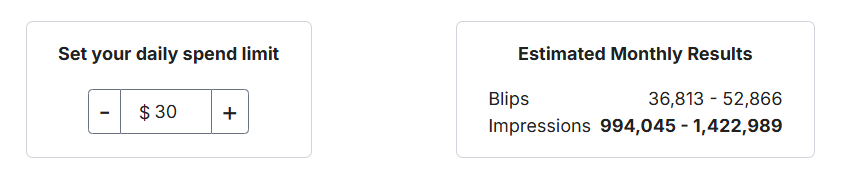
With Blip’s pay-per-blip model, you control exactly how much you spend on Johnson City billboards by setting a daily budget that can be adjusted anytime. Each blip is a 7.5–10 second ad on digital billboards near Johnson City, New York, and you only pay for the blips you receive. Pricing varies based on when you choose to run your ads, where the boards are serving the Johnson City area, and overall advertiser demand.
Where can I advertise with Blip in Johnson City, New York?
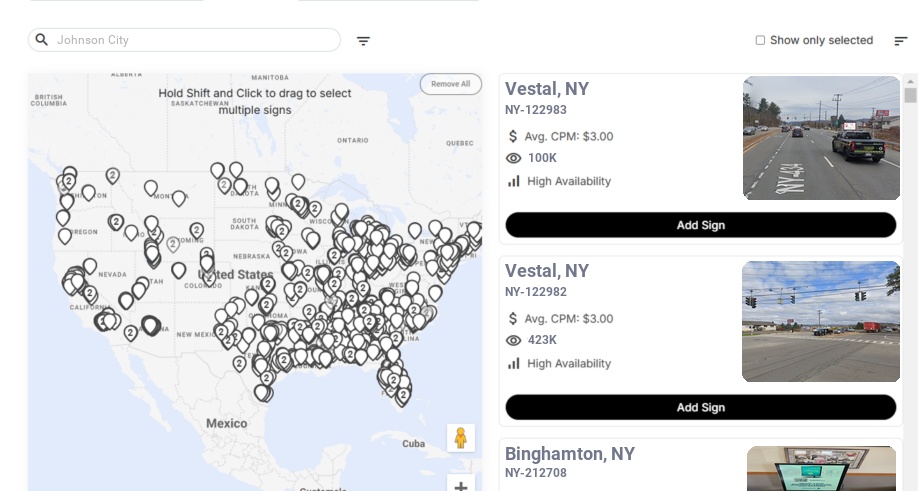
There are three digital billboards serving the Johnson City area from nearby Vestal, just 3.3 miles away. These locations reach high-traffic corridors that connect Johnson City, Vestal, and Binghamton’s commercial and medical hubs. For advertisers exploring billboard rental near Johnson City, these Vestal locations often deliver the best combination of impressions, visibility, and cost efficiency.
Who will see Johnson City billboards powered by Blip?
Johnson City sits at the heart of the Binghamton metropolitan area, giving advertisers access to a dense mix of commuters, students, hospital staff, and local shoppers. The market includes roughly 15,000–16,000 Johnson City residents, about 190,000–200,000 residents in Broome County, and roughly 240,000–250,000 people in the Binghamton metro. Nearby Binghamton University also enrolls roughly 18,000–19,000 students, many of whom live, shop, or socialize in Johnson City, Vestal, or Binghamton during the academic year.
What are the best times to run Blip ads near Johnson City, New York?
Morning peak is 6:30–9:00 a.m., midday is 11:00 a.m.–2:00 p.m., and evening peak is 4:00–7:00 p.m. These windows line up with healthcare shift changes, university traffic, retail and restaurant activity, and homebound commuters on NY-434 and NY-201. Late night after 9:00 p.m. still brings consistent traffic from late shifts, student nightlife, and late shopping.
Why do billboards near Johnson City, New York work well for local businesses?
Messages that speak to working families, healthcare workers, and students will perform especially well in and around Johnson City, especially on billboards near Johnson City that sit along commuting routes and near major medical campuses. Value, convenience, and local pride are strong themes in a market where over 60% of households are owner-occupied and many residents have deep local roots. Campaigns can succeed with both broad household messaging and niche professional or student-focused creative.
Do I need a contract to advertise with Blip near Johnson City?
No, Blip has no long-term contracts or minimum commitments. You can start, pause, or stop your campaign at any time.
How fast can I launch a billboard campaign with Blip near Johnson City?
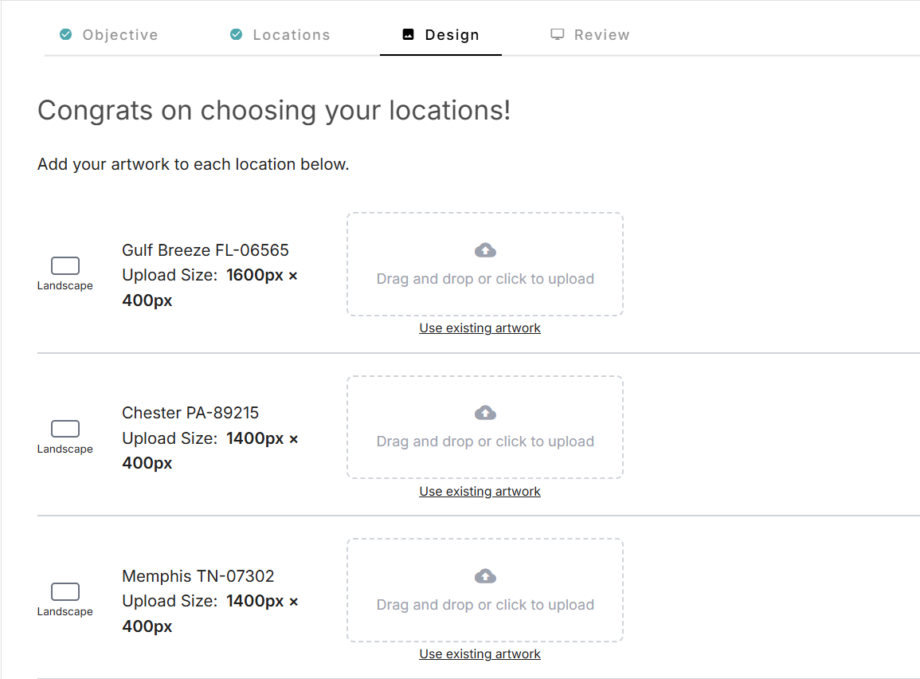
You can have your campaign live in minutes. Create a free account, select your locations, set your budget, upload your design, and start running once approved.
Where can I advertise with Blip near Johnson City?
Blip has digital billboards near Johnson City. You can browse available locations on a map, choose the ones that fit your audience, and start advertising right away.
Still have questions? Launch a campaign in minutes — no contracts, no commitments.
Start Your CampaignJohnson City Billboard Advertising Guide
Johnson City sits at the heart of the Binghamton metropolitan area, giving advertisers access to a dense mix of commuters, students, hospital staff, and local shoppers. With three digital billboards serving the Johnson City area from nearby Vestal—just 3.3 miles away—advertisers can tap into high-traffic corridors that connect Johnson City, Vestal, and Binghamton’s commercial and medical hubs. For brands looking for billboards near Johnson City without paying big-city prices, this cluster of signs offers efficient reach across the core of Broome County.
Understanding the Johnson City Area Market
Johnson City is a village in Broome County and part of the broader Binghamton metro. According to local and regional data summarized by Broome County, the Village of Johnson City, and regional planning organizations:
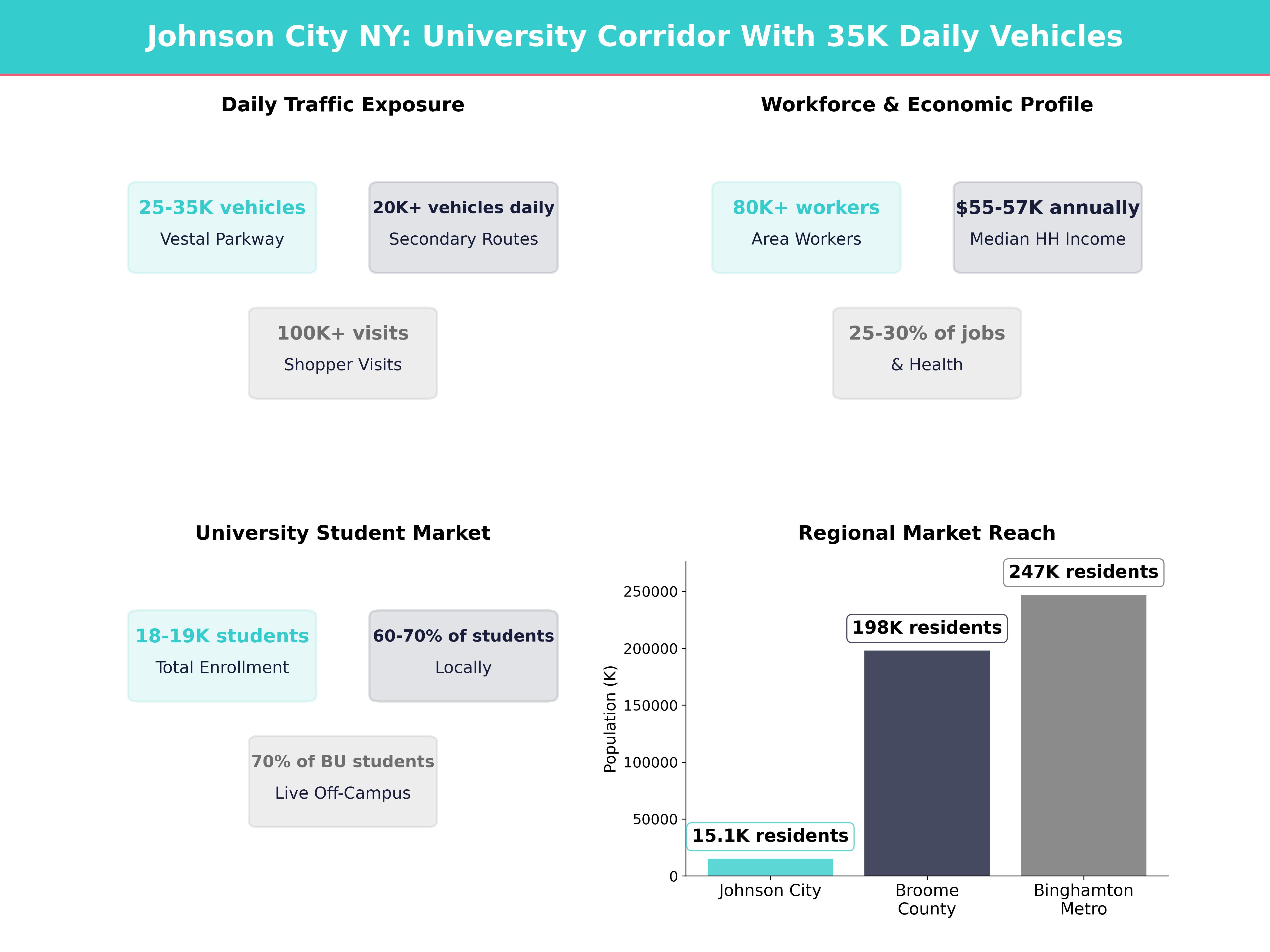
- Johnson City’s population is roughly 15,000–16,000 residents (about 15,100 residents in the most recent village figures).
- Broome County has about 190,000–200,000 residents (recent county estimates are around 198,000).
- The Binghamton metropolitan area (Broome and Tioga Counties) totals roughly 240,000–250,000 people (recent metro estimates cluster around 247,000 residents).
This means advertisers can use billboards serving the Johnson City area to reach both local residents and a broader regional audience that commutes through nearby Vestal and Binghamton
Key demographic characteristics (from Broome County and regional profiles):
-
Age mix
- Median age in Broome County is around 40–41 years, compared with about 39 nationally.
- Roughly 18–20% of residents are age 65+, higher than the U.S. share of seniors, which reinforces demand for healthcare and financial services.
- Nearby Binghamton University enrolls roughly 18,000–19,000 students across undergraduate and graduate programs, and local estimates suggest that 60–70% of those students live, shop, or socialize in Johnson City, Vestal, or Binghamton during the academic year.
-
Income
- Median household income in Broome County is in the mid‑$50,000s (about $55,000–$57,000 in recent county summaries).
- Approximately 35–40% of households fall in the $25,000–$75,000 range, supporting value‑oriented and mid‑market retail messaging.
- A meaningful professional cohort exists: local economic reports show roughly 25–30% of jobs in education and health services, and another 15–20% in professional, management, and manufacturing roles.
-
Education & employment
- The Binghamton metro’s unemployment rate in recent years has generally hovered around 3–4%, similar to New York State overall.
-
Healthcare and education are dominant. According to county and regional economic development data:
- Binghamton University employs 4,000+ faculty and staff.
- United Health Services (UHS) operates major facilities including UHS Wilson Medical Center UHS).
- Our Lady of Lourdes Memorial Hospital
- Advanced manufacturing, defense, and high‑tech employers (such as iM3NY The Agency – Broome County IDA/LDC) support thousands of additional high‑skill jobs.
What this means for billboard advertisers:
- Messages that speak to working families, healthcare workers, and students will perform especially well in and around Johnson City, especially on billboards near Johnson City that sit along commuting routes and near major medical campuses.
- Value, convenience, and local pride are strong themes in a market where over 60% of households are owner‑occupied and many residents have deep local roots.
- Campaigns can succeed both with broad household messaging and with niche professional or student-focused creative, particularly when tied to high‑traffic employers and institutions and delivered through Johnson City billboards that people see repeatedly during their weekly routines.
Why Vestal Billboards Work for the Johnson City Area
The three digital billboards serving the Johnson City area are located in nearby Vestal, a key commercial corridor that funnels traffic to and from Johnson City. For advertisers exploring billboard rental near Johnson City, these Vestal locations often deliver the best combination of impressions, visibility, and cost efficiency.
According to Vestal town information, the City of Binghamton Binghamton Metropolitan Transportation Study
- The Vestal Parkway (NY‑434) typically carries 25,000–35,000 vehicles per day on busy segments between Binghamton and Vestal.
- NY‑201 and NY‑17C, which link Johnson City, Vestal, and the surrounding highway network, combine for an additional 20,000+ daily vehicles on key stretches.
- Binghamton University’s main campus in Vestal brings thousands of daily trips from students, faculty, and staff; during the fall and spring semesters, local traffic counts often show 10,000–12,000 daily trips directly associated with campus access.
- Large retail centers, including regional shopping plazas and big-box stores along the Vestal Parkway, generate all‑day traffic. Local retail reports have estimated that the Vestal Parkway commercial strip attracts 100,000+ shopper visits per week when combining grocery, big-box, dining, and services.
Because Johnson City and Vestal are functionally part of the same urbanized area, billboards near Vestal effectively reach:
- Johnson City residents commuting to Vestal and Binghamton; regional commuting data suggest that more than half of Johnson City workers are employed outside the village, many in Vestal and Binghamton, which makes billboard advertising near Johnson City especially powerful on these cross‑community routes.
- Healthcare workers traveling to UHS Wilson Medical Center in the Johnson City area and other medical campuses in Binghamton and Vestal.
- Students and university staff traveling between campus, housing, and retail centers; over 70% of Binghamton University students do not live on campus, creating constant movement along NY‑434 and adjacent roads.
- Shoppers from across Broome and neighboring Tioga County heading to Vestal’s retail strip and Johnson City’s big‑box and medical clusters.
For many advertisers, this cluster of billboards offers regional reach with neighborhood relevance—ideal for both local brick‑and‑mortar businesses that rely on Johnson City foot traffic and broader brand campaigns that want visibility in Broome County’s busiest retail and education corridor.
Traffic Patterns: Best Times to Run Your Blips
Understanding how people move through the Johnson City area helps us decide when to prioritize impressions with Blip’s scheduling tools, and when billboards near Johnson City will be seen by the most drivers.
Regional transportation studies and employer schedules show that about 70–75% of Broome County workers commute by car alone, with average travel times around 19–21 minutes—shorter than the national average, but highly concentrated in peak periods.
Daily commuting and activity patterns, based on regional travel behavior and local employer schedules:
-
Morning peak (6:30–9:00 a.m.)
- Healthcare shifts changing at major hospitals in the Johnson City and Binghamton area—UHS and Lourdes/Ascension together support hundreds of shift‑based staff arrivals each morning.
- University faculty, staff, and students heading to Binghamton University’s Vestal campus; class schedules create noticeable surges around 8:00 a.m. and 9:00 a.m. Monday–Thursday.
- Office and service workers commuting along NY‑17, NY‑201, and Vestal Parkway from surrounding communities such as Endicott, Endwell in the Town of Union, and the Town of Dickinson
-
Midday (11:00 a.m.–2:00 p.m.)
- Retail and restaurant traffic to Vestal Parkway stores; local merchant feedback and sales data typically show 20–30% of daily sales occurring in this window.
- Hospital visitors and outpatient appointments, with many clinics in Johnson City and Binghamton concentrating visits between 9:00 a.m. and 3:00 p.m.
- Student lunch and class changes, especially during fall and spring semesters when campus enrollment is near its 18,000–19,000 peak.
-
Evening peak (4:00–7:00 p.m.)
- Homebound commuters; NY‑434 and NY‑201 often see traffic volumes similar to or higher than morning peaks, with roughly one‑third of daily vehicle trips occurring between 3:00 and 7:00 p.m.
- Shoppers stopping at grocery and big-box stores along the Vestal Parkway and in Johnson City’s commercial clusters.
- Evening classes and campus activities; Binghamton University schedules many events and labs in the 4:00–9:00 p.m. period, creating extended exposure to billboard messages.
-
Late night (after 9:00 p.m.)
- Reduced but consistent traffic from late shifts at medical centers, retail, and hospitality; healthcare and service jobs together account for over 40% of local employment, many on non‑traditional schedules.
- Student nightlife and late shopping, especially Thursday–Saturday, when bars, restaurants, and entertainment venues in Johnson City, Vestal, and downtown Binghamton are busiest.
How to apply this with Blip:
- B2B and professional services: Prioritize 7–10 a.m. and 4–6 p.m. when healthcare, education, and office workers are on the road. In a region where roughly 9 in 10 workers drive or carpool, these windows capture a large share of decision‑makers passing by Johnson City billboards and nearby digital displays.
- Restaurants, coffee shops, and quick-service concepts: Use 6–9 a.m. (breakfast), 11 a.m.–2 p.m. (lunch), and 4–8 p.m. (dinner), aligning with the times when restaurants commonly see their three main sales spikes.
- Retail and shopping: Focus on evenings and weekends, when Vestal Parkway shopping trips peak; local retailers often report 30–40% of weekly revenue occurring Friday–Sunday.
- Student-focused campaigns: Emphasize midday to late evening and lean into Thursday–Sunday when campus life is most active and when research on college markets shows higher discretionary spending on food, entertainment, and apparel.
Blip’s flexibility lets us buy more frequent “blips” during these priority windows and pull back during low-value hours, increasing effective impressions per dollar for billboard advertising near Johnson City.
Seasonality in the Johnson City Area
The Johnson City area experiences four distinct seasons, and each changes who is on the road and what they care about. Local tourism and events calendars from Visit Binghamton Broome County, and municipalities such as the City of Binghamton
Spring (March–May)
- Binghamton University’s spring semester is in full swing; enrollment around 18,000–19,000 means a continual flow of students and visitors, including multiple thousands of family and guest visits for events like spring open houses, Accepted Student Day, and commencement.
- Home improvement and landscaping spike as average temperatures rise from the 30s in March to the 60s by May; home and garden retailers often report double‑digit percentage increases in sales compared with winter months.
- Outdoor sports leagues, high school athletics, and charity runs resume, driving weekend and evening traffic near parks and sports facilities.
Advertising opportunities:
- Promote home services, auto care, tax prep, landscaping, and seasonal retail when household spending typically rises heading into tax refund season and when billboards near Johnson City see more daytime drive‑time exposure.
- Use bright, “fresh start” creative and clear calls to action like “Schedule this week” or “Spring savings near you,” timed to be most visible in evenings that get progressively lighter as daylight extends.
Summer (June–August)
- A portion of students leave, but summer sessions, research programs, and camps keep several thousand students and staff in the area.
- Regional tourism picks up: Visit Binghamton
- Construction and roadwork increase commute times (and thus exposure) on key corridors like NY‑434, NY‑17, and local arterials.
Advertising opportunities:
- Focus on tourism, recreation, home projects, HVAC, auto dealerships, and family activities as households commit more time and money to leisure and travel, and as visitors encounter Johnson City billboards while navigating the corridor.
- Consider evening and weekend scheduling when leisure trips spike; park, trail, and event usage data routinely show higher volumes Friday–Sunday.
- Promote weather‑sensitive offers (A/C tune‑ups, vehicle service, outdoor dining) on bright, legible creative that stands out in sun glare.
Fall (September–November)
- Binghamton University returns to full capacity; thousands of students arrive or return, plus family visits for move‑in, Family Weekend, and Homecoming. University and local tourism stats often show hotel occupancy and restaurant traffic spikes in early September and mid‑October.
- Back‑to‑school shopping, high school and college sports, and increased healthcare visits (flu shots, physicals) drive steady consumer traffic.
- Local retail spending typically trends upward ahead of the holidays; national data show that roughly 20–25% of annual retail sales can occur in the last few months of the year, and local merchants in the Binghamton area report similar seasonal patterns.
Advertising opportunities:
- Back‑to‑school and campus‑oriented campaigns for technology, clothing, housing, banking, and food, especially in late August and September, can perform very well on high‑visibility billboard advertising near Johnson City.
- Promote healthcare, flu shots, and insurance ahead of open enrollment and peak flu season (often October–February in Upstate New York).
- Consider rotating creative from “Welcome back students” in early September to “Holiday deals” by early November to match changing priorities.
Winter (December–February)
- Holiday shopping rush across Johnson City and Vestal’s retail corridors; for many retailers, 30–40% of annual revenue may come from November–December sales.
- Snow and short days mean more time driving in the dark—sunset can occur as early as 4:30 p.m. in December—making bright digital billboards particularly visible and impactful.
- Healthcare utilization for respiratory illnesses and elective procedures often remains high; local hospital systems regularly emphasize capacity and urgent care services during this period through advertising and public information campaigns.
Advertising opportunities:
- Lean into holiday retail, e‑commerce, local restaurants, and entertainment, especially gift cards and experiences, by increasing frequency on billboards near Johnson City and along Vestal Parkway.
- Promote insurance, tax prep, and financial services starting in January, when many households reassess budgets, refunds, and coverage.
- Keep designs high‑contrast and bold to stand out against snow, road salt, and low‑light conditions; strong color contrast can improve legibility by 30–50% versus low‑contrast designs at highway speeds.
Crafting High-Impact Creative for the Johnson City Area
To make the most of impressions on billboards serving the Johnson City area, creative needs to be tailored to local behaviors and conditions. Whether you are focused on Johnson City billboards themselves or nearby Vestal units, the same design rules apply.
Design fundamentals
- 6–8 words max: Traffic speeds on Vestal Parkway and connecting routes commonly range from 35–55 mph, giving drivers just 3–6 seconds to process your message. Aim for no more than one main idea per creative.
- High contrast: Winters are gray, nights are long, and rain/snow are common; Binghamton’s climate averages 120+ days per year with measurable precipitation. Pair light text on dark backgrounds (or vice versa) to ensure readability in all conditions.
- Large fonts: Text should be easily readable from 500–700 feet; industry best practices recommend a minimum of 18–24 inches of letter height on highway‑speed boards.
- One key visual: Use a single strong image—a product, a smiling face, or a recognizable landmark—to create memory. Multiple studies in out‑of‑home advertising have found that simpler creatives can improve recall by 20–30% compared to cluttered designs.
- Simple calls to action: “Exit in 2 miles,” “Order tonight,” “Call today,” or “Visit in Johnson City” work better than dense detail and are easier to recall once the driver has passed the sign.
Local relevance examples
- For a Johnson City restaurant:
“Dinner Tonight?
Exit for Johnson City Eats”
Plus logo and a simple food image, timed for 4–8 p.m. when traffic volumes and dining decisions peak on billboards near Johnson City. - For a Vestal or Johnson City auto shop:
“Oil Change in 15 Minutes
Near Johnson City”
With a clear arrow or short URL, especially effective during spring and fall when vehicle service visits increase by 10–20% in cold‑weather markets. - For Binghamton‑area healthcare:
“Urgent Care Near You
Open 7 Days”
With a recognizable health system logo such as UHS or Lourdes/Ascension, aligned with 7 a.m.–7 p.m. appointment and walk‑in windows.
Student-focused creative
With nearly 18,000–19,000 Binghamton University students nearby:
- Highlight student discounts (“Show your BU ID for 15% off”). National student‑market research suggests that over 60% of students are more likely to try a business that offers a student discount.
- Use language and visuals that resonate with 18–24‑year‑olds: convenience, late hours, mobile ordering, and social experiences. More than 90% of college students own a smartphone, so short URLs and QR codes can work well on static or slower‑moving approaches.
- Run these creatives more heavily during semester months (Sept–Dec, Feb–May) and early in each term when students are forming new habits about where to eat, shop, and bank, and when they are learning to navigate Johnson City billboards and other local landmarks.
Using Blip’s Tools Strategically in the Johnson City Area
Digital billboards serving the Johnson City area allow us to run highly targeted, flexible campaigns that match real local behavior. For advertisers experimenting with billboard rental near Johnson City for the first time, Blip’s tools make it easy to start small and scale.
Budget control and testing
- Start with a modest daily budget and test 2–3 creative variations. For example, allocate $10–$30 per day initially, depending on your overall budget.
- Allocate, for example, 50% of your budget to peak commuter times, 30% to midday, and 20% to evenings and weekends. This mirrors the way daily traffic volumes break down, with approximately two‑thirds of trips clustered in morning and evening peaks plus lunch.
- After 1–2 weeks, analyze which times and messages drive more web visits, calls, or store traffic—many small businesses find that a simple A/B test can improve response 15–25%—then shift budget accordingly.
Dayparting
Blip allows us to buy impressions only during selected hours:
- Service businesses (plumbers, HVAC, auto repair): Focus on 6–9 a.m. and 4–8 p.m. to catch people when problems are urgent or top of mind. Home services often see call spikes in early morning (after people discover an issue) and late afternoon.
- Healthcare and clinics: Run heavily 7 a.m.–7 p.m. to match appointment windows and walk‑in traffic; in many outpatient settings, 80–90% of visits occur in this band.
- Entertainment and restaurants: Emphasize evening and weekend hours, when discretionary trips and spending rise. Thursday–Saturday nights are especially important in college‑influenced markets like the Binghamton area.
Short-term “bursts” vs. always-on
- Bursts: For events, grand openings, or limited-time promotions, concentrate spending into 3–7 day bursts around the key date.
Example: A Johnson City retailer could triple blip frequency during Black Friday week, when national data show daily retail sales can be 2–3 times a typical November weekday. - Always-on: For ongoing awareness (e.g., law firms, healthcare, credit unions), maintain steady exposure at lower daily budgets, with seasonal creative refreshes every 6–8 weeks. Advertisers that refresh creative regularly often see 10–20% higher recall than those that run the same artwork for months.
Local Campaign Ideas by Industry
Here are ways different sectors can use billboards serving the Johnson City area effectively, informed by local economic and consumer patterns and coverage from outlets like the Press & Sun-Bulletin and WBNG 12 News. These examples apply whether you are focused on Johnson City billboards specifically or on nearby units that still reach the same audience.
Local Retail & Shopping Centers
- Highlight proximity: “2 Minutes from Johnson City” or “Next Right – Vestal Parkway.” In surveys, over half of shoppers say proximity is a top factor when choosing stores for everyday purchases, which makes billboards near Johnson City especially persuasive for impulse stops.
- Promote specific offers: “Weekend Sale: Up to 40% Off” during Thursday–Sunday, when many local retailers record their highest four days of foot traffic.
- Swap creative seasonally: back‑to‑school in August–September, holiday deals in November–December, and spring clearance in March–April to align with the major seasonal spending peaks.
Restaurants, Coffee Shops & Bars
-
Target commuters and students with time-specific messages:
- Morning (when many of the area’s 80,000+ workers are on the road): “Coffee on Your Way to Campus”
- Midday: “Lunch Specials Near Johnson City”
- Evening: “Game Night Tonight – Wings & Beer”
- Rotate specials or limited‑time menus easily with digital creative, adjusting art for sports seasons, student events, or holidays.
- In a college‑influenced market, consider late‑night creatives Thursday–Saturday when restaurant and bar revenues are often 20–30% higher than early‑week nights.
Healthcare Providers & Clinics
The Johnson City area is a healthcare hub, with longstanding hospital campuses and medical offices nearby, including UHS facilities in Johnson City and Lourdes/Ascension hospitals and clinics in Binghamton.
- Promote convenience: “Walk‑In Urgent Care – Open 8–8.” Research in healthcare marketing shows that extended hours and short wait times are among the top decision factors for urgent care choice.
- Use clear healthcare categories: “Primary Care,” “Pediatrics,” “Orthopedics,” “Imaging,” or “Lab Services” so viewers immediately understand what you offer.
- Schedule more impressions during flu season (Oct–Feb) and open enrollment windows (typically November–January for many plans) when demand and search interest for care and coverage rise sharply.
Financial Institutions & Credit Unions
Local and regional banks and credit unions can:
- Promote checking account bonuses, competitive CD rates, and mortgages with simple numeric offers (“3.XX% APY CD – Local Branches in Johnson City & Vestal”).
- Emphasize local roots: “Proudly Serving the Johnson City Area Since 19XX.” Regional surveys show that a majority of consumers prefer to bank with institutions perceived as local or community‑minded.
-
Align creative with key financial moments:
- Tax refund season (Feb–Apr) for savings, debt payoff, and auto loans.
- Back‑to‑school (Aug–Sept) for student accounts and credit cards.
- Year‑end planning (Nov–Dec) for IRAs, investment checkups, and small business financing.
Education & Training
-
Community colleges, trade schools, and training centers can target graduating high schoolers and adult learners with:
- “Career Training Near Johnson City – Enroll Now”
- “Start a New Career in 6–12 Months”
- Use dayparting to reach both teens (afternoons after school) and working adults (evenings and weekends).
- In a region where roughly 30% of adults have a bachelor’s degree or higher and many employers seek skilled trades, emphasizing short, job‑ready programs can resonate strongly when advertised on billboards near Johnson City.
Events, Entertainment & Tourism
Using information from Visit Binghamton Broome County Parks
- Promote festivals, concerts, and sports games 1–4 weeks ahead, with more intense bursts 3–7 days before the date. Event organizers often see 20–30% of ticket sales in the final week.
- Run countdown creatives: “3 Days Until Kickoff,” “This Saturday Only,” or “Concert Tonight – Exit for Vestal” to create urgency on Johnson City billboards and nearby digital displays.
- Increase frequency on Thursdays and Fridays to capture planners; many local events report that a majority of weekend attendance decisions are made 1–2 days in advance.
Measuring Success in the Johnson City Area
To make your campaign truly effective, we need clear ways to judge performance and optimize based on real behavior in and around Johnson City.
Trackable calls to action
- Use short, memorable URLs unique to your billboard campaign (e.g.,
YourBrandJC.comorVisit123Main.com). - Add billboard-only promo codes (“Mention ‘JC20’ for 20% off”). Businesses that use unique codes for out‑of‑home often find that 5–15% of redemptions can be directly tied back to billboard exposure.
- Track call volume to a billboard-only phone number, and note call spikes by day and time.
Tie to local behavior
- Watch website traffic by geography—look for increases in visits from Binghamton, Johnson City, Vestal, Endicott, and nearby ZIP codes during your campaign. An uplift of even 10–20% in local sessions during your flight can be a strong sign of impact from billboard advertising near Johnson City.
- Monitor in-store traffic and point-of-sale notes (“How did you hear about us?”). Even simple script changes with staff can uncover whether billboards are being noticed.
- For events, compare ticket sales and RSVP rates in weeks with billboard support versus similar periods without it.
Iterate with data
-
After 2–4 weeks, identify:
- Which creatives had the highest response (by URLs visited, codes used, or calls).
- Which days or times correlated with spikes in calls or visits; for example, you may discover that weekday evenings outperform mornings for your specific offer.
- Redirect budget to the best-performing slots and refresh weaker creative with clearer offers, simpler visuals, or stronger local hooks (“On Vestal Parkway,” “Near UHS,” “5 minutes from BU”).
Working the Johnson City Area Like a Local
By understanding how Johnson City connects with Vestal and the wider Binghamton metro, we can use digital billboards to reach people at exactly the right moments:
- Commuters and healthcare workers on their daily routes between Johnson City, Vestal, Binghamton, and surrounding towns.
- Students and faculty traveling between campus, housing, and local businesses along the Vestal Parkway and in Johnson City.
- Families shopping, dining, and running errands in the Johnson City area’s retail and medical hubs.
With three strategically placed digital billboards in nearby Vestal, flexible scheduling, and data‑driven creative, advertisers can build campaigns that are both highly visible and cost‑efficient. By aligning your message with local traffic patterns, seasonal rhythms, and the unique mix of students, workers, and families that define the Johnson City area, each blip can translate into measurable local impact for your brand—and make billboard rental near Johnson City a reliable part of your marketing mix.