Billboards in Webster, NY
No Minimum Spend. No Long-Term Contracts. Just Results.
Trusted by Leading Brands


Billboard advertising
in Webster has never been easier



How much is a billboard in Webster?
Why Choose Blip for Billboard Advertising in Webster
Blip lets you launch on Webster’s NY-104 and NY-250 commuter routes in minutes, reaching the same daily drivers again and again.
Set a flexible budget for Webster billboards and scale up for weekends at Empire Boulevard or Lake Ontario traffic, then pull back anytime.
No contracts means you can test Webster’s school-run and rush-hour audiences first, then adjust as traffic shifts through the week.
Use real-time analytics in Webster to see what’s working on 104 corridor impressions and optimize for commuters, shoppers, or park-bound traffic.
Blip’s creative tools make it easy to tailor Webster ads for back-to-school, Webster Park weekends, or retail runs near Ridge Road.
Frequently Asked Questions About Billboard Advertising in Webster
How much does a billboard cost in Webster, New York with Blip?
With Blip, you control exactly what you spend on Webster billboards by setting a daily budget that can be adjusted anytime, so you only pay for the digital billboard exposure you actually receive. Each “blip” is a brief 7.5 to 10-second ad display on rotating billboards in Webster, New York, and your total cost is simply the sum of these individual blips over time. Pricing per blip varies based on when and where your ad appears and on advertiser demand, making it easy to scale up during prime times or scale back when you want to spend less.
Where can I advertise with Blip in Webster, New York?
Key corridors in Webster include NY-104, NY-250, and the Empire Boulevard/Ridge Road/Hard Road area. NY-104 carries heavy commuter traffic, while NY-250 connects residential neighborhoods to the village center and local errands. Retail and restaurant zones near the 104 interchanges and routes to Webster Park and Lake Ontario are especially strong for billboard placement.
Why are Webster, New York billboards effective for local businesses with Blip?
Webster sits at a powerful crossroads of suburban affluence, daily commuter traffic, and regional recreation. A significant portion of Webster residents report doing most or all of their weekly shopping within a 5–10 minute drive, making local billboard presence and strategic billboard rental especially efficient. Most residents also commute on the same roads 5 days a week, creating high impression frequency when boards are well-placed.
When is the best time to run Webster, New York billboards with Blip?
Rush-hour windows around 6:30–9:00 a.m. and 3:30–6:30 p.m. are ideal for commuting professionals and often represent the top 30–40% of daily traffic volume. School and family routines also create strong visibility from 7:00–8:30 a.m. and 2:30–4:00 p.m. Weekends are especially useful for retail, home improvement, and recreation-focused campaigns.
Who should advertise on Webster, New York billboards with Blip?
Webster is a strong fit for commuting professionals, families with school-age children, higher-income homeowners, and active adults and seniors. The town has roughly 45,000 residents, a median age in the mid-40s, and many households with discretionary spending power. That makes it a valuable audience for healthcare, home services, education, restaurants, and local retail.
Do I need a contract to advertise with Blip in Webster?
No, Blip has no long-term contracts or minimum commitments. You can start, pause, or stop your campaign at any time.
How fast can I launch a billboard campaign with Blip in Webster?
You can have your campaign live in minutes. Create a free account, select your locations, set your budget, upload your design, and start running once approved.
Where can I advertise with Blip in Webster?
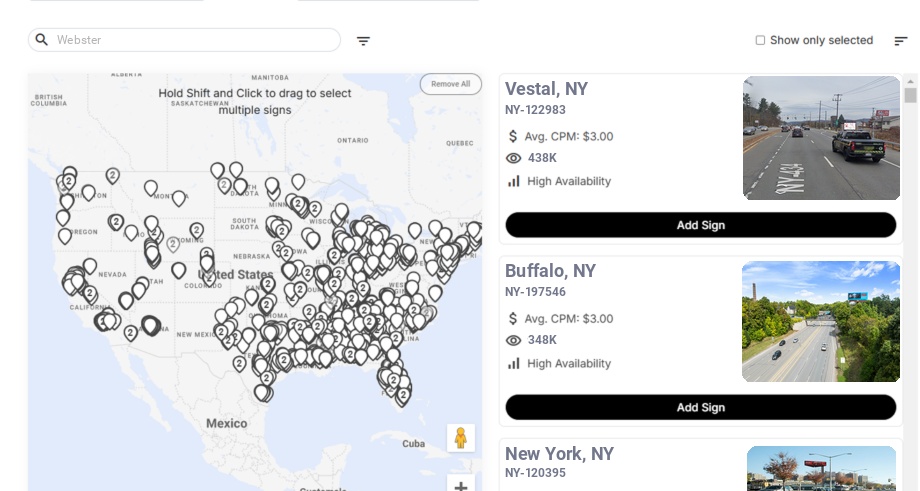
Blip has digital billboards in Webster. You can browse available locations on a map, choose the ones that fit your audience, and start advertising right away.
Still have questions? Launch a campaign in minutes — no contracts, no commitments.
Start Your CampaignWebster Billboard Advertising Guide
Webster, New York, sits at a powerful crossroads of suburban affluence, daily commuter traffic, and regional recreation. As Rochester's largest eastern suburb, the town combines higher-than-average household incomes, strong schools, and busy retail corridors with constant movement along NY-104 and the routes feeding into the city. When we leverage digital Webster billboards here with Blip, we’re tapping into a concentrated, repeatedly reachable audience that sees the same routes day in and day out, making Webster billboard advertising an efficient way to stay in front of local consumers.
Understanding the Webster Market
Webster is often described with its motto, “Where Life Is Worth Living,” and the numbers back up that quality-of-life positioning:
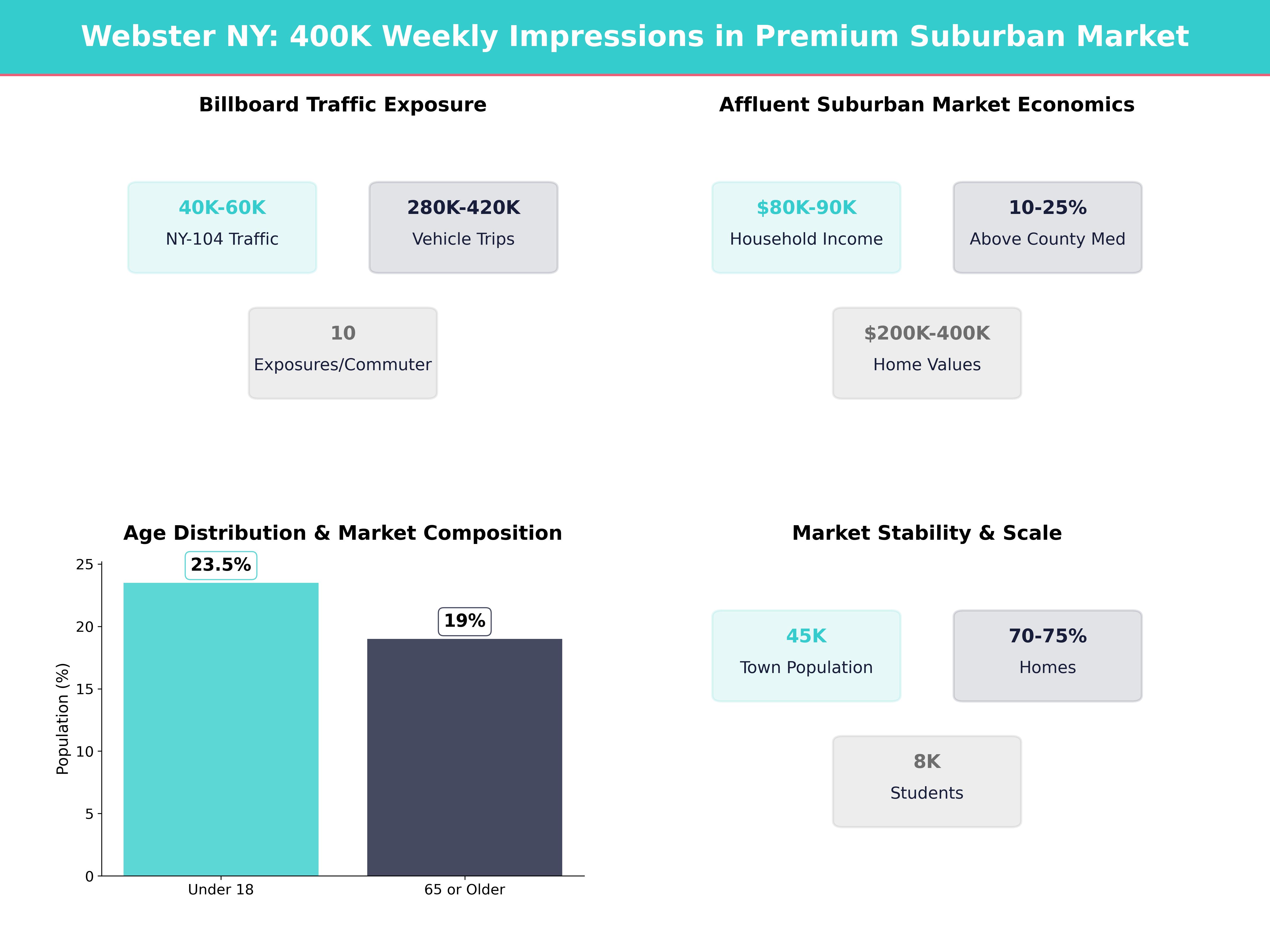
- The Town of Webster has roughly 45,000 residents, with the incorporated Village of Webster accounting for around 5,500–6,000 of that total, making it one of Monroe County’s larger suburbs, alongside Greece and Irondequoit.
- The median age in Webster sits in the mid-40s, compared to the ~40 years median for Monroe County overall, giving advertisers a strong mix of family households, established professionals in their prime earning years, and aging-in-place residents. About 22–25% of residents are under 18, and roughly 18–20% are 65 or older.
- Monroe County as a whole has a median household income near $70,000–$75,000, but eastern suburbs like Webster generally track 10–25% higher, giving us a realistic working range of $80,000–$90,000+ for many local households. In practical terms, that means a large share of households with discretionary budgets for dining, travel, home projects, and kids’ activities.
- Owner-occupancy is high: about 70–75% of homes in Webster are owner-occupied single-family houses, compared with closer to 60–65% for the county, reinforcing a stable, long-term resident base valuable for ongoing local service advertising.
- The Webster Central School District serves about 8,000 students across multiple elementary, middle, and high schools, with graduation rates in the mid- to high-90% range and consistently strong Regents and AP participation. This anchors a large base of school-age families who are anchored to local routines and school calendars.
Webster’s local government, via the Town of Webster, emphasizes business development along key commercial corridors, especially around NY-104, NY-250 (Webster’s main north–south artery), and the Empire Boulevard/Plaza area. According to town and Monroe County economic development data, these corridors concentrate:
- Big-box retailers and grocery stores, including regional anchors that draw shoppers from 10–20 miles away.
- Dining and entertainment, with dozens of chain and independent restaurants.
- Auto sales and service clusters, with multiple brand dealerships.
- Healthcare and professional services, including primary care, dental, urgent care, and specialty clinics.
For advertisers, this means that a relatively compact geographic area captures a large share of the community’s shopping, dining, and commuting behavior. A significant portion of Webster residents report doing most or all of their weekly shopping within a 5–10 minute drive, making local billboard presence and strategic billboard rental in Webster especially efficient.
Traffic Patterns and Where Billboards Matter Most
Billboards in Webster work because of predictable, high-frequency driving patterns rather than sporadic tourism. Most residents commute on the same roads 5 days a week, creating high impression frequency when boards are well-placed.
Key corridors and dynamics to understand:
-
NY-104 (Keeler Street Expressway)
- Main east–west expressway through Webster and into Rochester.
- New York State Department of Transportation (NYSDOT) counts show many segments of 104 in the Rochester area carrying 60,000+ vehicles per day, with Webster sections typically in the 40,000–60,000 Annual Average Daily Traffic (AADT) range. That equates to 280,000–420,000 weekly vehicle trips past key billboard locations.
- Heaviest flows: weekday mornings heading west toward Rochester and evenings heading east back into Webster and beyond, aligning with traditional 8–9 hour workday shifts downtown and at major employment nodes.
- A meaningful share of traffic includes commuters from Wayne County communities such as Ontario and Williamson
-
NY-250 (Webster’s Main North–South Spine)
- Connects residential neighborhoods to NY-104 and the Village center.
- Carries steady daily traffic for work commutes, school runs, and local errands; NYSDOT counts on similar suburban arterials often register 15,000–25,000 vehicles per day, giving advertisers a strong reach into core neighborhood populations.
- Intersections near Ridge Road, Main Street, and NY-104 ramps see regular peak-hour congestion—ideal conditions for slower-moving traffic and longer read times for Webster billboards.
-
Empire Boulevard / Ridge Road / Hard Road Corridors
- Dense retail and restaurant zones, especially near 104 interchanges.
- Weekend and evening traffic swells as people shop and dine, with big-box and grocery trips typically clustering between 10 a.m.–2 p.m. on Saturdays and 4–7 p.m. on weekdays.
- These corridors also capture destination traffic into neighboring Irondequoit and Penfield, expanding the audience beyond Webster’s borders.
-
Routes to Recreation (Webster Park & Lake Ontario)
- Webster Park encompasses over 550 acres on the Lake Ontario shoreline, with 4+ miles of hiking trails, picnic lodges, and shoreline access.
- Monroe County park usage data show that large regional parks can attract hundreds of thousands of visits per year, with peak days in summer drawing several thousand visitors.
- Summer and fall weekends see elevated traffic on Lake Road and routes north of 104 as residents and visitors head to the lakefront, campgrounds, and trailheads, especially on days highlighted by outlets such as Visit Rochester and local weather coverage.
Because Blip lets us select specific boards and times, we can align campaigns with these flows:
- Commuter-focused boards along NY-104 for daily repetition and broad reach into Rochester and Wayne County.
- Retail-intent boards near Empire Boulevard or Ridge Road for “on the way” influence at moments when shoppers are already primed to spend.
- Seasonal recreation boards on routes feeding Webster Park and Lake Ontario, especially from Memorial Day through October, when weekend park traffic can spike by 30–50% over winter baselines.
Seasonal and Weekly Rhythms in Webster
Webster’s four-season climate and school-centered lifestyle produce clear advertising rhythms that directly affect when impressions are most valuable.
Seasonality
-
Winter (Dec–Feb):
- Rochester-area winters average 70–100 inches of snowfall annually, and shorter daylight (sunset before 5 p.m. in December) keeps more activity local; people stick closer to home and rely heavily on familiar routes like NY-104 and NY-250.
- Retail focuses on holiday shopping (Nov–Dec), which can drive 20–30% of annual sales for many retailers, followed by a shift to home improvement, fitness, and financial planning in Jan–Feb.
- Great time for local services (heating, auto repair, medical, tax prep) because residents are in a “stay local, take care of essentials” mindset. Service calls for HVAC and auto tires/brakes typically spike 10–25% during extended cold snaps.
-
Spring (Mar–May):
- Outdoor activity spikes as temperatures rise from winter averages in the 20s–30s°F to 50s–60s°F.
- Regional contractors report that spring accounts for 30–40% of new annual project bookings (roofing, landscaping, exterior painting), driven by homeowners emerging from winter.
- Youth sports, school plays, and graduation planning accelerate, amplifying the need for family services, tutoring, photography, and event venues.
- Local events and festivals ramp up in the Rochester area; promotion windows widen, with organizations increasingly using cross-channel promotion via sites like Visit Rochester and local news calendars.
-
Summer (Jun–Aug):
- Heavy use of Webster Park, Lake Ontario beaches, and Irondequoit Bay; Monroe County’s lakefront parks routinely see summer weekend visitation multiples of 2–3x winter levels.
- Strong season for restaurants, ice cream shops, marinas, summer camps, and tourism-focused promotions, especially targeting visitors staying in the 10,000+ hotel rooms across Greater Rochester highlighted by Visit Rochester.
- Traffic patterns shift slightly earlier in the day for commuters (school buses are largely off the road) and later in the evening for recreation, with parks and waterfront areas busy until sunset around 8:30–9:00 p.m.
- Summer youth programs and camps can fill 70–90% of their enrollment during March–June promotion windows, making pre-summer campaigns on billboards in Webster particularly valuable.
-
Fall (Sep–Nov):
- Back-to-school for 8,000+ Webster students resets weekday routines and reestablishes strong morning and afternoon peak traffic on school routes and commuter corridors.
- Perfect window for education services, extracurriculars, retail, and healthcare (flu shots, physicals). Healthcare providers often see flu vaccination volumes ramping up by September and peaking in October–November.
- Fall foliage and weekend travel continue to feed traffic to parks and farms in eastern Monroe and Wayne Counties; agritourism operations in the region often report fall accounting for 40–60% of their annual visitor volume.
Weekly Patterns
-
Monday–Thursday:
- Consistent commuter flows, with typical weekday volumes on expressways and arterials often 20–30% higher than Sundays.
- Ideal for B2B, professional services, healthcare, and recurring errands that people plan around their workweek.
-
Friday:
- Commuters plus weekend prep: groceries, dining out, entertainment. Big-box and grocery stores frequently see 10–20% higher sales on Fridays compared with midweek.
-
Saturday–Sunday:
- More discretionary trips: shopping districts, home improvement stores, restaurants, recreation areas.
- Home improvement and garden centers often report weekends accounting for 50%+ of their weekly in-store traffic.
With Blip, we can weight budgets toward weekday rush hours for business messages and shift spend toward evenings and weekends for retail and leisure campaigns, effectively following these behavioral peaks that power Webster billboard advertising.
Who We’re Talking To: Key Audience Segments
Understanding local life in Webster helps us tailor creative and scheduling.
1. Commuting Professionals
- Many Webster residents commute into Rochester’s employment centers, including downtown, University of Rochester/Strong Memorial Hospital, and Eastman Business Park. Regional commute data show that in many Monroe County suburbs, 50–65% of workers leave their home municipality for work.
- Daily two-way exposure on NY-104 gives us repeated impressions—up to 10 exposures per week per commuter if your board sits on their primary route.
-
Ideal targets:
- Financial advisors, banks, credit unions
- Higher education and professional training institutions that draw from the east side
- Healthcare systems and specialty clinics
- B2B services located in Rochester but serving Webster households
2. Families with School-Age Children
- With thousands of students in the Webster Central School District, youth and family life are central to the community. The district operates multiple elementary schools, two middle schools, and two high schools, with daily bus and parent traffic converging on a limited number of access roads.
- Households with children typically spend a higher share of income on education, activities, and dining out; national patterns suggest $3,000–$5,000+ per year per child on extracurriculars, camps, and enrichment.
-
Campaign opportunities:
- Tutoring, test prep, music and art schools
- After-school programs, sports clubs, dance, and martial arts
- Pediatric and family healthcare
- Family-friendly dining, entertainment, and attractions
3. Higher-Income Homeowners
- A significant share of Webster’s housing stock consists of single-family homes built since the 1980s, many in subdivisions with home values above the Monroe County median. Typical three- or four-bedroom homes in Webster list in the mid-$200,000s to $400,000+ range, supporting a strong equity base.
-
Above-average household incomes support discretionary spending on:
- Home improvement and contracting, where typical project tickets (roofing, siding, decks) can range from $5,000–25,000+.
- Lawn care and landscaping contracts often priced at $1,000–3,000 per season.
- Automotive sales and service, with many households maintaining 2–3 vehicles.
- Travel, fitness, and wellness services such as gyms, clubs, and spas.
4. Active Adults and Seniors
-
The median age in the mid-40s and a sizeable 55+ cohort create demand for:
- Medical specialists, physical therapy, and dental services; healthcare spending per capita rises steadily after age 45, making this a high-value audience for clinics and systems.
- Senior living communities and in-home care as more residents choose to age in place in suburban homes.
- Financial planning and estate services, including retirement income planning, wills, and trusts.
Crafting Effective Billboard Creative for Webster
Because Webster is dominated by local driving rather than tourist pass-through, our creative should focus on clarity, trust, and local relevance so your investment in billboard rental in Webster delivers measurable results.
Message Strategy
-
Emphasize local cues:
- “Serving Webster and Rochester for 20+ years”
- “Just off 104 at [exit/intersection]”
- “Across from Wegmans / Target / [local landmark]”
-
Use distance or time-based CTAs:
- “Next Right on 250”
- “2 Minutes Ahead on Empire Blvd”
- “Exit 104 at Holt Rd”
-
Highlight family- and community-oriented language (aligned with “Where Life Is Worth Living” and messaging from the Town of Webster):
- “Keeping Webster families healthy”
- “Webster’s choice for after-school activities”
Visual Design Tips
Given 5–8 seconds of viewing time for drivers and average billboard read distances of 300–500 feet:
- Keep text to 7 words or fewer whenever possible; legibility studies show comprehension drops sharply beyond 8–10 words on roadside ads.
- Use large sans-serif fonts with high contrast (white/yellow text on dark backgrounds or vice versa). Aim for at least 18–24 inch letter height on standard-sized bulletins.
- Feature one focal image only (person, product, or logo), not a collage, to avoid cognitive overload at freeway speeds of 45–55 mph.
- Make your logo and URL/short call-to-action clearly legible from 300–500 feet, with minimal fine detail.
- Use local imagery sparingly but powerfully: silhouettes of Webster Park’s shoreline, a stylized NY-104 shield, or Webster school colors for school-related products.
Ad Variants
Blip’s digital flexibility allows us to rotate multiple creatives:
- One board design tailored to commuters (benefit-driven, quick CTA).
- One design tailored to weekend shoppers (sale, special offer, or event).
- One design for seasonal messages (back-to-school, summer at the lake, holiday deals).
Running 2–3 variants and measuring response gives enough data to see clear performance differences in a 4–8 week campaign.
Timing and Dayparting: When to Run Your Blips
Because Blip lets us choose specific times of day, we can match message to mindset and mirror real traffic volumes measured by NYSDOT and regional transportation agencies.
Rush-Hour Commuters (Approx. 6:30–9:00 a.m. & 3:30–6:30 p.m.)
Use this window for:
- Healthcare and appointments (“Schedule your checkup on your commute”)
- Financial institutions and insurance (retirement, college savings, coverage)
- B2B services, especially if your office is in Rochester but serves east-side clients
- These windows often represent the top 30–40% of daily traffic volume, so concentrating impressions here maximizes reach to working adults.
School and Family Routines
-
7:00–8:30 a.m. & 2:30–4:00 p.m., aligned with school drop-off and pick-up:
- Tutoring, after-school programs, music and sports
- Quick-service restaurants and family takeout options
- Pediatric and dental practices located near school routes
- On school days, these periods see a noticeable bump in local arterial traffic as families move between neighborhoods and campuses, giving Webster billboard advertising strong visibility with parents.
Evenings (5:00–9:00 p.m.)
- Entertainment: movies, bowling, family fun centers, live events.
- Restaurants and bars, especially on Thursdays–Saturdays, often doing 40–60% of weekly covers during these peak nights.
- Fitness centers, gyms, and classes, particularly between 5–7 p.m. when many adults exercise right after work.
Weekends
-
Saturday morning to mid-afternoon:
- Big-box retail, auto dealers, home improvement, and garden centers. Many retailers see Saturday as their #1 sales day.
-
Saturday evening and Sunday afternoon:
- Churches and faith communities, brunch spots, and local attractions.
- Recreational activities connected to Webster Park, Irondequoit Bay, and area trails. Good weather weekends can raise park and trail usage by 50%+ versus rainy periods.
We can also ramp spend up or down around local events that drive coverage in outlets like the Democrat & Chronicle, News 8 WROC 13WHAM, and Spectrum News 1 Rochester. When Webster or Rochester are in the news for festivals, sports, or community happenings, billboard impressions often correlate with increased local movement and event-driven traffic spikes of 10–30%.
Geographic Targeting and Board Selection Strategy
While specific Blip board locations will vary, we can think in zones and audience density.
1. 104 Corridor Boards
Best for:
- Reaching commuters from Webster, Penfield, and Wayne County heading into Rochester.
- Regional businesses drawing from a wide radius (auto dealers, hospitals, universities).
- Multi-location brands wanting high-frequency exposure and broad reach within a 15–25 mile radius.
Creative angle:
- Short, bold offers and directional CTAs.
- Clear benefits that appeal to time-pressed professionals, such as “Save 15 Minutes” or “Open Until 8 p.m.”
- Emphasis on easy access and parking, since these boards influence decisions made at highway speeds.
2. Retail and Commercial Cluster Boards
Best for:
- Local restaurants, coffee shops, salons, and boutiques in Webster, especially those listed by the Webster Chamber of Commerce.
- Fitness centers, healthcare clinics, and service businesses with easy off-highway access.
- Promotions timed to paydays, weekends, or monthly cycles like back-to-school and holidays.
Creative angle:
- “Turn Left at Next Light” or “Behind [anchor store].”
- Simple, price- or event-focused messages.
- Including a time-bound callout (“Today Only,” “Friday–Sunday”) can help capture impulse visits from nearby traffic and maximize your return on billboard rental in Webster.
3. Recreational Route Boards
Best for:
- Seasonal and weekend promotions tied to Lake Ontario, Webster Park, boating, or outdoor gear.
- Local events, festivals, and community gatherings publicized through channels like Visit Rochester and town/community calendars.
- Tourism-adjacent marketing to visitors staying in Rochester but exploring the lakefront.
Creative angle:
- Lifestyle imagery (families at the park, lake sunsets) with simple messaging.
- Emphasizing “Today,” “This Weekend,” or date-specific events.
- Highlighting free or low-cost activities, which are especially appealing to families and visitors planning day trips.
Vertical-Specific Tips for Webster Advertisers
Local Retail & Restaurants
-
Use price points and time-limited offers:
- “Kids Eat Free Tuesdays on Empire Blvd.”
- “This Weekend Only: 20% Off Grills & Patio Sets.”
- Align schedule with Friday–Sunday and early evening for restaurants; Saturday morning to afternoon for retail, reflecting peak shopping and dining patterns where these days may contribute 50–60% of weekly revenue.
- Consider syncing promotions with events promoted by local outlets like Democrat & Chronicle and CITY Magazine to ride the wave of increased area activity.
Healthcare Providers
-
Promote proximity and convenience:
- “Urgent Care on 104 at [Exit] – Open 7 Days.”
- Focus on weekdays and commute windows to catch people when they’re planning their week, as appointment booking often spikes during business hours.
- Use gentle but clear health prompts: “Overdue for a checkup? We can see you this week.”
- Highlight extended hours or same-day appointments, which can be decisive for busy commuters.
Home Services and Contractors
- Concentrate spend in spring and fall when homeowners plan projects; many contractors book 70–80% of their annual schedule during these seasons.
- Use board locations that cover neighborhoods east and south of 104 where much of the housing stock resides.
-
Message format:
- “New Roof? Free Estimates in Webster.”
- “Lawn Care for Webster Homes – Call Today.”
- Include short URLs or memorable phone numbers, as home services often have higher average ticket values and longer consideration cycles.
Auto Dealers and Repair Shops
- Place boards near 104 ramps and retail corridors, capitalizing on automotive shopping districts.
-
Feature quick, bold copy:
- “Oil Change While You Shop – Exit 104 at Hard Rd.”
- “0% APR on SUVs – 5 Minutes from This Exit.”
- Weekends and early evenings are strong for shopping; weekday mornings for service reminders. Auto dealers often report Saturday as their single biggest showroom day, while service bay utilization is highest Monday–Wednesday.
Education, Camps, and Youth Programs
- Use Feb–Apr for summer camp registration and Jul–Sep for after-school and fall programs; many camps fill 60–80% of spots before June.
- Target boards near school routes and neighborhoods to intersect with parent traffic patterns.
-
Speak directly to parents:
- “STEM Camp in Webster – Weekly Sessions Starting June 24.”
- “After-School Tutoring on 250 – Enroll Now.”
- Consider referencing local academic calendars from the Webster Central School District so your messaging aligns with key enrollment periods.
Community Organizations, Events, and Nonprofits
-
Leverage billboards as a megaphone for:
- Local festivals, charity runs, and school events coordinated with the Town of Webster and community groups.
- Arts performances covered by local media like CITY Magazine or community calendars.
- Use countdowns: “Webster Summer Fest – 3 Days Away!”
- Schedule heavier bursts 1–2 weeks before your date, with dense frequency in the final 3–5 days; many events see 20–40% of attendance decisions made in the last week.
Measuring and Improving Your Campaign
To get the most from Webster billboards with Blip, we should treat campaigns as iterative and data-informed.
-
Define a concrete goal
- Website visits, store traffic, calls, event attendance, or brand awareness.
- Tie targets to realistic baselines (e.g., “Increase weekend traffic by 10–15% over the next 60 days”).
-
Use trackable elements
- Unique URLs or QR codes visible at a glance (e.g., “MyBizWebster.com”).
- Short promo codes (“Show this code: WEB104”).
- Offer-specific phone numbers or extensions, allowing you to attribute calls to billboard viewers.
-
Watch timing and creative separately
- Test heavy weekday spend vs. weekend spend, comparing changes in sales or inquiries.
- Run Variant A for two weeks, then Variant B, and compare outcomes. A difference of even 10–20% in response rate justifies reallocating spend.
-
Align with local news and events
- When Webster is in the spotlight in outlets like Democrat & Chronicle or 13WHAM, people are out and about and paying attention. Increase impressions during high-activity periods such as major festivals, sports seasons, or regional celebrations that draw thousands of visitors.
-
Optimize board selection over time
- Drop locations that underperform for your specific goal based on store traffic, calls, or web analytics.
- Add or emphasize boards closer to your store, office, or event, or ones that align better with your audience (e.g., school routes for youth programs, 104 commuter boards for professional services).
- Reassess every 4–8 weeks to align with changes in season, school schedules, and daylight hours.
By matching Webster’s commuting flows, family-centered lifestyle, and seasonal rhythms with Blip’s flexible scheduling and board selection, we can build campaigns that feel both hyper-local and highly efficient. The core advantage in Webster is repetition: thousands of residents drive the same roads every day. When our message is clear, local, and timed to their routines, digital billboards become one of the most powerful tools in the Webster marketing toolkit, and thoughtful billboard rental in Webster can anchor a broader, multi-channel strategy.