Billboards in Utica, NY
No Minimum Spend. No Long-Term Contracts. Just Results.
Trusted by Leading Brands


Billboard advertising
in Utica has never been easier



How much is a billboard in Utica?
Why Choose Blip for Billboard Advertising in Utica
Blip lets you launch Utica billboards fast on the North-South Arterial or I-90, reaching commuters and regional travelers without a media buy headache.
In Utica, flexible budgets help you scale up for Boilermaker weekend, hockey games, or holiday shopping—and dial back when traffic softens.
Use Blip's dayparting to hit Utica's morning school runs, evening commutes, or weekend shoppers on Commercial Drive at the right time.
No contracts means you can test Utica's diverse audience—students, health-care workers, and manufacturers—then keep what performs best.
Track real-time results in Utica and shift spend quickly as winter snow, summer tourism, or event traffic changes corridor demand.
Blip's creative tools make it easy to swap local offers for Utica drivers, from quick-turn promos near Genesee Street to arena-night specials.
Frequently Asked Questions About Billboard Advertising in Utica
How much does a billboard cost in Utica, New York with Blip?
With Blip, you can use Utica billboards on almost any budget, because you only pay for each brief 7.5–10 second “blip” your ad appears on a rotating digital screen. You set a daily budget when you create your campaign, and Blip automatically keeps your advertising within that limit, so costs stay under your control. The price of individual blips on billboards in Utica, New York varies based on when and where you choose to advertise and overall demand, making it flexible for local businesses.
Where can I advertise with Blip in Utica, New York?
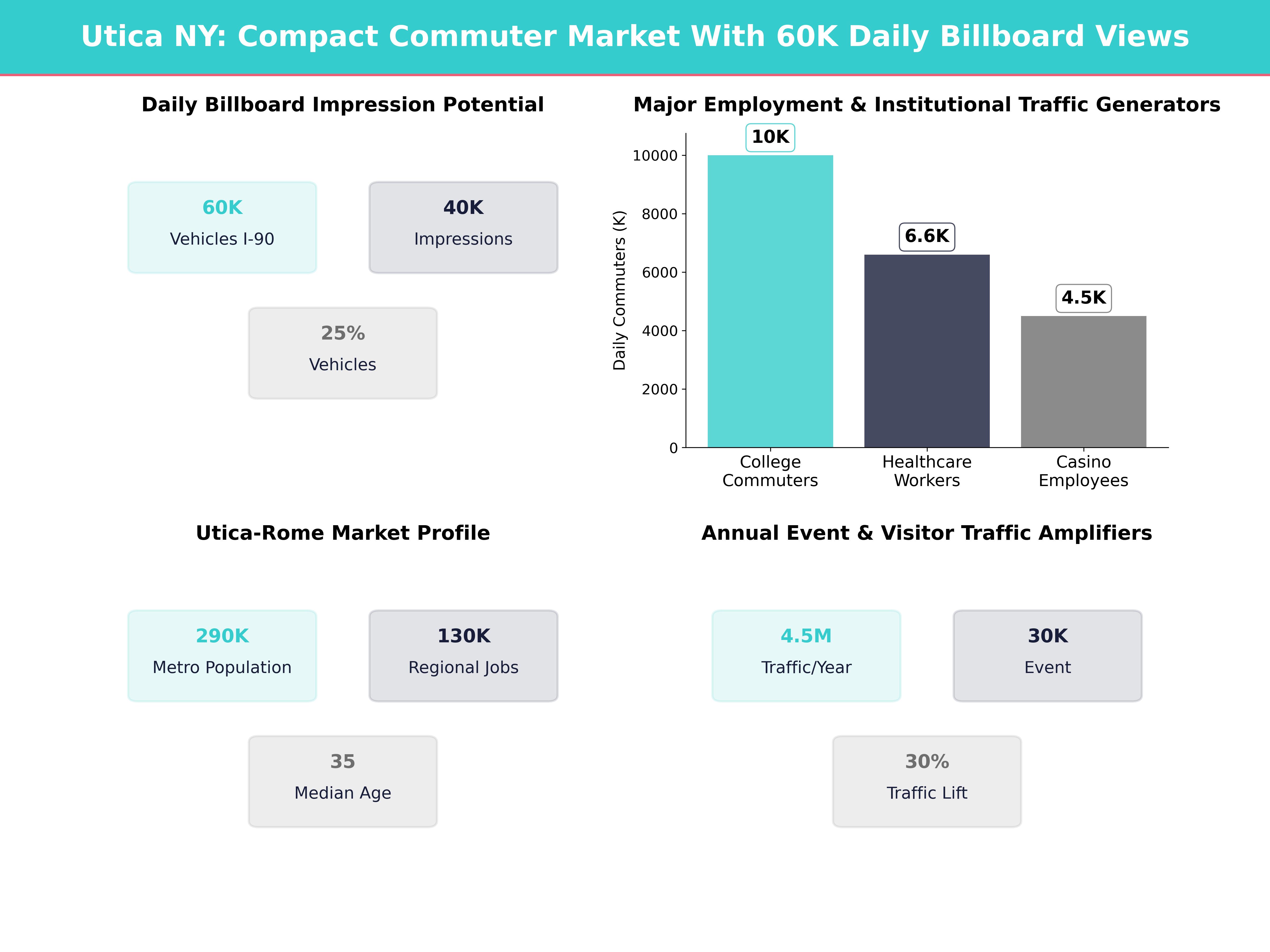
Utica is a crossroads, with the New York State Thruway (I‑90) just north of downtown and Routes 5/8/12 cutting through the city. Major segments of I‑90 and the Arterial around Utica carry between 30,000 and 60,000 vehicles per day, giving digital boards substantial daily reach. Commercial corridors like Genesee Street and Commercial Drive also capture commuters, shoppers, and event traffic.
Who can Utica, New York billboards with Blip reach?
Utica sits at the heart of the Mohawk Valley, pulling in commuters, college students, health‑care workers, manufacturers, and visitors traveling between Albany and Syracuse. The market includes roughly 64,000 city residents and about 290,000 people across the broader Utica–Rome metro. Nearby campuses and regional employers add thousands of daily travelers along consistent commuting routes.
What makes Utica, New York a good market for Blip billboard ads?
Utica is a classic “small city with regional reach,” with density along key corridors like the North–South Arterial and the New York State Thruway. Oneida County reports more than 4.7 million annual vehicle miles traveled on its state and local highway network, which supports strong daily reach. This combination of population and traffic volumes creates strong potential reach with relatively modest budgets.
When is the best time to run billboard ads in Utica, New York with Blip?
Utica’s four distinct seasons dramatically change how and when people move around the city, so timing billboard rental around these shifts is essential. Winter can bring 90–120 inches of snow in a typical season, while spring and summer bring outdoor activity, tourism, and event traffic. Morning and evening commutes, as well as event days and weekends, are especially useful times to focus impressions.
Do I need a contract to advertise with Blip in Utica?
No, Blip has no long-term contracts or minimum commitments. You can start, pause, or stop your campaign at any time.
How fast can I launch a billboard campaign with Blip in Utica?
You can have your campaign live in minutes. Create a free account, select your locations, set your budget, upload your design, and start running once approved.
Where can I advertise with Blip in Utica?
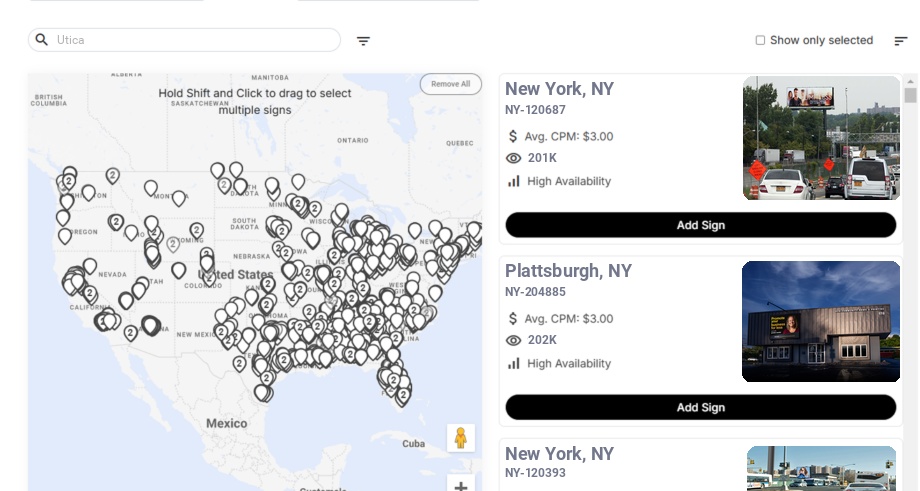
Blip has digital billboards in Utica. You can browse available locations on a map, choose the ones that fit your audience, and start advertising right away.
Still have questions? Launch a campaign in minutes — no contracts, no commitments.
Start Your CampaignUtica Billboard Advertising Guide
Utica, New York sits at the heart of the Mohawk Valley, pulling in commuters, college students, health‑care workers, manufacturers, and visitors traveling between Albany and Syracuse. When we plan a digital billboard campaign here, we’re really tapping into a compact but diverse market of roughly 64,000 city residents and about 290,000 people across the broader Utica–Rome metro. That density along key corridors like the North–South Arterial and the New York State Thruway makes Utica an efficient and cost‑effective place to run Blip campaigns, especially given that Oneida County reports more than 4.7 million annual vehicle miles traveled on its state and local highway network. For brands looking at Utica billboards for the first time, this combination of population and traffic volumes creates strong potential reach with relatively modest budgets.
Understanding the Utica Market
Utica is a classic “small city with regional reach.” A few key facts shape how we should approach billboard advertising here and help us decide which billboards in Utica are the best fit for a given campaign:
- Population: The City of Utica has roughly mid‑60,000 residents, while the Utica–Rome metro is just under 300,000 people. The City of Utica’s own Comprehensive Plan and Mohawk Valley planning documents describe a stable, slowly growing core, with Oneida County projections holding close to 230,000–235,000 residents through the mid‑2020s.
- Regional draw: Utica anchors Oneida County, which has around 232,000 residents spread across small cities, villages, and rural townships. Nearby suburbs like New Hartford (about 21,000 residents), Whitesboro Yorkville, and New York Mills regional travel demand models indicate thousands of daily work trips flowing toward Utica from these communities.
- Transportation corridors: Utica is a crossroads. The New York State Thruway (I‑90) runs east–west just north of downtown, while Routes 5/8/12 (the North–South Arterial) cut through the city. According to New York State Department of Transportation traffic data, major segments of I‑90 and the Arterial around Utica carry between 30,000 and 60,000 vehicles per day, giving digital boards substantial daily reach and making Utica billboard advertising highly visible to regional travelers.
- Economic mix: Health care, higher education, advanced manufacturing, logistics, and tourism all contribute to the local economy, as highlighted by regional development agencies like Mohawk Valley EDGE. Mohawk Valley EDGE notes that the Utica–Rome labor shed supports roughly 120,000–130,000 jobs, with major anchors including Mohawk Valley Health System (about 6,600 employees), Turning Stone Resort Casino
For advertisers, this means we can reach:
- Everyday local shoppers and families
- A wide commuter base from surrounding communities (tens of thousands of daily inbound work trips)
- Visitors heading to Adirondack destinations, Turning Stone Resort Casino, and other regional attractions promoted by Oneida County Tourism
- College students and staff from multiple campuses
Our planning goal is to match the right Blip boards and schedules to these overlapping audiences as they move through and around the city, ensuring your investment in Utica billboards reaches the people most likely to respond.
Demographics and Audience Insights
Understanding who lives and works in Utica guides both our targeting and our creative, and ultimately how we structure any billboard rental in Utica.
Age distribution
- Local planning documents and demographic profiles show Utica skewing slightly older than the U.S. overall, with a median age in the mid‑30s and a sizable share (roughly 15–17%) of residents aged 65 and over.
- Households with children make up roughly one‑quarter to one‑third of all households in the city and surrounding towns, while single‑person and older‑adult households also represent a large segment in Utica’s older neighborhoods.
-
Nearby campuses (e.g., Utica University, Mohawk Valley Community College, and SUNY Polytechnic Institute) bring in thousands of students and staff:
- Utica University enrolls around 3,000–3,500 students on campus each year.
- MVCC serves roughly 5,000–6,000 credit‑bearing students annually across its Utica and Rome campuses.
- SUNY Poly reports about 2,000–2,500 students in its Utica‑area programs.
- Combined, these institutions create a daily flow of 10,000+ students and faculty along consistent commuting routes, with peak movements around class start and end times.
This combination suggests:
- Dual‑audience messaging: Family‑oriented offers (groceries, health care, home services) perform well, but we should also tailor creatives for students (food delivery, entertainment, banking, fitness, and housing).
- Multiple creatives per campaign: With Blip, we can rotate several creatives—e.g., one targeting parents during school commute times and another aimed at students later in the evening or weekends.
Income and cost of living
- Fiscal and economic profiles from the Office of the New York State Comptroller show Utica’s median household income trailing statewide figures. While New York State’s median household income exceeds $75,000, Utica’s is commonly reported in the low‑to‑mid $40,000s, and Oneida County’s in the mid‑$50,000s.
- The Mohawk Valley is consistently identified as a lower‑cost region; housing and transportation costs sit well below downstate metros like New York City or Westchester. Local real‑estate data show median home sale prices in the Utica–Rome area often in the $170,000–$220,000 range—less than half of many downstate markets.
-
That implies:
- Price‑forward messaging (specials, discounts, financing options) will resonate strongly with a cost‑conscious audience.
- Clear value propositions—“save 20%,” “under $25/month,” “kids eat free”—are more impactful than purely aspirational messages, especially when paired with concrete price points.
Cultural diversity
Utica is known regionally for its diversity, including substantial Bosnian, Burmese, and other refugee and immigrant communities. Over the past few decades, tens of thousands of refugees have resettled in the Mohawk Valley through organizations like The Center (formerly Mohawk Valley Resource Center for Refugees), helping stabilize and grow neighborhoods. Local news outlets like the Observer‑Dispatch and WKTV NewsChannel 2 frequently highlight the city’s multicultural food, events, and neighborhoods.
For billboard creatives, this encourages us to:
- Use inclusive imagery that reflects a diverse community.
- Emphasize community themes—supporting local schools, neighborhood partnerships, charity events.
- Consider campaigns tied to cultural festivals and local celebrations promoted by Visit Utica and Oneida County Tourism.
Traffic Patterns and Key Corridors
To maximize impressions, we want boards that sit on high‑volume roads and capture repeat commuter traffic. Using traffic count data from the New York State Department of Transportation, local planning reports, and corridor studies, we can outline typical flows and see where billboards in Utica consistently reach the same audiences day after day.
1. New York State Thruway (I‑90)
- NYSDOT and Thruway traffic counts near the Utica interchange (Exit 31) typically show average annual daily traffic in the 30,000–40,000 vehicles‑per‑day range, with higher peaks during summer travel and holiday periods.
- Truck traffic can account for 15–25% of these volumes, reflecting Utica’s role along the Albany–Syracuse freight corridor.
-
Audience profile:
- Long‑distance travelers between Albany and Syracuse
- Trucking and logistics traffic moving across upstate
- Regional visitors coming for events, Turning Stone (4.5 million annual visitors), or the Adirondacks
Blip campaigns on boards near the Thruway are ideal for:
- Tourism marketing (hotels, casinos, attractions, ski and lake destinations)
- Travel‑related services (gas, dining, convenience stores)
- Regional brands looking for exposure beyond just the city
2. North–South Arterial (Routes 5/8/12)
- This corridor carries a large share of daily commuter traffic through Utica and connects downtown to New Hartford, Whitesboro, and beyond.
- NYSDOT traffic counts show large segments of the arterial with combined volumes around 40,000–60,000 vehicles per day when both directions are included.
- Morning and evening peaks align tightly with standard work hours and school bell times, making these boards ideal for repetitive daily exposure.
These boards are prime for:
- Local retail (big‑box stores, auto dealers, supermarkets)
- Health care systems and urgent care such as Mohawk Valley Health System and other providers
- Employment and recruitment ads for major employers in manufacturing, health care, gaming, and logistics
3. Commercial Corridors: Genesee Street & Commercial Drive
- Downtown and south Genesee Street link offices, restaurants, bars, entertainment venues, and civic destinations like City Hall, the Stanley Theatre, and the Utica Memorial Auditorium/Adirondack Bank Center.
- Commercial Drive (New Hartford) is a major retail corridor with malls, chains, and locally owned shops. Local traffic studies and retailer data often cite weekend traffic spikes of 15–30% above weekday averages along this stretch.
- The combination of daily commuters plus weekend shopping traffic can easily push effective weekly reach on well‑placed boards into the tens of thousands of unique drivers.
Using Blip’s location selection, we can:
- Focus budgets on boards closest to key shopping zones during high retail hours.
- Differentiate creatives by direction—e.g., “Turn right at next light” style calls to action when boards are close to your business.
- Emphasize quick‑trip language (“2 minutes ahead,” “Next right into Commercial Dr”) that resonates with short‑hop travel patterns and makes the most of Utica billboard advertising along these corridors.
4. Game‑day and Event Traffic
- The Adirondack Bank Center (home of the Utica Comets and Utica University Pioneers hockey) seats around 3,800 for hockey and up to 5,700 for concerts and events, drawing thousands of fans for dozens of home games and special events each season.
- The annual Boilermaker Road Race attracts roughly 14,000 runners and tens of thousands of spectators, creating city‑wide traffic and exposure. Local coverage from outlets like WKTV and the Observer‑Dispatch routinely notes that race weekend fills hotels across Utica and New Hartford.
- Other recurring events—parades, high school championships at the Utica University Nexus Center Proctor Park
If we know event dates and times, we can:
- Use Blip’s flexible scheduling to “upweight” impressions on the days around these events.
- Run event‑linked offers—e.g., “Show this ad on your phone for a post‑game discount”—for nearby restaurants, bars, and retailers.
- Coordinate with event calendars from Visit Utica or Oneida County Tourism
Seasonality in Utica: Weather and Timing
Utica’s four distinct seasons dramatically change how and when people move around the city. Snowfall, tourism seasons, and the academic calendar all shape traffic volume and trip purpose, so timing billboard rental in Utica around these shifts is essential.
Winter (roughly November–March)
- Utica lies squarely in New York’s snowbelt. It is common for the region to see 90–120 inches of snow in a typical winter, with some seasons topping 150 inches according to regional climate summaries from the National Weather Service Binghamton Office.
- Major storms slow traffic and keep people closer to home, while routine commutes still generate reliable weekday flows on the Thruway, Arterial, and Genesee Street.
- Commute times can lengthen, and some discretionary trips (dining out, shopping) dip during storm days but rebound quickly afterward.
Implications for billboard campaigns:
- Emphasize essential services: heating and plumbing, auto repair, health care, grocery, and online retail.
- Use creative that references winter conditions: “Stay warm with…”, “Snow day special,” or “Make winter easy with delivery.”
- Consider more daytime impressions when visibility and traffic are higher compared to late evening; in winter, sunset can be as early as 4:25 p.m., making legible night‑time creative especially important.
Spring and Summer
- Outdoor activity spikes: park visits, Little League and soccer, trips north toward the Adirondacks, and regional tourism. Oneida County Tourism highlights that summer is peak season for attractions like Sylvan Beach Delta Lake State Park, and Old Forge, all of which pull traffic through or around Utica.
- The Boilermaker (usually in July) brings 14,000 runners plus family and spectators—often 30,000+ people engaged with race‑related activities throughout the weekend.
- Summer concerts at venues like Saranac Brewery Stanley Theatre, and festivals in city parks significantly increase downtown and corridor traffic on event days.
Summer strategies:
- Highlight tourism, recreation, and hospitality offers (hotels, campgrounds, restaurants, ice cream stands, outdoor gear).
- Align spend around known event weekends and school vacation periods—the Utica City School District calendar and local college academic calendars provide clear timing cues.
- Use vibrant, high‑contrast visuals that pop in bright sunlight and stand out against green summer foliage.
Fall
- Back‑to‑school for local K‑12 and college campuses reliably increases commuting and after‑school travel. Between the Utica City School District (~10,000+ students) and surrounding districts like New Hartford, Whitesboro, and Sauquoit Valley, tens of thousands of students and staff are back on the roads each weekday.
- College campuses return to full activity, with enrollment drives, athletics, and campus events pulling more evening and weekend trips.
- Retailers often report strong fall and early‑holiday shopping periods, especially along Commercial Drive and major grocery corridors.
Best uses:
- School‑related products and services, tutoring, youth sports, and after‑school programs.
- Enrollment pushes for colleges, adult education, and training programs aligned with October/January start dates.
- Retailers can promote fall sales and early holiday messaging starting mid‑fall, capturing both local families and visiting alumni.
Crafting Effective Creative for Utica
Clear, punchy creative is especially important in a compact city where dwell time is limited. For Utica, we recommend:
1. Lead with location and convenience
Because many trips are short hops—New Hartford to downtown, Whitesboro into the city—messages that emphasize proximity perform well. Local travel time surveys show many common origin‑destination pairs inside the Utica urbanized area are under 10 minutes.
Use phrases like:
- “5 minutes from Downtown Utica”
- “Next exit off the Arterial”
- “Across from the Adirondack Bank Center”
Pair this with simple directional icons (arrows, distance markers) and a strong call to action so your Utica billboards immediately communicate how close you are.
2. Use value‑driven offers
With a cost‑conscious audience, highlight:
- Prices (“Oil change $39.99,” “Lunch specials from $8.99”)
- Limited‑time deals (“Today only,” “This week”)
- Clear benefits (“Zero‑down financing,” “Free same‑day estimates”)
Rotating multiple price points or specific offers is easy with Blip’s digital format; we can test which ones generate more response and re‑weight impressions toward the best performers.
3. Reflect local pride and culture
Utica residents are proud of their city’s identity—Italian, Bosnian, and other communities; local foods like Utica greens and tomato pie; and local institutions like the Comets and Saranac. Coverage in the Observer‑Dispatch, WKTV, and Spectrum News 1 Central New York regularly reinforces this local pride.
Incorporate:
- References to local teams or events (“Comets fans welcome,” “Boilermaker weekend special”).
- Visuals that feel distinctly Utica (recognizable skyline, the Utica sign, local venues like the Stanley or Saranac).
- Community‑oriented language (“Locally owned since 19XX,” “Proud to serve the Mohawk Valley”).
4. Plan for all‑weather legibility
Given snow, rain, and low‑sun winter days, prioritize:
- High contrast (light text on dark background or vice versa)
- Large fonts (at least ~18–24 inches in physical scale; in design tools, think 36–60 pt depending on layout)
- Minimal text (ideally 7 words or fewer per frame)
Avoid intricate details or thin fonts that can disappear in snow glare or fog. In a market where winter conditions can affect visibility on 30–40% of days in peak season, legible design is a practical necessity for effective Utica billboard advertising.
Using Dayparting and Scheduling Strategically
One of our biggest advantages with Blip is granular control over when messages appear. For Utica, we can align dayparts with how the city actually moves:
Morning commute (6–9 a.m.)
- Heavy on Routes 5/8/12, Genesee Street, and feeder roads from New Hartford and Whitesboro. School bus traffic ramps up sharply between 7–8 a.m. during the academic year.
-
Best for:
- Coffee shops and breakfast spots
- Auto services (reminding drivers about winter tires, inspections, oil changes)
- Local news, radio, and weather apps, including stations highlighted by CNYRadio.com
- B2B messaging catching business owners and managers on their way to work
Midday (10 a.m.–3 p.m.)
- Mix of errands, retirees, flexible workers, and service calls.
-
Good for:
- Medical practices, dental, and eye care (many schedule routine appointments mid‑day)
- Retailers and grocery stores
- Non‑urgent home services (remodeling, flooring, HVAC quotes, landscaping)
Evening commute (3–7 p.m.)
- School pickup and work commutes blend on the same corridors. Traffic counts on the Arterial and Commercial Drive often peak in this window.
-
Ideal for:
- Restaurants and take‑out
- Gyms and fitness studios
- Entertainment and events (games, shows, movies)
- Child‑focused activities (sports leagues, tutoring, music lessons)
Evenings and weekends
- More discretionary trips: dining, entertainment, shopping, recreation.
-
Perfect for:
- Nightlife, bars, and breweries (including regional favorites promoted by Saranac Brewery
- Family entertainment centers and local attractions
- Weekend retail promotions and holiday sales
- Tourism messaging for visitors staying locally in Utica or New Hartford hotels
With Blip, we can weight our budget toward the times that matter most—e.g., 70% of impressions on weekday commutes, 30% on weekend afternoons—or shift entirely to weekends if that’s when your business sees the most demand. This level of control makes billboard rental in Utica more efficient, since you pay for exposure when your audience is most active.
Aligning with Local Events and Calendars
Utica’s event calendar gives us natural spikes in attention and traffic. A few anchors to build around:
- Boilermaker Road Race (July): ~14,000 runners, tens of thousands of spectators, extensive media coverage from outlets like WKTV NewsChannel 2 and the Observer‑Dispatch. Local hotels frequently report near‑full occupancy for race weekend.
- Hockey season: Dozens of home games for the Utica Comets and Utica University Pioneers at the Adirondack Bank Center, each bringing 3,000–4,000 fans into the city, plus pre‑ and post‑game spending at nearby businesses.
- Summer concerts & festivals: Shows at Saranac Brewery, festivals in Proctor Park, events at the Stanley Theatre, and activities promoted on Visit Utica’s event calendar draw audiences ranging from a few hundred to several thousand on individual dates.
- Holiday season (November–December): Increased downtown and retail corridor travel for shopping and celebrations, with many local retailers reporting some of their strongest monthly sales of the year.
How we can use Blip’s flexibility:
- Launch short, high‑impact “event bursts” (e.g., 3–5 days around a major game or concert).
- Swap creatives by date: a generic ad most of the month, then an event‑specific offer (like “Show your game ticket for 10% off tonight”) on game days.
- Adjust budgets seasonally—heavier in June–December for retail, or targeted bursts during specific enrollment or hiring periods (e.g., health‑care recruitment, college application deadlines).
Sample Campaign Approaches by Industry
To make these ideas concrete, here’s how we might structure billboard campaigns for common Utica‑area advertisers and choose among different billboards in Utica based on goals and audiences.
Local Restaurant or Bar (Downtown or Near the Arena)
- Target boards: Corridors feeding into downtown and the Adirondack Bank Center—Genesee Street, the Arterial exits, and key access points from New Hartford.
- Dayparts: Heavy on evenings and weekends; lighter weekday midday. Consider shifting 60–70% of impressions into 4–10 p.m. on event days.
-
Creative rotation:
- “Pre‑Game Specials Tonight – 2 Blocks from the Arena”
- “Post‑Game Kitchen Open Late – [Restaurant Name] on Genesee St”
- Weekday lunch deal creative during 11 a.m.–2 p.m. (“Lunch from $9.99 – 5 Minutes from Here”)
- Event tie‑ins: Boost budget on Comets home game days and major Stanley Theatre shows, using the published schedules on the Utica Comets and Stanley Theatre websites.
Regional Retailer (New Hartford / Commercial Drive)
- Target boards: Near Commercial Drive and key approach routes from Utica and Whitesboro.
- Dayparts: Weekday late afternoon and Saturday/Sunday all day, capturing peak shopping windows that regional traffic counts show can be 20–30% higher than weekday flows.
-
Creative rotation:
- General brand billboard: “The Mohawk Valley’s Home for [Category] – Exit at Commercial Dr”
- Weekly sale creative updated each season (Back‑to‑School, Holiday Sale, Spring Clearance) with specific discounts (“Up to 40% Off This Weekend Only”).
- Seasonality: Heavier spend August–December; maintain a brand presence year‑round at lower levels, with short bursts around key sales events (Presidents’ Day, Memorial Day, Black Friday).
Health Care Provider or Urgent Care
- Target boards: High‑traffic commuter routes and near clinic locations; corridors that lead directly to facilities like Wynn Hospital (MVHS) and urgent care centers.
- Dayparts: All day, with slightly more impressions in morning and early evening when patients are commuting.
-
Creative rotation:
- “Urgent Care in Utica – Open 8 a.m.–8 p.m. – Walk‑In Welcome”
- Seasonal variants: flu shots in fall (“Flu Shots Today – No Appointment Needed”), sports physicals in late summer, allergy care in spring.
- Messaging: Emphasize convenience, short wait times, and insurance compatibility (“Most Insurance Accepted – Free Parking”).
College or Training Program
- Target boards: Corridors frequented by 18–34 year‑olds: around MVCC, Utica University, SUNY Poly, and major apartment clusters.
- Dayparts: Morning and early evening commutes, plus weekend afternoons when prospective students and parents tour campuses.
-
Creative rotation:
- “Finish Your Degree in Utica – Apply by May 1”
- “Fast‑Track Career Training – Classes Start September”
- Program‑specific frames (“Nursing, Cybersecurity, Business – Learn More at [short URL]”)
- Flighting: Concentrated bursts around enrollment deadlines and open houses (e.g., 4–6 weeks before start dates), with lighter evergreen brand ads in between to maintain awareness.
Home Services (HVAC, Roofing, Plumbing)
- Target boards: Broad coverage across commuter routes into and out of the city—Thruway feeders, the Arterial, and key east‑west streets.
- Dayparts: Daytime and early evening, when homeowners are most likely to make service calls.
-
Creative rotation:
- Winter: “Furnace Trouble? 24/7 Service in Utica – Call ###‑####”
- Spring/Fall: “Free Estimate on New Roof – Serving the Mohawk Valley”
- Summer: “Stay Cool All Summer – AC Install & Repair – Financing Available”
- Strategy: Emphasize emergency availability and fast response times (“Same‑Day Service Available”), and rotate season‑appropriate creatives so messaging always matches the current need.
Measuring and Optimizing in a Compact Market
Because Utica is relatively small and interconnected, changes in creative, timing, or spend can produce measurable differences quickly. To make the most of Blip’s capabilities, we should:
- Use trackable calls to action: Custom URLs, QR codes, or offer codes (“Mention ‘Utica Billboard’ for 10% off”) aligned with each creative. Even a modest redemption rate—1–3% of exposed viewers taking action—can be very meaningful in a market where daily board impressions can exceed 20,000–40,000 vehicles.
- Align campaigns with internal data: Watch store traffic, website visits, or call volume before, during, and after campaigns—especially around major event bursts or creative changes. For example, compare sales on Comets home game days with and without boosted Blip impressions.
- Test and iterate: Run A/B tests with different headlines, price points, or images. After 2–4 weeks, shift more budget toward the top‑performing creative. In a market with heavy repeat commuters, small improvements in response rate compound quickly over hundreds of exposures per month.
- Leverage frequency: In a city where the same commuters pass the same boards daily, consistent repetition builds recognition. Rather than spreading too thin across many boards at low frequency, we often see better results focusing on a handful of high‑value locations with enough impressions to create multiple exposures per person per week (e.g., aiming for 5–10 weekly impressions among core commuter audiences).
By aligning our Blip billboard strategy with Utica’s specific traffic flows, seasonal rhythms, and community character—and grounding decisions in local data from sources like NYSDOT, the City of Utica, and Oneida County Tourism—we can create campaigns that feel local, timely, and persuasive. The combination of data‑driven scheduling, flexible creative, and Utica’s compact, high‑frequency corridors makes this market especially well‑suited to digital out‑of‑home advertising, and helps ensure your investment in billboard rental in Utica delivers meaningful, measurable results.