Billboards near Manhattan, NY
No Minimum Spend. No Long-Term Contracts. Just Results.
Trusted by Leading Brands


Billboard advertising
near Manhattan has never been easier



How much is a billboard near Manhattan?
Why Choose Blip for Billboard Advertising near Manhattan
Blip lets you launch Manhattan billboards fast and self-serve, hitting Lincoln, Holland, and George Washington Bridge traffic before they reach the city.
Set flexible budgets for Manhattan, then scale for weekday 6:30-10 a.m. and 3:30-7:30 p.m. peaks from Jersey City, Brooklyn, and Weehawken commuters.
No contracts means you can test Manhattan on Times Square, Midtown, and Lower Manhattan audiences, then shift spend to the corridors that respond best.
Blip's real-time analytics show what works in Manhattan, so you can optimize around tourism surges, Fashion Week, and holiday traffic fast.
Use creative tools to tailor Manhattan messages for office workers, tourists, or Broadway crowds—then swap in new ads for Brooklyn and NJ routes instantly.
Frequently Asked Questions About Billboard Advertising near Manhattan
How much does a billboard cost near Manhattan, New York with Blip?
With Blip, you control exactly how much you spend on Manhattan billboards by setting a daily budget that can be adjusted at any time. Each 7.5–10 second “blip” on digital billboards near Manhattan, New York is priced individually based on when and where your ad appears and current advertiser demand, so you only pay for the exposure you receive. This pay-per-blip model makes it easy to start small, test what works in the Manhattan area, and scale up as you see results.
Where can I advertise with Blip near Manhattan, New York?
Our 213 digital billboards serving the Manhattan area are concentrated in nearby high-traffic corridors where drivers funnel toward core Manhattan destinations. Key nearby cities and corridors include New York, Brooklyn, Jersey City, Weehawken & North Bergen, and Ridgefield, Secaucus, Kearny, Lodi, Maywood, Hackensack, and Bogota, NJ. These locations let you target Manhattan-bound commuters before they hit city congestion.
Who can Blip reach with billboard ads in Manhattan, New York?
Manhattan sits at the center of one of the densest, wealthiest, and most media-saturated markets on earth. For advertisers, this means a single campaign near Manhattan can reach high-income professionals, global tourists with spending budgets, local residents from all five boroughs, New Jersey commuters who rely heavily on driving, and students and young professionals. Because the audience is so diverse, clarifying who you want to reach is the foundation for your creative and scheduling decisions.
When is the best time to run Blip campaigns near Manhattan, New York?
The Manhattan area never truly sleeps, but traffic patterns are predictable enough to target specific audiences with time-based scheduling. Weekday morning peak into the Manhattan area runs roughly 6:30–10:00 a.m., and evening peak out of the area runs 3:30–7:30 p.m. Midday and evening can also work well for service workers, tourists, shoppers, nightlife, dining, and entertainment.
Why should I advertise near Manhattan, New York instead of only inside the borough with Blip?
While the faces sit near Manhattan rather than inside the borough itself, they align with real travel paths into and around it, giving you billboard advertising near Manhattan that behaves like in-city coverage at a fraction of the cost. Boards near Hudson River crossings, East River bridges, and major artery highways let you intercept commuters and visitors on the way into Manhattan. This approach is efficient for reaching Manhattan-bound drivers and keeping billboard rental near Manhattan focused.
Do I need a contract to advertise with Blip near Manhattan?
No, Blip has no long-term contracts or minimum commitments. You can start, pause, or stop your campaign at any time.
How fast can I launch a billboard campaign with Blip near Manhattan?
You can have your campaign live in minutes. Create a free account, select your locations, set your budget, upload your design, and start running once approved.
Where can I advertise with Blip near Manhattan?
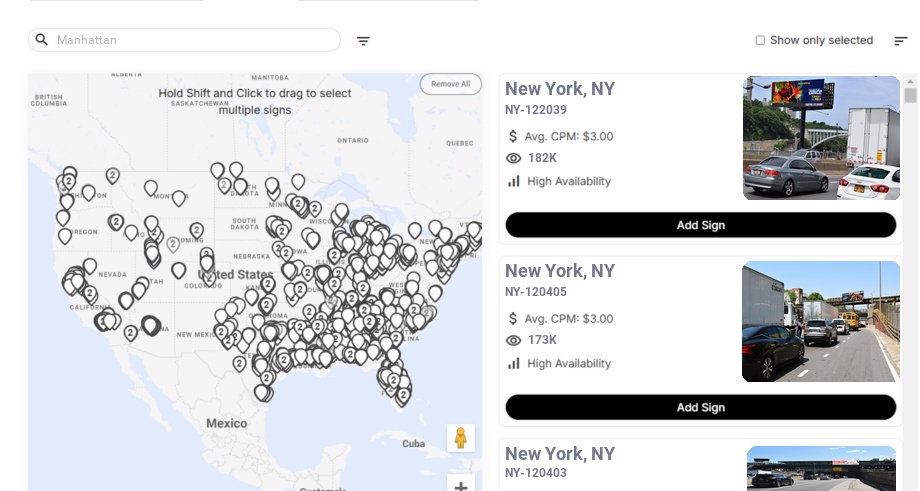
Blip has digital billboards near Manhattan. You can browse available locations on a map, choose the ones that fit your audience, and start advertising right away.
Still have questions? Launch a campaign in minutes — no contracts, no commitments.
Start Your CampaignManhattan Billboard Advertising Guide
Manhattan sits at the center of one of the densest, wealthiest, and most media-saturated markets on earth. With 213 digital billboards serving the Manhattan area from nearby locations such as New York City, Jersey City, Weehawken, Secaucus, and Brooklyn
Understanding the Manhattan Area Audience
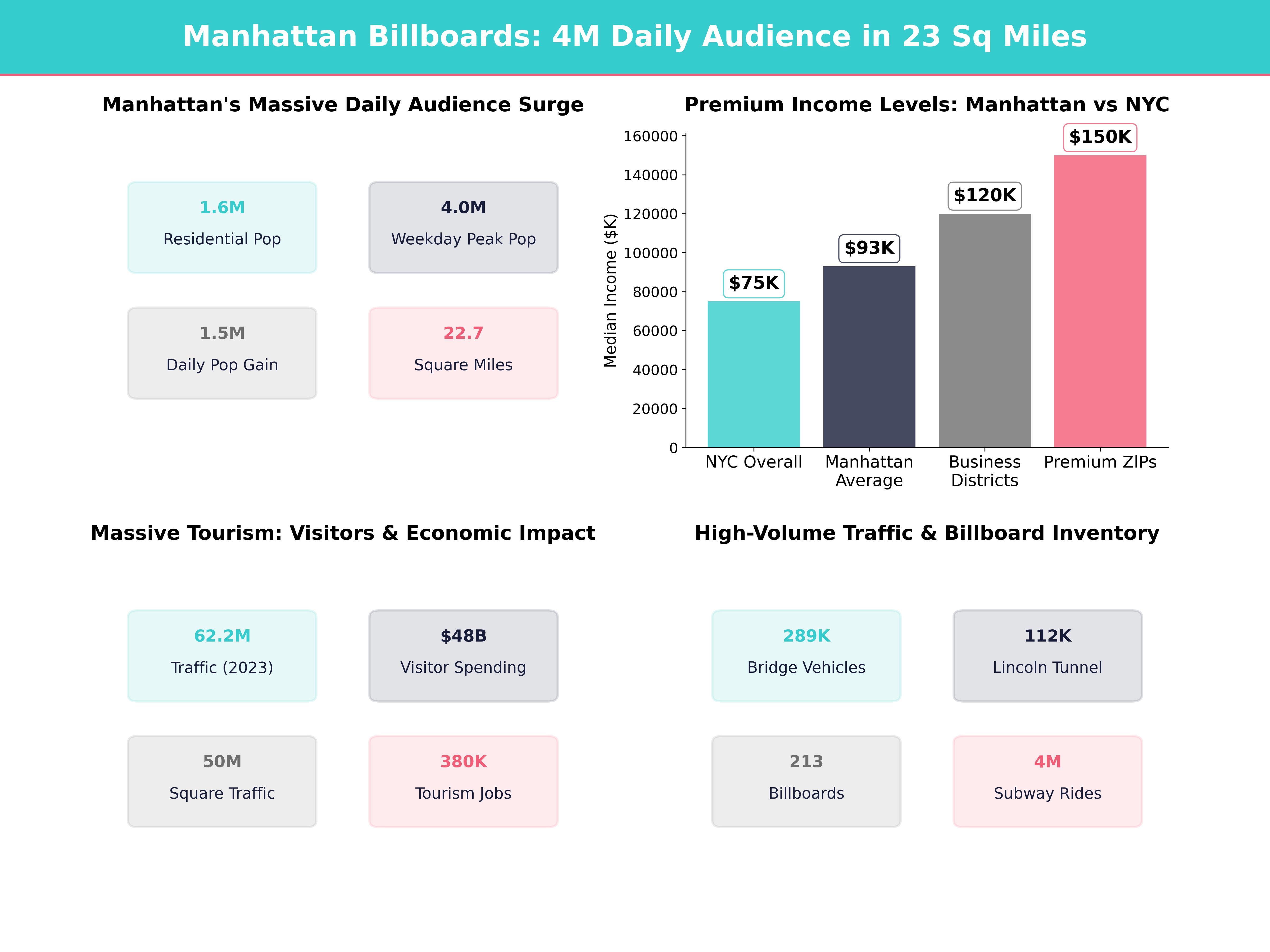
Manhattan is small in land area—just 22.7 square miles—but enormous in influence:
- Manhattan’s residential population is about 1.6 million, while New York City as a whole has over 8.3 million residents, according to city demographic summaries from NYC Planning
- The weekday daytime population in the Manhattan area swells to roughly 3.8–4.0 million when you include commuters and visitors coming from the other boroughs and New Jersey; NYC Planning estimates that Manhattan gains well over 1.5 million people on a typical workday.
- The New York metropolitan area counts over 19 million people, many of whom regularly travel through corridors served by our boards near Manhattan, making it one of the top 10 largest metro areas in the world by population.
- According to NYC Department of Transportation over 1 million vehicle trips per weekday, a large share of which originate in New Jersey, Brooklyn, Queens, and Long Island.
Spending power is extremely high:
- Manhattan’s median household income is around $93,000, while the median for NYC overall is closer to $75,000, according to city income profiles compiled by NYC.gov.
- Median income in Manhattan’s business-heavy community districts, such as Midtown and the Upper East Side, often exceeds $120,000, based on neighborhood profiles from NYC Planning
- Several ZIP codes in Midtown and Downtown report median household incomes above $150,000, making them prime targets for luxury, B2B, and high-consideration purchases.
- New York City’s total consumer spending has been estimated at over $250 billion annually, with Manhattan accounting for a disproportionate share in categories like financial services, luxury retail, travel, and dining, according to economic briefs from the NYC Economic Development Corporation
Tourism magnifies this market:
- New York City welcomed 62.2 million visitors in 2023, according to NYC & Company
- Of these, roughly 50 million were domestic visitors and over 12 million were international, bringing in diverse, global audiences and higher average spend.
- Visitor spending in NYC exceeded $48 billion in 2023, supporting more than 380,000 jobs in hospitality, retail, arts, and entertainment, per NYC & Company
- Times Square alone now sees 300,000–400,000 pedestrians per day, and over 50 million visitors per year, per Times Square Alliance. During peak holiday periods, single-day pedestrian counts can exceed 450,000.
- Hotel occupancy in Manhattan often runs above 80% on peak nights, with average daily room rates regularly topping $300–$350, according to data cited by NYC & Company
For advertisers, this means a single campaign near Manhattan can reach:
- High-income professionals
- Global tourists with spending budgets
- Local residents from all five boroughs
- New Jersey commuters who rely heavily on driving
- Students and young professionals concentrated around institutions like Columbia University New York University over 600,000 students citywide
Because the audience is so diverse, clarifying who you want to reach (e.g., “weekday Midtown office workers” vs. “weekend tourists and families”) is the foundation for your creative and scheduling decisions, and helps you decide which Manhattan billboards and corridors make the most sense for your brand.
Where Our Digital Billboards Reach Manhattan-Area Drivers
Our 213 digital billboards serving the Manhattan area are concentrated in nearby high-traffic corridors where drivers funnel toward core Manhattan destinations. While the faces sit near Manhattan rather than inside the borough itself, they align with real travel paths into and around it, giving you billboard advertising near Manhattan that behaves like in-city coverage at a fraction of the cost.
Key nearby cities and corridors include:
-
New York, New York (3.0 miles from Manhattan)
Boards in nearby New York City neighborhoods serve heavy traffic approaching Manhattan from the outer boroughs and major bridges. The NYC Department of Transportation 80,000–100,000 vehicles per day, creating sustained flows of Manhattan-bound drivers. -
Brooklyn, New York (7.1 miles from Manhattan)
Brooklyn has over 2.7 million residents. Drivers use the Brooklyn Bridge, Manhattan Bridge, Williamsburg Bridge, and Brooklyn–Battery Tunnel to access Downtown and Midtown. Combined, these crossings handle well over 350,000 vehicle trips daily, according to bridge and tunnel traffic summaries from the Metropolitan Transportation Authority. Placing blips on Brooklyn-facing boards lets you intercept Manhattan-bound commuters before they reach denser, more distracted environments.- Neighborhoods like Williamsburg, Downtown Brooklyn, and Brooklyn Heights are key gateways to Lower Manhattan business districts.
- Brooklyn’s daytime population is bolstered by more than 560,000 private-sector jobs, per Brooklyn Chamber of Commerce, many tied to creative industries and tech—prime targets for B2B and lifestyle brands.
-
Jersey City, New Jersey (6.2 miles from Manhattan)
With over 300,000 residents, Jersey City is one of the fastest-growing cities in the region and a major financial services hub across the Hudson. Many residents commute to Manhattan area jobs via the Holland Tunnel, ferries, and PATH trains.- The Holland Tunnel carries around 90,000–100,000 vehicles per day, based on Port Authority of New York and New Jersey counts.
- PATH rail ridership regularly exceeds 250,000 weekday trips, much of it between Jersey City/Hoboken and Manhattan, according to PATH statistics. Boards here can target both reverse commuters (Manhattan residents working in NJ) and inbound office workers. For local business context, see City of Jersey City Visit Jersey City.
-
Weehawken & North Bergen, NJ (3.3–4.0 miles from Manhattan)
These towns sit along the Hudson River waterfront opposite Midtown, with direct visibility to the Manhattan skyline. Approaches to the Lincoln Tunnel, which carries roughly 112,000 vehicles per day according to the Port Authority of New York and New Jersey, are prime locations for Manhattan-focused messaging.- Hudson County as a whole is home to more than 700,000 residents and has some of the highest transit ridership rates in the nation, per Hudson County, NJ
- Park-and-ride facilities and bus lanes feeding the Lincoln Tunnel mean long dwell times in view of digital boards.
-
Ridgefield, Secaucus, Kearny, Lodi, Maywood, Hackensack, Bogota, NJ (4.4–9.3 miles from Manhattan)
These New Jersey communities feed into the Lincoln Tunnel, George Washington Bridge, and other crossings. The George Washington Bridge alone handles around 289,000 vehicles daily, making it one of the busiest bridges in the world.- According to NJ Department of Transportation 100,000–160,000 vehicles per day, much of it Manhattan-bound or returning.
- Secaucus and Hackensack also host large retail centers and office parks, attracting shoppers and employees who regularly cross into Manhattan for entertainment and business.
These locations allow you to:
- Target Manhattan-bound commuters before they hit city congestion.
- Reach suburban and New Jersey audiences who spend during evenings and weekends in the Manhattan area.
- Build frequency on daily commute patterns that cross state and borough lines.
- Capture attention from regional visitors coming from airports like Newark Liberty International Airport LaGuardia Airport, and John F. Kennedy International Airport, which together handled over 130 million passengers in recent years, according to the Port Authority.
When planning, think in terms of gateways to the Manhattan area: Hudson River crossings, East River bridges, and major artery highways. Choosing the right mix of billboards near Manhattan along these gateways is the key to maximizing reach and keeping billboard rental near Manhattan efficient and focused.
Timing Your Blips Around Manhattan Traffic and Activity
The Manhattan area never truly sleeps, but traffic patterns are predictable enough to target specific audiences with time-based scheduling.
Commuter Peaks
According to MTA and regional traffic reports:
- Weekday morning peak into the Manhattan area runs roughly 6:30–10:00 a.m.
- Evening peak out of the area runs 3:30–7:30 p.m.
- Subway ridership averaged about 4 million weekday rides in 2023 citywide, with many trips beginning or ending in Manhattan; pre-pandemic weekday ridership peaked near 5.5 million, showing how much volume is returning.
- The MTA’s commuter railroads—Long Island Rail Road and Metro-North Railroad—carry roughly 600,000+ weekday riders combined, many funneling into Penn Station and Grand Central, which in turn generate taxi, rideshare, and private car trips through nearby corridors.
For campaigns targeting professionals, financial services, B2B, or higher-end retail:
- Emphasize weekday rush hours near access points like Weehawken, North Bergen, Secaucus, Jersey City, and Brooklyn.
- Use shorter, benefit-driven messages (“Cut your commute costs by 30%,” “Upgrade your office tech today”) that can be understood at highway speeds.
- Consider heavier frequency on Tuesdays–Thursdays, when many hybrid workers are in-office; several NYC office occupancy indexes reported midweek occupancy rates 10–15 percentage points higher than Mondays or Fridays in 2023.
Midday and Evening
- The midday window (11:00 a.m.–3:00 p.m.) sees strong volumes from service workers, freelancers, tourists, and shoppers. Retail activity trackers cited by NYC & Company 12:00–4:00 p.m.
- Evening and late night (7:00 p.m.–midnight) is ideal for entertainment, nightlife, dining, streaming, and on-demand services. Theater curtains for Broadway and Off-Broadway shows typically rise between 7:00–8:00 p.m., according to The Broadway League, making the 5:00–8:00 p.m. drive-time window critical for show promotions.
- NYC’s restaurant and bar scenes remain busy late: NYC Hospitality Alliance reports that a substantial share of food-and-beverage revenue comes after 7:00 p.m., with many venues active until midnight or later.
Tourists and leisure visitors often move by car, cab, or rideshare between hotels, shows, dining, and airports. Use time-of-day targeting to:
- Promote restaurants and bars ahead of dinner time.
- Push Broadway or Off-Broadway shows near showtime.
- Highlight delivery apps or late-night services after 9:00 p.m.
- Capture rideshare passengers and taxi traffic traveling to nightlife zones like Meatpacking, Lower East Side, Williamsburg, and DUMBO.
Weekends
Weekends reshape the audience mix:
- Office commuter volume drops, but regional visitors and families spike, especially headed toward Manhattan’s museums, shopping, and entertainment.
- According to NYC & Company
- Museums like the Metropolitan Museum of Art, American Museum of Natural History Museum of Modern Art 2–6 million visitors annually, with a high proportion on weekends.
- Weekend subway ridership, while lower than weekday peaks, still reaches 2–3 million trips per day, per MTA ridership data
Weekend-focused creatives can:
- Promote attractions, tours, and events in the Manhattan area.
- Drive walk-in retail and dining traffic.
- Support local services (fitness studios, salons, healthcare) with “This weekend only” or “Book today” offers.
- Capture suburban shoppers, as regional mall and city-shopping visits from New Jersey and Long Island surge on Saturdays and Sundays.
With Blip, you can dial spending up during the hours and days that most closely align with your target audience, instead of paying a flat rate for 24/7 coverage. This makes always-on billboard advertising near Manhattan more attainable for businesses of all sizes.
Crafting Creative That Cuts Through Manhattan-Level Clutter
The Manhattan area is one of the world’s most advertising-saturated environments. Drivers and passengers are bombarded by storefronts, mobile devices, taxis, and DOOH everywhere. Studies of digital out-of-home (DOOH) attention generally show that drivers process billboard messages in 2–3 seconds, and recall drops sharply when creatives are cluttered or text-heavy. Your creative must be brutally clear and instantly legible to stand out among other Manhattan billboards and city visuals.
Guidelines tailored to this market:
-
Design for 2–3 Seconds of Attention
At highway speeds near Hudson River crossings or outer-borough arterials, drivers may see your creative for only a few seconds.- Limit to 7 words or fewer for your main message.
- Use a single dominant image.
- Make your logo large and high-contrast.
- Use font sizes that remain legible at 300–500 feet, typically the viewing distance on major approaches.
-
Use High-Contrast Colors
Manhattan-area roads often have complex backgrounds (skyline, signage, lights).- Pair dark backgrounds with bright type (or vice versa).
- Avoid thin scripts or low-contrast combinations like red on black.
- Ensure a minimum contrast ratio of 4.5:1 for accessibility and readability, following design best practices similar to those promoted by NYC Digital Accessibility
-
Leverage Location Cues
Since our boards are near Manhattan rather than inside it, contextual cues are valuable:- “5 minutes from the Lincoln Tunnel”
- “Next stop: Midtown—try us today”
- “Before you hit Manhattan traffic… switch to us”
- “Exit in 2 miles for SoHo’s best coffee” Location-specific references can increase relevance and recall, especially for commuters who travel the same route 200+ days per year.
-
Speak to the Commute Mindset
Many viewers are on their way to or from demanding jobs:- Morning: productivity, finance, education, professional services.
- Evening: stress relief, entertainment, food delivery, wellness.
- Surveys of NYC-area workers reported average commute times around 37–40 minutes, among the longest in the U.S., making commute-focused benefits (“save time,” “cut your costs,” “make tomorrow easier”) particularly resonant.
-
Use Clear Calls to Action (CTAs)
Even if you’re building awareness, give a next step:- “Search: [Brand] NYC”
- “Visit [short URL]”
- “Use code TUNNEL for 20% off”
- “Scan to save” with large QR codes for slower roadways where vehicles may stop or slow to under 25 mph (e.g., approaching toll plazas or traffic lights).
-
Adapt Creatives by Direction and Time
For example:- NJ → Manhattan area mornings: “Upgrade your workday. Try [Brand] before 9 a.m.”
- Manhattan area → NJ evenings: “Tomorrow’s commute could be better. Learn how at [URL].”
- Brooklyn → Manhattan weekends: “Brunch in the city? Reserve at [Restaurant] now.” Using directional and time-based variations helps you better match intent, which can improve response rates by 20–30% in many DOOH tests.
Because Blip lets you upload multiple creatives and rotate between them, you can tailor messages to specific corridors, dayparts, or audiences without printing new vinyl, and you can test which styles perform best on different Manhattan billboards and approaches.
Tailoring Campaigns to Key Manhattan Area Districts and Audiences
Different Manhattan-area districts attract distinct audiences. Even though your boards are positioned near Manhattan, your message can speak directly to the destinations those travelers care about.
Midtown & Times Square
- Midtown is home to major corporate HQs, media, and tourism landmarks. According to NYC EDC hundreds of millions of square feet of office space and a large share of the city’s professional and financial jobs.
- Times Square’s daily pedestrian counts (300,000–400,000) mean a huge share of inbound drivers are headed there.
- Hotel and theater density is particularly high: Broadway theaters, centered around Times Square, sold over 12 million tickets in the 2022–2023 season, according to The Broadway League.
Ideal advertisers:
- Entertainment: Broadway, comedy clubs, live music.
- Hospitality: hotels, rooftop bars, restaurants.
- Consumer brands seeking broad awareness.
- Streaming services, tech devices, and mobile apps looking for halo effects in one of the world’s most photographed neighborhoods.
Messaging examples for commuters approaching via Lincoln or Holland Tunnels:
- “Headed to Midtown meetings? Make your impression with [Brand].”
- “Before Times Square, meet NYC’s best [product/service].”
- “Your 8 a.m. meeting near Bryant Park? Fuel up at [Brand] on the way.”
Downtown & Financial District
- Home to Wall Street, the World Trade Center, and many global financial firms. The Alliance for Downtown New York 200,000 workers in Lower Manhattan across finance, insurance, tech, and government.
- Office workers here skew high-income and time-poor; Downtown’s average salary levels in financial services can exceed $200,000, according to regional labor market summaries.
Ideal advertisers:
- Financial services, fintech, B2B SaaS, wealth management.
- Premium gyms, luxury retail, private healthcare, executive education.
- Professional services (law, consulting, accounting), many of which depend on in-person client meetings.
Use direct, benefit-focused messages:
- “NYC pros save an average of $1,200/yr with [Fintech App].”
- “Executive health checkups near the World Trade Center—book today.”
- “Lower Manhattan offices trust [B2B Brand] to cut costs by 18%.”
Uptown & Cultural Corridors
Upper Manhattan areas like the Museum Mile, theaters, and Columbia University campuses attract students, families, and cultural tourists.
- The Museum Mile millions of visitors every year.
- Columbia University City College of New York anchor large student populations in Morningside Heights and Hamilton Heights.
- Neighborhoods like Harlem and Washington Heights have strong cultural identities and active local businesses, highlighted by organizations such as Harlem One Stop.
Consider:
- Education, test prep, and language schools.
- Museums, cultural events, nonprofit fundraising.
- Healthcare and family services.
- Local restaurants, cafés, and arts venues looking to draw both locals and tourists.
Messaging can lean into cultural identity and community pride:
- “Supporting New York’s next generation of leaders—learn about [Institution].”
- “Spend your weekend on Museum Mile—tickets at [URL].”
- “Harlem’s best live music—just a few subway stops away.”
Using Blip Tools for Manhattan-Focused Strategies
Because our boards serve the Manhattan area from multiple nearby cities, Blip’s flexibility becomes especially powerful for brands that want scalable billboard advertising near Manhattan without committing to long-term static placements.
Geographic Targeting by Corridor
You can choose specific boards close to:
- Hudson River Crossings: Weehawken, North Bergen, Jersey City, Secaucus
- Brooklyn–Manhattan Connectors: boards in Brooklyn neighborhoods feeding the Brooklyn, Manhattan, and Williamsburg Bridges.
- Northern Gateways: Hackensack, Bogota, Maywood, Lodi for George Washington Bridge–bound traffic.
Strategy examples:
- A Broadway show runs heavier impressions on NJ–based boards feeding the Lincoln Tunnel and Holland Tunnel during afternoons and early evenings, targeting both commuters and out-of-town visitors arriving from New Jersey and points south.
- A Brooklyn-based restaurant focuses on boards in Brooklyn that catch Manhattan-bound commuters in the morning and reverse commuters in the evening.
- A New Jersey medical group highlights Manhattan-quality specialists without the Manhattan prices, targeting Bergen and Hudson County residents who cross into the city for work or care.
Because traffic volumes on these approaches routinely exceed 80,000–250,000 vehicles per day, even a modest share-of-voice can translate into tens of thousands of impressions per day for a well-targeted Blip schedule.
Daypart Budget Allocation
Allocate more budget to:
- Rush hours if you target office workers.
- Late nights and weekends if you focus on nightlife, streaming, or food delivery.
- Midday and weekends if you target tourists and families.
With Blip, you can set maximum bids per time block, so you remain cost-efficient even in highly competitive windows. For example:
- You might allocate 60–70% of spend to weekday peaks if you’re a B2B SaaS company selling into Midtown and Downtown firms.
- A tourism or attraction brand might dedicate 50%+ of budget to weekends and late afternoon/early evening windows when visitors are en route to activities.
Creative Rotation and A/B Testing
Use multiple creatives to:
- Test different CTAs: “Book now” vs. “Learn more.”
- Test benefit framing: “Save time” vs. “Save money.”
- Localize messages for New Jersey vs. Brooklyn audiences.
You can then monitor which creatives correlate with better website traffic, search volume, or store visits, and shift your budget to the stronger performers. Many advertisers see 10–30% improvements in response when they iteratively optimize DOOH creatives and schedules based on performance data.
To tighten your feedback loop:
- Monitor real-time analytics dashboards for your site or app.
- Track changes in branded search volume around the specific corridors you’re targeting, using geographic filters.
- Align panel-level reporting from Blip with your internal metrics by date and daypart.
Seasonal & Event-Based Opportunities Near Manhattan
The Manhattan area’s event calendar creates natural spikes in demand and attention. Align your campaigns with these peaks.
Major Seasons
-
Spring (March–May): Gradual tourism uptick; outdoor dining and events return. Good for hospitality, attractions, and apparel.
- Visitor data from NYC & Company
-
Summer (June–August): High tourist volume, school vacations, outdoor concerts. Target entertainment, tourism, transportation, and family attractions.
- Summer months often approach or surpass 6 million visitors per month citywide, with heavy use of waterfronts, parks, and outdoor venues such as Central Park and Hudson River Park
-
Fall (September–November): Back-to-school and a surge in business travel and conferences. Focus on education, B2B, professional services.
- Conferences and trade shows at the Javits Center can draw tens of thousands of attendees per event, many staying in Midtown hotels and moving between venues by car and taxi.
-
Holiday Season (late November–December): NYC’s holiday tourism is world-famous. According to NYC & Company
- Promote retail, gifting, travel, year-end financial services, and events.
- Attractions like the Rockefeller Center millions per week, intensifying the value of visibility on approaches into the city.
Anchor Events and Themes
While dates change yearly, examples include:
- New Year’s Eve in Times Square – massive global attention. The ball drop draws over 1 million people in person (in typical years) and a worldwide TV audience, heightening brand exposure from campaigns running in the weeks prior.
- New York Fashion Week (February & September) – crucial for fashion, beauty, and luxury brands. The CFDA and event organizers note hundreds of shows and presentations attracting industry professionals, celebrities, and media.
- New York City Marathon (November) – good for sports, health, and wellness brands. Organized by New York Road Runners, the race welcomes over 50,000 runners and 2+ million spectators along a 26.2‑mile course through all five boroughs.
- Major conventions at Javits Center – great B2B and niche audience opportunities, with some shows bringing in 30,000–100,000 attendees over several days.
- Seasonal cultural events, parades, and festivals covered by outlets like AM New York, NY1, Gothamist, and The City can each draw tens of thousands of visitors to specific districts.
Tie campaigns to these events:
- “In town for Fashion Week? Discover [Brand] in SoHo.”
- “Marathon weekend: hydrate with [Product]—find us across NYC.”
- “Holiday shopping in Midtown? Save 20% today at [Store].”
Stay tuned to local coverage from outlets like AM New York, NY1, or Gothamist for upcoming events you can leverage with timely billboard advertising near Manhattan.
Measuring Success and Iterating in the Manhattan Area
Because the Manhattan area is high-cost and high-competition, measurement and iteration are crucial.
Trackable Elements
- Use vanity URLs or subdomains (e.g.,
BrandNYC.com) on your creatives. In many DOOH campaigns, vanity URLs account for 10–30% of directly attributable traffic. - Include location-specific promo codes (“LINCOLN20”, “BROOKLYN15”) to distinguish which corridors drive responses.
- Monitor Google Trends and search volume for your brand during and after your flights.
- Track QR code scans where appropriate; DOOH case studies often show scan-through rates in the 0.2–1.0% range in slower-traffic environments.
Match Timing and Results
Compare your Blip schedule with:
- Website analytics (sessions, conversions by hour/day/region).
- Store traffic near major Manhattan-area hubs.
- Inquiry forms or calls with fields like “How did you hear about us?”
- Point-of-sale data for locations in Midtown, Downtown, and key neighborhoods like SoHo or the Upper West Side.
If you see spikes during specific time windows when your blips run more frequently, concentrate budget there. For example:
- If conversions increase 25% during periods when you prioritize 4:00–7:00 p.m. impressions on NJ approaches, double down on those windows.
- If weekend tourist-focused creatives outperform weekday business messages by 15–20%, adjust your mix to emphasize visitor-driven messaging.
Refine by Corridor
For example:
- If boards near Weehawken and North Bergen convert better, increase bids on those while reducing spend on lower-performing corridors.
- If Brooklyn boards drive more engagement on weekends than weekdays, reallocate accordingly.
- If your promo code usage shows that 60% of redemptions come from “LINCOLN” vs. 40% from “HOLLAND,” prioritize the higher-yield tunnel approaches.
Because our inventory near Manhattan is 100% digital, you can adjust locations, timing, and creative rapidly—without the lead times traditional static boards require. This makes it easy to treat Manhattan billboards like an agile, test-and-learn channel rather than a fixed, long-term commitment.
By combining deep knowledge of Manhattan-area travel patterns, local demographics, and event cycles with Blip’s flexible, data-friendly platform, we can help you build a campaign that truly leverages the power of this market. Whether you’re a local business, a regional brand, or a national advertiser, boards serving the Manhattan area from nearby cities like New York, Brooklyn, Jersey City, Weehawken, and Secaucus can deliver the visibility and impact you need—on your terms and on your budget. For brands comparing options for billboard rental near Manhattan, this approach offers a scalable way to tap into world-class exposure without overextending your spend.