Billboards near Oceanside, NY
No Minimum Spend. No Long-Term Contracts. Just Results.
Trusted by Leading Brands


Billboard advertising
near Oceanside has never been easier
How much is a billboard near Oceanside?
Why Choose Blip for Billboard Advertising near Oceanside
Blip lets you launch Oceanside billboards in minutes, reaching commuters on Southern State Parkway and Sunrise Highway without sales calls or delays.
Set a flexible budget for Oceanside and stay in control while your ads reach beach-bound traffic to Jones Beach and Long Beach all summer.
Use dayparting in Oceanside to hit 6:30-9:30 a.m. LIRR commuters and 4:00-7:30 p.m. homebound drivers when attention is highest.
No contracts means Oceanside advertisers can test Nassau County routes near Hempstead, Rockville Centre, and Freeport, then scale what works.
Track Oceanside campaign results in real time and shift fast for back-to-school, holiday shopping, or weekend surges around Roosevelt Field.
Blip's creative tools help Oceanside brands build bold, readable ads for 3-6 second views on Long Island roads and school pickup traffic.
Frequently Asked Questions About Billboard Advertising near Oceanside
How much does a billboard cost near Oceanside, New York with Blip?
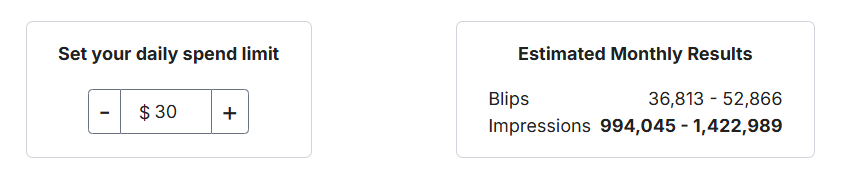
With Blip, you set your own daily budget for Oceanside billboards, and our system automatically keeps your campaign within that limit, so you never overspend. Each “blip” is a short 7.5–10 second ad on rotating digital billboards near Oceanside, New York, and you only pay for the individual blips you receive. Pricing for each blip varies based on when and where you choose to advertise and overall advertiser demand, giving you flexibility whether you want to run during premium rush hours or quieter times in the Oceanside area.
Where can I advertise with Blip near Oceanside, New York?
With 16 digital billboards near Oceanside, primarily in nearby Hempstead about 5.5 miles away, we can help you reach shoppers, commuters, and families moving through this dense Long Island corridor. Our 16 digital billboards serving the Oceanside area are concentrated in nearby Hempstead and surrounding corridors within roughly 10 miles. This coverage allows us to intercept north-south traffic, east-west commuters, and shoppers and students traveling to major local destinations.
What kind of people do Oceanside billboards reach in Oceanside, New York?
The Oceanside area has roughly 32,000 residents and about 11,000–12,000 households, and it is a compact but economically strong community. Median household income in the Oceanside/Hempstead south shore band is typically in the $115,000–$130,000 range, putting the area well above the New York State median. Homeownership in this part of Nassau County often exceeds 70%, and in some Oceanside blocks can approach 80%.
When is the best time to run billboards in Oceanside, New York with Blip?
Traffic near Oceanside follows rhythms that smart advertisers can tap into with Blip’s dayparting and scheduling tools. Morning rush is typically 6:30–9:30 a.m., and evening rush is 4:00–7:30 p.m., with evening peaks often accounting for 35–40% of weekday daily traffic. Friday evenings and Saturdays also see heavy flows toward shopping areas, restaurants, and entertainment spots throughout the Town of Hempstead.
Why are Oceanside billboards a good fit for local businesses?
For advertisers, this means digital billboards near Oceanside are perfect for reaching high-income homeowners, families, and commuters who regularly travel a small set of predictable routes. The area’s family-focused, high-income, culturally diverse, and car-dependent profile makes the billboards especially effective for focused, high-frequency campaigns. These roads can put your message in front of the same viewers dozens of times per month, helping make efficient use of billboard rental near Oceanside.
Do I need a contract to advertise with Blip near Oceanside?
No, Blip has no long-term contracts or minimum commitments. You can start, pause, or stop your campaign at any time.
How fast can I launch a billboard campaign with Blip near Oceanside?
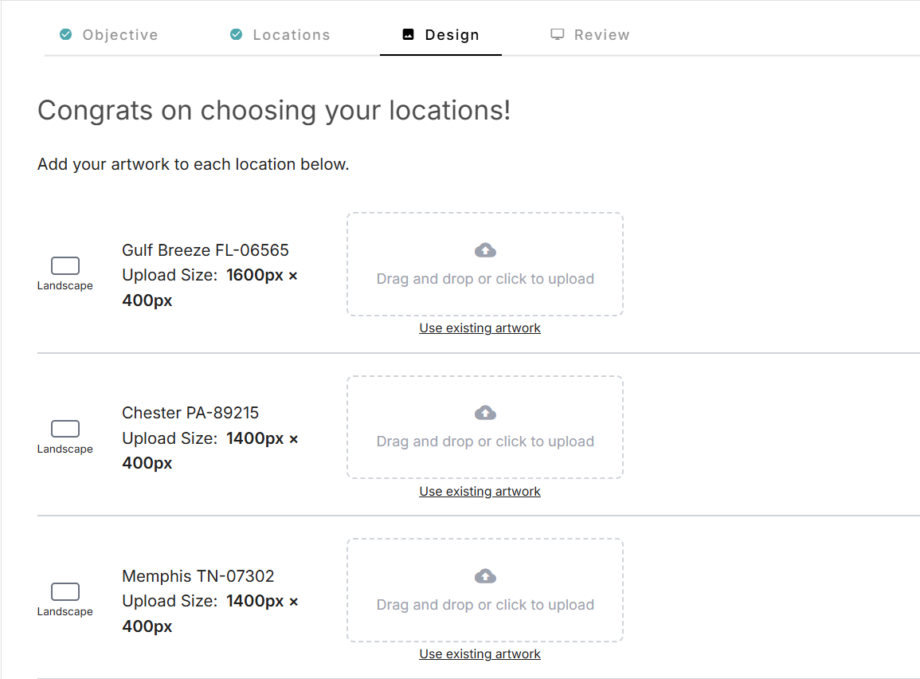
You can have your campaign live in minutes. Create a free account, select your locations, set your budget, upload your design, and start running once approved.
Where can I advertise with Blip near Oceanside?
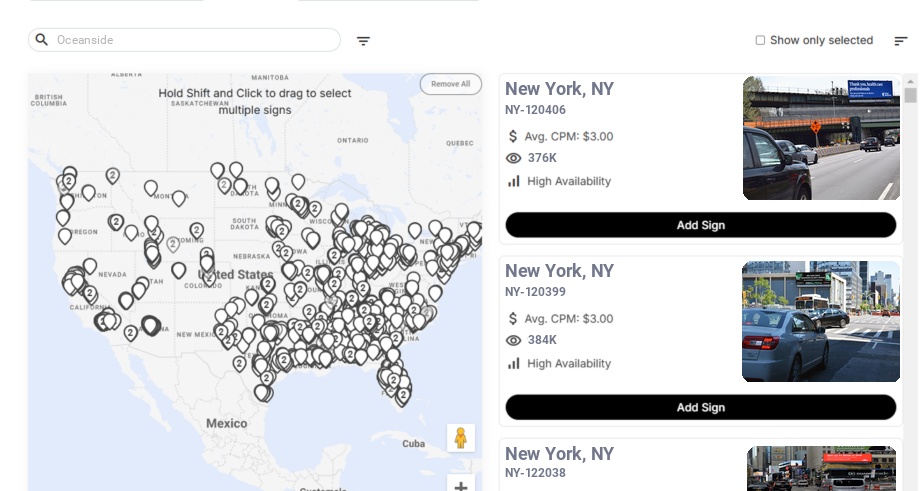
Blip has digital billboards near Oceanside. You can browse available locations on a map, choose the ones that fit your audience, and start advertising right away.
Still have questions? Launch a campaign in minutes — no contracts, no commitments.
Start Your CampaignOceanside Billboard Advertising Guide
Oceanside sits on Nassau County’s busy south shore, wedged between beach-bound traffic and Manhattan commuters—an ideal environment for high-impact digital billboard advertising. With 16 digital billboards near Oceanside, primarily in nearby Hempstead about 5.5 miles away, we can help you reach shoppers, commuters, and families moving through this dense Long Island corridor, all with flexible, data-driven Blip campaigns that make it easy to tap into billboards near Oceanside without long-term contracts.
Understanding the Oceanside Area Market
Oceanside is a compact but economically strong community that punches above its weight for advertisers, making Oceanside billboards particularly attractive for brands looking for a concentrated, high-income audience.
-
Population & households
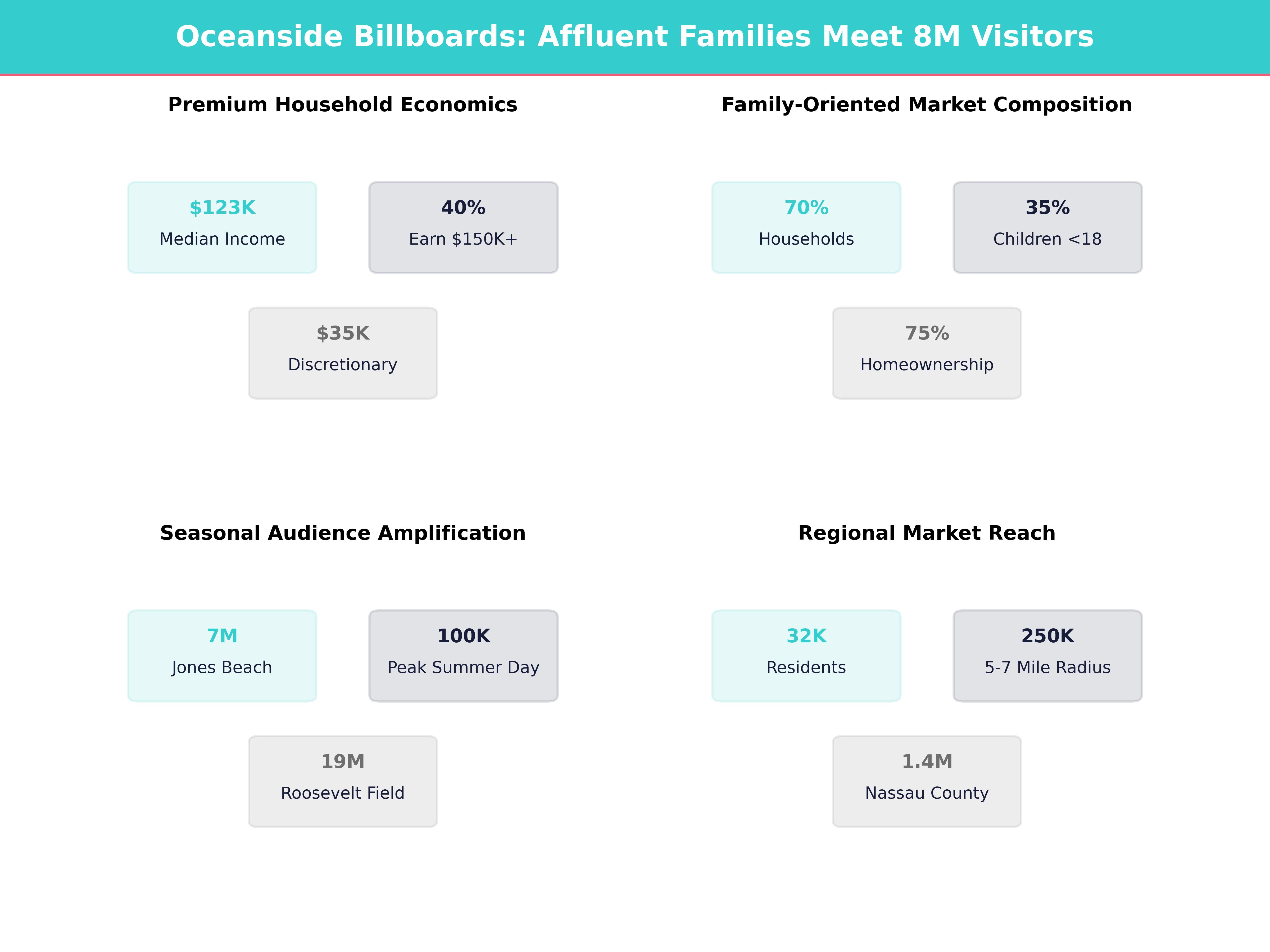
- The Oceanside area has roughly 32,000 residents and about 11,000–12,000 households, according to recent demographic estimates for the hamlet and the Town of Hempstead.
- Nassau County as a whole is home to about 1.4 million people, making it the second-most populous county in New York State and supporting a labor force of roughly 700,000 workers across major sectors such as healthcare, education, retail, and professional services.
- Within a 5–7 mile radius of Oceanside (encompassing Baldwin Rockville Centre Freeport, and central Hempstead), you can tap into a broader trade area of well over 250,000 residents, giving your campaign true regional reach when you invest in billboard advertising near Oceanside.
-
Income & spending power
- Median household income in the Oceanside/Hempstead south shore band is typically in the $115,000–$130,000 range, similar to Nassau County’s countywide median (around $125,000), putting the area well above the New York State median.
- More than 40% of households in much of southwestern Nassau report incomes above $150,000, supporting premium retail, home services, travel, financial, and healthcare spending.
- Owner-occupied homes in Oceanside and adjacent communities commonly have estimated median values in the $600,000–750,000 range, reflecting significant homeowner equity and capacity for larger-ticket home improvement and professional services.
- In affluent Nassau County suburbs, annual consumer spending on categories such as food away from home, personal services, and entertainment often exceeds $35,000 per household, creating strong demand for local restaurants, fitness studios, medical offices, and family attractions that can be effectively promoted with Oceanside billboards.
-
Commuter patterns
- Many Oceanside area residents commute to Manhattan, Brooklyn, and Queens via nearby Long Island Rail Road (LIRR) stations such as Rockville Centre Baldwin Lynbrook, operated by the MTA Long Island Rail Road. Pre‑pandemic weekday ridership on key LIRR branches serving Nassau regularly surpassed 200,000 trips per day, and recent recovery data show steady rebounds in commuter volumes.
- Southern State Parkway, Meadowbrook State Parkway, and Sunrise Highway (NY‑27) carry heavy daily traffic. Typical average annual daily traffic (AADT) levels on these corridors in Nassau County range from about 120,000–180,000 vehicles per day on major parkway segments to 40,000–70,000 vehicles per day on key stretches of Sunrise Highway.
- Local north–south arterials such as Long Beach Road, Grand Avenue, and Peninsula Boulevard serve tens of thousands of daily trips connecting Oceanside, Baldwin, Freeport, Rockville Centre, and Hempstead, ensuring your message is seen multiple times per week by the same high-value audiences.
-
Local anchors & activity centers
- The Oceanside area is part of the densely populated Town of Hempstead, the largest township in the country with nearly 800,000 residents across 22 incorporated villages and numerous hamlets.
- Major retail and employment nodes nearby include Hempstead Village, Rockville Centre Baldwin Freeport, and the Roosevelt Field area in Garden City, where the Roosevelt Field 18–20 million visitors per year.
- Higher-education institutions nearby—Nassau Community College and Hofstra University—enroll a combined 30,000+ students, plus thousands of faculty and staff, generating steady weekday traffic in and around Hempstead.
- Beach destinations such as Long Beach and Jones Beach State Park (promoted by Discover Long Island) draw millions of seasonal visitors through nearby roadways. Jones Beach alone typically welcomes 6–8 million visitors per year, with peak summer weekends seeing 100,000+ visitors per day under favorable weather.
For advertisers, this means digital billboards near Oceanside are perfect for reaching high-income homeowners, families, and commuters who regularly travel a small set of predictable routes—ideal for focused, high-frequency campaigns that can reach the same viewers dozens of times per month and make efficient use of billboard rental near Oceanside.
Where Our Billboards Reach Near Oceanside
Our 16 digital billboards serving the Oceanside area are concentrated in nearby Hempstead and surrounding corridors within roughly 10 miles. This coverage allows us to intercept:
- North–south traffic moving between Oceanside, Baldwin, Rockville Centre, Hempstead, Uniondale, and Freeport—corridors where daily combined traffic volumes can easily top 100,000 vehicle trips across major arteries like Long Beach Road, Grand Avenue, and Peninsula Boulevard.
- East–west commuters along Sunrise Highway and Southern State Parkway connecting Queens, southeastern Nassau, and Suffolk County. These roadways function as the backbone for tens of thousands of daily commutes into job centers in Hempstead, Uniondale (home to major office parks and Nassau Coliseum
- Shoppers and students traveling to downtown Hempstead, Nassau Community College, Hofstra University, and regional retail hubs such as Roosevelt Field, the Green Acres Mall in Valley Stream, and downtown Rockville Centre, where weekend traffic often outpaces weekday volumes by 10–20% during peak shopping seasons.
By placing your messages on boards near Hempstead and along those key corridors, you are effectively surrounding the Oceanside area’s daily journeys—from school drop-offs and grocery trips to beach weekends and Manhattan commutes. With typical digital billboard loop structures, a well-configured campaign can deliver multiple impressions per driver per week along their primary route, turning Oceanside billboards into a consistent presence in local routines.
With Blip’s flexible platform, we can:
- Concentrate your budget on specific boards that best align with your customer draw area—for example, focusing 60–70% of impressions on boards that capture homebound traffic toward Oceanside and neighboring communities.
- Shift delivery as needed—e.g., heavier exposure on boards oriented toward Oceanside-bound traffic during certain times of day, or ramping up impressions by 20–30% on weekends during key retail periods such as back‑to‑school or the December holidays, maximizing the value of your billboard advertising near Oceanside.
Who You’re Talking To in the Oceanside Area
The Oceanside area has a distinctive demographic profile that should shape your creative and scheduling:
-
Family-focused suburb
- A significant share of households are family households with children; in many Oceanside-area census tracts, families comprise 70% or more of all households, and homes with children under 18 commonly represent 30–40% of households.
- The Oceanside School District, Oceanside Union Free School District, serves roughly 6,000–7,000 students, and nearby districts in Hempstead, Baldwin, and Freeport
-
Homeownership
- Homeownership in this part of Nassau County often exceeds 70%, and in some Oceanside blocks can approach 80%, reflecting a stable base of long-term residents.
- These homeowners invest heavily in home improvement, landscaping, HVAC, roofing, and professional services. In affluent Long Island suburbs, average annual spending on home maintenance, repairs, and improvement often surpasses $4,000–5,000 per household, creating strong demand for visible, locally trusted providers.
-
Cultural and religious diversity
- The south shore corridor, stretching from Oceanside through Baldwin and into the greater Hempstead area, includes sizeable Jewish, Italian, Irish, Caribbean, and Latin American communities, with some neighborhoods where foreign-born residents make up 25–35% of the population.
- Religious institutions, including synagogues, churches, and community centers, are significant traffic generators, particularly on weekends and holidays. Large congregations can draw several hundred to over 1,000 attendees to key services, adding predictable surges to local traffic.
-
Age distribution
- You’ll see a mix of young families, middle-aged professionals, and older adults aging in place. In many Oceanside-area neighborhoods, residents under 18 account for 20–25% of the population, while adults aged 45–64 make up another 25–30%, and seniors 65+ represent 15–20%.
- This mix supports everything from childcare and enrichment programs to healthcare, financial planning, and senior services. For example, older residents typically generate higher demand for cardiology, orthopedics, and home care services, while the robust youth population fuels demand for tutoring, sports, music, and arts programs.
Building your campaigns around these realities—family-centric, high-income, culturally diverse, and car-dependent—will make your Oceanside-area billboards far more effective and help you speak directly to the tens of thousands of local residents who see these roads as part of their daily routine.
Key Traffic Patterns and Best Times to Run Your Ads
Traffic near Oceanside follows rhythms that smart advertisers can tap into with Blip’s dayparting and scheduling tools. Regional traffic count data and commuter surveys suggest that in Nassau County suburbs, 60–65% of workers commute by car, and typical one-way commute times often range from 35–50 minutes, which increases exposure opportunities for roadside media and strengthens the case for billboard rental near Oceanside during peak drive times.
Weekday rush hours
- Morning: 6:30–9:30 a.m. as commuters head toward LIRR stations, parkways, and major job centers in Hempstead, Uniondale, Garden City, and New York City. On some parkway segments, peak-hour traffic volumes can reach 7,000–9,000 vehicles per lane per hour.
- Evening: 4:00–7:30 p.m. with homebound traffic converging toward Oceanside, Baldwin, Freeport, and Rockville Centre. Evening peaks often last slightly longer than morning peaks and may account for 35–40% of weekday daily traffic.
-
These windows are ideal for:
- Transit-related ads (parking, rideshare, EV charging).
- Food and coffee offers (“Grab dinner on your way home”) timed to catch the 30–40% of commuters who report stopping for errands or food on their way home at least once a week.
- Service businesses targeting homeowners (reminding them of to‑dos they’ll handle after work).
Midday and school traffic
- Late morning to 3:00 p.m. sees steady local movement: errands, medical appointments, and retail trips. For many suburban corridors, midday represents 25–30% of daily traffic, driven by retirees, shift workers, and parents.
- 2:30–4:00 p.m. spikes with school pickups and after-school activities, especially during the September–June school year. Traffic near major school clusters can increase 10–15% relative to midday baselines in that window.
-
Great for:
- Quick-service restaurants and cafes.
- Tutoring, music schools, sports programs.
- Healthcare and wellness (urgent care, dentists, PT, optometry), since many local practices schedule a significant share of pediatric and family appointments between 3:00–6:00 p.m.
Evenings and weekends
- Friday evenings and Saturdays see heavy flows toward shopping areas, restaurants, and entertainment spots throughout the Town of Hempstead. Retail and dining districts often experience 20–30% higher traffic on Saturdays compared to midweek days.
- Summer weekends bring additional beach-bound travelers passing near Oceanside on their way to Long Beach and Jones Beach. During peak-season weekends, south shore routes feeding these beaches can see traffic volumes surge by 15–25% compared to off-season weekends.
-
Ideal for:
- Restaurants, nightlife, and entertainment.
- Tourism, events, and local attractions promoted by outlets like Discover Long Island.
- Seasonal services (AC tune-ups, landscaping, pool services), which often see inbound call volume spike 20–40% on the first warm or cold weekends of the season.
With Blip, we can allocate your budget to the days and hours that map directly to your target audience, rather than paying for impressions that don’t fit your customer’s daily rhythm. For many advertisers, concentrating 70–80% of impressions into the top 40–50% of the most valuable hours produces better response rates than an always‑on, evenly distributed schedule.
Seasonal Opportunities in the Oceanside Area
Seasonality on Long Island is pronounced, and campaigns near Oceanside should reflect that. Retail and service businesses across Nassau commonly report revenue swings of 20–40% between low and high seasons, so aligning your billboard schedule can have a substantial impact.
Spring (March–May)
- Home projects ramp up; hardware and garden centers see strong traffic as temperatures rise and daylight extends. Home improvement retailers often see spring sales increase 15–25% over winter levels.
- Graduations and communions drive event and catering bookings, with local venues and caterers sometimes securing 50% or more of their annual booking volume between March and June.
-
Strategy:
- Feature home improvement services, lawn care, and contractors.
- Promote event venues, photographers, florists, and caterers.
- Use countdown messaging (“Book before May 15 and save 10%”) to create urgency leading into peak weekends.
Summer (June–August)
- Beach season hits; Discover Long Island reports millions of annual beach visitors across Long Beach, Jones Beach, and other south shore destinations. Visitor volumes mean there can be hundreds of thousands of additional vehicle trips on approach roads over a typical summer month.
- Youth camps, sports leagues, and summer programs peak, with local camps often operating at 80–100% capacity and many families enrolling children in multiple programs.
-
Strategy:
- Target weekends and Friday afternoons for tourism, dining, and entertainment messages, potentially shifting 60–70% of your impressions to these high-leisure windows.
- Emphasize heat-related services (HVAC, pool services, ice cream and beverage brands), which frequently see service calls or sales spike 30–50% during heat waves.
- Use bright, high-contrast creative that stands out under strong sun, recognizing that summer daylight can stretch to more than 15 hours per day.
Fall (September–November)
- Back-to-school and fall sports shift traffic patterns around schools and fields. Retailers nationwide typically see a mid‑single to low‑double digit percent sales lift in August–September associated with back‑to‑school spending, and Long Island is no exception.
- Homeowners tackle pre-winter projects (roofing, insulation, heating). Service providers often aim to complete 60–70% of their annual cold-weather preparation jobs before late November.
-
Strategy:
- Promote education, tutoring, and after-school programs as families lock in routines for the school year.
- Push service and maintenance offers with limited-time autumn promotions.
- Tie messaging into local high school or college sports themes in the area, referencing teams and schedules covered by outlets like Newsday and Oceanside Patch
Winter (December–February)
- Holiday shopping drives visitors to malls and downtowns across the Town of Hempstead. December sales can represent 20–30% of annual revenue for some local retailers.
- Weather-related services (snow removal, heating) become priorities. A single major snow event can generate 2–3x normal weekly call volume for plowing, heating, and emergency repair businesses.
-
Strategy:
- Use urgency-driven retail copy and gift ideas, especially between Thanksgiving and December 24, when many stores experience 50%+ of their holiday traffic.
- Advertise health, insurance, and tax planning in January–February, ahead of typical tax-filing deadlines and open enrollment periods for some plans.
- Consider simple, high-contrast designs to cut through early dusk and winter glare; sunset can occur as early as 4:30 p.m., pushing much of the evening commute into darkness.
Blip’s ability to schedule campaigns by exact dates and times means you can pivot creative quickly—for example, launching a snow-storm special 24–48 hours before a forecasted event or promoting last-minute holiday offers in the final 7–10 days before Christmas.
Crafting Effective Creative for Oceanside-Area Drivers
Given the typical 3–6 seconds of viewing time for drivers near Oceanside, billboard creative has to be both simple and hyper-relevant. Industry research on out-of-home (OOH) advertising indicates that ads with fewer than 7–10 words and high color contrast are significantly more likely to be recalled.
Design principles that work especially well here:
-
Big, bold headlines
- Aim for 7 words or fewer; studies show that concise headlines can improve recall by 20–30% compared to wordier options.
- Speak directly to Oceanside-area life: “South Shore’s Most Trusted Plumber” or “Baldwin & Oceanside Parents Trust Us.”
-
Readable typography
- Use large sans-serif fonts; avoid scripts or thin weights that break up at distance.
- Ensure key text is at least 18–24 inches tall on the physical board, which translates into large point sizes in your digital file and remains legible at highway speeds of 40–55 mph.
-
High contrast colors
- Dark backgrounds with bright lettering (or vice versa) perform best under varied lighting. High-contrast creative can increase legibility distances by 30–60%.
- Test color choices against both bright midday sun and nighttime conditions.
-
One main call to action
- Phone number (ideally with vanity digits) or a short URL. Short domains can increase direct-type website visits by 20% or more versus long, complex URLs.
- QR codes can work at lower speeds (near intersections or surface roads) but should not be your sole CTA. At 40 mph+, many drivers will not have enough time to safely scan, but they can still remember a short web address or phrase.
-
Local cues
- Referencing Oceanside area landmarks, neighborhoods, or commonly used roads helps ads feel relevant: “Just off Sunrise Highway” or “Minutes from Rockville Centre.”
- But avoid implying your physical location is in Oceanside if it’s not—clarity builds trust and reduces confusion, which can otherwise reduce response rates.
Because Blip campaigns can easily rotate multiple designs, we recommend:
- Testing at least 2–3 creative variations simultaneously.
- Comparing performance using secondary metrics like website visits or offer redemptions by time window; even a 10–15% difference in response between creatives is meaningful.
- Iterating every 4–8 weeks based on what resonates, in line with national OOH best practices that recommend refreshing creative at least 6 times per year for ongoing campaigns.
Matching Your Business Type to the Oceanside Area Audience
Different industries should lean into different aspects of the Oceanside area’s behavior and demographics:
Local retail and restaurants
- Focus on boards that intercept traffic heading back toward Oceanside, Baldwin, Rockville Centre, and Freeport in the late afternoon and evening, when many residents are deciding where to eat or shop. Surveys show that 30–40% of consumers make same-day decisions about dining and entertainment.
- Use “tonight” or “this weekend” language and simple offers: “Kids Eat Free Tuesdays” or “Happy Hour 4–7 PM.”
- Tie into local news and event calendars from outlets such as Oceanside Patch Newsday, and the Town of Hempstead events listings to time your promos around parades, concerts, and community fairs that draw thousands of additional visitors and pass by many Oceanside billboards.
Home services & contractors
-
The homeownership and income levels in the Oceanside area make it prime for:
- Roofing, siding, and windows.
- Landscaping and tree services.
- Plumbing, HVAC, electrical, and solar.
- In suburbs like Oceanside, a significant portion of homeowners—often 40–50%—report undertaking at least one major home project each year, making constant visibility important.
-
Run campaigns heavily during:
- Early morning (when homeowners are planning their day).
- Evening rush (when they’re thinking about home projects as they return), capturing the 60–70% of workers commuting by car.
- Emphasize proof points: “Rated #1 in Nassau County,” “Serving the Oceanside area for 25 years,” or “Over 500 local 5‑star reviews,” since trust and reputation are top decision factors in high-ticket home services.
Professional & medical services
- Law firms, accountants, financial advisors, and medical practices can use Oceanside-area boards to create a perception of “everywhere” presence that matches or exceeds larger regional competitors.
-
Target:
- Tax season for accountants—roughly January 15–April 15, when consumer intent and search activity for tax help often more than doubles.
- Fall and early winter for healthcare and open enrollment messaging, when many employers and plans have 4–8 week enrollment windows.
-
Include a very clear next step:
- “Call for Free Consultation”
- “Same-Day Urgent Care – Exit at [Road Name]”
- For medical services near major corridors such as Sunrise Highway or the Meadowbrook Parkway, clear directional cues (“Next Right,” “3 Lights Ahead”) can boost response, especially in an area where daily traffic volumes per segment can exceed 50,000 vehicles.
Education, tutoring & youth programs
-
With a strong family presence, there is demand for:
- Tutoring, test prep, and college counseling.
- Music, arts, and sports academies.
- Day camps and after-school programs.
- Households with school-age children often allocate 10–15% of discretionary spending to education, activities, and enrichment, especially in high-achieving school districts like Oceanside and Rockville Centre.
-
Focus on:
- Afternoon and early evening slots during the school year.
- Morning and midday in summer, when schedules shift and many camps and programs begin earlier in the day.
- Use visuals of kids and teens engaged in specific activities (science, sports, arts) with a short, confident headline, and consider aligning creative with local school calendars and exam windows shared by districts and covered by local outlets like Oceanside Patch
Using Blip’s Flexibility to Target the Oceanside Area
Blip’s platform lets us turn these local insights into actionable strategy:
-
Budget control
- Start with as little as a few dollars per day and scale up as you see results—perfect for small businesses testing OOH for the first time.
- Allocate more budget to specific days (e.g., weekends for restaurants, weekdays for B2B services). For many advertisers, directing 50–60% of spend to their top two days of the week produces outsized returns.
-
Board-level targeting
- Choose particular boards near Hempstead and along key corridors that best align with Oceanside-area traffic flowing to your business—whether you’re closer to Long Beach, Uniondale, or Garden City.
-
Prioritize boards that face:
- Homebound commuters heading toward Oceanside and nearby neighborhoods such as Baldwin, Lynbrook, and Freeport.
- Shoppers moving toward major retail clusters like Roosevelt Field, Freeport’s Nautical Mile
-
Dayparting
-
Run ads only when your audience is most likely to act—for example:
- Breakfast and evening windows for quick-service restaurants.
- Business hours for professional services and medical offices.
- After-school and weekend hours for youth programs and family attractions.
- If you know that 70–80% of your conversions occur during a particular 6–8 hour window each day, Blip can concentrate the majority of your impressions into that window.
-
Run ads only when your audience is most likely to act—for example:
-
Creative rotation and testing
- Upload multiple creatives and automatically rotate them.
- Compare metrics like web traffic patterns or store visits around your scheduled times. Even small differences—for instance, a 10% higher click-through or call volume during certain time blocks—can guide budget shifts.
- Refresh creative seasonally to stay aligned with the highly seasonal Oceanside and south shore economy.
Because campaigns can be modified in real time, you can react quickly to:
- Local news and events covered by Newsday or Oceanside Patch
- Weather changes (heat waves, snowstorms), which can shift demand for HVAC, snow removal, auto repair, and indoor entertainment within 24–72 hours.
- Business milestones (grand openings, anniversaries, new product launches) that you want to spotlight heavily for a defined 1–4 week window.
Measuring and Optimizing Campaign Performance
While digital billboards serve a broad audience, you can still measure and optimize in sophisticated ways. National studies on OOH indicate that more than 40–50% of consumers report searching online for a business after seeing an outdoor ad, and more than 30% report visiting a business in person.
-
Use unique URLs and phone numbers
- Create a short, memorable URL or a campaign-specific landing page. Advertisers often see 10–20% higher attributable traffic when using simple, billboard-only URLs.
- Track call volume through a dedicated number associated with your billboard campaign to quantify lead flow.
-
Tie offers to time windows
- “Show this ad (or mention ‘Oceanside board’) for 10% off.”
- Limit validity by day or time to understand when people respond (e.g., “Valid Monday–Thursday 4–7 PM”). This helps you see whether your peak redemptions align with the rush-hour or weekend slots you’re purchasing.
-
Watch web and foot traffic
- Compare website traffic and in-store visits during periods when your ads are set to show vs. when they’re paused.
- Look for shifts such as a 5–15% increase in sessions from Oceanside-area ZIP codes or a noticeable uptick in walk-in volume reported by staff.
-
Adjust monthly
- Reassess boards, budgets, and creative at least every 30 days, which matches the billing and reporting cycles many businesses already use.
- Reallocate spend toward the time windows and corridors that drive the best results, and gradually increase your total budget if you see strong return on ad spend (ROAS) or cost per lead metrics.
Over time, even simple metrics will reveal which messages resonate most with Oceanside-area residents and which parts of the day and week are your sweet spot—allowing you to refine campaigns until you consistently reach the right people, at the right time, on the right roads.
By combining a strong understanding of the Oceanside area’s demographics, traffic flows, and seasonal rhythms with Blip’s flexible, data-driven platform, we can help you build billboard campaigns that feel local, timely, and effective. Whether you’re a neighborhood storefront looking to own your corner of Nassau County or a regional brand seeking dense suburban reach, the digital billboards near Oceanside give you a powerful way to stay top of mind with the people you most want to reach—across tens of thousands of daily trips up and down Long Island’s busy south shore—and make billboard advertising near Oceanside and billboard rental near Oceanside simple, measurable, and accessible.