Billboards in Bay Shore, NY
No Minimum Spend. No Long-Term Contracts. Just Results.
Trusted by Leading Brands


Billboard advertising
in Bay Shore has never been easier
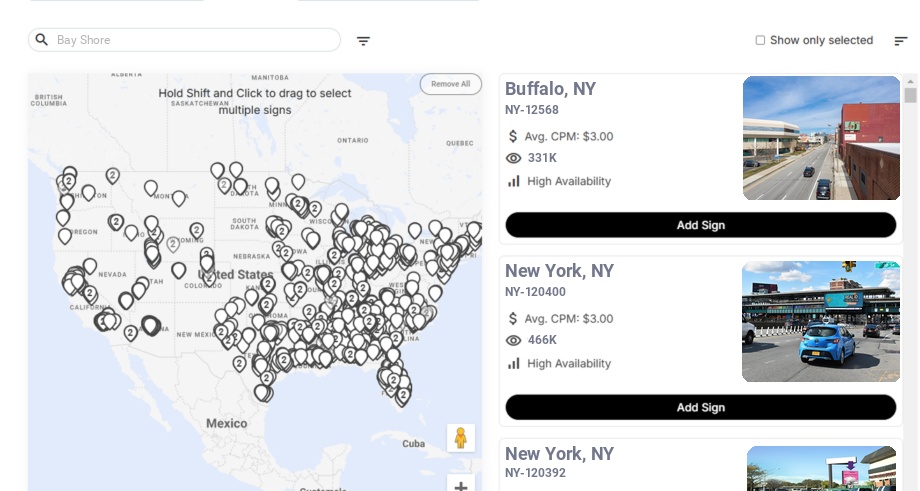



How much is a billboard in Bay Shore?
Why Choose Blip for Billboard Advertising in Bay Shore
Blip lets you launch in Bay Shore fast, perfect for Sunrise Highway commuters and daily car traffic without traditional billboard hassle.
No contracts or minimums in Bay Shore mean you can test ads near the Fire Island ferries and scale only when summer traffic responds.
Use Blip's dayparting to hit Bay Shore's 6-10 a.m. and 3-7 p.m. commuter peaks on the Southern State and Sagtikos corridors.
Blip's real-time analytics help Bay Shore advertisers track what works across Sunrise Highway, Montauk Highway, and downtown routes.
Create and swap Bay Shore creative anytime, with flexible budgets that fit healthcare, retail, and beach-season traffic on the South Shore.
Frequently Asked Questions About Billboard Advertising in Bay Shore
How much does a billboard cost in Bay Shore with Blip?
With Blip, billboard advertising in Bay Shore can fit a wide range of budgets because you only pay when your ad actually appears. Each “blip” is a 7.5-to-10-second display on a rotating digital billboard, with prices starting at just $0.01 per display. Your daily budget is used by Blip’s algorithm to bid for open ad slots, and the cost per blip can vary based on time of day, location, and advertiser demand.
Where can I advertise with Blip in Bay Shore?
Bay Shore’s travel patterns are anchored by a handful of high-volume corridors, including Sunrise Highway, the Southern State Parkway, the Sagtikos connection, Robert Moses Causeway, and Montauk Highway. Sunrise Highway segments in the Bay Shore and Islip area commonly run in the 100,000 to 125,000-plus vehicles per day range. The Robert Moses Causeway is especially useful for summer visitors and Fire Island traffic, while local arterials can be strong for downtown trips and restaurant decisions.
Why is Bay Shore a good billboard market for Blip?
Bay Shore gives us one of Long Island’s most versatile billboard markets because it combines a local population of 30,748 with dense commuter movement, major healthcare employers, and summer tourism. The hamlet sits inside the Town of Islip and Suffolk County, so even a neighborhood-focused campaign can reach a much larger trade area. The market is also highly car-oriented, with roughly 84% of Suffolk workers commuting by car or carpool.
When is the best time to run a Bay Shore billboard campaign with Blip?
Summer deserves special attention in Bay Shore because ferry traffic, beach traffic, and South Shore leisure travel all rise from Memorial Day through Labor Day. We usually like to weight summer campaigns toward Friday afternoons, Saturday mornings, and Sunday late afternoons and evenings. Late August through October is another excellent window because back-to-school and fall routines bring family schedules back into focus.
What kind of audiences can I reach in Bay Shore with Blip?
We can reach weekday commuters moving between Bay Shore, Brentwood, Islip, West Islip, Deer Park, and beyond. Bay Shore is also a strong gateway for Fire Island visitors, with Fire Island Ferries serving 7 communities from Bay Shore. Healthcare workers, patients, caregivers, students, families, and retail shoppers also make up important audience segments in the market.
Do I need a contract to advertise with Blip in Bay Shore?
No, Blip has no long-term contracts or minimum commitments. You can start, pause, or stop your campaign at any time.
How fast can I launch a billboard campaign with Blip in Bay Shore?
You can have your campaign live in minutes. Create a free account, select your locations, set your budget, upload your design, and start running once approved.
Where can I advertise with Blip in Bay Shore?
Blip has digital billboards in Bay Shore. You can browse available locations on a map, choose the ones that fit your audience, and start advertising right away.
Still have questions? Launch a campaign in minutes — no contracts, no commitments.
Start Your CampaignBay Shore Billboard Advertising Guide
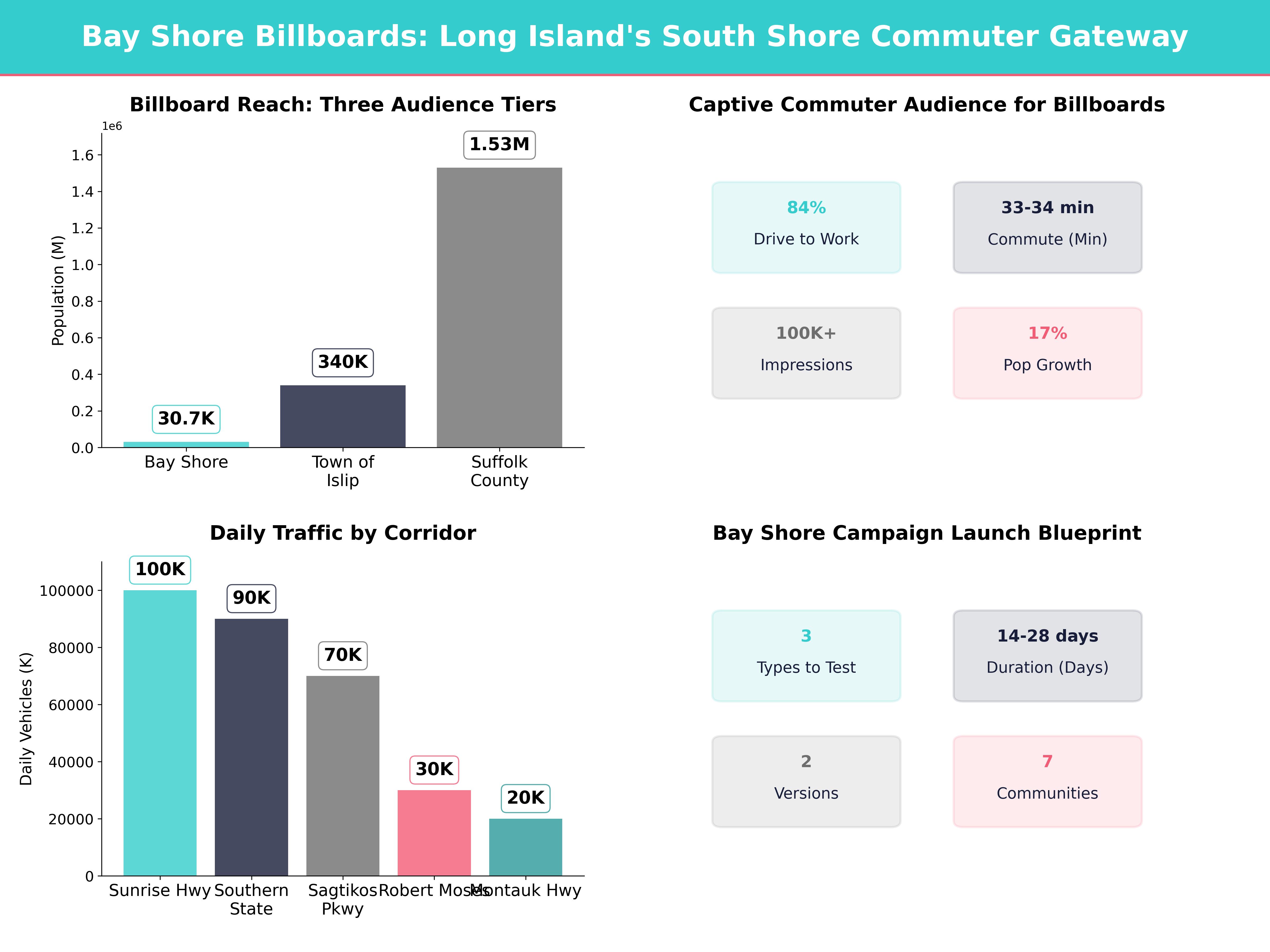
Bay Shore, New York gives us one of Long Island’s most versatile billboard markets because it combines a local population of 30,748 with dense commuter movement, major healthcare employers, and summer tourism. The hamlet sits inside the Town of Islip 339,938 residents in 2020, and inside Suffolk County 1,525,920 residents, so even a neighborhood-focused campaign can reach a much larger trade area. The market is also highly car-oriented, with roughly 84% of Suffolk workers commuting by car or carpool and average travel times running about 33 to 34 minutes in recent ACS estimates. We also benefit from Bay Shore’s role as a gateway to Fire Island Ferries, the South Shore beaches, and regional retail, which keeps audiences flowing well beyond the resident base.
Bay Shore Market Overview
Bay Shore’s population base and growth
We can think of Bay Shore as a local market with regional pull. Bay Shore counted 30,748 residents in 2020, and it grew by about 17% over the previous decade, adding roughly 4,400 residents from the previous census, which is a meaningful gain for a mature Long Island community. That growth matters because it signals household formation, redevelopment momentum, and a larger pool of local consumers seeing the same roads every day.
The trade area around Bay Shore is even more important than the hamlet itself. The surrounding Town of Islip 339,938 residents in 2020, and nearby Brentwood had more than 66,000 residents. When we buy boards around Bay Shore, we are not only speaking to Bay Shore residents. We are also speaking to drivers moving among Bay Shore, Brentwood, West Islip, Islip, Brightwaters, Deer Park, and Central Islip.
What Bay Shore’s economy means for advertisers
Bay Shore works well for billboard advertising because it is not only residential. It is also a healthcare, dining, retail, education, and travel node. Northwell Health South Shore University Hospital 300-bed regional hospital in Bay Shore. Nearby Good Samaritan University Hospital in West Islip adds another major 537-bed healthcare employment center. Those institutions create reliable weekday traffic from staff, patients, vendors, and visiting family members.
Education and shopping add more daily movement. Suffolk County Community College serves more than 20,000 students across 3 campuses, including the Michael J. Grant campus in Brentwood. Tanger Outlets Deer Park adds a destination retail draw with 100-plus stores. Long Island MacArthur Airport 1.2 million passengers in 2023, which gives nearby roads an additional layer of travel demand.
Commuting behavior and why outdoor works here
Bay Shore is a classic market where repeated roadside visibility matters. In Suffolk County, roughly 84% of workers commute by car or carpool, and average commute times are about 33 to 34 minutes. That combination gives us two billboard advantages. First, the audience is concentrated on a manageable set of parkways, highways, and arterials. Second, the same people are exposed to the same messages repeatedly, which is ideal for recall-based categories like healthcare, home services, legal, retail, dining, and local events.
For many advertisers, this is the core Bay Shore opportunity. We are reaching people when they are on the road, close to purchase, and often deciding where to stop next.
Key Traffic Corridors for Bay Shore Billboards
Bay Shore’s travel patterns are anchored by a handful of high-volume corridors. When we understand how each one functions, we can match placements to audience intent instead of buying reach in the abstract.
Sunrise Highway, NY 27
According to New York State Department of Transportation traffic data, major Sunrise Highway segments in the Bay Shore and Islip area commonly run in the 100,000 to 125,000-plus vehicles per day range. This is the South Shore spine. It carries east-west commuters, shoppers, healthcare visitors, and local service traffic through one of Suffolk’s most active suburban belts.
We usually like Sunrise Highway for advertisers that need broad local frequency. Retail, dining, and entertainment advertisers benefit because commuters can act on the message the same day. Healthcare, urgent care, and specialty practices benefit because patients often recognize the facility name and route. Home services, legal services, and insurance benefit because these categories rely heavily on repeated exposure and memory.
Southern State Parkway and the Sagtikos connection
The Southern State Parkway is the west-east commuter artery linking central Suffolk to Nassau County and western job centers. Nearby segments often carry roughly 90,000 to 120,000-plus AADT, while the Sagtikos State Parkway connection commonly runs above 70,000 AADT near major interchanges. That makes this system extremely valuable when we want regional reach instead of only hyperlocal Bay Shore visibility.
We often use this corridor for advertisers that draw from a wider radius. Auto dealers, colleges, and regional healthcare brands do well here because they serve customers from multiple towns. Telecom, banking, and consumer finance campaigns do well because they benefit from high-frequency commuter repetition. Event venues and destination retail do well because these roads move people who are already accustomed to cross-town trips.
Robert Moses Causeway and the Fire Island gateway
The Robert Moses Causeway is lower volume than Sunrise or Southern State, but it carries exceptionally high-intent seasonal traffic. NYSDOT counts around the corridor are often in the 30,000-plus vehicles per day range on key approaches, and demand rises sharply on summer weekends. This route is the gateway to Robert Moses State Park, which offers 5 miles of ocean beachfront, and to the southern end of Fire Island, the barrier island that stretches about 32 miles along the South Shore.
Bay Shore also has a unique advantage here because Fire Island Ferries serves 7 Fire Island communities from Bay Shore, including Ocean Beach, Saltaire, Kismet, Fair Harbor, Dunewood, Atlantique, and Seaview. If we want tourists, renters, second-home visitors, beachgoers, and weekend day-trippers, this is one of the cleanest audience funnels on Long Island.
This corridor is especially strong for: Hospitality, restaurants, bars, and live entertainment because summer visitors are actively making same-day decisions. Beach-related retail, convenience, and pharmacy because travelers often need last-minute items before boarding a ferry or heading south. Healthcare, urgent care, towing, and travel services because needs along this route are immediate and location-sensitive.
Montauk Highway, Main Street, and local arterials
Montauk Highway through Bay Shore generally carries lower totals than the regional expressways, but busy commercial stretches often land in the 20,000 to 30,000 vehicles per day range. That matters because local arterials can outperform larger roads when our goal is action instead of pure reach. Downtown trips, restaurant decisions, retail stops, and medical appointments often happen on these roads.
This is also where the local texture of Bay Shore comes into play. Downtown Bay Shore Bay Shore Brightwaters Chamber of Commerce MTA Long Island Rail Road, and Suffolk County Transit
Audience Segments We Can Reach in Bay Shore
Daily commuters across the South Shore
The first audience is the most obvious and often the most valuable. We can reach weekday commuters moving between Bay Shore, Brentwood, Islip, West Islip, Deer Park, and beyond. With roughly 84% of Suffolk workers commuting by car or carpool, roadside impressions are not incidental here. They are part of the daily routine.
This audience responds well to categories with practical utility. We usually see strong strategic fit for healthcare, home improvement, attorneys, financial services, gyms, telecom, restaurants, and quick-turn retail.
Fire Island visitors and beach traffic
Bay Shore is not just serving year-round residents. It is also one of Long Island’s cleanest tourism gateways, with Fire Island Ferries serving 7 communities from Bay Shore. Discover Long Island, Fire Island Ferries, Robert Moses State Park, and the Fire Island Lighthouse all help create a strong seasonal visitor funnel. The audience expands noticeably from late spring through early fall, especially on Fridays, Saturdays, Sundays, and holiday weekends.
For advertisers, that means we can target: Couples and groups planning leisure spending. Families heading to beaches and ferries. Short-stay visitors who need food, drinks, supplies, parking, and services immediately.
Healthcare workers, patients, and caregivers
Healthcare is one of Bay Shore’s most dependable year-round audiences. South Shore University Hospital Good Samaritan University Hospital strengthens the medical draw just to the west. Healthcare audiences are useful because they move all year, they travel on fixed schedules, and they often need nearby services such as pharmacies, physical therapy, imaging, food, lodging, legal help, and senior care.
This audience also creates valuable daypart opportunities. Morning shift change, late afternoon departure windows, and mid-day appointment periods can each justify different billboard timing.
Students, families, and multicultural households
We can also reach a substantial family audience in and around Bay Shore. The Bay Shore Union Free School District, the Brentwood Union Free School District, and the Central Islip Union Free School District all feed daily parent trips and school-year routines. On the higher education side, Suffolk County Community College serves more than 20,000 students, which adds commuting students, faculty, and staff to the mix.
This part of the market is also culturally important. Bay Shore, Brentwood, and Central Islip include large Latino populations, so Spanish-language or bilingual creative is often worth testing. For many local businesses, the best creative strategy is not “English only” or “Spanish only.” It is two clear message variants tailored to the same offer.
Retail shoppers and regional travelers
Bay Shore advertisers can also pull from broader destination traffic. Tanger Outlets Deer Park attracts shoppers to a 100-plus-store retail center, and Long Island MacArthur Airport 1.2 million annual passenger trips nearby. Those audiences are useful for hotels, restaurants, entertainment, travel parking, and larger retail brands that want to capture movement across central and southern Suffolk.
Seasonal and Timing Opportunities in Bay Shore
Summer in Bay Shore is a major advertising season
If we are advertising in Bay Shore, summer deserves special attention. From Memorial Day through Labor Day, ferry traffic, beach traffic, and South Shore leisure travel all rise. This is the best period for restaurants, bars, marine services, beach retail, sunscreen and pharmacy categories, urgent care, entertainment, and local attractions.
We usually like to weight summer campaigns toward: Friday afternoons, because weekend trips begin early. Saturday mornings, because beach and ferry travel starts early. Sunday late afternoons and evenings, because return traffic is strong.
Back-to-school and fall routines
Late August through October is another excellent window. Bay Shore Schools, Brentwood Schools, Central Islip Schools, and Suffolk County Community College all bring family schedules back into focus. This is a smart time for tutoring, pediatric care, orthodontics, after-school programs, telecom, family dining, and apparel.
Fall also keeps traffic patterns steady without the same summer tourism congestion. That often makes it a very efficient season for campaigns targeting residents rather than visitors.
Holiday retail, winter services, and weather-driven driving
November and December create strong retail timing, especially with Tanger Outlets Deer Park, downtown shopping in Bay Shore Long Island MacArthur Airport
Winter and early spring are also underrated for Bay Shore billboards. Cold weather, rain, and snow keep people in cars, which can increase attention to roadside media. That period often favors tax services, legal services, HVAC, plumbing, roofing, healthcare, gyms, and home improvement campaigns.
Bay Shore Billboard Design Tips
Use cues that feel like Bay Shore, not generic suburbia
Bay Shore is a South Shore market, so our creative should look and sound local. Water, sky, docks, ferries, beach textures, and sunset colors often feel more native here than generic corporate imagery. We do not need to turn every ad into a tourism poster, but a subtle coastal visual language can make the brand feel more relevant.
Place names matter too. “Bay Shore,” “Brightwaters,” “West Islip,” “Brentwood,” “Main Street,” and “Fire Island” are stronger than vague “Long Island” language when we want people to feel the ad is for them.
Match the message to the road
On higher-speed roads like Sunrise Highway and the Southern State, we should keep copy extremely disciplined. If our ad appears for 7.5 to 10 seconds, one offer, one brand cue, and one location cue usually outperform cluttered layouts. A commuter board should tell people exactly what they need to remember.
Examples of locally grounded approaches include: “Now Open in Bay Shore.” “Before the Ferry, Stop Here.” “Appointments Near South Shore.” “Outlet Deals, Exit Ahead.”
Each of those concepts is simple, local, and actionable.
Test bilingual and value-led creative where it fits
Because the Bay Shore trade area includes strong multicultural and multilingual communities, especially in Bay Shore, Brentwood, and Central Islip, we should seriously consider bilingual testing. For some categories, especially grocery, telecom, healthcare, family services, and legal, Spanish-language variants can improve relevance.
Value also matters in this market. Even affluent suburban audiences respond to convenience, speed, trust, and savings. “Same Day,” “Open Late,” “Free Estimate,” “Family Care,” and “Near You” often resonate more than abstract brand slogans.
Regional Strategies Around Bay Shore
Downtown Bay Shore and Brightwaters
Downtown Bay Shore Brightwaters
If our goal is foot traffic, we should favor concise location cues and time-sensitive messaging, especially around weekends and evenings.
North Bay Shore, Brentwood, and Central Islip
North of the village core, the audience becomes more commuter-heavy, more price-sensitive in many categories, and more multicultural. This is where bilingual creative, practical offers, and convenience-led messaging often outperform polished lifestyle branding. Categories like auto repair, telecom, healthcare access, family restaurants, trade schools, legal services, and discount retail can do very well in this zone.
This area also benefits from the larger surrounding population base, including Brentwood’s more than 66,000 residents.
West Islip and the healthcare corridor
To the west, the Bay Shore market blends into West Islip’s medical corridor and residential neighborhoods. This is ideal territory for hospitals, urgent care, imaging, physical therapy, senior living, home health, pharmacies, and related services. It is also a smart zone for family-oriented consumer brands because the surrounding neighborhoods are stable and heavily car-based.
When we advertise here, trust cues matter. Clean design, institutional colors, and simple calls to action often beat flashy creative.
Deer Park, airport access, and regional retail spillover
To the north and northwest, the Bay Shore market connects into Deer Park retail and airport-oriented movement. Tanger Outlets Deer Park, the Sagtikos State Parkway, and Long Island MacArthur Airport
The Fire Island gateway strategy
The southern Bay Shore strategy is different from every other sub-area. When we target the ferry and beach audience, we should treat it as a seasonal funnel rather than a static neighborhood. Summer-heavy flights, weekend weighting, and “today” or “this weekend” language usually make sense. This is where we can be more promotional and more urgent.
Using Blip Tools for Bay Shore Campaigns
Daypart around Bay Shore’s real traffic rhythms
Bay Shore campaigns usually improve when we align budgets with actual movement patterns instead of running evenly all day. For commuter-driven brands, we often start with 6 a.m. to 10 a.m. and 3 p.m. to 7 p.m. dayparts. For restaurants and retail, lunch, afternoon, and early evening may outperform morning traffic. For Fire Island and beach traffic, Friday through Sunday weighting is often the smarter move.
Blip’s flexible scheduling makes this practical. We can stay concentrated around the hours that matter most to Bay Shore behavior.
Use small tests across different Bay Shore zones
Bay Shore is a market where location strategy matters as much as creative. We often learn more by testing 3 different zone types than by overcommitting to one board at the start. A good Bay Shore test mix might include one commuter corridor board, one local Bay Shore board, and one summer or ferry-oriented board.
That approach helps us answer real questions quickly. Are we driving awareness best on Sunrise Highway. Are we getting stronger action from Montauk Highway. Does a tourism-adjacent board outperform on weekends. Blip makes those comparisons much easier than a traditional static buying process.
Refresh creative as the season changes
The Bay Shore message in July should not always be the Bay Shore message in October. Summer leisure creative, back-to-school family creative, and holiday retail creative each speak to different motivations. With Blip, we can rotate artwork, test bilingual variants, and update offers without turning a local campaign into a long production cycle.
We can also use analytics to see where reach and spend are concentrating. That helps us push more budget toward the corridors and times that are actually delivering for our goals.
Getting Started with Billboard Rental in Bay Shore
Start with the business goal, not the map
Before we choose a Bay Shore billboard, we should define the outcome we want. If we want top-of-funnel awareness, we should prioritize high-volume commuter corridors like Sunrise Highway or the Southern State network. If we want store visits, calls, or appointment bookings, we should prioritize boards closer to the point of action, including Montauk Highway, downtown approaches, or medical corridors.
A simple planning framework usually works well. Awareness goals usually point us toward the highest-traffic regional roads. Foot-traffic goals usually point us toward neighborhood or destination-adjacent boards. Seasonal goals usually point us toward ferry routes, beaches, shopping corridors, or holiday retail areas.
Evaluate Bay Shore billboard locations the practical way
When we compare locations, we should ask four questions. Which direction is traffic moving. What audience is most likely on that road. How close is the board to the action we want. What time of day does that audience pass the sign.
In Bay Shore, a board can be valuable for very different reasons. One sign may capture 100,000-plus daily commuter impressions on Sunrise Highway. Another may capture fewer vehicles but higher intent near downtown or the ferry. The best rental is not always the biggest traffic count. It is the board that matches our audience and objective.
Why Blip simplifies the Bay Shore rental process
Traditional billboard buying often means longer commitments, slower revisions, and less control over timing. Blip makes Bay Shore billboard rental more practical for local and regional advertisers because we can choose boards on a map, set our own budgets, launch quickly, and change course when the data tells us to. We do not need to lock ourselves into a large static commitment just to test whether Bay Shore is a fit.
For many advertisers, a smart Bay Shore launch looks like this. We start with a 14-day or 28-day test. We use 2 creative versions, such as one commuter message and one local-action message. We monitor direct results like calls, bookings, redemptions, and branded search lift. We scale the locations and dayparts that prove they can move the audience we care about.
That is the advantage of approaching Bay Shore strategically. The market gives us commuter scale, coastal seasonality, and neighborhood intent in one place. When we combine those local realities with flexible digital execution, Bay Shore becomes a strong and very workable billboard market for brands of almost any size.