Billboards in Lyons, NY
No Minimum Spend. No Long-Term Contracts. Just Results.
Trusted by Leading Brands


Billboard advertising
in Lyons has never been easier
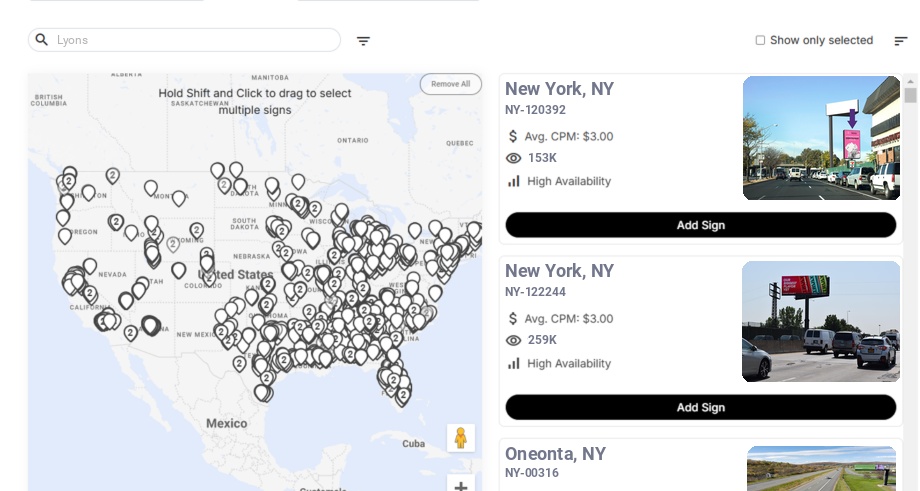



How much is a billboard in Lyons?
Why Choose Blip for Billboard Advertising in Lyons
Blip lets you launch in Lyons fast, with self-serve access for Route 31 and Route 14 traffic — no sales calls needed.
Use flexible budgets in Lyons to reach county-seat drivers and canal-season visitors, then scale up or pause anytime.
Daypart your Lyons ads for commuter peaks and weekend canal traffic, so your message shows when the right people are driving.
No contracts with Blip make Lyons easy to test for apple season, school traffic, or summer canal crowds without long-term risk.
Track Lyons campaign results in real time and shift creative or budget as Route 31, Route 14, and Thruway feeder traffic changes.
Blip's creative tools help you build Lyons ads for canal season, fall harvest, and local services — fast and easy.
Frequently Asked Questions About Billboard Advertising in Lyons
How much does a billboard cost in Lyons, New York with Blip?
With Blip, pricing starts at just $0.01 per display. Each “blip” is a 7.5-to-10-second display on a rotating digital billboard, and costs shift based on time of day, location, and advertiser demand. Your total cost is simply the sum of the individual blips you receive, and there are no minimums or contracts.
Where can I advertise with Blip in Lyons, New York?
Lyons advertising works best on the roads that organize movement through western and central Wayne County, especially New York State Route 31, New York State Route 14, nearby Interstate 90 / the New York State Thruway, and Route 104. Route 31 is Lyons’s signature east-west corridor, while Route 14 provides a north-south spine through the village. Route 104 can extend reach into northern Wayne County households that may not drive through the village every day.
Why is Lyons, New York a good market for Blip billboard ads?
Lyons is small in raw population, but it punches above its size because it is the county seat of Wayne County. That county-seat role brings government traffic, legal-service traffic, school-related trips, healthcare trips, and routine errands into the village on a predictable weekday schedule. Lyons also benefits from seasonal visitor flow across roughly 5 months of canal season.
When is the best time to run billboard ads in Lyons, New York with Blip?
From mid-May into mid-October, the canal season creates one of the clearest ad windows in Lyons. Late summer and fall are another major opportunity, because apple season usually builds from August through October and Wayne County’s agricultural identity becomes very visible during that window. Winter, especially December through March, is also useful for heating, auto repair, healthcare, insurance, legal services, and comfort-food hospitality.
Who sees billboard ads in Lyons, New York?
The first core audience is the everyday driver, including village residents, nearby households, county employees, courthouse visitors, school families, contractors, healthcare users, and local shoppers. Another major audience is the working economy of Wayne County, including agriculture, industrial, and trade workers. A third audience is seasonal leisure traffic, such as weekend travelers, cyclists, boaters, history-minded visitors, and people heading toward the Lake Ontario shore.
Do I need a contract to advertise with Blip in Lyons?
No, Blip has no long-term contracts or minimum commitments. You can start, pause, or stop your campaign at any time.
How fast can I launch a billboard campaign with Blip in Lyons?
You can have your campaign live in minutes. Create a free account, select your locations, set your budget, upload your design, and start running once approved.
Where can I advertise with Blip in Lyons?
Blip has digital billboards in Lyons. You can browse available locations on a map, choose the ones that fit your audience, and start advertising right away.
Still have questions? Launch a campaign in minutes — no contracts, no commitments.
Start Your CampaignLyons Billboard Advertising Guide
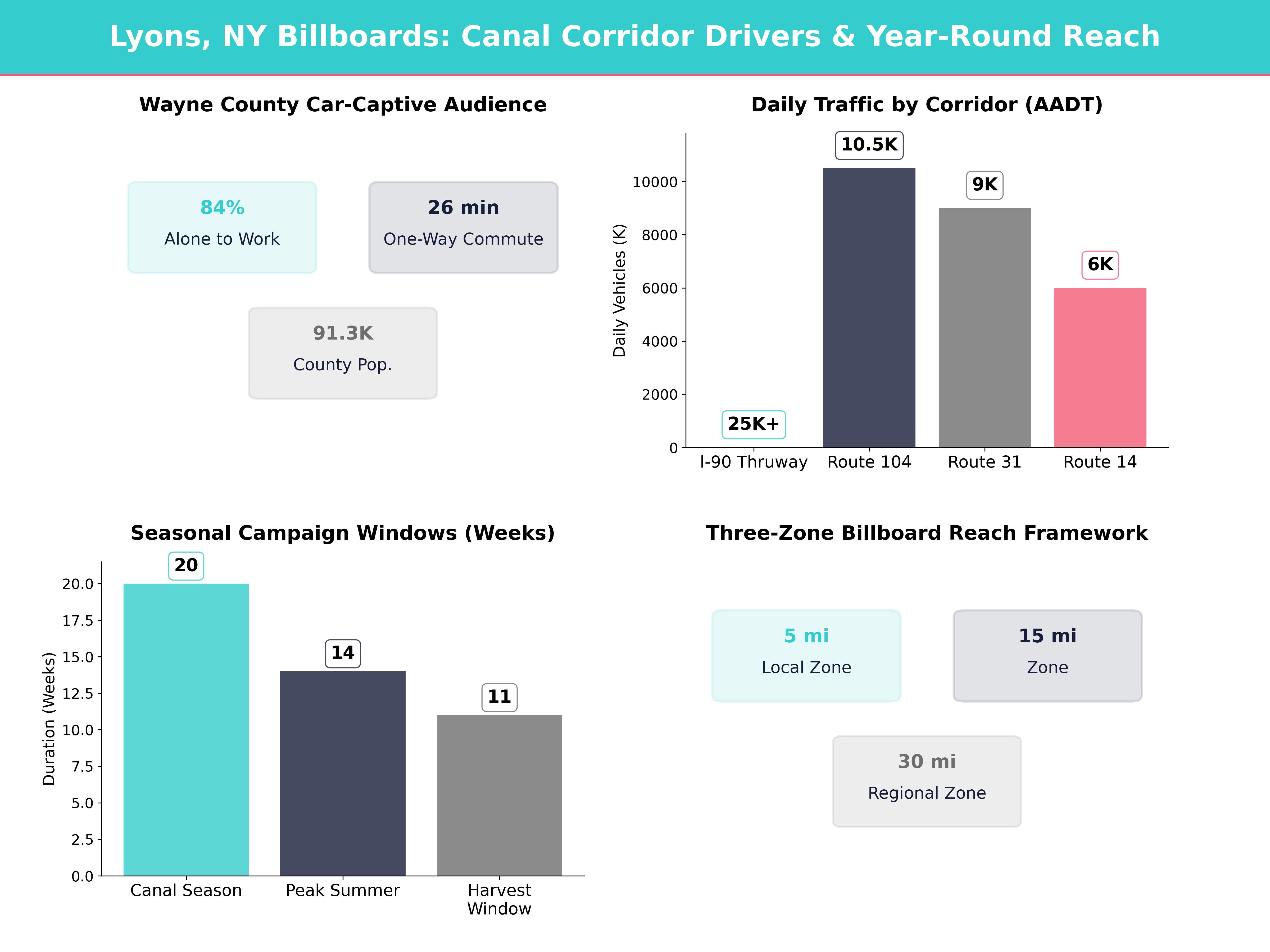
Lyons, New York 5 months of canal season. The Village of Lyons had 3,637 residents in the 2020 count, but the practical ad market is much larger because Lyons serves surrounding communities across Wayne County 524-mile state canal system. Wayne County counted 91,296 residents in 2020, and recent commuting estimates show that about 84% of workers drive alone, while public-transit use is around 0.5%. When we add summer canal travel, fall apple-season movement, and regional trips toward the Thruway and the Finger Lakes, Lyons becomes a market where billboard frequency can work especially hard.
Market Overview for Lyons Billboard Advertising
Lyons is small in raw population, but it punches above its size because it is the county seat of Wayne County
Lyons and Wayne County Demographics
The Village of Lyons had 3,637 residents in 2020, and Wayne County had 91,296 residents. Wayne County’s total population was 93,772 in 2010, so the county changed by about -2.6% over the decade, or roughly 2,500 residents. We do not read that as a reason to ignore the market. In many Upstate New York communities, modest population change still coexists with stable households, long-established routines, and strong repeat exposure on key roads.
Wayne County’s economy is anchored by agriculture, food production, manufacturing, healthcare, logistics, and public services. The Wayne County Industrial Development Agency Wayne County Chamber of Commerce, and Empire State Development all highlight the county’s role in agribusiness and light industry. Lyons also benefits from being positioned between lakeshore recreation to the north and Finger Lakes destinations to the south.
What Car Dependence Means in Lyons
For billboard strategy, the most important local behavior is still driving. Recent commuting estimates for Wayne County indicate that about 84% of workers commute by driving alone, and the average one-way commute is roughly 26 minutes. That matters because a commuter who passes the same sign twice a day, 5 days a week, can generate 10 exposures per week before we even count shopping, school, or weekend trips.
In practical terms, Lyons rewards campaigns that depend on repetition rather than a single high-profile splash. If we want to promote a restaurant, a hardware store, a law office, a healthcare provider, or a seasonal event, we can use billboards to stay in front of drivers over 2 weeks, 4 weeks, or an entire season. In a lower-clutter market like Lyons, that consistency can be more valuable than sheer metro-scale volume.
Key Traffic Corridors for Lyons Billboards
Lyons advertising works best when we think beyond the village line and focus on the roads that actually organize movement through western and central Wayne County. The most important local and regional corridors are New York State Route 31, New York State Route 14, nearby Interstate 90 / the New York State Thruway, and northern Wayne County’s Route 104. New York State Department of Transportation traffic data show that these roads carry the mix of everyday local traffic and regional through-travel that makes billboard placement useful.
Route 31 Through Lyons
Route 31 is Lyons’s signature east-west corridor. It ties Lyons to nearby communities in Wayne County and funnels a steady blend of local residents, service providers, and regional travelers through the village. Depending on the count station and segment, busy Route 31 stretches in western Wayne County commonly fall in roughly the 8,000 to 10,000 AADT range, which is meaningful volume for a rural county-seat market.
This corridor is especially effective for advertisers that need repetition and broad household reach.
- Restaurants, convenience stores, pharmacies, and local retailers benefit because Route 31 captures routine errand traffic and weekday pass-through trips.
- Healthcare, legal, tax, insurance, and home-service brands benefit because drivers on Route 31 are often making intentional trips into Lyons or between neighboring communities.
- Event promoters and nonprofits benefit because Route 31 can keep a simple date-and-location message in front of the same residents multiple times each week.
Route 14 North-South Through Lyons
Route 14 provides Lyons with a north-south spine and helps connect the village to lakeshore destinations in northern Wayne County and to the Finger Lakes side of the region to the south. In and around village-adjacent segments, Route 14 counts are often in the neighborhood of 5,000 to 7,000 AADT, which is lower than metro freeway traffic but still very useful when we want tightly targeted local reach.
This corridor tends to work well for category-specific advertisers.
- Auto dealers, repair shops, agricultural suppliers, and hardware stores can use Route 14 to speak to practical, trip-based buyers.
- Medical practices, urgent care, and hospital systems, including Rochester Regional Health and Newark-Wayne Community Hospital, can use north-south messaging to catch healthcare trips.
- Tourism and hospitality advertisers can use seasonal creative on Route 14 to pull drivers toward canal, lakeshore, and Finger Lakes destinations.
Nearby Thruway Access via I-90
Lyons is not directly on I-90, but nearby access to the New York State Thruway Authority network matters for regional strategy. Travelers using Thruway exits near Geneva Seneca County, especially Exit 42 and Exit 41, help feed regional travel patterns that can be captured on connecting routes. Mainline Thruway segments in this part of the state commonly carry well above 25,000 AADT, and many rural stretches are substantially higher than the local road network.
That makes Thruway-adjacent or Thruway-feeder billboards a smart fit for larger trade-area campaigns.
- Casinos, hotels, wineries, colleges, and regional attractions can use these placements to intercept travelers before they choose a final destination.
- Healthcare systems and colleges can use feeder routes to reach people heading toward Ontario County, Geneva Hobart and William Smith Colleges, and Finger Lakes Community College.
- Higher-consideration purchases, such as furniture, vehicles, and financial services, often perform better on regional corridors where people are already thinking beyond the next stop.
Route 104 and the Northern Wayne County Pull
If we are advertising to the broader Wayne County market, Route 104 deserves attention even though it sits north of Lyons. It is one of the county’s main east-west routes for commuters, shoppers, and recreational travelers headed toward the Lake Ontario shoreline. Depending on the segment, busy Route 104 stretches in Wayne County often run around 8,000 to 13,000 AADT.
For Lyons-area advertisers, Route 104 can extend reach into households that may not drive through the village every day but still spend money across the county.
- Home improvement, retail, and healthcare brands can use Route 104 to add countywide frequency.
- Marinas, restaurants, campgrounds, and summer attractions can use northern placements during the warm season.
- Employers recruiting across Wayne County can use Route 104 and Lyons-area boards together to build both breadth and repetition.
Audience Segments We Can Reach in Lyons
Lyons works best when we think in audience layers rather than in village limits alone. Our goal is to match the corridor to the trip purpose, because people moving through Lyons are not all doing the same thing.
Lyons Commuters and County-Seat Visitors
The first core audience is the everyday driver. This includes village residents, nearby households, county employees, courthouse visitors, school families, contractors, healthcare users, and local shoppers. Because Wayne County commuting is heavily car-based, billboard campaigns can efficiently reach the same people on repeated weekly patterns.
This audience is ideal for advertisers that need regular reminders rather than long explanations. Banks, dentists, restaurants, repair services, pharmacies, and election campaigns all fit that model. When we use a clear message and a familiar route, Lyons can deliver dozens of monthly exposures to the same household.
Agricultural, Industrial, and Trade Audiences in Lyons
The second major audience is the working economy of Wayne County. New York Apple Association recognizes Wayne County as New York’s leading apple-producing county, and Cornell Cooperative Extension of Wayne County supports a broad local agriculture network. That gives Lyons-area billboard campaigns a very real B2B and blue-collar dimension.
For advertisers in this segment, timing matters as much as placement. Orchard, packing, trucking, equipment, fuel, insurance, recruiting, and ag-finance messages are especially relevant from August through October, when harvest activity intensifies for roughly 10 to 12 weeks. Spring field preparation and early summer operations also create windows for seed, equipment, and service providers.
Canal, Lakeshore, and Weekend Leisure Visitors
The third audience is seasonal leisure traffic. Lyons sits on the Erie Canal, which is part of the New York State Canal Corporation 524 miles of navigable waterways. The associated Canalway Trail network extends about 360 miles, and the canal’s original 1825 opening reached its 200th anniversary in 2025. Those numbers matter because they remind us that Lyons is part of a heritage corridor with built-in destination value.
This audience grows during the navigation season, which typically runs for about 5 months, from mid-May into mid-October. Weekend travelers, cyclists, boaters, history-minded visitors, and people heading north toward the Lake Ontario shore are all reachable with simple, directional messaging. Restaurants, antique shops, lodging, festivals, museums, and local attractions can all benefit from this traffic pattern.
Families, Students, and Community Event Audiences
The fourth audience is family and community life. Lyons Central School District creates regular school-year traffic from roughly September through June, or about 10 months, and countywide events like the Wayne County Fair Hobart and William Smith Colleges, Finger Lakes Community College, and healthcare trips to Newark-Wayne Community Hospital.
For this audience, billboards are especially useful for promoting practical decisions. We can advertise sports registration, school fundraisers, urgent care, pediatric dentistry, back-to-school retail, and seasonal entertainment with messages that are short, local, and date-driven.
Seasonal and Timing Opportunities for Lyons Campaigns
Lyons is not a market where we should advertise the same way every month. The best results usually come when we align campaigns with travel seasons, weather, school routines, and event calendars.
Summer and Canal Season in Lyons
From mid-May into mid-October, the canal season creates one of the clearest ad windows in Lyons. That is roughly a 5-month tourism and recreation stretch, and the most visible summer demand usually lands between Memorial Day and Labor Day, which is about 14 weeks. During that period, we can emphasize food, lodging, antiques, festivals, ice cream, farm markets, waterfront activities, and weekend events.
For summer campaigns, weekend weighting often makes sense. Friday afternoons, Saturdays, and Sundays can be particularly valuable when people are making leisure plans instead of commuting on autopilot. If we have a time-sensitive offer, we should rotate in date-based creative and keep the call to action immediate.
Harvest Season and Fair Timing Around Lyons
Late summer and fall are another major opportunity. Apple season usually builds from August through October, and Wayne County’s agricultural identity becomes highly visible during that window. If we are advertising farm markets, cider, fall festivals, equipment dealers, heating services, hunting-related retail, or local restaurants, this is one of the best periods of the year.
The Wayne County Fair
Winter, Tax Season, and Everyday-Service Timing in Lyons
Winter in Upstate New York changes how people drive. Snow and reduced daylight can slow traffic and increase dwell time at intersections and village approaches, which can help simple billboard messages stand out. December through March is especially useful for heating, auto repair, healthcare, insurance, legal services, and comfort-food hospitality.
Lyons also benefits from county-seat traffic in the first part of the year. January through April is a strong window for tax preparation, attorneys, financial services, and public-service messaging. Because many local trips are essential rather than discretionary, billboard visibility stays relevant even when leisure traffic softens.
Billboard Design Tips for the Lyons Market
Designing for Lyons is not the same as designing for Manhattan, Buffalo, or even downtown Rochester. We want creative that fits rural driving patterns, local culture, and the practical decision-making that dominates this market.
Use Visual Cues That Feel Like Lyons
The strongest Lyons creative usually looks and sounds local. Erie Canal blues, harvest greens, apple reds, and peppermint-inspired red-and-white accents can feel more authentic here than generic corporate stock imagery. Lyons is known for its peppermint heritage, so brands that can borrow that local memory tastefully may feel more rooted and more memorable.
We should also consider imagery that reflects how people actually experience the area. Canal bridges, orchards, farm stands, small-town storefronts, and family recreation all fit the visual language of Lyons better than anonymous skyline photos. When a billboard feels like it belongs on Route 31 or Route 14, people process it faster.
Write for Rural Speed and Repeat Exposure
Because local roads here often involve steady through-driving rather than stop-and-go urban congestion, we should keep text lean. In most cases, 6 to 8 words for the main headline is a safer target than trying to explain everything at once. A strong Lyons billboard often includes just 1 offer, 1 brand cue, and 1 action, such as a short URL or simple direction.
We also prefer directional and time-based language in this market. Phrases like “Next Right on 31,” “5 Minutes from Downtown Lyons,” or “Open Daily This Fall” work better than abstract slogans. If we use a phone number, we should be realistic about readability and avoid making drivers process a full 10-digit string unless the number is extremely memorable.
Match the Message to the Local Trip Purpose
Trip intent matters in Lyons. If we are near village-center traffic, we should use convenience, trust, and immediacy. If we are on a regional feeder route, we can push destination appeal, entertainment, or a larger purchase.
That means our creative should change by corridor. A healthcare ad on a commuter route might feature same-day appointments, while a restaurant ad on a weekend leisure route might feature canal dining or seasonal specials. A farm-market board in September should not look like a tax-service board in February, even if both are targeting the same county.
Regional Strategies Around Lyons
The smartest Lyons campaigns usually divide the market into distinct zones. We recommend thinking in 3 practical trade areas: a 5-mile local zone, a 15-mile county-service zone, and a 30-mile regional pull zone.
The Lyons Core and Immediate 5-Mile Zone
The local zone is where we chase frequency. This is the right strategy for restaurants, salons, dentists, insurance agents, attorneys, pharmacies, churches, local government notices, and community events. In this radius, repetition is more important than novelty because people are making routine decisions close to home.
If our business depends on foot traffic or quick-turn local calls, this is where we should start. County-seat visibility is especially valuable for services that benefit from weekday daytime exposure.
West Toward Newark Palmyra
The westbound strategy is about broadening household reach. Western Wayne County feeds into larger shopping and work patterns that connect to the City of Rochester side of the region. Advertisers selling healthcare, home services, furniture, financial services, and recruitment can do well by pairing Lyons boards with west-corridor boards.
This is also where we can increase scale without abandoning local relevance. If our ideal customer lives outside Lyons but still travels through Wayne County regularly, westbound placements help us stay in the consideration set.
South Toward Geneva, Seneca County, and Thruway Feeders
The southern strategy works well for higher-value destinations and regional decision-making. Routes connecting Lyons to Geneva Ontario County, Seneca County, and del Lago Resort & Casino
If we want to reach people before they commit to a destination, southern feeder routes are especially useful. They give us room to promote attractions, events, and premium services to travelers who are already in motion.
North Toward Route 104 and Lake Ontario Recreation
The northern strategy is the most seasonal. It is ideal for marinas, restaurants, campgrounds, rentals, summer retail, and anything tied to lakeshore recreation. During warmer months, northbound and southbound traveler intent changes quickly, so we should adjust creative by season and by weekend demand.
For Lyons businesses, this zone is a smart expansion play. We can use it to remind northern Wayne County residents that our store, office, or attraction is worth the drive back toward Lyons.
Blip Tools and Capabilities for Lyons Campaigns
Blip’s tools are useful in Lyons because this is a market where timing, geography, and message fit often matter more than brute-force spending. We can use the platform’s map-based planning to compare village-area inventory with broader county and feeder-route options, then shape the campaign around how people actually move.
Dayparting and Budget Pacing in Lyons
In Lyons, dayparting can make a real difference. Weekday commuter-focused campaigns often perform best in the 6 a.m. to 9 a.m. window and again from 3 p.m. to 6 p.m. Weekend leisure campaigns usually deserve stronger daytime weighting, especially from late morning into early evening.
We can also pace budgets by season. A canal restaurant might lean into summer weekends, while a heating contractor might intensify spending during winter cold snaps. A farm-market brand might run light awareness in July and then scale up hard from August into October.
Creative Testing and Real-Time Optimization for Lyons
Lyons is a strong market for message testing because the audience segments are distinct. We can run one creative version for county-seat commuters, another for canal visitors, and a third for fall agricultural traffic. If one version clearly produces better engagement, we can shift budget quickly instead of waiting on a long traditional contract cycle.
Blip also makes it easier to localize artwork without building every design from scratch. In a place like Lyons, that matters because a “canal season” creative, a “back-to-school” creative, and an “apple harvest” creative may all be relevant within the same 12-month period.
Getting Started With Billboard Rental in Lyons
Renting a billboard in Lyons starts with being honest about our true market. If our goal is local foot traffic, we should focus first on village-centered routes and the immediate 5-mile area. If our goal is countywide awareness, we should look at a 15-mile service radius. If we want regional pull from Thruway travelers, lakeshore visitors, or Finger Lakes traffic, we should think in a 30-mile strategy.
How to Evaluate Lyons Billboard Locations
We should judge each billboard by a few practical questions.
- Does the board sit on a route people use repeatedly, or only occasionally?
- Is the message aligned with the trip purpose on that road?
- Is the board close enough to our location, exit, or turn to influence action?
- Does traffic move fast enough to require extra-simple creative, or slow enough to support a little more detail?
- Is the audience mostly local, mostly regional, or strongly seasonal?
In Lyons, a great local board is often the one that drivers see over and over, not the one attached to the biggest road on the map.
How Blip Simplifies Lyons Billboard Rental
Compared with traditional billboard buying, Blip lets us enter a market like Lyons with much less friction. We can choose boards on a map, launch a test campaign, watch performance, and adjust without waiting through a long sales cycle. That flexibility is especially helpful in a market where seasonal timing matters and where a 2- to 4-week test can tell us a lot.
A good first move is usually to launch a small, focused campaign tied to a clear objective. We can promote one service line, one event, one seasonal offer, or one location. After that, we can compare local-route performance against broader regional placements and scale only where the market is responding. In a place like Lyons, that disciplined approach often beats a one-size-fits-all billboard buy.