Billboards in Rochester, NY
No Minimum Spend. No Long-Term Contracts. Just Results.
Trusted by Leading Brands


Billboard advertising
in Rochester has never been easier



How much is a billboard in Rochester?
Why Choose Blip for Billboard Advertising in Rochester
Blip lets you launch Rochester billboards yourself in minutes, perfect for I-490 and I-390 commuters without buying a long media plan.
Set flexible budgets in Rochester and pay only for the blips you run, so you can test peak rush hour on NY-590 or stretch spend on quieter hours.
No contracts means Rochester brands can pivot fast for Lilac Festival, Jazz Fest, or fall move-in traffic near UR and RIT.
Blip's real-time analytics show what's working in Rochester, so you can adjust creative and timing as commuter flow shifts across the city.
Use Blip creative tools to build bold Rochester ads with QR codes for campus crowds, downtown nightlife, and East Avenue event traffic.
Frequently Asked Questions About Billboard Advertising in Rochester
How much does a billboard cost in Rochester, New York with Blip?
With Blip, you control exactly what you spend on Rochester billboards by setting a daily budget that can be changed anytime. Your message appears in short, 7.5 to 10-second blips on digital billboards in Rochester, New York, and you only pay for the blips you receive. Costs vary based on when and where your ads run and on advertiser demand, so you can choose peak times or stretch your budget with more economical hours.
Where can I advertise with Blip in Rochester, New York?
For broad reach in Rochester, the page recommends prioritizing a mix of I-490, I-390, and at least one east-side or west-side arterial. I-490 is the east-west spine through the city, I-390 connects Greece, the airport, and Henrietta, and I-590/NY-590 and NY-104 capture east-side commuters and higher-income households. City arterials like East Avenue, Lake Avenue, West Main, and Monroe Avenue also handle heavy daily volumes and significant pedestrian and bike activity.
When is the best time to run Blip billboards in Rochester, New York?
Rochester’s four seasons are pronounced, so weather and daylight changes significantly affect how, when, and why people are on the road. The page says winter works well for auto service, healthcare, grocery, and home services, while spring is a great window for event promotion and outdoor categories. Summer is best for tourism, restaurants, and entertainment, and fall is ideal for apartment leasing, recruiting, and student-focused campaigns.
Who do Rochester, New York billboards with Blip reach best?
Rochester gives advertisers a rare mix of dense urban neighborhoods, high-income suburbs, a large student population, and heavy commuter traffic concentrated on a few key corridors. The page recommends thinking in terms of three overlapping audiences: city residents, commuters from higher-income suburbs, and the student and young professional population clustered around campuses and downtown. Around 77-80% of workers in the Rochester metro commute by car, truck, or van, creating robust daily roadside audiences.
How should I target billboards in Rochester, New York for different neighborhoods?
Because there is such a difference in income, lifestyle, and trip purpose between the city and its suburbs, many of the best campaigns intentionally split strategy. City-focused boards are recommended for downtown workers, residents, RTS bus riders, and neighborhood shopping corridors, while suburban-focused routes should reach Henrietta, Greece, Webster, Irondequoit, Pittsford, Penfield, and Fairport. The page says city inventory can drive frequency and community presence, while suburban inventory can reach higher-spend households and commuters.
Do I need a contract to advertise with Blip in Rochester?
No, Blip has no long-term contracts or minimum commitments. You can start, pause, or stop your campaign at any time.
How fast can I launch a billboard campaign with Blip in Rochester?
You can have your campaign live in minutes. Create a free account, select your locations, set your budget, upload your design, and start running once approved.
Where can I advertise with Blip in Rochester?
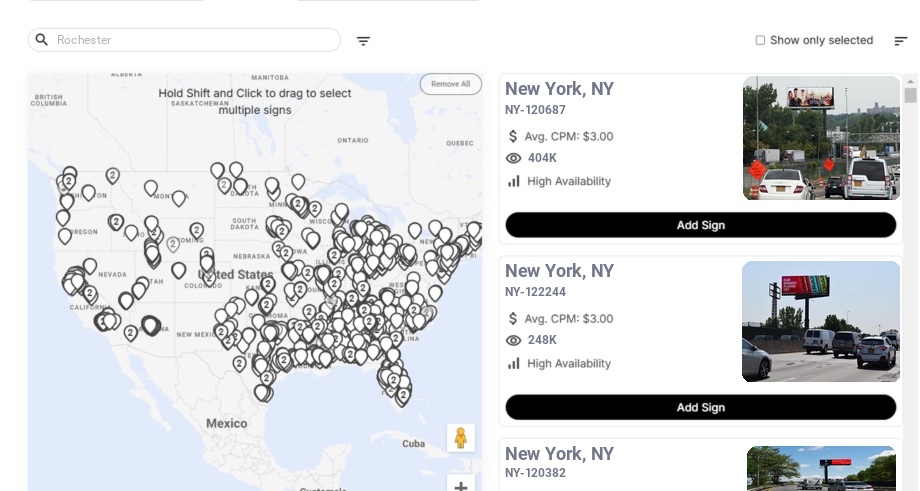
Blip has digital billboards in Rochester. You can browse available locations on a map, choose the ones that fit your audience, and start advertising right away.
Still have questions? Launch a campaign in minutes — no contracts, no commitments.
Start Your CampaignRochester Billboard Advertising Guide
Rochester, New York gives advertisers a rare mix of dense urban neighborhoods, high‑income suburbs, a large student population, and heavy commuter traffic concentrated on a few key corridors. When we plan a digital billboard campaign here, success comes from aligning creative, timing, and locations with how people actually move through the Flower City and its suburbs all year long. For many brands, that means using Rochester billboards as the backbone of a broader local media strategy and then fine‑tuning placements by corridor and season.
Rochester at a Glance: Market Snapshot
Rochester’s scale and structure make it ideal for precise, budget‑controlled digital billboard campaigns and test‑and‑learn Rochester billboard advertising.
-
Population density and reach
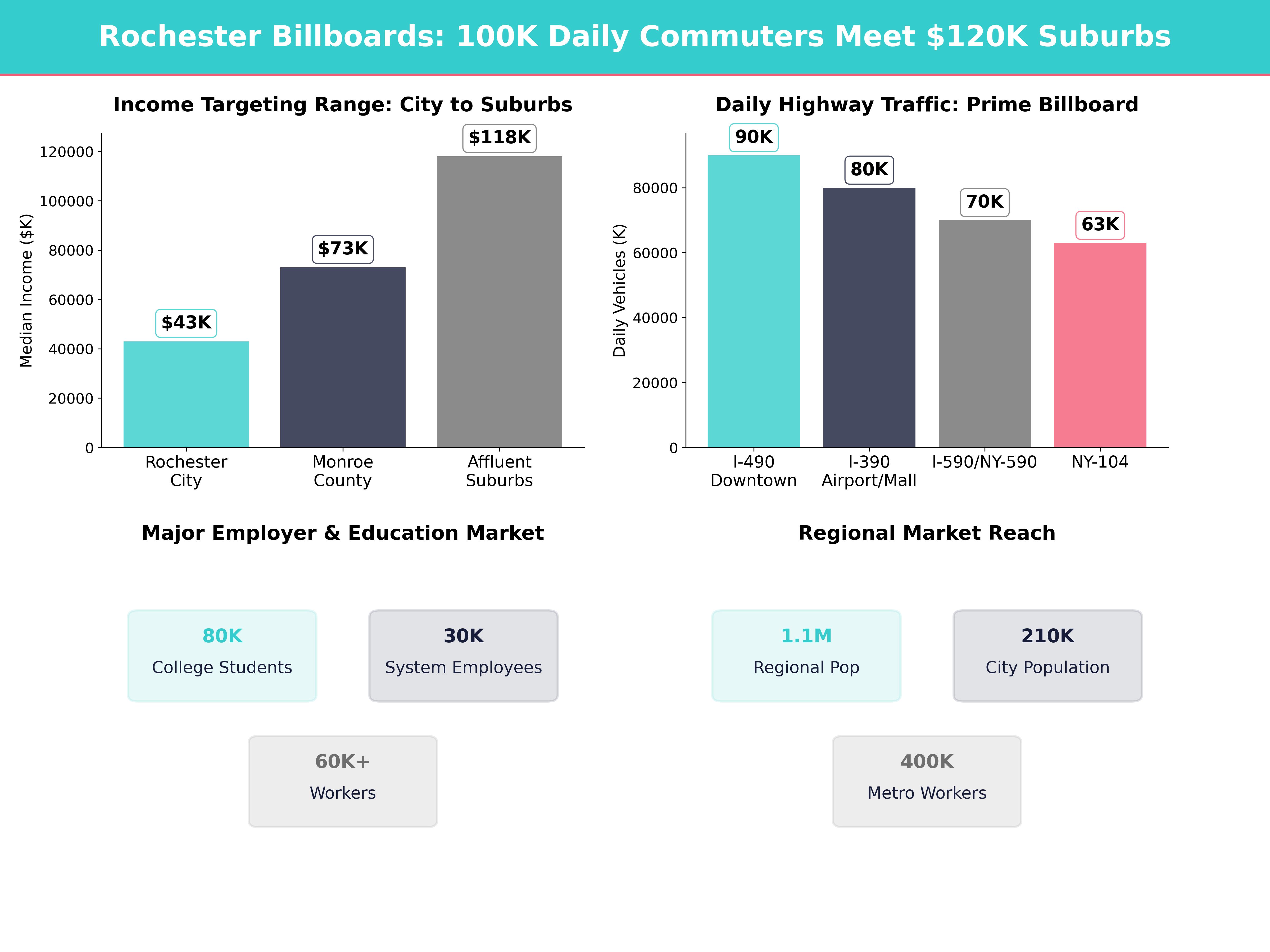
- City of Rochester population: about 210,000 residents, with roughly 86,000–90,000 households, according to estimates used by the City of Rochester
- Greater Rochester region (9‑county area) totals roughly 1.1 million people, as highlighted by Visit Rochester
- Population density in the city is over 5,700 people per square mile, which means even a small number of well‑placed faces can generate strong repeat impressions. Core neighborhoods like the 19th Ward, Beechwood, and Marketview Heights frequently exceed 7,000–8,000 residents per square mile.
- Around 77–80% of workers in the Rochester metro commute to work by car, truck, or van, while about 7–8% use public transit and 10–12% walk or bike, creating robust daily roadside audiences for both drivers and pedestrians around high‑visibility boards.
-
Economic profile
- The Rochester metro’s gross regional product is around $55–60 billion annually, supported by health care, education, advanced manufacturing, optics/photonics, and food & beverage processing. The City of Rochester’s economic development office
- The Greater Rochester Enterprise notes that more than 19,000 people work in optics, imaging, and photonics and roughly 60,000+ in health care and social assistance across the region.
-
Median household income:
- City of Rochester: roughly $40,000–$45,000.
- Monroe County overall: roughly $70,000–$75,000, reflecting stronger suburban buying power.
- In several east‑side suburbs (Pittsford, Mendon, Perinton), median household incomes frequently top $110,000–125,000, while some inner‑city tracts fall below $30,000, illustrating the importance of differentiated messaging on city vs. suburban boards.
- About 30–35% of Rochester city households are families with children under 18, while in some suburbs (e.g., Henrietta, Penfield, Webster) family households exceed 60%, impacting which family‑oriented or education‑focused campaigns perform best in which corridors.
-
Student and young professional base
- The region hosts more than 80,000 college students, according to Visit Rochester University of Rochester, Rochester Institute of Technology, Monroe Community College, St. John Fisher University, and others.
- The University of Rochester 12,000 students and employs more than 30,000 people system‑wide, while RIT 19,000 students and around 4,000 faculty and staff, creating dense, repeatable traffic near campus approaches.
-
This creates strong demand for:
- Apartment communities
- Food & beverage
- Entertainment and nightlife
- Entry‑level recruiting and internships
- Tech, gaming, and consumer electronics
When we build a campaign, it’s often useful to think in terms of three overlapping audiences: city residents, commuters from higher‑income suburbs, and the student/young professional population clustered around campuses and downtown. Matching each of these with the right billboards in Rochester keeps budget focused on the corridors that matter most.
Key Traffic Corridors and Placement Strategy
Rochester’s traffic patterns are highly corridor‑driven. The New York State Department of Transportation Region 4 (NYSDOT Region 4) and the Genesee Transportation Council show that a relatively small set of highways handles a large share of vehicle miles traveled. Across Monroe County, average daily traffic on major expressways frequently tops 50,000–100,000 vehicles per day (AADT), while key surface arterials carry 20,000–35,000 vehicles daily.
Focus on these for broad reach when planning Rochester billboard advertising:
-
I‑490 (East–West spine through the city)
- Connects Gates/Chili on the west to Penfield/Fairport on the east.
- Daily traffic volumes often exceed 80,000–100,000 vehicles on the busiest segments near downtown and the Inner Loop, according to NYSDOT traffic count data for Monroe County.
- With typical peak‑period speeds dropping below 35 mph near downtown, dwell time on messages increases during the morning and evening rush.
-
Best for:
- Mass‑reach consumer brands
- Regional healthcare systems
- Colleges and universities
- High‑frequency retail and QSR
-
I‑390 (North–South from Greece/airport to Henrietta)
- Links Greece, the Frederick Douglass – Greater Rochester International Airport Henrietta.
- Segments near the airport and Marketplace Mall commonly see 70,000–90,000 vehicles per day, combining commuters, airport traffic, and regional shoppers.
- Key for reaching shoppers heading to Marketplace Mall, big‑box retail, and office parks; Henrietta alone supports more than 5 million square feet of retail and commercial space.
-
Ideal for:
- Automobile dealers
- Furniture and big‑ticket retail
- Airport‑adjacent services (parking, hotels, rideshare promos)
- Recruitment for employers concentrated in Henrietta and Chili
-
I‑590 / NY‑590 and NY‑104
- I‑590 and NY‑590 carry commuters from Brighton, Pittsford, and Irondequoit; many segments record 60,000–80,000 vehicles per day, capturing a high share of east‑side and southeast‑side commuters.
- NY‑104 runs east‑west through Irondequoit and Webster, serving high‑income households and retail centers. AADT on busy stretches often exceeds 55,000–70,000 vehicles.
-
Good corridors for:
- Financial services and wealth management
- Home improvement and contractors
- Higher‑end dining and specialty retail
-
City arterials and downtown approaches
- Roads like East Avenue, Lake Avenue, West Main, and Monroe Avenue handle heavy daily volumes and connect key neighborhoods. Many segments carry 15,000–25,000 vehicles per day, plus significant pedestrian and bike activity in dense neighborhoods and entertainment districts.
- Approaches to downtown and the Rochester Public Market often see sharp volume spikes on market days and event days.
-
These routes provide:
- High repetition for neighborhood‑focused businesses
- Strong visibility for events, festivals, and nightlife
For regional reach on a modest budget, we typically recommend prioritizing a mix of I‑490, I‑390, and at least one east‑side or west‑side arterial, then layering in more granular city or suburban boards around your best‑performing ZIP codes. This lets you treat billboard rental in Rochester as a scalable tool: start with proven, high‑traffic corridors, then expand into neighborhood‑level inventory as results come in.
Seasonality and Weather: Timing Your Blips
Rochester’s four seasons are pronounced. Weather and daylight changes significantly affect how, when, and why people are on the road, and smart use of Rochester billboards accounts for those shifts.
-
Winter (November–March)
- Rochester averages 90+ inches of snow annually, with some seasons topping 100 inches, and frequent lake‑effect events off Lake Ontario, as noted by the National Weather Service Buffalo office Monroe County.
- Average high temperatures in January hover around 31°F, and sunset can be as early as 4:30 p.m., increasing the share of impressions in low‑light conditions.
- Commuters are still on the roads—regional employment figures show more than 400,000 workers in the metro—but leisure and discretionary trips drop on severe weather days.
-
Effective winter categories:
- Auto service (tires, brakes, wipers, car washes)
- Grocery and delivery
- Healthcare (urgent care, flu shots)
- Home services (heating, plumbing, snow removal)
-
Creative tips:
- Use high‑contrast, bold fonts that cut through snow glare and gray skies.
- Short, safety‑oriented copy (“Stay road‑ready. $20 off winter checkup.”).
- Warmer color palettes (oranges/reds) stand out against winter landscapes.
-
Spring (April–May): Event and tourism ramp‑up
- The famous Rochester Lilac Festival in May, promoted by Visit Rochester 500,000–550,000 visits over its run in Highland Park.
- Average daytime highs climb from the mid‑40s in early April to the mid‑60s by late May, and precipitation remains frequent, pushing people to mix indoor and outdoor activities.
- People resume evening and weekend outings as temperatures rise; local parks like Highland Park and Durand Eastman Park
-
Great window for:
- Event promotion and ticketed attractions
- Landscaping, outdoor furniture, garden centers
- Spring sales for auto, fashion, and home goods
-
Summer (June–August): Maximum leisure mobility
- Outdoor concerts, Rochester Red Wings games at Innovative Field Ontario Beach Park, and festivals (e.g., the Rochester International Jazz Festival
- The Rochester International Jazz Festival typically reports 200,000–250,000 total attendees across its run, concentrating large walking and driving audiences in the East End and downtown.
- Nighttime impressions rise with extended daylight; sunset shifts to around 8:45–9:00 p.m. in June, giving digital boards more usable daylight hours.
-
Lean into:
- Restaurants, bars, breweries
- Tourism attractions and family activities
- Education (summer classes, fall enrollment campaigns)
- Local sports and entertainment
-
Fall (September–October): Back‑to‑school and campus energy
- Over 80,000 students return to campuses. Traffic spikes around UR, RIT, MCC, St. John Fisher, and Nazareth University, with move‑in weekends producing temporary traffic increases of 10–20% on key approaches like Mt. Hope Avenue, Jefferson Road, and East Avenue.
- The Rochester City School District serves around 25,000–27,000 students, adding to school‑related traffic patterns at start and end of day.
-
Ideal for:
- Apartment leasing and student housing
- Banking, cell phones, and subscription services
- Recruitment and internship programs
- Coffee shops, fast casual, and late‑night food
Using flexible scheduling, we can increase our digital billboard presence during key seasonal windows (such as two weeks before Lilac Festival or fall move‑in) and dial back when audiences are less active. This type of dynamic timing is one of the biggest advantages of digital billboards in Rochester versus static media that can’t adjust as quickly.
Demographics & Audience Segments
Rochester’s demographics vary sharply from neighborhood to suburb. Aligning message and board selection with these segments dramatically improves relevance.
-
Urban core
- Younger median age (low 30s), with some central tracts dipping into the 28–30 range.
- Higher renter share and more multi‑family housing: in the city, roughly 65–70% of occupied housing units are renter‑occupied, compared with under 30% in many suburbs.
- Higher transit usage via Regional Transit Service (RTS); RTS reports around 8–10 million annual rides system‑wide in recent years, with most bus routes converging on downtown and major corridors like Main, Monroe, and Lake Avenue.
-
Strong audiences for:
- Affordable services, quick food options, and local retail
- Public health campaigns
- Entertainment, nightlife, and cultural events
- Workforce development and training programs
-
First‑ring suburbs (Irondequoit, Greece, Gates, Chili, Brighton)
- Mix of middle‑income families, empty nesters, and long‑time homeowners; many areas show homeownership rates of 65–75%.
- Average household sizes of 2.4–2.7 people create strong demand for family‑oriented categories.
-
Good targets for:
- Home improvement, HVAC, roofing, solar
- Family healthcare, dental, and optical
- K‑12 schools, tutoring, and extracurriculars
-
Affluent east‑side suburbs (Pittsford, Fairport, Penfield, Webster, Victor)
- Median household incomes frequently exceed $90,000–$100,000 in several census tracts, with Pittsford and Mendon often topping $120,000.
- Homeownership rates in many of these communities exceed 80%, and a higher share of residents hold bachelor’s or graduate degrees (often 50–60%+ of adults).
-
Strong fit for:
- Financial advisors, credit unions, and private banks
- Luxury auto, real estate, and high‑end home services
- Private schools, colleges, and enrichment programs
-
Students and young professionals
- Typically 18–34 years old, tech‑savvy, and highly mobile between campus, downtown, and nightlife districts.
- Downtown Rochester has seen a surge of residential conversions, with thousands of new apartment units added since 2010, according to the Rochester Downtown Development Corporation, attracting young professionals to live near work and entertainment.
-
Respond well to:
- Strong calls to action with URLs and QR codes
- Time‑limited promotions (“This weekend only” or “Tonight”)
- Bold, modern design and humor
When planning a campaign, we often map your ideal customer’s home ZIPs and main commute routes to align creative variants with the demographic realities of each corridor. Approaching billboard rental in Rochester this way helps ensure each board is speaking to the right audience segment, not just adding generic impressions.
Message & Creative Strategy for Rochester
The most effective billboard creative in Rochester reflects local context: weather, geography, and culture.
Design fundamentals that work especially well here:
-
Big, bold typography
-
Snow, overcast skies, and wet roads reduce contrast. Use:
- Sans‑serif fonts
- 6–10 words max
- High color contrast (e.g., white/yellow on dark blue or black)
-
Snow, overcast skies, and wet roads reduce contrast. Use:
-
Local cues and landmarks
- References to the Genesee River, High Falls, the Public Market, the Lilac Festival, or “ROC” identity resonate strongly.
- Example: “ROC’s Fastest Tire Change – Exit 16 Off I‑390”
-
Weather‑relevant copy
- “Snow won’t wait. Is your roof ready?”
- “Warm up in 15 minutes – coffee off Exit 5.”
-
Directional elements
- With short exit spacing on I‑490 and I‑390—often 1–2 miles between key exits—simple arrows and distance (“Next Exit,” “2 Miles Ahead”) work well.
- QR codes and short URLs
- Rochester’s high student and professional population is comfortable scanning QR codes at red lights or saving a URL to visit later. Campaigns that add QR elements often see mobile site traffic lifts of 10–30% during active flight periods when measured against similar non‑QR creative.
We recommend creating 2–4 variations tailored to different corridors (e.g., “East‑side families,” “West‑side value shoppers,” “City nightlife crowd”) rather than one generic message. This allows a single Rochester billboard advertising campaign to speak differently to each micro‑market while sharing a consistent brand theme.
Dayparting & Weekly Patterns
Daily and weekly rhythms matter in Rochester, especially for campaigns with modest budgets that need to punch above their weight.
Regional commute data and traffic counts from NYSDOT Region 4 and Genesee Transportation Council show that weekday peak periods typically account for 35–45% of total daily traffic on major expressways, while weekend traffic volume shifts toward shopping and recreation corridors.
-
Morning commute (6–9 a.m.)
- High volumes on I‑490, I‑390, I‑590, and NY‑104; many segments hit 75–90% of their daily peak hour capacity around 7:30–8:30 a.m.
-
Priority segments:
- Commuter‑oriented messages (coffee, breakfast, news, traffic apps)
- Brand awareness for B2B and professional services
- School‑related services (tutoring, child care)
-
Midday (10 a.m.–3 p.m.)
- Volumes dip slightly from peak but remain strong, often 50–65% of peak levels, creating more relaxed driving conditions and better opportunity for message absorption.
-
Strong for:
- Seniors and retirees (healthcare, financial planning)
- Stay‑at‑home parents and flexible workers
- Airport‑related traffic on I‑390 and Brooks Avenue
- Good time to run messages for appointments, shopping, and daytime activities.
-
Evening commute (3–7 p.m.)
- Strong for retail, QSR, grocery, and family activities; many expressway segments see a second daily peak with speeds again dropping below 35–40 mph.
-
Heavy traffic heading toward suburbs; time promos like:
- “Dinner for 4 under $25 – Exit 45.”
- “Tonight only – 2 for 1 tickets.”
-
Late evening and weekends
- Late evening (after 8 p.m.) accounts for a smaller share of total daily traffic—often 10–15% on weekdays—but has a higher concentration of leisure trips.
- Weekends see volume reductions on some commute‑heavy routes but increases around malls, big‑box clusters, and entertainment districts.
-
Perfect for:
- Bars, breweries, nightlife, and live music
- Streaming services and entertainment
- Events, festivals, and sports
- Weekend traffic patterns center on shopping districts (Henrietta, Greece, Webster) and recreation corridors (Lake Ontario, downtown entertainment areas).
By aligning our digital billboard schedule with these patterns, we can push more impressions into the hours when our target audience is most likely to take action, making each Rochester billboard placement work harder for the same spend.
Aligning With Local Events & Culture
Rochester’s vibrant cultural calendar offers multiple anchor points for time‑sensitive campaigns.
-
Major annual events
-
Rochester Lilac Festival (May) – Highland Park
- Draws hundreds of thousands of visits across its duration, typically 500,000–550,000, according to Visit Rochester
-
Rochester International Jazz Festival (June) – Downtown
- Brings 200,000+ music fans to the East End and downtown core over nine days, as reported by event organizers and covered by local outlets such as WXXI News.
-
Roc Holiday Village (December) – Downtown
- Popular winter market and family attraction in Dr. Martin Luther King Jr. Memorial Park; recent seasons have reported 100,000+ visits across the month‑long run, according to organizers and coverage by News 8 WROC
-
Rochester Lilac Festival (May) – Highland Park
-
Sports
-
Rochester Red Wings baseball at Innovative Field
- The ballpark seats about 10,500 and hosts 60–70 home games per season, plus special events, drawing hundreds of thousands of annual visits.
-
Rochester Americans (Amerks) hockey at Blue Cross Arena.
- Arena capacity is around 11,000, and Amerks home games plus concerts and events can total 100+ event days per year.
- College sports at UR, RIT, St. John Fisher, and others add dozens of home games and tournaments, especially during fall and winter.
-
Rochester Red Wings baseball at Innovative Field
-
Local media and news
- Leverage news cycles from outlets like the Democrat & Chronicle, WHEC‑TV, and 13WHAM to time advocacy or awareness messages when related topics are in the headlines.
- The City of Rochester events calendar and Visit Rochester events calendar list hundreds of festivals, races, parades, and cultural events each year.
We often recommend:
- Running lead‑up campaigns 2–3 weeks before major festivals.
- Using event‑themed creative (“Heading to Jazz Fest? Park here.”).
- Targeting boards on approaches to downtown, East Avenue, and key parking areas during event windows.
This kind of event alignment is where digital billboards in Rochester can feel almost like live media, changing in step with what residents are actually doing that week.
Suburban vs. Urban Targeting
Because there is such a difference in income, lifestyle, and trip purpose between the city and its suburbs, many of the best campaigns intentionally split strategy.
-
City‑focused approach
-
Focus on boards that capture:
- Downtown workers and residents
- RTS bus riders
- Neighborhood shopping corridors
- City neighborhoods like North Clinton, Dewey‑Lake, and Joseph Avenue corridors show higher concentrations of retail, social service, and public health messaging needs, as reflected in campaigns frequently coordinated with the Monroe County Department of Public Health.
-
Message angles:
- Affordability, convenience, and community impact
- Local flavor and authenticity
- Walkability or proximity (“5 minutes from Public Market”)
-
Focus on boards that capture:
-
Suburban‑focused approach
-
Favor routes that reach:
- Henrietta (I‑390, Jefferson Rd)
- Greece (I‑390 north, NY‑104, Ridge Rd)
- Webster and Irondequoit (NY‑104, NY‑590)
- Pittsford, Penfield, Fairport (I‑490 east, I‑590)
- Many of these suburbs report homeownership rates of 70–85% and higher vehicle ownership—often 2+ vehicles per household—which correlates with strong highway billboard exposure.
-
Message angles:
- Quality, peace of mind, long‑term value
- Family and home investments (education, home upgrades, healthcare)
- Commuter‑friendly services (express care, drive‑through, click‑and‑collect)
-
Favor routes that reach:
A simple framing: use city inventory to drive frequency and community presence, and suburban inventory to reach higher‑spend households and commuters. Structuring Rochester billboard advertising this way ensures each part of the metro gets messages tailored to how residents live, work, and travel.
B2B and Recruitment Campaign Opportunities
Rochester’s economy is heavily driven by B2B sectors and talent‑hungry employers, making digital billboards effective for recruitment and business outreach.
-
Key employer sectors
- Health systems (e.g., University of Rochester Medical Center, Rochester Regional Health) together employ 40,000+ people across hospitals and clinics in the region, according to their published community impact reports.
- Optics, photonics, imaging, and precision manufacturing, supported by organizations like Rochester Regional Photonics Cluster, collectively include hundreds of companies and tens of thousands of jobs.
- Software, IT, and financial services clustered in downtown, Brighton, and Pittsford.
- Education (K‑12 and higher ed), including the Rochester City School District and suburban districts such as Pittsford Central School District, employ thousands of teachers and staff.
-
Why billboards work for B2B and hiring in Rochester
- Many professionals commute by car from suburbs into job centers in downtown, Brighton, Henrietta, and Greece; typical one‑way commute times in the metro average 20–23 minutes, giving repeated daily exposure to corridor‑based messages.
- Workers in industrial and logistics sectors travel on the same I‑390, I‑490, and NY‑104 corridors as consumers, ensuring repeated exposure.
- The Greater Rochester Chamber of Commerce has highlighted persistent hiring needs in health care, skilled trades, and IT, making high‑visibility recruitment campaigns especially valuable.
Effective tactics:
-
Recruitment messages on:
- I‑390 near Henrietta and the airport logistics area.
- I‑490 leading into downtown and the UR/Strong Memorial area.
-
Simple, outcome‑driven copy:
- “RNs: Earn up to $X/hr. Apply at [short URL].”
- “Engineers wanted – Optics careers in Rochester. [short URL]”
-
Including clear next steps:
- Short URLs or QR codes leading to job pages.
- Text‑to‑apply numbers.
For B2B targeting:
- Focus on morning and evening commutes.
- Use thought‑leadership style messaging (“Rochester’s trusted IT partner since 1995”) to build familiarity before sales outreach.
Because so many employers are recruiting from the same limited talent pool, well‑timed Rochester billboards along key commute routes can be a differentiator in both brand perception and applicant volume.
Measuring and Iterating Your Rochester Campaign
To get the most from digital billboard advertising in Rochester, we should treat campaigns as ongoing experiments that respond to the city’s rhythms.
Key practices:
-
Align with local data
- Monitor traffic and transport reports from Genesee Transportation Council and NYSDOT Region 4 to understand construction, detours, and major changes that may affect visibility and commute patterns. Major construction projects can shift 10–20% of traffic to alternate routes, temporarily increasing the value of boards on detour paths.
- Check the Monroe County 511/traffic resources City of Rochester Department of Environmental Services for local roadwork and street closures.
-
Rotate creative by season and event
- At least 4 seasonal swaps per year (winter, spring, summer, fall).
- Additional variants for major events (Lilac Festival, Jazz Festival, back‑to‑school).
- Campaigns that refresh creative at least once every 6–8 weeks often see better sustained engagement in web and in‑store metrics than those that run a single static design all quarter.
-
Track downstream metrics
-
Compare:
- Website traffic by daypart and geography.
- Store visits and sales lifts during campaign windows.
- Application or lead volumes when recruitment or B2B campaigns are active.
- Many local advertisers also track branded search volume and direct traffic; tying these to flight dates often reveals 5–25% lifts during active billboard periods, depending on spend and category.
-
Compare:
By grounding creative and scheduling decisions in real Rochester data—commuter routes, seasonal behaviors, event calendars, and local demographics—we can use digital billboards not just as static signage, but as a dynamic, highly targeted channel that moves with the city and its people. Thoughtful billboard rental in Rochester becomes less about simply “being seen” and more about consistently showing up in the right place, at the right time, for the right audience.