Billboards in Boscobel, WI
No Minimum Spend. No Long-Term Contracts. Just Results.
Trusted by Leading Brands


Billboard advertising
in Boscobel has never been easier
How much is a billboard in Boscobel?
Why Choose Blip for Billboard Advertising in Boscobel
-
Blip lets you launch fast in Boscobel on U.S. 61 or WI 133, reaching commuters, hospital visitors, and river travelers without a sales rep.
-
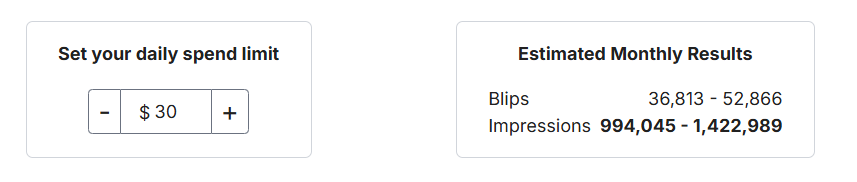
Set flexible budgets in Boscobel and only pay when ads play, so you can test tourism, retail, or healthcare messages along the Driftless roads.
-
Use dayparting on Blip to hit Boscobel’s rush windows—morning, lunch, and after-work—when local drivers and cross-county traffic are on the move.
-
No contracts mean you can pause or shift in Boscobel as the Wisconsin State Turkey Festival, fall color, or deer season changes demand.
-
Track Blip performance in real time in Boscobel and see which corridor works best for U.S. 61 commuters vs. WI 133 local trips.
-
Blip’s creative tools make it easy to build bold, simple ads for Boscobel’s fast-moving roadside audience and seasonal river traffic.
Frequently Asked Questions About Billboard Advertising in Boscobel
How much does a billboard cost in Boscobel with Blip?
With Blip, billboard advertising in Boscobel can fit a wide range of budgets because you only pay when your ad actually appears. Each “blip” is a 7.5-to-10-second display on a rotating digital billboard, and pricing starts at just $0.01 per display. Costs can vary based on time of day, location, and advertiser demand, so you stay in control while Blip works to maximize your exposure.
Where can I advertise with Blip in Boscobel?
The most important thing to remember in Boscobel is that route context matters as much as raw traffic. U.S. Highway 61 is the main spine for Boscobel billboard reach, and Wisconsin Highway 133 gives advertisers concentrated local and river-corridor exposure. Boards closest to town are strongest for urgency and frequency, while the corridors toward Prairie du Chien, Fennimore, and Richland Center support different kinds of planned-stop and local-service campaigns.
Why is Boscobel a good billboard market for local ads?
Boscobel is a small city, but it is a strong billboard market because it sits on a concentrated road network in the middle of southwest Wisconsin’s Driftless region. The city had 3,255 residents in 2020, yet the effective audience is much larger because drivers from Grant County, Crawford County, and Richland County regularly pass through for work, school, healthcare, shopping, and recreation. In a market where most trips happen by car and a few highways do most of the work, digital billboards can create unusually efficient frequency.
When is the best time to run a billboard campaign in Boscobel with Blip?
Summer is prime time for Boscobel recreation and drive-market visibility, especially from Memorial Day through Labor Day. Fall is especially strong in Boscobel because it combines scenic travel, school routines, harvest activity, football, and local events. From August through May, school calendars bring back reliable weekday peaks, and winter from December through March shifts attention toward practical needs such as heating, snow-related vehicle service, urgent care, and tax prep.
Do I need a contract to advertise with Blip in Boscobel?
No, Blip has no long-term contracts or minimum commitments. You can start, pause, or stop your campaign at any time.
How fast can I launch a billboard campaign with Blip in Boscobel?
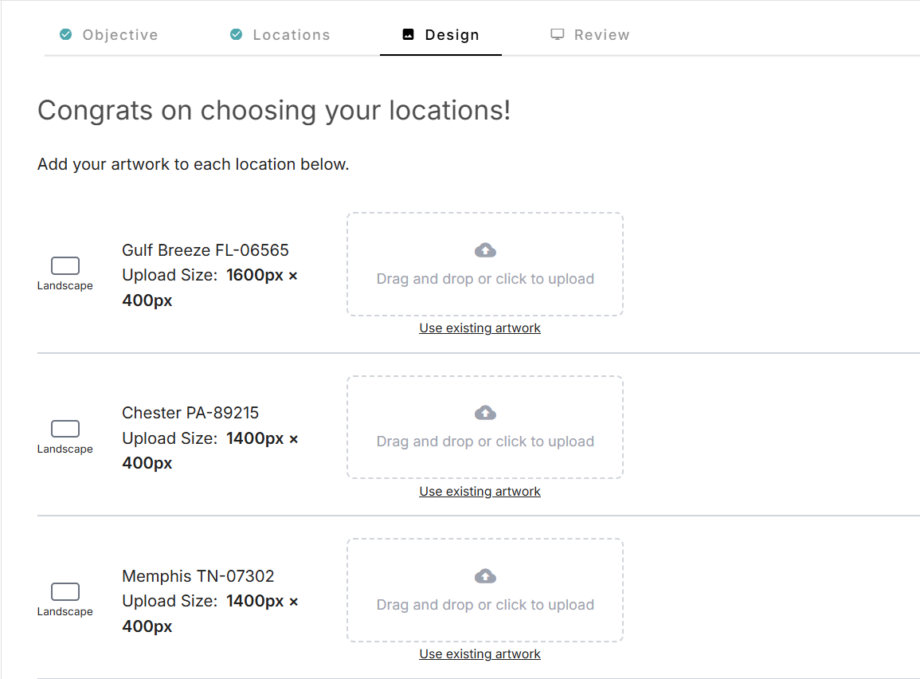
You can have your campaign live in minutes. Create a free account, select your locations, set your budget, upload your design, and start running once approved.
Where can I advertise with Blip in Boscobel?
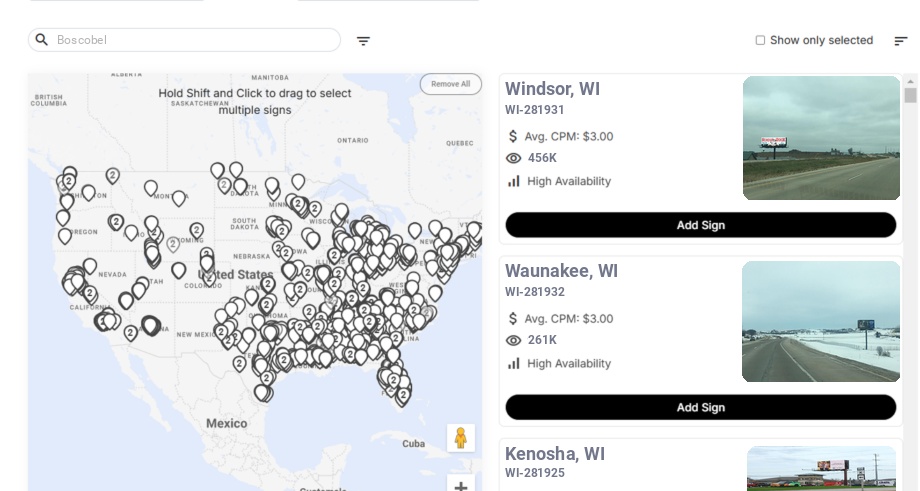
Blip has digital billboards in Boscobel. You can browse available locations on a map, choose the ones that fit your audience, and start advertising right away.
Still have questions? Launch a campaign in minutes — no contracts, no commitments.
Start Your CampaignBoscobel Billboard Advertising Guide
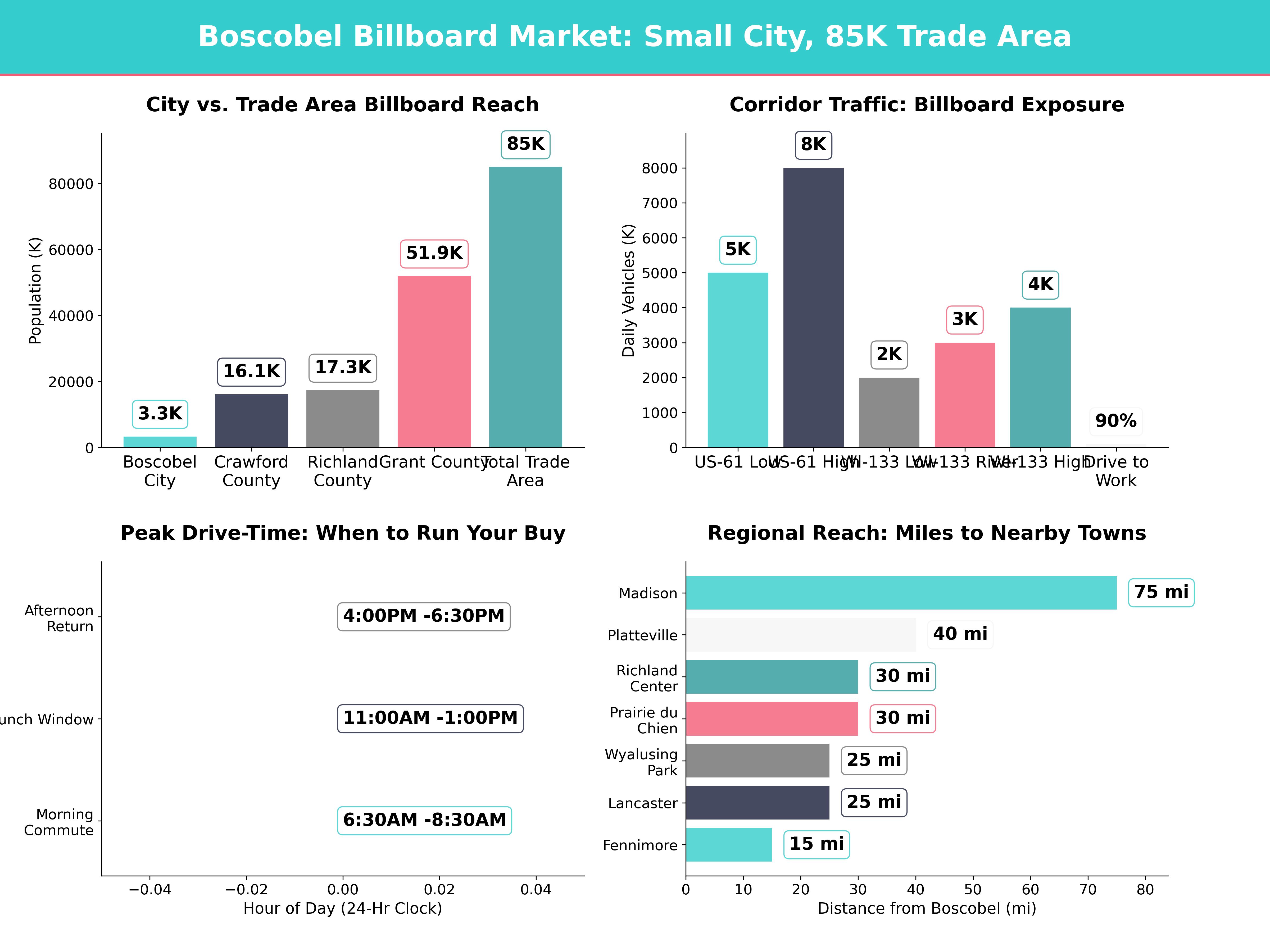
Boscobel is a small city, but it is a strong billboard market because it sits on a concentrated road network in the middle of southwest Wisconsin’s Driftless region. The City of Boscobel 3,255 residents in 2020, yet the effective audience is much larger because drivers from across Grant County 51,938 residents), Crawford County (16,113 residents), and Richland County (17,304 residents) regularly pass through for work, school, healthcare, shopping, and recreation, for a combined population of roughly 85,000 residents. In a market where most trips happen by car and a few highways do most of the work, digital billboards can create unusually efficient frequency. Tourism on the Wisconsin River, seasonal events, and steady local-service demand give us reasons to advertise here in every quarter of the year.
Boscobel Market Overview for Billboard Advertising
Boscobel is small, but the Boscobel trade area is meaningfully larger than the city line
When we advertise in Boscobel, we are not just reaching one city block or one neighborhood. We are reaching a rural service hub that pulls people from a wide drive market. Grant County 51,938 residents in 2020, and Boscobel’s location between larger regional destinations makes it a practical stop for residents from multiple surrounding communities.
The population story is stable rather than explosive, and that matters for out-of-home planning. Boscobel itself grew by about 24 residents, or roughly 0.7%, between 2010 and 2020. Grant County grew by about 730 residents, or roughly 1.4%, over the same decade. That kind of modest change tells us that billboard success here usually comes from consistency, repetition, and route relevance, not from chasing fast-moving suburban sprawl.
Boscobel is also well positioned relative to nearby centers. It is about 15 miles from Fennimore, about 25 miles from Lancaster, about 30 miles from Prairie du Chien 30 miles from Richland Center 40 miles from Platteville 75 miles from Madison. For advertisers, that means even a “small-town” billboard can influence decisions across a broad multi-county geography.
Boscobel’s economy favors repeat vehicle exposure
Boscobel’s economy is built around practical, recurring needs. The Wisconsin Secure Program Facility is a 500-bed state institution, and Gundersen Boscobel Area Hospital and Clinics 25-bed critical access hospital. Add agriculture, trucking, local retail, education, and home services, and we get a market where people make many repeated trips with very similar routes week after week.
Commuting in this part of Wisconsin is overwhelmingly vehicle-based. In rural southwestern counties like Grant County, commuting profiles consistently show that roughly 9 in 10 workers get to work by car, truck, or van when we combine solo drivers and carpools. That is ideal for billboard advertising because the audience is not scattered across dense transit systems or walkable downtown blocks. The audience is on the road.
For many categories, that creates a strong local fit:
- Healthcare advertisers can stay visible to patients, caregivers, and staff making routine trips.
- Restaurants, convenience stores, and fuel retailers can influence immediate stop decisions within the next 5 to 15 minutes.
- Banks, insurance agencies, legal services, and auto repair shops can build familiarity in a market where trust and name recognition matter.
- Farm, home, and hardware businesses can connect with households that often combine several errands into one drive.
Key Traffic Corridors for Boscobel Billboard Campaigns
U.S. Highway 61 is the main spine for Boscobel billboard reach
According to Wisconsin Department of Transportation traffic counts U.S. Highway 61 generally carry traffic in the 5,000 to 8,000 vehicles per day range, depending on the exact segment and count year. The busiest in-town stretch near the U.S. 61/WI 133 junction typically sits near the upper end of that band. For a rural market, that is meaningful daily exposure.
This route matters because it connects Boscobel northward toward Prairie du Chien Wisconsin Great River Road, and southward toward Fennimore, Southwest Wisconsin Technical College, and the University of Wisconsin-Platteville sphere. If we want broad regional reach, U.S. 61 is usually the first corridor to evaluate.
Advertisers that often benefit most from U.S. 61 placements include the following categories:
- Retail, food, and fuel advertisers benefit because drivers are often deciding where to stop before they reach downtown.
- Healthcare, financial, and professional services benefit because the route captures planned weekday trips.
- Regional employers benefit because the corridor reaches both local commuters and cross-county workers.
Wisconsin Highway 133 gives Boscobel advertisers concentrated local and river-corridor exposure
Wisconsin Highway 133 is the other defining route in Boscobel. WisDOT count maps generally place Boscobel-area WI 133 segments in the 2,000 to 4,000 vehicles per day range, with the crossing near the Wisconsin River commonly above 3,000 vehicles per day. Those are not big-city freeway numbers, but they are exactly the kind of concentrated counts that can produce strong rural frequency.
WI 133 matters because it collects local traffic, school traffic, service trips, and recreation-oriented travel tied to the river corridor. It is especially useful when we want to reach residents who already know the area and are likely to act quickly on a message for a clinic, restaurant, church event, hardware store, or local promotion.
This corridor is especially useful for the following campaign types:
- Urgent local services work well because the audience is close enough to respond the same day.
- Community events work well because the route captures familiar local residents repeatedly.
- Tourism and hospitality work well during warm-weather weekends and fall color season.
Regional approach roads shape how Boscobel advertisers should think about timing and offers
The most important thing to remember in Boscobel is that route context matters as much as raw traffic. A driver coming from Fennimore at 15 miles out is in a different mindset than a driver already in town. A traveler coming from Prairie du Chien 30 miles out may be in leisure mode, while someone coming from Richland Center 30 miles out may be on a service or work-related trip.
We should match the corridor to the buying decision:
- On longer regional approaches, we should promote destinations, brands, appointments, and planned stops.
- On in-town or near-town boards, we should promote immediacy, convenience, hours, and turn-by-turn action.
- On river and recreation routes, we should emphasize food, lodging, attractions, events, and seasonal offers.
Boscobel Audience Segments We Can Reach
Boscobel commuters and errand-driven households
The first audience in Boscobel is the everyday local driver. Because the city functions as a service center, many trips combine work, school, drop-off, groceries, healthcare, and errands in one loop. That creates repeated exposure opportunities on the same roads, often several times per week.
This audience is ideal for:
- Primary care, dental, vision, and pharmacy messaging.
- Home services, including heating, cooling, plumbing, roofing, and electrical work.
- Banks, credit unions, insurance agencies, and legal services that depend on familiarity over time.
- Restaurants and local retail that benefit from a lunchtime or after-work decision.
Boscobel workers in healthcare, corrections, agriculture, and logistics
Boscobel has a larger base of steady institutional and essential-service traffic than its population alone suggests. The 500-bed Wisconsin Secure Program Facility creates daily employee and vendor movement. The 25-bed Gundersen Boscobel Area Hospital and Clinics
This segment usually responds well to messages built around utility and trust. We should think about:
- Clear hours.
- Strong local credentials.
- Direct offers.
- Practical categories such as auto care, workwear, tools, healthcare, insurance, and meals.
Boscobel students, families, and education-connected travelers
Even though Boscobel is not a major college town, education still shapes traffic patterns. Boscobel Area Schools create predictable weekday peaks, and nearby higher-education campuses extend the regional student audience. Southwest Wisconsin Technical College in Fennimore is about 15 miles south, and UW-Platteville is about 40 miles south.
That matters for advertisers such as:
- Apartments and rental housing in the broader regional market.
- Telecom, internet, and financial services aimed at young adults and parents.
- Fast food, coffee, and convenience retail tied to school and commuter routines.
- Healthcare and family services aimed at parents traveling with children.
Boscobel tourists, outdoor visitors, and weekend traffic
Boscobel also benefits from southwest Wisconsin tourism. The Wisconsin Department of Natural Resources promotes nearby outdoor assets, and Wyalusing State Park is roughly 25 miles west of Boscobel near the Prairie du Chien area. The Wisconsin Great River Road, the lower Wisconsin River corridor, fall scenic drives, paddling, camping, and hunting all bring periodic visitor traffic into the region.
For this audience, the strongest categories are usually:
- Lodging and short-term stays.
- Restaurants, supper clubs, bars, and coffee stops.
- Outdoor gear, convenience stores, and fuel.
- Attractions and seasonal events.
Seasonal and Timing Opportunities in Boscobel
Summer is prime time for Boscobel recreation and drive-market visibility
From Memorial Day through Labor Day, southwest Wisconsin sees stronger leisure travel, campground traffic, river recreation, and weekend driving. Travel Wisconsin regularly highlights the Driftless region for scenic travel, which helps small markets like Boscobel punch above their size.
During summer, we should prioritize:
- Friday afternoon and evening visibility.
- Saturday late-morning and mid-afternoon rotations.
- Sunday return-trip periods.
- Creative that highlights food, fuel, lodging, cooling services, events, and river recreation.
Fall gives Boscobel advertisers one of the best local timing windows of the year
Fall is especially strong in Boscobel because it combines scenic travel, school routines, harvest activity, football, and local events. The community’s annual Wisconsin State Turkey Festival Boscobel Area Chamber of Commerce, runs for 4 days in late September. That is a highly visible local moment for restaurants, retailers, banks, healthcare providers, and community organizations.
Fall color traffic usually builds from late September into October, and hunting demand rises again in November. Wisconsin’s traditional gun deer season runs for 9 days beginning the Saturday before Thanksgiving, and Wisconsin DNR activity around hunting seasons amplifies travel across rural corridors. If we sell sporting goods, convenience items, auto services, cabins, food, or workwear, that is a natural seasonal window.
School-year and winter campaigns in Boscobel can be very efficient
From August through May, school calendars bring back reliable weekday peaks. That makes this period useful for family-focused categories, healthcare, financial services, tutoring, telecom, and quick-service food. Winter, especially from December through March, also shifts consumer attention toward practical needs such as heating, insulation, snow-related vehicle service, urgent care, and tax prep.
Winter creative should be simpler and higher-contrast than summer creative. Snow cover, early darkness, and gray skies can reduce background detail, so bold typography and direct offers usually perform best.
Boscobel Billboard Design Tips
In Boscobel, route-aware messaging works better than abstract branding alone
In a market like Boscobel, people often know the geography well. That means directional specificity can outperform vague slogans. Messages such as “Next Right on 133,” “South on 61,” “2 Miles Ahead,” or “Open Until 8” are often more useful than a purely image-driven ad.
When we design for Boscobel, we should usually keep copy short:
- On faster rural approaches posted around 55 mph, we should aim for about 6 to 8 words.
- On slower in-town roads that may run closer to 25 to 35 mph, we can sometimes support slightly more detail.
- We should usually feature 1 main offer, 1 brand name, and 1 call to action.
Boscobel creative should feel local, practical, and visually grounded in the Driftless region
The best local creative usually looks like it belongs in southwest Wisconsin. Scenic bluffs, river views, agricultural imagery, small-town hospitality, and outdoor lifestyle cues tend to feel more authentic than generic urban stock photos. In late summer and fall, earthy greens, deep reds, oranges, and golds can visually align with the Driftless landscape. In winter, stronger contrast such as dark blue, black, white, and bright accent colors can improve legibility.
We should also remember that Boscobel audiences often prioritize usefulness over novelty. Ads that emphasize savings, convenience, durability, trust, family ownership, or appointment availability often fit the market better than hyper-clever copy.
Boscobel advertisers should make the next step obvious
Because many viewers are driving through and making decisions on the go, our creative should answer the practical question, “What should I do next?” We should consider including only one of the following elements, not all of them at once:
- A turn cue.
- A nearby town name.
- A clear offer.
- A short website.
- A memorable phone number.
In Boscobel, simplicity usually wins.
Regional Strategies Around Boscobel
The Boscobel core is best for urgency and frequency
Boards closest to town are where we should emphasize immediate action. These placements are strongest for clinics, pharmacies, restaurants, churches, grocery, hardware, urgent home repair, and local events. In this zone, the audience is near enough to act today, and repeat exposure can build very strong familiarity.
If our business depends on same-day traffic, we should start here first.
South of Boscobel, the Fennimore and Platteville approach supports planned-stop messaging
The southbound and northbound U.S. 61 corridor is useful because it connects Boscobel with Fennimore, Southwest Wisconsin Technical College, and the broader Platteville
In the 15- to 40-mile decision window, we should focus on destination messaging such as appointments, shopping trips, dining plans, or event promotion.
West and northwest of Boscobel, river and Prairie du Chien traffic support tourism-oriented campaigns
The route toward Prairie du Chien Wyalusing State Park, and the Wisconsin Great River Road carries more leisure intent, especially from late spring through fall. That makes this side of the market especially good for food, lodging, attractions, fuel, convenience retail, and seasonal recreation.
If we are promoting an event, a scenic stop, a supper club, or a weekend offer, this is one of the most natural regional directions to emphasize.
East of Boscobel, the river communities and Richland-side approach support dependable local-service campaigns
Drivers coming from Muscoda Richland Center
In this zone, helpfulness beats hype. We should make it easy for people to understand where we are, what we offer, and why it is worth the stop.
Using Blip Tools Effectively in Boscobel
We can use dayparting to match Boscobel’s actual traffic behavior
Boscobel is a market where timing matters. Morning commuter windows around 6:30 to 8:30 a.m., lunch windows around 11:00 a.m. to 1:00 p.m., and afternoon return windows around 4:00 to 6:30 p.m. are often more efficient than a flat all-day schedule for service-oriented advertisers. Weekend timing can matter even more for tourism, restaurants, and events.
Blip makes that practical because we can align our spend with the hours when the audience is most likely to act, rather than buying the same intensity at every hour of the day.
We can test Boscobel creative by route, season, and message
In a small market, tiny creative changes can matter. We can run one message on a U.S. 61 approach board, another on a more local Boscobel board, and compare results. We can also rotate seasonal creative, such as summer recreation, back-to-school, fall festival, or winter service messaging, without locking ourselves into one long static design.
A good local testing approach is often simple:
- Start with 2 or 3 boards.
- Run for 2 to 4 weeks.
- Compare one direct-response message against one brand-building message.
- Shift budget toward the corridor and creative that produce the best response.
We can let Blip analytics guide regional expansion around Boscobel
Because Boscobel is a route-driven market, analytics are especially helpful. If our strongest response comes from boards near the city core, we can increase frequency there. If performance improves on the Prairie du Chien side during summer weekends, we can lean into that seasonal pattern. If a healthcare campaign performs best on weekday mornings, we can concentrate spend in that window.
That kind of flexibility is valuable in a town where audience behavior changes with the school calendar, weather, and event schedule.
Getting Started with Billboard Rental in Boscobel
We should begin with the trip we want to intercept
The easiest way to choose a Boscobel billboard is to decide which trip matters most to us. Are we trying to catch a daily commuter, a school-related family trip, a hospital visitor, a prison employee, a weekend tourist, or a regional shopper coming in from 15 to 30 miles away? Once we answer that, the right corridor usually becomes much clearer.
In Boscobel, location strategy often comes down to a few practical questions:
- Are we trying to influence a same-day stop or a planned visit?
- Do we need local residents, pass-through travelers, or both?
- Is our ideal customer more likely to be on U.S. 61, WI 133, or a near-town connector?
We should evaluate Boscobel boards by direction, speed, and decision distance
Not every board on the same highway serves the same purpose. We should compare locations based on the following factors:
- Direction of travel, because northbound and southbound audiences may have different intent.
- Vehicle speed, because a 55 mph rural approach needs simpler creative than a slower in-town approach.
- Distance to our business, because some categories need a board within 2 to 5 miles, while others can work from 15 to 30 miles out.
- Nearby landmarks, because local directional cues are unusually powerful in a town this size.
- Competitive clutter, because one clean local read can outperform a busier corridor.
Blip simplifies Boscobel billboard rental for businesses that want control
Traditional billboard buying often involves longer commitments, more manual coordination, and less agility than many local advertisers want. With Blip, we can browse available screens, select boards on a map, set the schedule that fits our goals, upload creative, and adjust quickly if we see better opportunities on a different route or in a different season.
That is especially useful in Boscobel because this market rewards experimentation. We can start small, learn which roads and time windows perform best, and scale with confidence. For many businesses here, the smartest path is not to buy the biggest possible campaign on day one. The smartest path is to launch with a clear local objective, monitor response, and refine until our message is showing up in front of the right drivers at the right moments.