Billboards near Eau Claire, WI
No Minimum Spend. No Long-Term Contracts. Just Results.
Trusted by Leading Brands


Billboard advertising
near Eau Claire has never been easier
How much is a billboard near Eau Claire?
Why Choose Blip for Billboard Advertising near Eau Claire
Blip lets you launch on Eau Claire-area boards near US-53 and WI-29 in minutes, reaching commuters, shoppers, and students without the usual hassles.
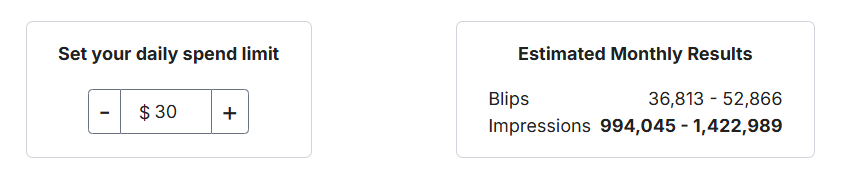
Set a flexible daily budget for Eau Claire and only pay when your ad runs—great for testing Lake Hallie and Chippewa Valley traffic without overspending.
Daypart your Blip campaign in Eau Claire to hit 6:30-9 a.m. commuters and weekend retail traffic when US-53 and Commercial Blvd. are busiest.
No contracts means you can turn Eau Claire billboards on for Country Jam, Blue Ox, or back-to-school traffic, then pause when demand cools.
Blip's real-time analytics help Eau Claire advertisers see what works, so you can shift spend from weekday worker routes to holiday shopping spikes fast.
Use Blip's creative tools to build bold Eau Claire messages for fast-moving drivers on US-53, WI-29, and the Lake Hallie shopping corridor.
Frequently Asked Questions About Billboard Advertising near Eau Claire
How much does a billboard cost near Eau Claire, Wisconsin with Blip?
With Blip, you set your own daily budget for Eau Claire billboards, and our pay-per-blip model means you only pay each time your 7.5–10 second ad actually appears on billboards near Eau Claire, Wisconsin. Costs vary based on when you run your ads, where your ad appears in the Eau Claire area, and local advertiser demand, so you stay in control and never overspend. You can adjust your budget or pause your campaign at any time, and your total cost over any period is simply the sum of the individual blips you receive.
Where can I advertise with Blip near Eau Claire, Wisconsin?
With Blip, we can tap into 2 digital billboards in nearby Lake Hallie—just 4.2 miles from Eau Claire—positioned along major commuter and shopping routes that serve the Eau Claire area. Our 2 digital billboards in Lake Hallie are strategically located within roughly 10 miles of Eau Claire, along high-traffic commuter and retail routes that connect Eau Claire, Lake Hallie, and Chippewa Falls. These placements function as high-impact extensions of the Eau Claire billboards ecosystem without the higher costs sometimes associated with in-city inventory.
What makes the Eau Claire, Wisconsin area a strong market for Blip billboard advertising?
The Eau Claire area punches above its weight as an advertising market because it combines a stable residential base, strong education and healthcare anchors, and a steady stream of visitors. This makes billboard advertising near Eau Claire particularly effective for brands that need both frequency with locals and visibility with out-of-town visitors. The broader Eau Claire–Chippewa Falls region reaches roughly 170,000–180,000 residents, making it one of northwest Wisconsin’s primary population and retail hubs.
When is the best time to run billboards in Eau Claire, Wisconsin with Blip?
The Eau Claire area has distinct seasonal rhythms, and digital billboards let us pivot quickly as those change. Daily traffic volumes on key corridors can swing 10–25% across seasons, and local retail sales can vary even more sharply month to month. For advertisers managing billboard advertising near Eau Claire, adjusting spend and creative by season ensures that impressions coincide with real demand.
What kind of traffic do billboards near Eau Claire, Wisconsin reach?
US‑53 between Eau Claire and Lake Hallie commonly sees 35,000–45,000 vehicles per day on key stretches, with some segments approaching or exceeding 50,000 AADT where traffic converges near major interchanges and retail nodes. WI‑29 near Lake Hallie/Chippewa Falls often sees 25,000–35,000 vehicles per day, including a high share of regional freight and intercity travelers. Business corridors connecting to these routes frequently log 15,000–20,000+ vehicles per day, serving major big-box retail, grocery, and dining clusters.
Do I need a contract to advertise with Blip near Eau Claire?
No, Blip has no long-term contracts or minimum commitments. You can start, pause, or stop your campaign at any time.
How fast can I launch a billboard campaign with Blip near Eau Claire?
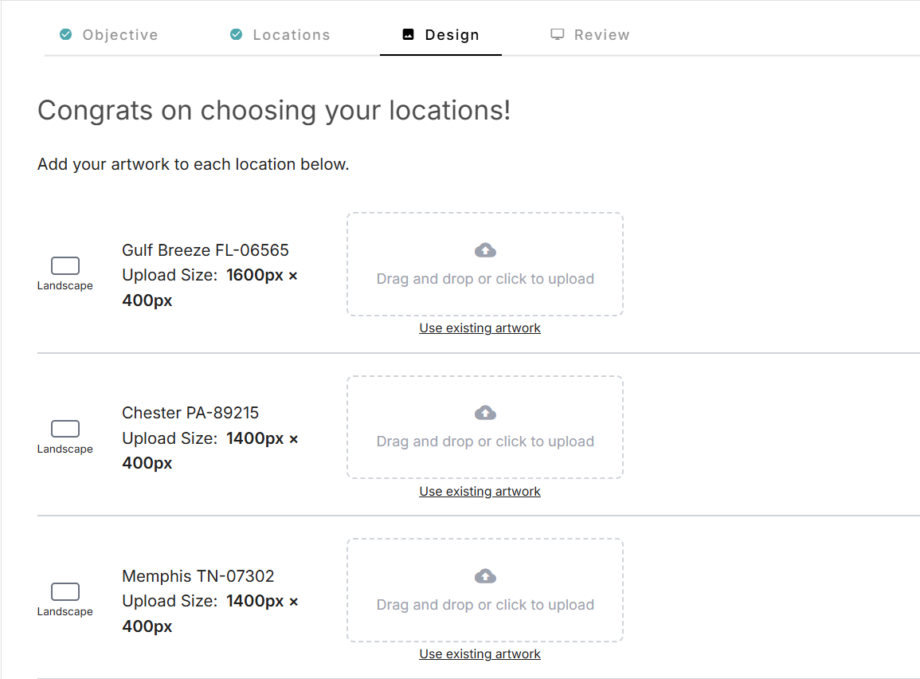
You can have your campaign live in minutes. Create a free account, select your locations, set your budget, upload your design, and start running once approved.
Where can I advertise with Blip near Eau Claire?
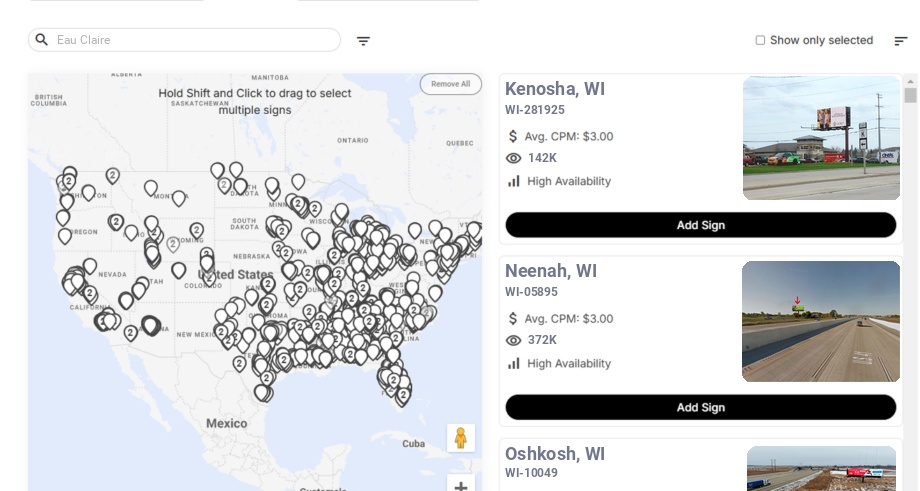
Blip has digital billboards near Eau Claire. You can browse available locations on a map, choose the ones that fit your audience, and start advertising right away.
Still have questions? Launch a campaign in minutes — no contracts, no commitments.
Start Your CampaignEau Claire Billboard Advertising Guide
Digital billboards near Eau Claire, Wisconsin give us a cost-efficient way to reach residents, commuters, students, and visitors moving through the Chippewa Valley every day. With Blip, we can tap into 2 digital billboards in nearby Lake Hallie—just 4.2 miles from Eau Claire—positioned along major commuter and shopping routes that serve the Eau Claire area. For advertisers looking specifically for billboards near Eau Claire, these placements function as high-impact extensions of the Eau Claire billboards ecosystem without the higher costs sometimes associated with in-city inventory.
Why the Eau Claire Area Is a Powerful OOH Market
The Eau Claire area punches above its weight as an advertising market because it combines a stable residential base, strong education and healthcare anchors, and a steady stream of visitors. This makes billboard advertising near Eau Claire particularly effective for brands that need both frequency with locals and visibility with out-of-town visitors.
Key population and economic indicators:
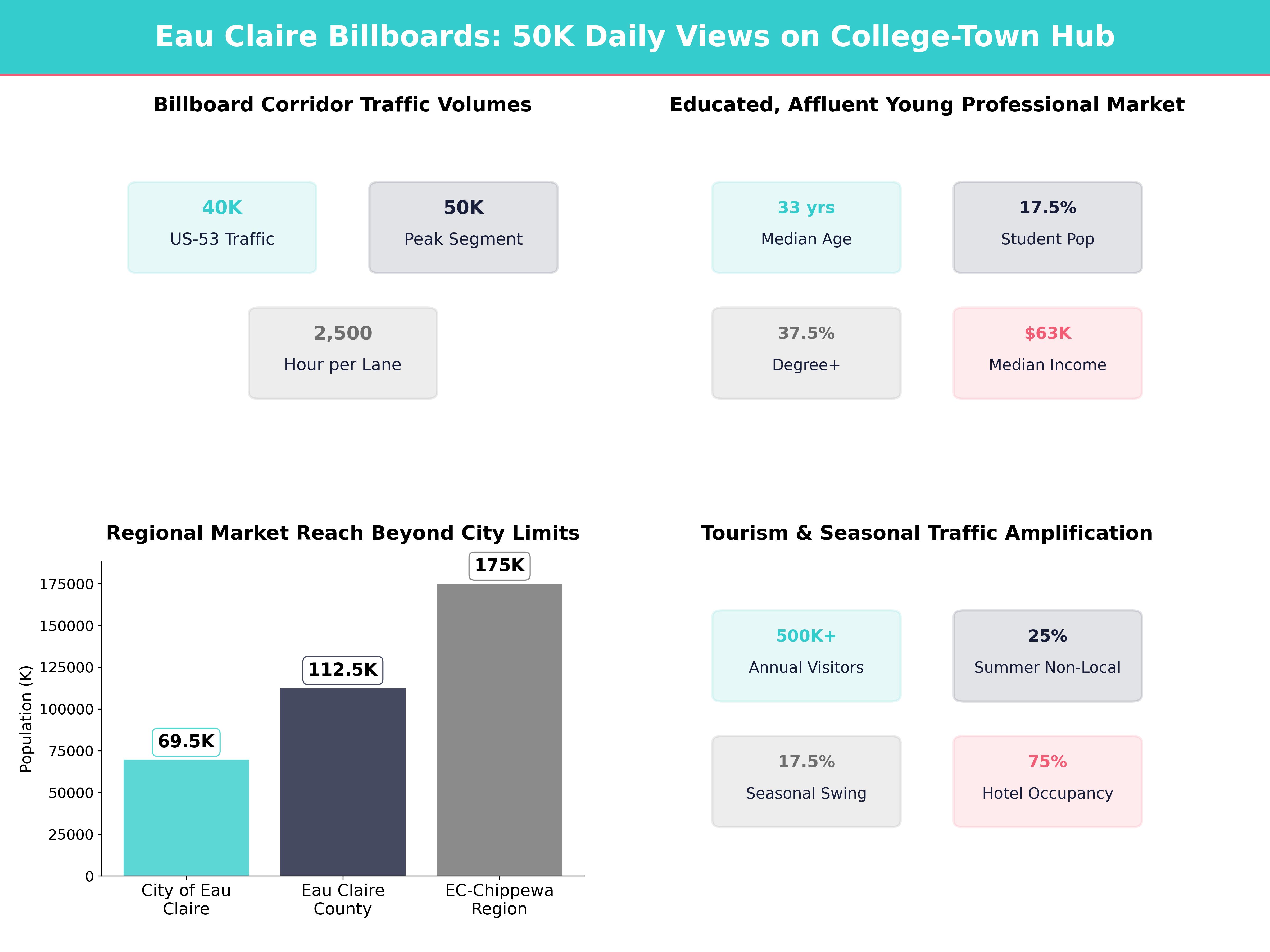
- The City of Eau Claire has roughly 69,000–70,000 residents, while Eau Claire County is home to about 110,000–115,000 people. When you combine Eau Claire and Chippewa counties, the broader Eau Claire–Chippewa Falls region reaches roughly 170,000–180,000 residents, making it one of northwest Wisconsin’s primary population and retail hubs. Population and planning data are regularly updated by the City of Eau Claire Eau Claire County.
- Median household income in the Eau Claire area is in the $63,000–67,000 range, close to the statewide median, with many surrounding suburban and rural townships clustering between $60,000 and $75,000. This supports significant discretionary spending on dining, retail, recreation, and professional services.
- Major employers include Marshfield Clinic Health System, Mayo Clinic Health System – Eau Claire, University of Wisconsin–Eau Claire, Eau Claire Area School District, large distribution centers, and manufacturing/logistics companies in the Chippewa Falls and Lake Hallie corridor. Local employer and economic development resources are available via the City of Eau Claire Eau Claire County, the Village of Lake Hallie, and the Eau Claire Area Chamber of Commerce.
- UW–Eau Claire enrolls roughly 10,000–11,000 students annually, according to UW–Eau Claire data, and Chippewa Valley Technical College (CVTC) serves another 8,000+ credit students plus several thousand continuing-education learners each year. Taken together, postsecondary students can represent 15–20% of the city’s population during the academic year—an unusually high concentration of college-aged, highly mobile consumers.
Tourism also drives buying power:
- Visit Eau Claire reports that the Eau Claire area draws well over 500,000 visitors per year, with recent tourism economic impact estimates in the hundreds of millions of dollars annually when lodging, food & beverage, retail, and transportation are combined. Conferences, sports tournaments, and events like Country Jam, Blue Ox Music Festival, and the broader arts and riverfront scene are core drivers. You can explore event data and visitor demographics at Visit Eau Claire.
- Regional tourism organizations such as Go Chippewa County hundreds of thousands of visitor-days annually for recreation on area lakes, rivers, and trails—much of that traffic moving along US‑53 and WI‑29 through Lake Hallie.
- Events and tournaments at regional venues (such as Carson Park, Hobbs Ice Center, UW–Eau Claire’s athletics facilities, and regional youth sports complexes) can each bring in hundreds to several thousand participants and spectators over a weekend, filling hotels and pushing incremental traffic past boards near Lake Hallie.
For advertisers, this mix implies that campaigns near the Eau Claire area should:
- Balance messaging between long-term residents and transient visitors.
- Highlight convenience and proximity (e.g., “10 minutes south in Eau Claire” or “Next exit to Lake Hallie”).
- Speak to both family-oriented buyers and younger, college-aged audiences.
- Consider bilingual or inclusive creative where appropriate, as local school districts report 10%+ of students speaking a language other than English at home in some attendance areas, according to reports from Eau Claire Area School District.
Understanding Local Traffic Flows Near Eau Claire
Our 2 digital billboards in Lake Hallie are strategically located within roughly 10 miles of Eau Claire, along high‑traffic commuter and retail routes that connect Eau Claire, Lake Hallie, and Chippewa Falls. For brands exploring billboard rental near Eau Claire, these placements offer a way to leverage strong daily traffic volumes while keeping budgets efficient.
While exact counts vary by segment and year (Wisconsin Department of Transportation maintains annual average daily traffic—AADT—data by corridor; see WisDOT Traffic Counts
-
US‑53 between Eau Claire and Lake Hallie
- Commonly sees 35,000–45,000 vehicles per day on key stretches, with some segments approaching or exceeding 50,000 AADT where traffic converges near major interchanges and retail nodes.
- Heavy commuter use in both directions, particularly 6:30–9:00 a.m. and 3:30–6:00 p.m., when peak-hour volumes can reach 2,000–3,000 vehicles per lane per hour on the busiest segments.
-
WI‑29 near Lake Hallie/Chippewa Falls
- Often 25,000–35,000 vehicles per day, including a high share of regional freight and intercity travelers moving between the Twin Cities and central/northern Wisconsin.
- Weekend and evening volumes routinely run 5–15% above weekday baselines during peak tourism weeks as shoppers and visitors head toward Eau Claire or farther west.
-
Business corridors connecting to these routes (e.g., Business 53 / Hastings Way, Commercial Boulevard in Lake Hallie)
- Frequently log 15,000–20,000+ vehicles per day, serving major big-box retail, grocery, and dining clusters anchored by national chains and local independents.
- During holiday periods, local agencies and media such as WEAU 13 News and WQOW News 18 often report double-digit percentage increases in traffic around Lake Hallie’s retail centers, especially on Black Friday and the final weekends before Christmas.
What this means for our Blip strategy:
-
Boards near Lake Hallie naturally intercept:
- Daily commuters between Eau Claire and Chippewa Falls—together accounting for tens of thousands of work trips each weekday.
- Shoppers visiting power centers (Walmart, Sam’s Club, Fleet Farm, etc.), where single large stores can average 1–2 million visits per year.
- Travelers using WI‑29 and US‑53 as through routes to the Twin Cities, northern Wisconsin, and beyond—segments that can see 20–30% of traffic made up of non-local plates in peak summer months.
-
We can use Blip’s scheduling tools to:
- Concentrate impressions during commute windows to reach workers and students when peak hourly volumes are highest.
- Shift weight to weekend daytime and early evenings to reach shoppers and visitors, especially when retail trips and restaurant visits can spike 20–30% above weekday levels.
- Boost presence during event influx periods when traffic and hotel occupancy spike—festivals, tournament days, graduation weekends, and university move-in periods that can temporarily add thousands of extra vehicles per day to local corridors.
Demographics and Audience Segments in the Eau Claire Area
Because the Eau Claire area combines a university town, regional retail hub, and healthcare/education center, we can target several distinct audience segments with the same boards by rotating creative. This makes digital Eau Claire billboards and nearby inventory in Lake Hallie especially versatile for multi-audience campaigns.
Key demographic patterns:
-
Age and households
- Median age in the City of Eau Claire is around 32–34, compared with Wisconsin’s median in the 39–40 range, largely because of the student population. The broader Eau Claire–Chippewa Falls region trends slightly older, into the mid‑30s.
- About 25–28% of residents in Eau Claire County are under 20, and roughly 15–17% are 65+, creating strong markets both for youth-oriented businesses and senior services.
- Homeownership rates in the core city hover around 50–55%, while surrounding towns and suburbs in Eau Claire and Chippewa counties can reach 70–80% owner-occupied housing, according to local planning documents from Eau Claire County and the Village of Lake Hallie.
-
Education
- The presence of UW–Eau Claire and CVTC drives a high educational attainment profile: local estimates indicate that 35–40% of adults in the city have at least a bachelor’s degree, with another 25–30% having some college or an associate degree.
- This skews the audience toward information-savvy, value-seeking consumers who research online but still respond strongly to concise, high-impact visuals outdoors.
-
Income and occupations
- Median household incomes in the mid‑$60,000s mask variation by neighborhood: student-heavy tracts can be under $40,000, while some outlying communities exceed $80,000–$90,000.
-
Employment is broadly diversified:
- Healthcare and social assistance can account for 20%+ of local jobs.
- Education (K‑12 and higher ed) typically represents 10–15% of employment.
- Manufacturing and logistics roles together often make up 15–20% of the workforce, with large campuses in and around Lake Hallie and Chippewa Falls.
- Retail trade and hospitality together contribute another 15–20% of local employment, according to regional profiles published by the Eau Claire Area Economic Development Corporation.
This mix supports campaigns for professional services, B2B hiring, and consumer categories like automotive, home improvement, and finance.
Segment-specific ideas:
-
Students and young professionals
- Use short-term, high-urgency offers: “$3 latte before 11 a.m. – Exit at Lake Hallie” or “Student discount – 10 min south near campus.” A price point clearly under $5 or percentage-off savings of 15–25% tends to feel compelling for this group.
- Rotate creatives around semester start (late August/early September), midterms, and finals when UW–Eau Claire and CVTC see campus daytime populations peak around 15,000–18,000 combined.
-
Families and homeowners
- Emphasize trust, local roots, and convenience: “Locally owned dental care serving the Eau Claire area,” “Remodel this summer – book now.” With regional homeownership rates above 60%, home services (roofing, HVAC, landscaping, remodeling) have broad appeal.
- Increase presence in spring/summer when local building permit activity and home-improvement spending typically rise 15–30% over winter levels, based on permitting summaries from the City of Eau Claire
-
Older adults and healthcare users
- Clear, legible typography and simple calls to action: “Joint pain? Schedule with our Eau Claire-area clinic.”
- Align heavier flighting with Medicare enrollment periods and health-screening campaigns; regional health systems like Marshfield Clinic Health System and Mayo Clinic Health System – Eau Claire hundreds of patients during targeted campaigns.
Local media like the Leader-Telegram and Volume One frequently cover demographic and lifestyle trends; aligning our messaging tone and imagery with what we see there keeps campaigns culturally tuned to the market.
Seasonal and Event-Driven Timing Strategies
The Eau Claire area has distinct seasonal rhythms, and digital billboards let us pivot quickly as those change. Daily traffic volumes on key corridors can swing 10–25% across seasons, and local retail sales can vary even more sharply month to month. For advertisers managing billboard advertising near Eau Claire, adjusting spend and creative by season ensures that impressions coincide with real demand.
Spring (March–May)
- Snow melt, pothole season, and home improvement planning drive demand for car care and property services. Local public works updates from the City of Eau Claire Chippewa County often highlight dozens of active road and utility projects in spring, reminding residents to think about maintenance and repairs.
- Gradually rising traffic on weekends as residents emerge for shopping, garden centers, and outdoor activities—regional trail and park usage can increase 50% or more from February to May.
-
Effective campaigns:
- Auto repair, tire shops, and car washes—especially as freeze–thaw cycles create potholes and damage.
- Landscaping, roofing, HVAC tune‑ups, and construction—spring is when many contractors book out 3–4 months in advance.
- Prom season (boutiques, salons, tux rentals), which can concentrate the majority of annual formalwear revenue into a 6–8 week window.
Use Blip to:
- Increase weekday rush-hour coverage as commuting normalizes after winter slowdowns and school sports ramp back up.
- Run creative with bright, high-contrast colors to stand out against gray/dirty snow backdrops and cloudy skies that are common in March and early April.
Summer (June–August)
- Peak tourism and event season; Visit Eau Claire’s calendar shows festivals, concerts, riverfront activities, and sports nearly every weekend. Hotel occupancy often reaches 70–80% on busy weekends, versus 50–60% in shoulder months.
- Outdoor attractions (lakes, rivers, trails) pull both locals and visitors through the Eau Claire–Lake Hallie–Chippewa Falls corridor. Local tourism groups estimate that summer months can account for 40–50% of annual visitor spending in some recreation segments.
-
Effective campaigns:
- Restaurants, bars, and breweries—especially those with patios or river views. Average ticket sizes for groups can be 20–30% higher during event weekends.
- Attractions (waterparks, outdoor recreation, museums, cultural sites like the Chippewa Valley Museum).
- Construction/home improvement and garden centers, which often post their highest monthly revenues between May and August.
- Summer hiring for retail, hospitality, and manufacturing, when employers may need to quickly add dozens or even hundreds of seasonal workers.
Use Blip to:
- Increase impressions on Friday afternoons, Saturdays, and event weekends, when traffic volumes and discretionary spending peak.
- Promote time-sensitive offers like “Tonight only,” “This weekend,” or “Doors open at 7 p.m.”—to capture impulse decisions from visitors and locals already en route.
- Run creatives for multiple venues or events in a rotation to dominate the entertainment category and keep frequency high among repeat corridor users.
Fall (September–November)
- Back-to-school and university semester kickoff: UW–Eau Claire and CVTC welcome thousands of new and returning students each fall, with move-in weekends alone bringing thousands of additional vehicles into town.
- Football season and fall festivals draw regular crowds; high school games, college athletics, and events like Oktoberfest-style celebrations can each attract hundreds to several thousand spectators.
- Pre-holiday shopping patterns emerge by late October, with many retailers reporting 20–30% month-over-month sales increases from September to November.
-
Effective campaigns:
- School/office supplies, electronics, and tech—especially laptops, tablets, and phones for students.
- Healthcare (flu shots, physicals, wellness visits) as health systems encourage vaccinations; public campaigns often aim to reach tens of thousands of area residents.
- Colleges and training programs recruiting for spring or next academic year.
Use Blip to:
- Increase spend in early September around back-to-school and again in late October/early November as holiday planning begins.
- Target commuting windows when parents, students, and staff are on the road to and from schools and campuses.
Winter (December–February)
- Weather can dampen some activity but brings strong demand for indoor services, winter sports, and holiday shopping.
- Holiday retail is a major driver along the US‑53 corridor near Lake Hallie’s big-box centers; stores can see 30–40% of annual sales in the November–December period.
- Local ski areas, snowmobile trails, and indoor sports complexes keep weekend travel robust even in colder months, particularly when snowfall totals are above average.
-
Effective campaigns:
- Holiday retail, gifting, and dining—emphasizing extended hours and last-minute gift options.
- Auto service (batteries, tires, winterization), as cold snaps can dramatically increase roadside assistance calls.
- Tax prep and financial services beginning in January, when refunds and planning become top of mind.
Use Blip to:
- Emphasize high-contrast, bold creative to cut through early dusk and snow; local winter daylight can shrink to about 8.5–9 hours per day in December.
- Shift some impressions to midday hours when winter daylight is strongest, while still maintaining presence during evening commutes and shopping trips.
Creative Best Practices for Billboards Serving the Eau Claire Area
Because our billboards near the Eau Claire area are on fast-moving highways and arterial roads, clarity and local relevance matter more than anything else. Typical approach speeds on US‑53 and WI‑29 range from 55–65 mph, giving drivers only a few seconds of viewing time. Whether you are testing digital options or planning longer-term billboard rental near Eau Claire, these principles help maximize every impression.
Core design principles:
-
Keep it to 7–10 words max
- Drivers on US‑53 and WI‑29 may only have 3–5 seconds to see your message; at 65 mph, a vehicle travels about 95 feet per second.
- Focus on one core idea: “Now hiring welders – Lake Hallie plant” or “Urgent care – 10 min south.”
-
High contrast and bold fonts
- Winters are long and often overcast; the Eau Claire area averages 110–120 days per year with measurable precipitation and many more with cloud cover.
- Use light text on dark backgrounds or vice versa, with sans-serif fonts that stay readable in snow and rain.
-
Local hooks
- Mention “Chippewa Valley,” “near the Eau Claire area,” or specific exits/landmarks to ground the message.
- Speak to local identity—outdoors, music, community pride—rather than generic stock imagery. Cultural coverage in Volume One and visitor imagery at Visit Eau Claire offer strong visual cues for what resonates.
-
Directional and distance cues
-
Boards near Lake Hallie are ideal for:
- “Next 2 exits for [business].”
- “10 minutes to our Eau Claire-area showroom.”
- “Turn at [Street/Exit name].”
- Simple directional cues (e.g., “LEFT at next light,” “RIGHT at Exit 94”) can increase wayfinding success and on-the-spot visits, especially for travelers unfamiliar with the area.
-
Boards near Lake Hallie are ideal for:
-
Image choices
- Use a single, strong image rather than a collage; research from OOH industry studies suggests that single-image creatives can improve recall by 20–30% over cluttered designs.
- For service businesses, faces of real local staff or simple icons (tooth, wrench, house, heart) work well.
- For events, one hero image (artist, crowd, mascot) plus clear date/time is typically enough.
-
Weather-aware content
- Winter: emphasize safety, warmth, convenience (“We plow our lot early,” “Order online, curbside pickup”).
- Summer: highlight rivers, trails, patios, festivals to tap into seasonal mood.
- Consider versioning creative for extreme-weather days (heat advisories, snowstorms); local stations like WEAU 13 News and WQOW News 18 frequently promote weather alerts that influence travel and shopping behavior.
You can find inspiration for how local culture is visually represented by browsing imagery used by Visit Eau Claire and local outlets like Volume One.
Smart Use Cases for Eau Claire–Area Billboards
Because our Lake Hallie boards intercept such a diverse flow of traffic, we can execute a variety of strategies. These use cases apply whether your goal is short-term billboard advertising near Eau Claire or an always-on presence to build long-term brand equity.
1. Retail and Dining Hubs
The Lake Hallie/Eau Claire retail belt includes large-format stores, restaurants, and entertainment that collectively draw thousands of vehicles per day into parking lots along US‑53, Commercial Boulevard, and nearby arterials.
-
Promote:
- “Tonight’s special” for bars and restaurants—especially when average party sizes of 2–4 people can quickly add up to high-ticket tables.
- Limited-time sales for big-box and specialty retailers, timed to national sale events and local paydays.
- Curbside and online order pickup for shoppers driving home; many chains now report that 20–40% of sales involve some form of online or hybrid ordering.
Tactics:
- Run heavier Thursday–Sunday schedules when shopping and dining trips spike; weekend traffic to major centers can be 20–30% higher than early-week lows.
- Pair “awareness” creative (“New in the Eau Claire area!”) with “deal” creative (“20% off this weekend”) in rotation to both build brand familiarity and prompt immediate action.
2. Healthcare and Wellness
With multiple health systems and clinics, the Eau Claire area is a regional medical hub serving patients from a 50–75 mile radius.
-
Promote:
- New clinic openings and service lines (orthopedics, urgent care, dental, optical).
- Screenings and vaccinations in seasonal windows—such campaigns often aim to reach thousands of eligible patients within weeks.
- Recruitment campaigns for nurses, techs, and specialists, where a single successful hire can be worth tens of thousands of dollars in lifetime value to the organization.
Tactics:
- Use reassuring, simple language: “24/7 ER care – 10 min south” or “Walk-in urgent care – Exit [X].”
- Daypart toward morning and late afternoon when medical appointments are common; appointment data from regional systems often show peaks around 8:00–10:00 a.m. and 3:00–5:00 p.m.
3. Hiring and Workforce Development
Manufacturing, distribution, and healthcare employers across the Chippewa Valley often compete for the same labor pool of roughly 80,000–90,000 workers across Eau Claire and Chippewa counties.
-
Promote:
- “Now hiring” messages with starting pay (e.g., “Starting at $22/hr”) and clear benefits.
- Training programs at CVTC or other institutions, highlighting job placement rates where available.
- Seasonal and summer work for students; local employers may seek hundreds of temporary workers across retail, food service, and manufacturing each summer.
Tactics:
- Heavy presence in the early morning commute (4:30–8:00 a.m.) for shift workers heading to industrial parks and distribution centers.
- Rotate creatives to test which pay/benefit combinations drive more applications—e.g., comparing “$22/hr + bonus” vs. “4-day work week + benefits.”
4. Events, Festivals, and Sports
The Eau Claire area has a robust arts and events calendar, from major music festivals to youth sports tournaments. Single large festivals can draw 10,000–20,000+ attendees over multiple days, while regional tournaments can bring in hundreds of teams annually.
-
Promote:
- Ticket sales and early-bird pricing; early-bird phases often drive 30–50% of total ticket volume for major events.
- Same-day reminders: “Tonight – Gates at 6 p.m.” to capture undecided locals and hotel guests.
- Multi-day events, updating creatives as days sell out.
Tactics:
- Start campaigns 6–8 weeks out for big-ticket events; ramp up significantly in the final 10–14 days, when decision-making accelerates.
- Use sequential creatives: one for awareness (“Blue Ox Music Festival, June XX–XX”), another with a call to buy (“Tickets at BlueOx.com”).
- Coordinate timing and messaging with listings on Visit Eau Claire’s events calendar and coverage from local outlets like the Leader-Telegram.
5. Tourism, Hospitality, and Attractions
Hotels, campgrounds, breweries, museums, and outdoor outfitters can leverage visitors passing through the corridor, many of whom are deciding in real time where to stop.
-
Promote:
- Exit-based calls to action: “Craft beer 1 mile ahead” or “Family fun next exit.” Studies of wayfinding show that simple exit-based prompts can significantly increase spontaneous stops, especially among travelers driving more than 2 hours.
- Package deals—“Stay & Play,” “Bed & Breakfast + Tubing,” etc.
- Seasonal vignettes: summer tubing, fall colors, winter snow sports, spring fishing.
Tactics:
- Focus on weekends, holidays, and summer weekdays for family road trips; regional tourism offices note that summer family travel can account for half or more of seasonal visitor nights.
- Use Blip’s flexibility to run concentrated bursts on busy travel weekends (Memorial Day, Fourth of July, Labor Day) when highway volumes may spike 10–20% over average.
Geo-Targeting Strategy: Connecting Lake Hallie to the Eau Claire Area
Although our digital billboards are physically in Lake Hallie, they are engineered to serve the Eau Claire area effectively because of how people travel across the region. Surveys of commuting patterns in local planning documents indicate that 30–40% of workers in some Eau Claire-area communities cross municipal boundaries daily. This means that well-placed billboards near Eau Claire can influence daily routines even when the structures sit just outside city limits.
We can think of it in concentric rings:
- Inner ring (0–5 miles): Lake Hallie residents and workers, big-box shoppers, and local diners—tens of thousands of repeated weekly impressions among a relatively small residential base of roughly 7,000–8,000 Lake Hallie residents plus surrounding townships.
- Middle ring (5–15 miles): Eau Claire and Chippewa Falls residents commuting to jobs, college students, and daily shoppers; combined populations in this ring reach roughly 120,000–140,000 people.
- Outer ring (15–50 miles): Regional visitors from communities like Menomonie, Bloomer, and smaller towns using US‑53 and WI‑29; this catchment can total 200,000+ people when considering the broader trade area.
Practical geographic tactics:
- Make distance part of your message: “10 minutes south to our Eau Claire-area campus” or “3 miles to our Lake Hallie store.” Time-based directions (“10 minutes”) can be easier to process at highway speeds than mileage alone.
-
Align board messaging with what people are about to do:
- Northbound traffic leaving the Eau Claire area might be heading home or to destinations in Chippewa Falls or farther north—promote quick stops, fuel, food, and services ahead.
- Southbound traffic toward the Eau Claire area might be commuting or heading to campus, downtown, or hospitals—promote professional services, education, and retail anchored there.
- Coordinate billboard language with what users see on digital maps (Google Maps, Apple Maps): use the same business name, exit names, and street labels to reinforce recall. Local governments like the City of Eau Claire Village of Lake Hallie provide official street and addressing information that should match your listings.
Measuring and Optimizing Your Eau Claire-Area Billboard Campaign
To make the most of digital billboards near the Eau Claire area, we should build in measurement and continuous optimization from day one. Even simple tracking can reveal 20–50% performance differences between creative versions, dayparts, or offer types. This applies whether your goal is to test low-commitment billboard rental near Eau Claire or to refine a long-term program.
Measurement ideas:
-
Promo codes and vanity URLs
- Use “EC53” or “LAKEHALLIE10” in billboard-only offers.
- Track traffic to a simple URL such as
YourBrandEC.comvs. your main domain, and monitor how many visits and conversions occur during campaign weeks vs. baseline periods.
-
Location-based offers
- “Show this board at checkout” or “Mention ‘Lake Hallie’ for 10% off.”
- Compare redemption counts during weeks when your Blip campaign is active vs. paused; even a 5–10% lift in transactions can make a campaign highly cost-effective.
-
Google Analytics and call tracking
- Monitor direct and branded-search traffic from the Chippewa Valley region during your campaign period. Look for spikes in sessions from ZIP codes in Eau Claire and Chippewa counties.
- Use trackable phone numbers on creatives; compare call volumes and appointment bookings. A sustained 10–20% increase in calls from the region can justify scaling up spend.
Optimization using Blip’s capabilities:
-
Daypart testing
- Start with broad coverage, then narrow to the hours that produce the biggest lift (e.g., morning commute vs. evening, weekday vs. weekend).
- If you see that 60–70% of redemptions are timestamped after 3 p.m., shift more impressions into afternoon and evening slots.
-
Creative A/B testing
-
Run two or more creatives simultaneously:
- Version A: Emphasizes price.
- Version B: Emphasizes location or benefits.
- Shift budget to the better performer based on offer redemptions, form fills, or call volumes. Aim for at least 1–2 weeks of data per version to smooth out day-to-day noise.
-
Run two or more creatives simultaneously:
-
Seasonal iteration
- Refresh art at least quarterly to match Eau Claire-area seasonality (winter safety vs. summer recreation). Campaigns that swap creative seasonally often see double-digit percentage improvements in engagement metrics over static, year-round executions.
- Add event- or festival-specific messages when the local calendar heats up; even 7–10 days of focused event creative can move the needle on attendance.
Using local data sources like City of Eau Claire Visit Eau Claire, and local news outlets including the Leader-Telegram, Volume One, WEAU 13 News, and WQOW News 18, we can align our campaigns with real-world trends, civic projects, and community priorities—whether that’s major road construction, new retail openings, or evolving neighborhood demographics.
By combining these local insights with Blip’s flexible, pay-per-blip model, we can reach the right people moving through the Eau Claire area—at the right time, with the right message, and on the right budget—using smart, data-informed billboard advertising near Eau Claire that fits businesses of all sizes.