Billboards near Germantown, WI
No Minimum Spend. No Long-Term Contracts. Just Results.
Trusted by Leading Brands


Billboard advertising
near Germantown has never been easier

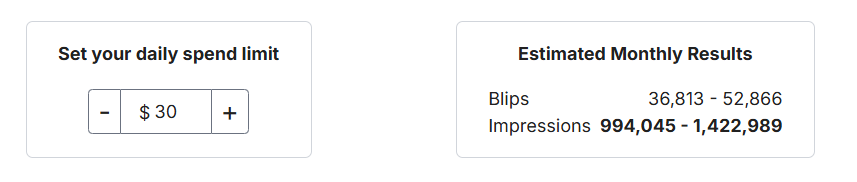
How much is a billboard near Germantown?
Why Choose Blip for Billboard Advertising near Germantown
-
Blip lets you launch billboard ads in Germantown fast, picking nearby Menomonee Falls boards that catch I-41 commuter traffic in minutes.
-
Set flexible budgets in Germantown and pay only for blips, ideal for testing suburban households, regional shoppers, and Washington County drive-bys.
-
Daypart your Germantown campaign for 6-9 a.m. and 3-7 p.m. to reach repeat commuters, school families, and shift workers when they’re on the road.
-
No contracts means Germantown advertisers can spike spend for summer fairs, Brewers games, or back-to-school season, then adjust anytime.
-
Track Germantown results in real time and shift creative as traffic changes on I-41, County Line Road, and Fond du Lac Avenue.
-
Use Blip’s creative tools to build clear Germantown messages for home services, hiring, or winter prep that drivers can read in one glance.
Frequently Asked Questions About Billboard Advertising near Germantown
How much does a billboard cost in Germantown, Wisconsin with Blip?
Blip makes billboard advertising in the Germantown area flexible and affordable. You choose a daily budget, and you only pay when your ad actually runs, with each 7.5-to-10-second display, or “blip,” starting at just $0.01 per display. Pricing can change based on time of day, location, and demand, so Blip works to stretch your budget and maximize your reach.
Where can I advertise with Blip near Germantown, Wisconsin?
We currently serve the Germantown area with 2 digital billboards in nearby Menomonee Falls, within 10.0 miles of the market and about 3.5 miles from the Village of Germantown. That positioning lets us reach people traveling between Washington County, Waukesha County, and the northwest side of Milwaukee without needing billboard inventory inside village limits. For local businesses, regional retailers, service companies, schools, and employers, the Germantown area offers the kind of repeat vehicle exposure that digital out-of-home campaigns are built to capture.
Is Blip a good way to reach commuters in Germantown, Wisconsin?
Commuters are the most obvious audience near Germantown, and they are one of the best billboard audiences too. In a market where more than 4 out of 5 workers commute by car, we can build strong repetition without needing a huge number of boards. We can place hiring messages where workers are already thinking about wages, schedules, commute convenience, and benefits.
What traffic routes near Germantown, Wisconsin get the most billboard exposure with Blip?
The most important roadway serving the Germantown area is Interstate 41, which connects the market to Milwaukee to the south and to Richfield, Slinger, West Bend, and Fond du Lac to the north. According to traffic data from the Wisconsin Department of Transportation, segments of I-41 near County Line Road and nearby interchanges commonly exceed 100,000 vehicles per day. Surface routes like WI 145, County Line Road, WI 167, and Pilgrim Road also carry steady local and commuter traffic.
When is the best time to run billboards in Germantown, Wisconsin?
Timing matters here, and we usually recommend stronger weekday presence from 6:00 to 9:00 a.m. and 3:00 to 6:00 p.m., because those windows align with commute routines and errand planning. Winter is a strong fit for weekday evening visibility from 3:00 to 7:00 p.m. because darkness increases visual prominence and weather tends to lengthen drive times. Summer and fall also bring major local and regional travel tied to fairs, festivals, schools, and holiday shopping.
Do I need a contract to advertise with Blip near Germantown?
No, Blip has no long-term contracts or minimum commitments. You can start, pause, or stop your campaign at any time.
How fast can I launch a billboard campaign with Blip near Germantown?
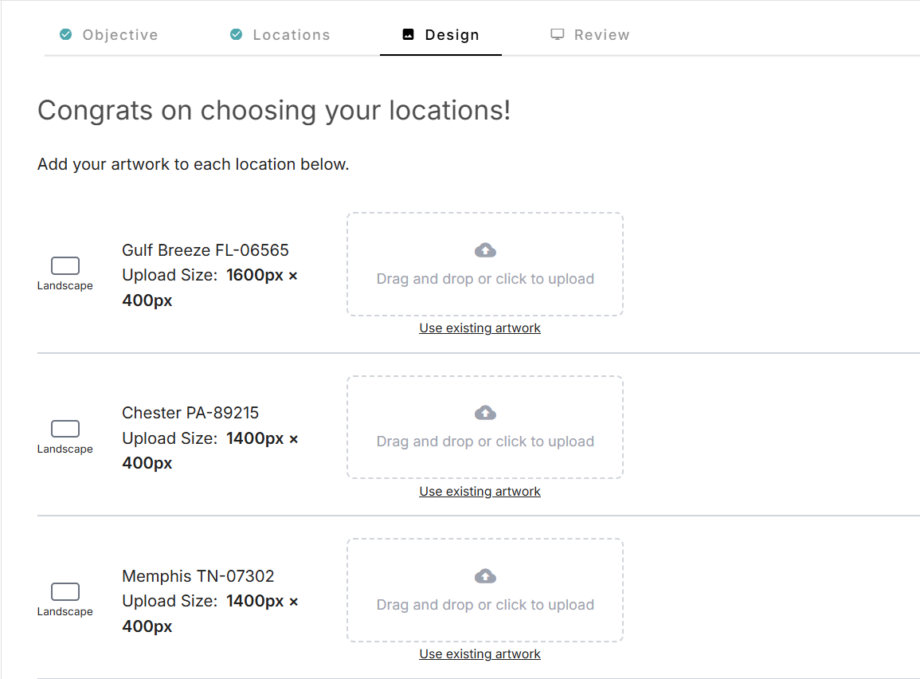
You can have your campaign live in minutes. Create a free account, select your locations, set your budget, upload your design, and start running once approved.
Where can I advertise with Blip near Germantown?
Blip has digital billboards near Germantown. You can browse available locations on a map, choose the ones that fit your audience, and start advertising right away.
Still have questions? Launch a campaign in minutes — no contracts, no commitments.
Start Your CampaignGermantown Billboard Advertising Guide
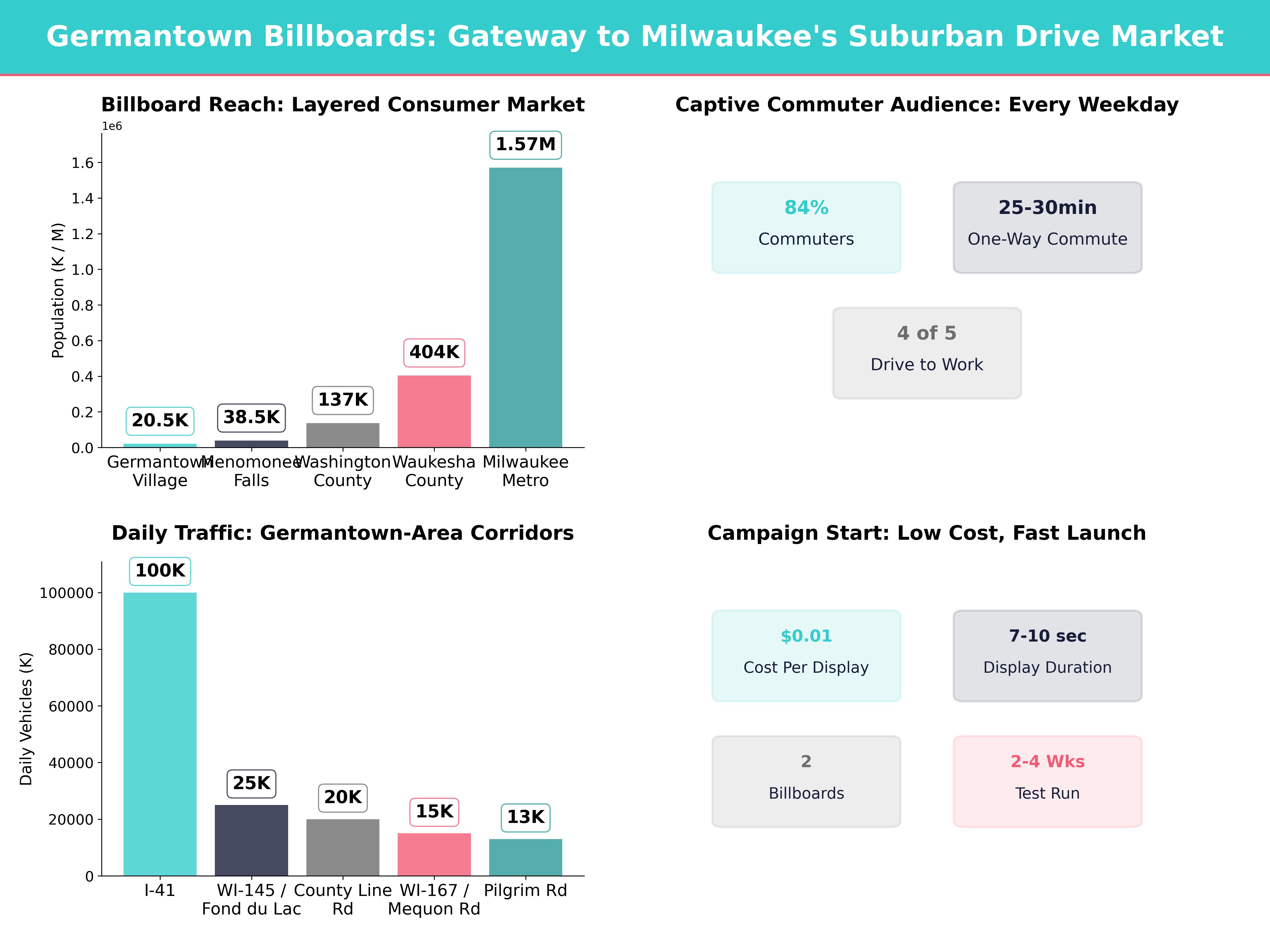
Billboard advertising near Germantown works well because the market sits at a high-value intersection of suburban households, regional commuter traffic, and northwest Milwaukee economic activity, serving roughly 20,539 Germantown residents, 136,761 Washington County residents, and about 1.57 million people in the Milwaukee metro. We currently serve the Germantown area with 2 digital billboards in nearby Menomonee Falls 10.0 miles of the market and about 3.5 miles from the Village of Germantown Washington County Waukesha County, and the northwest side of Milwaukee
Germantown area market overview
Population, trade area, and regional scale
The Germantown area is large enough to support local targeting, but connected enough to support regional campaigns too. That combination matters because many advertisers are not only trying to reach village residents, but also the broader pool of people who shop, work, commute, and spend time near Germantown.
- The Village of Germantown 20,539 residents at the 2020 count.
- Nearby Menomonee Falls 38,527 residents at the 2020 count.
- Washington County 136,761 residents at the 2020 count.
- Adjacent Waukesha County had 404,198 residents at the 2020 count.
- The broader Milwaukee metro totals roughly 1.57 million residents, which gives the Germantown area a much larger consumer ecosystem than its village population alone suggests.
We should think about the Germantown area as a practical suburban trade zone rather than a single municipal boundary. Residents regularly move among Richfield Jackson Sussex Menomonee Falls
The area also benefits from its place in the Milwaukee 7 7 counties. That regional context makes near-Germantown billboard campaigns useful not only for hyperlocal businesses, but also for brands that want suburban Milwaukee reach without paying for the densest urban inventory.
Economic indicators and commuting behavior near Germantown
The Germantown area has a strong suburban economic profile. We see a healthy mix of manufacturing, logistics, construction, health care, professional services, retail, education, and home services throughout Washington County Waukesha County, and the wider metro.
A few numbers help explain why this matters for billboard planning:
- The Wisconsin Department of Workforce Development has frequently shown Washington County 2% to 3% in recent years.
- In suburban communities like those serving the Germantown area, drive-alone commuting typically exceeds 80% of workers, often around 84%.
- Typical one-way commute times often land in the 25- to 30-minute range.
- Downtown Milwaukee is roughly 25 miles from the Germantown area, close enough for frequent work and entertainment travel, but far enough that roadway media gains repeated exposure value.
That last point is especially important. In an auto-oriented market where most workers commute by personal vehicle, billboards are not just awareness tools. They are frequency tools. We can put a message in front of the same driver several times per week as that person moves between home, work, errands, and weekend activities.
Key traffic corridors serving the Germantown area
I-41 is the primary high-volume spine near Germantown
The most important roadway serving the Germantown area is Interstate 41. It connects the market to Milwaukee to the south, and to Richfield Slinger West Bend, and Fond du Lac to the north.
According to traffic data from the Wisconsin Department of Transportation, segments of I-41 near County Line Road and nearby interchanges commonly exceed 100,000 vehicles per day. That is the kind of volume that makes nearby Menomonee Falls inventory relevant for advertisers targeting the Germantown area, even when the billboard face is just outside the village boundary.
For many campaigns, I-41 serves three jobs at once:
- It captures daily work commuters.
- It reaches regional shoppers and dining traffic.
- It picks up weekend recreation and event travel.
When we want broad awareness, freeway visibility is usually the first place to start.
Surface routes near Germantown help convert local intent
Freeways create reach, but local arterials often create intent. The Germantown area is supported by several important surface routes that carry residents between neighborhoods, schools, retail centers, and employment corridors.
- WI 145 / Fond du Lac Avenue often carries roughly 20,000 to 30,000 vehicles per day on busier segments near the Germantown and Menomonee Falls market.
- County Line Road commonly carries 20,000 or more vehicles per day near commercial nodes and freeway access points.
- WI 167 / Holy Hill Road / Mequon Road often falls in the 10,000 to 20,000 vehicles-per-day range on active stretches serving the Germantown area.
- Pilgrim Road and nearby north-south connectors frequently carry about 10,000 to 15,000 vehicles per day on busier suburban stretches.
These roads matter because they support practical consumer behavior. We use them to reach people going to grocery stores, youth sports, restaurants, auto service appointments, medical clinics, and shopping districts. If I-41 is the awareness engine, these arterials are often the reminder network.
Why Menomonee Falls billboards still serve Germantown well
Because our digital billboards are in nearby Menomonee Falls 3.5 miles from the village can outperform a technically closer location if it captures stronger commuter flows, cleaner sightlines, or more relevant trip purposes.
For the Germantown area, that means nearby Menomonee Falls inventory is especially useful for:
- Southbound and northbound I-41 commuters.
- County Line retail and dining traffic.
- Cross-county travel between Washington and Waukesha counties.
- Regional trips heading toward Milwaukee events, shopping, and entertainment.
Germantown area audience segments
Commuters and shift-based workers
Commuters are the most obvious audience near Germantown, and they are one of the best billboard audiences too. In a market where more than 4 out of 5 workers commute by car, we can build strong repetition without needing a huge number of boards.
This audience includes people traveling to and from:
- Industrial and business parks in the Germantown area.
- Office and retail concentrations in nearby Menomonee Falls
- Employers across Milwaukee Waukesha County, and Washington County
- Health care, construction, logistics, and skilled-trades jobs with early or staggered shifts.
For recruiting campaigns, this is especially valuable. We can place hiring messages where workers are already thinking about wages, schedules, commute convenience, and benefits.
Families, homeowners, and local service buyers
The Germantown area has a strong family-and-homeowner profile, which makes it a natural fit for service businesses. We see good alignment for HVAC, plumbing, roofing, landscaping, pest control, pediatric care, orthodontics, family dining, youth programs, insurance, and financial services.
A few local signals support that strategy:
- The Germantown School District serves roughly 4,000 students.
- School calendars create reliable demand cycles from late August through early June.
- Suburban owner-occupied housing makes recurring maintenance and improvement spending especially relevant near Germantown.
For these audiences, billboard messages do not need to be flashy. They need to be useful. Clear offers, recognizable brands, and practical calls to action tend to outperform abstract branding when we are aiming at household decision-makers.
Students, parents, and education-related audiences
The Germantown area is not a classic college-town market, but education still creates meaningful advertising opportunities. Students, parents, staff, and adult learners all travel the same roads that serve the area.
Relevant institutions include Germantown School District, Milwaukee Area Technical College, Moraine Park Technical College, Concordia University Wisconsin, and the broader University of Wisconsin-Milwaukee network.
This audience responds well to campaigns for:
- Enrollment drives.
- Child care and after-school programs.
- Tutoring and test prep.
- Apartments and student-friendly banking.
- Part-time hiring.
- Health, dental, and vision services.
Tourists, recreation visitors, and event travelers
The Germantown area also benefits from regional visitor traffic. It sits close to popular recreation and pilgrimage destinations, while also drawing from the broader entertainment pull of Milwaukee.
Notable travel drivers include Holy Hill Basilica and National Shrine Pike Lake Unit of the Kettle Moraine State Forest, Washington County Fair Park & Conference Center, and Little Switzerland.
Milwaukee-bound event traffic adds another layer:
- The Milwaukee Brewers play 81 regular-season home games at American Family Field.
- Summerfest runs across 3 weekends.
- The Wisconsin State Fair runs 11 days each summer.
- Fiserv Forum and the Milwaukee County Zoo Visit Milwaukee.
For advertisers with broad consumer appeal, these regional travel patterns give near-Germantown billboards a longer reach than the village population alone would suggest.
Seasonal and timing opportunities near Germantown
Spring and early summer near Germantown
Spring is one of the best times to advertise near Germantown if we are selling services, outdoor products, health care, or home projects. As soon as weather improves, residents shift into action mode.
We typically like spring campaigns for:
- Lawn care and landscaping.
- Exterior remodeling and roofing.
- Auto maintenance after winter wear.
- Allergy, dental, and family health services.
- Real estate and moving services.
Timing matters here. We usually recommend stronger weekday presence from 6:00 to 9:00 a.m. and 3:00 to 6:00 p.m., because those windows align with commute routines and errand planning.
Summer festivals, fairs, and recreation traffic
Summer brings the broadest mix of local and regional mobility near Germantown. Families are out more often, schools are out, and weekend traffic becomes more recreational.
Important summer anchors include:
- The Washington County Fair, which runs for 6 days in late July.
- The Wisconsin State Fair, which runs for 11 days in early August.
- Summerfest, which runs over 3 weekends.
- Brewers season, with 81 home games.
- Milwaukee’s heavy festival calendar from June through September.
This is a good season for restaurants, attractions, retail, entertainment, tourism, beverages, family events, outdoor gear, and convenience-driven offers. Weekend campaigns often work better in summer than they do in colder months.
Fall routines, schools, and holiday ramp-up
Fall is one of the most strategic periods for the Germantown area because it combines the return of routine with strong seasonal demand. Schools restart in late August or early September, youth activities pick back up, and fall color travel increases around Holy Hill Kettle Moraine area across September and October.
We often recommend fall campaigns for:
- Back-to-school retail.
- Sports physicals and health care.
- Heating and insulation services.
- Auto tires and winter prep.
- Financial planning.
- Community events and church programming.
Then holiday retail begins. The core holiday selling period typically compresses into about 5 to 6 weeks, so frequency matters more than long copy. We want short, memorable messages that drivers can absorb instantly.
Winter timing near Germantown
Winter changes visibility and consumer behavior in useful ways. Around the Milwaukee area, sunset comes before 4:30 p.m. in December, so the evening commute starts feeling like nighttime much earlier. Bright digital creative can stand out strongly in that environment.
Winter is a strong fit for:
- Snow removal, towing, and auto service.
- Heating, plumbing, and emergency home repair.
- Health care and urgent care.
- Tax prep from January through April.
- Ski and recreation traffic tied to Little Switzerland.
- Restaurants, coffee, and indoor family entertainment.
We usually prioritize weekday evening visibility from 3:00 to 7:00 p.m. in winter, because darkness increases visual prominence and weather tends to lengthen drive times.
Billboard design tips for the Germantown area
Design for fast suburban traffic near Germantown
Because many of the best impressions come from I-41 and other higher-speed roads, we should design for instant comprehension. On freeway segments where traffic can move at 70 mph, drivers do not have time to decode clutter.
Our best practice for the Germantown area is simple:
- Use 1 main idea.
- Use 1 dominant visual.
- Use 1 logo.
- Use 1 short call to action.
- Keep headline copy to about 7 words or fewer.
That approach is especially important when we are serving the Germantown area from nearby Menomonee Falls boards. The ad needs to communicate before the driver is past the read zone.
Use visuals that feel local to the Germantown area
Creative that fits the local environment usually performs better than generic stock imagery. Near Germantown, we often recommend visuals that reflect suburban Wisconsin life rather than dense urban imagery.
Good local cues include:
- Families, youth sports, patios, driveways, and home exteriors.
- Trucks, vans, and service vehicles.
- Fall trees, winter weather, and outdoor recreation.
- Practical business imagery for skilled trades, manufacturing, and logistics.
Color choices matter too. Forest green, navy, white, warm orange, and high-contrast red can all work well in this market. In winter, high-contrast color schemes become even more important because road spray, cloud cover, and early darkness reduce the readability of low-contrast artwork. In summer, when daylight lasts past 8:00 p.m., stronger contrast still helps against bright ambient light.
Message with clarity, value, and local relevance
The Germantown area tends to reward direct messaging. We generally see stronger results from practical offers than from vague brand poetry.
Useful message styles include:
- “Open Saturday.”
- “Free Estimate.”
- “Now Hiring.”
- “Just Minutes Away.”
- “Same-Day Service.”
- “Book This Week.”
If location matters, we can reference broader geography without claiming the billboard sits inside the village. Phrases like “serving the Germantown area,” “near County Line Road,” or “minutes from the Germantown area” keep the message accurate and useful.
Regional strategies serving the Germantown area
Use Menomonee Falls as the gateway to the Germantown market
Because our 2 digital boards are in nearby Menomonee Falls
This strategy works especially well for:
- Retailers drawing from southern Washington County.
- Restaurants and entertainment venues.
- Home service brands covering multi-city service areas.
- Medical and dental offices.
- Recruiting campaigns for employers with regional labor pools.
For many businesses, a nearby Menomonee Falls board is not a compromise. It is the correct approach because it intercepts travelers before they make spending decisions.
Segment by trip type, not just by municipal boundary
We usually recommend planning around behavior instead of borders. The Germantown area contains several overlapping trip patterns:
- Daily work commutes.
- School and family errands.
- Weekend shopping runs.
- Church and recreation travel.
- Regional event traffic toward Milwaukee.
A home services company may care most about weekday commuter repetition. A restaurant may care more about Thursday through Saturday afternoons. A recruiter may want early-morning and shift-change windows. An event promoter may want a short burst 7 to 10 days before the event.
When we organize the campaign around the trip purpose, the board selection and dayparting decisions become much clearer.
Expand messaging to the wider Washington County draw area
If a business serves more than the village itself, we can widen the creative message to include the county-level audience. Nearby communities such as Richfield Jackson Slinger West Bend often share the same commuting and shopping routes that pass near Germantown.
That makes regional messaging especially effective for:
- Health systems.
- Auto dealers.
- Banks and credit unions.
- Trades and contractors.
- Furniture and mattress stores.
- Community colleges and workforce programs.
Blip tools for campaigns near Germantown
We can control reach without overbuying the Germantown area
Blip is useful in the Germantown area because we do not need to overcommit to get started. Since the market is currently served by 2 nearby digital billboards in Menomonee Falls, we can select those specific locations on a map and focus on the routes that matter most.
That flexibility matters when we want to:
- Test one board versus both boards.
- Concentrate on weekdays rather than weekends.
- Increase spend during fair week, back-to-school season, or holiday shopping.
- Pause or adjust quickly if demand changes.
We can match budgets to local timing patterns
The Germantown area has clear timing rhythms, and Blip makes them easy to follow. We can place more budget behind the moments that matter most, such as 6:00 to 9:00 a.m., 11:00 a.m. to 1:00 p.m., or 3:00 to 7:00 p.m., instead of spreading spend evenly across low-value hours.
A few platform details support that strategy naturally:
- Ads display for about 7.5 to 10 seconds per blip.
- Pricing starts at $0.01 per display.
- Campaigns can run with any budget level, which is helpful for local businesses testing the Germantown area for the first time.
Because pricing varies by demand, we can stay disciplined. That is especially useful for seasonal bursts, recruiting pushes, or event countdowns when we want efficiency more than excess inventory.
We can learn quickly and improve creative fast
Digital boards are most powerful when we treat them like an iterative channel. Near Germantown, we often recommend testing 2 creative versions rather than assuming the first one is perfect.
For example, we might compare:
- A direct price or offer message versus a brand-awareness message.
- A family-oriented visual versus a more product-driven visual.
- A weekday commuter schedule versus a mixed weekday-and-weekend schedule.
With real-time reporting, we can see what is delivering and keep improving instead of waiting for a long fixed contract to end.
Getting started with billboard rental serving the Germantown area
Start by defining the real goal
Before we choose a board, we should decide what success looks like. Near Germantown, the right billboard strategy for a restaurant is different from the right strategy for a roofer, a medical clinic, or a manufacturing employer.
We usually start with one of these goals:
- Build local awareness.
- Drive store visits.
- Support a seasonal promotion.
- Recruit employees.
- Promote an event.
- Reinforce a broader media plan.
That goal determines whether we should favor commuter-heavy timing, weekend traffic, or short high-frequency bursts.
Evaluate billboard fit based on travel behavior
Since the Germantown area is served by nearby Menomonee Falls inventory, location fit should be judged by traffic behavior, not by ZIP code alone. A billboard 3.5 miles away can be ideal if it intercepts the right audience at the right moment.
We recommend asking five practical questions:
- Does the board reach people traveling to or from the Germantown area?
- Is the audience commuting, shopping, or making a service decision nearby?
- Is the business within a realistic 10- to 15-minute drive of the board?
- Can the message be understood in 1 glance?
- Is the campaign timed to a real seasonal or daily demand window?
If the answer is yes to most of those questions, the location is probably a good fit.
Expect a simpler process than traditional billboard buying
Traditional billboard companies often require rep-led conversations, fixed terms, limited flexibility, and production coordination. Blip simplifies that process. We can choose digital boards online, upload creative, set a daily budget, adjust timing, and make changes without the slower workflow that usually comes with conventional out-of-home buying.
For the Germantown area, that is especially helpful because many advertisers want to:
- Test the market before scaling.
- Support a promotion for only 2 to 4 weeks.
- Shift creative quickly between seasons.
- Run around specific dates like the fair, school registration, or holiday retail peaks.
Launch, measure, and refine
The best way to start near Germantown is usually with a focused test campaign. We recommend selecting the nearby Menomonee Falls billboards, aligning the schedule with actual customer movement, and monitoring response through website traffic, branded search, calls, promo codes, or store-visit trends.
Then we refine:
- If weekday mornings perform best, we shift more budget there.
- If one creative clearly wins, we rotate out the weaker version.
- If weekends show strong lift during summer, we lean into seasonal traffic.
- If the campaign proves the area, we expand duration or add more regional boards later.
That approach lets us build a billboard program for the Germantown area based on evidence, not guesswork.