Billboards near Shorewood, WI
No Minimum Spend. No Long-Term Contracts. Just Results.
Trusted by Leading Brands


Billboard advertising
near Shorewood has never been easier




How much is a billboard near Shorewood?
Why Choose Blip for Billboard Advertising near Shorewood
Blip lets you launch fast in Shorewood and target I-43 commuters without contracts or minimums.
Use Blip in Shorewood to auto-pick billboards and timing for North Shore households, UWM students, and downtown Milwaukee traffic.
Set flexible daily budgets in Shorewood and stretch spend across peak hours on Capitol Dr, Silver Spring Dr, and Port Washington Rd.
Track Shorewood campaign results in real time and shift bids as event traffic builds for Fiserv Forum, American Family Field, and Summerfest.
Blip’s creative tools help Shorewood ads stand out with clear, bold designs for fast-moving I-43 drivers and local shoppers.
Frequently Asked Questions About Billboard Advertising near Shorewood
How much does a billboard cost in Shorewood with Blip?
Blip makes billboard advertising in the Shorewood area flexible and easy to budget for. You only pay when your ad actually appears, with each 7.5-to-10-second display called a blip, and pricing starts at just $0.01 per display. Since costs can change based on time of day, location, and demand, Blip helps stretch your budget to maximize reach without locking you into contracts or minimums.
Where can I advertise with Blip in Shorewood?
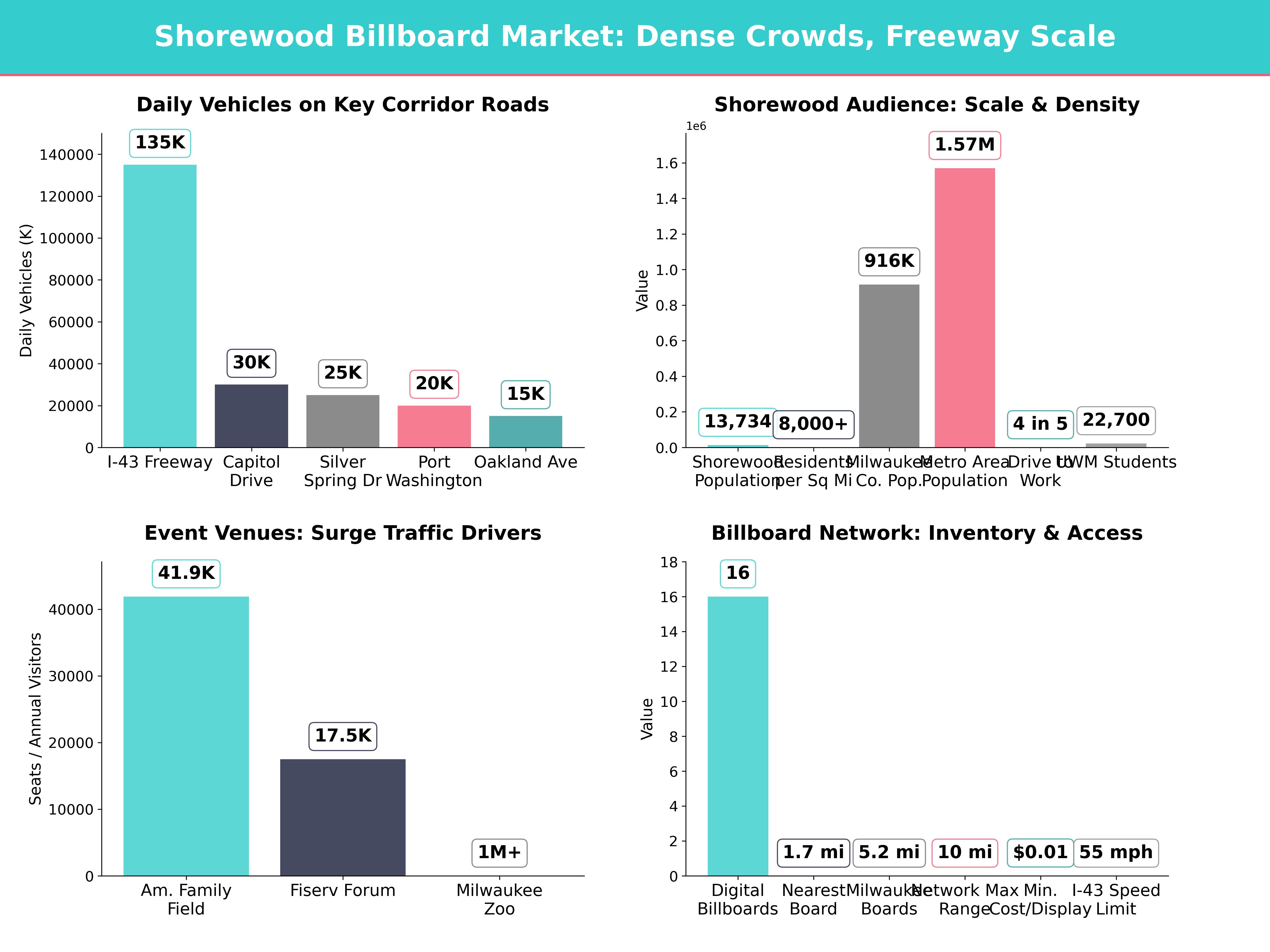
Our 16 digital billboards serving the Shorewood area are all located in nearby Glendale and Milwaukee, with inventory as close as 1.7 miles from Shorewood and all of it within 10.0 miles. That gives us practical reach near the Village of Shorewood without limiting a campaign to one small municipal footprint. For brands that want flexible visibility near Shorewood, the market combines local frequency, regional movement, and year-round activity unusually well.
What makes the Shorewood area a strong billboard market?
The Shorewood area is a strong billboard market because it sits at the meeting point of dense North Shore households, major commuter routes that carry roughly 120,000 to 150,000 vehicles per day on nearby I-43, university traffic from roughly 22,700 UWM students, and Milwaukee entertainment travel to venues with 17,500 seats at Fiserv Forum and about 41,900 at American Family Field. The surrounding market adds even more scale, including Milwaukee County’s 2020 population of 916,205 and the broader Milwaukee metro at about 1.57 million residents. Shorewood also sits directly beside Whitefish Bay, Glendale, and Milwaukee’s East Side, so advertisers are reaching a connected North Shore audience that crosses municipal lines constantly.
When is the best time to run a Shorewood Blip campaign?
Spring and summer are especially strong because the Shorewood area is tied to Lake Michigan, neighborhood parks, festivals, and patio traffic. Late August through October is another high-value window because UWM move-in, the start of fall classes, and the return of full K-12 schedules all increase repetitive travel. Winter can also work well near Shorewood, especially in the morning, afternoon, and Thursday through Sunday for dining, retail, and entertainment.
How does Blip help with billboard testing near Shorewood?
Blip also works well because Shorewood is a market where timing matters. Morning commuters, afternoon school traffic, evening entertainment trips, and weekend leisure movement do not all behave the same way. Each ad display is a 7.5-to-10-second blip, pricing starts at $0.01 per display, and we can start, stop, or modify campaigns without contracts.
Do I need a contract to advertise with Blip near Shorewood?
No, Blip has no long-term contracts or minimum commitments. You can start, pause, or stop your campaign at any time.
How fast can I launch a billboard campaign with Blip near Shorewood?
You can have your campaign live in minutes. Create a free account, select your locations, set your budget, upload your design, and start running once approved.
Where can I advertise with Blip near Shorewood?
Blip has digital billboards near Shorewood. You can browse available locations on a map, choose the ones that fit your audience, and start advertising right away.
Still have questions? Launch a campaign in minutes — no contracts, no commitments.
Start Your CampaignShorewood Billboard Advertising Guide
The Shorewood area is a strong billboard market because it sits at the meeting point of dense North Shore households, major commuter routes that carry roughly 120,000 to 150,000 vehicles per day on nearby I-43, university traffic from roughly 22,700 UWM students, and Milwaukee entertainment travel to venues with 17,500 seats at Fiserv Forum and about 41,900 at American Family Field. Our 16 digital billboards serving the Shorewood area are all located in nearby Glendale Milwaukee 1.7 miles from Shorewood and all of it within 10.0 miles. That gives us practical reach near the Village of Shorewood
Shorewood Area Market Overview
Why the Shorewood area matters to advertisers
The Village of Shorewood 2020 population of 13,734, and the village packs that audience into less than 2 square miles, which translates to more than 8,000 residents per square mile. That density matters because it creates short, repeated travel patterns for errands, school drop-offs, dining, fitness, healthcare, and commuting.
The surrounding market adds even more scale. Milwaukee County 2020 population of 916,205, and the broader Milwaukee metro totals about 1.57 million residents. Shorewood also sits directly beside Whitefish Bay Glendale
This is also a high-value market because Shorewood combines stable households, a strong neighborhood retail culture, and a location just north of downtown Milwaukee. Local businesses, professional services, healthcare brands, schools, arts organizations, and real estate advertisers can all benefit from that mix. The village’s income and education profile is generally stronger than the county average, while its proximity to the East Side keeps the audience younger and more mobile than many outer-ring suburbs.
Demographics, economics, and commuting behavior near Shorewood
From an advertising standpoint, the Shorewood area works because it blends several audience types at once. We can reach established homeowners, renters, graduate students, faculty, downtown professionals, and North Shore families on the same campaign. That overlap is especially valuable for categories such as healthcare, financial services, higher education, restaurants, home services, recruiting, and events.
Driving still dominates regional travel. In Milwaukee County 4 in 5 workers commute by car, truck, or van. The Shorewood area is more walkable and bike-friendly than many suburbs, especially near the University of Wisconsin–Milwaukee, but autos still drive most school, shopping, and cross-town trips. That means billboard exposure near Shorewood is not just about freeway commuters. It also captures daily repeat travel from people moving between Shorewood, Glendale retail, downtown offices, and the East Side.
We also like this market because its commercial and civic anchors create consistent year-round movement. The Shorewood Business Improvement District, North Shore Chamber of Commerce, Shorewood School District Milwaukee County Transit System all help keep the area active beyond a single peak season.
Key Traffic Corridors Near Shorewood
The freeway spine serving the Shorewood area
The biggest traffic advantage near Shorewood is the north-south freeway network just west of the village. According to WisDOT traffic count resources I-43 near Milwaukee and Glendale commonly carry roughly 120,000 to 150,000 vehicles per day. For advertisers, that is the backbone of regional reach serving the Shorewood area.
I-43 matters because it collects traffic from several different intent groups at once. It carries downtown commuters, North Shore residents traveling to work, shoppers headed to Glendale, event traffic headed south, and visitors moving between hotels, attractions, and the lakefront. A campaign on boards near this corridor can deliver repeated impressions to people who live near Shorewood even if their destination changes day to day.
Interchanges near Capitol Drive, Hampton Avenue, and Silver Spring Drive are especially important because they connect Shorewood-area drivers to the freeway quickly. If we want broad awareness, these approaches are usually the first places we examine.
Surface streets that feed Shorewood’s daily routines
The local street network is just as important because Shorewood is a short-trip market. WisDOT counts generally show substantial volume on the roads that feed the village’s retail, school, and neighborhood activity.
- Capitol Drive near the Shorewood area and I-43 typically carries about 25,000 to 35,000 vehicles per day.
- Silver Spring Drive through Glendale’s retail corridor often carries roughly 20,000 to 30,000 vehicles per day.
- Port Washington Road near commercial zones and freeway connections frequently lands in the 15,000 to 25,000 vehicles per day range.
- Oakland Avenue and nearby lakefront connectors often carry about 10,000 to 20,000 vehicles per day depending on the segment.
Those numbers are important because Shorewood-area travel is not only commuter travel. It is also grocery runs, school pickups, medical visits, restaurant trips, and neighborhood shopping. Streets connected to Bayshore, UWM, and the East Side give us strong exposure to that everyday movement.
Why these corridors work for Shorewood-focused campaigns
We usually think about Shorewood-area routing in three layers.
- The freeway layer captures scale and commuter repetition.
- The commercial arterial layer captures shoppers and families.
- The lakefront and campus layer captures students, young professionals, and leisure travel.
That layered approach is why nearby Glendale and Milwaukee boards can serve Shorewood so effectively. The audience does not stay inside one small geography. It moves across corridors all day.
Audience Segments in the Shorewood Area
Commuters and professionals serving the Shorewood area
Shorewood sits only a few miles north of downtown Milwaukee, so many households near Shorewood travel south for work, meetings, events, and services. That makes commuter campaigns especially effective for banks, legal services, healthcare systems, staffing firms, B2B brands, and regional retail.
Because Milwaukee County has 916,205 residents, and because the metro has about 1.57 million, a Shorewood-area campaign can scale beyond the village itself quickly. Boards in nearby Milwaukee also help us reach professionals traveling to the Wisconsin Center District, Fiserv Forum, and major downtown employers.
Students, faculty, and young adults near Shorewood
The student audience is a major differentiator here. The University of Wisconsin–Milwaukee enrolls roughly 22,700 students, and its campus sits immediately south of the Shorewood area. That creates steady movement from students, graduate assistants, faculty, staff, and visiting families.
This matters for advertisers in education, wireless, apartments, fitness, entertainment, food delivery, healthcare, and recruiting. It also matters for brands that need a younger audience without abandoning higher-income households. The Shorewood area gives us both.
The local K-12 audience is meaningful too. Shorewood School District 2,500 students, which helps sustain family-oriented trips around the school calendar. For tutoring, orthodontics, after-school programs, camps, and family services, that is a useful concentration.
Families, shoppers, and neighborhood consumers
The Shorewood area is not only a commuter market. It is a routine-purchase market. Families and neighborhood consumers make frequent local trips for coffee, groceries, dining, childcare, pharmacy needs, pet care, and recreation.
Nearby Bayshore in Glendale is a major retail and dining anchor serving the North Shore. The Shorewood business district, the East Side commercial corridors, and adjacent communities such as Whitefish Bay Fox Point
Visitors, sports fans, and entertainment audiences
The Shorewood area also participates in Milwaukee’s visitor economy. Residents near Shorewood regularly travel to Summerfest, Wisconsin State Fair, American Family Field, Fiserv Forum, the Milwaukee Art Museum, the Milwaukee Public Museum, and the Harley-Davidson Museum.
A few numbers show why that matters.
- Summerfest runs across 3 weekends and 9 festival days.
- Wisconsin State Fair runs for 11 days.
- Fiserv Forum seats about 17,500 for basketball.
- American Family Field has a baseball capacity of about 41,900.
- The Milwaukee County Zoo more than 1 million visitors annually.
Those trips create opportunities for restaurants, hospitals, attorneys, universities, tourism brands, rideshare services, and entertainment advertisers serving the Shorewood area.
Seasonal and Timing Opportunities Near Shorewood
Spring and summer near Shorewood
Spring and summer are especially strong because the Shorewood area is tied to Lake Michigan, neighborhood parks, festivals, and patio traffic. As the weather improves, the audience expands beyond routine commuters to include beachgoers, park users, shoppers, and event attendees.
This is when we like to emphasize dining, retail, healthcare, home improvement, real estate, and local events. It is also the best window for tourism and entertainment messaging because the region’s visitation peaks around warm-weather programming. Summerfest alone delivers 9 days of concentrated activity, and Wisconsin State Fair adds another 11 days in August.
If a brand wants to own the summer conversation near Shorewood, we often recommend heavier presence from late May through August, with extra weight around festival weekends and lakefront recreation periods.
Back-to-school and fall patterns serving the Shorewood area
Late August through October is another high-value window. UWM move-in, the start of fall classes, and the return of full K-12 schedules all increase repetitive travel. With roughly 22,700 UWM students and about 2,500 Shorewood School District students, the back-to-school cycle is meaningful even before we count parents, faculty, staff, and part-time student workers.
This is a strong season for apartments, storage, furniture, internet service, career programs, tutoring, urgent care, and retail. We also like fall for B2B, professional services, and recruiting because commute patterns become more predictable after summer vacations end.
Holidays and winter timing near Shorewood
Winter can work surprisingly well near Shorewood because the market remains active even when leisure travel dips. Holiday shopping at Bayshore, downtown events at Fiserv Forum, museum visits, medical appointments, and daily commuting all continue. In December, darkness arrives before 5:00 p.m., which can make bright digital creative stand out during the evening drive.
For many advertisers, the best winter windows are:
- 6:00 a.m. to 9:00 a.m. for commuter messaging.
- 3:00 p.m. to 7:00 p.m. for early-darkness visibility.
- Thursday through Sunday for dining, retail, and entertainment.
Billboard Design Tips for the Shorewood Market
Creative choices that fit the Shorewood area
The Shorewood area responds well to polished, modern creative. This is a lakefront North Shore audience, so we usually recommend visuals that feel clean, confident, and locally aware. Deep blues, greens, neutrals, and bright white contrast often work well because they fit the Lake Michigan setting and remain readable in gray-weather months.
We also recommend local relevance over generic Midwest imagery. If the goal is to connect with the Shorewood area, imagery tied to neighborhood retail, campuses, coffee culture, family life, lakefront recreation, or Milwaukee arts and sports usually feels more authentic than broad rural visuals.
Make the message readable at Shorewood-area driving speeds
Many impressions serving Shorewood happen on high-speed routes. On I-43, drivers may be moving around 55 mph, so simple creative matters.
We generally recommend:
- 6 to 8 words on freeway-focused designs.
- 1 main image instead of a collage.
- 1 call to action instead of multiple asks.
- A phone-friendly URL or short brand name that can be understood in a glance.
That advice is especially important for service businesses. A Shorewood-area audience is often deciding quickly between several brands while commuting. Clear category cues such as “Urgent Care,” “Now Leasing,” “North Shore Dental,” or “Open Late” usually outperform clever but vague copy.
Use geography-specific language
Messages that reference the local lifestyle can perform well if they stay concise. Phrases such as “North Shore,” “East Side,” “Lakefront,” “Near UWM,” or “Serving the Shorewood Area” can create instant context. We also like to match the offer to the corridor. Event ads can lean into downtown energy, while family services can sound more neighborhood-oriented near Glendale routes.
Regional Strategies Serving Shorewood
Use Glendale boards for everyday North Shore frequency
Our nearest inventory is in nearby Glendale 1.7 miles from Shorewood. These boards are excellent for everyday repetition because they sit close to the shopping, school, and service patterns that define the North Shore.
We often prioritize Glendale-area boards for:
- Retail and restaurant campaigns.
- Healthcare and dental practices.
- Home services.
- Local schools and community events.
- Real estate and apartment marketing.
- Family-focused brands.
If the goal is to stay top of mind with households serving the Shorewood area, Glendale usually gives us the strongest local frequency.
Use Milwaukee boards for scale and event-driven reach
Our boards in nearby Milwaukee 5.2 miles from Shorewood, which keeps them close enough to influence the same audience while expanding the campaign’s reach. These boards are especially useful when we want to add commuter scale, downtown exposure, sports and concert visibility, or UWM-adjacent impressions.
Milwaukee boards often make sense for:
- Universities and career programs.
- Regional healthcare systems.
- Recruiting campaigns.
- Law firms.
- Entertainment and attractions.
- Sports, nightlife, and event promotions.
Combine both geographies for full-funnel Shorewood-area coverage
Many advertisers do best when we combine Glendale and Milwaukee rather than choosing only one. Shorewood residents and nearby consumers might live on the North Shore, work downtown, shop in Glendale, and attend events in Milwaukee all within the same week. A combined strategy mirrors how people actually move.
A practical starting approach is to use Glendale for steady household frequency and Milwaukee for broader commuter and event reach. If local frequency is the top priority, we often start around a 60/40 split favoring Glendale. If regional awareness is the goal, a 50/50 split can make more sense.
Blip Tools for Shorewood-Area Campaigns
When Blip-optimized campaigns make sense near Shorewood
If the main goal is efficient reach across all 16 digital billboards serving the Shorewood area, Blip-optimized campaigns are usually the easiest starting point. We can set goals, audience priorities, and budget, and then let the platform allocate across nearby Glendale and Milwaukee inventory based on timing and opportunity.
That approach is especially useful when the target is broad, such as “North Shore awareness,” “Milwaukee-area recruiting,” or “summer event promotion near Shorewood.” It helps us adapt as traffic, demand, and pricing shift.
When manual billboard selection is the better choice
Manual campaigns make more sense when we know exactly which corridors matter. If we want to emphasize Glendale retail routes, UWM-adjacent movement, or southbound commuter traffic into downtown Milwaukee, map-based selection gives us that control.
This can be helpful for:
- School move-in periods.
- Weekend entertainment pushes.
- Short retail promotions.
- Hyperlocal service businesses.
- Directional campaigns tied to specific neighborhoods.
Why Blip fits Shorewood-area testing and optimization
Blip also works well because Shorewood is a market where timing matters. Morning commuters, afternoon school traffic, evening entertainment trips, and weekend leisure movement do not all behave the same way. With Blip, we can test multiple dayparts, compare creatives, and adjust without getting locked into a rigid long-term structure.
A few feature details matter here:
- Each ad display is a 7.5-to-10-second blip.
- Pricing starts at $0.01 per display.
- We can start, stop, or modify campaigns without contracts.
That flexibility is useful in a market that mixes neighborhood routines with festival spikes, university timing, and sports traffic.
Getting Started With Billboard Rental Near Shorewood
Step 1: Define what success looks like near Shorewood
Before selecting boards, we recommend choosing one primary goal. For Shorewood-area campaigns, the most common goals are local awareness, event promotion, lead generation, recruiting, foot traffic, or brand reinforcement.
That first choice affects everything else. A dental office serving the Shorewood area will usually prioritize frequency close to Glendale and North Shore travel paths. A regional university or healthcare system may want a wider blend of Milwaukee and Glendale boards.
Step 2: Match the locations to the audience
When evaluating billboard rental near Shorewood, we usually ask three practical questions.
- Are we trying to reach local households repeatedly?
- Are we trying to intercept commuters headed to downtown Milwaukee?
- Are we trying to capture students, shoppers, or event traffic?
If the answer is mostly local households, the nearest Glendale inventory is often the best fit. If the answer is commuter scale or regional visibility, nearby Milwaukee boards should be part of the mix. If the answer is all of the above, we recommend a combined buy across both cities.
Step 3: Start with a test campaign and learn quickly
One of the simplest ways to begin is with a 2-to-3-week test. We usually suggest launching with 2 dayparts and 3 creative variations so we can learn what message, timing, and geography perform best. That approach gives enough data to see patterns without overcommitting budget.
For example, we might test:
- A commuter-focused message in the morning.
- A family or retail message in late afternoon.
- A weekend version tied to dining, events, or shopping.
Step 4: Use Blip instead of the traditional billboard process
Traditional billboard buying often involves rep conversations, fixed inventory packages, and longer commitments than smaller advertisers want. Blip simplifies the process because we can launch online, control spend directly, evaluate performance in real time, and adjust locations or timing without waiting on a lengthy revision cycle.
That makes billboard rental near Shorewood more accessible for local businesses, regional brands, nonprofits, schools, and event organizers. We can begin with a modest test, learn from the data, and scale only where the Shorewood-area audience is responding.
If we approach the Shorewood market with the right corridor strategy, seasonal timing, and creative discipline, nearby Glendale and Milwaukee boards can deliver far more reach than the village’s small footprint might suggest.