Billboards in Sullivan, WI
No Minimum Spend. No Long-Term Contracts. Just Results.
Trusted by Leading Brands


Billboard advertising
in Sullivan has never been easier
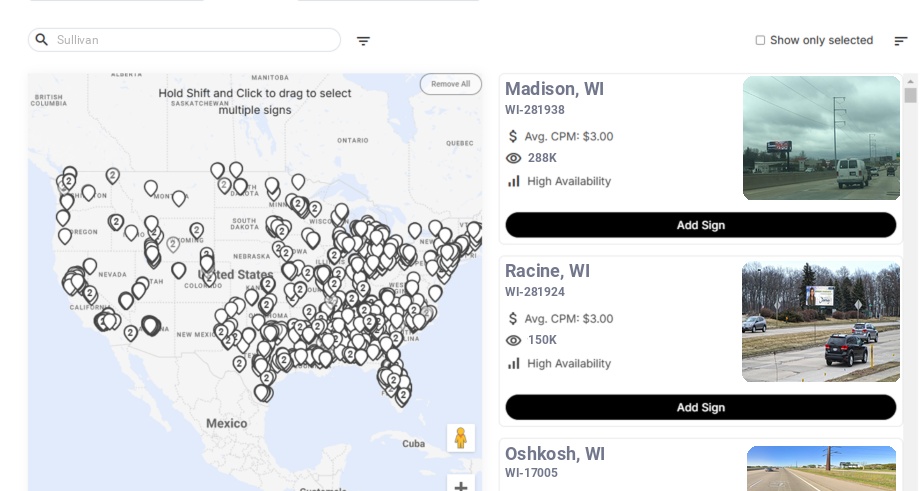



How much is a billboard in Sullivan?
Why Choose Blip for Billboard Advertising in Sullivan
-
Blip's self-serve tools let you launch in Sullivan fast and target I-94 commuters between Madison and Milwaukee without the usual media-buying hassle.
-
In Sullivan, Blip-optimized campaigns can auto-pick timing and boards for I-94, WIS 26, or US 18 to reach commuters, shoppers, and weekend travelers.
-
Flexible budgets fit Sullivan's pay-as-you-play model, so you can scale with traffic on the I-94 corridor and pause anytime no contracts.
-
Use dayparting in Sullivan to hit 6-9 a.m. and 3-6 p.m. commuters, or shift to Friday and weekend traffic for Johnson Creek shoppers and lake-country visitors.
-
Track real-time analytics in Sullivan and move spend toward what works, whether that's interstate reach, local-route repetition, or seasonal traffic near Kettle Moraine.
-
Blip's creative tools help tailor quick, readable ads for Sullivan's 70-mph I-94 drivers and local families heading to outlets, farms, and recreation.
Frequently Asked Questions About Billboard Advertising in Sullivan
How much does a billboard cost in Sullivan, Wisconsin with Blip?
With Blip, the cost of billboard advertising in Sullivan is flexible and easy to control. You choose a daily budget, and Blip’s algorithm uses it to bid for open ad slots on rotating digital billboards, so you only pay when your ad actually displays. Each “blip” is a 7.5-to-10-second placement, with pricing that can start at $0.01 per display and vary based on time of day, location, and advertiser demand.
Where can I advertise with Blip in Sullivan, Wisconsin?
Sullivan sits in the middle of one of Wisconsin’s most practical travel corridors: the I-94 route between Madison and Milwaukee. In this stretch, I-94 carries roughly 40,000 to 55,000 vehicles per day. WIS 26 is the key north-south connector for the Sullivan area, and US 18 gives us a more community-oriented billboard environment.
Why is Sullivan, Wisconsin a good market for Blip billboard ads?
Sullivan’s advertising value comes from geography as much as population. The community sits in Jefferson County, close to Oconomowoc, Johnson Creek, Watertown, and Lake Mills, with straightforward access to both the Milwaukee 7 economy to the east and the Madison Region Economic Partnership economy to the west. That combination of daily driving, regional shopping, and outdoor tourism makes Sullivan a smart place for us to build frequency.
When should I run billboard ads in Sullivan, Wisconsin?
Timing matters in Sullivan because the market changes with weather, school calendars, and recreation patterns. From roughly May through Labor Day, the Sullivan area benefits from lake, trail, camping, golf, and day-trip traffic, while winter from roughly December through March is a strong season for HVAC, plumbing, auto repair, healthcare, and pharmacy. For many Sullivan campaigns, weekday commute windows matter most, especially 6 to 9 a.m. and 3 to 6 p.m.
Do I need a contract to advertise with Blip in Sullivan?
No, Blip has no long-term contracts or minimum commitments. You can start, pause, or stop your campaign at any time.
How fast can I launch a billboard campaign with Blip in Sullivan?
You can have your campaign live in minutes. Create a free account, select your locations, set your budget, upload your design, and start running once approved.
Where can I advertise with Blip in Sullivan?
Blip has digital billboards in Sullivan. You can browse available locations on a map, choose the ones that fit your audience, and start advertising right away.
Still have questions? Launch a campaign in minutes — no contracts, no commitments.
Start Your CampaignSullivan Billboard Advertising Guide
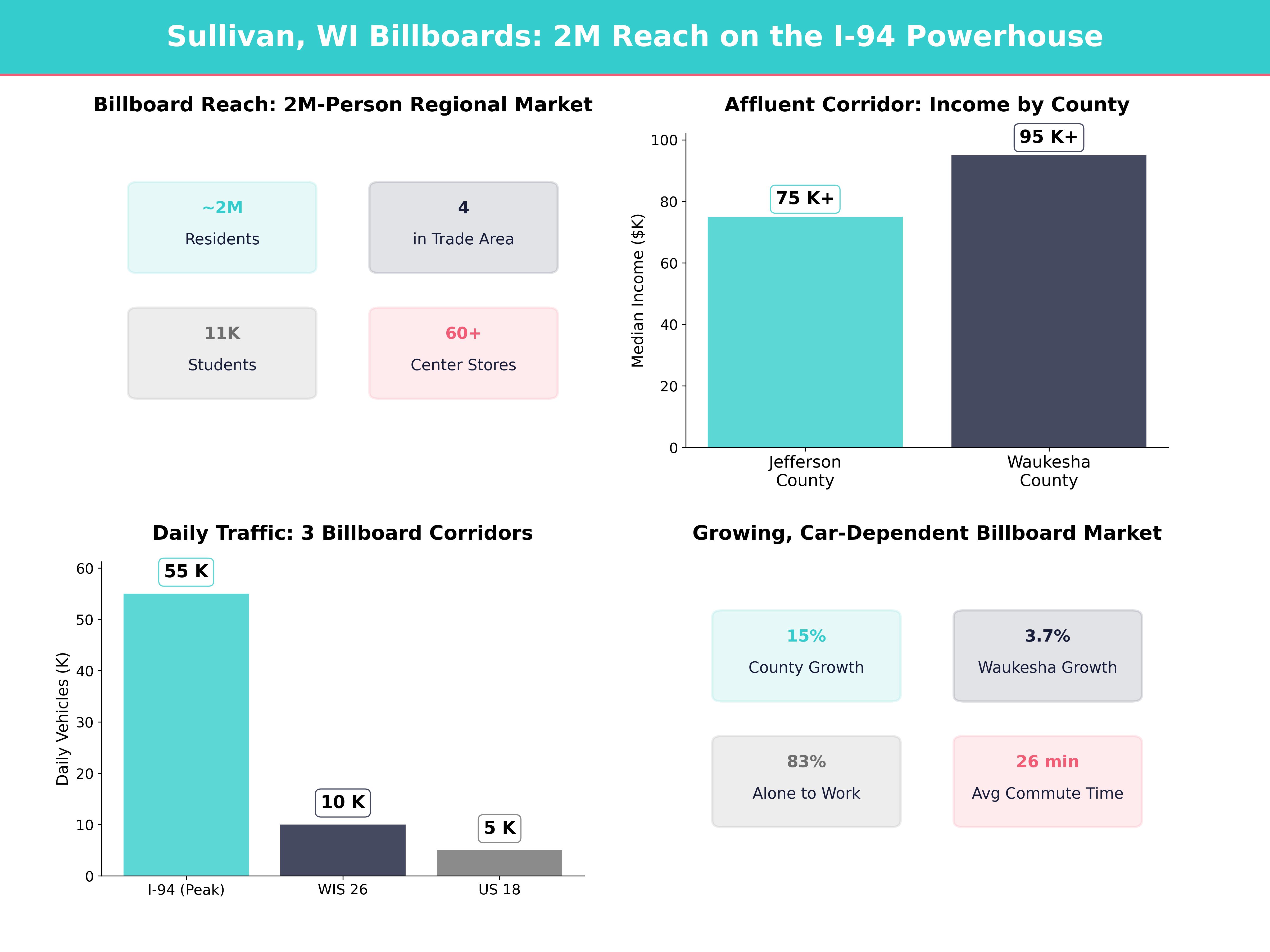
Sullivan I-94 route between Madison Milwaukee 40,000 to 55,000 vehicles per day. While Sullivan itself is small, the surrounding county-and-metro trade area is not. Jefferson County, Waukesha County, Dane County, and Milwaukee County 2.0 million residents (about 1,990,000), and this part of Wisconsin is overwhelmingly car-oriented, with about 83% of workers in Jefferson County driving alone to work. That combination of daily driving, regional shopping, and outdoor tourism makes Sullivan a smart place for us to build frequency, catch travelers in motion, and connect local businesses with high-intent audiences.
Sullivan, Wisconsin Market Overview
Sullivan’s advertising value comes from geography as much as population. The community sits in Jefferson County, close to Oconomowoc Johnson Creek, Watertown Lake Mills, with straightforward access to both the Milwaukee 7 Madison Region Economic Partnership economy to the west.
Sullivan’s regional position
At the county level, the numbers show why this market matters. Jefferson County had 84,900 residents in 2020. Nearby Waukesha County had 404,198, Dane County had 561,504, and Milwaukee County 939,489. Even if our campaign is aimed at a single rural or exurban community, we are still operating inside a regional travel shed with almost 2 million people (about 1,990,000).
Growth trends also support billboard demand. From 2010 to 2020, Jefferson County grew from 83,686 to 84,900, which is modest but positive growth, adding about 1,200 residents. Over the same decade, Waukesha County grew from 389,891 to 404,198, an increase of about 3.7%. Dane County grew from 488,073 to 561,504, a jump of roughly 15.0%, which continues to pull commuters, logistics traffic, and regional business travel through the Madison-to-Milwaukee corridor.
What the local economy means for billboard advertisers
Sullivan is not a transit-first market. In Jefferson County, more than 4 out of 5 workers commute by driving alone, and average commute times are roughly 26 minutes. That matters because out-of-home advertising works especially well when people follow repeatable road habits across the same corridors week after week.
The local economy is also broad enough to support multiple advertiser categories. Jefferson County Economic Development Consortium, Wisconsin Economic Development Corporation, and the regional communities around Sullivan all point to manufacturing, agriculture, healthcare, retail, logistics, and construction as important sectors. For advertisers, that means we are not limited to one audience type. We can speak to plant workers, homeowners, shoppers, students, and weekend visitors in the same market.
Household buying power is meaningful too. Recent estimates place median household income in Jefferson County above $75,000, and Waukesha County above $95,000. That mix gives us room to run both value-driven campaigns and premium-service campaigns depending on whether we want to target local families, Lake Country households, or regional travelers.
Key Traffic Corridors for Sullivan, Wisconsin Billboards
Sullivan’s road network is its media network. When we understand how drivers move through the area, we can match billboard placement to intent, urgency, and category fit.
I-94 near Sullivan
I-94 is the main event. Through the Jefferson County stretch near Sullivan, Wisconsin Department of Transportation traffic maps commonly place interstate volumes in the 40,000-plus vehicles per day range, with busier segments east toward Oconomowoc Waukesha County climbing above 50,000 AADT. Because rural Wisconsin interstate speed limits are generally 70 mph, creative on this corridor has to be immediate and readable.
This corridor is especially useful for:
- Restaurants, fuel, and convenience retail, because travelers make quick decisions near interchanges.
- Healthcare and urgent care, because frequency matters for providers in Watertown Oconomowoc Fort Atkinson.
- Recruiting campaigns, because manufacturing, warehouse, and skilled-trades employers can hit workers from multiple counties on one route.
- Tourism and entertainment, because I-94 carries shoppers and recreation traffic between metro areas.
WIS 26 and the Johnson Creek-Sullivan connection
WIS 26 is the key north-south connector for the Sullivan area. Near the I-94 interchange and the Johnson Creek commercial zone, traffic is typically around 10,000 vehicles per day, depending on the exact segment and count year. That is a materially different audience than the interstate. These drivers are often local or regional rather than purely pass-through.
This route works well for:
- Local healthcare, including providers such as Watertown Regional Medical Center and Fort HealthCare
- Home services, because homeowners use these roads repeatedly for work, errands, and school trips.
- Auto dealers, tire shops, and repair businesses, because route relevance is strong and drivers are often close to decision points.
- Agribusiness and equipment-related advertisers, because the corridor reaches rural households and working landowners.
US 18 through Sullivan and nearby local routes
US 18 gives us a more community-oriented billboard environment. In and around Sullivan, segments of US 18 and similar local connectors often run in the 5,000 vehicles per day range rather than interstate scale, but those impressions can be highly valuable because they come from residents, school traffic, tradespeople, and repeat local shoppers. Typical speeds on these roads are often around 55 mph, which gives us slightly more room for directional messaging than we have on I-94.
These placements are ideal for:
- Banks, insurance agencies, and real estate firms, because trust-based services benefit from repetition.
- Local dining and seasonal attractions, because route users are more likely to act the same day.
- Community events and nonprofit campaigns, because local roads are where awareness converts into attendance.
How we should think about corridor selection
A simple rule works well in Sullivan: we use I-94 for broad reach, WIS 26 for regional shoppers and workers, and US 18 for community frequency. If our goal is awareness across multiple counties, the interstate usually leads. If our goal is store traffic, service appointments, or event attendance, the connectors around Johnson Creek, Watertown
Audience Segments We Can Reach in Sullivan, Wisconsin
Sullivan is strongest when we think in layers. We are not just buying “small-town” attention. We are reaching overlapping audiences that move through the area for work, shopping, school, and recreation.
Commuters and cross-county workers
Commuters are the foundation. With more than 80% of workers in Jefferson County driving to work and average commutes around 26 minutes, road-based media fits everyday behavior. Many residents move between Jefferson County, Waukesha County, and the broader Madison-Milwaukee corridor for employment.
This audience is especially valuable for:
- Healthcare systems.
- Recruiting campaigns.
- Automotive services.
- Financial services.
- Quick-service restaurants, coffee, and convenience.
Families and homeowners in exurban Wisconsin
Sullivan sits in an exurban household market where vehicles, homes, yards, and schools shape daily routines. Advertisers in categories such as roofing, HVAC, landscaping, remodeling, childcare, family entertainment, and grocery can benefit from repeated exposure on roads people use every week. The income profile supports this approach. Median household income is above $75,000 in Jefferson County and above $95,000 in Waukesha County, so we can tailor our message to either value-seeking families or higher-end discretionary buyers.
Tourists, shoppers, and outdoor recreation visitors
The visitor market around Sullivan is larger than many advertisers expect. The Kettle Moraine Scenic Drive 115 miles, and the nearby Kettle Moraine State Forest - Southern Unit 22,000 acres. The Glacial Drumlin State Trail stretches 52 miles, which supports cycling and warm-weather recreation traffic. To the west, Johnson Creek Premium Outlets 60 stores, and to the southeast, Old World Wisconsin offers a 600-acre living-history attraction.
These are strong audiences for:
- Retail and dining.
- Lodging and attractions.
- Seasonal events.
- Outdoor gear, powersports, and recreation.
- Healthcare, because regional visitors still need urgent and specialty care messaging.
Students and academic-year traffic
Students are not the first audience many brands think of in Sullivan, but they should still be part of our planning. University of Wisconsin-Whitewater enrolls about 11,000 students, and the broader region includes Waukesha County Technical College and Madison College. These institutions create recurring fall and spring traffic for apartments, food, telecom, banking, healthcare, events, and part-time job recruitment.
Industry workers and shift-based audiences
Industrial and logistics audiences matter in this corridor. Employers in Watertown Fort Atkinson, Johnson Creek, and the broader I-94 corridor rely on manufacturing, warehousing, transportation, and skilled trades. These workers often travel early, commute by car, and respond well to direct billboard offers such as wages, signing bonuses, locations, and schedules.
Seasonal and Timing Opportunities in Sullivan, Wisconsin
Timing matters in Sullivan because the market changes with weather, school calendars, and recreation patterns.
Spring and summer in Sullivan
From roughly May through Labor Day, the Sullivan area benefits from lake, trail, camping, golf, and day-trip traffic across Lake Country, Kettle Moraine State Forest - Southern Unit
- Tourism and hospitality.
- Outdoor retailers.
- Home improvement companies.
- Festivals and family attractions.
- Healthcare campaigns tied to orthopedics, urgent care, and seasonal wellness.
Jefferson County Fair Park adds another reason to advertise aggressively in summer, especially around its annual fair and event calendar.
Fall in Sullivan
From September through October, the area picks up leaf-season travel, school-year routines, and hunting-related traffic. Billboard campaigns for farm supply, boots, powersports, insurance, and local retail can feel especially relevant in this stretch. Fall is also ideal for business-to-business and hiring campaigns because families have settled back into routine travel patterns after summer.
Winter in Sullivan
Winter is not a reason to slow down here. It is a reason to sharpen the message. From roughly December through March, we can target holiday shopping, ski traffic, and weather-driven service demand. Alpine Valley Resort and Little Switzerland support winter recreation traffic in the broader region, while Johnson Creek Premium Outlets
Winter is also a strong season for:
- HVAC, plumbing, and emergency services.
- Auto repair, tires, and collision centers.
- Healthcare and pharmacy.
- Tax, legal, and financial services beginning in January.
Weekday and weekend timing
For many Sullivan campaigns, weekday commute windows matter most. We usually want to emphasize 6 to 9 a.m. and 3 to 6 p.m. for employers, clinics, restaurants, and convenience brands. Friday afternoon can be especially valuable because recreation and shopping traffic rises before the weekend. Saturday often works well for retail, entertainment, and family-oriented services, while Sunday can help us catch return travel.
Billboard Design Tips for the Sullivan, Wisconsin Market
Sullivan is not a one-style market. Creative should feel useful to drivers on a regional freeway and familiar to households in an exurban-rural community.
Design for speed in Sullivan
On I-94, where speeds are typically 70 mph, we should keep copy extremely tight. In most cases, 6 to 8 words is a smart ceiling. One strong image, one offer, and one action point usually outperform clutter. If we are advertising near an interchange, directional language such as “Next Exit,” “2 Miles,” or “Near Johnson Creek” can increase response.
Match the visual language of the area
Sullivan-area audiences often respond well to practical, grounded creative. Imagery tied to homes, trucks, families, outdoor recreation, lakes, forests, and local convenience generally fits better than abstract urban design. That does not mean we need rustic clichés. It means we should make the ad feel like it belongs in Jefferson County, Lake Country, and the Kettle Moraine
Examples of locally resonant themes include:
- Warm outdoor imagery from late spring through early fall.
- High-contrast winter creative with bold colors that read against snow and gray skies.
- Price, trust, and proximity language for home services and healthcare.
- Convenience, selection, and savings language for retail and outlet-oriented campaigns.
Use geography in the message
Because Sullivan sits between multiple commercial nodes, local geography can do persuasive work for us. References to Oconomowoc Watertown Johnson Creek, Fort Atkinson, and Whitewater help drivers place the offer quickly. In a market like this, “where” often matters almost as much as “what.”
Regional Strategies Across Sullivan, Wisconsin
A good Sullivan campaign usually performs best when we break the market into practical sub-areas instead of treating it as one uniform audience.
Sullivan and the immediate Jefferson County core
In Sullivan itself and the nearby Jefferson County zone, we should prioritize frequency and familiarity. These boards are often best for local clinics, real estate, insurance, trades, schools, churches, and community events. The audience is smaller than the interstate audience, but it is more repetitive and often closer to purchase.
East toward Oconomowoc and Lake Country
The eastbound strategy should focus on Oconomowoc Delafield Lake Country lifestyle market. This sub-area tends to be strong for:
- Medical specialists.
- Home design and remodeling.
- Financial services.
- Premium dining and entertainment.
- Higher-ticket retail.
This is where the higher-income side of the market becomes more important, and where polished, aspirational creative can be effective.
West toward Johnson Creek, Lake Mills, and Watertown
The westbound strategy should center on Johnson Creek, Lake Mills, and Watertown Johnson Creek Premium Outlets
South toward Fort Atkinson and Whitewater
To the south, Fort Atkinson, Whitewater, UW-Whitewater, and destinations such as the Fireside Theatre
Using Blip Tools in Sullivan, Wisconsin
Blip works well in Sullivan because the market rewards flexibility. We do not always need a broad, fixed buy across every board. Often, we get better results by matching local patterns with budget control and timing precision.
Use flexible planning for a multi-corridor market
If we want broad awareness, we can let a Blip-optimized campaign spread across the Sullivan trade area and adapt to available inventory and timing. If we have a specific objective, such as driving shoppers to Johnson Creek Premium Outlets Watertown
Daypart around actual local behavior
Because Sullivan is so road-dependent, dayparting can be especially useful here. We can emphasize morning and evening commute windows for recruiting, healthcare, and coffee or breakfast brands. We can shift toward midday and weekend hours for retail, attractions, and restaurants. We can also increase presence on Fridays during warm months, when recreational traffic starts building.
Rotate creative by season and audience
Sullivan is a good market for creative variation. We can run one message in summer for tourism and outdoor traffic, another in winter for service urgency, and another during school months for hiring or healthcare. We can also tailor one version to commuters and another to families without rebuilding the entire campaign.
Use analytics to refine local assumptions
Real-time analytics are valuable in a place like Sullivan because assumptions can differ from actual behavior. Sometimes the interstate delivers the biggest lift. Sometimes the smaller connector near the decision point does. Blip gives us room to test both, compare performance, and move budget toward the boards and times that fit our objective.
Getting Started with Billboard Rental in Sullivan, Wisconsin
Renting a billboard in Sullivan is easiest when we start with the business outcome rather than the map. We should decide whether we want awareness, store visits, appointments, recruiting leads, or event attendance. That goal will usually tell us whether we need I-94 reach, local-route repetition, or both.
What to look for in a Sullivan billboard
When we evaluate boards in this market, we should pay close attention to:
- Traffic volume, especially whether the board sits on I-94, WIS 26, or a local connector.
- Direction of travel, because eastbound and westbound patterns can serve different audiences.
- Distance to action, such as whether the business is within 1 to 3 miles of the board or several exits away.
- Audience fit, including commuters, families, tourists, or shift workers.
- Seasonality, because summer recreation traffic and winter service needs are very different.
How Blip simplifies the process in Sullivan
Traditional billboard buying in smaller regional markets can feel slow and rigid. We may have to call multiple media reps, ask for availability, negotiate schedules, and commit before we fully know which locations will perform. Blip simplifies that process by letting us evaluate inventory online, launch quickly, and adjust as local conditions change. That matters in a market like Sullivan, where weather, tourism, school calendars, and commute flow all affect results.
A practical way to launch in Sullivan
A smart Sullivan rollout often looks like this:
- We start with a clear audience, such as commuters, shoppers, or local homeowners.
- We choose one or two core corridors, such as I-94 plus WIS 26.
- We launch with concise creative tailored to the road speed and season.
- We run long enough to build frequency, often 2 to 4 weeks as an initial test.
- We review performance and expand into nearby sub-markets like Oconomowoc Watertown Fort Atkinson if the audience warrants it.
For many advertisers, Sullivan is not just a tiny Wisconsin town. It is a strategic foothold in a highly drivable corridor between major population centers, outdoor destinations, and growing commercial communities. When we combine that geography with smart timing, locally relevant creative, and flexible digital buying, Sullivan becomes a very workable market for efficient billboard advertising.