Billboards in Marshall, WI
No Minimum Spend. No Long-Term Contracts. Just Results.
Trusted by Leading Brands


Billboard advertising
in Marshall has never been easier
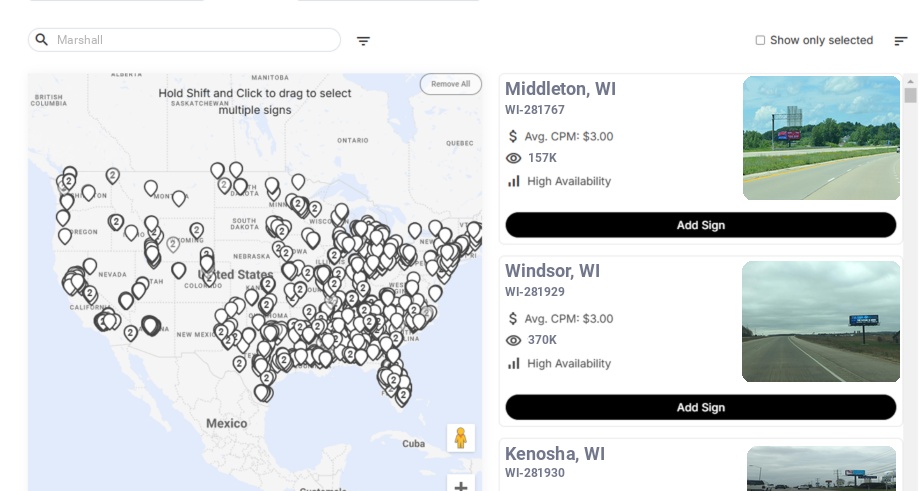



How much is a billboard in Marshall?
Why Choose Blip for Billboard Advertising in Marshall
-
Launch on Blip in Marshall in minutes—self-serve access fits I-94 commuters between Madison and eastern Dane County.
-
Blip-optimized campaigns can auto-choose timing and boards in Marshall to reach daily drivers on I-94 and WIS 73.
-
Set a flexible budget in Marshall and pay only for live plays, ideal for testing east Dane County traffic without contracts.
-
Use dayparting in Marshall to hit westbound mornings and eastbound evenings, plus fall Expo and Badgers traffic.
-
Track Marshall billboard results in real time and shift spend fast as Madison, Sun Prairie, and I-94 demand changes.
-
Blip's creative tools help Marshall ads stand out for commuters, farmers, and eventgoers with bold, readable messages.
Frequently Asked Questions About Billboard Advertising in Marshall
How much does a billboard cost in Marshall, Wisconsin with Blip?
Each “blip” is a 7.5-to-10-second display, and pricing can start as low as $0.01 per display, with the cost changing based on time of day, location, and advertiser demand. You set a daily budget, and Blip’s algorithm uses it to bid for open ad slots on rotating digital billboards, so you only pay when your ad actually appears. Your total cost is simply the sum of the blips you earn.
Where can I advertise with Blip in Marshall, Wisconsin?
Marshall sits directly on the I-94 path between Madison and communities farther east, and I-94 near Marshall generally sees about 30,000 to 40,000+ vehicles per day, depending on the exact segment. As traffic moves west toward Madison, counts climb above 60,000 vehicles per day. WIS 73 also connects Marshall directly to I-94 and the surrounding rural area, creating a more concentrated local audience.
Why is Marshall, Wisconsin a good billboard market for Blip?
Marshall combines small-town familiarity with interstate-scale visibility. The Village of Marshall sits in Dane County, which had 561,504 residents in the 2020 Census, and it benefits from the broader pull of the Madison market, where the metro area includes roughly 680,000 residents. Because travel here is strongly car-based, roadside advertising can build repeated exposure with the same drivers throughout the week.
What kinds of people does Blip reach in Marshall, Wisconsin?
Marshall lets us stack commuters, families, students, visitors, and rural trade audiences on the same campaign map. The area includes daily commuters traveling west to Madison, northwest to Sun Prairie, and east toward Jefferson County employment centers, plus family-oriented communities such as Sun Prairie, Cottage Grove, Lake Mills, Waterloo, and Deerfield. It also sits inside a powerful education and visitor market tied to UW–Madison, Madison College, and regional events.
When is the best time to run billboard ads in Marshall, Wisconsin?
Late August and September are strong windows because travel patterns intensify at the same time, with UW–Madison bringing back 50,000+ students and local districts restarting daily family routines. Fall is also one of the best billboard seasons in southern Wisconsin because Wisconsin Badgers football and the World Dairy Expo create a rare overlap of sports traffic, ag-industry travel, family outings, and regular commuting. Summer weekends and the holiday season also create useful opportunities tied to festivals, shopping, and winter service needs.
Do I need a contract to advertise with Blip in Marshall?
No, Blip has no long-term contracts or minimum commitments. You can start, pause, or stop your campaign at any time.
How fast can I launch a billboard campaign with Blip in Marshall?
You can have your campaign live in minutes. Create a free account, select your locations, set your budget, upload your design, and start running once approved.
Where can I advertise with Blip in Marshall?
Blip has digital billboards in Marshall. You can browse available locations on a map, choose the ones that fit your audience, and start advertising right away.
Still have questions? Launch a campaign in minutes — no contracts, no commitments.
Start Your CampaignMarshall Billboard Advertising Guide
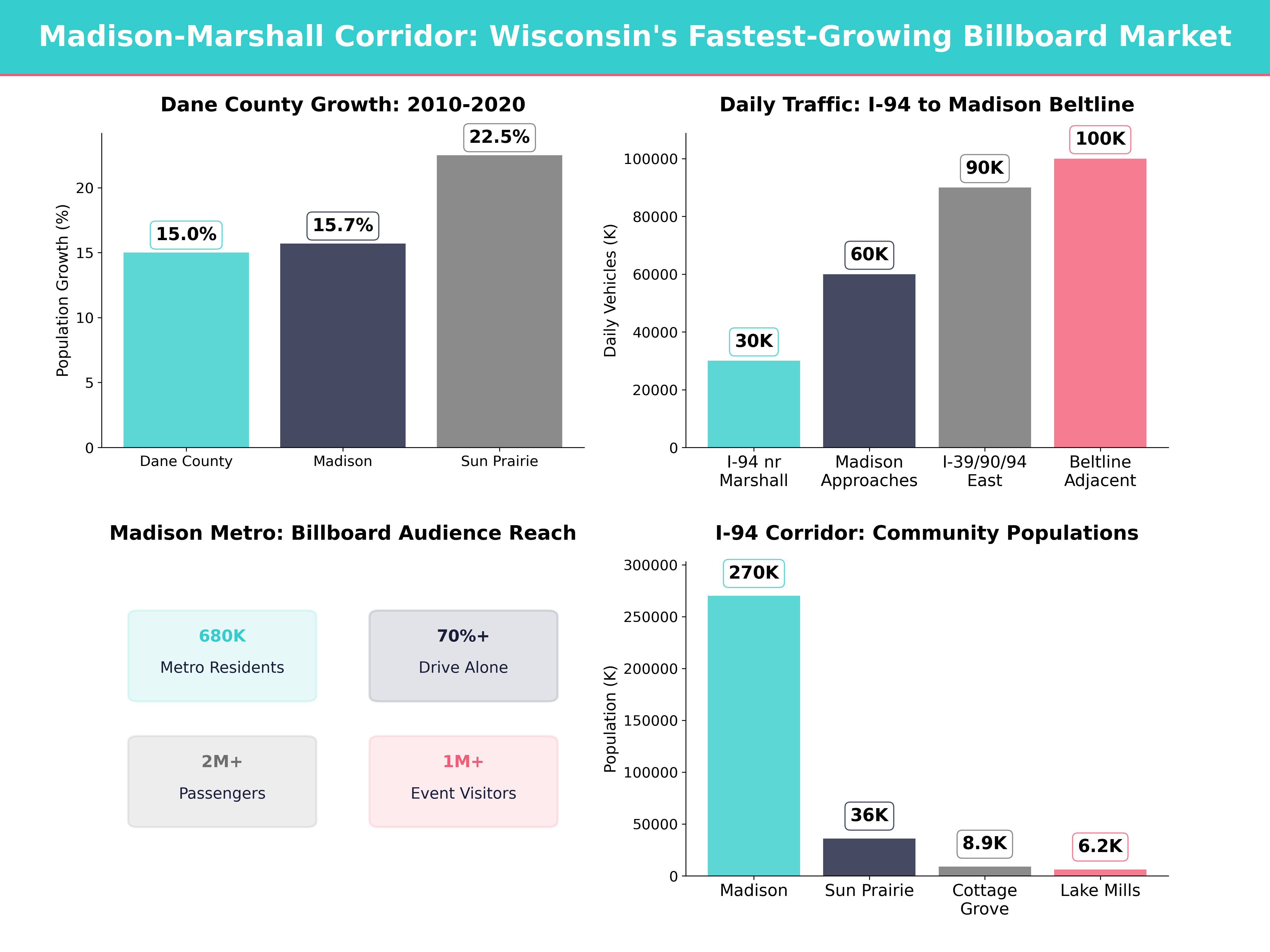
Marshall, Wisconsin Village of Marshall Dane County, which had 561,504 residents in the 2020 Census, and it lies directly on the I-94 path between Madison and communities farther east. Because travel here is strongly car-based, with more than 70% of workers commuting by driving alone in Dane County, and Marshall is not a major fixed-route transit hub, roadside advertising can build repeated exposure with the same drivers throughout the week. We can also benefit from the broader pull of the Madison 680,000 residents and university activity, tourism, sports, fairs, and business travel keep traffic circulating year-round.
Marshall, Wisconsin Market Overview
Marshall is a small village, but our effective advertising market is much larger than the village limits. When we plan for Marshall, we are really planning for a strategic slice of eastern Dane County and the east side of the Madison region.
Growth around Marshall and eastern Dane County
Population trends support that larger view. Data from the 2020 Census and the Wisconsin Department of Administration show that Dane County grew from 488,073 residents in 2010 to 561,504 in 2020, which was a strong 15.0% increase in just one decade. The City of Madison 233,209 to 269,840 over the same period, which was another sizable 15.7% gain.
The growth arc east of Madison is especially relevant for Marshall advertisers. Sun Prairie 35,967 residents in 2020, up from 29,364 in 2010, which was a 22.5% increase. Cottage Grove 8,947 residents in 2020, and nearby communities such as Lake Mills 6,211 residents, Waterloo, with 3,570, and Deerfield, with 2,319, add additional household density around Marshall’s trade area.
For billboard advertisers, this matters because Marshall sits in the path of expanding residential demand, not outside it. We can use Marshall-area boards to reach people who live in smaller communities, work in larger ones, and spend across both.
Economic drivers that strengthen Marshall billboard demand
The economic base surrounding Marshall is unusually diversified for a village market. We can tap consumer spending tied to UW–Madison, state government, healthcare, agriculture, manufacturing, logistics, and tourism. UW–Madison enrolls more than 50,000 students, and Madison College serves more than 30,000 students annually, which creates recurring demand for housing, food, retail, entertainment, banking, healthcare, and mobile services.
Regional event infrastructure also expands the audience pool. The Alliant Energy Center hosts 500+ events and welcomes 1 million+ visitors in a typical year. World Dairy Expo brings 50,000+ attendees to Madison in the fall, and Dane County Regional Airport handled more than 2 million passengers in 2023. Those numbers tell us that Marshall is not just a local village market. It is also part of a broader regional circulation system with steady visitor volume from a metro area of roughly 680,000 people.
What Marshall’s mobility patterns mean for advertisers
Marshall’s biggest advertising advantage is mobility. In Dane County, well over 70% of workers commute by driving alone, according to recent community commuting profiles, and Marshall’s local travel habits are even more auto-oriented than Madison’s urban core. Marshall is also roughly 20 miles east of downtown Madison, which puts it close enough for daily commuting but far enough out that highways matter.
For us, that means digital billboards can do three jobs at once:
- They can build frequency with daily commuters who use the same corridors repeatedly.
- They can capture decision-making for food, fuel, retail, healthcare, and local services near Marshall exits and connectors.
- They can extend regional awareness for brands based in Madison, Sun Prairie, Lake Mills, Waterloo, and the wider east-west I-94 corridor.
Key Traffic Corridors for Digital Billboards in Marshall, Wisconsin
Marshall’s billboard value comes from the way a few major roads concentrate local and regional movement. When we understand where those trips begin, where they merge, and where they slow down, we can choose boards that match our goals.
Interstate 94 through Marshall and eastern Dane County
I-94 is the core corridor for Marshall. WisDOT traffic maps generally show I-94 near Marshall in the neighborhood of 30,000 to 40,000+ vehicles per day, depending on the exact count station and segment. As traffic moves west toward the Madison approaches, counts climb above 60,000 vehicles per day.
This is the best corridor for businesses that benefit from immediate route relevance.
- Restaurants, convenience stores, fuel stations, and travel services can use I-94 boards to influence near-term stop decisions.
- Auto dealers, healthcare providers, and retail destinations can use I-94 for repeated reminder messaging among weekly commuters.
- Regional employers can use I-94 to reach workers traveling between Marshall, Sun Prairie, Madison, Lake Mills, and Jefferson County employment centers.
Because I-94 serves both local residents and through-travelers, we can use it for broad-reach awareness or tactical exit-based messaging.
I-39/90/94 and US 12/18 on Madison’s east side
As Marshall traffic approaches Madison, the road network gets denser and more powerful. On busy east-side segments of I-39/90/94 and US 12/18, daily traffic commonly exceeds 90,000 vehicles, and the busiest beltline-adjacent stretches run well above 100,000.
These are not “Marshall-only” boards, but they are highly relevant to Marshall campaigns because so many east Dane residents funnel through them for work, school, medical visits, entertainment, and shopping. They are especially effective for:
- Hospitals, clinics, and specialty care providers that draw patients from eastern Dane County.
- Universities, technical colleges, and training programs that want to reach commuter students and parents.
- Large retailers, event venues, and entertainment brands that want metro-scale reach tied to Marshall-origin traffic.
If our goal is high impression volume rather than immediate local action, this network deserves serious attention.
US 151 and the Sun Prairie approach
US 151 is one of the region’s most valuable secondary corridors for Marshall advertisers. Near Sun Prairie 30,000 to 50,000+ vehicles per day, depending on the location.
This route matters because Sun Prairie is both a destination and a transfer point. It is one of Wisconsin’s fastest-growing suburban cities, and many Marshall-area residents use Sun Prairie for shopping, healthcare, schools, employment, and everyday services. US 151 placements work well for:
- Family retail, grocery, and childcare brands that serve the east side of Dane County.
- Financial services, insurance agencies, and home improvement companies that need suburban homeowner reach.
- Recruiting campaigns for employers drawing from Marshall, Sun Prairie, and Columbus-area labor pools.
WIS 73 and local service routes in Marshall
WIS 73 is the village-scale connector that ties Marshall directly to I-94 and the surrounding rural area. Its counts are far lower than the interstate, but that is exactly why it matters for local advertisers. Traffic here is measured in the thousands rather than the tens of thousands, and that creates a more concentrated, high-intent audience.
We should think of WIS 73 and nearby local routes as frequency tools for hyperlocal demand. These placements fit:
- Restaurants, clinics, dental offices, banks, and pharmacies that want Marshall-area residents to remember a nearby option.
- HVAC, plumbing, roofing, and electrical companies that serve both village households and nearby rural customers.
- Community organizations, schools, and local events that need recognition among people who already live or work close by.
Audience Segments We Can Reach in Marshall, Wisconsin
Marshall works best when we stop thinking in terms of one audience and start thinking in layers. This market lets us stack commuters, families, students, visitors, and rural trade audiences on the same campaign map.
Commuters and regional workers
The first audience is the daily commuter. Marshall sits in a corridor where residents regularly travel west to Madison, northwest to Sun Prairie, and east toward Jefferson County employment centers. Because much of that movement happens by personal vehicle, billboards are naturally aligned with the way the audience moves.
For commuter-focused campaigns, we should emphasize convenience, trust, and timing. Healthcare systems, legal services, colleges, staffing firms, banks, and service businesses all benefit from repeated weekday exposure.
Families and homeowners across eastern Dane County
Marshall is surrounded by family-oriented communities that matter to local and regional brands. Sun Prairie 35,967 residents, Cottage Grove 8,947, Lake Mills 6,211, Waterloo has 3,570, and Deerfield has 2,319. That mix gives us a useful blend of suburban growth, small-town loyalty, and rural purchasing power.
This audience responds well to categories such as:
- Home services, because homeowners in growth corridors routinely need repair, remodeling, and seasonal maintenance.
- Healthcare and dental care, because family decision-makers often choose providers during routine weekly travel.
- Local retail and food, because household purchases are often made close to commute paths rather than close to home.
Students, parents, and education-linked spending
Marshall is not a college town, but it sits inside a powerful education market. UW–Madison enrolls 50,000+ students, and Madison College serves 30,000+ annually. K-12 movement also matters, with Marshall Public Schools Sun Prairie Area School District shaping family travel rhythms.
For us, that creates opportunities for:
- Apartments, financial services, and mobile carriers targeting students and young adults.
- Tutoring, childcare, healthcare, and family entertainment targeting parents.
- Quick-service restaurants and convenience offers targeting both commuter and school-related traffic.
Visitors, eventgoers, and agricultural professionals
Marshall also benefits from proximity to a major visitor economy. Destination Madison, the Alliant Energy Center, UW Athletics, and Dane County Regional Airport all bring nonresident traffic into the region. The Alliant Energy Center alone hosts 500+ events and draws 1 million+ visitors, while World Dairy Expo adds 50,000+ agriculture-focused attendees in the fall.
That makes Marshall useful for campaigns aimed at:
- Hotels, restaurants, and regional attractions serving visitors driving in from the east.
- Farm, equipment, feed, and veterinary brands serving dairy and ag professionals.
- Business services and B2B recruiting that want exposure during major convention and trade-event periods.
Seasonal and Timing Opportunities in Marshall, Wisconsin
Marshall is not a market where we should advertise the same way every month. The best campaigns line up with school schedules, sports calendars, tourism peaks, weather realities, and regional events.
Back-to-school season in Marshall and the Madison region
Late August and September are strong windows because travel patterns intensify at the same time. UW–Madison brings back 50,000+ students, Madison College ramps up fall attendance, and local districts such as Marshall Public Schools Sun Prairie Area School District restart daily family routines.
During this period, we should prioritize:
- Healthcare, dental, vision, and family services that fit back-to-school needs.
- Retail, grocery, and dining that can benefit from increased weekday trips.
- Student-targeted brands that want to intercept regional travel before habits reset for the semester.
Fall football, harvest, and expo traffic around Marshall
Fall is one of the best billboard seasons in southern Wisconsin. Wisconsin Badgers football typically gives Madison 6 to 7 home games, and the World Dairy Expo brings 50,000+ attendees to the region in early October. That creates a rare overlap of sports traffic, ag-industry travel, family outings, and regular commuting.
This is the time for us to run:
- Hospitality and restaurant campaigns that target game-day and event traffic.
- Agricultural brands timed to dairy and farm decision-makers.
- Retail and service campaigns that use football season as a memory anchor with bold, local creative.
Summer festivals and leisure travel near Marshall
Summer adds discretionary trips and more weekend movement. The 4-day Dane County Fair in July, Brat Fest over Memorial Day weekend, lake travel toward Lake Mills
For summer, we should lean into:
- Short bursts around event weekends, rather than one flat seasonal buy.
- Family-friendly creative that speaks to outings, dining, recreation, and convenience.
- Eastbound and westbound messaging that captures both outbound leisure traffic and return-home trips.
Holiday retail and winter service timing in Marshall
From early November through December, Marshall’s location on I-94 becomes especially useful for shopping and service campaigns. Drivers head west toward Madison retail, east toward destinations such as Johnson Creek Premium Outlets
Winter also shifts what people need. Auto repair, tires, urgent care, heating services, pharmacies, grocery, and quick dining all become more relevant. Because daylight is shorter and weather can be harsher, we should favor strong contrast, concise copy, and heavier emphasis on commute windows.
Billboard Design Tips for the Marshall, Wisconsin Market
Marshall is not a place for vague, overly polished, or purely aesthetic billboard creative. The audience here values clarity, usefulness, and local relevance.
Use Marshall-area place names and route cues
Specific place names work extremely well in this market. Copy such as “Marshall,” “Sun Prairie,” “Madison East,” “Lake Mills,” and “Off I-94” feels more useful than generic language like “near you.” If our location really is quick from the interstate, we should say so directly and truthfully.
This approach works because Marshall drivers are route-minded. They are thinking in terms of exits, minutes, errands, and whether a stop fits into the trip they are already taking.
Match eastern Dane County’s practical buying mindset
The Marshall audience spans commuters, families, tradespeople, rural households, and small-business owners. In that environment, clear value propositions usually outperform abstract brand poetry. We should emphasize credibility, convenience, pricing, selection, speed, or a concrete benefit.
Messages like these tend to fit the market well:
- “Family care close to I-94.”
- “Fast service for east Dane drivers.”
- “Heating help before the next cold snap.”
- “Worth the short drive from Marshall.”
These messages feel grounded in the way local people actually make decisions.
Use imagery that feels southern Wisconsin, not generic stock America
Marshall sits in a region shaped by agriculture, high school sports, university culture, commuter suburbs, and four-season weather. Creative that references those cues usually feels more authentic. We do not need clichés, but we do want visual language that fits local life.
That can mean using:
- Clean farm-and-field backdrops for ag, equipment, and rural service brands.
- Family or homeowner imagery for suburban services around Sun Prairie and Cottage Grove.
- Game-day color energy for fall campaigns tied to Madison weekends.
- Vehicle, road, or service-truck imagery for businesses that solve practical problems.
Design for fast reads and winter visibility
Marshall’s most valuable boards often face drivers moving at interstate speed. Because each digital display is only 7.5 to 10 seconds, and because many drivers will only glance once, we should keep our creative visually simple and verbally disciplined.
In this market, we should favor:
- High-contrast color combinations that remain legible in snow, cloud cover, and low winter light.
- Large type and short copy that can be absorbed instantly.
- One idea per board, rather than trying to explain an entire business.
Regional Strategies for Marshall, Wisconsin
Marshall works best when we treat it as a hub with multiple directional plays. Different sub-areas support very different campaign goals.
Marshall proper and the immediate I-94/WIS 73 trade area
If our goal is direct response close to the village, we should prioritize Marshall-adjacent boards and routes feeding the I-94 interchange. This strategy is ideal for restaurants, convenience retail, clinics, auto services, and home-service companies that need nearby conversion.
The audience here is smaller, but intent is higher. We are reaching people who can actually act today.
West toward Sun Prairie and Madison
If our goal is scale, we should move west. Sun Prairie 35,967 residents, and Madison 269,840. That westward corridor gives us access to suburban households, university-linked spending, healthcare demand, and major employment centers.
This strategy fits brands that want broader awareness, including:
- Regional healthcare systems that need east-county patients.
- Higher education and workforce programs recruiting across the metro edge.
- Retail brands and attractions that want Marshall-area residents to think west for their next trip.
East toward Lake Mills, Johnson Creek, and the Milwaukee-bound corridor
The eastbound strategy is different. Lake Mills 6,211 residents, and destinations such as Johnson Creek Premium Outlets
For Marshall-based businesses, eastbound boards can also tell drivers that they do not need to keep going. That is a smart tactic for fuel, dining, and convenience categories.
South and southwest toward Deerfield and Cottage Grove
The south and southwest approach captures a family-heavy, service-oriented audience. Cottage Grove 8,947 residents, and Deerfield has 2,319. These communities are useful for home services, youth programs, medical and dental services, local dining, and school-related promotions.
This strategy works especially well when we want a local feel without limiting ourselves to Marshall alone.
Using Blip Tools and Capabilities in Marshall, Wisconsin
Blip’s tools are especially useful in a market like Marshall because the opportunity is spread across local roads, interstate travel, and Madison-area spillover. We can stay flexible without losing strategic focus.
Match our schedule to Marshall travel behavior
Marshall is a classic dayparting market. We can put more weight behind westbound commuter periods in the morning, eastbound return periods in the evening, and weekend bursts around sports, fairs, and shopping travel. That kind of scheduling is valuable in a place where the same audience repeats routes throughout the week.
Test local and regional boards without overspending
Marshall advertisers often need to compare two very different goals, which are local action and regional awareness. Blip makes that test practical. We can run a Marshall-centered manual campaign if we already know the boards we want, or we can let a Blip-optimized campaign spread budget across the wider east Dane map and learn where performance concentrates.
That flexibility matters because even small tests can start at $0.01 per display. We do not need to commit our whole budget before we know which corridor is doing the work.
Build localized creative for each audience layer
Marshall usually performs best when we adapt creative by route and audience. We might run one version for Madison-bound commuters, another for local Marshall service buyers, and another for weekend retail or event traffic. Blip’s artwork tools make that practical, which is important in a market where “one message for everyone” is rarely the best option.
Use analytics to sharpen our Marshall strategy
Once a campaign is live, we should watch which boards, times, and creative versions are producing the strongest response. If Marshall-adjacent boards are driving action, we can lean in. If Sun Prairie or Madison-side boards are delivering more scale for the same spend, we can shift there quickly.
Getting Started with Billboard Rental in Marshall, Wisconsin
Renting a billboard in Marshall should start with geography, not with the board itself. The right board depends on what we need the audience to do next.
Start with a clear Marshall-area objective
We should first decide whether our priority is:
- Immediate local action near Marshall.
- Commuter awareness across east Dane County.
- Regional reach into Sun Prairie, Madison, or the I-94 corridor.
- Event or seasonal demand tied to sports, fairs, tourism, or agriculture.
A Marshall restaurant, gas station, clinic, or service company should usually begin close to Marshall and the I-94/WIS 73 movement pattern. A Madison healthcare provider or college program may benefit more from commuter-facing inventory farther west.
Evaluate boards by direction, distance, and decision point
When we compare billboard locations, we should ask practical questions. Is the board speaking to a driver before the turn, before the exit, or after the decision has already been made. Is it best for local frequency, or is it best for broad reach. Does it fit our customer’s real travel path.
For Marshall, the best locations usually fall into three buckets:
- Close-in boards for immediate stops and local services.
- Commuter corridor boards for repeated weekday exposure.
- Regional gateway boards for awareness tied to Madison, Sun Prairie, Lake Mills, and event travel.
Use Blip to simplify what used to be a slower process
Traditional billboard buying can feel rigid, especially in smaller markets where advertisers are often pushed toward larger commitments than they need. Blip simplifies that process by letting us test, learn, pause, and refine without getting locked into one static plan.
That matters in Marshall because this market rewards smart adjustment. We may discover that morning commuter traffic beats all-day delivery. We may find that fall football weekends outperform summer leisure traffic. We may learn that a Marshall-adjacent board converts better than a higher-volume Madison-side board because intent is stronger.
If we start with our goal, choose boards that match real travel behavior, and use Blip to optimize as results come in, Marshall can be one of the most efficient billboard markets in the eastern Dane County region.