Billboards near Mount Pleasant, WI
No Minimum Spend. No Long-Term Contracts. Just Results.
Trusted by Leading Brands


Billboard advertising
near Mount Pleasant has never been easier
How much is a billboard near Mount Pleasant?
Why Choose Blip for Billboard Advertising near Mount Pleasant
Blip lets you launch in Mount Pleasant fast, reaching I-94/I-41 commuters without contracts or minimums.
Set flexible budgets in Mount Pleasant and pay only for blips, ideal for testing WI 20, Green Bay Road, and Durand Avenue traffic.
Daypart your Mount Pleasant ads for 6-9 a.m. and 3-6 p.m. to hit commuters, students, and plant workers when they drive.
Track Mount Pleasant campaigns in real time, then shift spend toward Racine or Kenosha routes that perform best.
Use Blip's creative tools to build clear, local Mount Pleasant ads for retail, hiring, or weekend Fair traffic in seconds.
Frequently Asked Questions About Billboard Advertising near Mount Pleasant
How much does a billboard cost in Mount Pleasant with Blip?
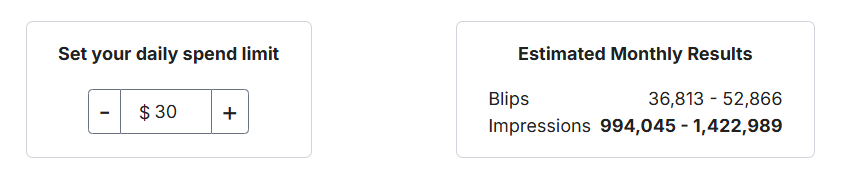
Blip makes billboard advertising in the Mount Pleasant area flexible and easy to fit your budget. Instead of paying a fixed rate, you set a daily budget and only pay when your ad actually displays as a 7.5-to-10-second “blip” on a rotating digital billboard serving the Mount Pleasant area. Pricing is dynamic, so the cost per blip can vary by time of day, location, and advertiser demand, while Blip’s algorithm works to maximize your reach for what you spend.
Where can I advertise with Blip near Mount Pleasant, Wisconsin?
Our 4 digital billboards serving the Mount Pleasant area are placed in nearby Racine and Kenosha, just 2.5 to 9.6 miles away. That placement gives us access to daily commuters, industrial decision-makers, regional shoppers, students, and families without relying on a single neighborhood or one narrow traffic stream. Because Mount Pleasant is tightly connected to I-94/I-41, WI 20, Green Bay Road, and the Racine-Kenosha retail spine, billboard advertising near Mount Pleasant can deliver both broad reach and strong local frequency.
Why is billboard advertising in Mount Pleasant with Blip effective?
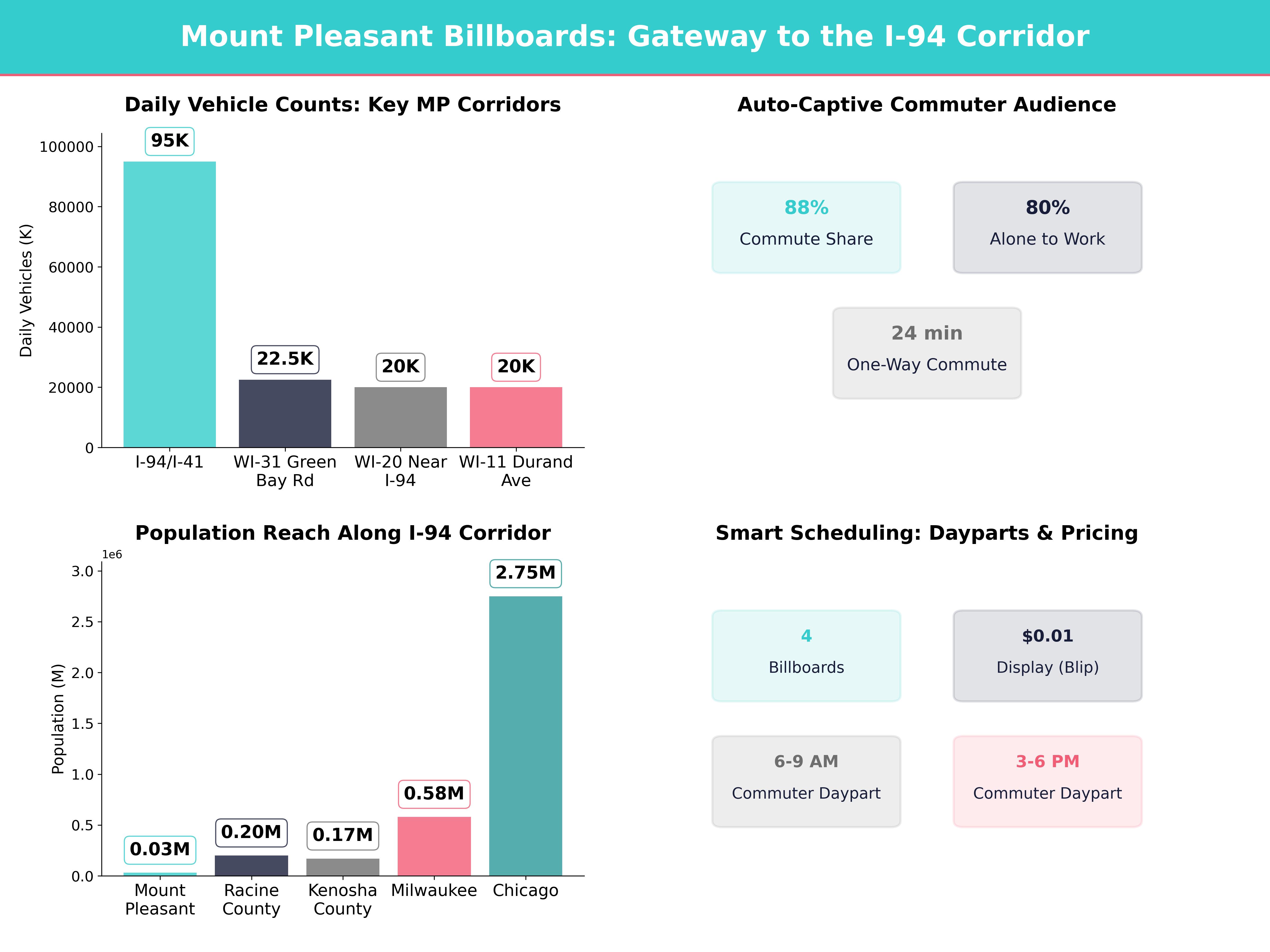
Advertising near Mount Pleasant works because the village sits in one of southeastern Wisconsin’s most traveled and economically varied corridors, with the nearby I-94/I-41 network carrying roughly 90,000 to 100,000+ vehicles per day and the broader Racine-Kenosha market totaling 366,878 residents. Mount Pleasant also sits on the corridor between Milwaukee and Chicago, which means many campaigns can speak to purely local demand while still benefiting from through-traffic, business travel, and cross-county shopping patterns. This gives local brands room to scale without immediately paying for broad metro media that reaches too far outside the target area.
What kinds of people can Blip reach in the Mount Pleasant area?
The most dependable audience serving the Mount Pleasant area is the commuter base, with about 80% of workers driving alone and total auto commuting near 88%. The area also benefits from nearby higher education audiences, including roughly 4,000 students at UW-Parkside and more than 20,000 annual students at Gateway Technical College. Families are a major part of the audience too, with about 16,000 students in Racine Unified School District and about 19,000 in Kenosha Unified School District.
When is the best time to run billboard ads in Mount Pleasant with Blip?
Late spring through early fall is the most obvious seasonal window for many advertisers serving the Mount Pleasant area. Back-to-school is consistently important because of the overlap between K-12 families and college commuters, and late July through September is packed with schedule resets. For commuter-heavy campaigns, the page recommends 6:00 to 9:00 a.m. and 3:00 to 6:00 p.m. windows, while weekend rotations from about 10:00 a.m. to 6:00 p.m. can be more valuable for retail, family entertainment, and tourism.
Do I need a contract to advertise with Blip near Mount Pleasant?
No, Blip has no long-term contracts or minimum commitments. You can start, pause, or stop your campaign at any time.
How fast can I launch a billboard campaign with Blip near Mount Pleasant?
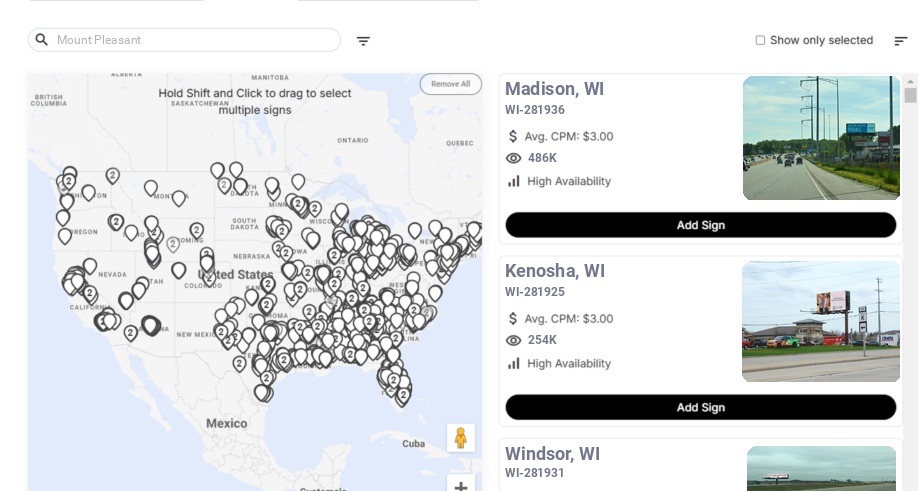
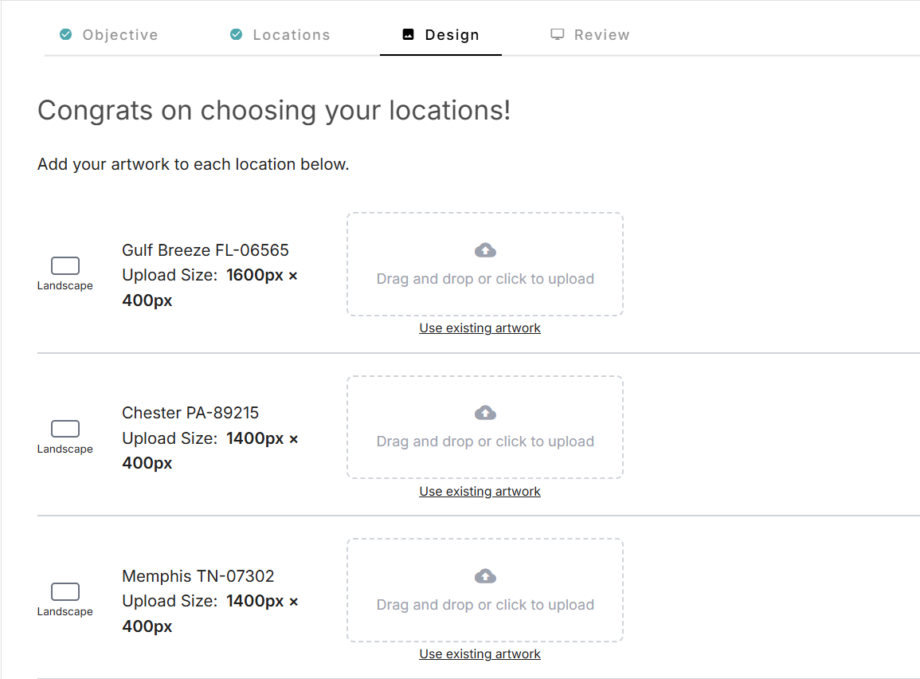
You can have your campaign live in minutes. Create a free account, select your locations, set your budget, upload your design, and start running once approved.
Where can I advertise with Blip near Mount Pleasant?
Blip has digital billboards near Mount Pleasant. You can browse available locations on a map, choose the ones that fit your audience, and start advertising right away.
Still have questions? Launch a campaign in minutes — no contracts, no commitments.
Start Your CampaignMount Pleasant Billboard Advertising Guide
Advertising near Mount Pleasant works because the village sits in one of southeastern Wisconsin’s most traveled and economically varied corridors, with the nearby I-94/I-41 network carrying roughly 90,000 to 100,000+ vehicles per day and the broader Racine-Kenosha market totaling 366,878 residents. The Village of Mount Pleasant 27,732 residents at the 2020 Census, and our 4 digital billboards serving the Mount Pleasant area are placed in nearby Racine and Kenosha 2.5 to 9.6 miles away. That placement gives us access to daily commuters, industrial decision-makers, regional shoppers, students, and families without relying on a single neighborhood or one narrow traffic stream. Because Mount Pleasant is tightly connected to I-94/I-41, WI 20, Green Bay Road, and the Racine-Kenosha retail spine, billboard advertising near Mount Pleasant can deliver both broad reach and strong local frequency.
Mount Pleasant Area Market Overview
Mount Pleasant sits inside a larger Racine-Kenosha trade area
When we evaluate the Mount Pleasant area, we do not look at the village in isolation. We look at the full Racine-Kenosha corridor that feeds it every day. Racine County 197,727 residents in 2020, Kenosha County had 169,151, and the two counties together total 366,878 residents. The City of Racine adds 77,816 residents, and the City of Kenosha 99,986 residents, so advertisers serving the Mount Pleasant area can tap a consumer base that is much larger than the village itself.
This is also a location with unusual regional leverage. Mount Pleasant sits on the corridor between Milwaukee 577,222 residents) and Chicago (2,746,388 residents), which means many campaigns can speak to purely local demand while still benefiting from through-traffic, business travel, and cross-county shopping patterns. We like this kind of market because it gives local brands room to scale without immediately paying for broad metro media that reaches too far outside the target area.
The economy near Mount Pleasant is diverse and practical
The economic base serving the Mount Pleasant area is not dependent on one sector. It is tied to manufacturing, logistics, healthcare, education, and retail through organizations such as SC Johnson, CNH Industrial Twin Disc, Ascension All Saints Froedtert South, Gateway Technical College, and University of Wisconsin-Parkside Racine County Economic Development Corporation, and the Kenosha Area Business Alliance reinforce that this is an active, connected employment market.
Mount Pleasant also has unusually strong B2B relevance for a suburban community. The village’s Wisconn Valley development area is roughly 2,800 acres (about 4.4 square miles), which keeps the Mount Pleasant area on the radar for industrial services, recruiting, construction, logistics, and professional services. For advertisers, that means the local audience is not just buying groceries and gas. It is also hiring crews, selecting vendors, comparing healthcare systems, and making business purchasing decisions.
Commuting patterns favor outdoor advertising near Mount Pleasant
Recent Census estimates indicate that about 80% of Mount Pleasant workers drive alone to work, and total auto commuting is close to 88% when we include carpools. The average one-way commute is about 24 minutes, which is long enough to create repeat exposure and short enough to keep drivers on familiar routes week after week. That combination is ideal for digital billboards serving the Mount Pleasant area.
We also see a regional commuting pattern, not just a village-only pattern. Workers move between Mount Pleasant, Sturtevant Caledonia, Pleasant Prairie Southeastern Wisconsin Regional Planning Commission consistently treats the Racine-Kenosha corridor as a highly connected regional economy, and that is exactly why billboard placement near Mount Pleasant can work for both hyperlocal and cross-county campaigns.
Key Traffic Corridors Serving the Mount Pleasant Area
I-94/I-41 is the main reach builder near Mount Pleasant
When we want broad exposure serving the Mount Pleasant area, I-94/I-41 is the first corridor we evaluate. According to the Wisconsin Department of Transportation 90,000 to 100,000+ vehicles per day range. That is the corridor that connects the Mount Pleasant area to northbound Milwaukee traffic, southbound Illinois traffic, distribution movement, business travel, and daily commuting.
This route is especially strong for categories that benefit from repeated exposure and wide geographic draw. We often like it for healthcare, colleges, recruiting, auto dealerships, home services, financial services, regional retail, and event promotion. If a business draws customers from more than one ZIP code, I-94/I-41 usually deserves a central role in the plan.
WI 20 is the Mount Pleasant area’s critical east-west connector
WI 20 matters because it ties the interstate directly to the Mount Pleasant area’s residential growth, commercial development, and industrial activity. WisDOT counts on and around the corridor are often in the 20,000-plus vehicles per day range near the interstate. That is a meaningful number for a route that carries a mix of commuters, local shoppers, business travelers, and service traffic.
For billboard strategy, WI 20 is where broad interstate visibility starts to convert into local intent. Drivers using this route are often heading somewhere specific, including stores, offices, medical appointments, schools, industrial sites, or neighborhoods. That makes WI 20 especially useful for clear calls to action, such as limited-time offers, grand openings, recruiting pushes, and appointment-driven services.
Green Bay Road and Durand Avenue connect daily errands to ad response
South Racine County’s retail and service corridors are just as important as the interstate because they support everyday trips. WisDOT counts frequently place WI 31, also known as Green Bay Road, in the 20,000 to 25,000 vehicles per day band through key commercial stretches. Parts of WI 11, also known as Durand Avenue, are also commonly above 20,000 vehicles per day near major retail nodes.
These are valuable corridors when we want to influence the kinds of decisions people actually make on the same day. Family dining, urgent care, dental, grocery, furniture, fitness, auto repair, and home improvement offers all perform better when the message reaches drivers already moving through familiar retail territory. In the Mount Pleasant area, those roads often do the final persuasion after I-94/I-41 has created the first impression.
Corridor strategy matters more than municipal lines
One of the biggest planning mistakes in this market is over-focusing on a city boundary. A person who lives in Mount Pleasant may shop in Racine, work in Pleasant Prairie, attend class in Kenosha, and use I-94 every weekday. That is why we build plans around route behavior. We want the message to appear where the audience actually drives, not just where a map label happens to end.
Audience Segments We Can Reach Near Mount Pleasant
Commuters and job seekers are a year-round audience
The most dependable audience serving the Mount Pleasant area is the commuter base. With about 80% of workers driving alone and total auto commuting near 88%, we know that road-based media has daily relevance. This is a strong market for recruiting campaigns, especially in manufacturing, warehouse, healthcare support, skilled trades, and business services.
Employers and staffing firms can use this to their advantage. The Mount Pleasant area sits near industrial and logistics activity in Racine County and southern Kenosha County, and the corridor’s drivers are already used to thinking about work, shifts, and career changes while they are on the road. Clear messages about pay, benefits, schedules, and location tend to resonate well here.
Students and young adults add a second high-value segment
The Mount Pleasant area also benefits from nearby higher education audiences. UW-Parkside 4,000 students, Gateway Technical College serves more than 20,000 students annually, and Carthage College in nearby Kenosha enrolls about 2,700 students. Those students and early-career adults create demand for apartments, internet service, financial products, telecom, quick-service dining, entertainment, and entry-level hiring.
This segment is especially useful because it overlaps with commuter behavior. Many students commute, work part time, or split time between campuses and jobs. That means a digital billboard near Mount Pleasant can reach them in practical decision moments rather than only in leisure settings.
Families and household decision-makers drive local spending
Families are a major part of the Mount Pleasant area audience. Racine Unified School District serves about 16,000 students, and Kenosha Unified School District serves about 19,000. Those school populations point to a broad family market of about 35,000 students across the two districts for pediatric care, family medicine, orthodontics, grocery, child enrichment, furniture, auto service, home improvement, and local entertainment.
We often recommend family-focused messaging on routes that sit between residential neighborhoods and commercial corridors. The strongest family campaigns usually feel useful rather than flashy. In the Mount Pleasant area, that often means emphasizing convenience, trust, price clarity, and proximity.
Tourists and weekend visitors expand the audience beyond residents
Summer and weekend traffic bring a meaningful visitor layer to this market. Bristol Renaissance Faire 9 weekends each summer, the Racine County Fair creates a concentrated 5-day burst of traffic, and Pleasant Prairie Premium Outlets 90+ stores that draw shoppers from across southeastern Wisconsin and northern Illinois. Tourism groups such as Real Racine Visit Kenosha promote attractions that keep the corridor active well beyond weekday commutes.
Family destinations add to that weekend flow. Racine Zoo, the lakefront, Kenosha Public Museum, and harbor districts in both counties create opportunities for restaurants, retail, events, lodging, and entertainment campaigns. If a business wants to capture both residents and visitors, the Mount Pleasant area offers a strong blend of weekday routine and weekend exploration.
Seasonal and Timing Opportunities in the Mount Pleasant Area
Summer near Mount Pleasant rewards tourism, retail, and event advertising
Late spring through early fall is the most obvious seasonal window for many advertisers serving the Mount Pleasant area. From Memorial Day through Labor Day, the lakefront becomes more active, fair and festival calendars pick up, and regional shopping traffic increases. We usually like this period for restaurants, family attractions, summer sales, tourism offers, healthcare with urgent seasonal relevance, and quick-response home services.
This is also when the broader Racine-Kenosha corridor becomes more fluid. Visitors mix with residents, and the same roads serve both leisure and routine travel. That gives digital billboards near Mount Pleasant a useful dual role. They can build awareness among local residents while also intercepting discretionary spending from out-of-town traffic.
Back-to-school season is one of the best annual windows
Back-to-school is consistently important in the Mount Pleasant area because of the overlap between K-12 families and college commuters. With about 16,000 students in Racine Unified School District, about 19,000 in Kenosha Unified School District, roughly 4,000 at UW-Parkside 20,000 annual students at Gateway Technical College, late July through September is packed with schedule resets.
We often see this period work well for orthodontics, primary care, tutoring, internet and mobile providers, grocery, apparel, apartment leasing, furniture, banking, and hiring. Messaging should be direct and practical. This is a season when consumers are juggling deadlines, not browsing for inspiration.
Fall and winter favor practical categories and strong contrast
Once temperatures drop, the Mount Pleasant area becomes even more responsive to useful, no-nonsense messaging. We usually like late fall and winter for HVAC, roofing, plumbing, auto service, urgent care, healthcare systems, legal services, and recruiting. Holiday retail also matters because nearby shopping destinations such as Pleasant Prairie Premium Outlets
Timing matters as much as season. For commuter-heavy campaigns, we often prioritize 6:00 to 9:00 a.m. and 3:00 to 6:00 p.m. windows. For retail, family entertainment, and tourism, weekend rotations from about 10:00 a.m. to 6:00 p.m. can be more valuable. The Mount Pleasant area rewards schedule matching because the difference between weekday utility trips and weekend leisure trips is very visible on the road.
Short bursts can work extremely well in this market
Not every campaign near Mount Pleasant needs to run for months. Some of the best uses of digital billboard advertising here are concentrated bursts tied to hiring drives, a 5-day fair, a special event weekend, a seasonal service promotion, or a short retail sale. Because the local audience is so route-based, repetition over even a limited time window can create solid recall.
Billboard Design Tips for the Mount Pleasant Market
We design for speed, weather, and instant comprehension
The Mount Pleasant area is a driving market first, so readability has to come before cleverness. We usually keep the main copy to 6 to 8 words, use one dominant idea, and make sure there is only 1 primary call to action. On I-94/I-41 and the fast commercial arteries around Mount Pleasant, people do not have time to decode layered messages.
This region’s weather also matters. Gray winter skies, early darkness, and fast-changing seasonal conditions make contrast especially important. We generally recommend bold type, thick letterforms, clean spacing, and color pairings that stay legible in dull light. Dark blue, white, black, yellow, and saturated red tend to hold up better than pale or overly textured palettes.
Local references work better than generic slogans
Because Mount Pleasant sits in the overlap of the Milwaukee and Chicago media spheres, we find that generic brand slogans can feel interchangeable. Specific local framing usually performs better. References to I-94, WI 20, Racine County, lakefront weekends, or the south Racine retail corridor can make a message feel instantly relevant.
That does not mean every ad needs a route number. It means the creative should feel grounded in real movement patterns. A healthcare provider might emphasize convenience for Racine County families. A recruiter might reference access near I-94. A retailer might highlight same-day shopping near the Racine-Kenosha corridor. In this market, local utility often beats abstract branding.
The strongest creative reflects the area’s practical mindset
The Mount Pleasant area includes manufacturing workers, medical staff, students, service professionals, families, and business owners. That mix tends to respond to clarity, value, and credibility. We usually recommend messaging built around one of three angles.
- We can lead with convenience, such as same-day service, easy access, or a short drive.
- We can lead with proof, such as local trust, years in business, or clear pricing.
- We can lead with urgency, such as limited hiring windows, event dates, or seasonal deadlines.
Creative should also match the audience by corridor. Recruiting ads can be more direct and wage-oriented on interstate approaches. Family-service ads can feel warmer and more reassuring on retail corridors. Event and tourism ads can use brighter imagery and stronger weekend timing.
Regional Strategies Near Mount Pleasant
The Racine side is usually the closest frequency play for the Mount Pleasant area
Our nearest inventory serving the Mount Pleasant area is in nearby Racine, about 2.5 miles from Mount Pleasant. We typically treat that side of the market as the first choice for brands that want regular visibility among local residents, neighborhood shoppers, and people making everyday service decisions. If the goal is steady local frequency, this is usually where we start.
This approach is especially effective for healthcare, dental, grocery, furniture, auto service, home improvement, family entertainment, community colleges, and smaller regional retail brands. The closer the business depends on repeat local awareness, the more attractive the Racine-side strategy becomes.
The Kenosha side broadens commuter and cross-market reach
Additional inventory serving the Mount Pleasant area is in nearby Kenosha 9.6 miles away. We use that side of the market when we want to capture more of the southbound and northbound corridor, expand frequency among shoppers and commuters moving through Pleasant Prairie
This is useful for larger healthcare systems, colleges, automotive, tourism, outlets, staffing, and employers with multi-site hiring needs. It is also valuable when a Mount Pleasant-area business wants to pull demand from both Racine County and southern Kenosha County instead of depending only on the closest local traffic.
Interchange strategy works well for broad trade areas
If a business serves a wider radius, we generally prioritize highway interchanges and their feeder routes. The I-94/WI 20 axis, plus the broader Sturtevant
These placements work because they intercept intent before the final destination is chosen. A commuter may not decide on lunch, a care provider, or a dealership until mid-route. Interchange-area visibility near Mount Pleasant lets us influence that decision while the audience is still flexible.
Commercial district strategy helps convert local intent
For businesses that need action rather than just awareness, we often emphasize the retail and service corridors that shape everyday decisions. Green Bay Road, Durand Avenue, and the broader Racine-Kenosha commercial strip are especially useful for local conversion. This is where family dining, clinics, banks, home services, fitness, and retail can win by feeling convenient and familiar.
When we build this kind of plan, we try to match the message to the trip purpose. Errand traffic responds to practical offers. Weekend family traffic responds to entertainment and dining. Post-work traffic responds to food, healthcare, retail, and service appointments. The Mount Pleasant area is strongest when we align geography and intent.
How Blip Helps Us Execute in the Mount Pleasant Area
We can daypart around how the Mount Pleasant area actually moves
One advantage of digital billboard advertising near Mount Pleasant is that we can schedule around real route behavior instead of buying every hour equally. If the goal is commuter frequency, we can concentrate delivery in 6:00 to 9:00 a.m. and 3:00 to 6:00 p.m. windows. If the goal is weekend retail or leisure traffic, we can shift emphasis toward midday and afternoon periods.
That flexibility matters in a market where route purpose changes by time of day. Morning traffic is often work-driven. Midday traffic can skew toward appointments and errands. Weekend traffic is more mixed and can include tourists, outlet shoppers, and family recreation.
We can scale budgets without traditional barriers
Because Blip uses pay-per-play pricing starting at $0.01 per display, we can build a sensible test without the heavy commitment that often comes with traditional outdoor buying. We can start small, learn quickly, and add spend where the best response is likely to happen. That matters in the Mount Pleasant area because advertisers often need to test whether the Racine side, the Kenosha side, or a combined approach works best.
We also avoid the rigidity that comes with fixed, long-term negotiations. If a fair week, hiring push, or retail event matters more than the rest of the month, we can put more budget behind that moment instead of spreading dollars too thinly.
We can optimize creative and locations in real time
Each Blip display runs for about 7.5 to 10 seconds, which means the creative must stay focused. The upside is that we can test variations quickly. We can compare a recruiting message with a benefits message. We can compare a convenience headline with a price headline. We can also adjust locations if one side of the Mount Pleasant area appears to fit the objective better.
Real-time reporting supports that process. If weekday commuting produces stronger reach than weekend rotations, we can lean into it. If the Racine-side inventory is creating enough local frequency, we can keep the campaign tight. If broader corridor reach matters more, we can widen into Kenosha-facing inventory.
Getting Started With Billboard Rental Near Mount Pleasant
We start with the business goal, not the map
The best way to rent billboard space serving the Mount Pleasant area is to define the outcome first. We usually begin by asking whether the campaign is trying to drive immediate visits, build local awareness, recruit employees, support an event, or expand regional reach. That answer shapes everything else, including which nearby city inventory matters most, how long the campaign should run, and what times of day deserve priority.
A local dental office, for example, may care most about nearby frequency and family routes. A regional employer may care more about interstate commuters. A seasonal event may need a short, high-pressure burst. The Mount Pleasant area supports all three, but not with the same location mix.
We evaluate nearby billboard locations by route behavior
When we compare billboard options near Mount Pleasant, we usually focus on three questions. We ask which direction of travel matters most, because northbound and southbound audiences do not always behave the same way. We ask how close the billboard is to the real decision zone, such as an interchange, retail corridor, or destination cluster. We ask whether the audience is in commute mode, errand mode, or leisure mode when it passes the board.
In practical terms, the closest Racine-side inventory is often the best starting point for local service businesses because it is only 2.5 miles from Mount Pleasant. The Kenosha-side inventory, about 9.6 miles away, usually becomes more valuable when we need broader regional reach, south-corridor commuters, or traffic influenced by Pleasant Prairie retail and Kenosha movement patterns.
Blip simplifies the rental process compared with traditional billboard buying
Traditional billboard companies often sell inventory on fixed 4-week cycles, through rep-led negotiation, with less flexibility once a campaign is live. That model can work, but it is not always ideal for a market like Mount Pleasant where timing, corridor choice, and test-and-learn optimization matter. We prefer an approach that lets us choose boards on a map, set a daily budget, control scheduling, upload creative, and make adjustments without waiting through a slow sales process.
That is where Blip is especially useful. We can launch with any budget, pause anytime, swap artwork when the offer changes, and let performance inform the next decision. For the Mount Pleasant area, that means we can start with the closest nearby inventory, add broader corridor coverage if needed, and tune the campaign around real local behavior instead of committing to a one-size-fits-all buy.
A simple first plan for the Mount Pleasant area often works best
When we are just getting started, we usually recommend a straightforward structure. We begin with the nearby locations that best match the primary audience, run focused creative with 1 clear message, and schedule around the strongest local dayparts. After that, we look at whether adding more corridor coverage improves the result.
That kind of disciplined setup works well near Mount Pleasant because the market is highly drivable, highly repetitive, and easy to segment by route. With 4 digital billboards serving the Mount Pleasant area from nearby Racine and Kenosha, we can build a campaign that feels local, stays flexible, and reaches the people most likely to act.