Billboards in Richland Center, WI
No Minimum Spend. No Long-Term Contracts. Just Results.
Trusted by Leading Brands


Billboard advertising
in Richland Center has never been easier
How much is a billboard in Richland Center?
Why Choose Blip for Billboard Advertising in Richland Center
-
Blip lets Richland Center advertisers launch fast on U.S. 14 or WIS 80, reaching county-seat errands, school runs, and healthcare trips without contracts.
-
Set flexible budgets in Richland Center and pay only when your ad runs—ideal for testing Driftless visitor traffic and local shoppers on a budget.
-
Use dayparting in Richland Center to hit 6-9 a.m. commuters, lunch errand traffic, or Thu-Sat tourism flow toward Spring Green.
-
Track Richland Center results in real time, then shift spend to U.S. 14 or WIS 58 as traffic, weather, and seasonal demand change.
-
Blip's creative tools make it easy to tailor Richland Center ads for back-to-school, winter services, or fair-week bursts with clear, local messaging.
Frequently Asked Questions About Billboard Advertising in Richland Center
How much does a billboard cost in Richland Center with Blip?
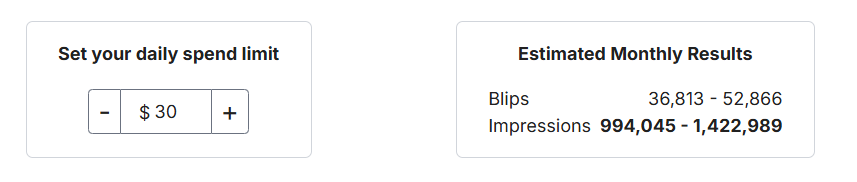
Pricing starts at just $0.01 per display. Each “blip” is a 7.5-to-10-second display on a rotating digital billboard, and the cost per blip can change based on time of day, location, and demand. There are no minimums or contracts, so you can set, adjust, or pause your budget anytime.
Where can I advertise with Blip in Richland Center?
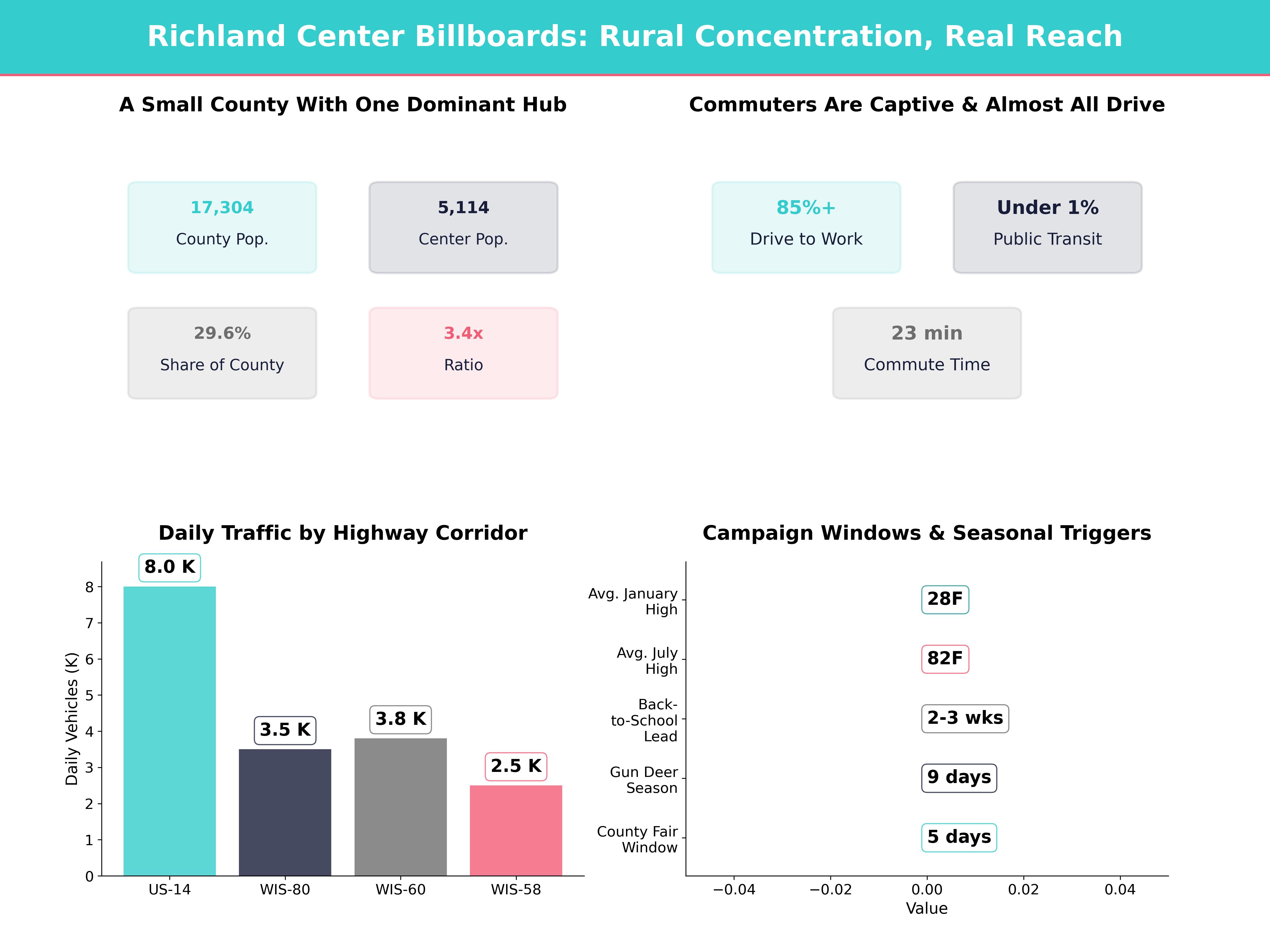
U.S. 14 is Richland Center’s primary billboard corridor and generally carries roughly 7,000 to 9,000 vehicles per day through the city. WIS 80 gives strong north-south local coverage in the 3,000 to 4,000 AADT range, and WIS 58 helps reach northern approach traffic and repeated local trips. Eastbound U.S. 14 and WIS 60 can also capture tourism spillover from the Spring Green side.
Why is Richland Center a good billboard market for Blip?
Richland Center is a strong billboard market because it concentrates a large share of local spending and services into one small, highly visible county-seat hub. Richland County had 17,304 residents in the 2020 Census, and Richland Center had 5,114, which means nearly 30% of the county lives in the city itself. This is a car-first place where errands, school runs, medical visits, and regional shopping all stack onto a limited set of roads.
What kind of traffic and audiences can Richland Center billboards reach?
Recent ACS estimates show that well over 85% of workers in Richland County commute by private vehicle, and public transit use remains under 1%. The mean travel time to work is about 23 minutes, which supports repeated exposure on predictable routes. Billboard audiences include county-seat errand traffic, families, healthcare consumers, tourists, and agriculture or trades workers.
When is the best time to run a billboard campaign in Richland Center with Blip?
Summer is Richland Center’s widest-reach advertising season because resident traffic and visitor traffic combine more effectively than at any other time of year. Back-to-school and fall are also major decision windows, and campaigns should generally begin 2 to 3 weeks before classes resume. Winter favors essential-service messaging for tire dealers, HVAC companies, pharmacies, and vehicle services.
Do I need a contract to advertise with Blip in Richland Center?
No, Blip has no long-term contracts or minimum commitments. You can start, pause, or stop your campaign at any time.
How fast can I launch a billboard campaign with Blip in Richland Center?
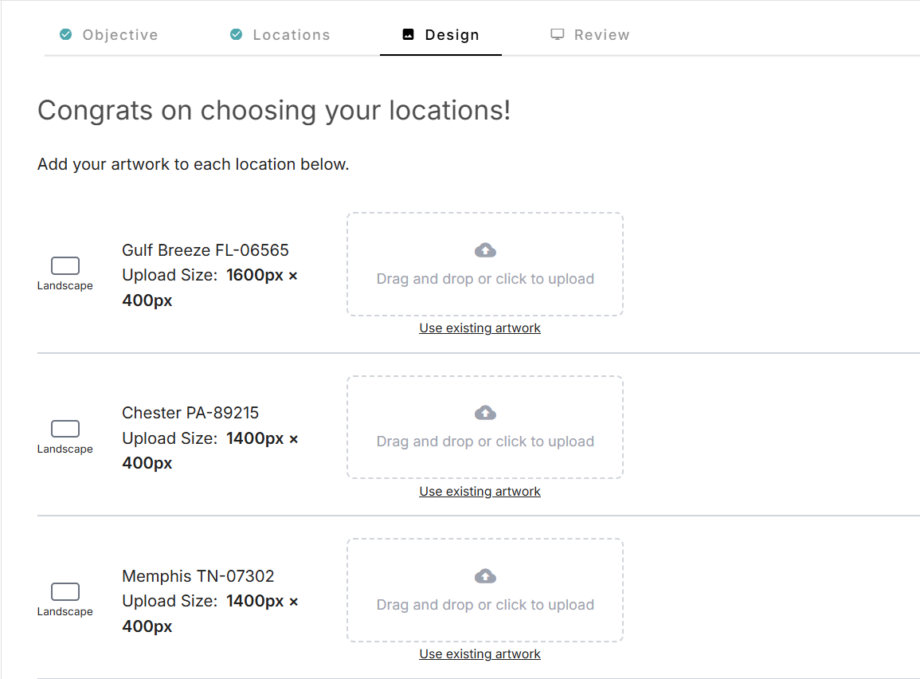
You can have your campaign live in minutes. Create a free account, select your locations, set your budget, upload your design, and start running once approved.
Where can I advertise with Blip in Richland Center?
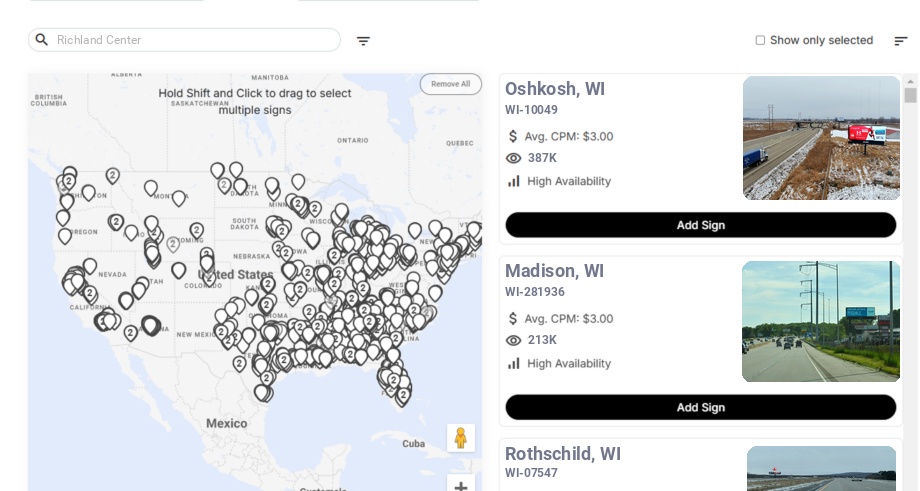
Blip has digital billboards in Richland Center. You can browse available locations on a map, choose the ones that fit your audience, and start advertising right away.
Still have questions? Launch a campaign in minutes — no contracts, no commitments.
Start Your CampaignRichland Center Billboard Advertising Guide
Richland Center is a strong billboard market because it concentrates a large share of local spending and services into one small, highly visible county-seat hub in a county of just 17,304 residents. Richland County had 17,304 residents in the 2020 Census, and Richland Center 5,114, which means nearly 30% of the county lives in the city itself, or about 3.4 county residents for every one city resident. That matters for advertising because this is a car-first place where errands, school runs, medical visits, and regional shopping all stack onto a limited set of roads. We also benefit from seasonal visitor traffic tied to the wider roughly 24,000-square-mile Driftless Wisconsin region, nearby Spring Green Area Chamber of Commerce attractions, and rural travel patterns that create repeated billboard exposure.
Richland Center Market Overview
Richland Center is the county-seat hub for a compact, loyal trade area.
According to the Wisconsin Department of Administration, Richland County counted 17,304 residents in 2020, while Richland Center counted 5,114. That city share works out to about 29.6% of the county population, or about 3.4 county residents for every one city resident, which is unusually concentrated for a rural market. From 2010 to 2020, the county moved from 18,021 residents to 17,304, a decline of about 4.0%, while the city moved from 5,184 to 5,114, a much smaller decline of about 1.4%. For advertisers, that pattern tells us that even without rapid population growth, Richland Center remains the place where county residents still gather for essential trips.
This kind of market rewards consistency more than brute force. We are not trying to chase dozens of disconnected neighborhoods. We are trying to stay visible in the few places people already pass every week for groceries, schools, county services, healthcare, restaurants, hardware, and fuel.
Richland Center is a car-dependent market, which is exactly what out-of-home advertising needs.
Recent ACS estimates show that well over 85% of workers in Richland County commute by private vehicle when we combine drive-alone and carpool trips, and public transit use remains under 1%. The mean travel time to work is about 23 minutes, which is long enough for message recall, but short enough that route choice stays fairly predictable. In practical terms, our audience is not scattered across rail platforms or bus corridors. Our audience is in pickups, SUVs, work vans, school-bound family vehicles, and local delivery traffic.
For billboard advertisers, that means frequency is realistic. People often travel the same corridors several times each week, and many trips are multipurpose. A single digital location can therefore reinforce awareness across morning commutes, lunch errands, afternoon school pickups, and evening return traffic.
Richland Center’s economy supports practical, service-oriented advertisers.
Richland Center is especially well suited for advertisers in healthcare, education, home services, legal services, banking, auto sales, farm supply, restaurants, retail, and hiring. Richland Hospital and Clinics is a 25-bed critical access hospital, which makes healthcare a major daily trip driver. The Richland School District anchors 3 primary campuses in the city, which creates dependable family traffic for back-to-school, sports, and community events. Nearby Organic Valley was founded in 1988 in La Farge
This is not a market where only national brands can win. Local businesses often have a real advantage because rural consumers respond to familiarity, convenience, and trust. When we match billboard creative to those local decision habits, Richland Center can perform very efficiently.
Key Traffic Corridors Around Richland Center
U.S. 14 is Richland Center’s primary billboard corridor.
Recent traffic count maps from the Wisconsin Department of Transportation generally show U.S. 14 7,000 to 9,000 vehicles per day through Richland Center, with the busiest in-town segments around the WIS 80 junction topping 8,000 AADT in recent count years. Exact counts vary by station and year, but the pattern is consistent. U.S. 14 is the county’s highest-value route for broad reach.
This corridor connects Richland Center to Spring Green Area Chamber of Commerce and the Madison direction to the east, and to the Viroqua
The best fits for U.S. 14 include the following categories:
- Local retailers can use U.S. 14 placements to stay visible to weekday shoppers and Saturday errand traffic.
- Restaurants, convenience stores, and fuel brands can use this corridor to catch impulse decisions while drivers are still mobile.
- Healthcare providers, banks, insurers, and legal firms can use U.S. 14 to build trust through repetition.
- Event promoters can use eastbound and westbound U.S. 14 placements to intercept regional visitors headed toward arts and tourism destinations.
WIS 80 gives us strong north-south local coverage.
WIS 80 serves Richland Center’s north-south movements and generally runs in the 3,000 to 4,000 AADT range near the city in recent WisDOT counts. That is lower than U.S. 14, but it can be more targeted. WIS 80 is especially useful for advertisers who care about county residents coming in for school, healthcare, hardware, farm supply, or municipal business.
We should think of WIS 80 as a precision route. It works well for:
- Auto repair shops, tire dealers, and truck services that benefit from rural drivers making planned purchases.
- Schools, clinics, and public-service campaigns that need credibility more than mass volume.
- Employers recruiting tradespeople, CDL drivers, technicians, and production workers from the wider county area.
WIS 58 helps us reach northern approach traffic and repeated local trips.
North of Richland Center, WIS 58 commonly falls around 2,000 to 3,000 AADT in recent count years. That number is smaller, but the audience is often highly local and highly relevant. In a smaller market, lower-volume roads can still work very well because they reach the exact households and business owners we want.
We should use WIS 58-oriented messaging when the goal is community penetration rather than regional scale. Contractors, home improvement brands, financial services, healthcare specialists, and local election or civic campaigns can all benefit from that tighter geographic focus.
WIS 60 and the Spring Green side create tourism spillover opportunities for Richland Center.
South and east of Richland County, WIS 60 generally ranges from about 2,500 to 5,000 AADT, climbing as travelers approach Spring Green Area Chamber of Commerce. That matters because Richland Center sits inside a wider leisure ecosystem that includes American Players Theatre, Taliesin Preservation, and The House on the Rock
This corridor is especially useful for the following advertiser types:
- Lodging, dining, and tourism brands can use it to pull visitors a bit farther into the region.
- Grocery stores, farm markets, and specialty retailers can use it to turn pass-through travel into stops.
- Real estate, healthcare, and financial services can use it to stay visible to second-home owners and affluent leisure travelers.
Audience Segments in Richland Center and Richland County
We can reach daily commuters and county-seat errand traffic.
Because nearly 30% of Richland County residents live in Richland Center, and many more travel there regularly, the city functions as a recurring service center. Our billboard audience is not just nine-to-five commuters. It also includes courthouse visitors, school families, medical patients, retail shoppers, restaurant users, and business owners making supply runs.
That matters because repeated exposure tends to be high in county-seat markets. A household may pass the same billboard on Monday for work, Wednesday for groceries, Friday for athletics, and Saturday for dining. When we want fast local awareness, Richland Center’s trip patterns work in our favor.
We can reach families, healthcare consumers, and local service buyers.
The presence of a 25-bed hospital at Richland Hospital and Clinics and 3 primary campuses in the Richland School District creates a dependable family-and-care audience. That audience is ideal for dentists, pediatric care, urgent care, vision providers, pharmacies, grocery stores, quick-service restaurants, family entertainment, youth sports programs, insurance agencies, and banks.
In this segment, billboard messaging should feel immediately useful. Offers such as seasonal checkups, school physicals, enrollment reminders, savings promotions, and family meal deals tend to align well with the reasons people are already on the road.
We can reach tourists exploring the Driftless region.
Richland Center benefits from tourism spillover tied to the broader Driftless Wisconsin brand. Nearby Taliesin Preservation became part of a UNESCO World Heritage listing in 2019, and American Players Theatre creates a sustained visitor draw during the warm-weather season. The House on the Rock
This segment is strongest from late spring through fall, and it often peaks Thursday through Sunday. Hospitality, dining, arts, antiques, specialty retail, and recreational services should all think beyond Richland Center’s resident base and include visitors in their planning.
We can reach agriculture, trades, and regional employers.
Rural Wisconsin audiences respond very well to billboard campaigns for equipment dealers, farm supply stores, seed and feed brands, financial institutions, hiring campaigns, HVAC, plumbing, roofing, internet providers, and building materials. The area’s economic identity is still closely tied to agriculture and production, and the founding of Organic Valley in 1988 nearby remains a strong cultural signal.
This audience often values practicality over polish. Hiring messages, financing offers, extended hours, and route-based calls to action usually resonate better than abstract branding alone.
Seasonal and Timing Opportunities in Richland Center
Summer is Richland Center’s widest-reach advertising season.
From roughly late May through October, we can combine resident traffic with visitor traffic more effectively than at any other time of year. The Richland County Fair 5-day burst of family activity, and the nearby Spring Green Area Chamber of Commerce visitor corridor brings added movement into the region. For restaurants, ice cream shops, retailers, campgrounds, attractions, and community events, this is the season to lean into broader awareness.
We should also remember that summer traffic is not only local. It includes day-trippers, cabin users, arts patrons, and scenic-drive travelers. That mix makes digital billboards especially useful because we can rotate resident-focused and visitor-focused creative by day and daypart.
Back-to-school and fall are major decision windows in Richland Center.
In Richland Center, late August and September create strong demand for school-related products and services. We should generally begin back-to-school campaigns 2 to 3 weeks before classes resume so parents see the message during shopping and scheduling mode. That window is especially effective for healthcare, vision, family dining, apparel, internet service, tutoring, youth activities, and financial services.
Fall also carries a different kind of emotional energy. Harvest, football, hunting, and holiday planning all begin to overlap. Wisconsin’s traditional gun deer season runs for 9 days, and the Wisconsin Department of Natural Resources makes that season one of the state’s most predictable bursts of rural travel. Brands selling trucks, outdoor gear, convenience items, auto services, sporting goods, quick meals, and cold-weather products can all benefit from strong late-fall billboard flights.
Winter in Richland Center favors essential-service messaging.
Richland Center’s average July high is around 82°F, while its average January high is around 28°F, and annual snowfall is roughly 35 to 40 inches in a typical year. Those weather realities shape what people buy and when they buy it. Winter is a natural fit for tire dealers, propane providers, HVAC companies, urgent care, pharmacies, winter apparel, grocery stores, hardware stores, and vehicle services.
Because weather can change fast in southwestern Wisconsin, we should think in short bursts. A cold snap, the first measurable snow, or a holiday travel weekend can justify a quick creative swap and a temporary budget increase.
Billboard Design Tips for Richland Center
Richland Center creative should make the route obvious.
In a rural market, directional clarity matters. Drivers respond well when we tell them exactly where to go, such as “On U.S. 14,” “Just off WIS 80,” “Downtown Richland Center,” or “2 miles ahead.” That kind of wording works because many trips are destination-based rather than spontaneous browsing.
We should also use local identifiers people recognize quickly. The 608 area code, Richland Center place names, and highly visible route numbers help the ad feel native to the market rather than imported from a generic statewide campaign.
Richland Center audiences tend to prefer authenticity over gloss.
The visual language that fits this market is different from what works in dense urban cores. We should lean into Driftless hills, farm fields, county-fair energy, Friday-night sports, small-business storefronts, and trustworthy service imagery. Colors such as deep green, navy, white, red, and even blaze orange in hunting season can feel more locally grounded than ultra-neon palettes.
That does not mean the creative should look old-fashioned. It means the creative should feel relevant. A clean, modern design paired with unmistakably local imagery usually performs better than stock photography that could belong anywhere.
Richland Center billboard copy should stay short and value-focused.
Even though rural roads can sometimes offer a little more read time than urban freeways, we should still keep copy compact. A practical target is 6 to 8 words plus one strong visual and one clear call to action. In this market, direct value statements often outperform clever but vague phrasing.
The strongest local themes usually include the following ideas:
- Savings and affordability matter, so price-led creative can work very well.
- Trust and convenience matter, so “local,” “same-day,” “family care,” and “open late” messages can perform strongly.
- Seasonal relevance matters, so hunting, fair, school, snow, and tourism cues help the message feel timely.
Richland Center creative should change with the calendar.
We should not run the exact same billboard art in July, October, and January if the audience mindset has changed. Summer creative can feature food, events, and weekend exploration. Fall creative can shift toward hunting, harvest, and school sports. Winter creative can highlight safety, warmth, reliability, and urgent services.
This is one of the easiest ways to make a smaller market feel larger. When the ad visibly reflects what people are living right now, relevance rises.
Regional Strategies Across Greater Richland Center
In Richland Center itself, we should focus on action-oriented local messages.
Within the city, our best plays are retail, dining, healthcare, banking, professional services, schools, churches, and community events. People already know the town, so the billboard does not need to explain the region. It needs to give them a reason to act now.
Messages such as appointments, lunch specials, hiring, weekly promotions, and event reminders tend to fit this zone best. If the location is close to a decision point, we should use that advantage directly.
East of Richland Center, we should plan for leisure and destination travel.
The eastbound U.S. 14 and WIS 60 side is where tourism and Madison-bound regional movement become more important. This is where campaigns can benefit from the visitor halo created by Spring Green Area Chamber of Commerce, American Players Theatre, Taliesin Preservation, and The House on the Rock
For this side of the market, we should emphasize food, fuel, lodging, attractions, scenic stops, and premium retail. People on these routes are often more open to discovery than strictly local errand traffic is.
West and northwest of Richland Center, we should stress practicality and repeat need.
On the westbound side toward Viroqua Chamber Main Street and the broader Driftless trade area, we should prioritize practical categories. Farm-related spending, healthcare, auto services, hardware, workforce recruiting, and business-to-business services all align well with these routes.
This side of the market is often less about tourism polish and more about usefulness. A clear service message can outperform a softer brand-awareness concept here.
Southern approaches should balance resident trips with river-and-recreation movement.
Routes toward the Wisconsin River Spring Green Area Chamber of Commerce can produce a mixed audience of locals, workers, and seasonal visitors. For these placements, we should think carefully about time of week. Resident service ads can work best early in the week, while hospitality and recreation ads often become stronger as the weekend approaches.
Using Blip Tools in Richland Center
We can use Blip to test Richland Center routes without overcommitting.
Richland Center is exactly the kind of market where testing matters. Instead of assuming one corridor will outperform another, we can put modest budgets behind U.S. 14, WIS 80, and tourism-oriented regional placements, and then compare results. In a smaller geography, that flexibility is valuable because traffic patterns can vary more by trip purpose than by sheer volume.
We can daypart Richland Center campaigns around local behavior.
For many advertisers, the most productive windows will be 6 to 9 a.m., 11 a.m. to 1 p.m., and 3 to 6 p.m.. Those blocks line up with commuting, lunch trips, school-related traffic, and after-work errands. Tourism and dining brands can often justify stronger delivery from Thursday through Saturday, while Sunday evening can work well for return-trip traffic.
We can localize Richland Center creative quickly.
Because seasonal shifts are meaningful here, we should take advantage of Blip’s artwork tools to create multiple versions of the same campaign. A summer version can emphasize events and outdoor activity. A school-season version can emphasize family routines. A late-fall version can reference hunting, heating, or holiday preparation. That kind of creative rotation keeps the campaign feeling native to the moment.
We can use analytics to learn the real trade area around Richland Center.
The most useful insight in a smaller market is often not total impressions alone. It is learning which direction, time window, and message produce the strongest business response. When we review results consistently, we can decide whether Richland Center itself, the eastbound corridor, or a more tourism-oriented placement deserves the next dollar.
Getting Started with Billboard Rental in Richland Center
We should start with one clear Richland Center objective.
Before we rent anything, we should decide whether the campaign’s main job is awareness, directional traffic, event promotion, hiring, or seasonal sales. Each goal points us toward a different kind of location. Awareness usually favors the biggest routes, especially U.S. 14. Directional traffic often favors a placement closer to the business. Hiring can work well on commuter-heavy approaches. Event promotion usually benefits from short, timely bursts.
We should evaluate Richland Center boards by trip purpose, not just by map pin.
A billboard is valuable when it sits in front of the right decision moment. In Richland Center, we should ask whether the board reaches county-seat errands, school-family trips, healthcare traffic, farm-and-trade traffic, or regional leisure travelers. We should also consider travel direction, speed, read distance, lighting, and how close the board is to the place where the driver can actually turn, stop, or remember the message.
As a practical rule, we can think about locations this way:
- U.S. 14 locations usually work best for broad awareness and repeat frequency.
- WIS 80 and WIS 58 locations often work best for targeted local services and hiring.
- Eastbound tourism-oriented placements often work best for dining, hospitality, attractions, and premium retail.
We should build a realistic Richland Center flight plan.
A good starting plan is often 2 to 3 boards with distinct jobs rather than one board trying to do everything. One location can handle broad market visibility. Another can reinforce a specific route into town. A third can target seasonal or visitor traffic. Once we see what performs, we can shift budget toward the strongest corridor.
This is where digital flexibility helps smaller markets tremendously. Traditional billboard buying can be slower to adjust and harder to test. With Blip, we can launch faster, make changes when local conditions change, and avoid treating a rural market like a one-size-fits-all media buy.
We should treat Richland Center as a repeat-exposure market.
Richland Center is not a place where a billboard needs to reach millions of people to work. It is a place where the right message can reach the same valuable people again and again on roads they already use. When we combine the county-seat role, the car-dependent travel pattern, the U.S. 14 corridor, and seasonal Driftless tourism, Richland Center becomes a very workable billboard market for local brands, regional service providers, and smart test-and-learn campaigns alike.