Billboards near Waukesha, WI
No Minimum Spend. No Long-Term Contracts. Just Results.
Trusted by Leading Brands


Billboard advertising
near Waukesha has never been easier




How much is a billboard near Waukesha?
Why Choose Blip for Billboard Advertising near Waukesha
Blip lets you launch in Waukesha fast, reaching I-94 and WIS 16 commuters with no contracts or minimums.
Use Blip-optimized buying in Waukesha to auto-pick the best times for weekday drivers, Lake Country traffic, and weekend shoppers.
Waukesha advertisers can start small, scale anytime, and pay only when ads run—great for serving the city and 404,198-county market.
Daypart Blip campaigns for Waukesha rush hours or Friday-to-Sunday leisure traffic near Downtown and Lake Country.
Track Waukesha billboard performance in real time, then shift spend as school-year, fair-week, and holiday traffic changes.
Use Blip creative tools to make sharp Waukesha ads for commuter speed, local employers, and the county's family-driven audience.
Frequently Asked Questions About Billboard Advertising near Waukesha
How much does a billboard cost in Waukesha with Blip?
Blip makes billboard advertising in the Waukesha area more accessible by letting you pay only when your ad actually appears. Each “blip” is a 7.5-to-10-second digital billboard display, and pricing starts at just $0.01 per display. You set a daily budget, and Blip’s algorithm uses it to bid for available ad slots, with costs that can vary based on time of day, location, and advertiser demand.
Where can I advertise with Blip in the Waukesha area?
Our 2 digital billboards in nearby Pewaukee, just 2.7 miles from Waukesha and within 10.0 miles of the market center, give us a focused way to reach people serving the Waukesha area. The Pewaukee gateway is especially useful for drivers moving through the east-west suburban corridor and between Waukesha, Brookfield, Delafield, and other nearby communities. Nearby I-94 and WIS 16 also support strong commuter and regional reach.
Why is Waukesha a good market for billboard advertising with Blip?
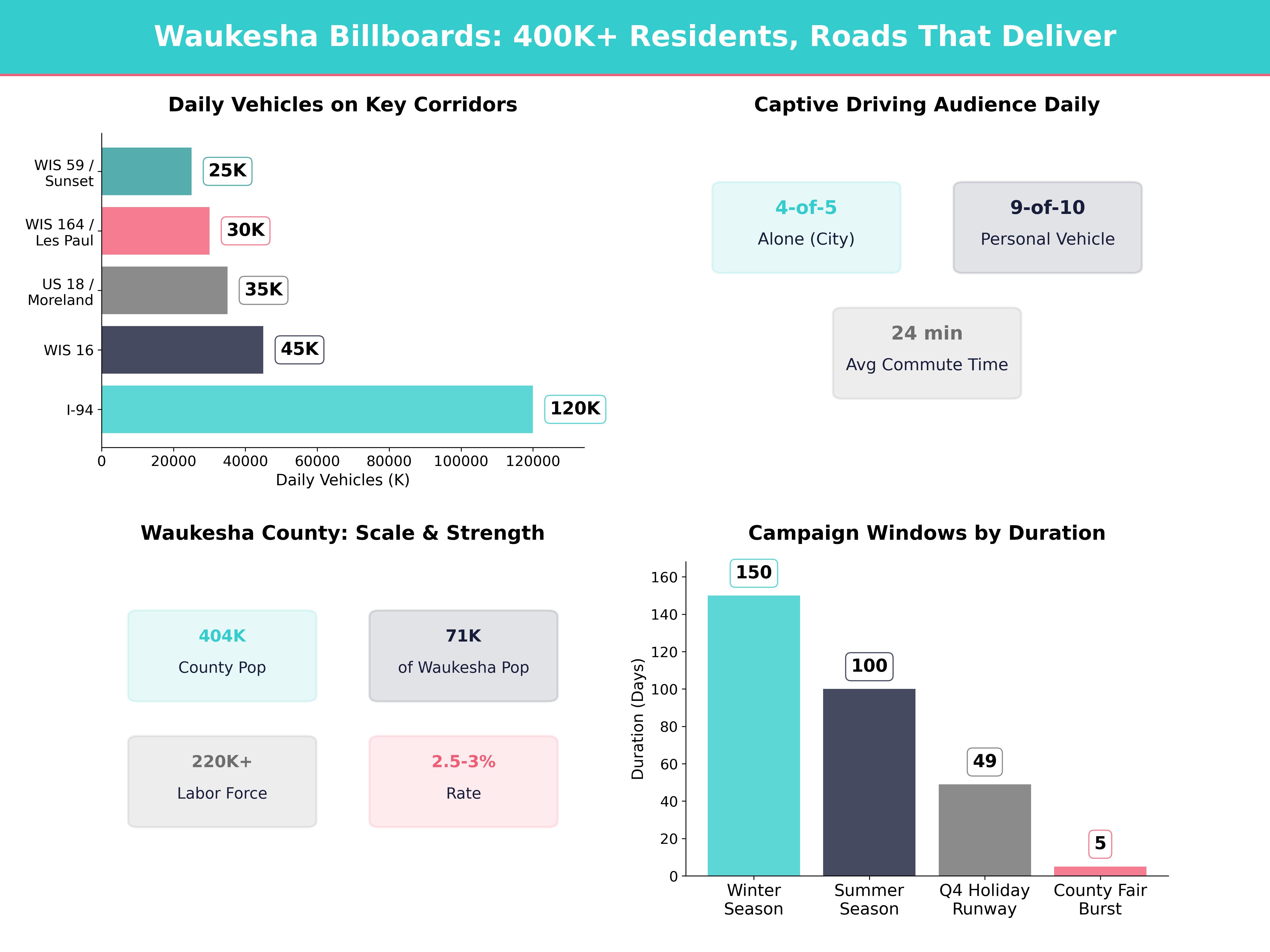
The City of Waukesha sits at one of southeastern Wisconsin’s most useful advertising crossroads, where suburban households, regional employers, Lake Country leisure traffic, and Milwaukee-bound commuters overlap every day. Waukesha County has 404,198 residents, and the City of Waukesha has 71,158 residents. That makes billboard advertising near Waukesha especially effective for brands that need repeat visibility, strong local recall, and steady drive-to-location traffic.
What kinds of people does a Blip billboard reach in Waukesha?
The Waukesha area gives advertisers a large base of weekday drivers who see the same corridors over and over, which is ideal for brand reinforcement, hiring campaigns, service reminders, and limited-time offers. It also reaches students, parents, and household decision-makers through Carroll University, Waukesha County Technical College, and local school districts. Visitors, shoppers, and weekend leisure traffic add another layer of reach through Downtown Waukesha, Lake Country, and the Waukesha County Fair.
When is the best time to run billboard ads in Waukesha?
From Memorial Day to Labor Day, we get a summer window of roughly 100 days, and that period is especially strong near Waukesha. Late August and early September create a major reset when school returns, and holiday planning should start earlier than many advertisers expect, with Q4 campaigns usually benefiting from a 6- to 8-week runway beginning in early November. Winter from roughly November through March is also important because drivers spend more time traveling in darkness, cold, and variable weather.
Do I need a contract to advertise with Blip near Waukesha?
No, Blip has no long-term contracts or minimum commitments. You can start, pause, or stop your campaign at any time.
How fast can I launch a billboard campaign with Blip near Waukesha?
You can have your campaign live in minutes. Create a free account, select your locations, set your budget, upload your design, and start running once approved.
Where can I advertise with Blip near Waukesha?
Blip has digital billboards near Waukesha. You can browse available locations on a map, choose the ones that fit your audience, and start advertising right away.
Still have questions? Launch a campaign in minutes — no contracts, no commitments.
Start Your CampaignWaukesha Billboard Advertising Guide
The City of Waukesha sits at one of southeastern Wisconsin’s most useful advertising crossroads, where suburban households, regional employers, Lake Country leisure traffic, and Milwaukee 404,198 residents and a city of 71,158. That makes billboard advertising near Waukesha especially effective for brands that need repeat visibility, strong local recall, and steady drive-to-location traffic. Our 2 digital billboards in nearby Pewaukee 2.7 miles from Waukesha and within 10.0 miles of the market center, give us a focused way to reach people serving the Waukesha area. For local businesses, healthcare groups, schools, retailers, home-service companies, and regional employers, this market offers the kind of daily movement that digital out-of-home handles very well.
Waukesha area market overview
Population and household scale near Waukesha
The Wisconsin Department of Administration Demographic Services Center 71,158 residents in the 2020 count, while Waukesha County had 404,198 residents. That gives advertisers a meaningful blend of city-scale population and countywide suburban reach without needing a large, sprawling footprint.
The county structure also matters. Waukesha County includes 8 cities, 9 villages, and 17 towns, for 34 municipalities in total. That spread creates a broad trading area around the Waukesha market, with daily trips flowing between neighborhoods, schools, retail districts, business parks, and recreation areas.
Geographically, Waukesha County sits immediately west of Milwaukee County 939,489 residents, so the Waukesha area benefits from both local demand and cross-county movement. For billboard planning, that means we are not only reaching residents tied closely to Waukesha itself. We are also speaking to people who shop, work, study, dine, and attend events across the broader western Milwaukee suburban belt.
Jobs, income, and commuting habits serving the Waukesha area
From an economic standpoint, the Waukesha area is attractive because it combines population density, strong household buying power, and a large employment base of more than 220,000 workers. Data from the Wisconsin Department of Workforce Development regularly places the county labor force above 220,000 people, and county unemployment has often run in the 2.5% to 3.0% range during stronger labor periods. That is the kind of environment where categories like healthcare, financial services, education, home improvement, legal services, recruiting, automotive, and dining can all perform well.
The local economy is also diversified. Major activity in the Waukesha area comes from manufacturing, healthcare, retail, professional services, education, logistics, and construction. Employers and institutions such as ProHealth Care GE HealthCare Generac, Carroll University, and Waukesha County Technical College help keep weekday traffic steady and varied.
Commuting patterns strongly support billboard use near Waukesha. Recent ACS estimates indicate that about 4 out of 5 workers in the City of Waukesha drive alone to work, and nearly 9 out of 10 county workers use a personal vehicle when carpoolers are included. Average travel time to work is about 24 minutes, which is long enough for repeated visual exposure and short enough to keep most trips road-based rather than transit-based. In practical terms, that means the Waukesha area is a classic driver market, and driver markets are where roadside digital billboards tend to shine.
Key traffic corridors serving the Waukesha area
I-94, WIS 16, and the Pewaukee gateway near Waukesha
For advertisers targeting the Waukesha area, the biggest traffic story is the east-west freeway network. According to WisDOT traffic count resources I-94 routinely exceed 120,000 vehicles per day. That corridor connects the Waukesha market to Brookfield
Our digital billboards in nearby Pewaukee are well positioned because Pewaukee functions as a gateway market for Waukesha-area travel. Drivers moving between the Waukesha area and destinations east or west often pass through this zone, which makes it especially useful for advertisers that depend on repeated commuter impressions.
WIS 16 is another important route tied closely to Pewaukee and the north side of the Waukesha area. WisDOT counts commonly place parts of that corridor in roughly the 40,000 to 50,000 vehicles-per-day range near major junctions. That adds another layer of value for brands trying to reach both local residents and travelers circulating through the broader western suburban network.
Local arterials that feed the Waukesha market
Beyond the freeway system, several major arterial routes help advertisers reach people whose daily routines center on the Waukesha area.
- US 18 / Moreland Boulevard commonly falls in the 30,000 to 40,000 vehicles-per-day range, depending on segment, and it is one of the most important commercial spines serving the Waukesha area.
- WIS 164 / Les Paul Parkway often carries about 25,000 to 35,000 vehicles per day and helps connect north-south suburban movement.
- WIS 59 / Sunset Drive often lands around 20,000 to 30,000 daily vehicles and serves retail, neighborhood, and service-related travel.
- Nearby interchange zones feeding retail and employment clusters add another layer of high-frequency exposure for businesses targeting appointments, shopping trips, or household purchases.
These local routes matter because billboard success near Waukesha is not only about freeway traffic. It is also about how people move between neighborhoods, schools, healthcare campuses, downtown destinations, and shopping areas. When we combine the Pewaukee gateway with the arterial network serving the Waukesha area, we get a practical path to both broad reach and useful repetition.
Audience segments we can reach near Waukesha
Daily commuters and working professionals near Waukesha
The first major audience near Waukesha is the daily commuter. With a county labor force above 220,000 and personal-vehicle commuting near 90% when carpools are included, the Waukesha area gives us a large base of weekday drivers who see the same corridors over and over. That consistency is ideal for brand reinforcement, hiring campaigns, service reminders, and limited-time offers.
This commuter audience is not narrow. It includes office workers, healthcare professionals, tradespeople, manufacturing employees, educators, retail managers, and business owners. It also includes people traveling between the Waukesha area, Brookfield New Berlin
Students, parents, and household decision-makers serving the Waukesha area
The second major audience is the education-and-family segment. Carroll University was founded in 1846, and it remains one of the defining institutions tied to the Waukesha area. Nearby Waukesha County Technical College in Pewaukee adds another major stream of student, faculty, staff, and continuing-education traffic.
K-12 movement also matters. The School District of Waukesha, the Pewaukee School District, and the Kettle Moraine School District all contribute to predictable weekday travel patterns tied to school drop-off, sports, after-school activities, and parent errands. That makes the Waukesha area especially useful for advertisers in tutoring, youth activities, family dining, orthodontics, urgent care, childcare, home services, and community events.
Timing here is predictable. We get 2 major academic reset points each year, one in late August and one in January, plus a school-year rhythm that runs for roughly 9 months. For advertisers that need family decision-makers, that repeat pattern is extremely valuable.
Visitors, shoppers, and weekend leisure traffic near Waukesha
The Waukesha area also has a meaningful leisure and shopping audience. Visit Lake Country promotes the surrounding lake communities, golf, dining, trails, and seasonal recreation that draw residents and visitors through the area. Downtown Waukesha adds dining, events, entertainment, and community activity that help keep the market active beyond work hours.
Summer and weekend movement is especially important. Families head toward lakes, parks, restaurants, fairs, and local attractions, while shoppers move between Waukesha, Pewaukee, Brookfield, and western county destinations. The Waukesha County Fair 5-day burst each July that can be very useful for restaurants, attractions, retail, healthcare, and event-driven brands.
For outdoor and recreation advertisers, the Waukesha County Park System supports steady seasonal traffic as well. That helps categories like sporting goods, family entertainment, tourism, beverages, quick-service dining, and automotive aftermarket brands.
Seasonal and timing opportunities near Waukesha
Spring and summer campaign windows in the Waukesha area
From Memorial Day to Labor Day, we get a summer window of roughly 100 days, and that period is especially strong near Waukesha. Lake traffic increases, patios and restaurants get busier, home improvement projects accelerate, and local events draw more weekend movement. If we are advertising HVAC, roofing, landscaping, decks, recreation, beverages, restaurants, outdoor retail, or family attractions, this is usually the first big seasonal opportunity to plan for.
July deserves special attention because of the 5-day Waukesha County Fair
For this market, Friday afternoon through Sunday evening can be particularly valuable during warmer months. That is when commuter patterns blend with recreation and family movement, and the Waukesha area audience becomes broader than a simple work-trip audience.
Fall, winter, and school-year timing near Waukesha
Late August and early September create a major reset near Waukesha because school returns, college terms restart, routines tighten, and family schedules become more structured. That window is excellent for healthcare, education, tutoring, restaurants, gyms, retail, after-school programs, and household services.
Holiday planning should start earlier than many advertisers expect. In the Waukesha area, Q4 campaigns usually benefit from a 6- to 8-week runway beginning in early November. Retail, events, restaurants, gift-driven categories, and family entertainment all gain from consistent exposure during that period.
Winter is also more important than many brands assume. Roughly November through March, or about 5 months, drivers in southeastern Wisconsin spend more time traveling in darkness, cold, and variable weather. Clear digital creative can stand out well in those conditions. Winter is often a strong period for healthcare, recruiting, tax services, home services, auto repair, fitness, and warm-food categories because people are still driving, but they are making more deliberate local decisions.
Billboard design tips for the Waukesha area
Creative choices that match the Waukesha market
The Waukesha area tends to respond best to billboard creative that feels practical, polished, and easy to process. This is a suburban market with a strong family base, a large commuter audience, and a mix of professional and blue-collar employment. Creative that looks overly abstract or overly urban usually does less work here than clear, benefit-led messaging.
We typically recommend high-contrast color palettes because the visual environment changes a lot by season. Bright whites, blues, reds, and yellows hold up well against green summer roadside backgrounds and gray winter skies. Photography or illustration should also match local expectations. Home exteriors, vehicles, clinicians, tradespeople, families, and leisure scenes usually feel more relevant near Waukesha than highly stylized stock imagery.
Copy discipline matters even more. We usually aim for 7 to 10 words, 1 main idea, 1 offer, and 1 action. That is especially important near Waukesha because so much of the audience is moving at commuter speed rather than strolling through a dense pedestrian district.
Messaging approaches that work near Waukesha
Certain message styles tend to fit this market particularly well.
- We often use directional or proximity language such as “Near I-94,” “Next Exit,” or “Serving the Waukesha area” when that wording is accurate.
- We use urgency carefully with phrases like “Today,” “This Week,” or “Now Hiring” when the campaign goal is immediate response.
- We keep contact information simple, usually limiting the board to 1 short URL, 1 phone number, or a very strong brand name.
- We often prepare 2 creative versions, one tuned for weekday commuters and one tuned for weekend leisure traffic.
For the Waukesha area, trust-building categories usually outperform bargain-heavy creative. Healthcare, legal, education, financial services, home services, and professional services often do better with clarity, credibility, and convenience than with aggressive discount language. On the other hand, restaurants, retail, entertainment, and events can benefit from straightforward promotional language tied to timing.
Regional strategies around Waukesha
Pewaukee gateway strategy for the Waukesha area
Because our 2 digital billboards sit in nearby Pewaukee, just 2.7 miles from Waukesha, we should think of them as gateway units for the Waukesha market. They are particularly useful for advertisers that want to catch people moving east-west through the suburban corridor rather than targeting a single neighborhood block.
This is a strong strategy for brands with regional appeal, such as hospitals, colleges, dealerships, law firms, staffing companies, event venues, family attractions, and destination retail. The Pewaukee location helps us reach drivers connected to the Waukesha area while also tapping into movement between Brookfield Delafield
Commercial-corridor strategy for local services serving Waukesha
For many local advertisers, the right lens is not city limits but drive time. If our business draws customers from a 5- to 15-mile radius, a billboard near Pewaukee can still be highly effective for the Waukesha area because customers often travel across municipal boundaries for healthcare, dining, shopping, and services.
That is especially true for categories like dentists, clinics, urgent care, banks, insurance agencies, HVAC companies, remodelers, auto repair shops, and specialty retail. These businesses do not need every impression to come from the exact same ZIP code. They need repeated exposure among likely local buyers who already move around the Waukesha area several times each week.
Countywide and Lake Country strategy near Waukesha
The Waukesha market is broader than the city alone. It connects naturally with Hartland Delafield Oconomowoc Brookfield New Berlin
That broader view is important for healthcare systems, colleges, major employers, home-service companies, and regional retail brands. If we only think narrowly about the Waukesha city core, we can underuse the true value of the market. If we think in terms of countywide and adjacent-suburb movement, the Pewaukee boards become more strategic.
Using Blip tools for Waukesha-area campaigns
When optimized buying works best near Waukesha
For the Waukesha area, Blip-optimized campaigns are especially useful when we want the platform to balance spend automatically across the best available opportunities. That approach can help when we care more about overall efficiency than about manually controlling every board or hour.
This is helpful for broader goals such as regional awareness, recruiting, healthcare promotion, college outreach, retail visibility, or general brand lift serving the Waukesha area. It can also help us adapt to changing demand between weekday commute windows and higher-value weekend periods.
When manual selection makes sense for the Waukesha market
Manual buying makes a lot of sense here too, especially because we currently have 2 digital billboards serving the Waukesha area. When inventory is this focused, manual selection is straightforward if we already know the audience and time windows we want.
For example, we may want to concentrate spend during 6:00 to 9:00 a.m. and 3:00 to 7:00 p.m. for commuter-heavy campaigns. We may prefer Friday at noon through Sunday evening for restaurants, attractions, or family entertainment. Manual control is also useful if we want to align with specific events, sales windows, or short-term hiring pushes.
Budgeting and testing for the Waukesha area
Because Blip uses flexible digital buying, we can test the Waukesha market without a heavy upfront commitment. Displays start at $0.01 per play, and each blip runs for 7.5 to 10 seconds. That lets us build a practical test, learn quickly, and scale what works.
We usually recommend a simple structure first. We can begin with 2 or 3 dayparts, run 2 creative versions, and evaluate performance over 7 to 14 days. After that, we can shift spend toward stronger times, refresh creative, or increase coverage around school starts, fair week, seasonal peaks, or holiday demand.
Getting started with billboard rental near Waukesha
What to expect from the rental process near Waukesha
Traditional billboard buying often involves fixed 4-week periods, limited flexibility, and back-and-forth negotiation. That model can work, but it is not ideal for every advertiser serving the Waukesha area, especially when campaigns need to move with seasonality, hiring demand, event timing, or sales cycles.
With Blip, we can approach billboard rental more practically. We can launch quickly, change art, adjust dayparts, pause spending, or scale up without getting locked into the same kind of rigid process that often comes with older out-of-home buying models. For local and regional advertisers, that flexibility is especially useful.
How we evaluate the right billboard locations for the Waukesha area
When we choose billboards serving the Waukesha area, we usually start with three practical questions.
- We ask who we need to reach, whether that is commuters, families, students, shoppers, or weekend visitors.
- We ask which travel direction matters most when those people are most likely to act.
- We ask whether the real trade area is 5 miles, 10 miles, 15 miles, or truly countywide.
Those questions help us match the board location to the actual business goal. A clinic may need weekday repetition. A restaurant may care more about Thursday through Sunday. A school may need strong August and January visibility. A regional employer may need morning and evening commuter frequency.
A simple launch plan for billboard rental near Waukesha
We usually recommend a straightforward launch plan.
- We define 1 primary goal, such as awareness, store traffic, recruiting, appointment generation, or event attendance.
- We choose whether to use manual buying or an optimized campaign based on how much timing control we need.
- We upload 1 or 2 clean creative versions built for fast roadside reading.
- We run a 1- to 2-week test and review results before expanding.
For businesses serving the Waukesha area, that process is often enough to identify whether commuter windows, weekend windows, or seasonal bursts deserve the most budget. Because our boards are close to Waukesha in nearby Pewaukee, we can build a campaign that feels local without overcomplicating the footprint. That is usually the smartest way to start billboard rental near Waukesha, and it gives us room to grow as soon as we see what resonates most.