Billboards in Greenfield, WI
No Minimum Spend. No Long-Term Contracts. Just Results.
Trusted by Leading Brands


Billboard advertising
in Greenfield has never been easier
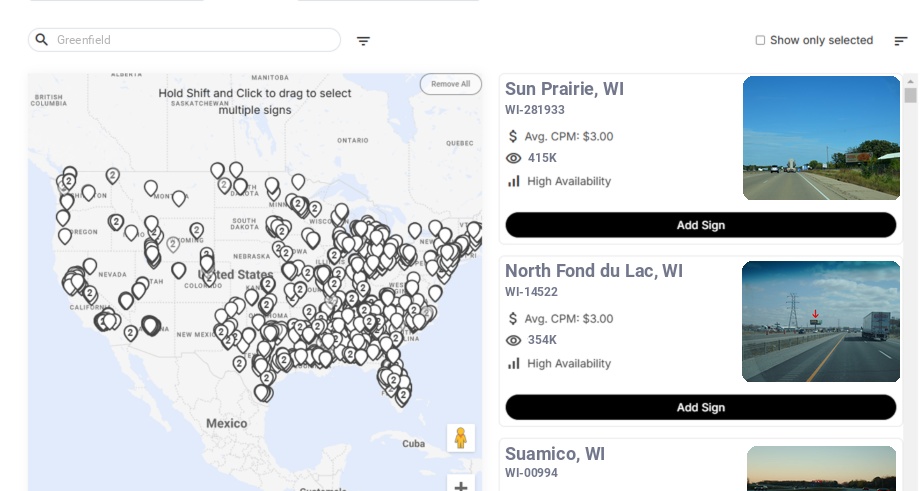



How much is a billboard in Greenfield?
Why Choose Blip for Billboard Advertising in Greenfield
-
Blip lets you launch in Greenfield fast, reaching I-894 and I-43 commuters without traditional buying delays.
-
Set any budget in Greenfield and pay only when ads play—great for testing Southridge and Highway 100 traffic.
-
No contracts means Greenfield advertisers can shift spend around Brewers games, summer fairs, or holiday shopping peaks.
-
Use Blip's real-time analytics to see what works in Greenfield, then move budget toward the busiest 27th Street and Layton routes.
-
Build and update creative quickly with Blip tools, tailoring Greenfield billboards for commuters, shoppers, and airport travelers.
Frequently Asked Questions About Billboard Advertising in Greenfield
How much does a billboard cost in Greenfield with Blip?
With Blip, billboard advertising in Greenfield can fit a wide range of budgets because you only pay when your ad actually appears. Each “blip” is a 7.5-to-10-second display on a rotating digital billboard, with pricing starting at just $0.01 per display. Your daily budget tells Blip’s algorithm how to bid for open ad slots, and the cost per blip changes based on time of day, location, and advertiser demand.
Where can I advertise with Blip in Greenfield to reach the most drivers?
I-894 and US 45 around Greenfield regularly carry well over 100,000 vehicles per day on major segments, with some interchanges in the 120,000 to 130,000 AADT range. I-43 near the Hale area typically falls around 110,000 to 125,000 AADT and connects Greenfield to the airport, downtown Milwaukee, and southeastern Wisconsin destinations. These corridors are the backbone routes for broad-reach campaigns.
What makes Greenfield a strong billboard market for Blip?
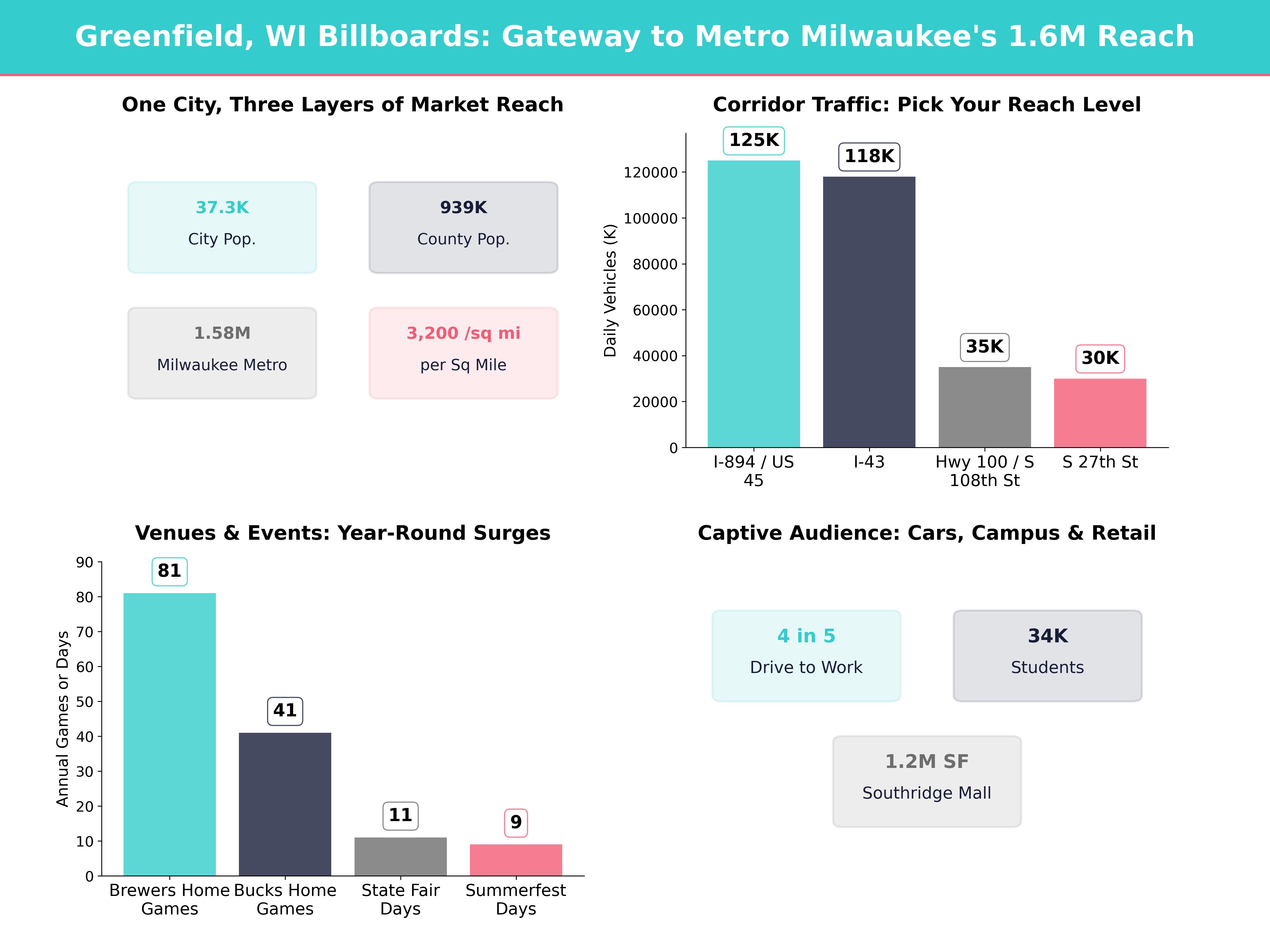
Greenfield is a compact, high-visibility suburb that gives access to both neighborhood shoppers and the full Milwaukee-area travel shed. The city has roughly 37,000 residents, but it sits inside Milwaukee County’s nearly 939,489-person market and within a metro area of about 1,576,816 people. Because daily life here is highly car-dependent, with well over 4 in 5 workers commuting by private vehicle, digital billboards can build repeated exposure quickly.
When is the best time to run billboard ads in Greenfield?
Morning commute windows, roughly 6 a.m. to 9 a.m., and evening commute windows, roughly 3 p.m. to 7 p.m., are natural fits for employers, healthcare, financial services, and everyday consumer brands. Midday can be more effective near Southridge for restaurants, retail, and same-day services, while evenings and weekends often make more sense for entertainment and event campaigns. Greenfield is also strong for seasonal timing around summer events, back-to-school, and holiday shopping.
Which Greenfield roads work best for local advertising with Blip?
South 27th Street is one of the most useful arterial routes for local intent, with many retail-heavy stretches in the roughly 25,000 to 35,000 vehicles per day range. Highway 100 near Southridge and surrounding shopping areas is often around 30,000 to 40,000 vehicles per day, while nearby stretches of Layton Avenue commonly carry about 20,000 to 30,000. These roads are especially good for advertisers that depend on nearby action because drivers are moving more slowly and are close to commercial destinations.
Do I need a contract to advertise with Blip in Greenfield?
No, Blip has no long-term contracts or minimum commitments. You can start, pause, or stop your campaign at any time.
How fast can I launch a billboard campaign with Blip in Greenfield?
You can have your campaign live in minutes. Create a free account, select your locations, set your budget, upload your design, and start running once approved.
Where can I advertise with Blip in Greenfield?
Blip has digital billboards in Greenfield. You can browse available locations on a map, choose the ones that fit your audience, and start advertising right away.
Still have questions? Launch a campaign in minutes — no contracts, no commitments.
Start Your CampaignGreenfield Billboard Advertising Guide
Greenfield Milwaukee 37,000 residents, but it sits inside Milwaukee County 939,489-person market and within a metro area of about 1,576,816 people. Because daily life here is highly car-dependent, with well over 4 in 5 workers commuting by private vehicle, and major routes like I-894, I-43, South 27th Street, and Highway 100 funnel steady traffic through the area, digital billboards can build repeated exposure quickly. We also benefit from nearby retail, airport, sports, convention, and festival traffic that keeps Greenfield relevant well beyond its city limits.
Greenfield Market Overview for Billboard Advertising
Why Greenfield matters beyond its city limits
Greenfield 11.5 square miles. With a 2020 population of roughly 37,286, the city’s density works out to about 3,200 residents per square mile, which is enough to support frequent local shopping, dining, healthcare, and service trips. Greenfield is also one of Milwaukee County 19 municipalities, so it functions as part of a tightly connected suburban network rather than as a stand-alone town.
That regional context is what makes billboard advertising here especially effective. Greenfield sits between the City of Milwaukee Village of Greendale, the Village of Hales Corners, the City of Franklin, and West Allis, which means a single corridor can capture multiple communities on the same commute or shopping loop. We are not just speaking to Greenfield residents. We are speaking to south-side Milwaukee workers, southwest suburban families, airport travelers, and regional eventgoers.
What Greenfield demographics mean for advertisers
Greenfield’s growth has been modest, at about 1.5% from 2010 to 2020, but that stability can actually be a strength for billboard advertisers. Stable suburbs often produce predictable weekly routines, repeat retail patterns, and strong response to familiar local brands. In practice, that means frequency matters here. A well-placed message along a commuter route can be seen several times each week by the same household decision-makers.
Greenfield also benefits from the broader economic diversity of the Milwaukee 7 7 counties and includes manufacturing, healthcare, finance, logistics, higher education, and hospitality. Employers and institutions across the market, including Froedtert & the Medical College of Wisconsin, Aurora Health Care, Children’s Wisconsin, Rockwell Automation Harley-Davidson, feed daily travel patterns that pass near Greenfield.
Car dependence and consumer behavior in Greenfield
Greenfield is built for drivers. In local commuting patterns, well over 4 in 5 workers travel to work by private vehicle, either driving alone or carpooling. That matters because billboard campaigns work best when we can count on repeated roadway exposure, and Greenfield delivers exactly that.
The retail landscape reinforces the same pattern. Southridge Mall, at about 1.2 million square feet, is one of the largest malls in Wisconsin and acts as a regional magnet for shopping, dining, and entertainment. For advertisers, that creates an unusually strong suburban combination of residential density, retail draw, and pass-through traffic.
Key Traffic Corridors for Digital Billboards in Greenfield
I-894 and US 45 in Greenfield
According to WisDOT traffic count tools well over 100,000 vehicles per day on major segments. Near the system interchanges serving the southwest side, volumes are commonly in roughly the 120,000 to 130,000 AADT range. That makes this the backbone corridor for broad-reach campaigns.
This corridor is ideal for several advertiser categories. Regional retail and dining brands can use I-894 and US 45 to reach households moving between Greenfield, Milwaukee, and the western suburbs. Healthcare systems and urgent care providers can use it to stay visible during daily commute windows when people are actively planning errands and appointments. Colleges, trade schools, and employers can use it to build repeated brand recognition across a large labor shed.
I-43 near Greenfield and the Hale area
I-43 is another critical route for Greenfield campaigns, especially near the Hale interchange area where south suburban, airport, and downtown travel converge. WisDOT counts in this part of the network typically fall around 110,000 to 125,000 AADT, depending on segment. This route matters because it connects Greenfield to the Milwaukee Mitchell International Airport, downtown Milwaukee, and southeastern Wisconsin destinations farther south.
Advertisers that benefit most from I-43 include the following groups. Hotels, attractions, and entertainment venues can reach visitors heading toward downtown, the lakefront, or the airport. Professional services and B2B firms can stay top of mind with business travelers and metro-wide decision-makers. Auto dealers, home services, and financial brands can reach higher-intent consumers on routine suburban trips.
South 27th Street in Greenfield
South 27th Street is one of the most useful arterial routes for local intent. WisDOT traffic maps commonly show many retail-heavy stretches in the roughly 25,000 to 35,000 vehicles per day range. That is lower than interstate traffic, but it often converts better for businesses that depend on nearby action because drivers are moving more slowly and are close to commercial destinations.
We often like South 27th Street for advertisers such as these. Quick-service restaurants and family dining chains can drive immediate visits with directional copy and limited-time offers. Staffing firms and employers can run recruiting messages that mention shifts, benefits, or location convenience. Auto repair, healthcare, insurance, and legal services can build strong neighborhood familiarity with repeated exposure.
Highway 100, Layton Avenue, and the Southridge retail core in Greenfield
South 108th Street, also known as Highway 100, is a major suburban retail spine. Near Southridge and surrounding shopping areas, volumes are often around 30,000 to 40,000 vehicles per day, while nearby stretches of Layton Avenue commonly carry about 20,000 to 30,000. Those are excellent numbers for local-market visibility, especially when we want to target shoppers already in a purchasing mindset.
This is the best part of the market for advertisers that rely on visits within the same day. Retailers, furniture stores, fitness brands, and grocery-adjacent services can catch consumers when they are already making comparison-shopping trips. Entertainment venues and seasonal attractions can promote weekend plans to family audiences. Local medical, dental, and wellness brands can position themselves as convenient options close to home.
Audience Segments We Can Reach in Greenfield
Greenfield commuters and suburban households
Greenfield’s first and most obvious audience is the commuter household. Because the city sits between residential neighborhoods, shopping centers, and freeway connectors, we can reach parents, homeowners, renters, and everyday errand-runners in the same campaign. The city’s roughly 37,000 residents matter, but the bigger opportunity comes from nearby communities feeding through the same corridors every day.
This audience responds especially well to messages around convenience, trust, price, and location. Healthcare, childcare, home improvement, banking, grocery-adjacent retail, and restaurant brands all benefit from staying visible during repeated weekly travel patterns.
South suburban shoppers and value-oriented consumers
The Southridge trade area gives us access to a much broader shopping audience than Greenfield alone would suggest. Wisconsin’s one of the largest malls, at about 1.2 million square feet, pulls consumers from Greenfield, Greendale, Franklin, Hales Corners, West Allis, Oak Creek
For this segment, billboard creative should answer practical questions fast. We should show where the business is, why it is worth the stop, and what the shopper gets by acting now.
Students and young adults across the Milwaukee market
Greenfield is not a college town, but it sits close enough to major campuses to benefit from student mobility and young-adult spending. The University of Wisconsin-Milwaukee enrolls roughly 23,000 students, and Marquette University enrolls about 11,000. Together, that is more than 34,000 students before we even count nearby technical and private institutions.
This audience is useful for advertisers promoting apartments, fast casual dining, entertainment, mobile services, healthcare, and entry-level hiring. Greenfield placements become especially effective when we time them around move-in periods, semester starts, and event-heavy weekends downtown.
Tourists, sports fans, and event-driven visitors near Greenfield
Greenfield also benefits from regional visitor flow. Baird Center now offers more than 1.3 million square feet of total space, including about 300,000 square feet of contiguous exhibit space, which strengthens convention traffic into Milwaukee. American Family Field seats about 41,900 fans, and the Milwaukee Brewers play 81 regular-season home games. Fiserv Forum seats about 17,500 for basketball, and the Milwaukee Bucks 41 regular-season home games.
Those visitors do not stay only downtown. Many arrive by car, use airport-area hotels, shop in suburban corridors, or dine outside the central city. That gives Greenfield advertisers a real chance to intercept event traffic before and after major outings.
Families and leisure audiences in the Greenfield area
Family marketing also works well here because Greenfield is surrounded by year-round leisure assets. Milwaukee County Parks 15,000 acres of parkland. The Milwaukee County Zoo 190 acres, and Boerner Botanical Gardens covers roughly 40 acres. These amenities support weekend travel, family outings, and seasonal programming that boost nearby roadway activity.
Seasonal and Timing Opportunities in Greenfield
Greenfield spring and summer opportunities
Spring and summer are especially strong in the Milwaukee market because recreational and event calendars expand at the same time. Summerfest runs for 9 days across 3 weekends, and the Wisconsin State Fair lasts 11 days each summer at nearby Wisconsin State Fair Park. The Brewers add 81 home games across the baseball season, which creates a long runway for dining, hospitality, healthcare, retail, and entertainment advertisers.
This is the right time for campaigns tied to restaurants, patio season, home improvement, HVAC, outdoor recreation, family activities, and tourism. We should also remember that summer travelers are often less familiar with the area, so directional language becomes more valuable.
Greenfield back-to-school and fall timing
Late August through October gives us a different audience mix. Students return to UWM, Marquette, and other campuses, families reset routines, and local spending shifts toward school-year habits. This is a strong window for healthcare, tutoring, youth activities, insurance, fitness, and recruiting campaigns.
Fall is also a good season for football-themed promotions, local service businesses, and brands that want to capitalize on the emotional reset that comes with a new school year. We often see strong performance from advertisers that swap out summer leisure messaging for practical copy focused on appointments, enrollment, and seasonal maintenance.
Greenfield holiday and winter campaigns
The holiday season is especially important around Greenfield because Southridge and nearby retail corridors become gift-buying destinations for the south suburbs. Retail, electronics, jewelry, dining, and entertainment campaigns all benefit from heavier share of voice from early November through late December.
Winter also creates urgency for certain categories. Snow, cold, and reduced daylight increase demand for urgent care, tire and auto service, heating, plumbing, legal services, and indoor entertainment. In this season, we should favor high-contrast creative and straightforward offers because evening visibility and fast comprehension become even more important.
Billboard Design Tips for the Greenfield Market
Creative that fits Greenfield driving patterns
Greenfield is a driver market first, so our creative has to respect speed and repetition. On I-894 and I-43, many viewers are moving at 55 mph or more, which means the message must be readable in a glance. We usually want one idea, one brand cue, and one action.
Local specificity helps here. Phrases such as “Near Southridge,” “Off 27th Street,” “Minutes from MKE,” or “Exit ahead” can outperform generic copy because they fit how drivers actually navigate the area.
Messaging that resonates with Greenfield households
Greenfield and the surrounding south suburbs tend to reward practical value. We should emphasize convenience, trust, local roots, easy parking, same-day service, flexible hours, and clear pricing. A billboard that says exactly what problem we solve often works better than one that tries to be overly clever.
We also like creative that reflects how households shop across municipal lines. People regularly move between Greenfield Franklin, Greendale, Hales Corners, and West Allis in a single afternoon, so “close by” claims should feel specific and believable.
Visual styles that feel local in Greenfield
For this market, we often recommend bold, clean color palettes over overly delicate designs. Green, navy, gold, red, and black all tend to hold up well against Wisconsin weather and varied light conditions. Sports-adjacent timing can also be useful. During Brewers, Bucks, or football season, color and energy cues that feel regionally familiar can make creative more culturally relevant without overcomplicating the message.
Along the south side and in corridors with broad demographic mix, bilingual English-and-Spanish creative can also be worth testing, especially for retail, healthcare, education, and community-focused services. When we test that approach, we should still keep the layout simple because digital billboard spots are brief.
Regional Strategies for Greenfield Billboard Campaigns
Greenfield retail-core strategy
If our goal is store visits, appointment bookings, or neighborhood awareness, we should focus on the Southridge area, Highway 100, Layton Avenue, and South 27th Street. This cluster is where Greenfield’s residential base and its retail draw overlap most directly. It is usually the best strategy for restaurants, clinics, salons, entertainment venues, auto services, and local retailers.
Greenfield-to-downtown strategy
If we need wider metro reach, we should use Greenfield as part of a corridor strategy connecting the southwest suburbs to downtown Milwaukee. This approach works well for entertainment, sports, conventions, universities, and large consumer brands. It is especially useful when we want to capture travelers heading toward Baird Center, Fiserv Forum, American Family Field, or the Historic Third Ward.
Greenfield southwest suburban strategy
When the target audience includes families, homeowners, or workforce commuters, we should think beyond Greenfield’s city line and include neighboring communities. Franklin, Greendale, Hales Corners, Oak Creek New Berlin
Greenfield airport and hospitality strategy
Because Greenfield is close to Milwaukee Mitchell International Airport, we can also build campaigns around airport access, hotel stays, and visitor dining. This works particularly well for attractions, convention-related services, rideshare and parking alternatives, restaurants, and business-travel brands. The key is to align placements and dayparts with arrival, departure, and event peaks rather than relying on all-day delivery alone.
Using Blip Tools in Greenfield
How we can daypart Greenfield campaigns
Greenfield is a strong market for schedule-based planning. Morning commute windows, roughly 6 a.m. to 9 a.m., and evening commute windows, roughly 3 p.m. to 7 p.m., are natural fits for employers, healthcare, financial services, and everyday consumer brands. Midday can be more effective near Southridge for restaurants, retail, and same-day services, while evenings and weekends often make more sense for entertainment and event campaigns.
Because demand changes by corridor, we can use Blip’s map, scheduling, and budget controls to put more weight behind the hours that matter most instead of buying a flat schedule everywhere.
How we can test Greenfield creative intelligently
Greenfield is ideal for A/B testing because the market has clearly different roadway contexts. We can run one creative version on interstate-facing boards for broad awareness and another on slower retail corridors for location-led conversion messaging. We can also rotate event-based creative around baseball, fair season, holiday shopping, and back-to-school periods without rebuilding the entire campaign structure.
That flexibility matters for smaller advertisers too. Even budgets that start small can be used productively in Greenfield because Blip’s pay-per-play system starts at $0.01 per display, letting us learn what works before scaling.
How analytics help us optimize Greenfield campaigns
Real-time reporting is especially valuable in a market like Greenfield, where intent can shift by season, corridor, and neighboring event calendar. If one board near retail performs better during weekends, or if a commuter-heavy board builds stronger weekday frequency, we can reallocate spend accordingly. We can also use Blip’s artwork tools to refresh messaging quickly when a promotion, event date, or offer changes.
Getting Started with Billboard Rental in Greenfield
How to choose the right Greenfield billboard locations
The first step is to decide whether we want reach, action, or both. If we want broad metro awareness, interstate boards near I-894, US 45, and I-43 usually make the most sense. If we want immediate response, we should lean into South 27th Street, Highway 100, Layton Avenue, and the Southridge trade area.
We should also match each location to the actual customer journey. A hospital, university, or regional retailer may benefit from broad commuter visibility. A local dentist, restaurant, or salon may benefit more from slower roads close to the point of purchase.
What to expect when renting a billboard in Greenfield
Traditional billboard buying often pushes advertisers toward long commitments, limited flexibility, and slower changes. Greenfield advertisers usually benefit from a more responsive approach because traffic patterns change with retail seasons, sports schedules, school calendars, and weather. With Blip, we can launch quickly, adjust timing, change creative, and add or remove boards as performance data comes in.
That flexibility is especially useful in a market where one campaign may need to speak to local residents in the morning, retail shoppers in the afternoon, and event traffic on weekends.
A practical Greenfield launch plan
A strong Greenfield campaign usually starts with 3 steps. First, we choose a primary objective, such as awareness, store traffic, recruiting, or event promotion. Second, we pick a small cluster of boards that reflects that goal, such as interstate boards for reach or Southridge-area boards for local action. Third, we monitor performance closely for the first 1 to 2 weeks and then adjust dayparts, budget allocation, or artwork based on what we learn.
When we approach Greenfield this way, billboard rental becomes much easier to manage. We can build local relevance, reach nearby suburbs, and scale into the larger Milwaukee market without getting locked into a one-size-fits-all media plan.