Billboards in Milwaukee, WI
No Minimum Spend. No Long-Term Contracts. Just Results.
Trusted by Leading Brands


Billboard advertising
in Milwaukee has never been easier



How much is a billboard in Milwaukee?
Why Choose Blip for Billboard Advertising in Milwaukee
-
Blip lets you launch fast in the Milwaukee area and reach I-41/I-94/I-894 commuters near the Zoo Interchange without contracts or minimums.
-
Set flexible budgets with Blip in the Milwaukee area to time ads for Summerfest, State Fair, and Brewers game-day traffic.
-
Use dayparting in Milwaukee area to hit 6-9 a.m. drive times, then pause or shift spend as commuter flow changes.
-
Track Milwaukee area results in real time and optimize for Greenfield’s south-side reach to Franklin, Oak Creek, and the airport corridor.
-
Blip’s creative tools help Milwaukee area ads stand out with bold, fast-read messaging for freeway traffic and winter visibility.
Frequently Asked Questions About Billboard Advertising in Milwaukee
How much does a billboard cost in Milwaukee with Blip?
Blip makes billboard advertising in the Milwaukee area flexible and budget-friendly. Instead of paying a fixed rate, you set a daily budget and only pay when your ad actually appears as a 7.5-to-10-second blip on a rotating digital billboard serving the Milwaukee area. Pricing is dynamic, so the cost per blip can change based on time of day, location, and advertiser demand.
Where can I advertise with Blip in the Milwaukee area?
Our current inventory serving the Milwaukee area is concentrated in Greenfield, and that is a meaningful advantage. Greenfield sits on the south and southwest approach to the market, where multiple travel purposes overlap. With our 2 digital billboards in Greenfield, about 7.7 miles from Milwaukee, we can reach drivers moving between the downtown core, the south side, the western suburbs, and the airport corridor.
Why is billboard advertising in Milwaukee effective for reaching local drivers?
Advertising near Milwaukee works because the market combines 577,222 city residents, 1,574,731 metro residents across 4 counties, freeway-heavy commuting, major event traffic, and strong suburban shopping patterns. Recent commuting patterns show roughly 7 in 10 workers living in the city drive alone to work, and the share rises to roughly 8 in 10 across the surrounding metro. That car dependence is exactly why billboard advertising near Milwaukee remains such a practical awareness channel.
What traffic corridors around Milwaukee get the most visibility?
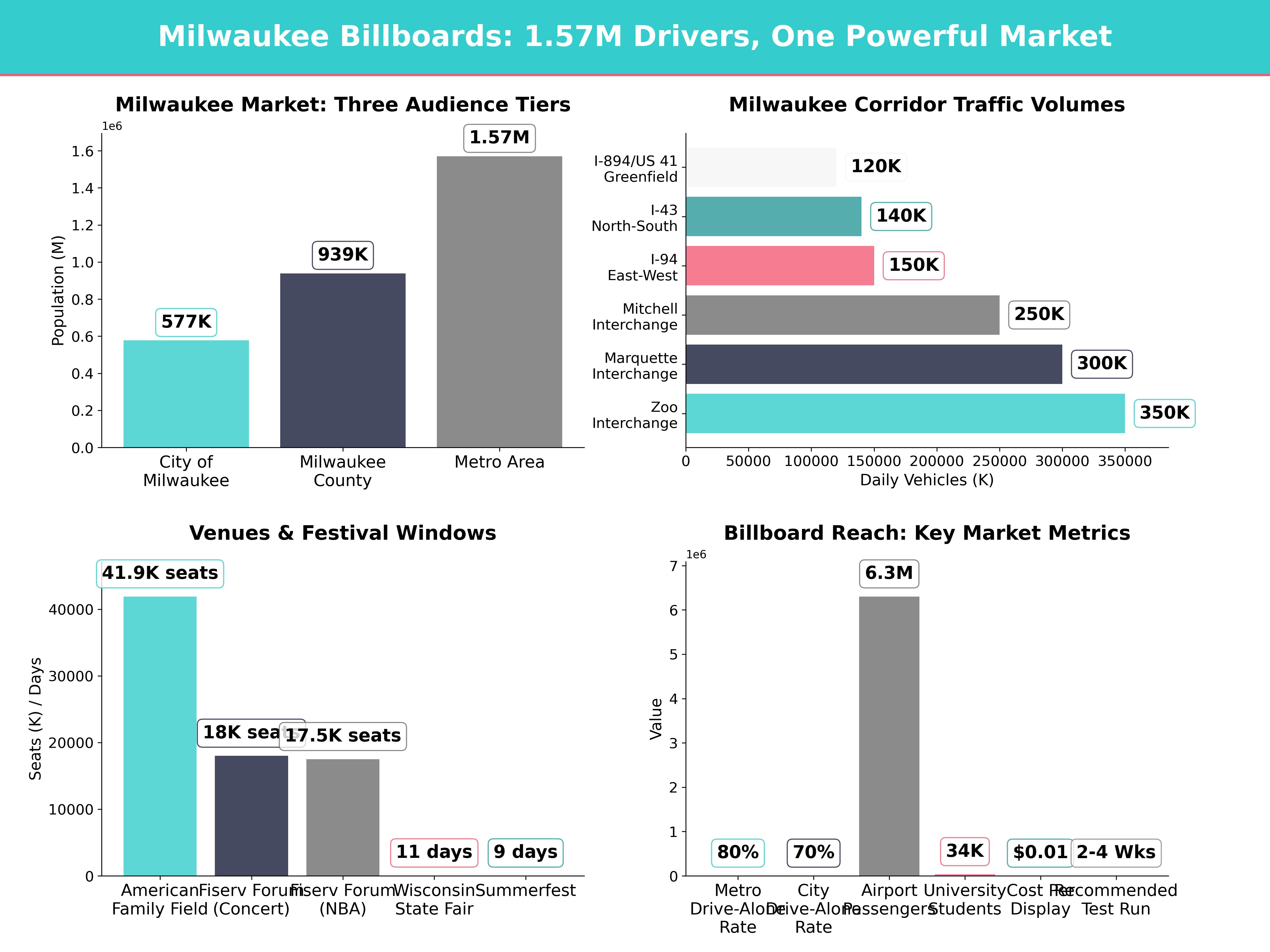
The Milwaukee area is served by a freeway network that channels movement across the whole region. The Zoo Interchange carries more than 350,000 vehicles on an average day, the Marquette Interchange handles more than 300,000 daily vehicles, and the Mitchell Interchange supports more than 250,000 daily vehicles. WisDOT traffic counts near Greenfield on I-894/US 41 commonly exceed 120,000 vehicles per day.
When is the best time to advertise in Milwaukee with Blip?
Spring and summer create some of the most obvious campaign windows near Milwaukee, with baseball season, Summerfest, and the Wisconsin State Fair all bringing high-traffic activity. Fall is also strong because colleges and universities return in late August and early September, and winter can still work well for retail, gift-driven purchases, tax services, legal services, fitness, healthcare, and home repair. Blip also helps because budgets can be adjusted at any time and creative can be swapped quickly as the Milwaukee area calendar changes.
Do I need a contract to advertise with Blip in Milwaukee?
No, Blip has no long-term contracts or minimum commitments. You can start, pause, or stop your campaign at any time.
How fast can I launch a billboard campaign with Blip in Milwaukee?
You can have your campaign live in minutes. Create a free account, select your locations, set your budget, upload your design, and start running once approved.
Where can I advertise with Blip in Milwaukee?
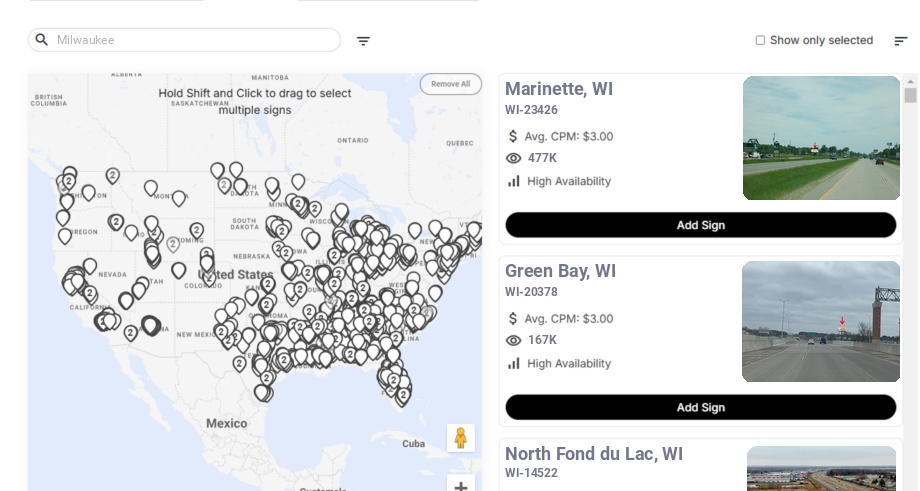
Blip has digital billboards in Milwaukee. You can browse available locations on a map, choose the ones that fit your audience, and start advertising right away.
Still have questions? Launch a campaign in minutes — no contracts, no commitments.
Start Your CampaignMilwaukee Billboard Advertising Guide
Advertising near Milwaukee works because the market combines 577,222 city residents, 1,574,731 metro residents across 4 counties, freeway-heavy commuting, major event traffic, and strong suburban shopping patterns. The City of Milwaukee 577,222 residents in the 2020 Census, while the larger Milwaukee-Waukesha-West Allis metro reached 1,574,731, giving advertisers a broad audience well beyond the city line. With our 2 digital billboards in Greenfield 7.7 miles from Milwaukee, we can reach drivers moving between the downtown core of the Milwaukee area, the south side, the western suburbs, and the airport corridor. That mix makes billboard advertising near Milwaukee especially effective for brands that want flexible regional reach rather than a single-neighborhood media buy.
Milwaukee area market overview
Scale and demographics near Milwaukee
The Milwaukee area gives us both concentration and range. The City of Milwaukee 577,222 residents in the 2020 Census, Milwaukee County 939,489, and the Milwaukee-Waukesha-West Allis metro reached 1,574,731 residents across Milwaukee County Waukesha County, Washington County Ozaukee County
The regional economy is even larger than the formal metro definition suggests. Milwaukee 7 7-county economic region, reflecting how connected southeastern Wisconsin really is. From an advertising perspective, that means a message near Milwaukee can influence not just city residents, but also commuters from West Allis, Wauwatosa Franklin, Greendale, Oak Creek Brookfield
The city itself is diverse, which should shape creative strategy. In 2020 Census data, about 38.6% of Milwaukee residents identified as Black or African American, and about 20.1% identified as Hispanic or Latino. We should treat that as a real creative consideration, not a footnote, especially for healthcare, education, retail, food, financial services, and community-focused campaigns serving the Milwaukee area.
Economic drivers and commuting patterns
The Milwaukee area economy is broad enough to support many billboard categories at once in a metro of 1,574,731 residents. We see strong demand tied to manufacturing, logistics, healthcare, education, tourism, conventions, and live entertainment. The Baird Center is a clear example of the region’s business-travel pull, with 1.3 million square feet of total space, 300,000 square feet of contiguous exhibit space, 52 meeting rooms, and a 24,000-square-foot rooftop ballroom. That convention capacity brings recurring weekday traffic from attendees, vendors, hospitality staff, and local businesses serving those visitors.
Travel volume adds another layer. Milwaukee Mitchell International Airport handled about 6.3 million passengers in 2023, which supports airport-area hospitality, parking, transportation, healthcare, and regional service advertising. The airport also reinforces why south-side and southwest freeway exposure matters so much for campaigns near Milwaukee.
Even with transit options from the Milwaukee County Transit System and the 2.1-mile The Hop streetcar, this is still a heavily car-oriented market. Recent commuting patterns show roughly 7 in 10 workers living in the city drive alone to work, and the share rises to roughly 8 in 10 across the surrounding metro. That car dependence is exactly why billboard advertising near Milwaukee remains such a practical awareness channel.
Key traffic corridors serving the Milwaukee area
The freeway network that feeds Milwaukee-area visibility
When we advertise near Milwaukee, we are really buying into a freeway network that channels movement across the whole region. According to the Wisconsin Department of Transportation, several major interchanges carry extraordinary traffic volumes:
- The Zoo Interchange, where I-41, I-94, and I-894 meet, carries more than 350,000 vehicles on an average day.
- The Marquette Interchange, which connects I-43, I-94, and I-794 near the central business district of the Milwaukee area, handles more than 300,000 daily vehicles.
- The Mitchell Interchange, which ties together I-94, I-43, and I-794 south of the core, supports more than 250,000 daily vehicles.
Those numbers matter because each interchange funnels regional movement, not just local trips. A driver traveling from Waukesha County to the lakefront, from Ozaukee County
Why Greenfield matters for Milwaukee-area reach
Our current inventory serving the Milwaukee area is concentrated in Greenfield, and that is a meaningful advantage. Greenfield sits on the south and southwest approach to the market, where multiple travel purposes overlap. Commuters, shoppers, airport travelers, event-goers, and suburban residents all use this side of the freeway system.
WisDOT traffic counts near Greenfield on I-894/US 41 commonly exceed 120,000 vehicles per day. Nearby I-94 east-west segments can top 150,000 daily vehicles, and I-43 north-south segments closer to the county core can exceed 140,000. For advertisers, that means our boards near Milwaukee can capture regional rather than purely local movement.
That location is especially useful for reaching people headed toward Southridge Mall, Wisconsin State Fair Park, American Family Field, Milwaukee Mitchell International Airport, and the employment clusters spread across West Allis, Wauwatosa Franklin, and the City of Milwaukee 10 miles of Milwaukee, they work well for brands that want Milwaukee-area impact without needing a placement inside the city limits.
Audience segments we can reach near Milwaukee
Commuters, shoppers, and everyday service buyers
The first major audience is the everyday driver. Since roughly 7 in 10 city workers and roughly 8 in 10 metro workers commute by driving alone, the Milwaukee area remains highly responsive to roadway messaging. That makes near-Milwaukee billboards effective for:
- Healthcare systems and urgent care providers.
- Auto dealers, repair shops, and tire services.
- Home services, including HVAC, plumbing, and roofing.
- Banks, insurance agencies, and legal services.
- Restaurants, grocery, and quick-service retail.
Because our Greenfield billboards sit on a major south-side approach, they are well positioned for reaching consumers making practical decisions during recurring weekly routines. Those are often the highest-frequency impressions, and repetition matters when we are building local recall.
Students, fans, and visitors in the Milwaukee area
The Milwaukee area also delivers younger and event-driven audiences. University of Wisconsin-Milwaukee enrolls about 23,000 students, and Marquette University enrolls about 11,400. Add Milwaukee Area Technical College, Milwaukee School of Engineering, and the area’s professional schools and community colleges, and we get a substantial student and young-professional population moving across the region each semester.
Sports and entertainment create another major segment. American Family Field has a seating capacity of 41,900. Fiserv Forum seats about 17,500 for basketball, and about 18,000 for concerts.
- Summerfest runs 9 days across 3 weekends, with 23 stages on 75 acres at Henry Maier Festival Park
- Wisconsin State Fair Park spans 200 acres, and the Wisconsin State Fair runs 11 days each summer.
Those event-driven audiences are valuable for restaurants, bars, entertainment brands, rideshare-adjacent businesses, apparel, ticketing, and promotional offers tied to specific dates.
Tourism adds still more reach. Visit Milwaukee promotes a destination set that includes sports, conventions, food, museums, and festivals, and Milwaukee Mitchell International Airport adds about 6.3 million annual passenger movements. That combination helps us serve visitors as well as residents.
Families and neighborhood decision-makers
For family-oriented brands, the Milwaukee area remains strong because it pairs dense neighborhoods with suburban household movement. Milwaukee County Parks 150 parks and parkways across nearly 15,000 acres, and the Milwaukee County Zoo 1.2 million visitors a year. Those destinations reflect an audience that is active, mobile, and frequently making decisions about weekend outings, family dining, education, healthcare, and household purchases.
South-side retail is another family signal. Southridge Mall offers roughly 1.2 million square feet of retail space, making it a useful reference point for campaigns targeting shoppers from Greenfield, Greendale, Franklin, and nearby parts of the Milwaukee area. If we want to reach parents, household planners, or suburban decision-makers, the Greenfield approach is a logical place to do it.
Seasonal timing opportunities in the Milwaukee area
Spring and summer event waves near Milwaukee
Spring and summer create some of the most obvious campaign windows near Milwaukee. Baseball season starts in late March or early April and runs through September, which gives American Family Field recurring game-day traffic for months. On top of that, Summerfest brings 9 days of concerts across 3 weekends, and the Wisconsin State Fair adds another 11 days of high-traffic summer activity.
This is when we usually like to increase visibility for:
- Restaurants and bars.
- Entertainment venues.
- Tourism and hospitality brands.
- Retail promotions.
- Healthcare and urgent care providers.
- Transportation, parking, and travel services.
Weekend and evening targeting can be especially useful during the summer, because discretionary travel increases across the Milwaukee area. Drivers are not just commuting. They are heading to festivals, games, lakefront events, shopping centers, and family attractions.
Fall and winter campaign windows serving Milwaukee-area demand
Fall is a strong reset period. Colleges and universities return in late August and early September, bringing back more than 34,000 students from UW-Milwaukee and Marquette University alone. Convention traffic also remains important thanks to the Baird Center, and Fiserv Forum becomes a major demand driver again as basketball season begins.
That makes fall useful for:
- Back-to-school campaigns.
- Apartment and student-housing promotions.
- Mobile carriers and technology brands.
- Financial services.
- Food and convenience brands.
- Healthcare and clinic outreach.
Winter should not be treated as dead time. The Milwaukee area still moves, even when daylight drops early and weather conditions get tougher. In fact, winter can make billboard creative more noticeable when we use bold contrast and direct offers. November and December are especially valuable for retail, gift-driven purchases, and service categories tied to holiday gatherings, while January and February often work well for tax services, legal services, fitness, healthcare, and home repair. Because the market is so commute-oriented, we can continue building frequency even outside peak tourism months.
Billboard design tips for the Milwaukee area
Build creative that feels unmistakably local
Near Milwaukee, generic creative is usually less effective than creative that feels rooted in the area. We do not need to overdo local slang, but we should use cues the audience recognizes immediately. Lakefront imagery, Cream City brick tones, industrial textures, sports-night energy, and winter-ready color contrast all fit the market better than stock visuals that could belong anywhere.
We also recommend reflecting the area’s real demographics. Since the city population is about 38.6% Black and about 20.1% Hispanic or Latino, inclusive casting and, when appropriate, bilingual English-Spanish messaging can make a campaign feel much more credible. That is especially true for healthcare, schools, community events, financial services, public outreach, and neighborhood retail serving the Milwaukee area.
Local references can also sharpen response. Phrases tied to game day, fair season, the south side, the airport corridor, or back-to-school timing often perform better than broad regional taglines because they connect to specific travel intent.
Design for fast traffic, gray winters, and bright summer weekends
Freeway-facing creative near Milwaukee needs to read instantly. We prefer short headlines, one clear offer, one visual focus, and one call to action. For south-side and southwest freeway traffic, that usually means designing for a very fast first read rather than trying to explain too much.
A few geography-specific design principles work especially well here:
- We use high-contrast color pairs because winter skies, road spray, and overcast light can mute low-contrast ads.
- We avoid thin scripts and low-weight fonts because fast-moving drivers on I-894, I-94, and related corridors need immediate readability.
- We use bold directional language when it fits, such as “Book Today,” “Now Open,” “Game Day Special,” or “South Side Pickup.”
- We keep imagery simple enough to land in a 7.5- to 10-second digital billboard rotation.
If a brand serves a specific part of the Milwaukee area, we should say so clearly. “Near the airport,” “off the south side,” “for Milwaukee-area families,” or “serving the west suburbs” is often more persuasive than a vague regional statement.
Regional strategies serving the Milwaukee area
South-side commuter capture from Greenfield
Because our Milwaukee-area inventory is in Greenfield, south-side commuter strategy is the first priority. This approach works well for advertisers that want recurring impressions among drivers traveling between Milwaukee, Greendale, Franklin, Oak Creek Cudahy St. Francis, and the airport corridor.
We typically like this strategy for:
- Retail and restaurant brands.
- Auto sales and service.
- Medical, dental, and urgent care providers.
- Home services.
- Community colleges and career training.
- Local entertainment and event promotion.
The reason is simple. These categories benefit from repeat reach among residents who pass the same corridors again and again.
West-suburban crossover and event spillover
The second strategy is to use near-Milwaukee billboard exposure as a crossover play for west-side and southwest suburban movement. Drivers coming from West Allis, Wauwatosa New Berlin Brookfield
This strategy is especially effective when paired with time-of-day targeting. Morning runs can prioritize commuting professionals, midday can reach shoppers and errand traffic, and evening can capture entertainment, dining, and return-home drivers. When the goal is top-of-mind awareness across several adjacent communities, this regional overlap is valuable.
Retail, airport, and destination-based targeting
A third strategy is destination-based messaging. Because the Greenfield approach connects to Southridge Mall, Milwaukee Mitchell International Airport, Wisconsin State Fair Park, American Family Field, and the central business and entertainment districts of the Milwaukee area, we can align campaigns with where people are going, not just where they live.
That is useful for advertisers selling immediate action, such as:
- “Tonight only” entertainment offers.
- Airport parking or travel services.
- Same-day healthcare appointments.
- Weekend dining and hospitality offers.
- Event, expo, or ticketed attraction promotions.
The closer the message matches the destination mindset, the better the billboard usually performs.
Blip tools for campaigns near Milwaukee
Use timing, budget control, and creative rotation strategically
Blip works well near Milwaukee because this market is highly time-sensitive. Traffic patterns look different at 6 to 9 a.m., 11 a.m. to 2 p.m., and 3 to 7 p.m., and summer weekends look different from winter weekdays. With flexible scheduling, we can match our campaign to the exact audience moment we want rather than buying one fixed pattern and hoping it fits.
That matters even more when we have 2 boards serving the Milwaukee area. Instead of relying on sheer inventory count, we can lean into precision. We can raise presence during game nights, the 11-day State Fair, summer festival weekends, back-to-school periods, or holiday shopping stretches, and then reduce or redirect spend when those windows pass.
Blip also helps because we can test without traditional friction. Pay-per-play pricing starts at $0.01 per display, budgets can be adjusted at any time, and digital creative can be swapped quickly as the Milwaukee area calendar changes. For a market with strong seasonality and distinct commuter waves, that agility is much more useful than a rigid long-term buy.
Getting started with billboard rental near Milwaukee
Decide what success looks like first
Before we rent a billboard near Milwaukee, we should define the real objective. Are we trying to build broad awareness across the Milwaukee area, drive traffic to a south-side location, support an event, increase airport-related bookings, or stay visible during a sports or festival season? The answer shapes everything else, from creative to schedule to budget.
If the goal is broad awareness, we usually favor simple branding and repetition. If the goal is immediate response, we recommend a sharper offer, a clearer call to action, and tighter timing around likely travel windows.
Evaluate Milwaukee-area billboards by travel behavior, not distance alone
A common mistake is choosing a billboard only because it is closest to the business. Near Milwaukee, corridor logic usually matters more than straight-line distance. Our Greenfield billboards are only 7.7 miles from Milwaukee, but their value comes from the flow they capture, not just the map radius.
When we evaluate which billboard locations fit an advertiser’s goals, we look at several questions:
- Does the board serve the right corridor for the audience we want?
- Does that corridor carry commuter, shopper, airport, or event traffic?
- Does the timing of travel match our offer?
- Does the ad need repeated weekly exposure, or a short burst around a specific date?
- Is the destination mindset more important than home ZIP codes?
For many Milwaukee-area campaigns, a billboard near a high-volume approach road will outperform a theoretically closer location with weaker regional flow.
Launch, measure, and improve without traditional friction
Traditional billboard companies often make the rental process feel slow, fixed, and difficult to adjust. Digital billboard rental through Blip is easier because we can choose boards on a map, set a daily budget, launch on our own schedule, and refine the campaign as data comes in. That is particularly valuable near Milwaukee, where audience mix changes with sports seasons, summer festivals, school calendars, and commuter patterns.
A practical starting plan usually looks like this:
- Start with one clear audience, such as commuters, shoppers, students, or event-goers.
- Run a focused test for 2 to 4 weeks.
- Concentrate on the times of day that best match that audience.
- Use one clean creative concept first.
- Review performance, then rotate offers or timing based on what we learn.
For brands serving the Milwaukee area, the simplest rule is this: start with the travel pattern, not the city boundary. When we do that well, our digital billboards in Greenfield can deliver efficient, flexible, and highly relevant reach near Milwaukee.