Billboards in Pewaukee, WI
No Minimum Spend. No Long-Term Contracts. Just Results.
Trusted by Leading Brands


Billboard advertising
in Pewaukee has never been easier
How much is a billboard in Pewaukee?
Why Choose Blip for Billboard Advertising in Pewaukee
-
Blip’s self-serve platform lets you launch in Pewaukee fast—perfect for I-94 commuters and Lake Country traffic without sales delays.
-
In Pewaukee, Blip auto-optimizes billboards and timing to hit weekday drive times on I-94, WIS 16, and WIS 164 within your goal and budget.
-
No contracts or minimums make Pewaukee campaigns easy to test, then pause or scale around Summerfest, the State Fair, or lake season.
-
Use Blip’s real-time analytics in Pewaukee to see what works on Brookfield and Milwaukee-bound routes, then shift spend instantly.
-
Blip’s creative tools help Pewaukee ads stand out to suburban homeowners, commuters, and Lake Country visitors with clear local messaging.
Frequently Asked Questions About Billboard Advertising in Pewaukee
How much does a billboard cost in Pewaukee with Blip?
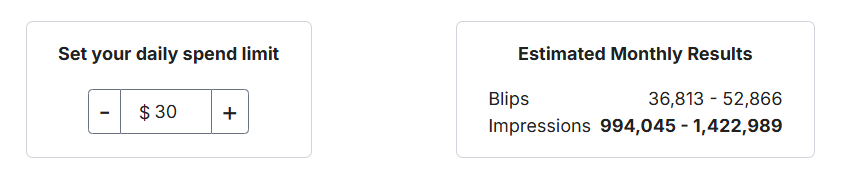
With Blip, billboard advertising in Pewaukee can fit a wide range of budgets because you only pay when your ad actually appears. Pricing starts at just $0.01 per display, and the cost per blip can change based on time of day, location, and advertiser demand. Your total cost is simply the sum of your individual blips, so you can set, adjust, or pause your budget whenever you want.
Where can I advertise with Blip in Pewaukee?
Pewaukee is a strong billboard market because it sits at the intersection of daily suburban commuting, Lake Country leisure travel, and the broader southeastern Wisconsin economy. The area includes the City of Pewaukee, the Village of Pewaukee, nearby Waukesha, Brookfield, Hartland, and Oconomowoc, plus commuters moving between Milwaukee and Madison. A Pewaukee billboard also benefits from pass-through traffic, regional shoppers, healthcare visitors, students, and event travelers.
What makes Pewaukee a good place for billboard advertising with Blip?
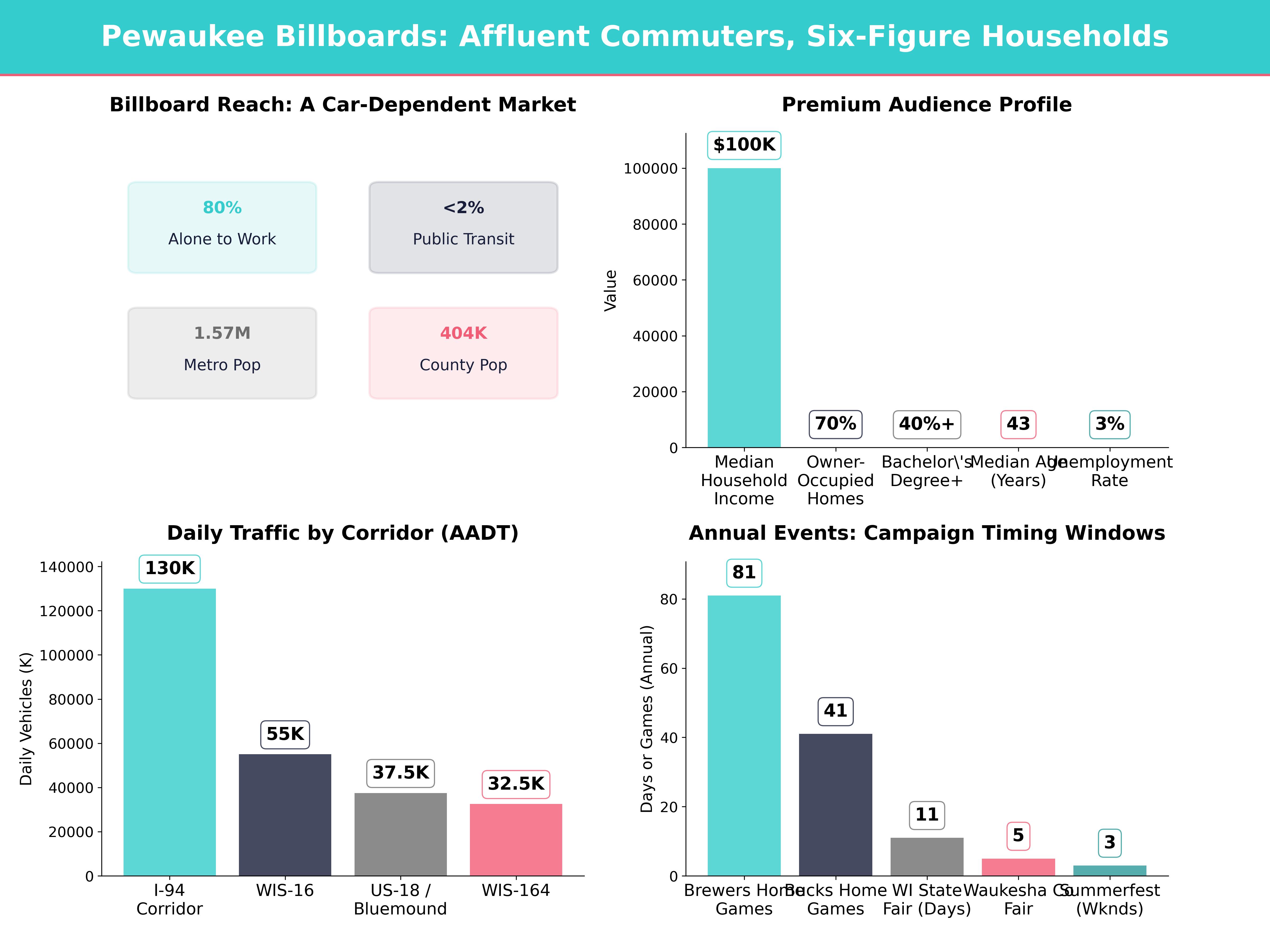
Pewaukee is especially valuable because it is about 20 miles west of downtown Milwaukee and about 60 miles east of Madison. The market is highly car oriented, with about 80% of workers driving alone to work and public transit use under 2%. That means roadside media stays visible where people actually make decisions about shopping, dining, healthcare, entertainment, and employment.
Which roads in Pewaukee get the most billboard traffic?
Interstate 94 is the backbone corridor for Pewaukee billboard strategy and carries the heaviest volumes in the area, commonly in the 110,000 to 150,000+ AADT range depending on the segment. Wisconsin 16 is a critical secondary east-west route with many segments in roughly the 40,000 to 70,000 AADT range, while Wisconsin 164 often lands in the 25,000 to 40,000 AADT range around key commercial zones and the I-94 interchange. US 18, especially the Bluemound Road corridor through Brookfield, is another strong retail spine with key segments often in the 30,000 to 45,000 AADT range.
When is the best time to run billboard ads in Pewaukee with Blip?
Pewaukee is a market where timing matters almost as much as location. For weekday commuter campaigns, the strongest repeated drive-time exposure usually comes in the 6:00-9:00 a.m. and 3:30-6:30 p.m. windows. For restaurants, recreation, and family entertainment, weekend scheduling from about 10:00 a.m. to 8:00 p.m. often makes more sense.
Do I need a contract to advertise with Blip in Pewaukee?
No, Blip has no long-term contracts or minimum commitments. You can start, pause, or stop your campaign at any time.
How fast can I launch a billboard campaign with Blip in Pewaukee?
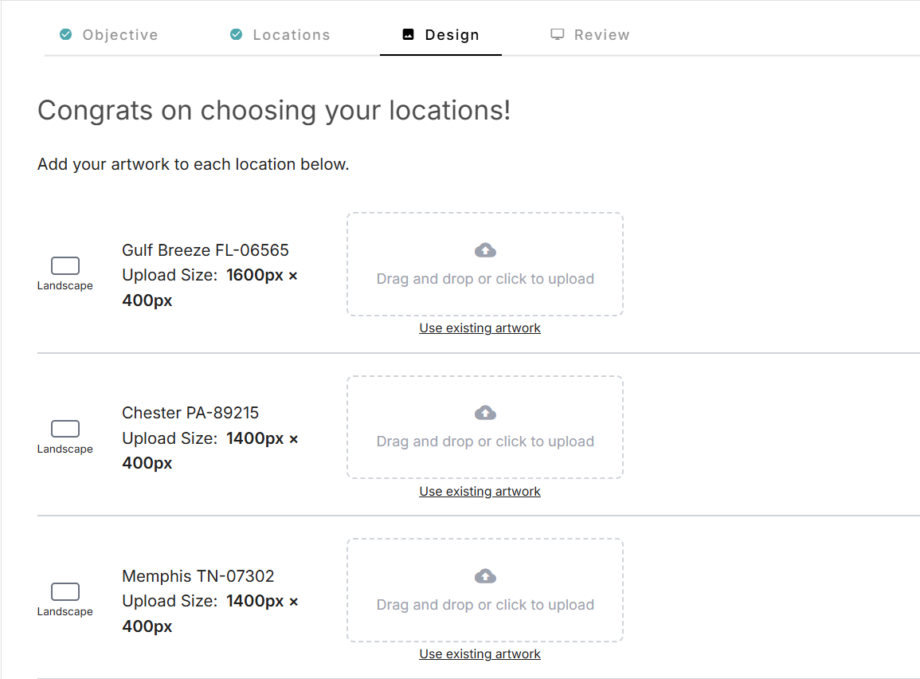
You can have your campaign live in minutes. Create a free account, select your locations, set your budget, upload your design, and start running once approved.
Where can I advertise with Blip in Pewaukee?
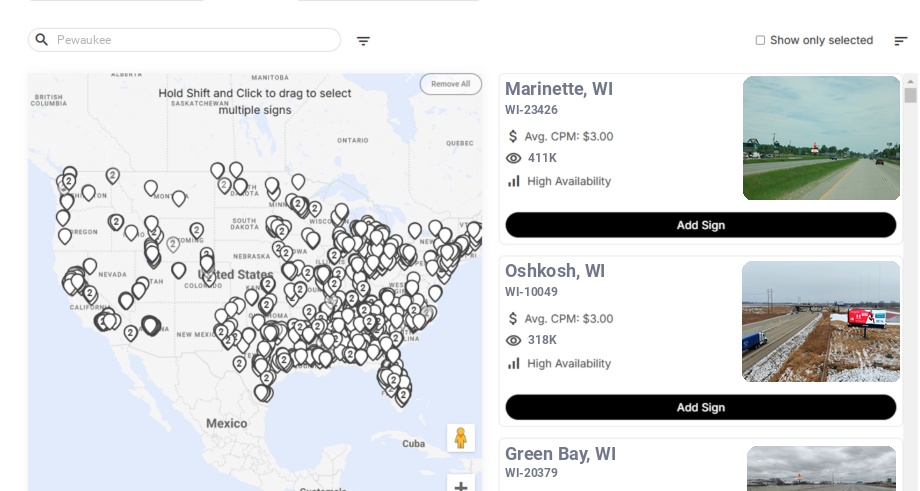
Blip has digital billboards in Pewaukee. You can browse available locations on a map, choose the ones that fit your audience, and start advertising right away.
Still have questions? Launch a campaign in minutes — no contracts, no commitments.
Start Your CampaignPewaukee Billboard Advertising Guide
Pewaukee Lake Country 1.57 million-person Milwaukee-area market. Waukesha County had 404,198 residents in the 2020 Census, and the wider Milwaukee-area market reaches roughly 1.57 million people, which gives us both local frequency and regional scale. The area is highly car oriented, with about 80% of workers driving alone to work and public transit use under 2%, so roadside media stays visible where people actually make decisions about shopping, dining, healthcare, entertainment, and employment. Add seasonal draw from the 2,437-acre Pewaukee Lake Brookfield Milwaukee
Pewaukee Market Overview
Pewaukee is more than one small municipality on a map. In practice, advertisers are reaching a trade area that includes the City of Pewaukee Village of Pewaukee Waukesha, Brookfield Hartland Oconomowoc Milwaukee Madison
Population, growth, and regional scale in Pewaukee
Waukesha County grew from 389,891 residents in 2010 to 404,198 in 2020, which was roughly 3.7% growth over the decade. Pewaukee also sits inside the 7-county Milwaukee 7 1.57 million. For advertisers, that means a Pewaukee billboard does not rely only on residents of Pewaukee itself. It also benefits from pass-through traffic, regional shoppers, healthcare visitors, students, and event travelers.
Pewaukee’s location is especially valuable because it is about 20 miles west of downtown Milwaukee 60 miles east of Madison
Income, education, and mobility in the Pewaukee area
Local profiles from the Waukesha County Center for Growth Waukesha County is around $100,000, and more than 40% of adults age 25+ hold a bachelor’s degree or higher. Roughly 7 in 10 homes are owner-occupied, and the county’s median age is around 43. Those indicators tell us that Pewaukee billboards can effectively support categories such as healthcare, financial services, home improvement, legal services, education, recruiting, and higher-ticket retail.
The mobility story is just as important. In a suburban county like this one, about 80% of workers drive alone to work, public transit use stays under 2%, and average commute time is about 24 minutes. That is why billboard frequency matters here. People are in cars, on the same routes, seeing the same messages repeatedly. Recent monthly data from the Wisconsin Department of Workforce Development has also generally kept county unemployment near 3%, which supports recruiting campaigns and signals a stable consumer base.
Key Traffic Corridors for Pewaukee Billboards
Pewaukee travel patterns are shaped by a handful of high-volume east-west and north-south routes. When we understand those corridors, we can match billboard placement to the actual trip purpose, whether that is work, shopping, healthcare, entertainment, or weekend recreation. For traffic volumes, we can lean on count maps from the Wisconsin Department of Transportation.
Interstate 94 through Pewaukee and western Milwaukee County
Interstate 94 is the backbone corridor for Pewaukee billboard strategy. It connects Madison Waukesha County, Brookfield Milwaukee 110,000 to 150,000+ AADT range, depending on the segment.
That kind of volume is powerful for advertisers because I-94 captures both routine and destination trips.
- Retail, restaurants, and entertainment perform well on I-94 because drivers are already moving between work, shopping districts, and Milwaukee event destinations.
- Healthcare, urgent care, and specialty clinics benefit because I-94 connects residential communities with major medical corridors served by ProHealth Care Froedtert & the Medical College of Wisconsin.
- Recruiting and B2B campaigns benefit because the freeway reaches workers tied to employers such as Generac, GE HealthCare
Eastbound I-94 is especially strong for morning commuting and Milwaukee-bound events. Westbound I-94 often works well for evening dining, home services, grocery, fitness, and destination retail closer to Pewaukee and Lake Country.
Wisconsin 16 and the Pewaukee-to-Lake Country route
Wisconsin 16 is a critical secondary east-west route for the Pewaukee market. It links Pewaukee with Hartland Oconomowoc 40,000 to 70,000 AADT range.
This corridor tends to carry a slightly more local and destination-oriented audience than I-94.
- Restaurants, coffee shops, and local attractions do well here because travelers are often choosing where to stop rather than simply passing through.
- Home services, auto services, and healthcare benefit because WIS 16 pulls from residential areas where people make practical household decisions.
- Lake-season advertisers benefit because WIS 16 helps feed weekend movement into the broader Lake Country
If our goal is “drive people from awareness to action,” WIS 16 can be a smart corridor because it often combines substantial traffic with more localized intent.
Wisconsin 164 in Pewaukee, Waukesha, and the north-south trade area
Wisconsin 164 is the main north-south connector for much of this market. It links Sussex Pewaukee Waukesha, and communities farther south. Around key commercial zones and the I-94 interchange, WisDOT traffic counts often land in the 25,000 to 40,000 AADT range.
That makes WIS 164 especially useful for advertisers who need local relevance more than pure regional scale.
- Healthcare and wellness providers benefit because the route serves everyday errands and appointment traffic.
- Auto dealers, repair shops, and tire retailers benefit because drivers on 164 are in a local decision-making mode and often notice nearby businesses.
- Contractors, remodelers, landscapers, and real estate-related services benefit because the corridor reaches established homeowner neighborhoods across western suburban communities.
- Schools, colleges, and employers benefit because 164 touches multiple education and employment nodes in the county.
For many advertisers, WIS 164 is where we can move from broad awareness into practical action.
US 18, Bluemound Road, and the Brookfield retail corridor near Pewaukee
US 18, especially the Bluemound Road corridor through Brookfield 30,000 to 45,000 AADT range, and the corridor is reinforced by major shopping destinations like Brookfield Square, The Corners of Brookfield, and nearby service clusters.
This corridor is especially strong for:
- Retail brands and shopping centers because consumers are already in a purchasing mindset.
- Furniture, mattress, flooring, and design businesses because the surrounding audience includes high-value suburban homeowners.
- Elective medical, dental, and wellness brands because the corridor matches convenience with household decision makers.
Supporting arterials around Pewaukee and Brookfield often carry another 15,000 to 30,000 vehicles per day, which helps distribute freeway impressions into local neighborhoods and shopping areas.
Audience Segments We Can Reach in Pewaukee
Pewaukee works well because it is not a one-audience market. We can reach weekday commuters, families, students, recreation seekers, and skilled workers with different timing and location strategies.
Pewaukee commuters and suburban professionals
The most dependable audience is the weekday commuter. With about 80% of workers driving alone and average commute times around 24 minutes, Pewaukee boards can build high repeat frequency. This segment includes professionals traveling between western suburbs and Milwaukee Waukesha County.
That audience is valuable for categories such as banks, legal services, recruiting, healthcare, higher education, insurance, and premium consumer services. It also responds well to repeated messaging because the same driver may see the same corridor 5 days a week.
Pewaukee families, homeowners, and household decision makers
With median household income around $100,000, homeownership at about 7 in 10, and a median age near 43, Pewaukee offers a strong family-and-homeowner audience. This is one of the best reasons to use billboards here. Household decision makers in this market are often considering home projects, kids’ activities, vehicles, dentists, primary care, grocery options, restaurants, and financial products.
Advertisers in home improvement, orthodontics, HVAC, pest control, roofing, landscaping, auto retail, and family entertainment can all benefit from that profile. The suburban format of the market means many of those decisions happen while people are driving between school, work, shopping, and activities.
Students, parents, and education communities around Pewaukee
Pewaukee also reaches a meaningful education audience. Carroll University in nearby Waukesha enrolls roughly 3,400 students, and Waukesha County Technical College adds a large commuter-student population of its own. The Pewaukee School District and surrounding districts create back-to-school and after-school traffic patterns that matter for tutoring, youth programs, family dining, healthcare, fitness, and part-time recruiting.
This audience becomes especially visible in late August, September, and January, when school and semester routines reset.
Tourists, recreation seekers, and event travelers in Pewaukee
Pewaukee’s leisure audience is stronger than many suburban markets because of its lake and its position between Lake Country and Milwaukee entertainment. Pewaukee Lake, the largest lake in Waukesha County, spans about 2,437 acres and stretches roughly 5 miles. That gives the area a real warm-weather destination identity.
Regional event traffic matters too. Summerfest now runs across 3 weekends, the Wisconsin State Fair lasts 11 days each August and often attracts more than 1 million visits in strong years, the Milwaukee Brewers play 81 regular-season home games at American Family Field, and the Milwaukee Bucks 41 regular-season home games at Fiserv Forum. Those events create clear timing opportunities for hotels, restaurants, bars, parking, rideshare alternatives, sports bars, apparel, and entertainment brands.
Seasonal and Timing Opportunities in Pewaukee
Pewaukee is a market where timing matters almost as much as location. The same board can work very differently in June, October, or February depending on what people are doing and where they are driving.
Summer in Pewaukee and Lake Country
Summer is the most obvious seasonal surge. From Memorial Day through Labor Day, Pewaukee benefits from lake traffic, patio dining, boating, family outings, and weekend movement across Lake Country
Regional summer events add even more reach. The Waukesha County Fair 5 days in July, Summerfest runs 3 weekends, and the Wisconsin State Fair runs 11 days in August. Eastbound freeway boards can catch event-goers heading toward Milwaukee, while westbound boards can capture return trips and post-event dining decisions.
Fall routines and school calendars in Pewaukee
Late August through October is a strong reset period. School calendars restart, youth sports come back, college students return, and homeowners start planning before winter. This is when we should think about education, healthcare, recruiting, insurance, home services, and fitness.
For outdoor and recreation brands, fall is also useful because southeastern Wisconsin attractions like Lapham Peak Unit and other nearby parks keep weekend traffic active. Creative that speaks to routines, convenience, and preparedness tends to work better in fall than purely aspirational messaging.
Winter shopping and indoor entertainment in Pewaukee
Winter changes the psychology of the market. From roughly November through March, indoor activities, gift buying, comfort, and convenience rise in importance. Holiday campaigns should emphasize shopping and family outings tied to Brookfield Square, The Corners of Brookfield, Mayfair, and Milwaukee entertainment.
After the holidays, family fun and indoor experiences become more relevant. Springs Water Park The Ingleside Hotel is a 45,000-square-foot indoor water park in Pewaukee, which is a good reminder that winter traffic is still there if we align the message with the season. Winter is also a strong time for tax services, healthcare, gyms, auto maintenance, and recruiting.
Spring reset campaigns in Pewaukee
Spring is a practical season in Pewaukee. As snow clears and temperatures improve, homeowners think about lawns, landscaping, roofing, gutters, decks, windows, flooring, HVAC tune-ups, and remodeling. Healthcare, dental, urgent care, allergy treatment, and elective medical campaigns also tend to perform well before summer schedules take over.
This is a good season to build early momentum with simple service messages and then shift into summer recreation and retail creative as traffic patterns change.
Billboard Design Tips for the Pewaukee Market
Good Pewaukee creative should feel local, practical, and confident. We do not need to overcomplicate the message for this audience. We need to show relevance fast.
Use Pewaukee and Lake Country cues that feel familiar
The best creative in this market often looks like it belongs here. Lake imagery, summer blues, patio scenes, boats, family dining, and clean suburban visuals can outperform generic national-style creative for local businesses. In colder months, warm indoor imagery, service reliability, and comfort cues usually fit the market better.
Place names matter too. Copy that references Pewaukee Brookfield Waukesha, Hartland Oconomowoc
Speak to value, but do not cheapen the offer in Pewaukee
Because household income is relatively strong, this audience often responds better to convenience, trust, quality, and time savings than to price alone. “Same-day appointments in Pewaukee” can be stronger than “Lowest price in town.” “Lake Country family dining” can be stronger than “Huge deals.” Discounts still matter, but they work best when they are paired with credibility.
For healthcare, education, and professional services, we should prioritize reassurance. For home services, we should emphasize reliability, local presence, and response speed. For retail, we should connect the offer to a nearby shopping pattern or seasonal occasion.
Build creative around the route, not just the brand
Pewaukee is a driving market, so directional relevance matters. Messages like “Next stop off I-94,” “Minutes from 164,” or “Tonight in Milwaukee” are often more effective than abstract slogans. If our audience is moving fast, we should give them one idea, one destination cue, and one reason to act.
This market also rewards creative rotation. Because many viewers see the same route repeatedly, we can refresh offers every 2 to 3 weeks without losing recognition. That keeps the campaign from blending into the commute.
Regional Strategies Around Pewaukee
A smart Pewaukee campaign usually works best when we treat the market as several connected sub-areas rather than one uniform audience.
The Pewaukee I-94 interchange zone
Boards near the I-94 and 164 area are ideal when we want broad reach plus local action. This is where commuter traffic, retail movement, and service-oriented trips overlap. We should prioritize these boards for urgent care, quick-service restaurants, entertainment, recruiting, and general local awareness.
East toward Brookfield and Milwaukee from Pewaukee
As we move east toward Brookfield Milwaukee American Family Field, Fiserv Forum, Summerfest, and the Wisconsin State Fair.
West and north into Lake Country from Pewaukee
As we move west and north, the audience becomes more destination-oriented and lifestyle-driven. This is where restaurants, recreation, seasonal retail, home services, and real estate-related businesses often perform best. The tone can be a little more aspirational here because the trip purpose is often leisure rather than work.
South toward Waukesha and the broader service corridor
Southbound strategies toward Waukesha and nearby communities are useful for healthcare, education, recruiting, legal services, and household services. The audience here is often in errand mode, and that can be excellent for brands that need direct response rather than pure awareness.
Using Blip Tools Effectively in Pewaukee
Blip’s value in Pewaukee is that we can match local traffic behavior without locking ourselves into a rigid traditional buy. We can test corridors, adjust timing, and learn what works for our specific audience.
Match Pewaukee dayparts to actual movement patterns
For weekday commuter campaigns, we should usually concentrate spend in the 6:00-9:00 a.m. and 3:30-6:30 p.m. windows. Those periods line up with the strongest repeated drive-time exposure on I-94, WIS 16, and WIS 164. For restaurants, recreation, and family entertainment, weekend scheduling from about 10:00 a.m. to 8:00 p.m. often makes more sense.
If our audience is event traffic heading east, we can bias later afternoon and early evening. If our audience is local services, we can stay closer to weekday commute blocks and Saturday errand periods.
Use Blip flexibility to follow Pewaukee’s seasons
Pewaukee is not a market where every month deserves the same budget. We can scale up before the lake season, during the Waukesha County Fair Summerfest, or around the Wisconsin State Fair. We can also swap creative quickly for back-to-school, holiday shopping, winter wellness, or spring home improvement.
That flexibility is especially useful for local businesses that need to advertise only when demand is highest.
Use analytics to compare Pewaukee corridors and creative themes
Blip’s analytics let us compare how different boards, times, and messages support our goals. In Pewaukee, that means we can learn whether I-94 is giving us reach, whether WIS 164 is driving more local response, or whether eastbound and westbound traffic react differently to the same offer. We can also test one creative built around convenience against another built around seasonal lifestyle and see which one deserves more budget.
Getting Started with Billboard Rental in Pewaukee
Renting a billboard in Pewaukee should start with a map and a business goal, not with a generic inventory list. The strongest campaigns here are built around who we want to reach, when they are on the road, and what decision they are likely to make next.
Start with a clear Pewaukee objective
We should first decide whether the campaign is meant to drive store visits, build brand awareness, recruit employees, promote an event, or support a seasonal push. That answer shapes everything else.
- If we need broad awareness, we should usually prioritize I-94.
- If we need local action, we should look closely at WIS 164 and localized retail corridors.
- If we need weekend leisure traffic, we should think about WIS 16, Lake Country movement, and seasonal timing.
- If we need Milwaukee-bound event traffic, we should bias eastbound placements and late-day timing.
Evaluate each Pewaukee billboard like a driver would
When we compare boards, we should look at direction of travel, distance from the next decision point, speed of traffic, visual clutter, and whether the board appears before or after the turn we want drivers to make. We should also think about trip purpose. A commuter board and a weekend lake board may both be good, but they are good for different reasons.
A practical starting plan is often a 2- to 4-week test across 1 to 3 corridors. That is long enough to see patterns, but still flexible enough to adjust quickly.
Use Blip to simplify the Pewaukee rental process
Traditional billboard companies often require longer commitments, fixed inventory decisions, and slower creative changes. Blip makes it easier for us to launch quickly, test specific Pewaukee corridors, and adjust based on performance instead of assumptions. We can start with a focused campaign, learn which locations and times match our goals, and then scale what works.
For evaluation, we should watch the business metrics that matter most to us. Those metrics can include website traffic, branded search lift, calls, form fills, foot traffic, coupon or promo-code use, event attendance, or job applications. If we are promoting a dated event, we should usually increase pressure during the final 7 to 10 days. If we are building local awareness for an ongoing business, we should focus on steady repetition and periodic creative refreshes.
In Pewaukee, billboard advertising works best when we respect how people actually move through the market. When we align route, timing, season, and message, we can turn a suburban commute and a Lake Country weekend drive into meaningful brand lift and measurable action.