Billboards near DeForest, WI
No Minimum Spend. No Long-Term Contracts. Just Results.
Trusted by Leading Brands


Billboard advertising
near DeForest has never been easier
How much is a billboard near DeForest?
Why Choose Blip for Billboard Advertising near DeForest
-
Blip lets you launch fast in DeForest and target I-39/90/94 and U.S. 51 commuters with map-based precision.
-
In DeForest, no contracts or minimums mean you can test weekday school runs, then pause or scale for football weekends.
-
Use Blip's real-time analytics to track DeForest-area plays across Windsor, Waunakee, and Sun Prairie, then shift budget to what works.
-
Blip's flexible budgets fit DeForest's seasonal flow, from spring home services to winter HVAC and holiday traffic.
-
Create and swap ads quickly on Blip for DeForest, using simple creative that stands out to drivers on 65-70 mph corridors.
Frequently Asked Questions About Billboard Advertising near DeForest
How much does a billboard cost in DeForest, Wisconsin with Blip?
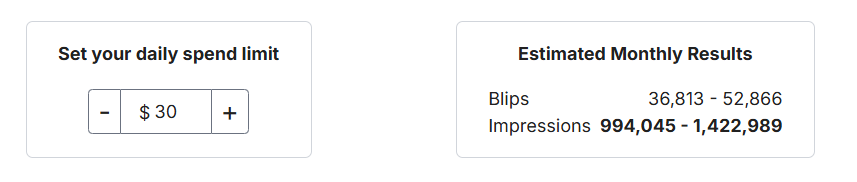
Blip makes billboard advertising in the DeForest area flexible and affordable. You set a daily budget that works for you, and Blip only charges when your ad actually appears as a 7.5-to-10-second blip on a rotating digital billboard serving the DeForest area. Pricing is dynamic, so the cost per display can change based on time of day, location, and advertiser demand.
Where can I advertise with Blip in DeForest, Wisconsin?
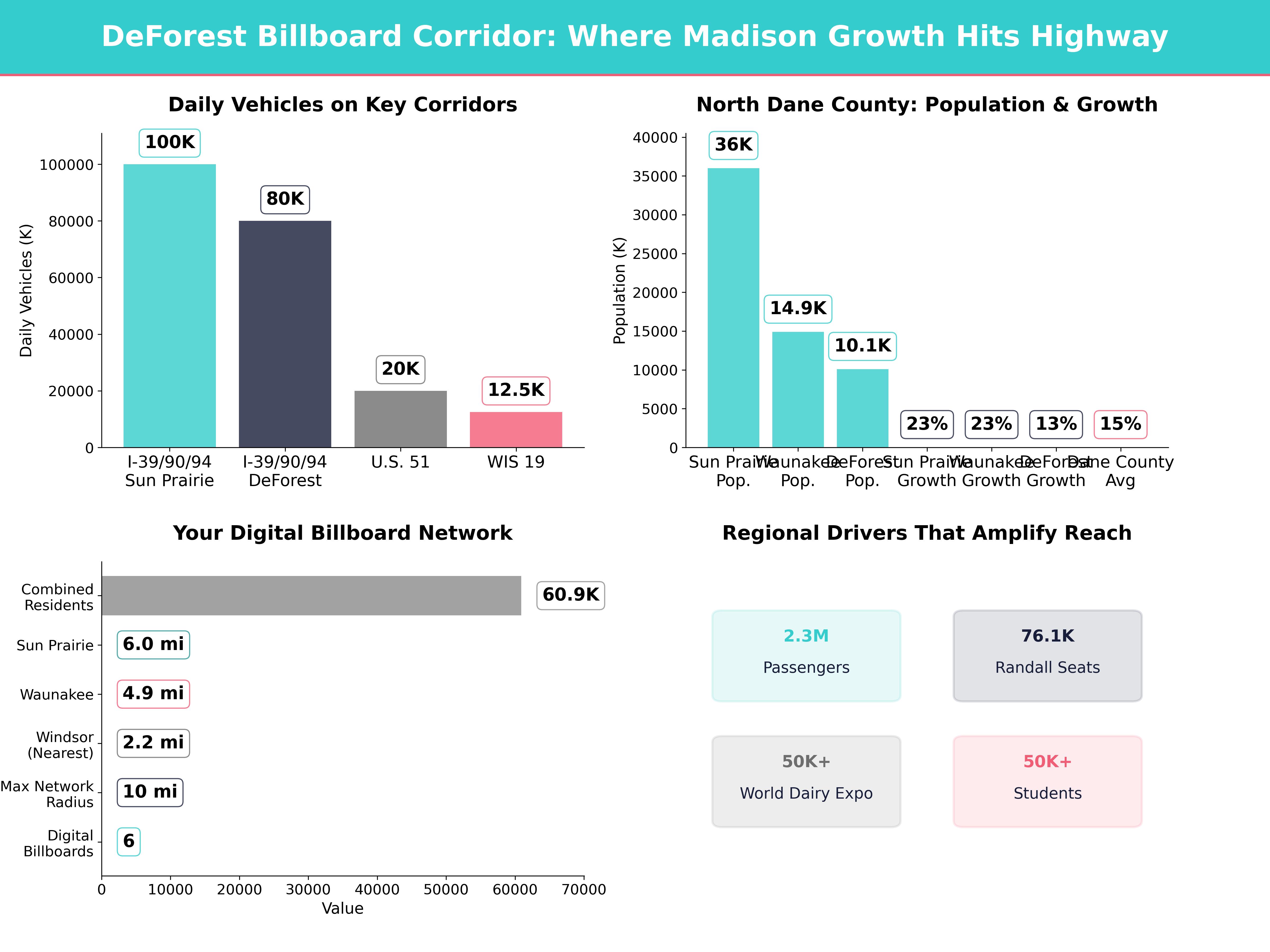
Our 6 digital billboards serving the DeForest area are all within 10.0 miles, including placements in Windsor, 2.2 miles away, Waunakee, 4.9 miles away, and Sun Prairie, 6.0 miles away. That gives us practical access to commuters, families, students, shoppers, and event traffic moving between north Dane County and Madison. A multi-board strategy across Windsor, Waunakee, and Sun Prairie often outperforms a single-location approach.
Why does billboard advertising work in DeForest, Wisconsin?
Advertising near DeForest works because the market is part of a tightly connected north Dane County travel shed rather than a single isolated village. More than 4 out of 5 DeForest workers commute by driving alone, and Dane County as a whole still relies on driving for more than 7 out of 10 work trips. That repeated daily movement creates the frequency advantage that billboard advertising depends on.
What kind of traffic can my Blip ad reach near DeForest, Wisconsin?
The most important corridor serving the DeForest area is Interstate 39/90/94, which routinely carries 80,000 or more vehicles per day near DeForest. U.S. 51 also functions as a critical route, with key segments in this trade area commonly carrying 20,000 or more vehicles per day. WIS 19 ties the area to local retail movement, with many segments generally landing around 10,000 to 15,000 vehicles per day.
When is the best time to advertise in DeForest, Wisconsin with Blip?
Fall is often the best season for broad-reach campaigns serving the DeForest area because school is back in session, routines become more predictable, and football drives extra regional travel. Spring and summer also bring strong opportunities for errands, youth sports, festivals, shopping, and outdoor plans. Winter can still work well because evening commute visibility becomes especially strong for healthcare, legal services, retail, heating, snow removal, gyms, and tax-season messaging.
Do I need a contract to advertise with Blip near DeForest?
No, Blip has no long-term contracts or minimum commitments. You can start, pause, or stop your campaign at any time.
How fast can I launch a billboard campaign with Blip near DeForest?
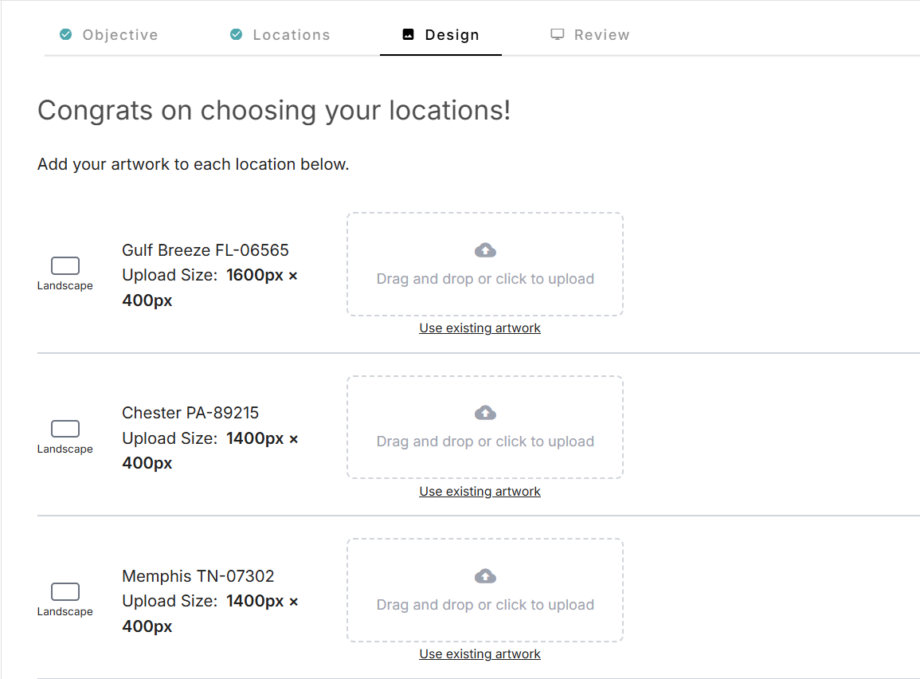
You can have your campaign live in minutes. Create a free account, select your locations, set your budget, upload your design, and start running once approved.
Where can I advertise with Blip near DeForest?
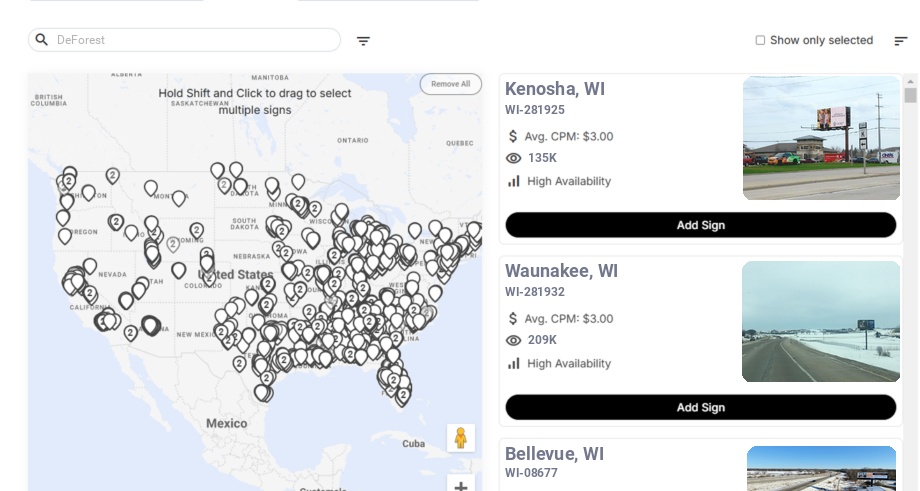
Blip has digital billboards near DeForest. You can browse available locations on a map, choose the ones that fit your audience, and start advertising right away.
Still have questions? Launch a campaign in minutes — no contracts, no commitments.
Start Your CampaignDeForest Billboard Advertising Guide
Advertising near DeForest 561,504 Dane County residents and 680,796 residents in the Madison metro creating overlapping daily travel. Our 6 digital billboards serving the DeForest area are all within 10.0 miles, including placements in Windsor, 2.2 miles away, Waunakee 4.9 miles away, and Sun Prairie 6.0 miles away. That gives us practical access to commuters, families, students, shoppers, and event traffic moving between north Dane County and Madison. In a market where daily life depends heavily on driving, digital boards near DeForest can deliver repeated visibility across work trips, school runs, retail errands, and regional event travel.
DeForest area market overview
Population, growth, and regional scale around DeForest
When we look at the DeForest area, we are really looking at a fast-growing slice of the greater Madison economy. The Village of DeForest 10,071 residents in the 2020 Census, which was growth of about 13% from 2010. Dane County reached 561,504 residents in 2020, up 15.0% from 2010, and the Madison metro reached 680,796 residents.
That scale matters because nearby communities add meaningful reach very quickly. Sun Prairie 35,967 residents in 2020, up about 23% from 2010, Waunakee 14,879, up about 23% from 2010, and Madison had 269,840, up about 16% from 2010. DeForest, Waunakee, and Sun Prairie alone combine for 60,917 residents before we even count Windsor, Madison’s north side, or east-side employment zones.
From an advertiser’s perspective, that makes the DeForest area attractive for more than local mom-and-pop campaigns. We can support awareness for healthcare groups, home services, auto dealers, event promoters, recruiters, colleges, restaurants, and regional retail brands because the audience does not stop at one municipal line. The Madison Region Economic Partnership highlights a diversified economy led by higher education, healthcare, insurance, public-sector employment, technology, advanced manufacturing, and logistics, all of which create steady weekday travel.
Commuting patterns and consumer movement near DeForest
Most travel serving the DeForest area still happens by car. Community-profile data consistently show that more than 4 out of 5 DeForest workers commute by driving alone, and Dane County as a whole still relies on driving for more than 7 out of 10 work trips. That is exactly the kind of mobility pattern that makes roadside media effective.
Commute times are also long enough to matter, but short enough to repeat. Many residents near DeForest travel roughly 20 to 25 minutes to jobs on Madison’s north side, east side, downtown, the University of Wisconsin–Madison campus, or employment centers such as The American Center. That repeated daily movement creates the frequency advantage that billboard advertising depends on.
We also benefit from the fact that the DeForest area is more auto-oriented than the urban core. Unlike central Madison, where Metro Transit
DeForest area traffic corridors that drive billboard reach
Interstate 39/90/94, U.S. 51, and the main north-south flow serving DeForest
The most important corridor serving the DeForest area is Interstate 39/90/94. It is the region’s freight spine, commuter spine, and visitor spine all at once. Wisconsin Department of Transportation traffic counts routinely show interstate segments near DeForest carrying 80,000 or more vehicles per day, which gives us substantial repeated exposure for campaigns that need scale.
Just west and south of the interstate, U.S. 51 functions as another critical route for residents moving between the DeForest area, Windsor, and Madison’s north and east sides. Key segments of U.S. 51 in this trade area commonly carry 20,000 or more vehicles per day. That makes it especially useful for advertisers that need to stay visible to local commuters rather than only long-haul interstate drivers.
This is why our nearby Windsor inventory is so important. At only 2.2 miles from DeForest, Windsor gives us the closest digital presence for the market and helps us capture motorists who treat DeForest, Windsor, and Madison’s north edge as one continuous daily routine.
WIS 19, Sun Prairie access, and east-west movement near DeForest
WIS 19 is another high-value route because it ties the DeForest area to the interstate system and to local retail movement. Traffic on WIS 19 is much lower than the interstate, but it is still meaningful, with many segments in the area generally landing around 10,000 to 15,000 vehicles per day. For local services, healthcare, banks, grocery, schools, and quick-service restaurants, that lower-speed traffic can be more actionable than pure freeway volume.
To the east and southeast, the Sun Prairie side of the market helps us intercept higher-volume regional movement. Interstate approaches near Sun Prairie and east Madison can exceed 100,000 vehicles per day on the busiest stretches, depending on the segment. That gives us a scale play for campaigns that want both DeForest-area relevance and broader Madison-area impressions.
We should also think of Waunakee access as part of the same pattern. Even though Waunakee sits northwest of DeForest, its households, school traffic, and shopping trips overlap with the DeForest area more than many advertisers first assume. That is why a multi-board strategy across Windsor, Waunakee, and Sun Prairie often outperforms a single-location approach.
Audience segments we can reach near DeForest
Commuters, workers, and job seekers in the DeForest area
The first major audience near DeForest is the daily commuter. We can reach residents heading to Madison, Windsor, Sun Prairie, the airport area, industrial parks, healthcare campuses, and university-related jobs. Because the area is so car-dependent, the same drivers tend to pass through the same corridors over and over, which builds message recall for employers, staffing firms, trade schools, and service brands.
Recruiting is especially relevant here. The north Dane County economy pulls workers into manufacturing, warehousing, food production, healthcare, education, and logistics jobs, while Madison draws additional office, university, and public-sector employment. A billboard campaign near DeForest can speak to both groups at once, which is valuable when we are trying to recruit beyond one city limit.
Families, homeowners, and school-connected households serving DeForest
The second major audience is suburban households. The DeForest Area School District serves more than 4,000 students, and the nearby communities around DeForest include large numbers of young families, homeowners, and move-up households. Those residents generate reliable demand for pediatric care, orthodontics, grocery, auto service, home improvement, insurance, financial services, youth activities, and family dining.
Because DeForest sits near both established neighborhoods and newer residential growth, household-targeted billboard campaigns can work well when they reflect real local needs. We can speak to seasonal HVAC service, roofing, landscaping, childcare, urgent care, tax preparation, or school-year enrollment with messaging that feels practical instead of abstract. We should also remember that these families do not confine their spending to one municipality. They move between DeForest Windsor, Waunakee Sun Prairie
That regional behavior is exactly why nearby digital boards can serve the DeForest area effectively.
Students, sports fans, visitors, and event traffic near DeForest
The third major audience is the region’s constant flow of students and visitors. UW–Madison enrolls more than 50,000 students, and its sports calendar drives significant regional travel. Camp Randall Stadium seats 76,129, so home football Saturdays create concentrated movement through Madison-area corridors that also serve the DeForest area before and after games.
Events matter beyond football as well. The Alliant Energy Center campus spans 164 acres and hosts major consumer shows, youth competitions, expos, and seasonal events. The World Dairy Expo alone regularly draws more than 50,000 attendees, many of whom move through the Madison region by car.
Air travel adds another layer. Dane County Regional Airport handled more than 2.3 million passengers in 2023, which keeps the north and east sides of the metro active with rental-car traffic, hotel demand, dining, and business travel. When we combine those visitors with local recreation at places like Token Creek County Park and the Yahara River Trail
Seasonal timing opportunities near DeForest
Spring and summer advertising near DeForest
Spring is a strong reset period in the DeForest area. Households start booking landscaping, lawn care, home exterior work, outdoor recreation, graduation-related purchases, and spring healthcare appointments. As school schedules loosen and weather improves, traffic diversifies from pure commuting into errands, youth sports, park visits, and weekend recreation.
Summer broadens the audience further. Families travel more frequently between DeForest, Sun Prairie, Waunakee, and Madison for festivals, shopping, and outdoor plans promoted by Destination Madison and local chambers such as the DeForest Windsor Area Chamber of Commerce Waunakee Area Chamber of Commerce, and the Sun Prairie Chamber of Commerce. This is an excellent time for restaurants, attractions, medical clinics, family entertainment, and retail campaigns that benefit from impulse visits.
Fall timing for DeForest-area commuters, schools, and football traffic
Fall is often the best season for broad-reach campaigns serving the DeForest area. School is back in session, routines become more predictable, and football drives extra regional travel. Between Badger home games at a 76,129-seat stadium, youth sports, college move-ins, and trade events, the roads serving north Dane County stay active.
This is also when advertisers can align with practical needs. We can run home-heating messages before cold weather, promote healthcare enrollment periods, push automotive maintenance, or support retail and dining tied to football weekends. Agricultural and expo traffic also peaks in early fall, especially around major events at the Alliant Energy Center and World Dairy Expo.
Winter campaigns that still work near DeForest
Winter should not be written off in southern Wisconsin. In fact, the darker season can increase the visual punch of digital boards, especially because sunset in mid-December arrives before 4:30 p.m. near Madison. Evening commute visibility becomes especially strong for healthcare, legal services, retail, heating, snow removal, gyms, and tax-season messaging.
The key is to match our timing to real winter behavior. People still drive to work, school, grocery, medical appointments, and holiday events, even when leisure travel softens. That means the DeForest area remains viable for frequency-based campaigns as long as creative is simple and schedules reflect weekday peaks.
Billboard design tips for the DeForest market
Creative choices that fit high-speed DeForest-area roads
Because many of the best routes near DeForest are fast-moving, we should design for quick recognition, not detailed reading. On roads where drivers may be moving at 65 to 70 mph, we should keep copy to about 6 words or fewer, use one dominant image, and feature one clear brand cue or call to action. A short URL usually works better than a QR code on interstate-facing creative.
We should also use bold contrast because south-central Wisconsin gives us bright summer greenery, gray spring skies, snow-reflective winter light, and early darkness in late fall. White text on deep blue, black on bright yellow, or red on white can all work well when contrast is strong. Thin fonts, crowded disclaimers, and pale-on-pale palettes are much harder to read from moving traffic.
Messaging and imagery that resonate near DeForest
The DeForest area responds well to practical, local messaging. We should name the offer, the category, or the location benefit immediately. Phrases such as “North Dane Urgent Care,” “Windsor Hiring Now,” “Waunakee Orthodontics,” or “Exit for Lunch Near DeForest” tend to work better than vague brand slogans.
Regional cues also help. College-sports-adjacent red and black can feel familiar near Madison, while blue and green often fit healthcare, financial services, and outdoor-oriented brands. Family imagery, home exteriors, pickup trucks, youth sports, and clearly local landscapes usually feel more believable here than generic stock visuals from a coastal city.
Seasonal creative can be especially effective in this market. We can rotate from spring lawn messages, to summer patio or attraction messages, to fall football and home-service messages, to winter HVAC or holiday retail messages without changing locations. The geography stays stable even when the audience mindset changes.
Regional strategies for billboard advertising near DeForest
Windsor strategy for the closest DeForest-area coverage
Windsor is our closest board market to DeForest at just 2.2 miles away, so it is the logical anchor for campaigns that need the most direct local relevance. When we want to promote a DeForest-area restaurant, clinic, dealership, school, bank, church, or service business, Windsor inventory is often the first place to start because it captures everyday traffic closest to the village.
This is also where frequency matters most. A nearby Windsor board can reinforce morning and evening commuter exposure, remind residents about nearby services, and support short-term promotions such as hiring events, open houses, or weekend sales. If our goal is repetition among residents who already know the area, Windsor is usually the most efficient first move.
Waunakee strategy for north Dane households serving DeForest
Waunakee sits 4.9 miles from DeForest, and its 14,879 residents add meaningful household reach to the broader market. We like Waunakee-facing strategy when we want to connect with suburban families, home-service demand, youth-sports households, and professional commuters moving across north Dane County.
This is especially useful for advertisers whose customer base naturally stretches between communities. Pediatric care, orthodontics, insurance, banks, remodeling firms, grocery, fitness, and education brands often benefit from messaging that is not locked to one town. A Waunakee board can help us reach people who may work, shop, or attend activities near DeForest even if they live elsewhere.
Sun Prairie strategy for scale, volume, and east-side access near DeForest
Sun Prairie is 6.0 miles from DeForest and brings the largest nearby population boost, with 35,967 residents in 2020. It also connects us to heavier east-side traffic, stronger retail movement, and higher-volume interstate travel. When we want more reach rather than only hyperlocal repetition, Sun Prairie is usually the best expansion market.
This is the right play for regional retail, auto, healthcare systems, colleges, event campaigns, and brands that want the DeForest area plus east Madison visibility. If we think of Windsor as the closest-frequency option, Sun Prairie is the scale option. Many campaigns work best when we run both together.
A practical multi-market plan for the DeForest area
Because our inventory is spread across 6 digital billboards in three nearby communities, we can build layered coverage instead of betting on one location. A smart regional plan often looks like this:
- We use Windsor for close-in DeForest frequency.
- We add Sun Prairie for larger traffic volume and east-side reach.
- We use Waunakee when household targeting and north Dane County overlap matter.
That approach reflects how people really move around the region. The DeForest area is not defined by one downtown block. It is defined by commuting loops, school routes, retail trips, and event travel across community lines.
Blip tools and capabilities for campaigns serving the DeForest area
How we can use Blip to match DeForest-area travel patterns
Blip’s format works well for the DeForest area because the market rewards flexibility. We can choose boards on a map, focus on the Windsor, Waunakee, and Sun Prairie locations that best fit our routes, and adjust timing around morning commutes, afternoon return traffic, lunch periods, or event windows. That is especially useful in a market where weekday work travel, school traffic, and weekend event traffic are all important.
Short digital spots are also a natural fit for fast-moving corridors. Each blip runs for about 7.5 to 10 seconds, which is enough time for a clean headline and strong visual if we keep creative simple. Because pricing starts at $0.01 per display, we can test DeForest-area strategy without committing to a large traditional out-of-home buy.
Why flexibility matters more near DeForest than in a static market
The DeForest area changes character by time of day. Morning traffic leans commuter-heavy, afternoons bring school and errand traffic, evenings favor dining and retail, and weekends can tilt toward sports, shopping, or event travel. Blip lets us adapt to those shifts instead of locking into one static plan.
That matters even more around seasonal spikes. We can increase activity during football weekends, expo periods, graduation season, hiring pushes, or holiday retail windows, then scale back when demand changes. Real-time analytics also help us compare locations and refine the mix as we learn which nearby corridors serve our goals best.
Getting started with billboard rental near DeForest
What to expect when we rent a billboard serving the DeForest area
The simplest way to begin is to define the job first. We should decide whether our campaign is trying to drive brand awareness, support a grand opening, recruit workers, promote an event, move retail traffic, or reinforce an existing local presence. Once that goal is clear, the right nearby boards become much easier to identify.
From there, we should evaluate each location by the travel behavior it captures, not just by distance alone. A board that is 2.2 miles away in Windsor may be ideal for local frequency. A board 6.0 miles away in Sun Prairie may still be stronger if our audience is broader and volume matters more. In the DeForest area, route quality often matters more than simple mileage.
How Blip simplifies billboard rental compared with traditional buying
Traditional billboard buying often involves longer commitments, rep-driven negotiations, slower revisions, and fewer opportunities to test multiple nearby corridors. Blip removes much of that friction. We can launch online, set a daily budget, change creative, pause a campaign, or reallocate spending without going through the usual back-and-forth.
That is valuable near DeForest because advertisers often need to react quickly. A local employer may need hiring support this month, a clinic may want a flu-shot push next month, and a retailer may care most about football weekends or holiday traffic. Flexible digital buying gives us a better way to match the market’s real pace.
How we should evaluate DeForest-area locations before launch
When we compare billboard options serving the DeForest area, we should ask five practical questions. We should ask whether the board reaches our core audience, such as commuters, families, students, or event travelers. We should ask whether the route is high-speed interstate traffic, lower-speed local traffic, or a blend of both.
We should ask whether proximity or scale matters more for our goal, whether our message is simple enough to read in a few seconds, and whether our timing matches the audience’s actual weekly routine. If we start with those questions, the DeForest area becomes very straightforward to plan. We can begin with one or two nearby boards, watch performance, then expand across Windsor, Waunakee, and Sun Prairie as results justify. For advertisers who want efficient, flexible visibility near DeForest, that is usually the smartest path to a strong billboard rental strategy.