Billboards in Glendale, WI
No Minimum Spend. No Long-Term Contracts. Just Results.
Trusted by Leading Brands


Billboard advertising
in Glendale has never been easier
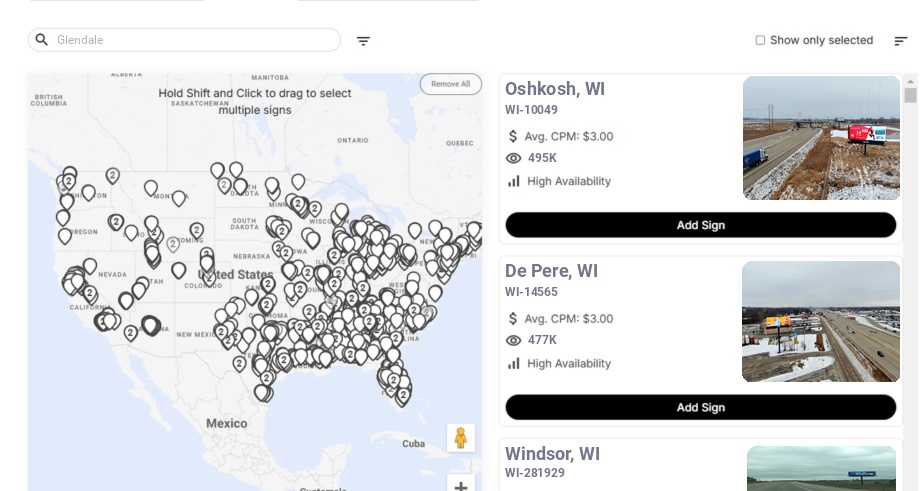



How much is a billboard in Glendale?
Why Choose Blip for Billboard Advertising in Glendale
-
Blip lets Glendale brands launch fast on I-43 and Brown Deer Road, reaching North Shore commuters without a long sales cycle.
-
Set flexible budgets in Glendale and only pay when your ad blips, perfect for testing Bayshore shoppers and Menomonee Falls traffic.
-
Use dayparting in Glendale to hit 6-9 a.m. and 3-7 p.m. commute windows when North Shore and I-41/US 45 drivers are on the road.
-
No contracts in Glendale means you can pivot for Summerfest, Brewers games, or holiday retail spikes as Milwaukee traffic changes.
-
Blip's real-time analytics help Glendale advertisers track what works near Port Washington Road and adjust creative on the fly.
-
Create clean, legible Glendale billboard ads with Blip's tools, built for 7.5-10 second views in winter glare and fast-moving suburban traffic.
Frequently Asked Questions About Billboard Advertising in Glendale
How much does a billboard cost in Glendale, Wisconsin with Blip?
Blip makes billboard advertising in the Glendale area flexible and budget-friendly. You set a daily budget, and Blip only charges you when your ad actually appears as a 7.5-to-10-second “blip” on a rotating digital billboard serving the Glendale area. With pay-per-play pricing starting at just $0.01 per display, plus no minimums or contracts, you can start small, adjust anytime, and pay only for the blips you receive.
Where can I advertise with Blip in Glendale, Wisconsin?
Our 2 digital billboards serving the Glendale area are both in nearby Menomonee Falls, about 9.9 miles away. That positions them well for traffic flowing between the northwest suburbs, Milwaukee employment centers, and the Glendale retail market. The nearby inventory is useful for reaching people who shop, work, dine, and buy services in the Glendale area.
What kind of traffic and audience does the Glendale, Wisconsin billboard market reach?
The City of Glendale sits at one of the most commercially active edges of metro Milwaukee, where North Shore households, regional commuters, and destination shoppers overlap every day across a 1,571,951-resident four-county market. That makes billboard advertising near Glendale especially effective for brands that need repeated visibility, not just one-time exposure. The market combines strong suburban purchasing power with road-based travel behavior that digital billboards are built to capture.
When is the best time to run Blip billboards in Glendale, Wisconsin?
We usually recommend weekday emphasis during 6:00 to 9:00 a.m. and 3:00 to 7:00 p.m. when the goal is commuter repetition. Summer is one of our favorite windows for campaigns serving the Glendale area, and we usually recommend launching summer promotions 1 to 2 weeks before the key decision period. For holiday campaigns, we often recommend starting creative 4 to 6 weeks before the peak shopping period.
What roads and traffic corridors matter most for billboard advertising in Glendale, Wisconsin?
If we want broad coverage serving the Glendale area, Interstate 43 is the first corridor we study. Our current digital inventory serving the Glendale area is in nearby Menomonee Falls, so I-41/US 45 deserves special attention as one of the region’s most important northwest-suburban routes. Roads such as Brown Deer Road/WIS 100, Port Washington Road/WIS 32, Silver Spring Drive, and Good Hope Road also help feed the Glendale market.
Do I need a contract to advertise with Blip in Glendale?
No, Blip has no long-term contracts or minimum commitments. You can start, pause, or stop your campaign at any time.
How fast can I launch a billboard campaign with Blip in Glendale?
You can have your campaign live in minutes. Create a free account, select your locations, set your budget, upload your design, and start running once approved.
Where can I advertise with Blip in Glendale?
Blip has digital billboards in Glendale. You can browse available locations on a map, choose the ones that fit your audience, and start advertising right away.
Still have questions? Launch a campaign in minutes — no contracts, no commitments.
Start Your CampaignGlendale Billboard Advertising Guide
The City of Glendale 1,571,951-resident four-county market. That makes billboard advertising near Glendale especially effective for brands that need repeated visibility, not just one-time exposure. Our 2 digital billboards serving the Glendale area are both in nearby Menomonee Falls 9.9 miles away, which positions them well for traffic flowing between the northwest suburbs, Milwaukee employment centers, and the Glendale retail market. For local businesses, healthcare groups, schools, restaurants, and regional brands, the Glendale area combines strong suburban purchasing power across a 4-county trade area with the kind of road-based travel behavior that digital billboards are built to capture.
Glendale area market overview
Population, geography, and economic footprint near Glendale
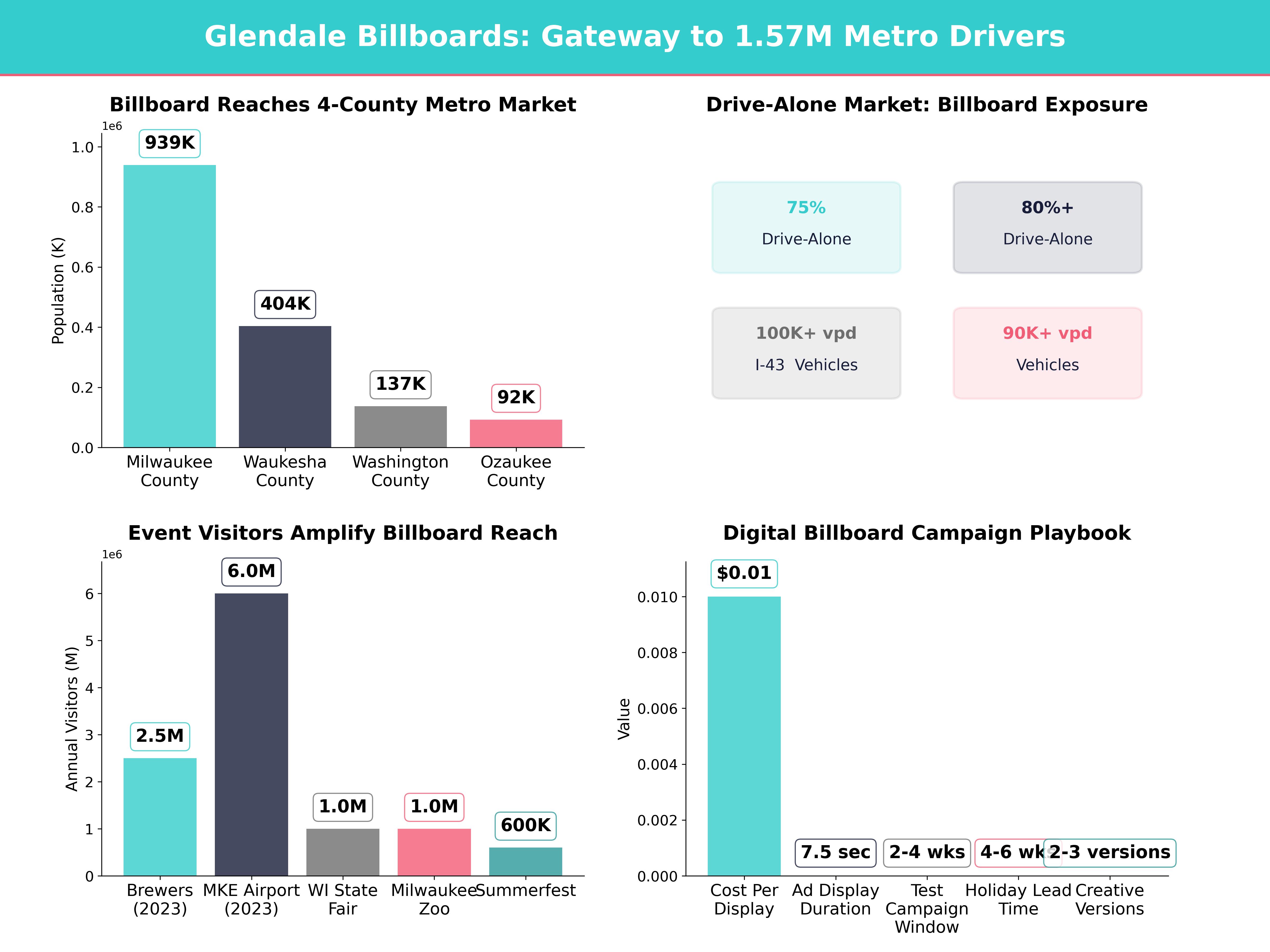
We like the Glendale area because it is small enough to feel local, but connected enough to act like a regional market. 2020 Census counts place Glendale at 13,357 residents, while Milwaukee County 939,489 residents. When we add the surrounding suburban counties that regularly feed traffic and commerce into the Glendale area, the numbers get much larger: Waukesha County has 404,198 residents, Washington County 136,761, and Ozaukee County 91,503.
Together, those four counties total 1,571,951 residents, which gives advertisers a broad metro base behind what might look like a relatively compact North Shore market. That scale matters because Glendale is not an isolated suburb. It sits between downtown Milwaukee
The nearby billboard inventory matters here too. Menomonee Falls 38,527 residents, and it functions as both a destination and a pass-through point for people who shop, work, dine, and buy services in the Glendale area. We often think of this market as a suburban crossover zone, where North Shore households, northwest suburban commuters, and Milwaukee-bound drivers all intersect.
Economically, the Glendale area benefits from several layers of demand at once. The market is supported by the Bayshore retail and dining district, regional office and healthcare employment, nearby higher education, and proximity to downtown Milwaukee entertainment and sports venues. That mix is useful because it creates all-day traffic patterns rather than a single narrow rush-hour audience.
Car commuting and mobility patterns serving the Glendale area
For billboard planning, the most important mobility fact is simple: the Glendale area is still heavily auto-oriented. Regional planning work from SEWRPC and traffic data from the Wisconsin Department of Transportation both reflect a metro built around freeways and arterial roads. In practical terms, local ACS commuting profiles typically show about 75% of workers in Milwaukee County driving alone to work, while the suburban counties around Glendale are commonly 80% or more drive-alone markets. Once carpooling is added, the share traveling by car, truck, or van rises into the 80% to high-80s range across much of the region.
That is exactly why billboard advertising works near Glendale. Even though Milwaukee County Transit System serves the region, a strong majority of daily trips tied to work, shopping, school, healthcare, and family logistics still happen by road. We are not trying to catch people once. We are trying to catch them repeatedly on the same routes, over multiple days each week, until the message sticks.
Key traffic corridors serving the Glendale area
I-43 and the North Shore spine near Glendale
If we want broad coverage serving the Glendale area, Interstate 43 is the first corridor we study. It is the main north-south spine for the North Shore, linking downtown Milwaukee with Shorewood Whitefish Bay Brown Deer Bayside Fox Point Mequon 100,000-plus vehicles per day, and some North Shore-adjacent segments are well above that threshold.
For advertisers, that means I-43 is not just a commuting road. It is a shopping road, a sports road, a dining road, and a healthcare access road. Drivers use it to move between the North Shore, downtown Milwaukee, lakefront destinations, and suburban service centers. Even when our boards are west of Glendale, campaigns that align with these commuter habits can still reach people who regularly spend money in the Glendale area.
I-41/US 45 and the Menomonee Falls connection to Glendale
Our current digital inventory serving the Glendale area is in nearby Menomonee Falls I-41/US 45 deserves special attention. This corridor is one of the region’s most important northwest-suburban routes, and segments near Menomonee Falls commonly reach 90,000 to 100,000-plus vehicles per day. That makes it a strong gateway for reaching people traveling between the northwest suburbs and the Milwaukee/North Shore side of the metro.
This matters more than many advertisers initially assume. A large share of the Glendale area’s customer base does not live on the same block as the business they visit. Patients travel for healthcare. Families drive for shopping and dining. Professionals commute across county lines. Workers in Menomonee Falls, Germantown, Butler, Wauwatosa, and Milwaukee often share overlapping road systems, and those daily patterns are exactly what make a Glendale-serving billboard buy effective.
Retail arterials and crosstown roads near Glendale
The freeway network gets most of the attention, but the Glendale market is also shaped by strong commercial arterials. Roads such as Brown Deer Road/WIS 100, Port Washington Road/WIS 32, Silver Spring Drive, and Good Hope Road often carry traffic volumes in the 15,000 to 35,000 vehicles-per-day range on major commercial segments. These routes help feed Bayshore, neighborhood retail, grocery traffic, school trips, and dining traffic throughout the North Shore.
We pay close attention to those patterns when we build creative strategy. If a business depends on repeat local visibility, we want messaging that feels relevant to drivers heading toward Brown Deer Road errands, Port Washington Road retail, or evening dining trips. If a brand wants broader awareness, we lean more heavily into regional freeway language and metro-scale offers.
Audience segments we can reach near Glendale
Commuters, professionals, and daily service buyers in the Glendale area
The first and largest audience is the everyday commuter. Because the Glendale area sits between residential North Shore communities and major employment zones to the south and west, we can reach drivers making the same trips several times each week. Those are excellent prospects for:
- Healthcare providers.
- Home services.
- Financial services.
- Legal services.
- Auto dealers.
- Employers recruiting staff.
- Restaurants positioned for dinner and takeout.
- Retailers with broad suburban appeal.
We usually recommend weekday emphasis during 6:00 to 9:00 a.m. and 3:00 to 7:00 p.m. when the goal is commuter repetition. Those windows align well with the region’s heaviest work-trip periods and often produce stronger recall for business categories tied to appointments, errands, or post-work decisions.
Students, faculty, and academic households near Glendale
The Glendale area also benefits from nearby higher education demand. The University of Wisconsin-Milwaukee enrolls roughly 22,000-plus students, Marquette University enrolls about 11,000, and Milwaukee School of Engineering enrolls about 2,700. Combined, that is nearly 36,000 students before we even count faculty, staff, parents, and visiting families.
UWM is especially relevant because it sits just south of the Glendale area and draws students from around Wisconsin and the broader Midwest. That audience can be valuable for apartments, banking, wireless, food, entertainment, career programs, tutoring, healthcare, and event promotions. We also see useful overlap between student traffic and younger professionals living in nearby neighborhoods and inner-ring suburbs.
Families, shoppers, and North Shore households serving the Glendale market
Glendale is part of the region’s 7-community North Shore cluster, and that cluster creates a concentrated family-and-household audience. The North Shore Chamber of Commerce represents Bayside Brown Deer Fox Point Glendale River Hills Shorewood Whitefish Bay
School calendars add even more predictability. Families tied to the Glendale-River Hills School District and Nicolet Union High School District create recurring patterns around drop-off, pickup, after-school activities, sports, and weekend errands. For advertisers, that means the Glendale area is not just a “rush hour” market. It is an all-week market built on repeat household movement.
Tourists, sports fans, and event visitors who pass near Glendale
The Glendale area also benefits from being close to one of the Midwest’s strongest event markets. Visit Milwaukee promotes a city with major festival, sports, and convention traffic that spills into suburban driving patterns.
A few numbers show why this matters:
- Summerfest runs for 9 days across 3 weekends, and recent attendance has topped 600,000.
- Wisconsin State Fair Park hosts an 11-day State Fair that drew more than 1 million attendees in 2023.
- The Milwaukee Brewers play 81 regular-season home games, and club attendance in 2023 topped 2.5 million.
- The Milwaukee Bucks 41 regular-season home games at Fiserv Forum.
- The Milwaukee County Zoo 1 million visitors annually.
- Milwaukee Mitchell International Airport handled more than 6 million passengers in 2023.
Not every one of those visitors travels through Glendale, of course. The key point is that the broader Milwaukee market creates a large, constantly renewing pool of discretionary spend. Restaurants, retail, entertainment, hotels, healthcare, and service brands can all benefit from that regional circulation.
Seasonal and timing opportunities in the Glendale area
Summer campaigns near Glendale
Summer is one of our favorite windows for campaigns serving the Glendale area. Daylight lasts past 8:00 p.m. in June, traffic expands for festivals and sports, and weekend mobility rises as people shop, dine, and head toward lakefront events. This is a strong season for retail, restaurants, outdoor services, live events, and family attractions.
We usually recommend launching summer promotions 1 to 2 weeks before the key decision period. That gives the creative enough repetition to build familiarity before the weekend or event rush arrives. If a campaign is tied to Summerfest, Brewers games, or lakefront travel, Thursday through Sunday often deserves the heaviest emphasis.
Back-to-school and fall timing near Glendale
Late August through October is another strong window. Colleges restart, K-12 routines return, and the Glendale area shifts back into a structured commuting rhythm. That season works well for healthcare, urgent care, after-school programs, banks, insurance, tutoring, family dining, and retail tied to routines rather than one-time events.
We also like fall for home services. In Wisconsin, homeowners start thinking about furnace tune-ups, roofing, insulation, windows, gutters, and snow prep well before winter fully arrives. Campaigns that begin in September can build trust before the cold-weather buying rush hits.
Holiday and winter opportunities serving the Glendale area
The holiday season is a major retail and dining opportunity near Glendale because the North Shore and the surrounding suburbs generate strong gift, gathering, and convenience spending. We often recommend starting holiday creative 4 to 6 weeks before the peak shopping period, especially for retailers, restaurants, and entertainment venues connected to Bayshore or broader Milwaukee holiday traffic.
Winter design and timing matter too. In December, sunset arrives before 4:30 p.m., which means evening visibility starts early. That helps advertisers in categories like healthcare, restaurants, grocery, auto service, and emergency home repair. It also means creative must be especially legible in lower light, snow glare, and messy road conditions.
Billboard design tips for the Glendale market
Creative approaches that fit the Glendale area
The Glendale area responds well to creative that feels polished, trustworthy, and local. We usually see better results with clean layouts, strong contrast, and simple benefits than with cluttered national-template designs. Colors inspired by Lake Michigan, such as blue, white, charcoal, and deep green, often feel more natural in this market than overly loud tropical palettes, unless the brand itself is built around entertainment or nightlife.
We also recommend local relevance in the copy. References to the North Shore, Bayshore, Brown Deer Road, Port Washington Road, Mequon, or Menomonee Falls can help a message feel grounded in the area’s actual travel behavior. That is especially useful for healthcare, home services, schools, retail, and dining brands that depend on geographic familiarity.
Messaging that works on Glendale-serving commuter routes
Because each digital ad appears for about 7.5 to 10 seconds, we keep Glendale-area creative disciplined. Our best-performing local campaigns usually follow a simple structure:
- We use 1 primary offer.
- We use 1 brand name or logo focus.
- We use 1 clear call to action.
- We keep the main message to roughly 6 to 8 words.
- We favor bold numerals for prices, dates, discounts, and phone numbers.
That approach matters even more in Wisconsin weather. Snow, rain, road spray, and lower winter light reduce the time drivers have to process details. A billboard that tries to say 3 different things will usually underperform a billboard that says 1 thing clearly.
Regional strategies for advertising near Glendale
Using Menomonee Falls billboards to serve the Glendale area
Since our Glendale-serving inventory is currently concentrated in Menomonee Falls
We often recommend this approach for:
- Regional healthcare groups.
- Home service companies with multi-city service areas.
- Employers recruiting from across Milwaukee, Waukesha, and Washington counties.
- Retailers and restaurants drawing from a 10- to 20-mile trade area.
- Event marketers targeting broad suburban awareness.
If a business depends on customers who live only a few blocks from one address, this is a narrower fit. If a business serves the wider Glendale area, however, the Menomonee Falls approach can be very efficient.
North Shore household strategy near Glendale
For brands focused on local households, we usually frame the campaign around the North Shore rather than a single city name. The Glendale area sits in a tightly connected suburban cluster where families cross community lines for shopping, school, healthcare, dining, and recreation. That is why messaging like “Serving the North Shore,” “Minutes from Bayshore,” or “Easy access from Brown Deer, Fox Point, and Whitefish Bay” often performs better than overly narrow copy.
This strategy is especially strong for dental offices, med spas, urgent care, senior services, financial planning, private schools, family entertainment, and home remodeling. The buyer is often evaluating trust and convenience at the same time, and billboard copy can reinforce both.
Interchange, commercial district, and cross-county strategy serving Glendale
Some campaigns need broader metro reach. In those cases, we align creative with the larger regional road system that feeds the Glendale area. The best examples are freeway interchange messaging, retail district awareness, and cross-county branding.
We usually divide those campaigns into 3 practical zones:
- North Shore household traffic, which is strongest for family services and everyday retail.
- Freeway interchange traffic, which is strongest for large-scale awareness, employers, auto, healthcare, and regional events.
- Commercial district traffic, which is strongest for shopping, restaurants, and entertainment.
That structure helps us keep the message matched to the reason people are on the road.
Using Blip tools for Glendale-area campaigns
How Blip helps us target the Glendale market efficiently
Blip’s platform is useful in the Glendale area because it lets us buy digital billboard time according to real travel behavior instead of forcing a one-size-fits-all schedule. With only 2 digital billboards currently serving this market, we want every play to work harder. That is why map-based selection, daypart targeting, flexible budgets, and rapid creative swaps matter so much here.
For example, we can emphasize weekday commute periods for a medical office, then shift toward Thursday-through-Saturday evenings for a restaurant or entertainment campaign. We can also test separate versions for recruiting, promotions, and brand awareness without rebuilding an entire long-term contract.
Budgeting, testing, and optimization near Glendale
We also like Blip for Glendale-area advertisers because campaigns can start small and scale with evidence. Pricing starts at $0.01 per display, and there are no minimum spends or long-term contracts. That makes it practical to test a local message for 2 to 4 weeks, review the results, then increase budget during the best-performing days or seasons.
In a market like Glendale, we often recommend testing 2 to 3 creative versions. One might emphasize convenience, another might emphasize price, and a third might emphasize local trust or neighborhood relevance. Real-time analytics make it easier to see what deserves more budget.
Getting started with billboard rental near Glendale
What to expect when renting a billboard serving the Glendale area
The first step is defining the real market, not just the mailing address. If our goal is to reach people who live, shop, work, or seek services in the Glendale area, then nearby inventory in Menomonee Falls
We usually start by asking 3 practical questions:
- Are we trying to reach commuters, households, shoppers, or event traffic?
- Are we trying to drive awareness, store visits, leads, or recruiting?
- When does the audience make the decision, such as morning, afternoon, weekends, or a seasonal window?
Those answers shape everything else, including dayparting, creative style, and budget pacing.
How Blip simplifies the rental process near Glendale
Traditional billboard buying often involves long proposal cycles, fixed terms, and less flexibility once the campaign is live. Blip simplifies that process. We can choose boards on a map, set a daily budget, upload artwork, and start or stop quickly based on what the Glendale-area market is doing that week.
That matters because local conditions change fast. School schedules shift. Weather changes buying behavior. Festival season creates bursts of traffic. A restaurant may want heavy Friday exposure one month, while a healthcare practice may want weekday mornings the next. Flexibility is not just convenient. In a road-based suburban market, it is a competitive advantage.
How we evaluate which locations fit Glendale-area goals
Because the Glendale-serving inventory is west of the city, fit comes down to audience flow. We usually see the strongest fit when at least one of these conditions is true:
- The business serves customers from the northwest suburbs and the North Shore.
- The business wants metro-scale awareness rather than hyperlocal pedestrian traffic.
- The category benefits from repeated commuter exposure.
- The offer is broad enough to attract people from multiple suburbs, not just one block or one ZIP code.
If a business relies mainly on walk-in foot traffic from a single retail center, billboard advertising near Glendale may work best as a support channel rather than a stand-alone tactic. If the business serves a wider radius, the fit improves significantly.
Our practical recommendation is to begin with a focused campaign, not an oversized one. We usually launch with one clear message, a modest daily budget, and a schedule matched to the audience’s actual road habits. From there, we watch performance, refine the creative, and scale what works. That approach keeps billboard rental near Glendale simple, measurable, and far more accessible than the old model of committing large dollars before we learn anything.